Stories That Can’t Be Told

I have mentioned stories that can’t be told. These are stories about the generation of the parents of our students and, if they are still alive, stories about the grandparents. Young people have told us these stories but there is no way that I can repeat them. They are, of course, stories of what people did and how they survived during the years of the French occupation, the American War, the years immediately following the end of the American War, the wars with Cambodia and China, the end of the Soviet Union and now the turn toward a mixed economy.

People in these stories fight in the wars, get bombed, get lost, get taken prisoner, get tortured, see their cities burned and friends and families killed. They also fight in war, bomb other people take prisoners, torture, burn cities and kill people. They experience famine, flood and drought. They practice voluntary privation to get through hard times.

The same people escape, some by helicopter and ship to the US where they live in Southern California or Houston. Some escape by boat, after paying thousands of dollars in gold to a fixer, and many drown or starve or are picked up by pirates. Some pay those thousands of dollars twice or more. Some people are in prison and they escape, or they are in re-education camps and they survive and are released. Some people are the fixers and the camp guards.

People in these stories migrate, from the south to the north or more often from the north to the south, bringing a different accent, different expectations and culture. They also migrate from Vietnam to the US, to Cuba, to Canada and other countries. They have been to Russia to study and know Russian. They have visited Soviet bloc countries, including East Germany, for specialized medical care.

Some of the ones who make it to the US come back, or their children come back, speaking Vietnamese and hopeful to be part of the new Vietnam, which is an economy developing at 6.8% per year. They meet the children of people who never left, who have profited from the new economy, who live in splendid houses – some in District Seven, a few kilometers east of TDTU – and have live-in maids and drivers.

Everyone who has a grandfather who worked for the French is sitting next to someone whose grandfather was Viet Minh. Everyone whose mother was transported away from a battle zone to live with strangers is sitting next to someone whose father who flew US-supplied planes on bombing runs over the battle zone.

If you pick any one of these stories and tell it by itself, it sounds like the story of a lone individual fighting for survival against mighty forces of evil. You have to braid them together to know what you see when you look out at a classroom of seventy students, sitting side by side.

What Books We Are Reading about Vietnam

This is a book of poetry that goes from at least 1000 years ago to the near-present. Joe is in the Museum of Ethnography bookstore in Hanoi. The ancient poetry is in Chinese characters, the more recent in the romanized script of contemporary Vietnamese.
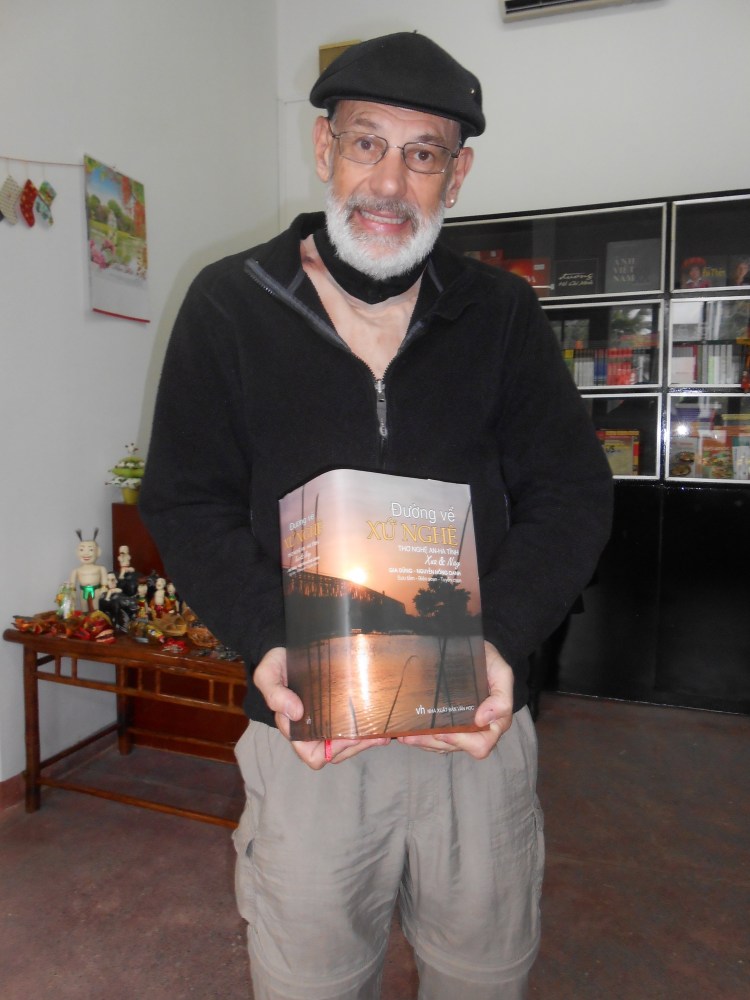
Fat book of poetry

We did not buy this book; it’s too heavy to carry around. I am posting this picture to suggest something about Vietnamese literature.

We found a real bookstore in Hanoi, by the way, down near the Museum of History. Called Savina or something like that. One floor of what look like textbooks. Second floor has a whole big section of English language books about Vietnam. We bought four or five that we hadn’t seen elsewhere. A few nights later, walking through that area on our way to the Opera House, we encountered a night market of books along a whole street. Some had stalls out on the street, some were regular shops with metal doors that run up and down. Lights were on and young people were standing over tables of books, reading just like in the US. This was along the north side of the Post Office, parallel to the big street where Savina is.

I am adding to this post as we read more books.

Nguyen Huy Thiep, The General Retires, 2003 (?), Curbstone Press in Willimantic, CT and distributed by ARTBOOK in Vietnam, http://www.artbook.com.vn.  These are short stories, some of the sharpest, clearest, most deftly written I have ever seen. The characters are people in the Vietnam of the 1960’s through the 1990’s, both village and city people (and people who go back and forth). There are some stories that go back into early kings and dynasties,but they connect to people in the present. YOu can almost picture the whole country by closing your eyes and thinking about these stories. The translation is excellent, as far as I can tell. I would use this book in a literature class (but that’s true of some of the others, as well.)

Dec 17:  Le Luu, A Time Far Past, University of Massachusetts Press 1997m first published as Thoi Xa Vang in 1986.  This is a real novel, the story of a whole life of a person who feels as real as any character you’ve ever met. It starts in 1954 when the main character, Sai, is ten years old and forced to marry a girl several years older. His married life and therefore his private life is interfered with by first his family and then by his comrades and the Party, which rejects him because of his wife’s family. Throughout this he’s really in love with another woman who eventually marries someone else. The war is the backdrop but the personal life of Sai is the main story. The book is dark but also beautiful.

Mandaley Perkins, Hanoi Adieu, 2012, The Gioi Publishers, Hanoi. A detailed memoir of the son of a French military officer posted in Indochina. This is a view through French eyes of the whole colonial experience fro the 1930’s through Dien Bien Phu. It’s a street-by-street, face-by-face picture of life in the city at that time.  The main character (who was the author’s stepfather) loves Hanoi, feels as if he belongs there, and stays despite the war going on around him. This should be read in tandem with General Giap’s book Unforgettable Days.

Vu Trong Phung, Dumb Luck, University of Michigan 2002. This book was first published as a newspaper serial in Hanoi in the 1930s. It reads like a comic book. It mostly satirizes the behavior of the Vietnamese middle class trying to be French. It does so with rough expertise. The main character is a grinning, indefatigable clown named Re-Haired Xuan. The introduction is nearly 30 pages long and gives a glimpse into the particular space created by the change of political regime in France (the Popular Front, where Communists, Socialists and others joined together and took over the government, for a while) that allowed some open political, artistic and  intellectual life in the colonies. Sitting reading this book I can hardly believe my eyes. Combine this with the Mandaley Perkins book for a multi-dimensional picture.

From here on, this post must have been written in early October.
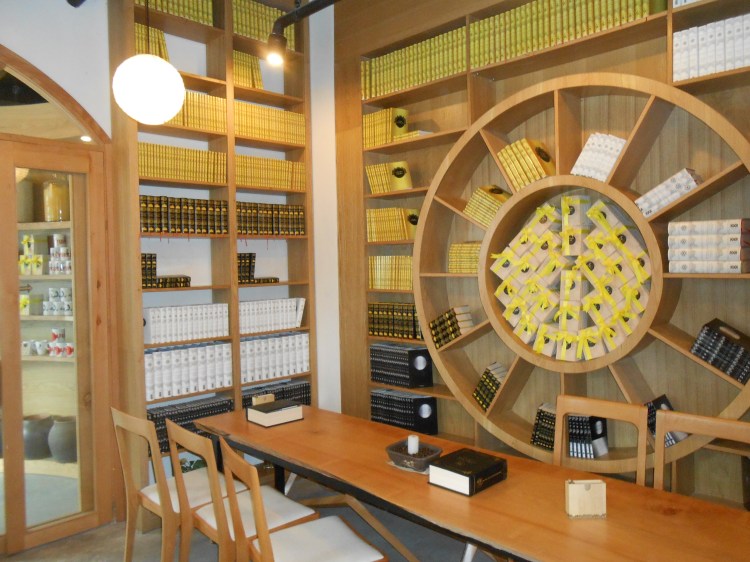
books as decor in coffee shop

This is a Trung Nguyen coffee shop in District 3, where I went with Clover, the woman who translated for me in the first teaching methods seminar. More books on display here than in most bookstores. 

There are not a lot of big bookstores in this part of Vietnam, as far as we can tell. The closest one to TDTU is at the Lotte Mart shopping center. It is one room about the size of Pegasus on Solano Ave in Berkeley (not huge) and has mostly school writing materials, notebooks, art materials and toys, with one quarter of the space for books and a couple of shelves for books in English, most of which are paperbacks like Game of Thrones and Fifty Shades of Gray. On a few occasions we did see some real Vietnamese books there. We bought Madame Binh’s book there, as well as the Duong Thuy book. There is not a separate bookstore a the University.

At a bookstore in District 1, HCMC, we got Bao Ninh’s The Sorrow of War and the Vo Thi Sau book. It was a narrow-fronted three-story building but a lot of the space was for ethnic handicraft souvenirs.

A place to get good books is at tourist destinations such as in the gift shops in the big imperial court sites in Hue. While this isn’t the obvious place to try to sell books, especially serious history books, they definitely reached us this way. At Emperor Le Duc’s summer palace and tomb Joe saw General Giap’s book, the Dang book on ethnic minorities, and the excellent Vietnam: A Long History, by Nguyen Kach Vien. In terms of American dollars they are not expensive, but in terms of dong, they are expensive. The Nguyen Kach Vien book cost 500,000 dong.

I bought the Denise Chong book about Kim Phuc from a vendor who came into a restaurant in District 1, in the tourist district. She was carrying around a shrink-wrapped tower of knock-offs. I paid 300, 000 dong for that plus a copy of Gone Girl, poorly Xeroxed.

Then Joe and Hollis and Leanna went for a walk south and east past Vivo City (a huge expensive all-inside-a-big-shiny-box shopping mall) into what’s called Koreatown, where all the Korean managers live, apparently. This is definitely a higher-rent area than where we are. It has sidewalks, for example. There are lots of restaurants, phone stores, travel agencies, etc etc. And a bookstore. Joe came home with 5 books. He says that there were a lot of airport-type self-help business books in Korean in the store.

Here is our collection so far:

Bao Ninh. 1998. The Sorrow of War. English translation copyright Martin Secker and Warburg. London, UK: Random House Vintage. This is a real war novel, said to be the All Quiet on the Western Front of Vietnam. The book begins with the narrator, one of the only survivors of his company, out in the jungle in a truck searching for remains of fallen soldiers, which he wraps and piles in the back of the truck. From then it flashes back to the first days and then the climax of the war. There is a long, difficult love affair interrupted by the war. The section in which the North Vietnamese troops are leaving to go south on the train, and the narrator and h is girlfriend miss his train and they decide to catch another train to try to catch up, both of them – what does she think she doing?- is intense. There is another memorable section in which the narrator hides while three giant American soldiers, “athletes” – huge guys, loaded with weapons – search for him with a giant Alsatian dog. The book itself was banned for a while. At the end, the narrator fades in and out as if he is becoming another person.

Binh, Madame. 2015. Friends, Family, Country. HCMC: The Gioi Publishers. This is a very clearly written, well-produced book that reads like a real story of a person’s real life. She hits a wonderful tone of one-on-one “here is what you need to know about my life” as she remembers it both as part of her own family and on the international stage. I loved it. As a young girl under the French, her job was organizing flash demonstrations in Saigon. She got identified by the French police, caught and tortured. She went North after 1954 and eventually became the representative of the Provisional Revolutionary Government at the Paris Peace Talks. Every person in the book is elaborately footnoted in case you don’t know who was who. When you read about these people in other books, you can find out who they are by looking at the footnotes in Madam Binh’s book. It also has great pictures, some in color. The Gioi Publishers must be some kind of official publisher; they do a good job.

Later, we read that only 1000 copies of this were printed in English and they ran out. Joe bought two more copies when he saw them in a different bookstores.

Chan, Anita, Editor. 2011. Labour in Vietnam. Singapore: ISEAS Publishing.  We bought this in the US. Good articles on strikes, corporate social responsibility, labor protests. Good chapter on comparison of strikes in China and Vietnam.

Chong, Denise. 1999- 2001. The Girl in the Picture: The Story of Kim Phuc, the Photograph and the Vietnam War. London: Viking. Kim Phuc is now living in Canada. Denise Chong got her to spend several years co-operating to produce this book. She is the little girl running naked down the road into the camera, napalm clouds behind her and hot napalm on her back. There is a lot in this book about the town, Trang Bang, where her family lived, which is in a province right about where the road into Cambodia and the Ho Chi Minh trail cross, so a whole lot of fighting took place there, first one side and then the other. Through it all, her mother supported the family (and had 10 kids) by running a noodle shop in the middle of town, and her shop suffers every possible kind of bad luck. The description of how Kim Phuc got used as a propaganda tool by the local leaders of her province is excruciating, as is the story of her changing relationship with her mother. This book is full of details that help bring that part of the war to life, help me understand what it was like on a daily basis. The CuChi tunnel museum is right near there.

Dang Nghiem Van, Chu Thai Son, and Luu Hung. Ethnic Minorities. Hanoi: The Gioi Publishers. Haven’t read this yet. Looks like a reference book. Later: Went to the Ethnography Museum in Hanoi and developed some respect for this book, as well as respect for the approach to minorities in Vietnam. It’s very different from “minority” issues in the US. There are 53 or 54 “minorities” in Vietnam, many still living in their historic regions and villages, speaking their own languages.

Huu Ngoc. 2010. Wandering Through Vietnamese Culture. Sixth Edition. Hanoi: The Gioi Publishers. Leanna says I will love this book and it will last me a long time. I will take it with me on our next trip. (Joe read it, cover to cover, all 1000 or so pages. He says it’s got a lot of good stuff in it. Unfortunately, it’s organized by topic, not in order in which it was written, which would have been more interesting to me.)

Lundquist, Lt. Col. Donald. 2014. Letters from the Battlefield. Vietnam Writer’s Association Publishing House. This is a very odd book. Its impact comes from its structure, as if it was a play. There are two sets of letters. One set is from a US officer who commanded a headquarters in Chu Lai-Tam Ky known to American troops as “Fat City.” On page 73 he describes “the battle a commander dreams of” when he called in four Cavalry platoons and “all the helicopters I could get” to shoot at “about 300 Viet Cong in open fields running”. The level of self-reflection never goes deeper than that. As if that wasn’t appalling enough, they’ve paired his letters with the letters of someone who actually thinks about the war. No comment, just the contrast.  Lindquist says that out of 180 killed he personally killed 11 himself and was “given much credit for the whole show”. He racks up many medals, retires to his wife’s home in Germany, and dies of a heart attack at age 38 after a helicopter ride.

Nearly 30 years later his daughter reads his letters, listens to his tapes, and goes to Vietnam to retrace his steps. She writes a book, is interviewed on NPR, and gets a screenwriter to write a script. While in Vietnam she is introduced to a family from Hanoi. The father of this family was also in the military, dug earthworks, pushed artillery up and down the Ho Chi Minh trail, saw friends killed, and wrote letters. This guy was a student in the Hanoi University of Literature at the time that he left to fight. His letters are thoughtful, reflective and beautifully written, although the translator certainly gets some credit. After 5 years of war he goes back to Hanoi and works in the military archives, making a personal project of collecting and organizing the letters and other writings of soldiers who were killed. In this case, his youngest daughter, born after he came back, introduces his letters. Both sets of letters are in Vietnamese and English. Side by side, the contrast is enough to make you want to throw the book across the room.

I am sure the book is not a fake. On the 40th anniversary of the end of the American war I read, maybe in an article in the New Yorker (which is where the My Lai story first got widespread attention), that some Vietnamese spokesperson, maybe someone at the War Remnants Museum, said, “We forgive but we do not forget.” I kept thinking of that when I read this book. So here’s a book that helps us not forget: that US military officers were given medals for shooting at fleeing Vietnamese from a helicopter. Like shooting at buffalo from a train.

Nguyen Ngoc Thuan. 2014. Open the Window Eyes Closed. Translated from Vietnamese by Thuong Tiep Truong. Nha Truat Ban Tre Publishing House. HCMC. This is a perfect book. It is written as if someone is holding you on his lap and telling you stories that are just scary enough, just terrible enough, but also completely believable and true, and told completely for the purpose of warning you what life is like, especially how beautiful and wonderful it is. Apparently it is a children’s book but it hits an adult right between the eyes, whammy.

Nguyen Kach Vien. 1987 (2014). Vietnam: A Long History. HCMC: The Gioi Publishers. This is a really good book. It starts with Paleolithic Vietnam and keeps on going up through the beginning of doi moi and the author keeps a steady narrative tone the whole time. He’s a real Marxist: holds everything up to the same standard, makes everything fit in the same story, including the role played by state religions, the labor invested in irrigation systems, how small communities combined for self-defense (against the Han), all the way into the arrival of the French and the experience of colonization. He can wrap a big complex historical crisis into a short paragraph by using exactly the right words. There is evidence that some really good English-speaking people were involved in the translation, because sometimes a word like “pressganged” shows up—a very specific word, correctly use. It wasn’t until I read this that I began to understand the post-1945 period. I think I have a better handle on it now. I assumed, since this book was so good, that it was a famous book and probably was the history book assigned in high schools. When I waved it around at Vinh’s wedding, no one had heard of it.

Ly Qui Trung. 2015.The Sky Does Not Have to be Blue. Nha Truat Ban Tre Publishing House. HCMC. This is one of the ones Joe got at the bookstore in Koreatown. It’s the happy story of a young entrepreneur who decides to open a restaurant selling pho, called Pho24, and turns it into a chain and then franchises it all over Asia. It is written to both inspire and guide young entrepreneurs.

Thong, Nguyen Dinh. 2014. Vo Thi Sau: A Legendary heroine. HCMC: Literature and Arts Publishing House. A very short book. A hagiography, really, for this young girl who was captured after throwing a bomb in a marketplace. She would throw a bomb and cry “Viet Minh attack!” and then run. After some years in prison with a lot of other Viet Minh (where they had a prisoner-run school and she learned to read and write) she was executed. Many cities have streets named after her. The book treats her like a saint but it still reads well; feels like a poem.

Thum Duong. 2013. Beloved Oxford. Translator, Elbert Bloom. HCMC: Tre Publishing House. This is a really strange book. The main character is a Vietnamese girl who goes to Oxford on some scholarship to study international business. Her advisor’s (tutor) assistant is a Portugese guy who, from the POV of a US woman, harasses and abuses her. However, it turns out this is a love story and the young woman actually likes what the guy does to her. Makes for very weird, unpleasant reading. Her assignments in her business class include preparing marketing plans for big US companies like Proctor and Gamble. The translation is strange, too; maybe it just reflects the original, but it is not recognizable as something a native English speaker would produce.

Tre Publishing House appears to cater to youth readers. They run a Book Bus, for example, and donate books. It’s true that you don’t see a lot of books around. YOu don’t see people sitting and reading books. So this may be a way to appeal to a youth audience and get them reading.

Tran, Angie Ngoc. 2013. Ties that Bind : Cultural identify, Class and Law in Vietnams’ Labor Resistance.  Cornell Southeast Asian Program PUblications. We bought this in the US. This is a major work of research into labor in Vietnam. We have used some of her anecdotes as case studies in our classes. The framework is the relationship, both in terms of time sequence and importance or power, between ethnic communities and villages of origin (hometowns), versus class. Which is the operative source of solidarity when it comes to resisting bad work? She carries these units of analysis into reports of labor disputes. Some of her research is library and archives, a lot of it is direct interviews with workers. A huge amount of research went into this. She piles examples and stories into the book. She apparently participated in the conference held last spring (2014) here, that Richard Fincher worked on. I don’t know of any other comparable book. She teaches at Monterrey Bay CSU in California.

Trung Trung Dinh. 2010. Lost in the Jungle. Translated by Gary Donovan and McAmmond Nguyen Thi Tu. Vietnam Writers’ Association Publishing House. This is a gripping can’t-put-it-down book, very short, unforgettable and unique. A young North Vietnamese soldier gets separated from his unit in the highlands and is captured by a guerrilla group that belongs to a small ethnic minority assigned to watch and report on the movements of Americans. It’s written from the point of view of the soldier/prisoner. Also captured by the guerrillas is an American soldier who has apparently decided that he’d rather stay with the guerrillas than go back to his unit. Lots and lots of descriptions of the life of the guerrillas, the jungle, the language, the food. The translation is very readable. This book has won a lot of prizes in Vietnam.

Vo Nguyen Giap. 2010 (written years ago). Unforgettable Days. Hanoi: The Gioi Publishers. General Giap is a good writer. He actually wrote many books; the year in question in one is 1945. The Vichy French government has lost the war, but DeGaulle doesn’t think that means that France has necessarily lost Indochina. The Japanese have also lost the war, and the Kuomintang Chinese, who are simultaneously confronting the Chinese Revolution (Mao) on their home territory, have been told that they (as allies with the Allies, meaning the US, Britain and Russia) are the ones who should disarm and peel off the Japanese who had invaded Vietnam. So we’ve got the Japanese on their way out in North Vietnam (but who inflicted huge damage during the war); the Kuomintang who have arrived in Hanoi with 200,000 soldiers and may not be eager to leave after they’ve carried out their assignment, and then the South jumping with homegrown Vietnamese uprisings against the French. In the middle of this, Ho Chi Minh comes down out of the mountains carried in a litter (he was ill) and has a short window of time in which to get a government together. He also has to deal with some provocateur nationalists on one side and some elitist pro-French on the other. Oh, and the French have just arrived in Hanoi harbor in a destroyer. So Uncle Ho calls a general assembly one day early and whips up new government set up in half a day, spreading seats in the governing body among the different constituencies so that everyone is on the same page. I am only halfway through this. Needless to say, this was done with full preparation; they just carried it out fast. Giap seems to be writing this from his diaries, so there’s a “Now today we did X, the next day we did Y” quality to it, but he conveys the intensity of the time. One lesson I have got so far is that if the gift for maneuvering and strategizing that is displayed in these events is inherent in Vietnamese character, we should not assume that anything happens by accident without enormous amounts of forethought, planning, and the ability to jump into action from dead zero when necessary. I’m talking about the TPP, which I’ll get into more later.

Wong, Kent and An Le. 2009. Organizing on separate Shores: Vietnamese and Vietnamese American Union Organizers. UCLA Center for Labor Research and Education.This is a beautiful, simple and much under-utilized book. It’s just a bunch of good interviews with organizers on each side, which is a simple idea, but it can be used for a lot of purposes such as learning some of the history the war through personal stories to teaching how to see what the working class struggle has in common on both sides of that history. The interviews start with the people’s childhoods so we have the story of the war’s impact on children on both sides. Could another book like this be written now, even only 7 years later? People are getting old! Maybe it was a good thing that the book got written when it did. You can see that the role of the organizer is fundamentally the same whether you’re doing it under Vietnamese or US law. This is important news. We’ve found a student named Dang Dang whose English is very good and he’s helping us translate it one chapter at a time. The parallels between organizing in Vietnam (with the VGCL) and in the US are really significant, both in terms of similarities (many) and differences (interesting and important).

A very weird, kind of unpleasant book is Vietnam as if....by Kim Hunyh. I do not recommend it.It occasionally rises to a level of cynicism combined with “more than I really wanted to know about that, thank you,” that seems motivated by a mean spirit.  For some reason it’s being distributed by the Australian National University. This ebook can be downloaded for free from press.anu.edu.au/titles/vietnam-as-if

Final note: If you are going to buy one book about Vietnam, buy the Nguyen Kach Vien. 1987 (2014). Vietnam: A Long History. HCMC: The Gioi Publishers. It’s curious that so far no one I’ve met in Vietnam has heard of it, though. Once I read it I saw it in both hardback and paperback, especially up in Hanoi at the Savina bookstore.

We are at about the halfway point of our time here. Hmmmm…..

Vinh’s Wedding #2

Sea coast

The second wedding took place in Phan Rang-Thap Cham, a coastal city north of Phan Thiet where we went with Nghia, but south of Nha Trang where we went with Vy and Anh. While the first wedding took place at the woman’s hometown, Hue, the second wedding takes place at the husband’s home town.

The coast along here is a little softer than Big Sur but nevertheless, it’s where the mountains come down to the sea, and it’s gorgeous. The water is warm.

We got there on a train, about 6 hours, leaving Ga Saigon (all the train stations are called “Ga” something, as in gare, French) at about 1 pm and getting in around 7. Our guide was T’ung’s grandmother, who was in a cabin two down from ours. She sat half- lotus-position (the woman is in her 80s) on her seat and chatted with other people in her cabin, but came out and warned us when we were three stops from arriving. First dinner

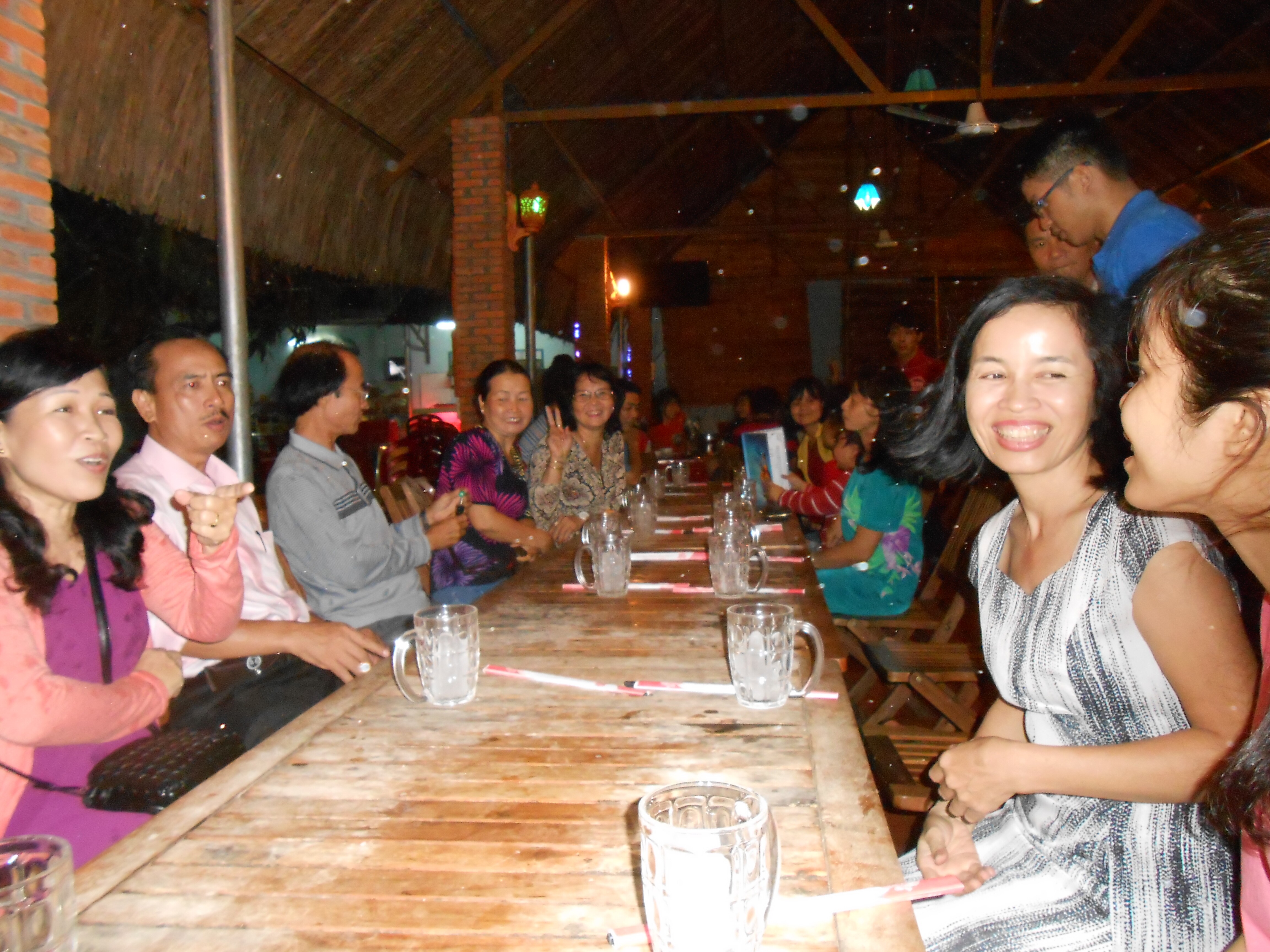
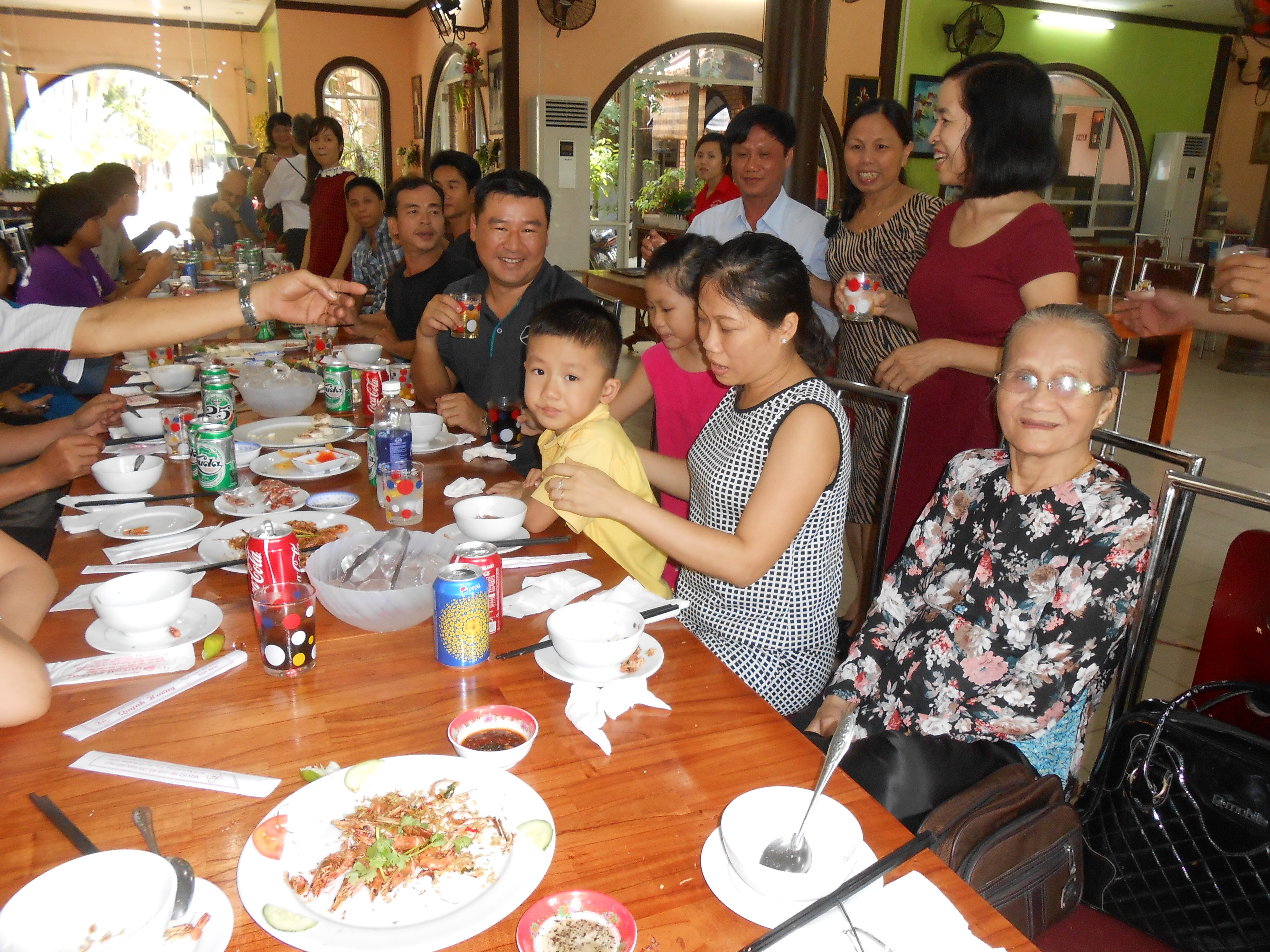
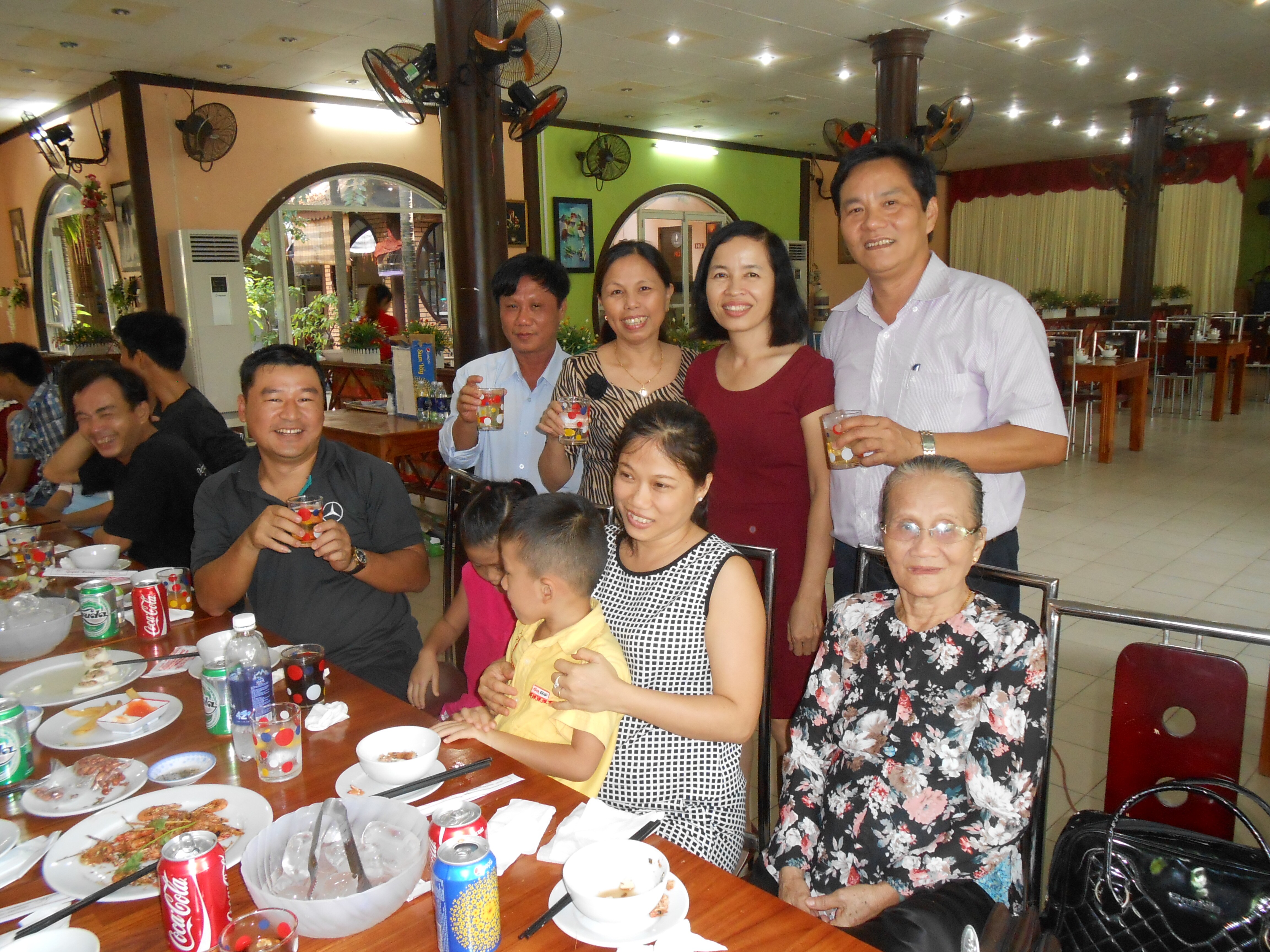
After being dropped at our hotel, we were taken in a van to the first of many, many meals, the central substance of which was very, very fresh seafood. This means everything from mussels to oysters to crabs to squid and octopus, to “fish” from the ocean with no English name. We were between thirty and forty people eating at long tables, drinking much beer. The picture above is from the first such dinner, on a terrace roofed with bamboo and rain pouring down. That’s Vinh’s mother on the right, smiling and looking about 15 years old.

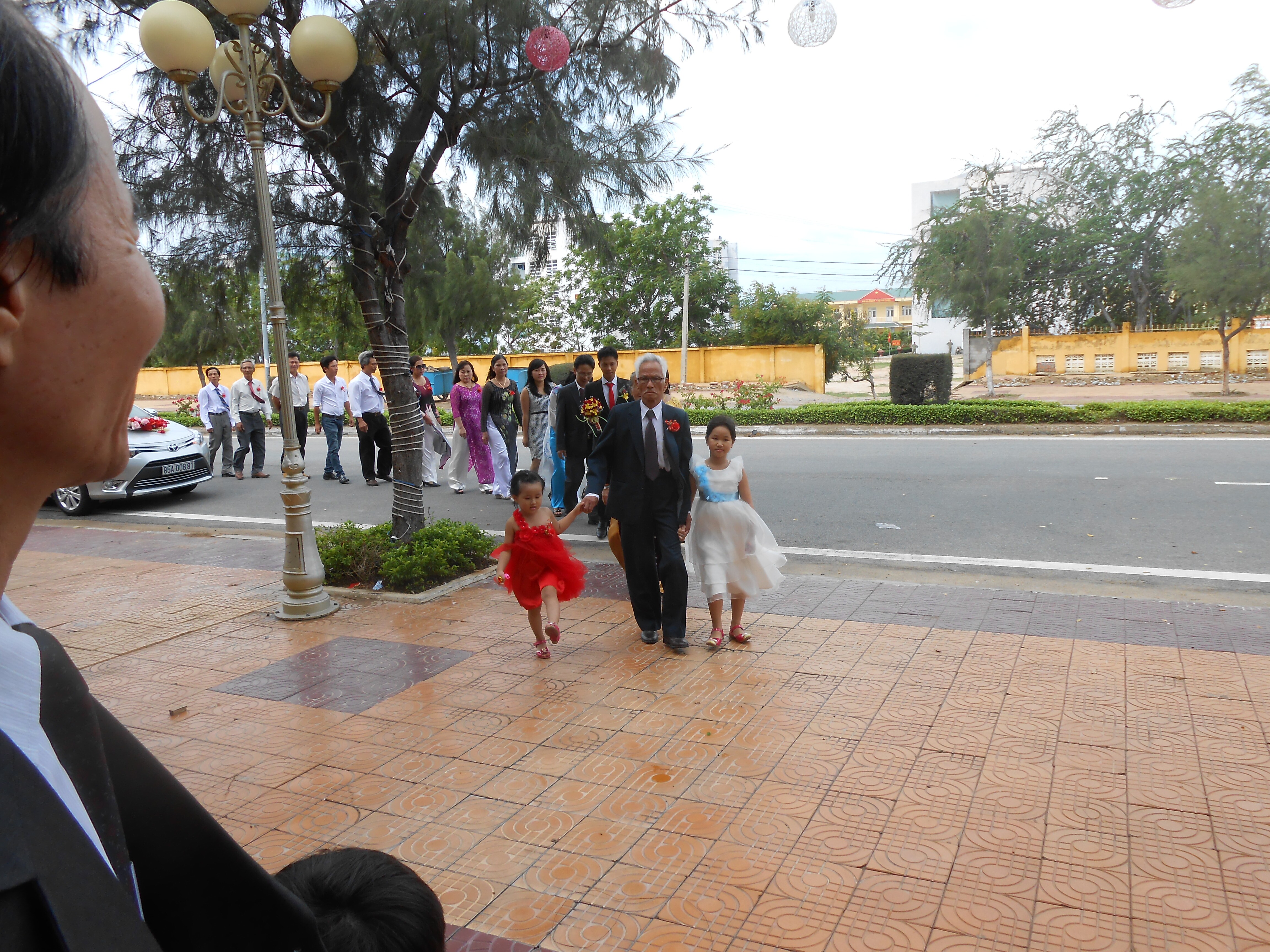
In the morning, the husband’s family comes to our hotel to get the bride. That’s T’ung’s grandfather leading, with two little nieces accompanying him. Inside the hotel, the bride’s family meets the husband’s family. That’s Vinh in the red ao dai and her father, in profile. the grandmother who was our guide is in the dark embroidered ao dai to the rear.

Husband's family comes to get bride Wedding party lining up

The whole party got in cars and vans and drove into Phan Rang-Thap Cham, which is a city of a million, not a big city for Viet Nam. However, it’s growing head over heels, construction everywhere. Miles of new highway (like what you see in the background, above) have been laid out, often with sidewalks and small trees planted, but no buildings, for miles and miles. An occasional hotel pops up, some still under construction like the one we stayed in, but elsewhere it’s flat open land with sometimes a herd of cattle coming past.Th sea is just over to your left if you’re going south. By this time next year this city will be famous as a resort town, because of its huge long curving beach with big gentle waves. Right now it’s not even listed in our edition of Lonely Planet.

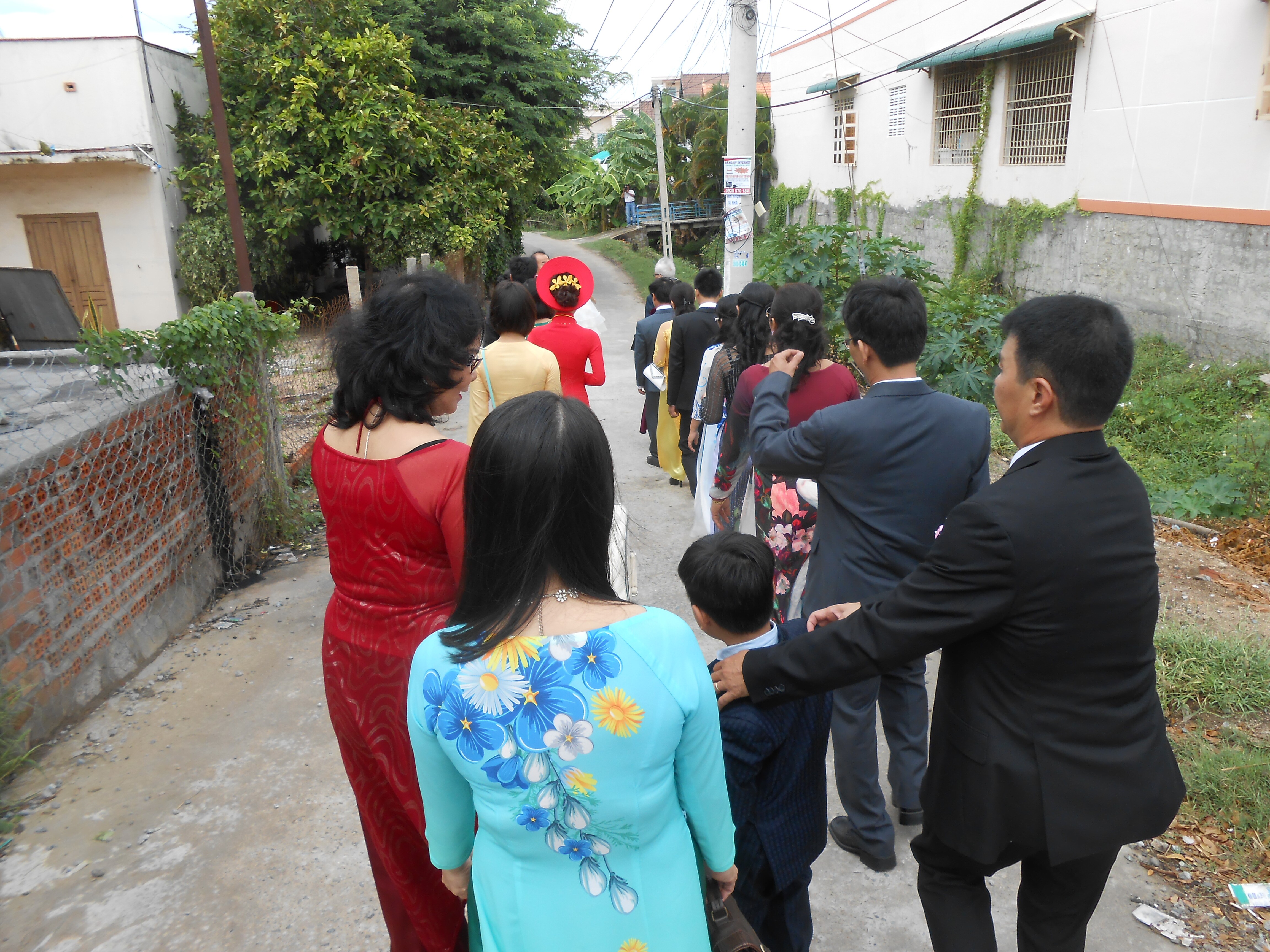
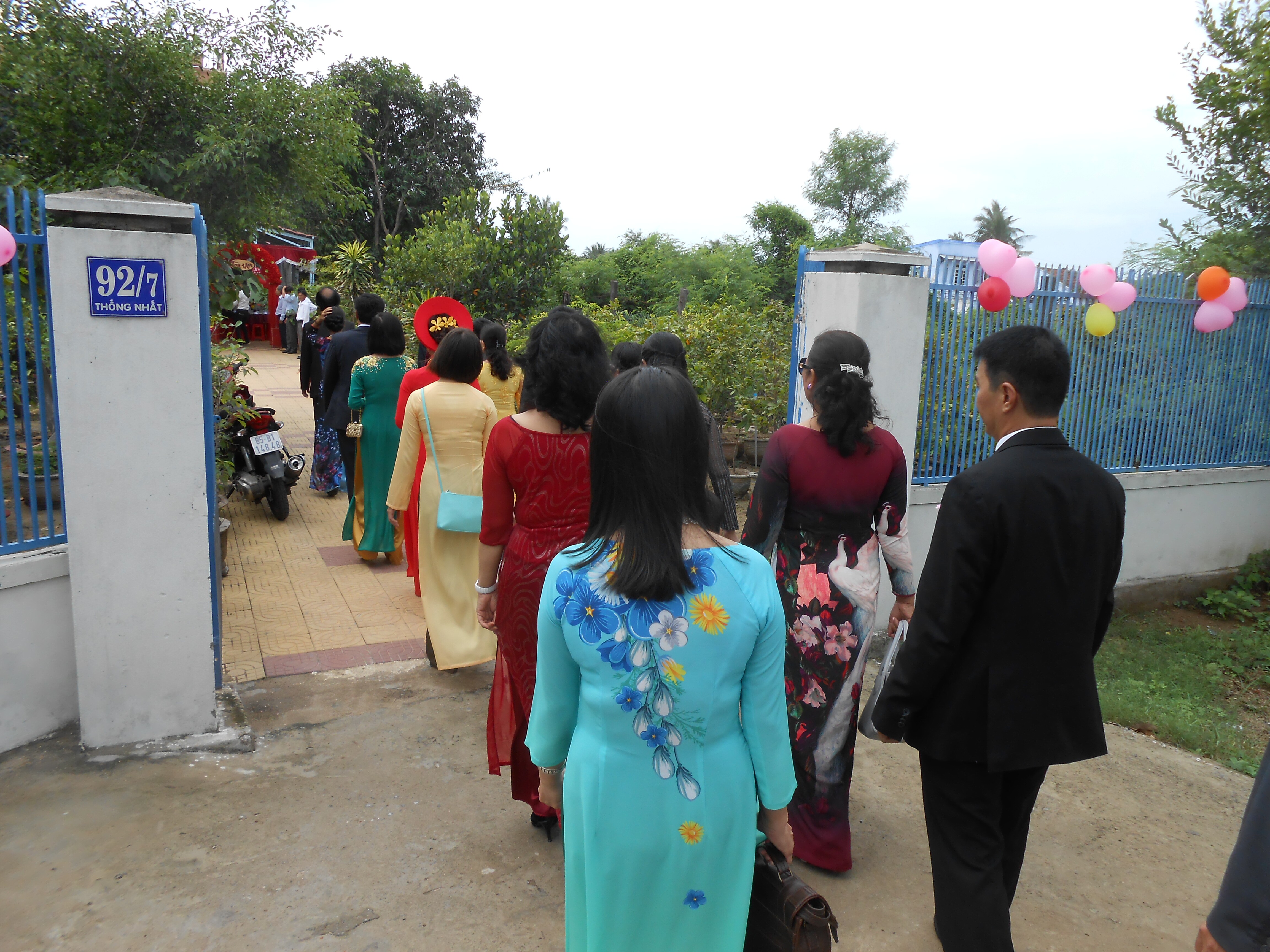
We went through the center of town and parked on a busy street that looked like any other street, full of shops and little food places. Then we turned a corner and were in a different world. We walked two-by-two (three is bad luck) down this narrow lane that was all houses. We turned in the gate at T’ung’s family home.

walking down the roadEnterint the gate

Between the gate that you see on the right and the house, which you can just barely see in the back, is a garden full of carefully tended plants. Some are in pots and look like giant bonsais. All of them look as if someone is paying attention to every leaf and fruit. I was very excited to see this. It turns out that the grandfather — the white-haired man who led the procession — was the original gardener and his son, T’ung’s father, is carrying it on. The land extends out beyond the back of the house quite a ways, too.

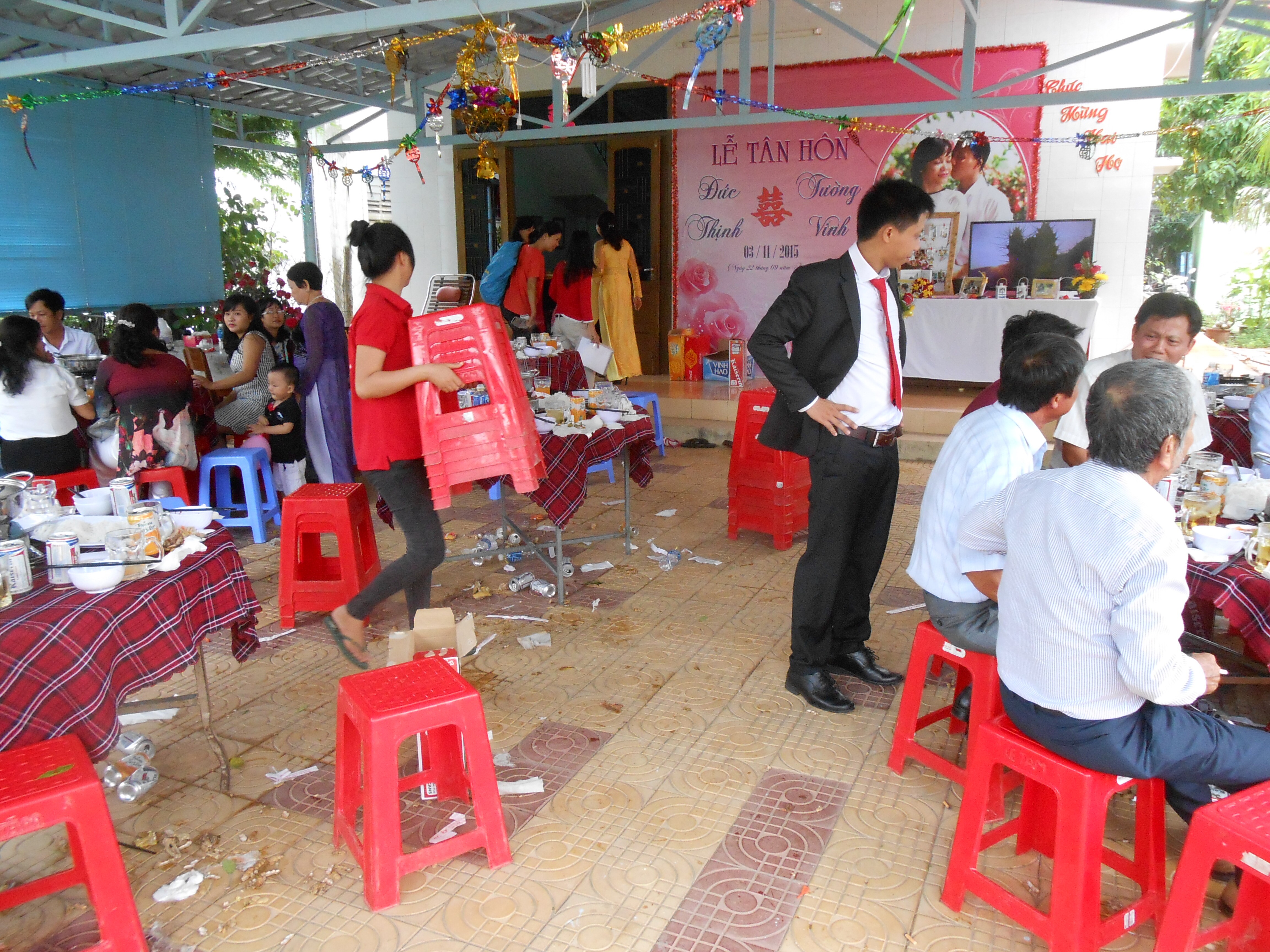
I did not take pictures during the ceremony at the husband’s family altar. Both his grandmothers were present, the one that guided us up from Ho Chi Minh City and his other grandmother, a woman in her 80s who is not well. This was a very simple, moving ceremony. I did not take plctures during the lunch, either, which was course after course again of wonderful food. I did take a picture of a Vietnamese custom which I think is a great idea, if you have marble or stone floors which you can wash down with a hose, as most everyone does: as you eat, cracking crabs and sucking oysters and swilling beer, you just throw everything on the floor. After you eat you leave the table someone comes along with a push-pan and water, and wipes it all away.

floor after lunch

Many of the guests were people from T’ung’s father’s work: he works in the state treasury agency, a state-owned enterprise. There were many men in white long-sleeved shirts who smiled and laughed a lot. Apparently there were also guests from T’ung’s famiy’s old rural home town, from before when they came to the big city. These people had to travel several hours to get there; one carload had a flat tire and got held up, but arrived at last.

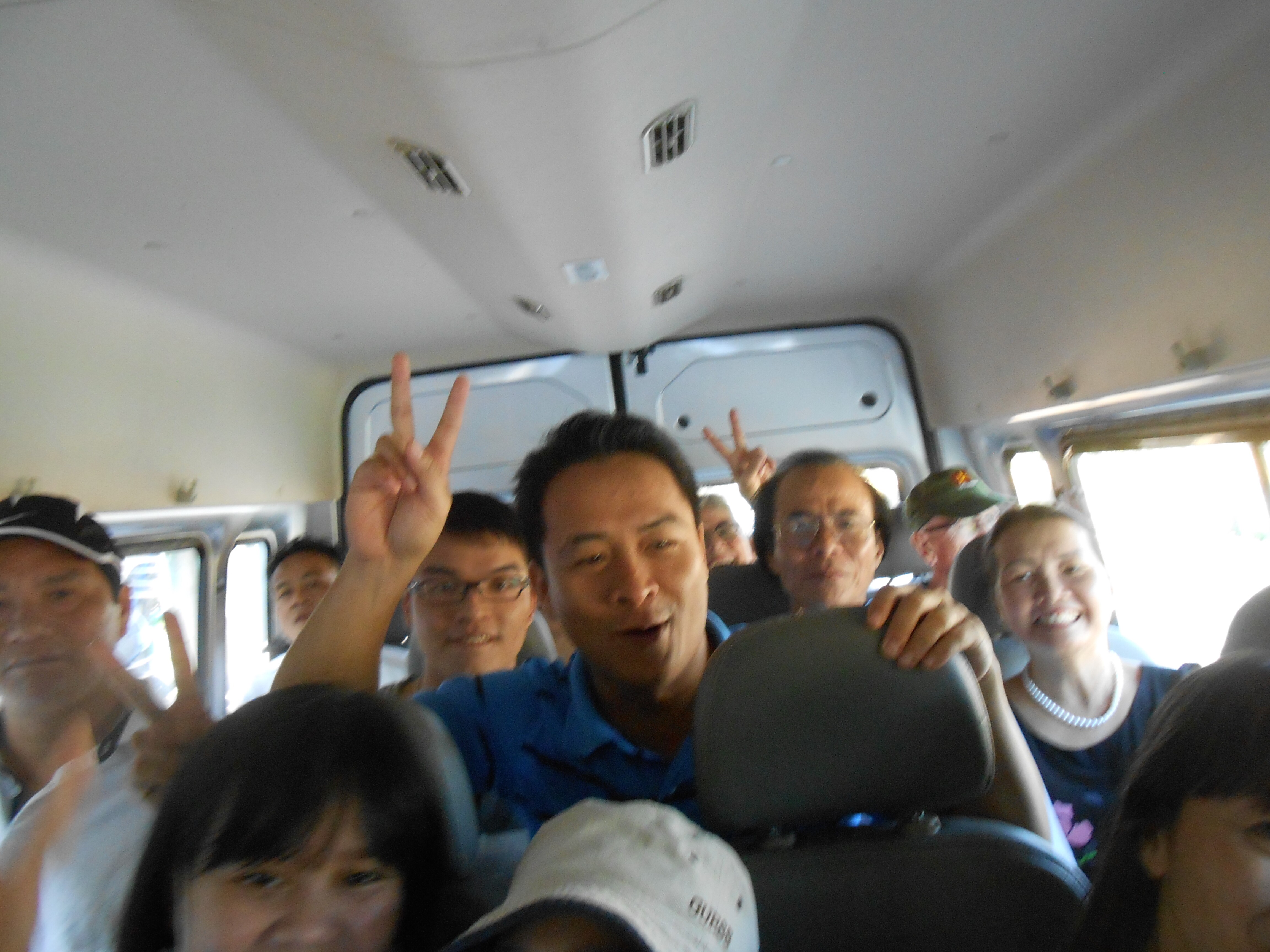
Many hours during the three days surrounding the wedding were spent in a van going around to see sights, No one uses seat belts, and the number of people who can fit in the van depends on the side of the people, which gives you an idea. You can barely see Joe in the left rear.

      travel in van

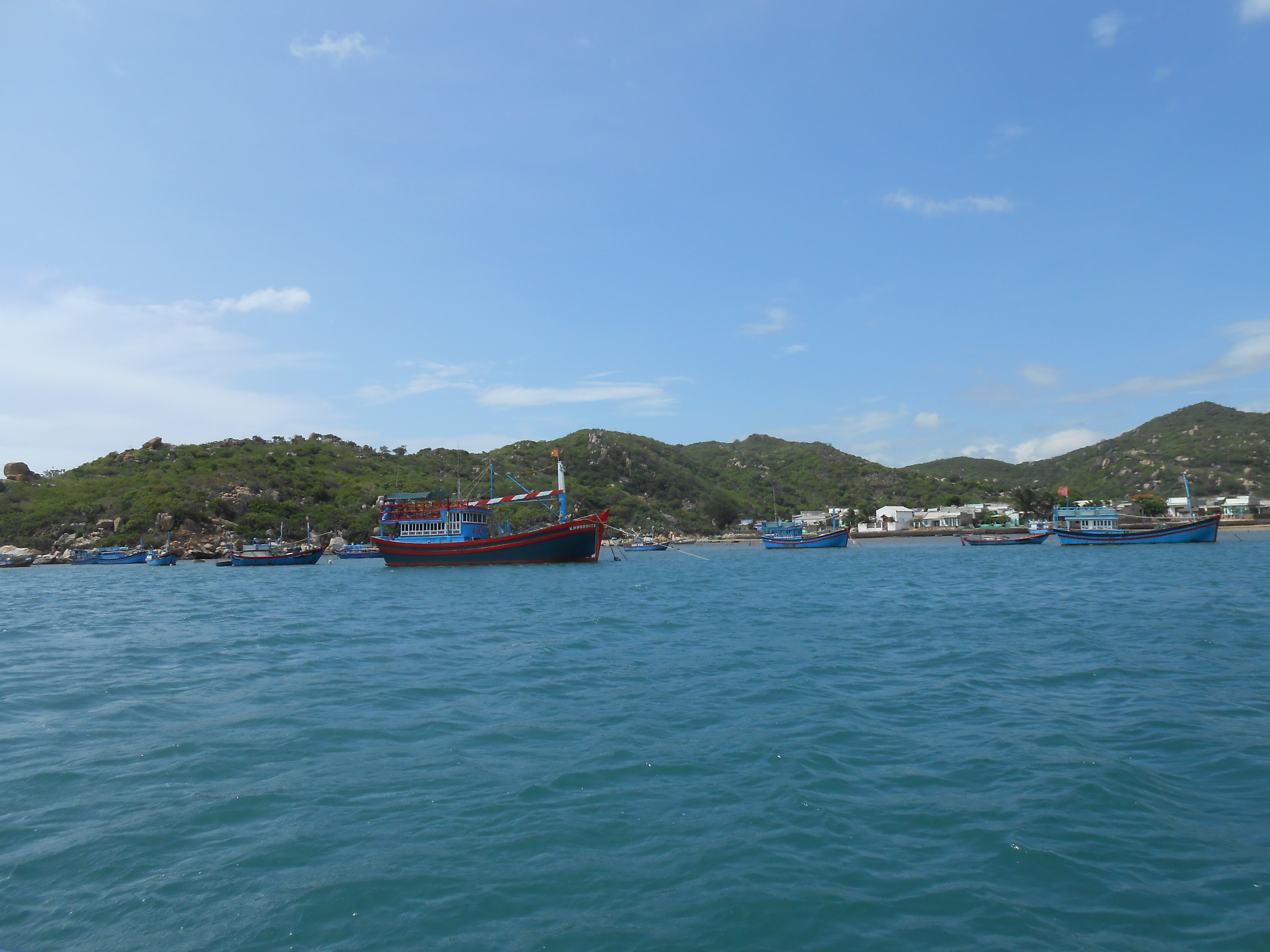
We went up the coast about 40 K to a resort on a bay with fishing boats.   This road has very little traffic, hardly any private cars (some motorbikes), a wide shoulder and just cries out for bicycle road trips.

fshign boats

The resort had a glass-bottomed boat that took us out to look at the coral, which was white-tipped — yes, I mentioned that the waves were warm. http://oceanservice.noaa.gov/facts/coral_bleach.html

glss botm boat_1

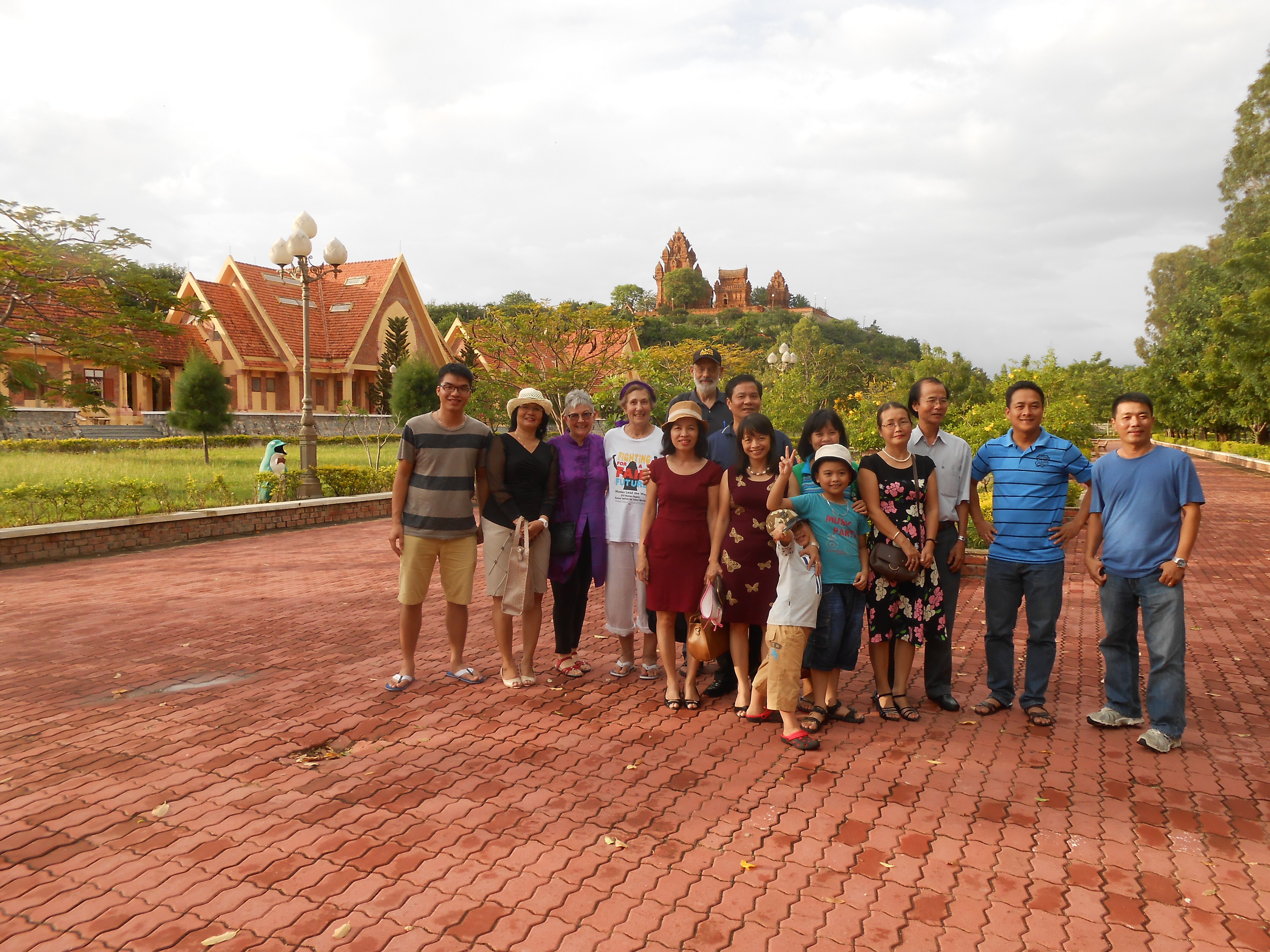
We went to the Cham temples, from the 7th century. The Cham were the ancient inhabitants of this part of Vietnam who came together in about the 6th century (at least as far as they can tell, from writings on the stelae of these temples) as a united group to defend themselves against the Chinese Han people. There are Cham temples in Na Trang and Phan Thiet, too — always on the highest point of land, where the view is best.

Cham temples

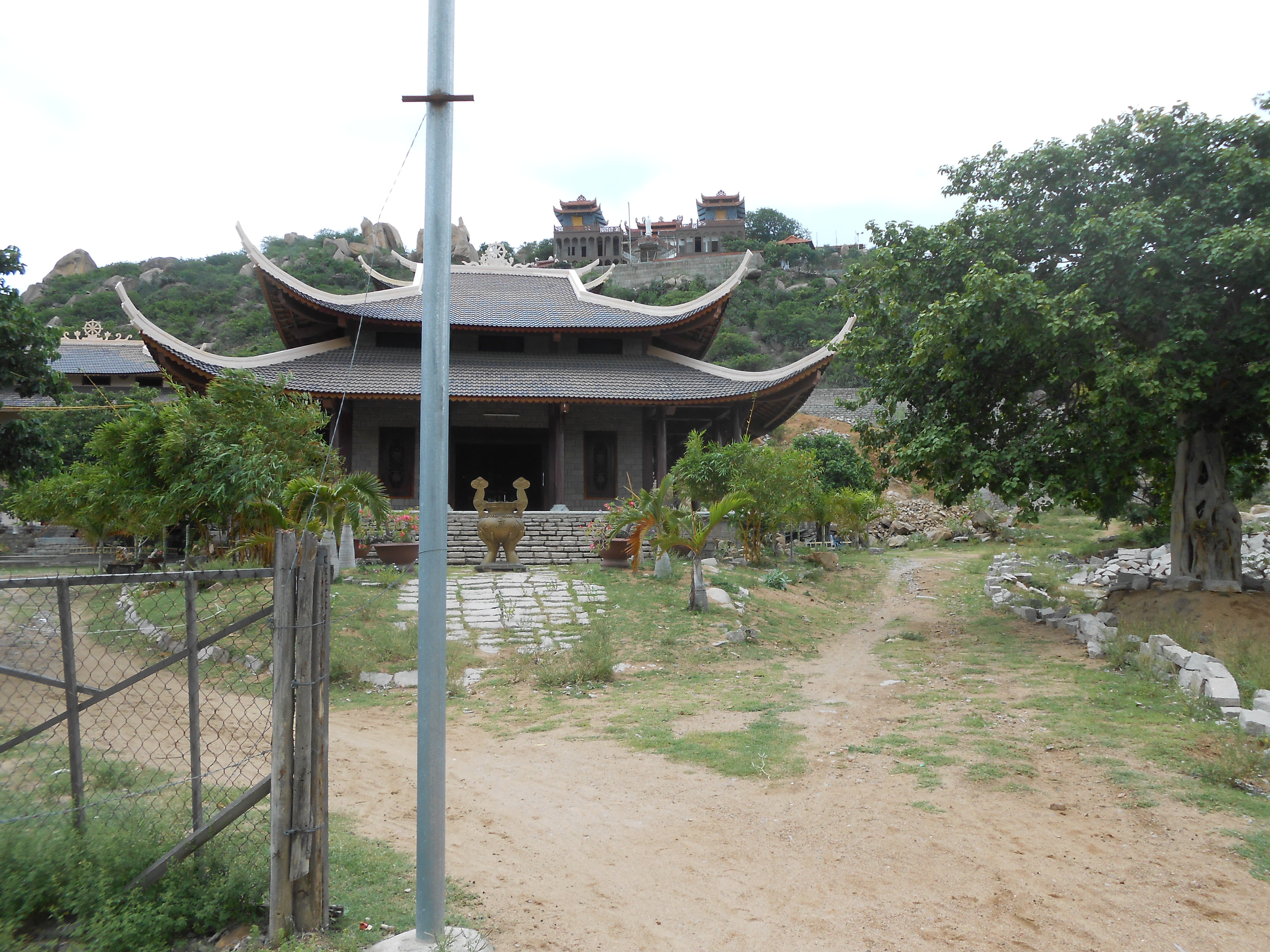
And a giant pagoda. The lower one was acessible, but the upper pagoda, a really giant affairs visible from a distance, was still under construction. Somehow I’d had the idea that it was ancient, but in fact it’s brand new. T’ung’s uncle told us that it was being paid for by Americans, very rich Americans, who were born in Vietnam and now send a lot of money back here. there are huge pagodas all over Vietnam being built like this, with this money.

giant pagods

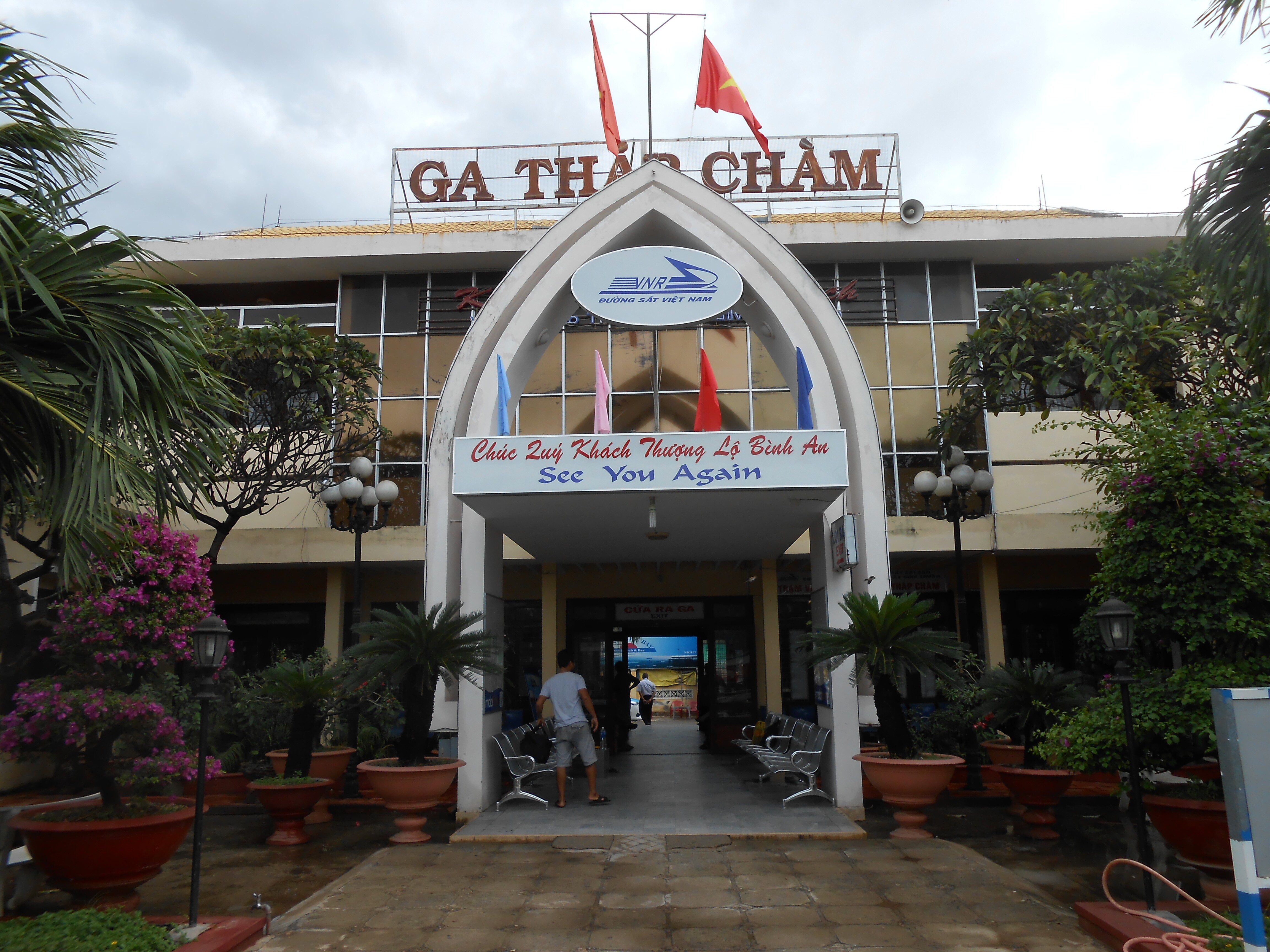
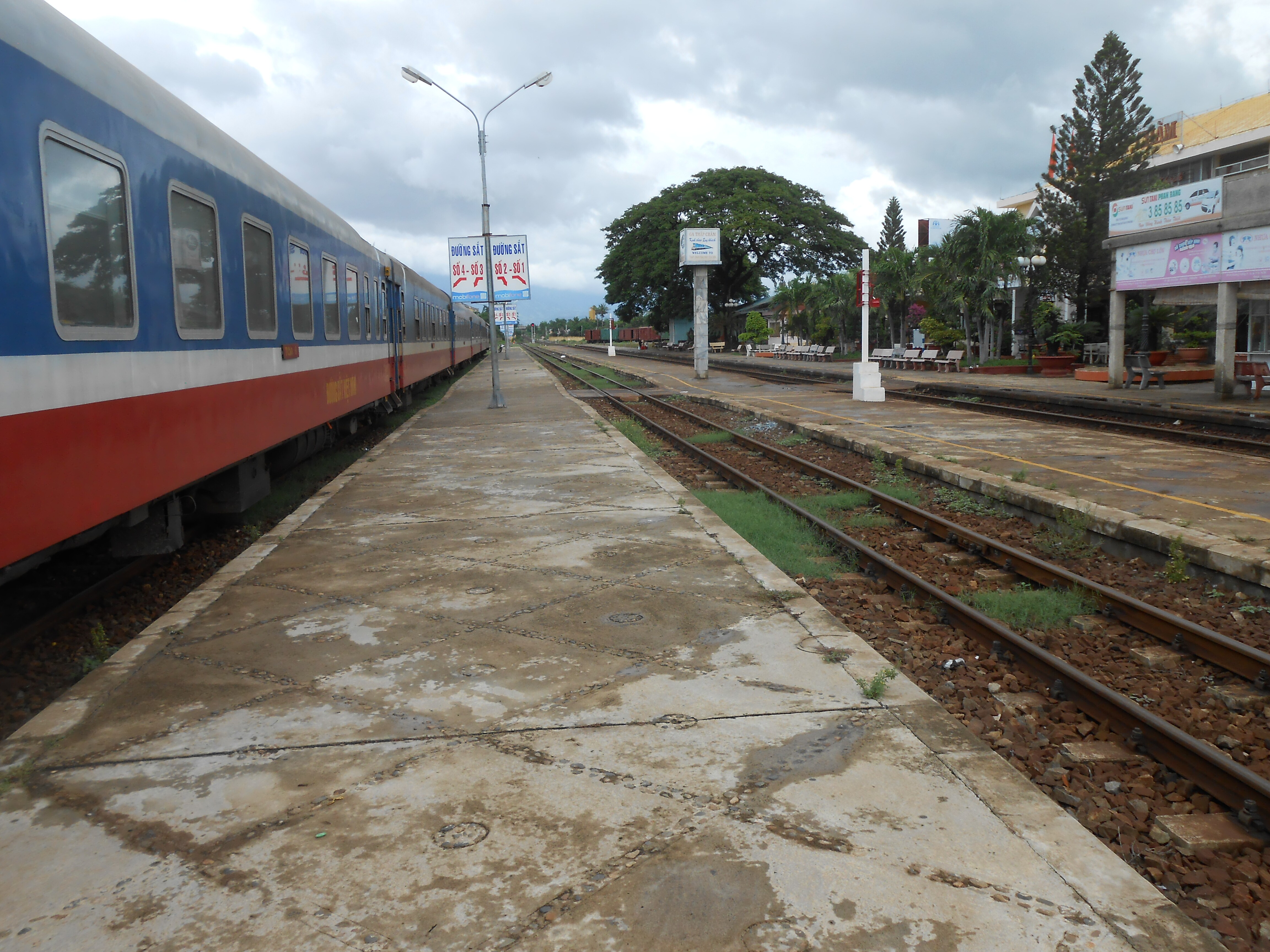
On  Wednesday, we went back to Ho Chi Minh City. This is the train station in Phan Rang Thap Cham.

station platrfomr at Phan rang

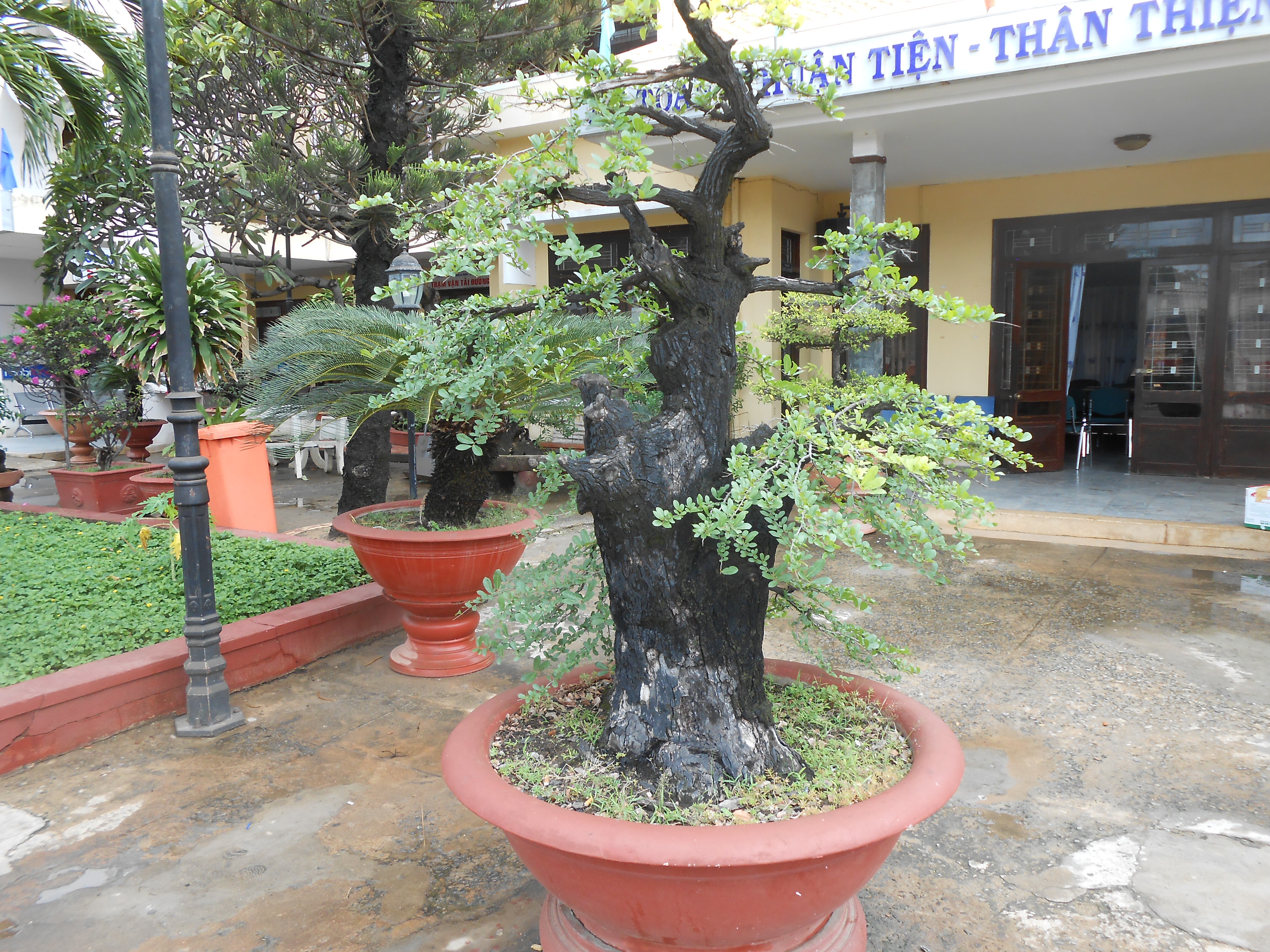
On the platform were many large bonsais like the one in T’ung’s family garden. This one is something i’ve never seen before: the wood is all charred and black, but the leaves are still actually growing on the tree from live branches. I would like to know what the technique or style is that creates something like this.

brnedbonsai

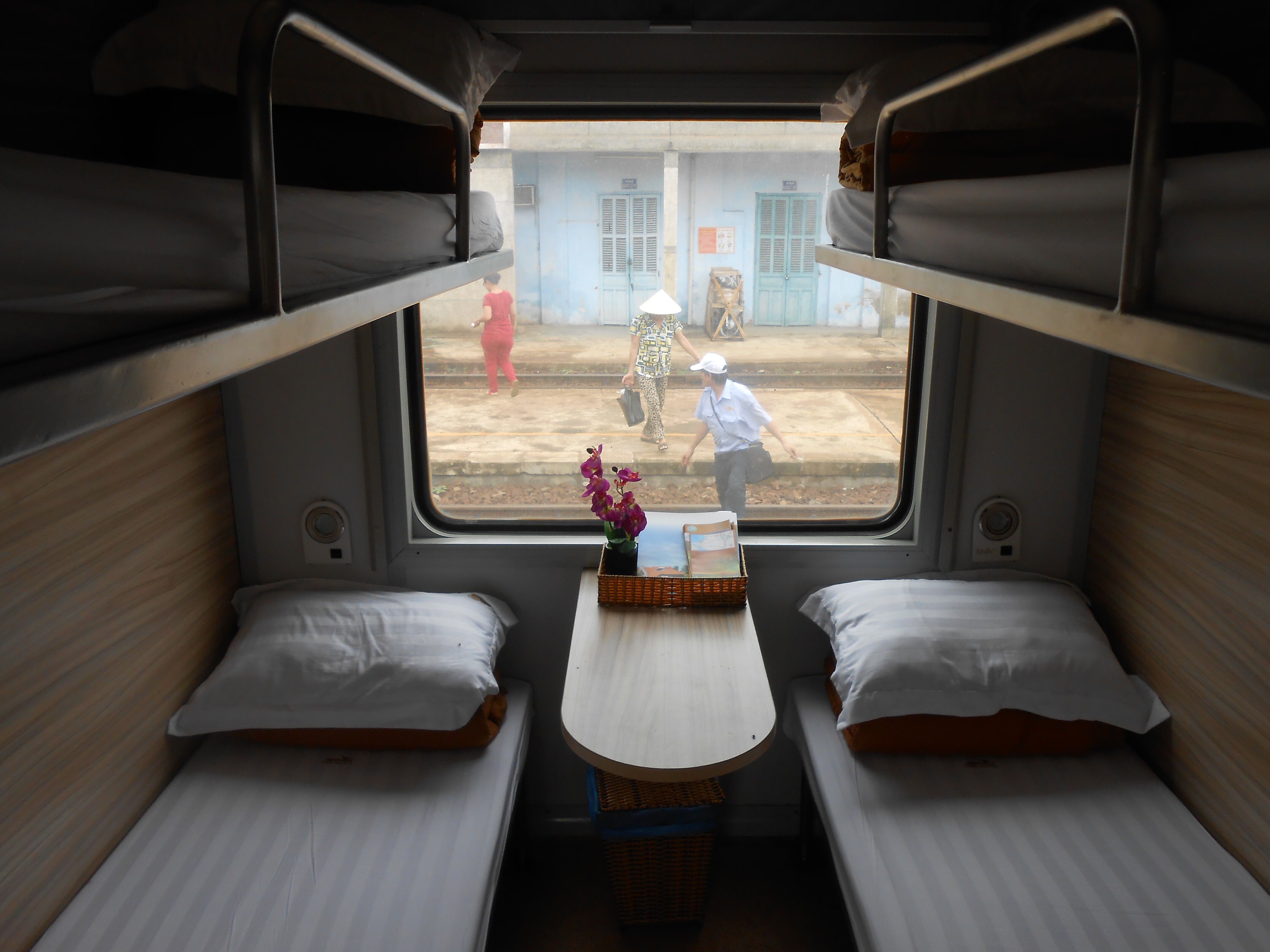
The train is nice, clean and comfortable. The run is new, so it’s not on the published schedule yet.

cabin

The “soft seat” cabins assume that you are going to sleep all the way, which most people do, day or night. You get assigned to a bunk and if you’re in the upper bunk, you stay there, unless the person in the lower bunk invites you to share their seat. These cabins appear to be preferred to the soft-seat coach cars, for reasons I don’t know, although you have privacy and can sleep in these.

You always want to know about the bathrooms on a train. Well, here’s a nice sink. And there was a water dispenser that did boiling water as well as hot water, although I didn’t actually drink it myself. One of the many conductors came along and gave us bottled water. But as far as the toilets go — yes, they had toilet paper, but it’s hard to keep a toilet clean on a 6-hour ride. Especially since one of the ways you clean yourself is with a spray nozzle that is found next to every toilet in Vietnam. It does spray all over the place and then there’s the problem of walking through the water on the floor.

sink on train

There was a dining car, with hard seats (wood) and a real person in it cooking, who made us rice, spinach and chicken, or beef noodle soup. The dining car was the oldest car on the train. It only had 6 booths and we and Hollis and Leanna were the only people who appeared to use it.

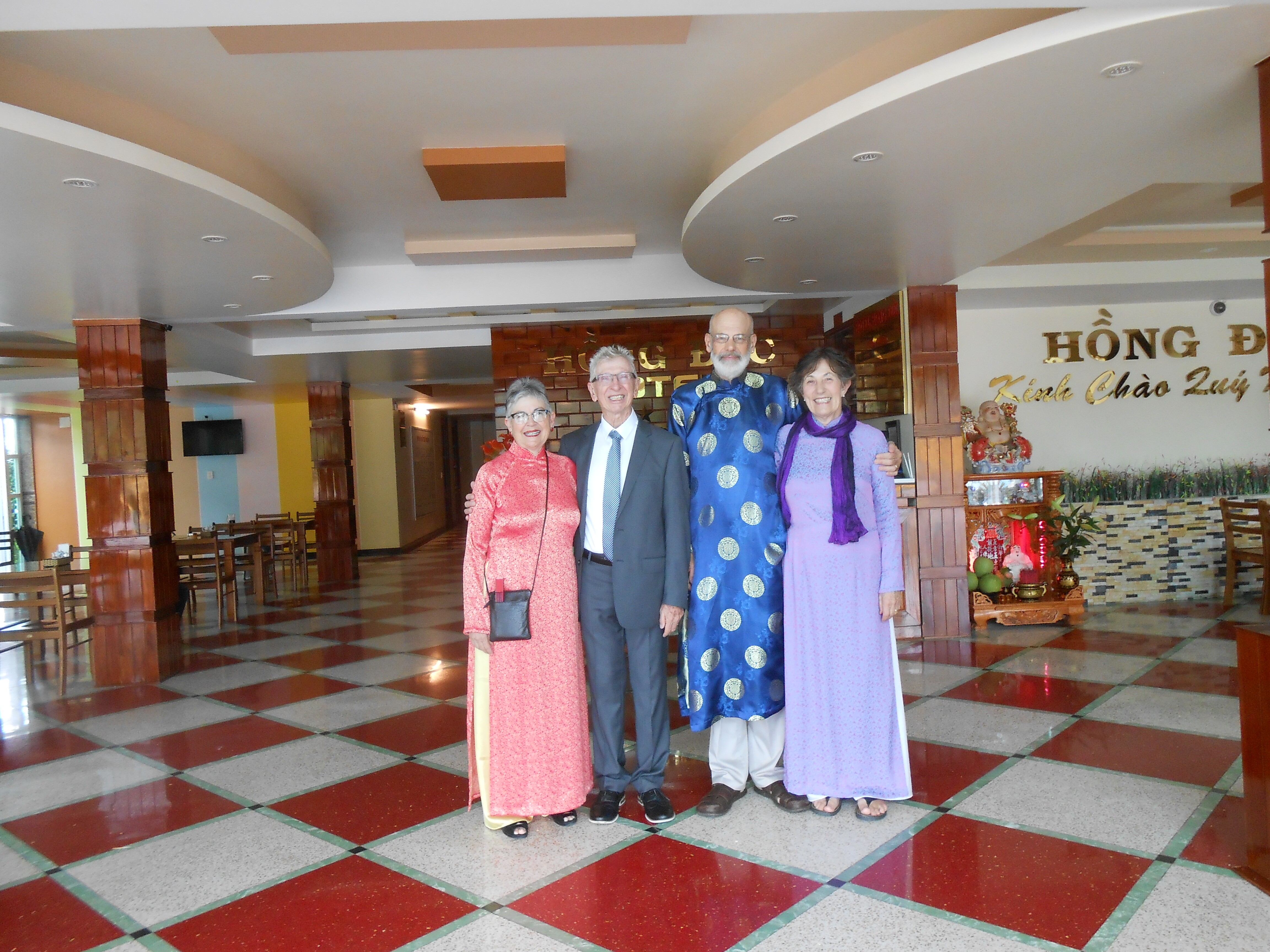
This is us in our wedding ao-dais in the lobby of the hotel where we stayed. We wore these to the ceremony, the lunch after the ceremony, and the “party” — another huge formal dinner -that evening.

Me, Joe, Leanna and hollis

Power Theater

Although we have written many class handouts specifically for these classes in Vietnam, this is the first one that I think really gets at what we have to teach.

When we teach collective bargaining in the US to trade unionists, we do not have to make explicit what the power relationships are behind what is going on at the table. That is taken for granted. American trade unionists know what capitalism looks like.

But here, we have to make it explicit. I think that in this handout we are starting to cut to the chase.  Here is the one we call Power Theater. It is being translated right now by a young guy named Dang.

Power Theater: What We Learn from Collective Bargaining Simulations

Collective bargaining is really Power Theater. Collective Bargaining is not an argument, in which one party tries to convince the other. Instead, it is like a chess game with an audience. Each turn in the conversation is a move. The whole conversation enacts a strategy. The Union has a strategy and the Employer has a strategy. Every move is strategic. In between every move, each side has to stop and think, “What happened? Has the balance of power changed with this move? How? What move shall we make in response?”

There are two audiences for the performance: one is the party on the other side of the table. The other is the people away from the table: the workers on one side, the investors or managers of the company on the other side, and the allies of both in the broader society and government.

The thing to remember is that the Union’s interests are different and opposed to the Employer’s in most respects. If they were not, we would not need a union or collective bargaining at all in this form.

Although the parties that meet and negotiate across the table are speaking politely and thoughtfully, what is really going on is a conversation about the power on both sides. Each one is silently showing how strong it is.

The Real Questions Behind the Questions People Ask

The Union is the moving party and starts the conversation. It says, “Here is what we want.” Whatever it actually says, this is what its words mean.

The Employer may really say, “Thank you, this is interesting,” but what they mean is, “Why should we? Can you force us to give this to you?”

The Union responds: “Yes, because if you don’t, we won’t work for you or we will make life difficult in other ways for you.” This is the power that the Union has.

The Employer then has three possible responses.

Employer Response #1: “I don’t believe you. You aren’t well-organized enough. You aren’t unified. You aren’t a real collective. You haven’t educated your members. Maybe some of you will refuse to work, but all the other people will come and work because they need jobs.”

Of course, the Employer doesn’t say this out loud. None of this conversation is going on out loud. But this conversation is what lies behind everything that goes on at the table.

Possible Employer Response #2 is this: “You need us because we give you jobs. Our company can go somewhere else. Or we could fire all the workers and hire new ones that will be satisfied with anything we give them. This is our threat.”

Possible Employer Response #3 is a question: “What really matters the most to you and your members? What are your priorities?”

What Does the Union Say Back to the Employer?

First we will talk about the Union response to Employer Responses #1 and #2. Then we will talk about the Union response to Employer Response #3.

One possible Union response to Employer Response #1, which is never said out loud, is “You are wrong. We are well-organized enough to do that.” If this is true, the union should have chosen to display how strong it is by gathering names on a petition, having a membership meeting at which workers talk about a strike, giving workers buttons or T-shirts to wear, talking to journalists and the media and other public actions. The Employer will have heard about this and will remember it when it meets the Union at the table.

A second possible Union response to Employer Question #1, also never said out loud, is: “Maybe you’re right. Maybe we aren’t well-organized enough to really give you a big problem. But we are still well-organized enough to give you a small problem, and you have to talk to us.”

This is the basic power equation of bargaining. The understanding that workers need jobs, and employers need workers, is what brings workers and employers to the table. But the relative strength of each is what determines what goes on at the table. By “relative strength” we do not mean how loud they talk or how emotional their language is. We mean their ability to either withdraw labor power (work), on the union side, or withdraw capital (jobs) on the other side. Both sides need each other and have to respect each other, but they are also engaging in shows of strength. They are performing.

At the table, the way the Union shows their strength is by being disciplined and prepared. Their self-discipline at the table symbolizes their ability to control the behavior of the workers who are not at the table, and who may be called upon to demonstrate their strength and unity as a collective. Likewise, the Employer shows strength by being firm but reasonable and knowing clearly what is possible and what is not possible. Their self-discipline symbolizes their control of the company.

What the Union says to Employer Response #2 (“What if we take away your jobs?”) depends on how well the union has researched the company and the legal context. An effective Union will have researched the company well and knows how much profit they are making. An effective Union will not ask for something that is impossible or will cripple the company. An effective Union will also know if the laws prevent a company from firing all the workers just in order to get cheaper workers.

So the Union might say, silently, “We know how much money you are making and we know that you can afford to give us what we want and still make plenty of profit. So we are ready to put pressure on you to give us what we want.” Out loud, the Union might say, “Here are the details of how this would work. Give our proposal your careful consideration.”

The Employer should be aware of how much research the Union has done. Just to make sure that it knows, the Union should be ready to mention relevant facts to show how well it has prepared.

The First Management Caucus


If the Employer is convinced that the Union is strong enough to put pressure on it, and prepared enough to negotiate something that is reasonable and will not force it to flee the country or fire all the workforce, there is a third response to the Union’s opening proposal. The Employer will ask:

Employer Response #3: “What are your priorities? What really matters the most to you and your members?”

This is a good question. It is the question that opens the conversation after the first exchange of proposals. The two sides have met and looked at each other. They have mentally estimated what the responses of the other party might be. The Employer might be thinking, “These people are well-organized and self-disciplined, and they are going to put serious pressure on us.” Or, the Employer might be thinking, “These people do not really represent the workers. They do not have the power to really pressure us, so I will give them only a little of what they want.” The Union might be thinking, “Do they understand that we are serious? Do they know that we have done our research and can check what they say about their finances and resources? Do they think we forgot to educate and prepare our workers? I think that they do not really understand how strong we are – yet.”

The Employer Caucuses

Let’s imagine that the Union has passed their first set of proposals across the table, saying, “This is what we want.” The proposals are written simply in clear language. They focus on the main idea. They do not contain the careful, fine language that will end up in the contract. That will be worked out later.

The Employer reads the proposals. Maybe a short question or two is asked. Someone makes a signal and they go into caucus. Maybe they wait to read the proposals when they are in caucus. They want to discuss their response to the proposals privately. Most important, they want to make sure they understand what the Union is asking for. They make a list of clarifying questions that they want to ask.

When the Employer comes back to the table after the caucus, they ask specific questions that are all part of this big Employer Question #3, which is: “What do you mean and what are your priorities?”

Clarifying Questions

The little questions that get answers to this big question are called “Clarifying questions.” The Employer wants the union to clarify its proposal. Questions like “What does this word mean? How often would this happen? What is the purpose of that? How does item 3 relate to item 4? Help me understand this item.” – things like that.

These are not hostile questions but they are strategic. The superficial purpose of them is to get the Union to clarify anything that is unclear. The deeper purpose is to get the Union talking and reveal what is important to them. This is a point at which several representatives from the workers’ side might speak, each one with special knowledge about their work groups. They have to be on board with the strategy.

Once a party knows whether something is important or not important to the other party, they can begin to think about trading. Here is where negotiation begins. The parties start to think about: “We will give this if you will give that.” But you don’t say this out loud. At this point, you are just learning about the other side.

The main activity in this part of negotiations is listening.

The Employer will listen to the Union’s answers and think, “This point is important to them, this one is not so important, here is another thing that would actually work well for us, maybe we can develop this idea, but here is something that is a real problem for us so we will not agree to it. But we need to find out whether it is a top priority for the Union. We need to find out if they are united about this.”

The Union will listen to the Employer’s questions and think, “Aha, so this is what worries them. This is what they want to know more about. This is something they like. They seem to think this is reasonable. We can build on that. But that other point, that’s going to be a hard one to win.”

Neither side reveals its strategy intentionally at this point, but it is impossible to avoid revealing it a little. This phase of bargaining is not hostile and not confrontational. At this point, the two sides are listening to each other very carefully. They are trying to build a relationship of respect because they both want to get an agreement.

Once the Employer believes that it has understood what the Union’s proposals mean, they go back and caucus and come to agreement among themselves about how to respond.

The Employer’s Counter-proposal, and what follows

What happens next is that the Employer presents their counter-proposal. The Union asks clarifying questions for the same reason that the Employer asked clarifying questions last time. Then the Union caucuses to decide what it will do.

And it goes on and on.

Sometimes a party says, “No, that’s impossible. We can’t consider it.” They set it aside for the time being. Maybe it will come up again.

Sometimes a party says, “We’re interested in this part of your proposal. Can you tell us more about how it would work?”

Or: “Let’s try a different way to accomplish what you’re trying to do.”

Sometimes (rarely) a party says, “That’s a good idea, we agree on that one.”

Or sometimes one party says, “You’re not bargaining seriously. Call us when you’re ready to be serious. In the meantime, we’re going back to work.” And they walk out.

The Point is Not to Convince the Other Side

This description of table skills takes us a little bit farther than we have gotten in any collective bargaining simulation we have done so far at TDTU. Mainly because of limitations of time, and also because of the difficulty of working with translation, we have had to cut short bargaining at about this point in each simulation. However, the biggest problem has been that in most of our classroom situations, students have made the mistake of trying to convince the other side, which is mostly impossible. We have written this handout in order to explain why this is a mistake.

Bargaining is not about convincing the other side. Bargaining is not debate. It is power theater. Debate can turn into blame and even squabbling – that is, arguing back and forth in an undisciplined, non-strategic manner.

Therefore we are writing up this special handout in order to emphasize the importance of strategy and to explain that collective bargaining is not a matter of convincing the other side that your demands should be granted. Every argument that you make is a move in a game of strategy in which the essential demand that you are making is always foremost in your mind. At the same time, the strategy creates theater. People are watching you perform. That means you do some things just to show power – even if perhaps you do not really have as much power as you would like. And some of what you say at the table is largely for the benefit of those watching you are away from the table, to build unity and resolve in your own ranks and to help to recruit and solidify allies. You will report portions of these sessions on the web or through other means and people will read what you report.

Examples of Kinds of Arguments and Their Use at the Table

Here are some different kinds of arguments that people use in real life. Some of them are useful in collective bargaining and some are not. Remember: bargaining is not about convincing. Bargaining is about power.

  1. The argument from power: “We can make you do something.” This is a threat. In bargaining, this is usually left unsaid. You are talking about coercion. You should only speak it out loud in the last moment, when everything else has failed. If bargaining fails, and you have to get up from the table and go on strike, that’s when you say this. You also need to be sure that you can do what you threaten, like having a big majority strike vote in your pocket.
  1. The argument from efficiency. This is useful when you get down to details. This is for going over the small numbers, showing that a wage increase will not really hurt profits, or that a different way of scheduling or doing the work will make things easier. Employers like efficiency. The Union likes efficiency only when it makes a job safer or better in some way for workers over the long term.
  1. The argument from pity. Be careful with this. Neither Employer nor Union should use this argument lightly. The people facing each other at the table are not there to be moved by pity. They have to make decisions based on their roles in the negotiations. Employers will say, “If workers don’t think their job pays enough, they should get a different job.” The Union will say, “If the Employer is losing money, they should do a better job of running their business.” If workers are not making enough wages to live decently, or if the employer is struggling to pay for overhead, these facts can be explained in detail without making it an emotional appeal. What really matters here is how strong each party is away from the table, how much pressure they can bring to bear.

The argument from pity can be used to mobilize certain allies who want to support companies just getting started or workers in their struggle. A city government might be willing to give a company a tax break if it is having trouble. Obviously, it is not a good argument to use directly with workers, who will feel insulted.

  1. The argument from blame: Be careful with this. The question of who is responsible for certain things is established in law and by the contract. It is a waste of time to try to make the other party feel bad or admit moral lapses. The only time to do this is if one party’s behavior, either at the table or away from it, is so insulting and disrespectful, either in form or content, that the other party needs to employ the theater of moral outrage, which may be accompanied by leaving the table for a time. Most effective bargaining teams have one person who can do this effectively, when needed. Generally, if one party is not fulfilling its legal and contractual responsibilities, such as ensuring health and safety or sanitation or controlling disruptions in production, the consequences of this failure should be explained so that the guilty party will do its job.
  1. The argument from justice: This works best when the Union talking with membership and potential allies. They know what is right and what is wrong. Workers will be moved by arguments about what is fair and right. They can be mobilized and unified around these arguments. But justice is not an argument that works at the table. At the table, saying that something is right or wrong is not a strong argument. The whole idea of right and wrong presumes the existence of a single, absolute standard of justice. At the table, each side takes a different perspective, and right and wrong look different depending on which side you are on. Some Employers, of course, will be swayed by this argument, but not if they will risk a lot of money by doing it.

The main argument that both parties should use are the arguments from power.

But Negotiators are Just Human

Even the most experienced negotiators break these rules sometimes. They will appeal to pity, get angry or confrontational, slam their fists on the table or ask hostile, confrontational or blaming questions. If they bargain all night they will be tired and let their discipline falter. The rest of the team has to be quick to call a caucus when they see that one of their members is falling apart.

If they really know what they are doing, they will break the rules strategically – that is, for a purpose, to confuse the other side, delay the process, try to separate and dis-unify the other group. When this happens, the other side should caucus quickly and come to an understanding of what that move meant in terms of the other party’s strategy. Was it an accident? Is one of the other negotiators just getting tired? Are they really weak and losing their self-discipline? Or was there a strategic intention behind this behavior? Maybe there is a split, a difference of opinions in the other party, and maybe they can drive a wedge between these differences and make them weak. All this information can be used strategically by the other side.

SUMMARY: POWER THEATER

Remember, most of all: This is power theater. At the table, you see only five or ten people, talking to each other and pushing pieces of paper across the table. But away from the table on one side are workers who may or may not be unified in support of the Union negotiators. Away from the table on the other side are investors and owners, and the families of owners of the company, who see their wealth being used either well or put at risk by the Employer. At the table, both parties perform a theater of power that reveals by representation the reality of what is off stage outside.

How effectively you bargain will depend on how well you wield the power of theater. The old saying is still true: You can lose at the table if you make a mistake, but you can’t win anything at the table that you can’t win in the street.

What Should We Teach #XXL

Kent Wong is bringing a delegation here in January. As preparation, he has sent us a video made by Howard Kling in Minnesota, about the 2007 delegation.

also at https://youtu.be/J-MSTu-RcWY

Watching this video makes me think about our first question: “What are we supposed to be teaching?” In this video, they talk about the benefits of exchanges with labor and labor educators. So here we are. And what are we supposed to do? The original answer to that question was, “They know that capitalism is coming and they want to know how to fight it.”

Well, this is true, as I’ve said before. But we’re still figuring out what that means in terms of what we do when we are standing in front of a class of 70 students at TDTU.

The problem surfaces in many ways. First was the surprise to find out that in many firms, the HR professional is also the union president. Second was to notice that in many of the student research projects, students bring back a report that says that workers are “satisfied” with their wages and working conditions. This is in spite of the fact that the VGCL has publicized the fact that minimum wage, which is typically the actual wage, not the floor wage, only covers 65% – 70% of what a person needs to eat. So our students are bringing back news of workers working for minimum wage and not much more, and they are “satisfied.”

What about “fighting capitalism”?

We also saw a video in Vinh’s class that demo-ed how collective bargaining works. It was created by the ILO, as part of a whole project to increase the use of collective bargaining and develop stronger relationships between the workers and union at the grassroots level. All of this is very good. However, here are some things we noticed about that video. One, in an early scene, the workers are complaining. They don’t organize, they just gripe. Then along comes the local union leader so they talk to him. This happens more or less by accident — he just happens to be coming by. He informs them that social dialog is taking place at this time and so their concerns will be brought up.

The local union leader then asks the District leader for help, and he agrees to come in and help.

Then we go to the scenes about social dialog. Now we see the District union leader visiting the management leader in an office. The two of them are alone in the room together. They talk in a friendly way. We don’t actually know what they talk about, but it is surprising, from my experience to see the two leaders alone together. You would expect that the union leader would have brought another union representative along as a witness that nothing untoward was going on.

Then we see some scenes from the negotiation, also friendly. Both sides get a lot of what they want. The union side lays out their demands without prioritizing them strategically.

Then we see the District leader reporting back to the workers. He says, “This is what we got.” The workers are disappointed — they wanted a 25% wage increase and they only got 12%, or something like that. So they fuss a bit and then the District leader explains. They also got a joint labor-management committee to work on the food and bathroom sanitation.

My reason for writing all this is to make clear that all communication between workers and representatives, from the griping workers who encounter their local leader, to the local leader requesting help, to the report from the District leader, is top-down. No real democratic participation is shown. The people lower down ask for help from the next level up, and get it, but they are otherwise passive and the workers don’t even seem to know that social dialog is going on at that moment. Also, nothing in this video suggests that there are serious vested interests on each side which are in conflict with each other. George Borjas’ sharply black-and-white view of the conflicting motives that drive the actions of workers and employers are no where in sight. Instead, you have people explaining things to each other and maybe arguing a bit to convince the other party that something is important. But it doesn’t look like “fighting capitalism.” Instead, it looks like a committee meeting.

Joe and I realized, after trying to run four  — no,five – different collective bargaining simulations, that this basic assumption — that workers and employers are on the same side, that there is no fundamental conflict of interest — leads our students to think that what they are supposed to be doing at the negotiating table is convincing the other side. It’s as if, by appealing to fairness, generosity, good-heartedness, pity and justice, or even efficiency, the workers will convince the employers that they deserve and should get more, and the employers will convince the workers that they can’t afford to give more. If only they can touch the hearts and maybe the minds of the people on the other side, they will get what they want. All they have to do is talk more.

At this point, the “bargaining” collapses into squabbling and he-said-she-said and maybe blaming, including confrontational questions and sometimes threats and insults. Bad behavior, in other words.

So Joe and I were trying to figure out what to do.

Suddenly, we realized what the problem is. We knew it all along, of course. What happens at the table is not the most important part. It’s what happens away from the table that really matters. Why? Because that’s where the strength of each side is. What happens at the table is not debate or convincing the other party. It’s strategy.

Conflict of interests does not mean shouting, insults, rough talk at the table. Conflicting interests, if they are embodied in smart strategy, can look totally cool and disciplined. The cooler they are, the bigger the threat, in fact.

We spent most of Friday writing the handout which I will post next, which we are calling Power Theater. I am thinking about how big martial arts are here; very formal, very disciplined — and then you grab the other guy and throw him on the ground. It’s not messy sloppy fighting with snatching and scratching. It’s one-two-three boom, very formal, very strategic. It’s a show, from the beginning when opponents bow to each other until the very end. The discipline, and the display of discipline, is essential to doing it right.  Same with bargaining, only the discipline is how well each party is in control of its agenda, how well it carries out its strategy, and how deep into the membership (or, on the other side, into its allies) the discipline goes. All of which depends on having an educated, active, conscious membership, which is where labor education comes in.

Hue, Vinh’s Wedding #1

Vinh wdn

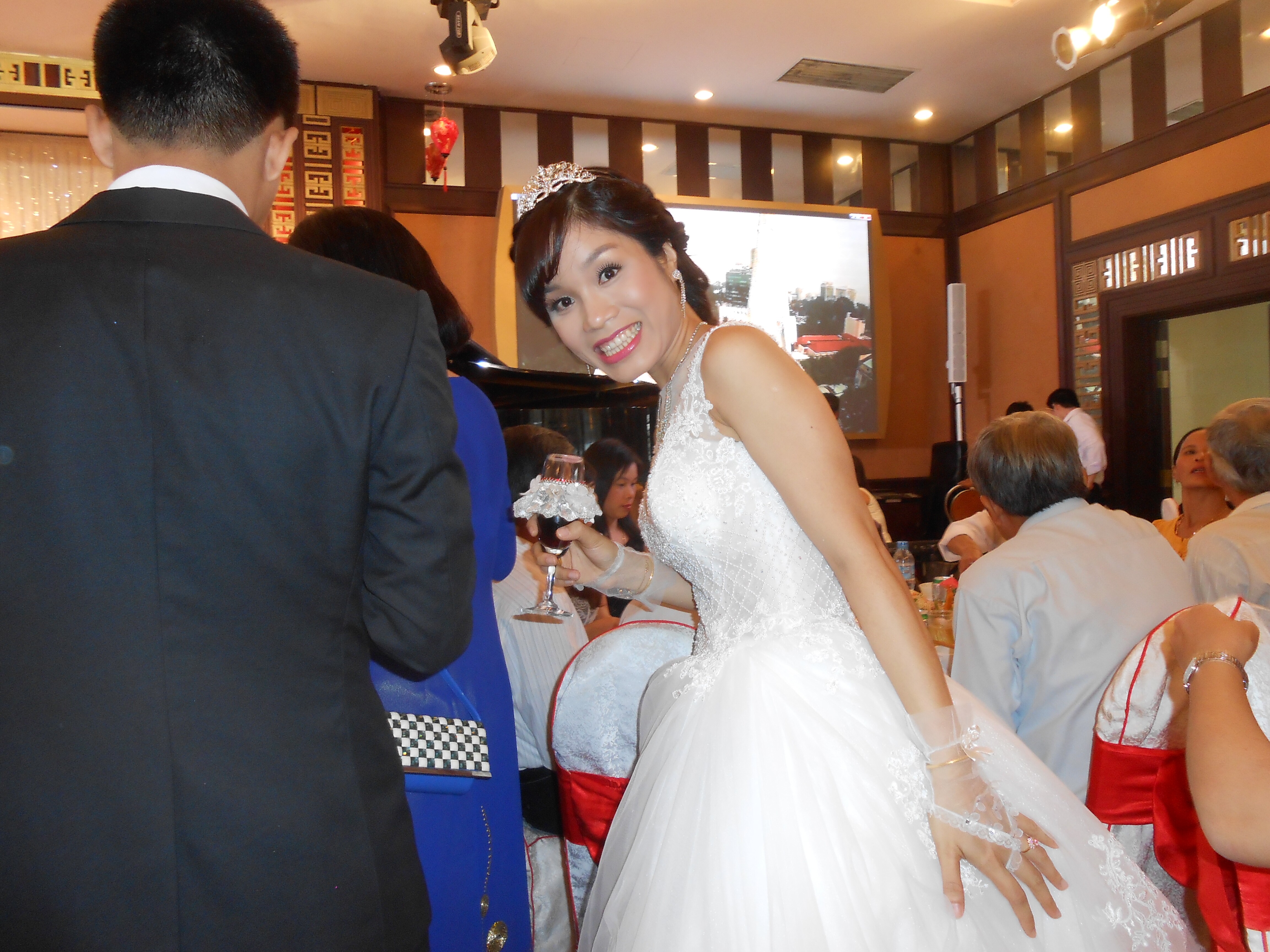
Vinh is from Hue and her family lives there so the first wedding (of three) was held there. Three solid days of ceremonies, family gatherings and meals after meals, all in extraordinary places. At one extreme was the wedding dinner, at least 7 courses served efficiently but unobtrusively to 800 guests seated at round tables in the Full House ballroom of the Century Hotel. At another extreme was the final breakfast before we got on the plane back to HCMH, which took place at a noodle shop under a tent out in the countryside, Quail eggs and pho.

I did not take photos of everything. Other people were on the job. Here are a few of mine. These are from the family lunch, at a restaurant overlooking the Perfume River. The little woman on the right is the grandmother of Vinh’s husband. When all the family was assembled, there were at least five grandmothers with similar hairdos, nice jewelry and very attractive garments including ao dais. This grandmother is in her 80s, likes to travel, travels alone around Southeast Asia going to pagodas while her husband, who doesn’t like to travel, stays home. She seems to be in perfect shape and is fearless.

long tableVinh's family

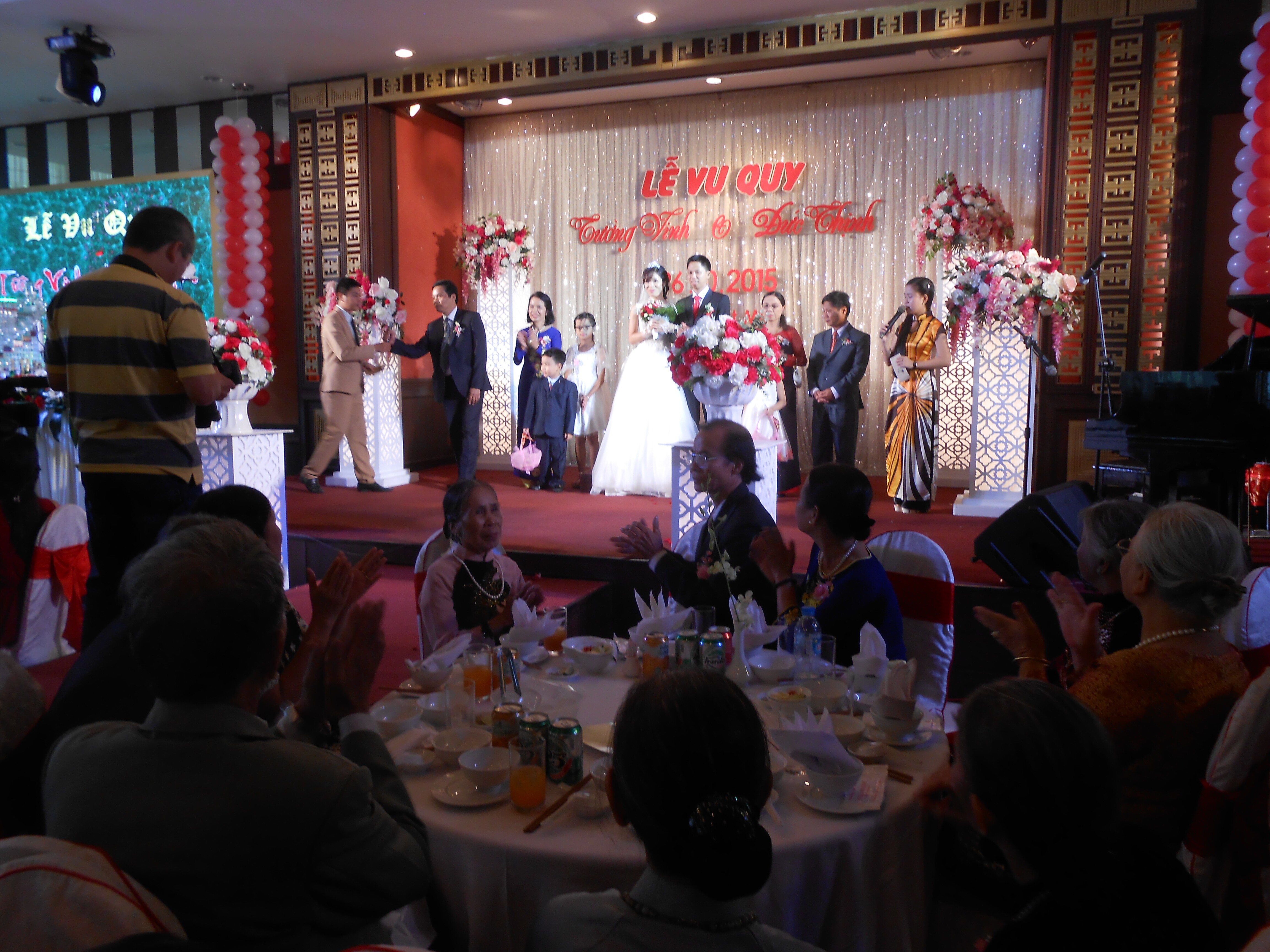
This is the major media moment, when the whole family is assembled onstage at the big banquet. There was entertainment throughout the meal — many singers, and a great clown show (see below)

Vinh et al on stage

The small thin quick clown is a lecturer at TDTU in environmental and labor health and safety. He performs magic all over Europe. THe tall husky slow-moving clown is his brother. The essence of their act is that each is trying to perform magic to impress the other; the other guy always figures out the trick, and reveals it. The audience loves it.

Clown magicians

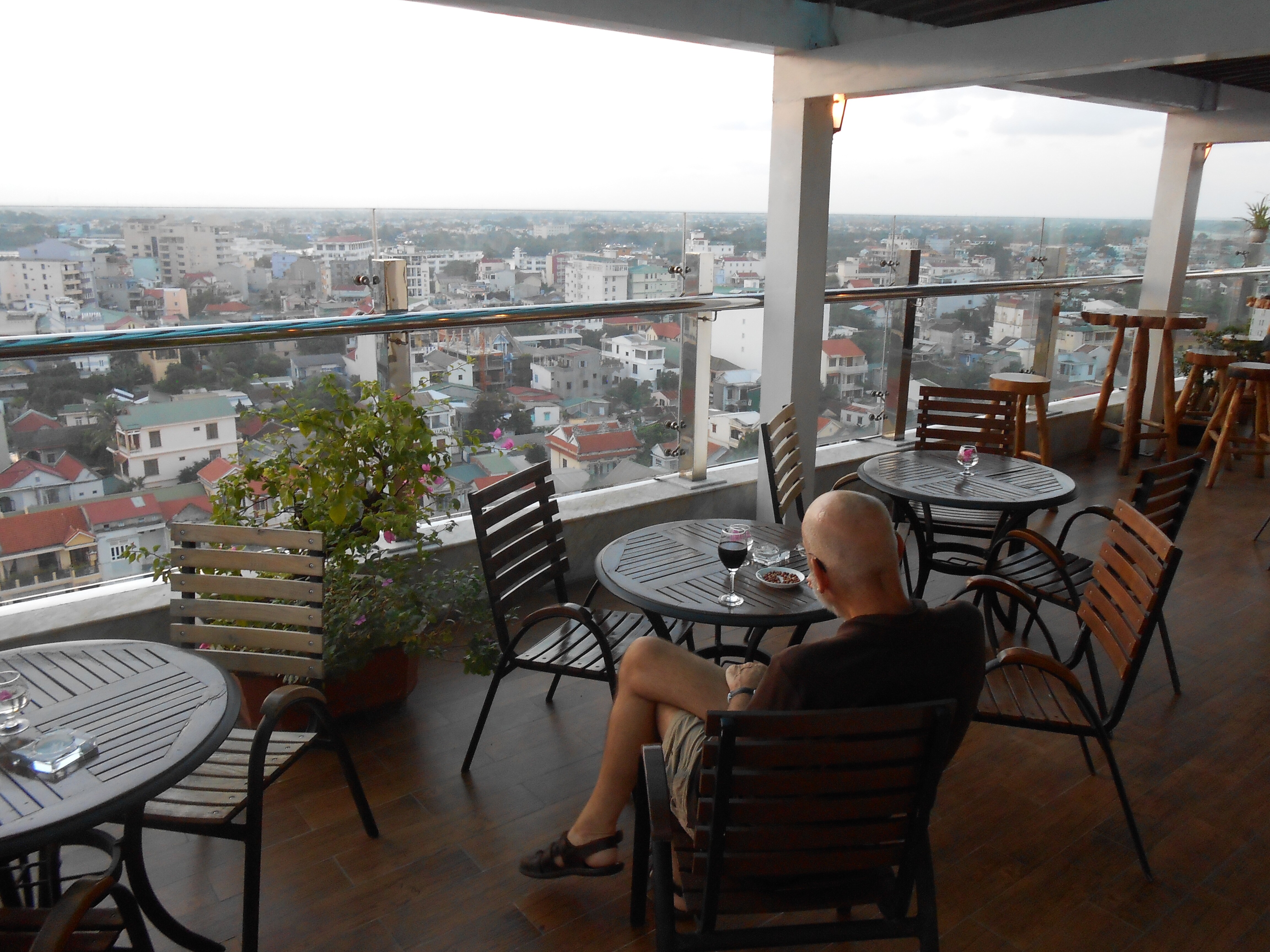
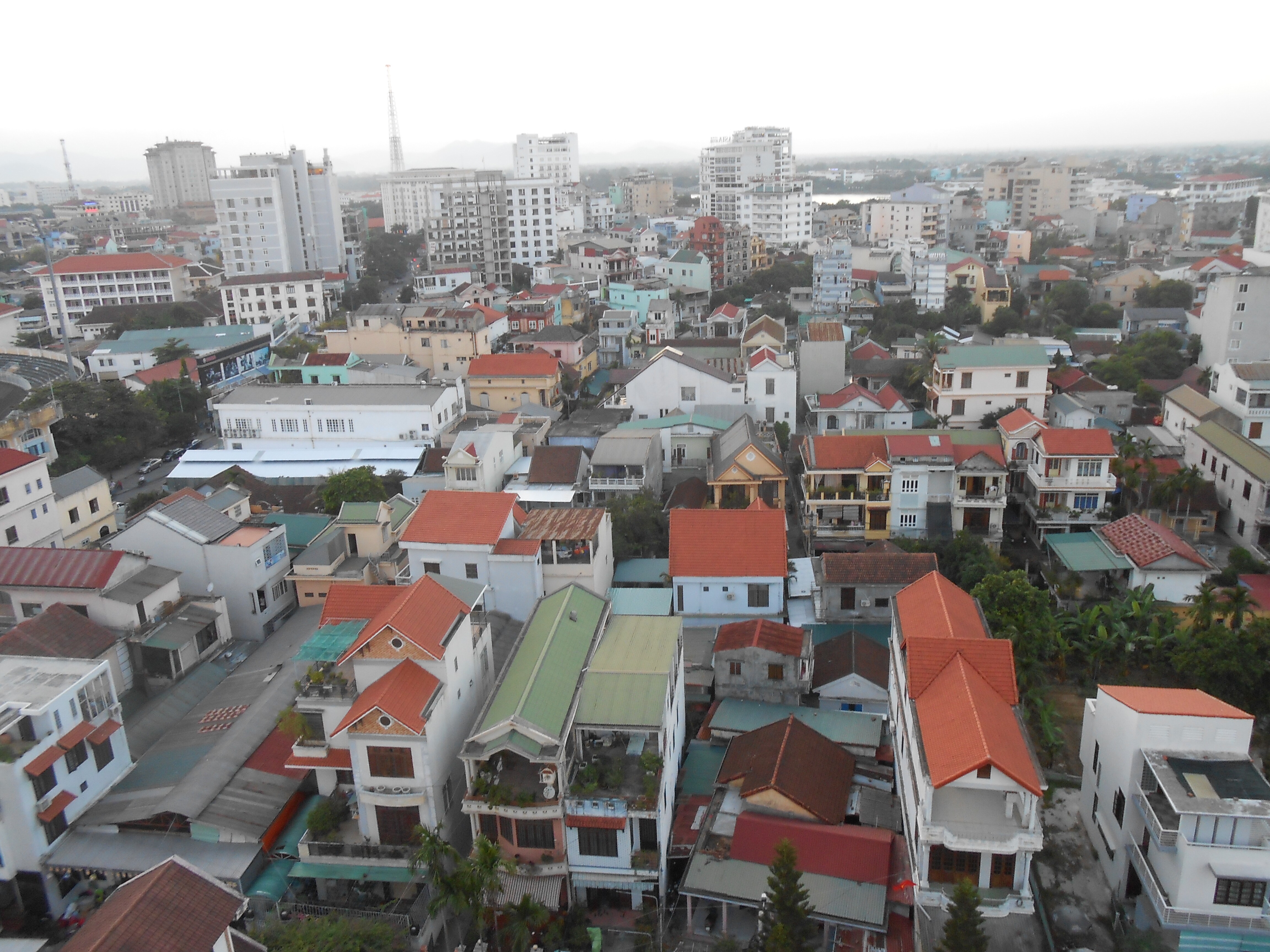
Joe and I took a quiet moment to sit on the deck on the 12th floor of our hotel, The Gold Hotel, and look out over Hue, toward the Perfume River.  Hue is in the middle of Vietnam, about 15 K from the sea. It is a city of one million with many colleges and universities. It is the cultural and historical heart of Vietnam and the seat of the old emperors.

Joe on deck

Hue City, Perfume River

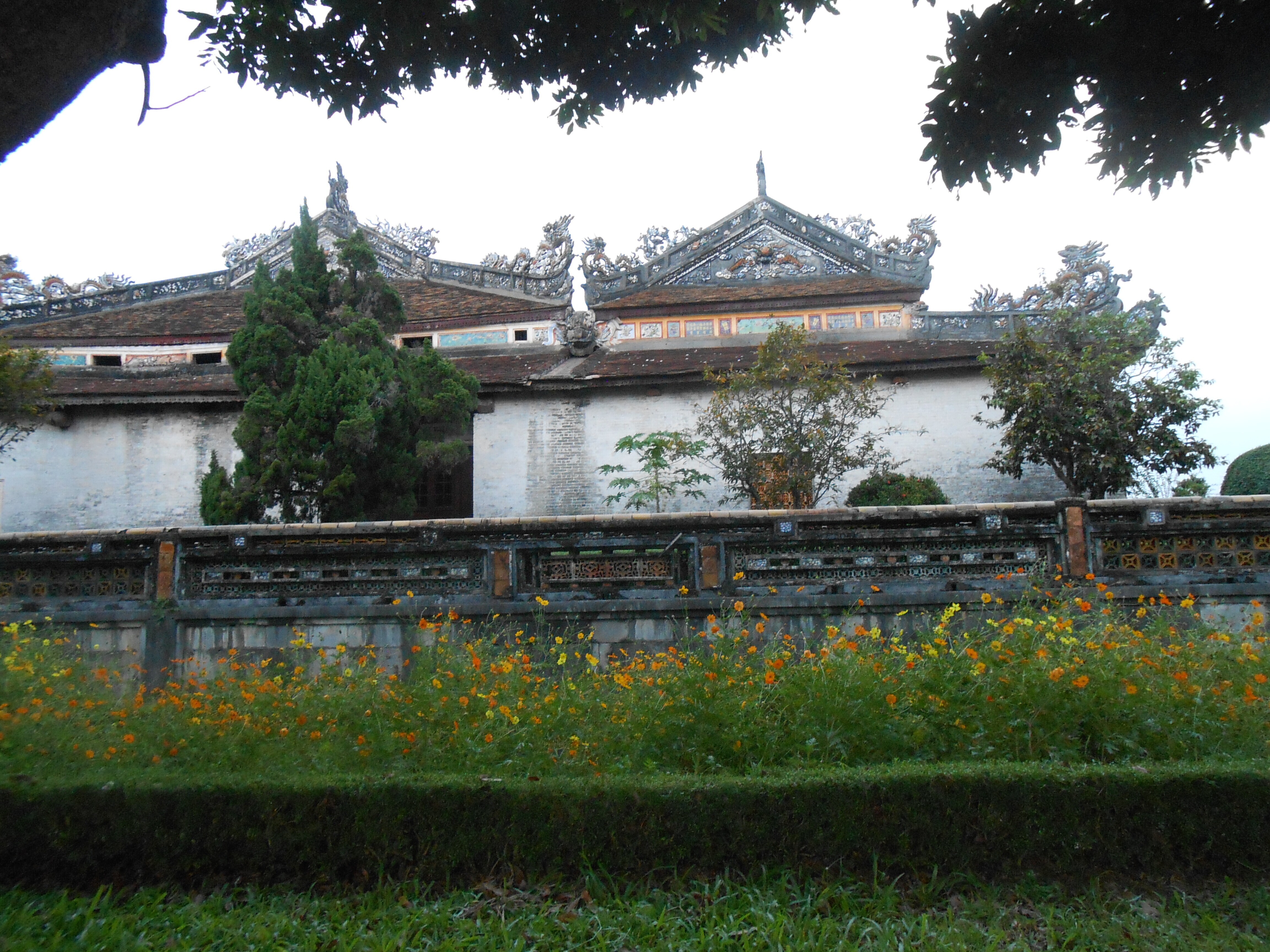
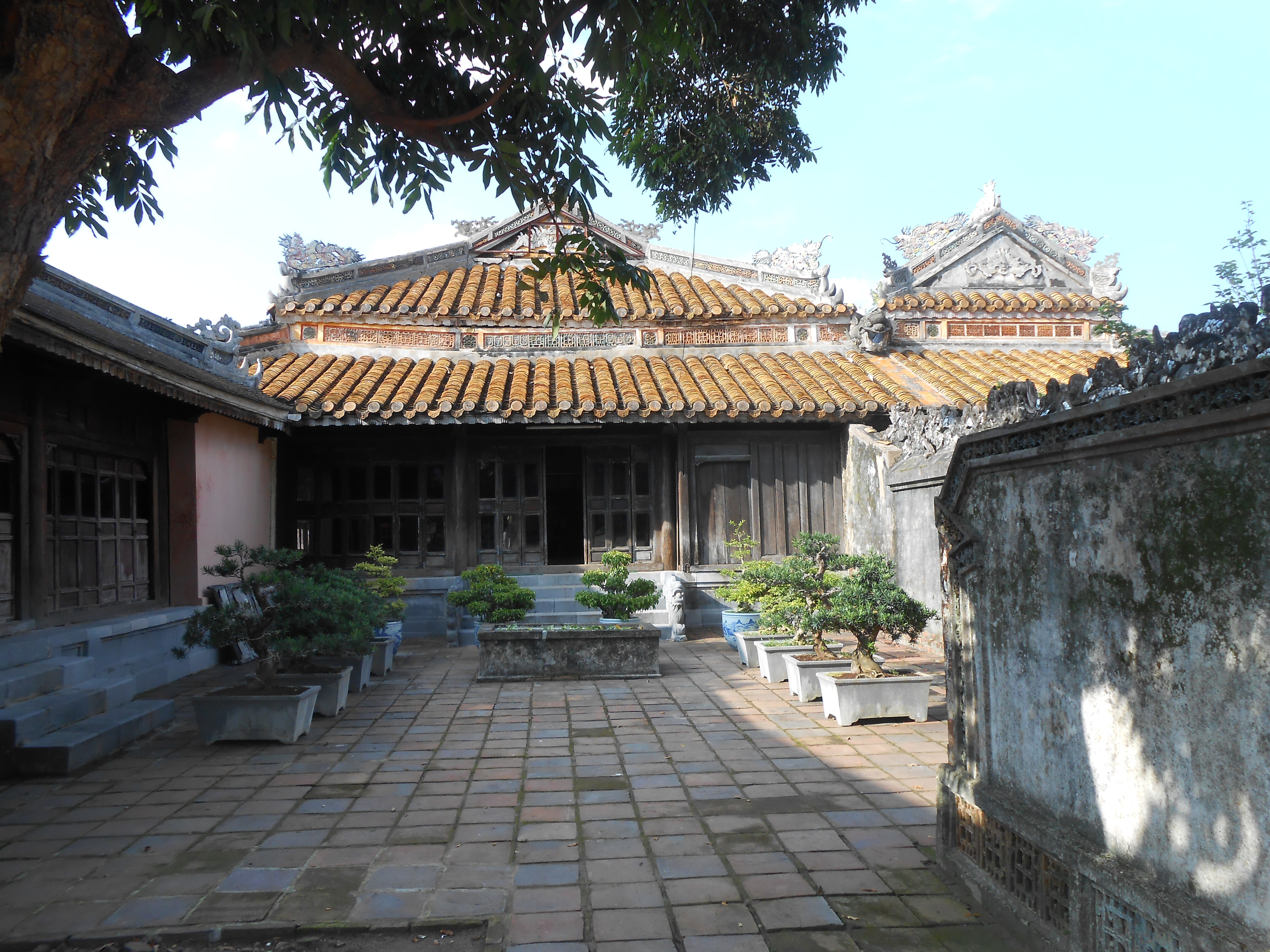
In the free moments between wedding events we went to The Citadel, which is the 3-mile square site of the forbidden city of the emperors. It’s surrounded by both a moat and a canal. Although its design is feudal, construction didn’t start until the early 1800s. Emperors lived there under the French, protecting their dynasty by making one concessionary deal after another with the French. In 1945, when the French supposedly left, the last emperor handed things over to Ho Chi Minh.

By the time of the American war, the inside of the Citadel was full of the houses of ordinary people. Only a small proportion of the population lived in the other side of the river. So much of the fighting happened in the Citadel. This was at Tet, 1968. Viet Cong came into the city dressed as peasants and ordinary people and brought arms on covered wagons that looked  as if they were going to the market. When the uprising started, they were in place.  People talk about the Tet massacre, and it looks from what I can see on the internet that were were about 2,500 – 3,000 people killed on both sides. Many in mass graves. Many of the buildings we saw — more than half — were war-damaged. The ones that had been renovated were amazing.

Ctadel_1tiny part of tomb

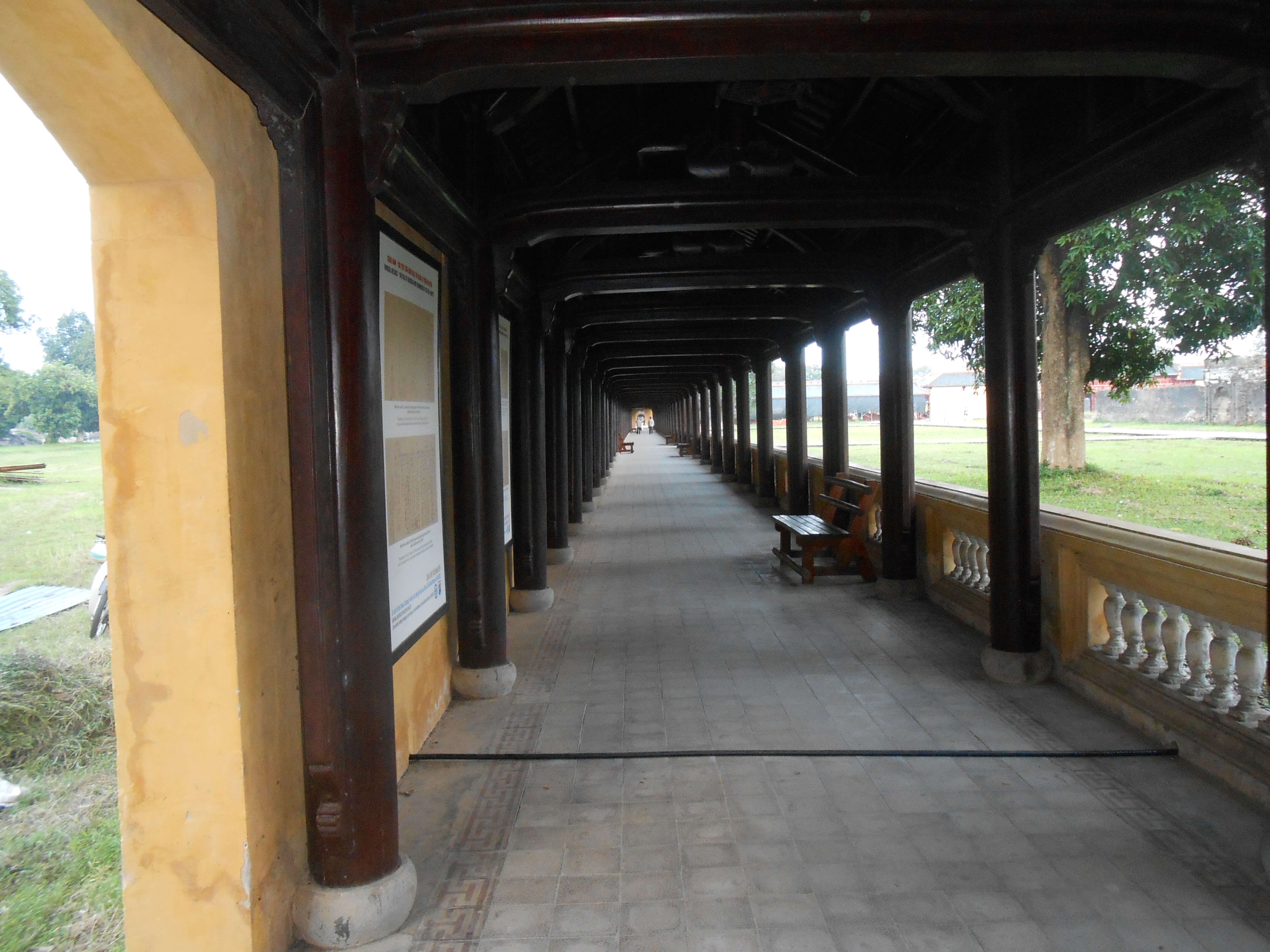
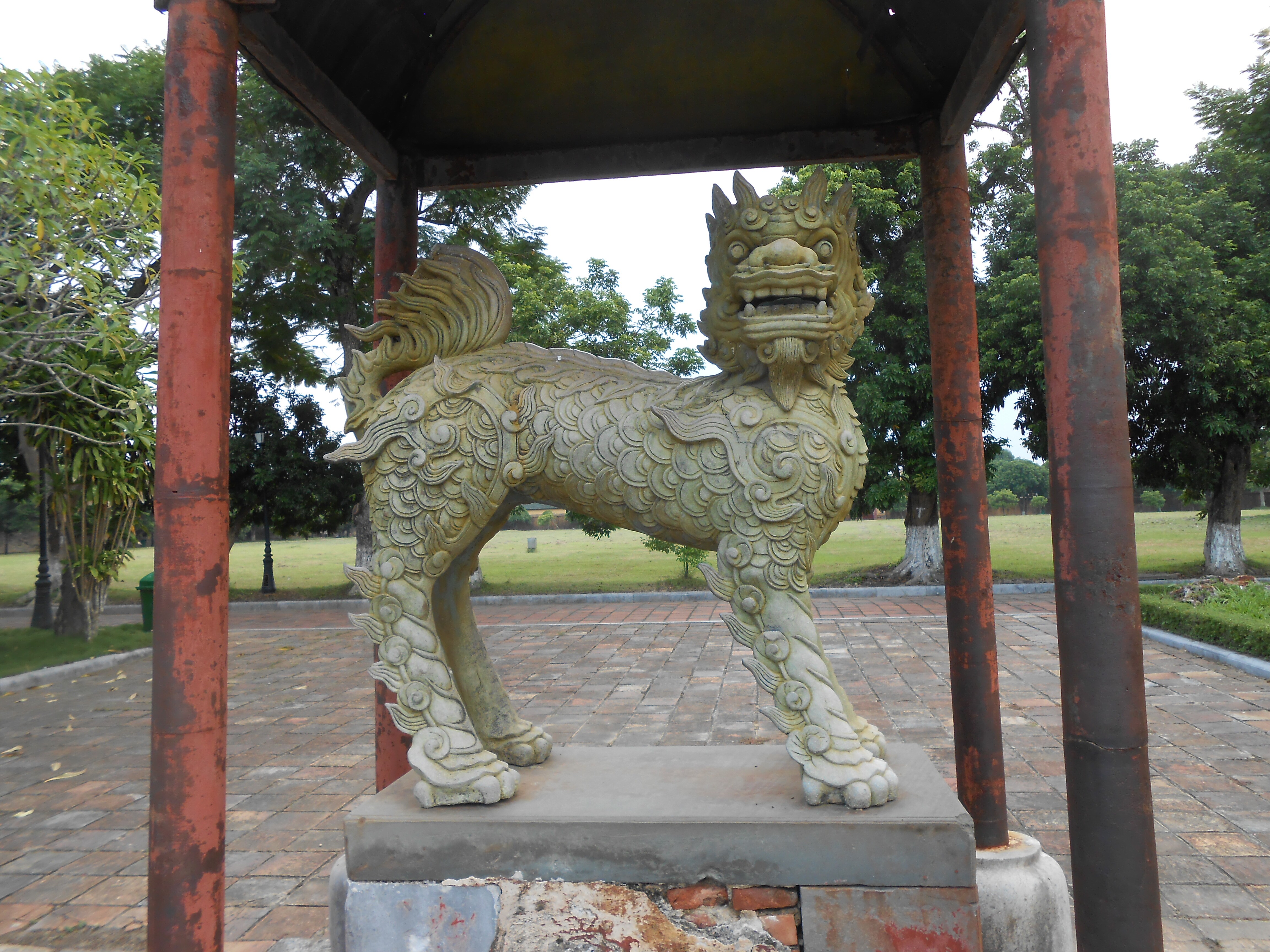
The site is huge These pictures just capture a tiny part of the space. Here’s a long loggia. The documents all along the wall are from the archives and show documents with the different kinds of signatures, comments, approvals or denials written by the Emperor of the time.  On the right, a bigger than life tiger-dog that Aunt Margaret would have liked.

Long arcadetiger dog

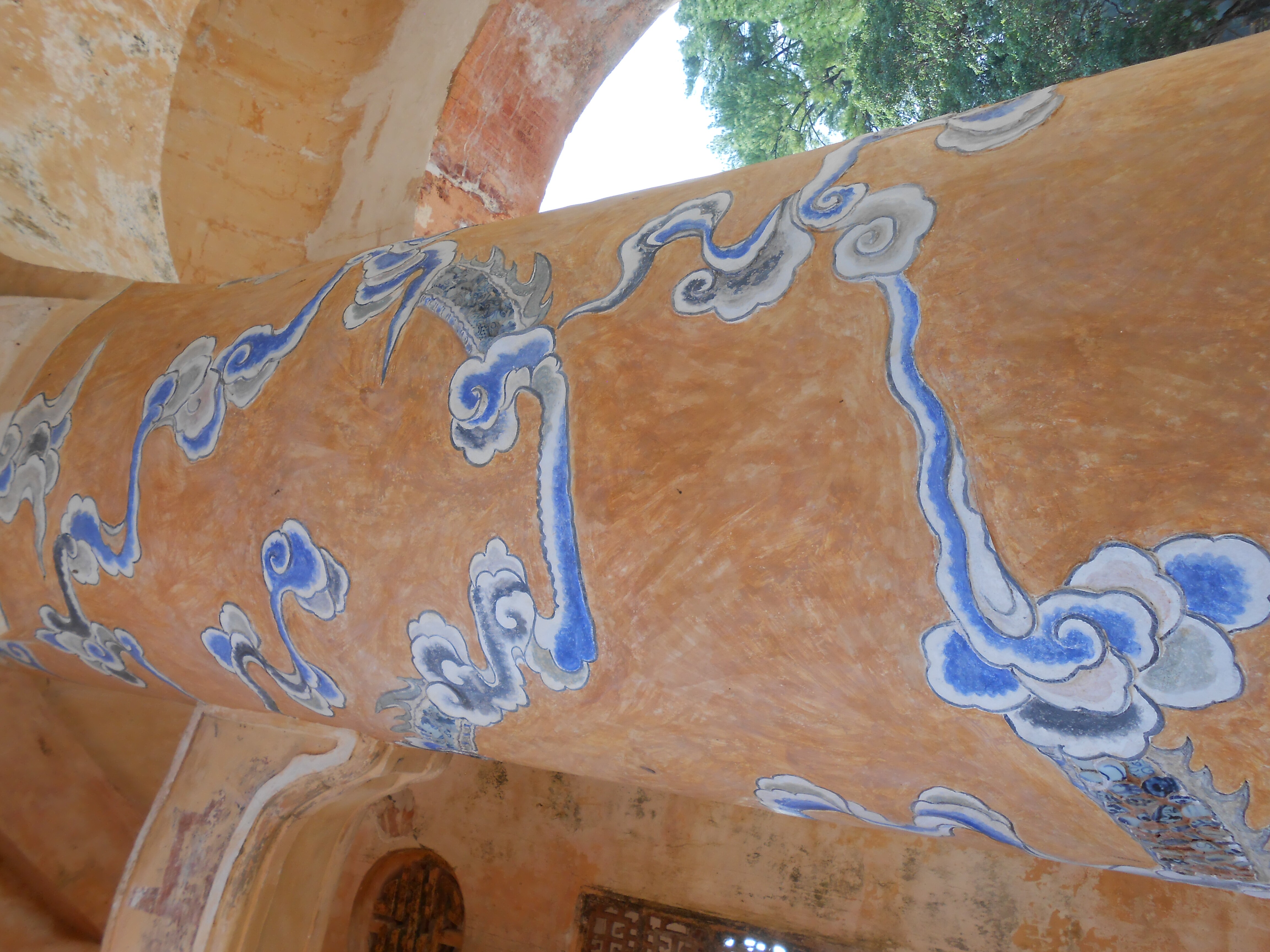
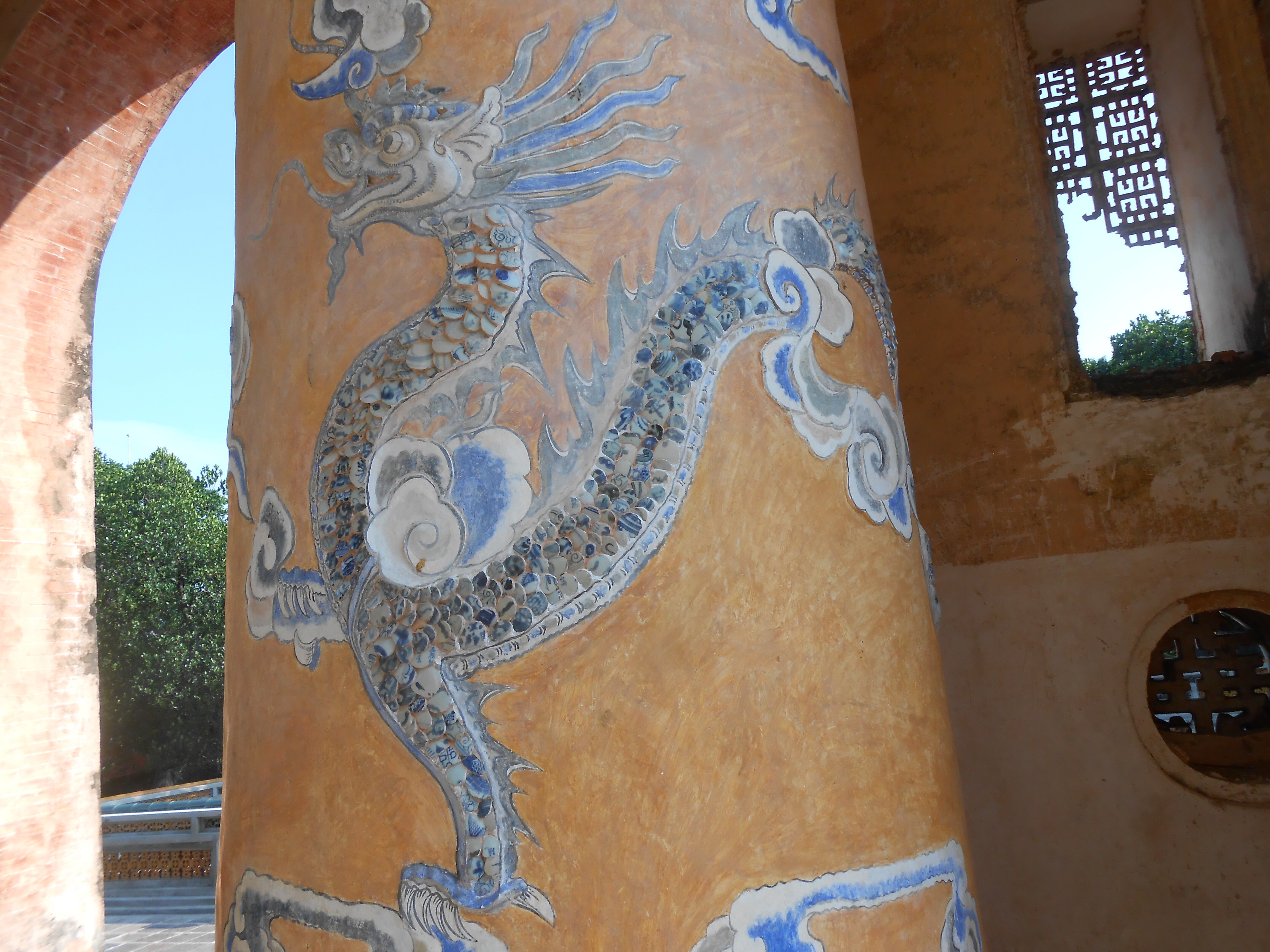
Painted clouds and flying dragons on the pillars and walls of the tomb of Le Duc, at his country palace, also a tomb. This is out among hills and has a lake with an island in it.

Renovation is taking place here as well as at the Citadel, and it’s being done by hand using tools and materials that aren’t much different from what was used to build the place the first time. All over both sites we saw people varnishing, sawing, smoothing down the joints between stones. Lots of women were doing this.

clouds dragon mosaic

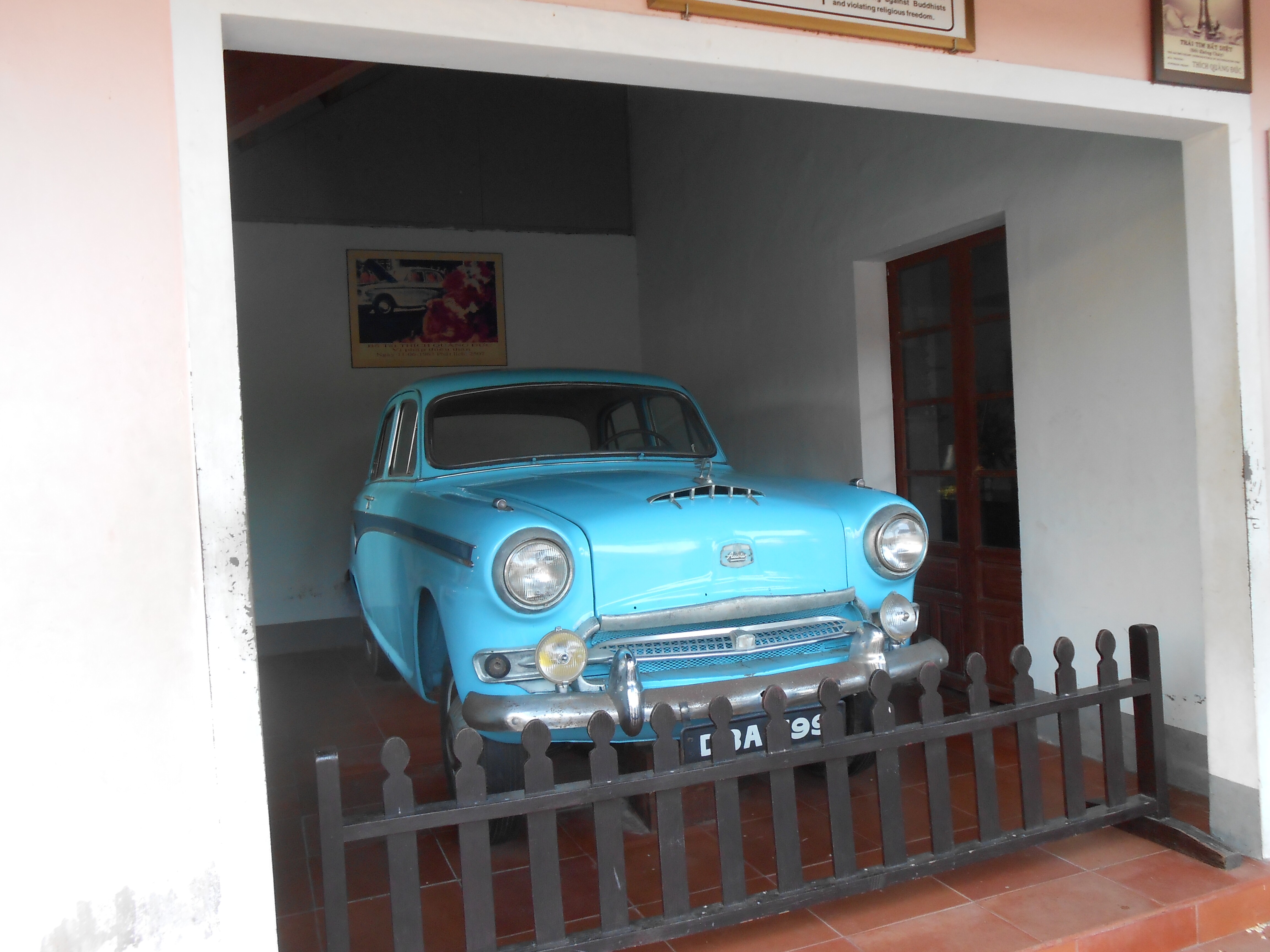
The burning monk, 1963

Immocation car  The car that drove him to that intersection is on display at Xa Loi Pagoda. The Pagoda is more than just one building with ceremonial spaces. It’s a whole monastery, with dormitories and many young monks in gray robes. It sits on a high bluff overlooking the Perfume River, nearly across from the Citadel.
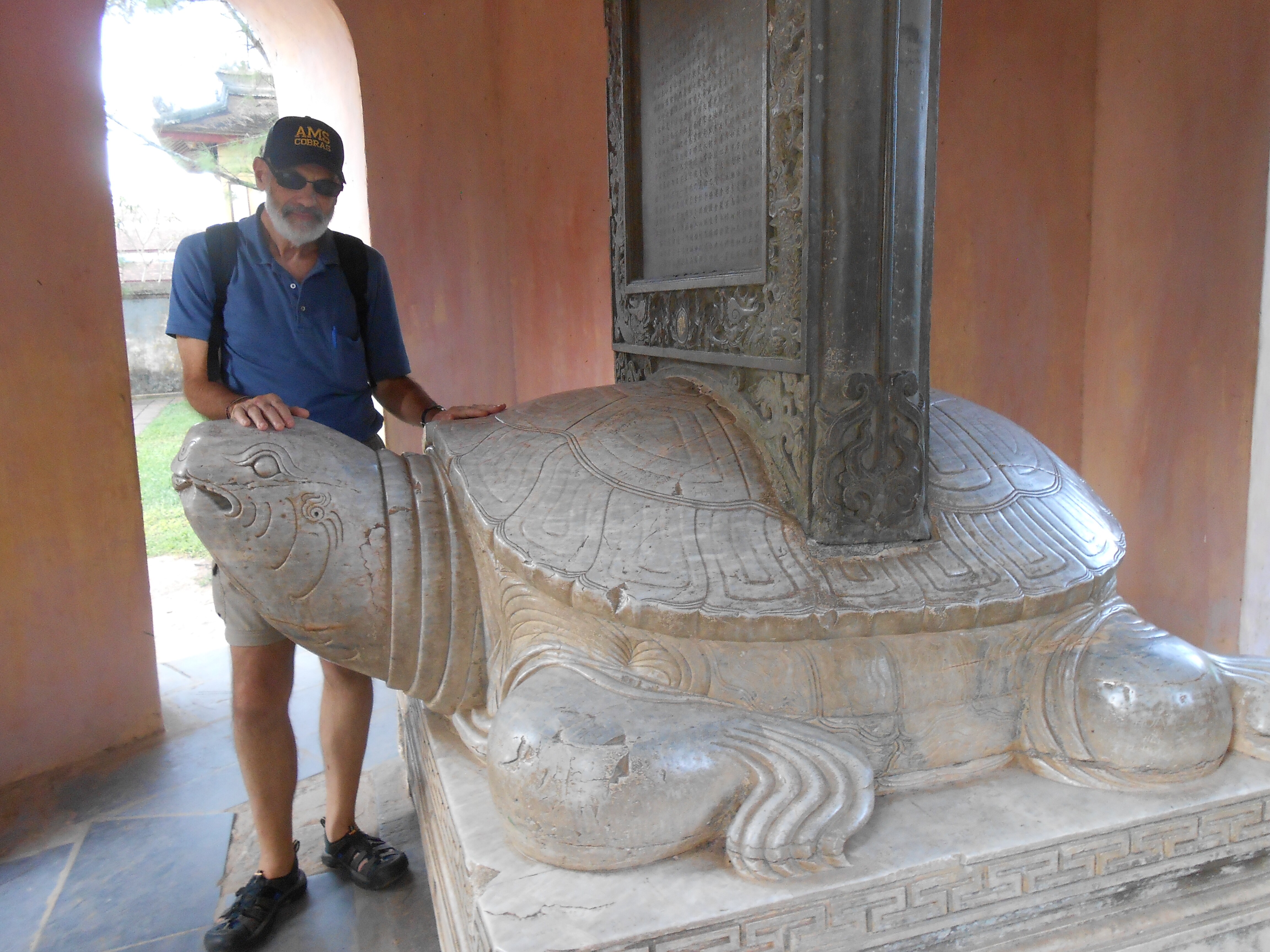
Turtle

This photograph of a turtle, also at the Pagoda, is dedicated to Terry Prachett. Somewhere in the place where imagination and reality meet, there is a turtle.

Teaching George Borjas’ Labor Economics; a real Vietnamese song  

We presented the first 17 of our 33 powerpoint slides on the Borjas book in a session yesterday afternoon with Dean Hoa, Miss La, Mr. Theit and Ms Pem, with Vinh translating. This book has been chosen to be part of the curriculum for the “Top 100” courses, a program at TDTU that is scheduled to be taught to students from Vietnam, Laos, Cambodia, and other ASEAN countries starting two years from now. The “Top 100” refers to a list of the top one hundred universities in the world, which TDTU aspires to join. I have also heard it called the “Top 26,” referring to universities in the ASEAN group. These courses will use books used in the top 100 universities in their programs. There will be some twenty or more courses in this program, and part of our assignment is to go through the books chosen for these courses one by one and help the teachers prepare. All the courses will be taught in English.

Borjas teaches at Harvard, in the Kennedy School, and this is the 6th edition of his book.

We decided that the way to provide a structure for teaching this book to Vietnamese and Southeast Asian trade unionists was to frame it three ways: First, to place Borjas’ book in the context of other approaches to labor economics, noting the difference between the approaches of neoclassical (free market, neoliberal) economists and political economists (radical, pro-worker, including Marxists).  Second, to talk about Borjas’ specialized use of ordinary words. These usages have to be defined because they do not mean what ordinary speech takes them to mean. This is invisible to non-native English speakers. Examples are “prefer”(as if people have a choice), “positive and normative,” “utility”, and the “labor-leisure bundle,” etc.. Third, to put Borjas’ actual words up on the screen, so that students can get a taste of his ideas as he expressed them and have at least some of the experience of having read the book.
We were working from a pdf of the book. Students will not have actual paper copies of the book.

Borjas is a straight up neoclassical free-market economist. To him, economics begins and ends with the market, with what price something can bring on the market. Everything can be and should be for sale. He understands workers as trying to sell labor at the highest price, and “firms” to try to buy labor at the lowest possible price. He is clear that this means they are motivated differently. He doesn’t actually use the words class conflict, much less class struggle. This is not because he thinks the class struggle is over. It’s because he doesn’t think in terms of class. To him, workers are not a class, they are individuals. If workers were to organize into unions and act like a class, that would be a market distortion. In his chapter on labor, he argues that the union wage effect (union wages are higher) is about the same as the effect that you get by licensing a profession.

Ironically, Vietnam’s socialism took workers and employers to be on the same side, both motivated by the desire to develop and protect their country. Class conflict had been resolved. Two generations after the reunification, this idea still holds. This is how it’s possible that a firm’s HR professional can simultaneously be the union president – unions and firms harmonize together and solve problems together.

Which means that when capitalist firms come in to hire Vietnamese workers, expecting to pay nearly the lowest wages in the world, the current generations of Vietnamese workers since 1975 do not have a history or a set of relationships – at least not a formal, public one – ready to fight back. Yes, they have a union, the VGCL,but it mainly represents the interests of workers to the government.  Problem-solving at the local level is done through mediation, which they are trying to develop and expand, but it has the goal of harmonizing labor and capital, not fighting back.

Borjas legitimizes this situation with charts, graphs, and equations using Greek letters, and enshrines it in the glow of the Harvard name. To make his book useful, rather than stupefying, to Vietnamese trade unionists who may be in a position to actually move things forward, it has to be accompanied by the tools with which to critique and contextualize it and some clarity about who profits from spreading its agenda.

Discussions during and following our presentation of the Borjas’ material were lively. Our attempts to frame the book were understood as criticism. We did not get past more than 17 of the slides.

Later, I asked Dean Hoa if he had noticed that the textbook comes with a weblink that gives you access to a lot of teacher resources, including a set of powerpoint slides.

We went to Miss La’s class on labor law. She had a beautiful basket of flowers for me, in honor of Women’s Day. Then a young man sang a song. It was the most beautiful piece of Vietnamese music that I’ve ever heard. It was long and emotional and of course a capella. I wouldn’t call it operatic, although it was complex. His voice moved up and down into a falsetto at times. I was amazed. It seemed to have a pattern, but it wasn’t just a repetition of verses. This is nothing like either the traditional music we heard up at Na Trang, in the coffee shop. Nor is it anything like the music that gets blasted at 7 am in the soccer stadium, which ranges from movie soundtrack orchestral stuff to rap. This was completely different, complex, beautiful and gripping to listen to.

Then the boy went back to his desk and laid his head down for the rest of the period.

Happy Birthday! I’m 27

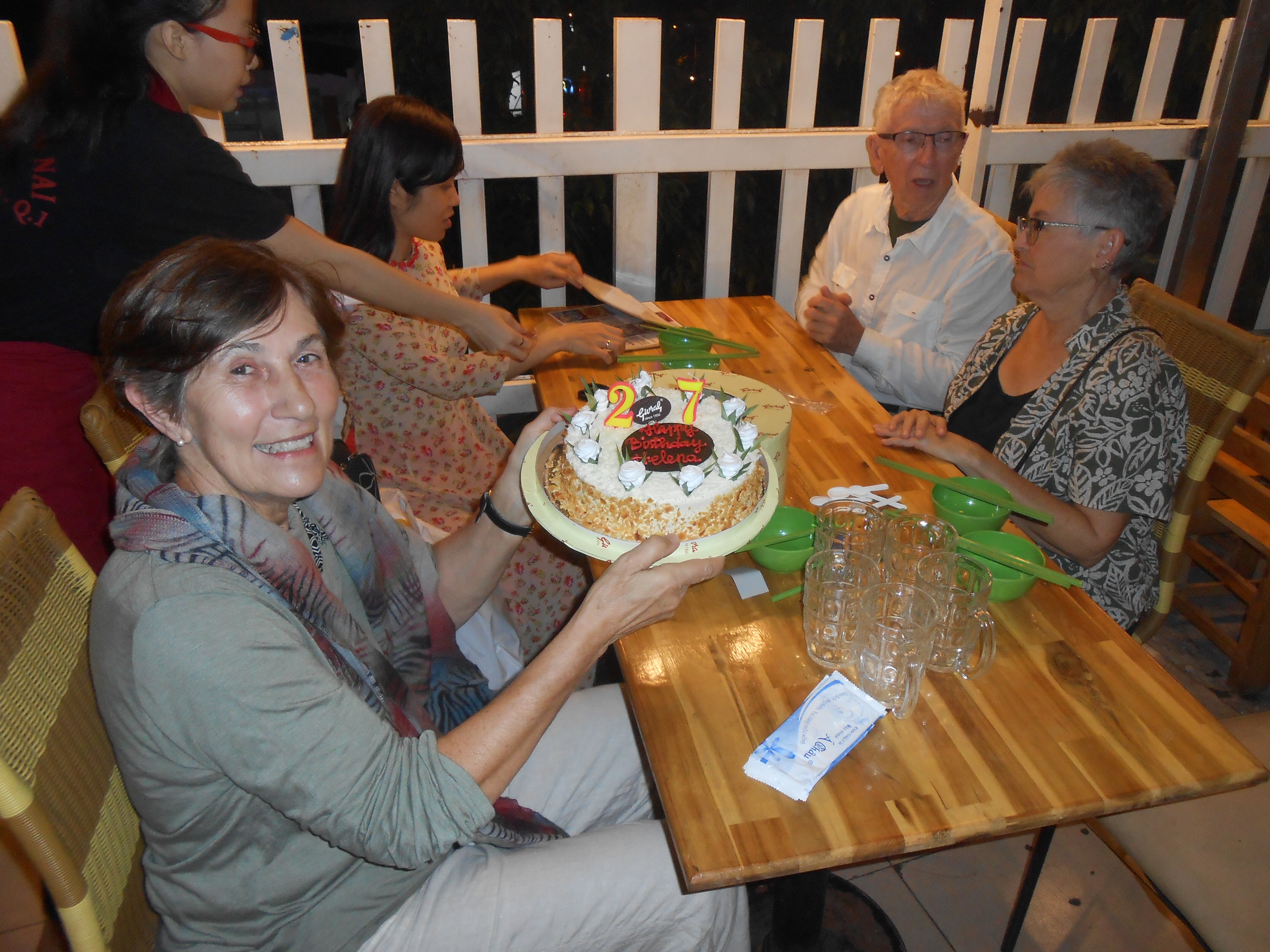
me and cake,

Hollis, Leanna and Joe and I cabbed into District 1, followed (or led) by Vinh on her motorbike.  In case I haven’t explained this before, she  is a very pretty young woman at all times, but when she gears up with a face-covering mask, safety glasses, long-sleeved cotton jacket, big gloves and one of those semi-blanket type velcro-closing aprons that cover your business clothes from your waist down to your toes, she is quite a spectacle. The way you can pick her out in the crowd of bikes is that she the one sitting up ramrod straight, as if she’s playing the piano. This is in spite of also carrying my birthday cake in a big box (see above).

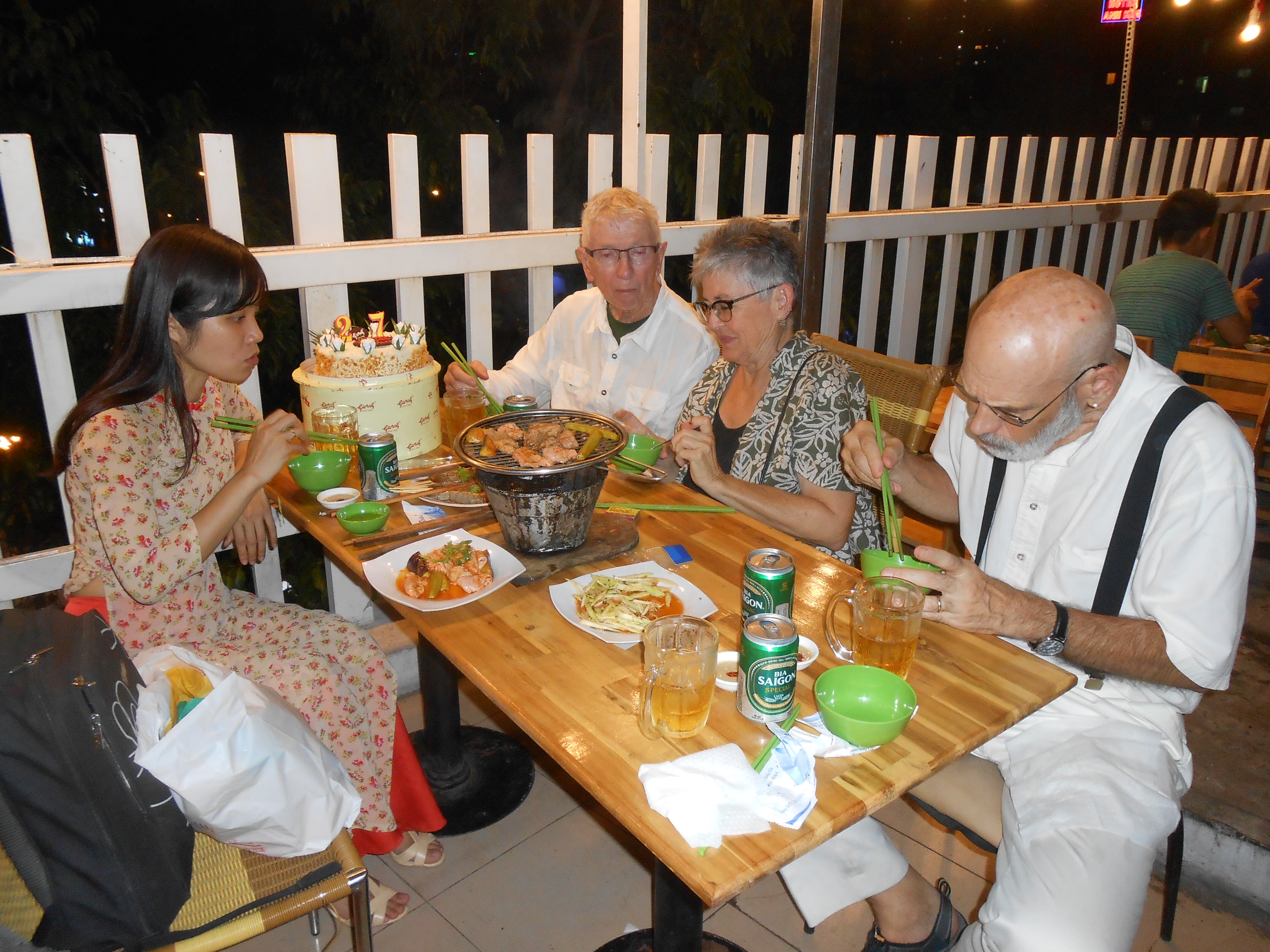
She took us through seas of traffic to a building we did not recognize as a likely place to have a birthday dinner for me: The Yummy Tutti Frutti shop on a street corner somewhere. However, there were six floors to the building, with different things on each floor (a yoga studio, for example, with moms and babies sprawled all over) and we climbed up to the very top where, overlooking the city but above the traffic fumes, we ate barbecue.

Serious eating

That’s the stove, in the middle of the table, and cooking on it are huge shrimp, okra, eggplant, beans, zuccihini, and something that comes from “inside the pig”.

There was also a great deal of serious conversation on topics of common interest, including the differences between being a Communist in Vietnam and a Communist in the US, with some historical context thrown in.

It was a great party. I miss Gabi and Jake but I got phone calls and videos from them that made me feel good.

Exams graded

I’ve finished the exam grading for the Cross-Cultural Leadership class and will put them on Mr. Hieu’s desk this morning.

I graded them on a rubric like this:

2 points if they actually identified three things that they learned and talked about them.

2 points if they showed that they had done the readings and were present in the class. Many people lost points on this. Some of them only wrote as much as they could have found from the syllabus.They may have been in the class, but they were talking or looking at their cell phones.

2 points if they wrote in their own language and I could understand it. One paper attempted to express some very abstract ideas (which is good) but his/her language just wasn’t up to it, and I couldn’t tell what he/she was saying. I had to take off a point for that.

2 points for reflections on how they learned. Many people wrote about what they did — read the assignments, looked on the internet — but only a few talked about how that resulted in learning. I actually think that most of the points for this one came from people commenting on their experience in the scenarios. The people who mentioned them seemed to really understand what was going on. They spoke about participating in the scenarios and how they developed confidence.

2 points if they talked about what they needed to learn in the future. This was usually related to career (international business, a specific country like Japan or Korea, or the hotel industry where they would probably be interacting with guests or sub-contractors). However, there was a little bit of sheer curiosity about other cultures.

There were 12 papers that got 10’s.

9 got 9’s

14 got 8’s

8 got 7’s

4 got 6’s

4 got 5’s

2 got 4’s

1 got 2 points

I did not get papers from two students.

I was curious to see if the grades corresponded to teams. The students with the worst grades did seem to be on the same team, and there were four teams where two people had 10s.

During the two days running up to the due date for the exam, I got over 60 visitors to my blog. One of the students posted my blog website to the rest of the class.

The Fence, and How to Get Over It In Certain Places

Last May when Richard Fincher came though Berkeley while attending a conference of arbitrators in San Francisco, we had dinner and he talked about what teaching in Vietnam was like. I can check that blog posting and confirm what he said.

I remember him saying that he taught classes of 75 or more, that the students were all seated elbow to elbow on benches, that the benches could not be moved around to enable students to work in groups, that you use a microphone to talk to the back of the room, and that Vinh does sequential translation. The classes are taught on a once-a-week basis in 2.5 hour sessions, even social sciences classes that require discussion and thinking in between teaching points. He didn’t write the exam his students took, didn’t know what was on it, didn’t grade it and didn’t know how the students did. He mentioned that the boys sit in the back and talk, and don’t participate unless you make them.

So we were warned.

A lot of this is still basically true for us, too. I am calling this, and various other elements of the educational system here, “the fence.” Another piece of the fence: we can’t communicate with students directly. They have email addresses with the domain tdtu.edu and our gmail emails won’t connect with them. So we go through Vinh, who has the email addresses for Joe’s classes and my class, and her classes. For my Cross Cultural Leadership class, I communicated through Nhu, the class monitor.

Can the students learn under these conditions?

I think they can. I would say that students somehow figure out how to learn in spite of the fence. They learn over the fence, or through the fence, or around the fence. Again and again when I meet the students and talk with them, to the extent that I can – and many of them can speak sufficient English, if you listen patiently – I find that they are ahead of me. They see the fence, can comment on it, are critical of it, and manage to learn in spite of it.

Some things have changed since Richard’s experience. For our Community Mobilization and Leadership classes in the Labor Relations and Trade Unions Faculty we more or less wrote our own exams, with modifications by others (Vinh and Dean Hoa). I was allowed complete freedom to write a final exam for my special short course, Cross-Cultural Leadership, taught in the International Business Program faculty. It consisted of one question, “What did you learn in this class?” And I am grading it myself. I have read half of the exams by now and am going to treat this experiment as a success. I can read these exams and they do in fact tell me what they learned. They definitely learned something. In fact, I could not have written a multiple choice exam that would have collected better information about whether they learned anything. Plus, the exams are easy to read and have some personal information in them.

(A note written a month later, in November: Vinh graded all the exams for my Art of Leadership and Joe’s Community Mobilization classes. It turns out that we cannot find out how our students did. We may be able to get a general overview of how they did, but nothing specific for a given student.)

I will write a separate post about the progress in the student reports for the Art of Leadership class (group research reports looking at workplaces, especially youth employment) that are now in their second round of presentations. The presentation are taking too much time relative to the value of the points toward their grade, so this is sending a mixed message to the students. On the one hand, they put a lot of work into these research projects!! On the other hand, the whole project only counts a small percent of their grade. We will have to find out how to compensate for that. However, we are getting great information from them. Will the students benefit from this information? We have to make sure they do.

And now here is another example of getting over the fence.

This afternoon, Wednesday the 21, we went to the English Zone. Leanna and Hollis came too, and went off to join different groups. I sat with Tom (Tuan), Ngoc, Heiu, one more whose name I can’t write down, and another girl named Ngoc. One of the girls had lived for 2 years in Los Angeles and had an awful time – it was seventh grade and apparently a whole gang of kids decided to make life miserable for her.

Her story is another story that I can’t report fully in my blog. I would say that by now, I’ve got five or six stories that I can’t write about. I’m not just talking about the English zone students. I’m talking about other Vietnamese we have met in other situations who have told us their life stories, including the stories of their parents, and I cannot write about them.

There is a link here. The link is politics. I believe that the reason I can’t write about these stories is the same reason there is so little talk about politics.

We keep wondering why there is no talk about politics – not bulletin boards posting about meetings, no political clubs, no T-shirts promoting campaigns, no public debates about current issues, no movies about Vietnam in the last 40 years, or even 60 years. Instead, talent shows and food competitions. I’m starting to understand. Here’s a generalization about why that is the case at TDTU.

The students here all have parents who had extremely divergent experiences during and after the American war. Many people here in the South worked for the French or for the Americans. If we’re talking about the grandparents of these kids, we’re talking about working for the French. If we’re talking about parents and some grandparents, we’re talking about working for the Americans. That means they experienced profound changes in their life trajectory after the French left – in 1945 or really 1955- or, in the next generation, after the Americans left, in 1975. Then there are people whose parents were on the other side in the war, supporting the National Liberation Front and the PRG, the Provisional Revolutionary Government.

Then there are people who actually came south from the North after the war (meaning the American war), in many cases, to re-unify with their families. These were people who had relocated to the north in 1954 after the Geneva Accords, for what they expected would be a short time, since they were promised an election that would re-unify the country within the next 24 months. The elections never happened, and it was 20 years before they could return. By then they had kids, too. According to Madame Binh (who was one of these people), for example, a wave of teachers came south after the war to staff the schools that were being built all over the place.

The people who are alive today, and their children and grandchildren, are the survivors of a half-century of war that killed 3.8 million (or 5% of the population) between 1955 and 2002 (according to wikipedia, Vietnam war casualties).  They were fighting the French and the Americans, but they were also fighting each other. The sharply different experiences of this generation’s parents and families are still undigested, un-normalized, un-reconciled and raw. There may have been some kind of effort at a public national reconciliation movement, like in South Africa, but I have not heard about it. (Not that it was the total fix in South Africa, either. And we haven’t exactly done a fix on our Civil War, either.) The re-education camps clearly did not serve this purpose.

So the way this raw memory has been handled is that political speech has been simply suppressed, both officially and by culture and custom. Students tell us that they study Vietnamese history from 500 years ago, but nothing in the last 50 years. That makes sense. Recent history here, like in the United States can be a way to open wounds that are not yet healed and may never be healed, not within the lifetime of people who were hurt, winners or losers. Joe tried to teach a class at CCSF on the Vietnam War and got shut down right away – and that was in the US!

But today, sitting with five or six students, we started innocently enough with talk about who speaks what languages. Soon we were talking about what language their parents speak. Three of them speak Russian. Russian?? This is the first time anyone has mentioned Russian, at least in this group.

But sure enough. One has a father who went to study in Russia. Two have fathers who speak Russian. One has a grandmother who speaks Russian. She studied in Russia. She doesn’t speak it any more. Now she rides her bicycle all over Ho Chi Minh City and organizes groups to sing old songs. But she also speaks Chinese and French. One has a mother who used to speak Russian. Someone else has a father who speaks Russian.

Do they speak Russian now? No. Do they want their kids to learn Russian? No. They want their kids to learn English.

This is good luck for me. Thirty years ago, my English would have had no value at all. Today, I can come to Vietnam and just because I speak English, I have value. I am useful to these kids. But maybe I can also be useful by giving them a little research assignment. Here is the question: Why isn’t Russian the language of choice any more? What happened?

So we actually assigned this as question to be investigated by the kids in the English zone (and yes, at a certain point I am going to stop calling them kids). We said, “For next week, go and find out what happened to make English the language of the market, not Russian. Why do your parents speak Russian, but now they want you to speak English. What happened?”

Some blank looks. I give them a hint – “Try 1989, 1990. What happened in 1989, 1990?” One of them writes it down.

They don’t know. But they accept the assignment.

Tune in next Wednesday.