Military training, other celebrations

Military training starts at 7 am in the soccer stadium behind our room, sometimes accompanied by orchestral music or commands played on a powerful loudspeaker. New students are inducted into the military right away, issued camo uniforms. After a few days they of mass training they break into groups of 20 or 30 that line up along the road around the stadium, including right in front of our room, and practice marching. One of them calls out one-two, one-two in Vietnamese while the others learn to swing their arms and step out. We’ve seen them bandaging each other and practicing with rifles and AK-47s that look fairly real.

This morning while I ate my pho on the terrace of the canteen I looked out at a group that was stalking step by step through hypothetical trees and bushes, then crawling back on their stomachs, sliding their rifles along beside them. Girls and boys in the same group.

Some catch-up: We went to the Ho Chi Minh memorial museum on Sunday with Thi. It’s a classic two-story building with verandas all the way around, next to the Saigon River and overlooking an extensive manicured garden and park. The breeze off the river comes in through open doors and cools off the inside. All the exhibits are on the upper floor. It’s photos and documents all the way, so it’s like reading a biography of him. Many documents are in French, such as the report on his activities in France by the French secret service agent who was assigned to watch him. It’s thorough and single minded: this is the story of this person. You are immersed in typewritten reports of meetings; requests for money; cloudy photos of groups of people, mostly men, with Russian, French, Chinese, African names; handwritten lists of people who are in prison and scheduled to be executed (including Ho Chi Minh); rooms in different countries where he stayed and worked. Each room has a map up high with red light bulbs that mark places Ho Chi Minh travelled. All over Europe and Asia; even the US. This is a story that goes from the 1890’s to today.

The rooms were quiet and mostly empty except for us and a few other older people. Thi said that the older men who were making their way one-by-one through the exhibition rooms were all speaking languages other than Vietnamese. They looked Asian, however.

Dean Hoa tells us that he’s looking for academics from the US who would work with TDTU for 2 months a year here in Vietnam and then consult with their program the rest of the year, and cooperate with them on research projects. This is part of the President’s goal of bringing TDTU into the ranks of the top 100 universities in the world, including starting a new curriculum for international students which would be taught entirely in English.

The job would include writing or helping people write research that would get published in ranked journals. “Ranked” refers to the journals that get many citations in other journals. We have asked Dean Hoa to write up this announcement with specifics including pay, status, duties, deadlines, etc so that I can put it out on the UALE or LERA lists. There should be a number of people who would be interested in doing this, although no one can guarantee what gets published where, and the ranking system is iffy to say the least.

I wrote my 40 multiple choice questions for the Cross Cultural Leadership class (20 for each version of the exam) and sent them over to Hiew who will put them in the correct format. The class really ran away with the assignment last week: they made up their own scenarios to demonstrate cross cultural encounters. Lots of laughter.

Three days of major celebrations this week. First, Founder’s Day: Praying at the gold statue of Ton Duc Thang, followed by a celebration (songs, dances, a terrific karate-kickboxing demo, speeches) in the giant auditorium in Building A. In the front row sat the President, who gave an extended speech, and one person away from him was Mr. Tung, the head of the VGCL, a handsome man with a gray buzz cut in a brown suit.

Then today we attended the graduation in the same auditorium. This was for the students who completed their studies last spring. More songs and dances (girls in blue, white or red ao dais, boys in white with sparkles on their collars; the dances involve lifts and silk scarves). Then every single graduating student came on stage, hundreds and hundreds of them, had their name read, walked up to a red-swagged podium, shook hands with the president or appropriate dean, received a medal (some), plus diploma and some other framed item, plus a bouquet of flowers. Then a pause while the photographer shoots the student and the administrator. We left after about 3 hours; other people had left as well. Dean Hoa was still waiting for his students to come up.

A sense that the event becomes real when it’s photographed. No other evidence required, such as a program listing names of classmates.

Sitting behind me in the auditorium was a girl who contacted me a long time ago to correct an email she wanted to send to get support for a “No Money” journey. Turns out she and three friends did it. They made $800 dollars to give to a charity. They got as far as “you could see China”, hitchhiking and staying in people’s houses and eating whatever they were given. They were gone 24 days and just got back yesterday. Apparently hundreds of other kids did it, too.

Tomorrow will be an event in which the new students are welcomed. We have special TDT T-shirts to wear to this. It apparently involves a fishing contest.

Joe has a bad cough which keeps him up at night. I think it’s related to our taking evening walks near traffic. In our room and on the campus it’s not too bad, but on the sidewalks along the street the pollution is considerable. You can feel it stinging your skin. We’re going to get those masks that everyone wears.

Got a good cautionary message from Jocelyn.

On the other hand…

I wrote this on September 21, four months ago. Only a couple of weeks ago did I find out what Hoc Mon is. It’s not just any small commune located out in the country west of the airport but east of Cu Chi. It’s at least two other things. It’s a crossroads, for one thing, where the French used to take resisters to get shot. It was an execution site. Second, it was the site of an ambush ( google The Hoc Mon Bridge Ambush) that killed 58 US soldiers during the American War.


I had heard that “there was a lot of fighting around there” but I had no idea how much. It was just a battleground. And if you go on YouTube and look at movies of the period, you can see that some of the trees were defoliated and have that distinctive ragged look.

So far, the most engaged students I’ve seen are the ones in the English Zone, who are desperate to learn English but draw a blank on labor or unions, and the ones who came to the collective bargaining simulation on Friday morning.

Here are two photos: One of the management caucus and the other of the two teams meeting at the table. Did they actually bargain? No – they squabbled. But at least they got interested and want to try it again.

     Mgmt caucus 2

  At the table 2

What they learn in the English Zone and in our series of simulations will not show up on the exams. The results of the exams will not reveal what the students are learning. But judging from what we saw on Saturday (yesterday), out at a village called Hoc Mon, they are learning something – somehow, and not from us.

My sense that the students are ahead of the system is growing stronger.

Yesterday, Saturday, Joe had had to go into District 1 to find a hearing aid service store because the wire on his hearing aid broke. He did find a place, and they are fixing it, but he wasn’t here at 1 pm when Nghia and Thy, two students who volunteer to help foreigners get around, came to pick us up. This was a planned event, something about an Autumn Moon festival out in a village 20 km north of here. Vinh told us, “It is beautiful, you will like it.”

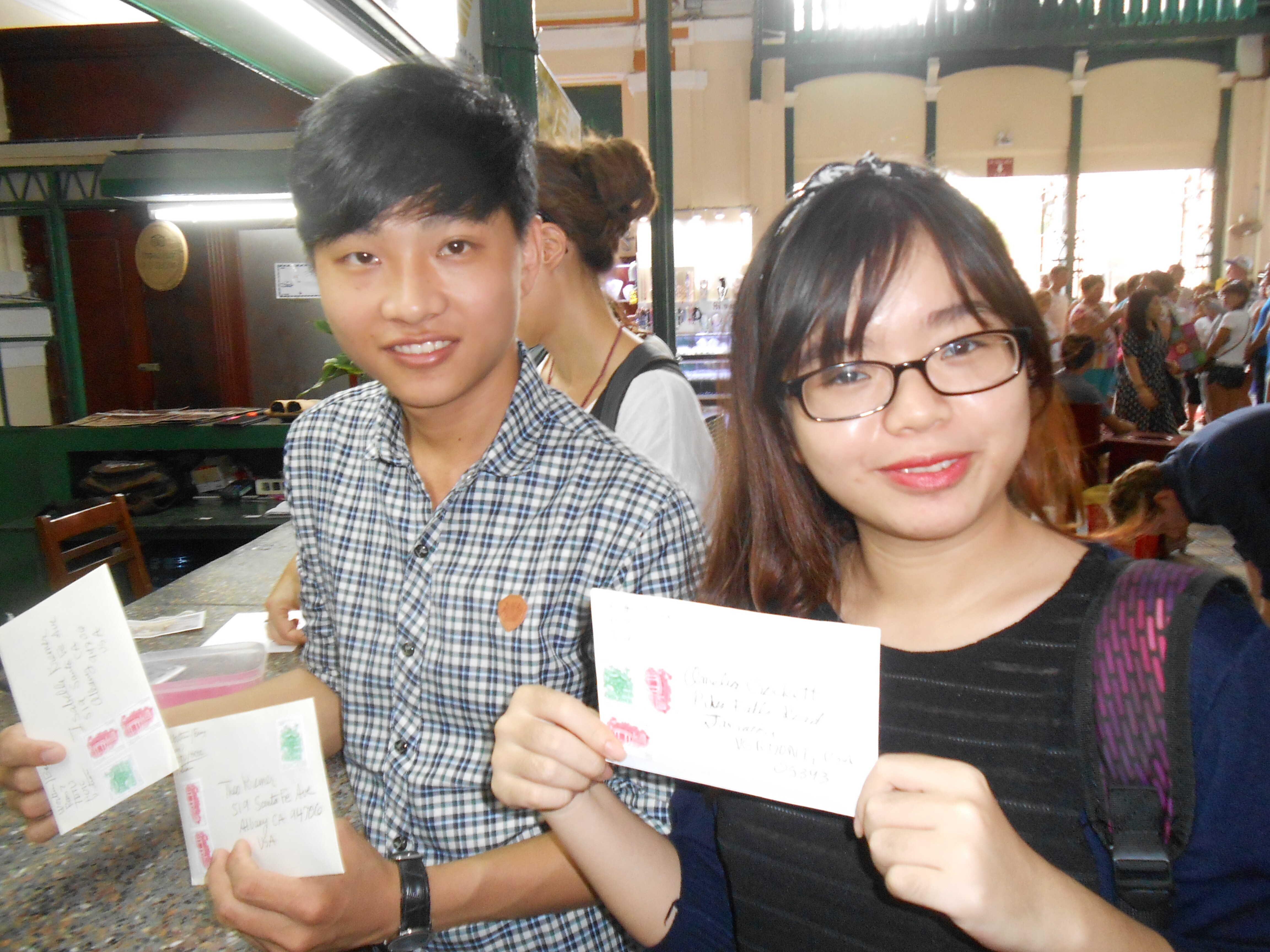
Phone calls between me and Joe ensued: not only the wire on his hearing aid was broken, but also the battery, in this humidity, was going bad. But the driver of the TDTU van was willing to find him at the service center in District 1. It was near the Post Office, so we stopped there and I mailed cards to Lorenzo, Massimo, Theo and Isabelle and Amelia Crockett in Vermont.

Mailing letters

When Joe finally came and got in the van, we headed out a long, long narrow road, two lanes of heavy traffic leading north of the city about 20 Km, Hoc Mon.  Eventually the traffic thinned out and it started to feel as if we were in the country.

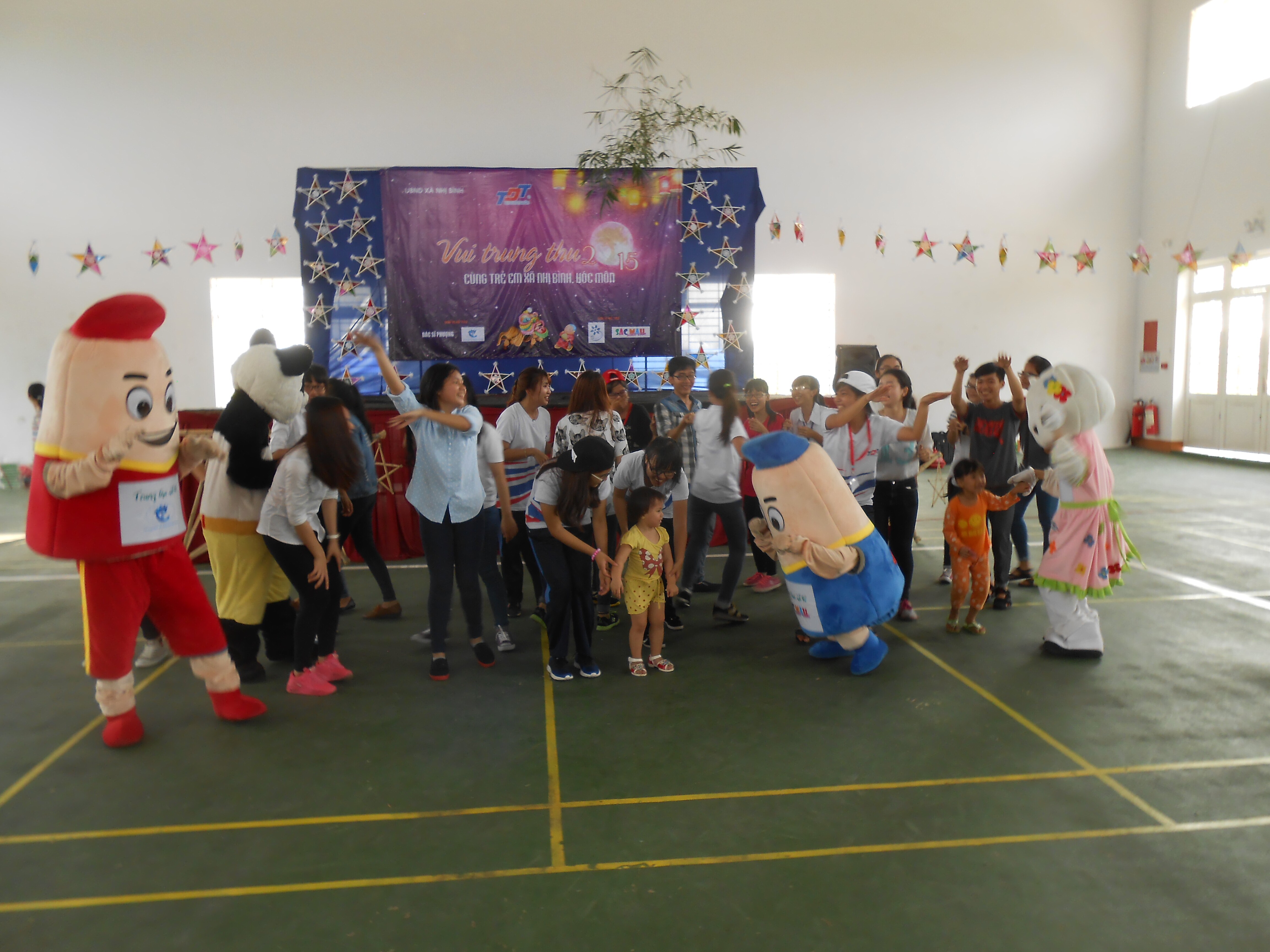
Hoc Mon is a village, once small and surrounded by open agricultural land but now on the edge of the city. The reason we were going there is because every year the students in the Labor Relations and Trade Unions faculty prepare a celebration for the children of the village. It’s the Autumn Moon festival, the day in the lunar calendar that is in the middle of the month of the autumn moon.

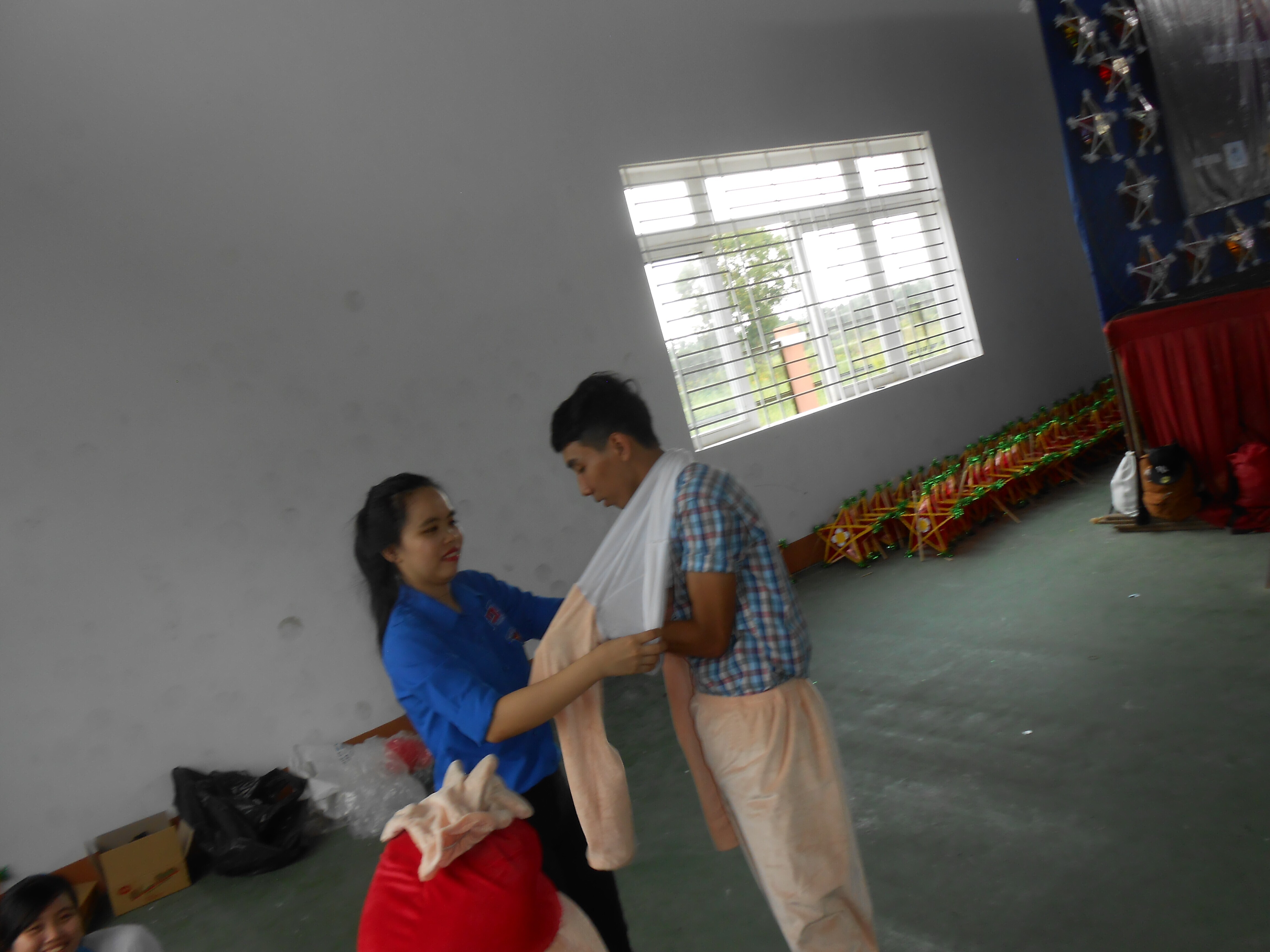
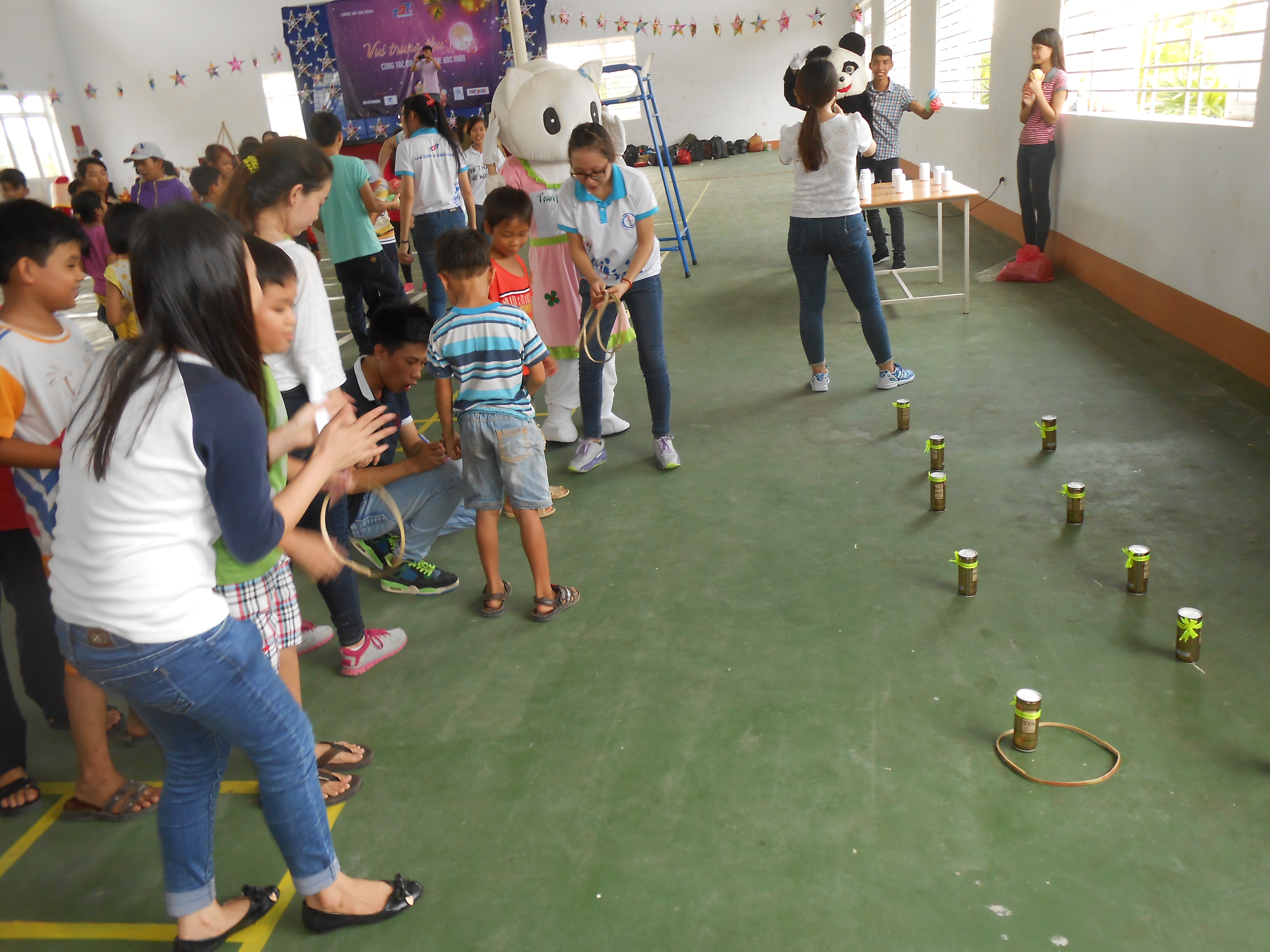
The event took place in a large high-ceilinged cement building with a metal roof that is the community meeting and activity center of the village. Inside the building, which was all one room with lines painted on the floor for volleyball or badminton courts, the students had set up games like throw-the-coconut-at-the-water bottles, or toss the bamboo hoop over the cans. There was a stage at one end of the room. Adorning the stage were many stars made of colored paper glued to a bamboo frame and decorated with gold and white paper. Vinh had told us that the students had made all these stars themselves, even down to making the bamboo frames. They would give them to the children at the end of the celebration, and they’d light candles in them and the children would walk around the village in honor of the Autumn Moon.

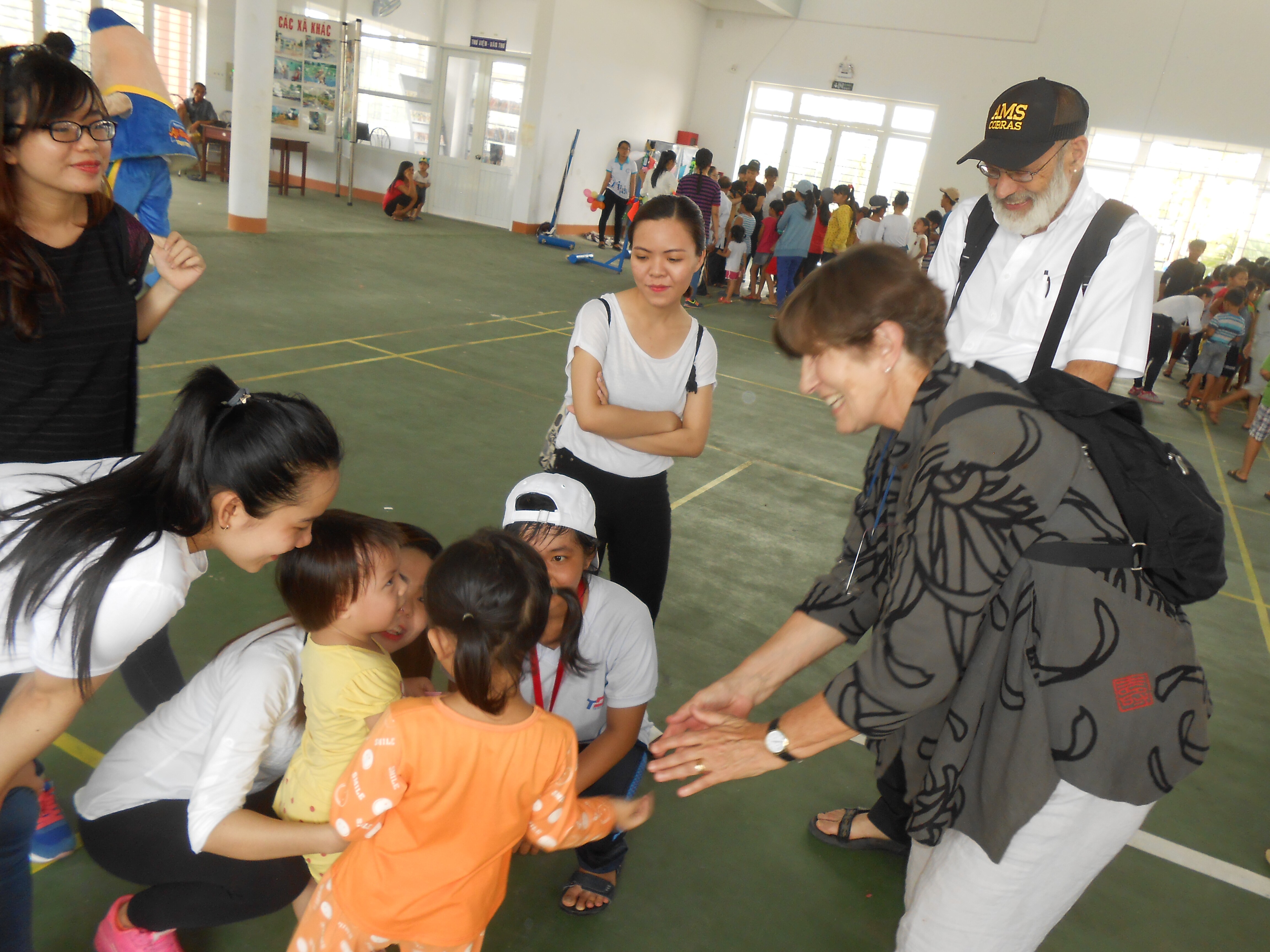
The whole thing is planned and carried out by students, although Ms La, Mr Quan who works in the department office, and another woman whose name I will learn to spell later, were the original contacts and help. We were the only faculty there. Mr. Quan came and took pictures. Students were running the games, talking to the children –ages 3 to maybe 11 or 12 – dancing with the children, everything. I recognized most of the students from our classes. There were about 20 of them. They all seemed to be whole-heartedly engaged in playing with the children and making sure they had a good time. There were a few grownups around, but it was really all students, all interacting with each other very creatively and being wonderful with the kids. Like a whole team of big brothers and sisters, and having a good time.

Little guy 2Costume, stars_1

hoop gameAngry birds shirt

I thought, “Well, here’s organizing.”

pick up baby

The noise in the room was deafening: the hundred children running around, laughing and clapping and playing, plus the music and the announcements from the microphone.

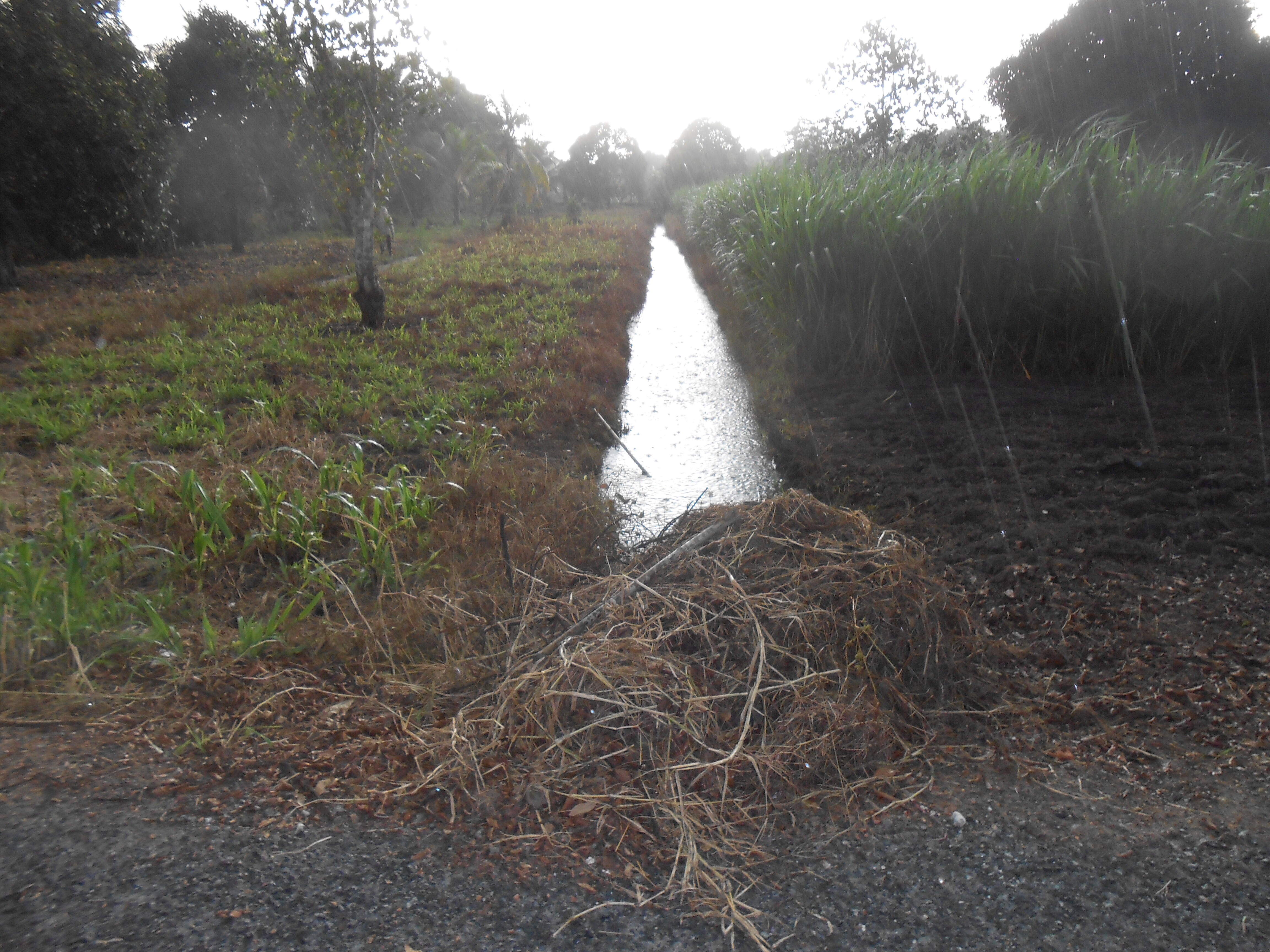
After playing some games we — Joe and me and 4 or 5 students, including Nigha, Thi, and Vy and Anh, all students we have spent some time with – walked down the road outside to see what the surroundings were like. Trees, ditches, houses behind the trees. The community center is in the back right of this photo.

Road

A tiny pretty woman with very short gray hair, wearing jade earrings and a purple blouse, came out through the trees and climbed up to the road and talked with us. She told us she was 80 years old and had lived there all her life.

We came to a small commercial building which turned out to be a plastics extrusion factory that employs 15 people. We went in and talked with the manager; we’ll talk with him again, I’m sure. He spoke functional English and said that they have a union, that the union is very important. This might be someone we could learn a lot from.

Suddenly it started to rain so we hurried back up the road. Nghia ran from tree to tree. I put on my plastic gear.

Ditch_1

Inside the community center, the ceremony had begun and two of our students were up on the stage, one dressed in a gold shirt who was the Man in the Moon and the other dressed in a beautiful white gown with lace and blue beads, who was the Autumn Moon Goddess. They called the children up on the stage in groups and gave them each a star and a bag of presents. Joe and I were called up to do some of this, too.

Joe stars bags

We met the woman who is the Activity Chairman of the village – a young woman with a big smile.

The rain was the hardest and loudest I have ever seen. More than what I’ve experienced as hurricanes.

Bottom line: pure fun, completely organized by students, who obviously put a lot of work and some of their own money into this. Not the slightest evidence of cynicism or falseness. Simply: “We want to do something for the children so that they have a good festival.” Offered and received on both ends with complete sincerity and unreserved good will, a pleasure for both the children and the students.

I will let pictures tell the rest of the story.

Exams in Vietnam

Exams: The final exam will be 70% of the student’s final grade. The midterm exam will be 20% and then there is another exam that is worth 10%. The 10% exam floats around the calendar and the teacher gives it when it is appropriate. The final and the midterm are given during weeks set aside for the whole university as exam weeks.

The final exam is one hour long and the midterm is 40 minutes.

Here is how the exam is prepared and given.

First, the teachers write the exams. For the midterm, you have to ask two or three questions. The teacher has to write out what the answers are.

This is because the exams are not graded by the teachers. They are graded by a separate department called the Department of Evaluation. The people in the Department of Evaluation do not attend the class, read the book, or know anything about the subject. Therefore they can only grade the exam by matching what the student writes against the answers that the teacher provides.

The questions have to have answers that can be found in the textbook or in the class handouts or power points. The Department of Evaluation may ask you to show them where the answers are.

The teacher has to write two exams, each one with answers. This is because, should the electricity go out during an exam, they will have to start all over again and unless there is a second backup exam, students will have already seen the exam and it will not be a fair test.

So the teacher writes the two exams, writes out the answers to the exams, and puts the whole thing into a format in which each answer is given a point value. The total point value for the midterm exam is 10. So if there are three questions, each question might be worth 2 to 4 points. Each question will have small sub-questions – for example, if a question worth 2 points asks students to list four different characteristics of a certain type of leadership –then the answer to each sub-question would be worth .5 points.

After the teacher has written the two exams, they get passed to the Dean for his or her approval. In our case, there have been many back and forths at this level, with Vinh doing a great deal of revising and discussing with us.

Once the Dean has given approval to the exam, the exam is passed over to the Department of Evaluation. They may have some opinions about the exam, too. For example, if I include a question that is related to the research project, the people at the Department of Evaluation may notice that nothing in that question seems to have anything to do with “leadership” which is the name of the course. To prevent this, I added a sentence to the question linking the research project and the study of leadership.

The Department of Evaluation will administer the test, grade it blind by masking the student’s names, and report a grade. The goal is to produce a bell curve slightly to the right of passing, which is 5. Ideally, the biggest group of students would get 7s. This is what you try to do, “so that the students will succeed.”

I do not know where to begin on this. Poor Vinh has to implement this and is negotiating between me and this Department of Evaluation. It makes me want to cry.

On the other hand, some of the students seem to think there is something to learn here. This morning we did our collective bargaining simulation. Twenty students showed up. We had only 2 hours. But we did our best and the students, for the first time, seemed to be excited to actually be doing something. They caucused, prepared a proposal, and came to the table. It was extremely hard to follow the bargaining through translation, and in fact I missed the moment when management just told the workers to go ahead and strike – which should have caused the union team to call a caucus and walk out. I could see that there was no concept of discipline, and they were carrying on like a bunch of fussy siblings at a dinner table. But when we stopped them and gave them some criticism, they listened seriously as if they were aware that there was a huge problem here and it was time to do some learning.

I suggested that we try it again. They asked for more time – starting at 9 instead of 9:30, and they asked if we could do one that was more closely related to the Vietnam experience. I realized we could do one based on the kinds of stuff that their research projects are producing. I said, “How about Lotte Mart?” and a bunch of them nodded their heads. One guy gave me his email address.

A Walk up Le Van Luong Street

There has been a request for more photos, so this afternoon when Joe and I were having a late lunch on the balcony of the canteen on the 10th floor of Building C, we looked down at the neighborhood to the east of us and decided to take a walk there. The street that we would follow is called Le Van Luong.

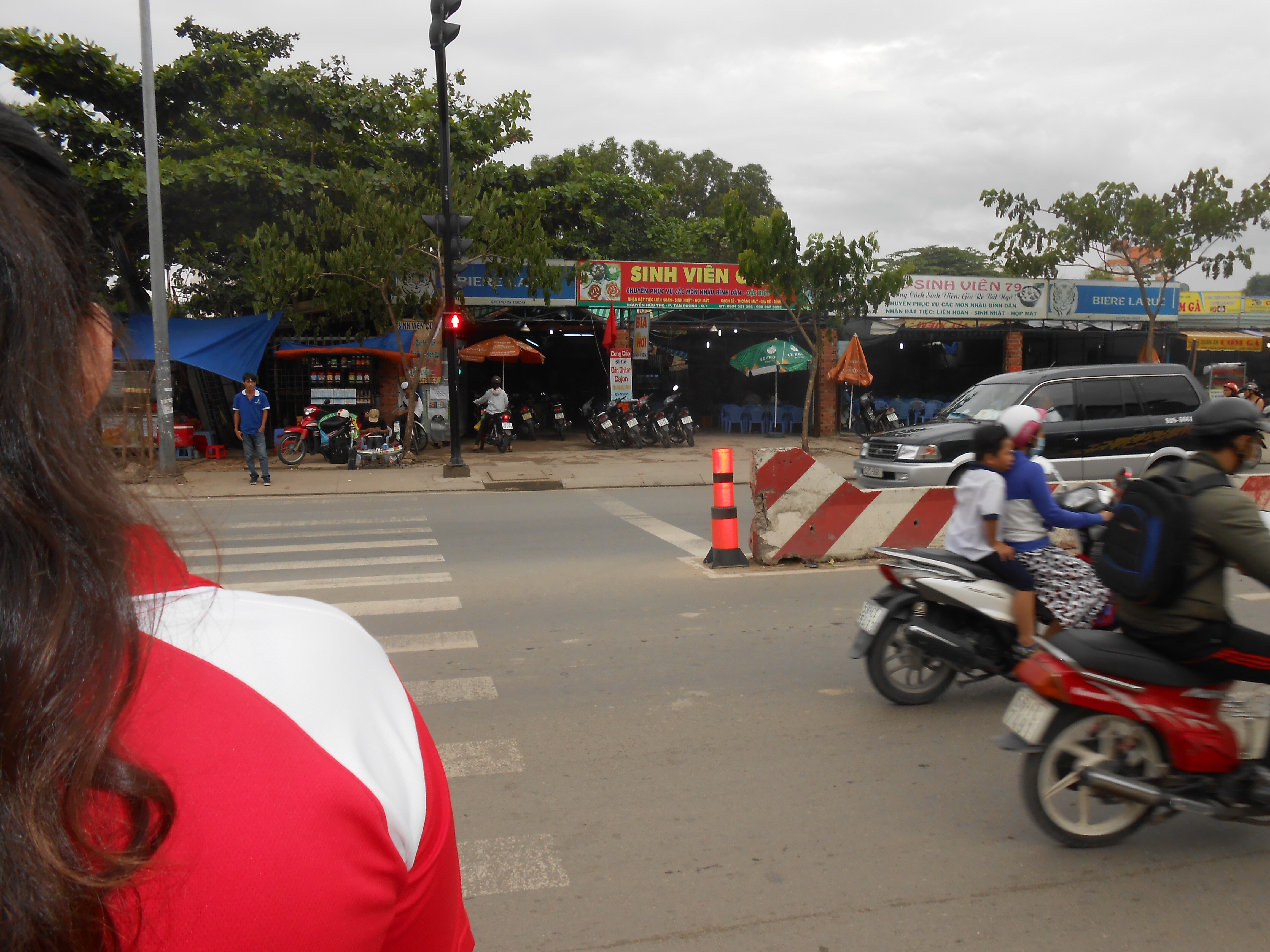
Getting to Le Van Luong street meant crossing Nguyen Huu Tho Street, a large divided boulevard. We are getting better at crossing streets. Crossing at a crosswalk is a good idea, especially if they have a pedestrian signal light. The idea is to start walking and proceed smoothly, not changing your pace or direction, and leave it up to the motor scooters to avoid you. They are pretty good at it. So here is a picture of the cross walk:

  more bikes

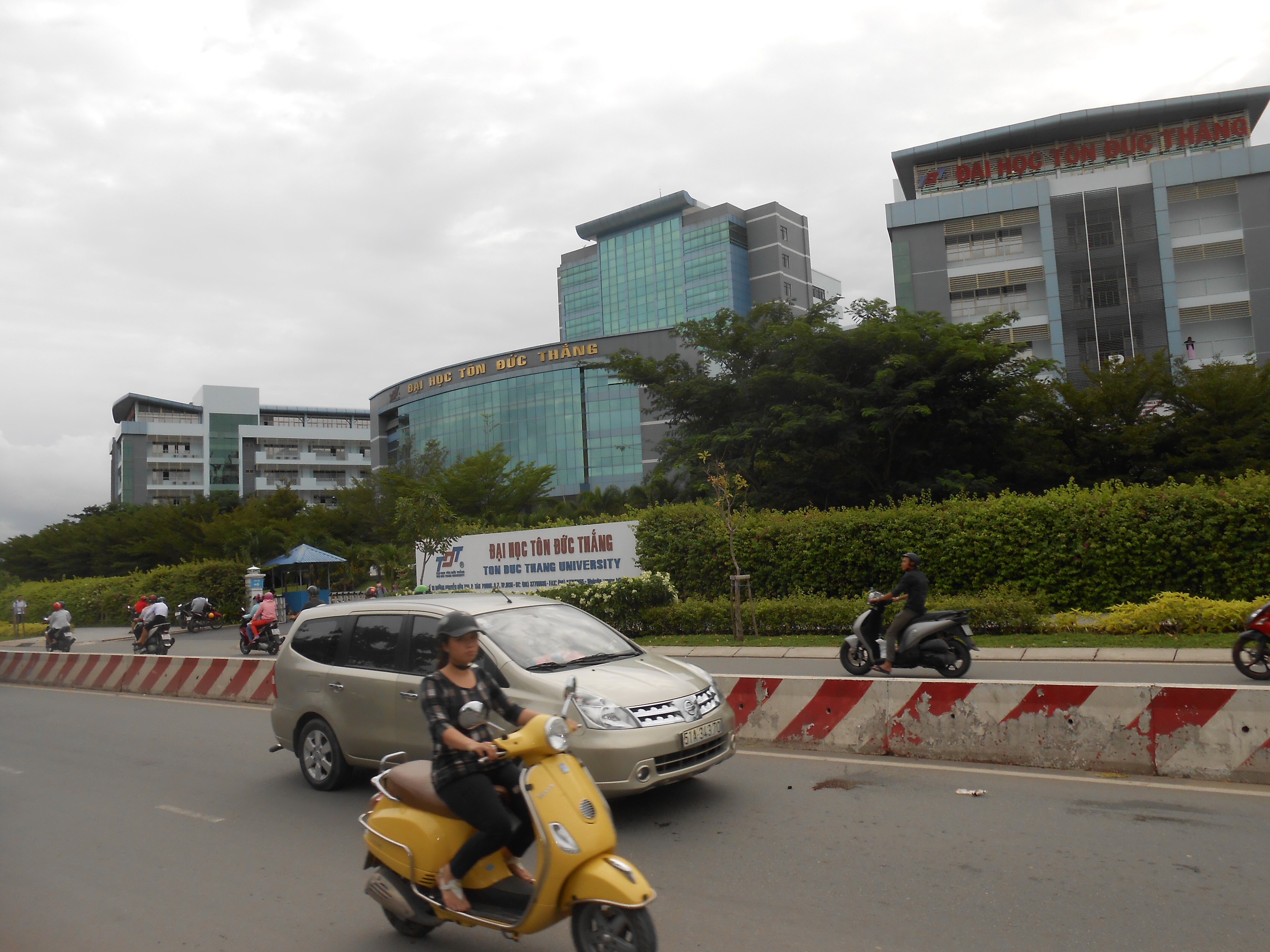
This for some reason does not show the hundreds of motorbikes that were really there. But never mind. See the little shops lined up on the other side of the street? Those are mostly little cafes, selling different kinds of food that they cook right there on the sidewalk. Here is what’s on the other side of the same street: Ton Duc Thang, modern high-rise technical university.

TDTU across street

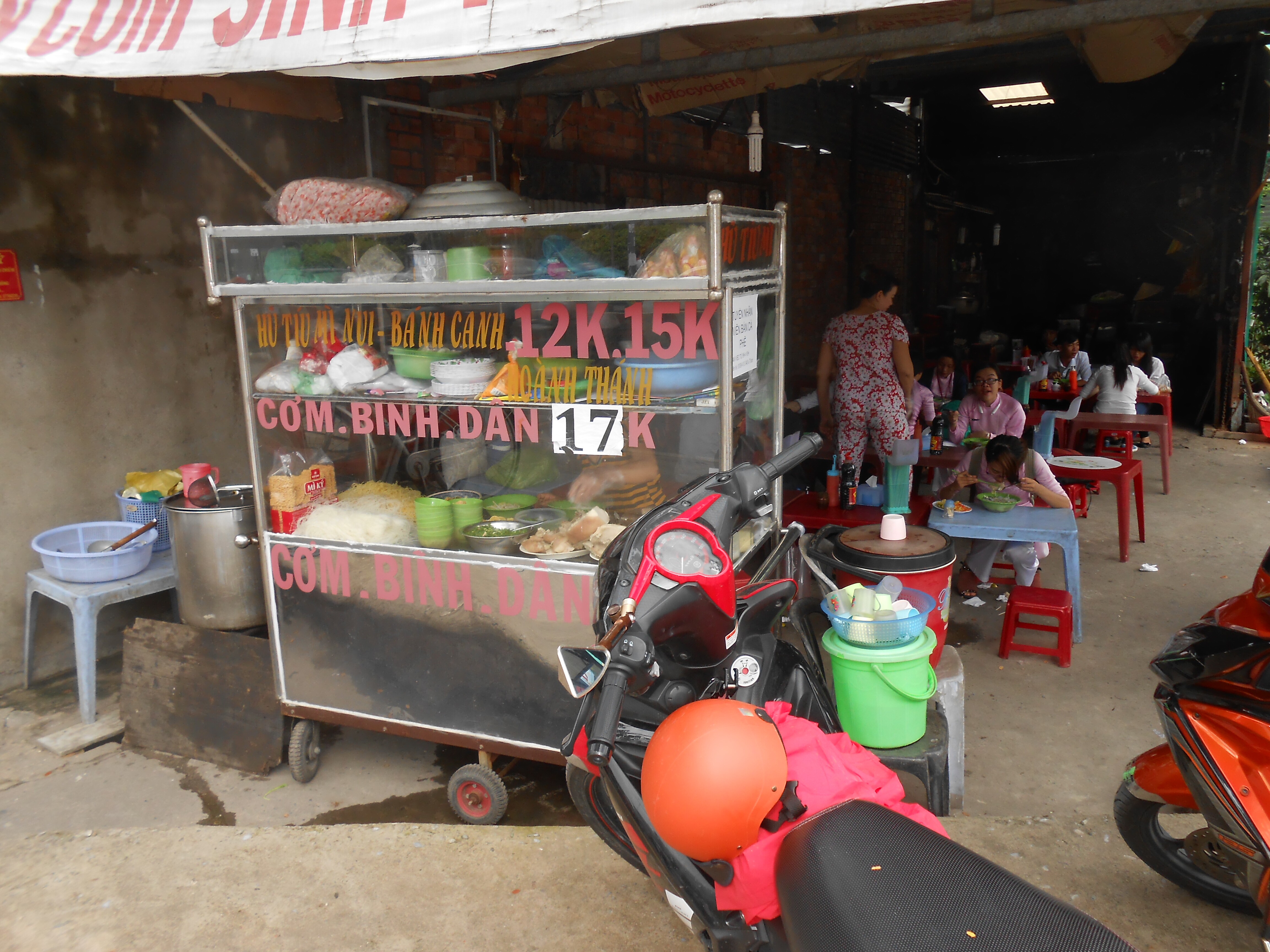
So we started walking south along this big street, Nguyen Huu Tho. We passed cafes with students in them, and some of them waved to us — it was hard to see exactly who they were, but they seemed to recognize us. To say we are conspicuous is putting it mildly. I have decided to think of ourselves as giraffes. That would explain the way kids gape at us. The young people in white in the back are students.

Students coffee shop

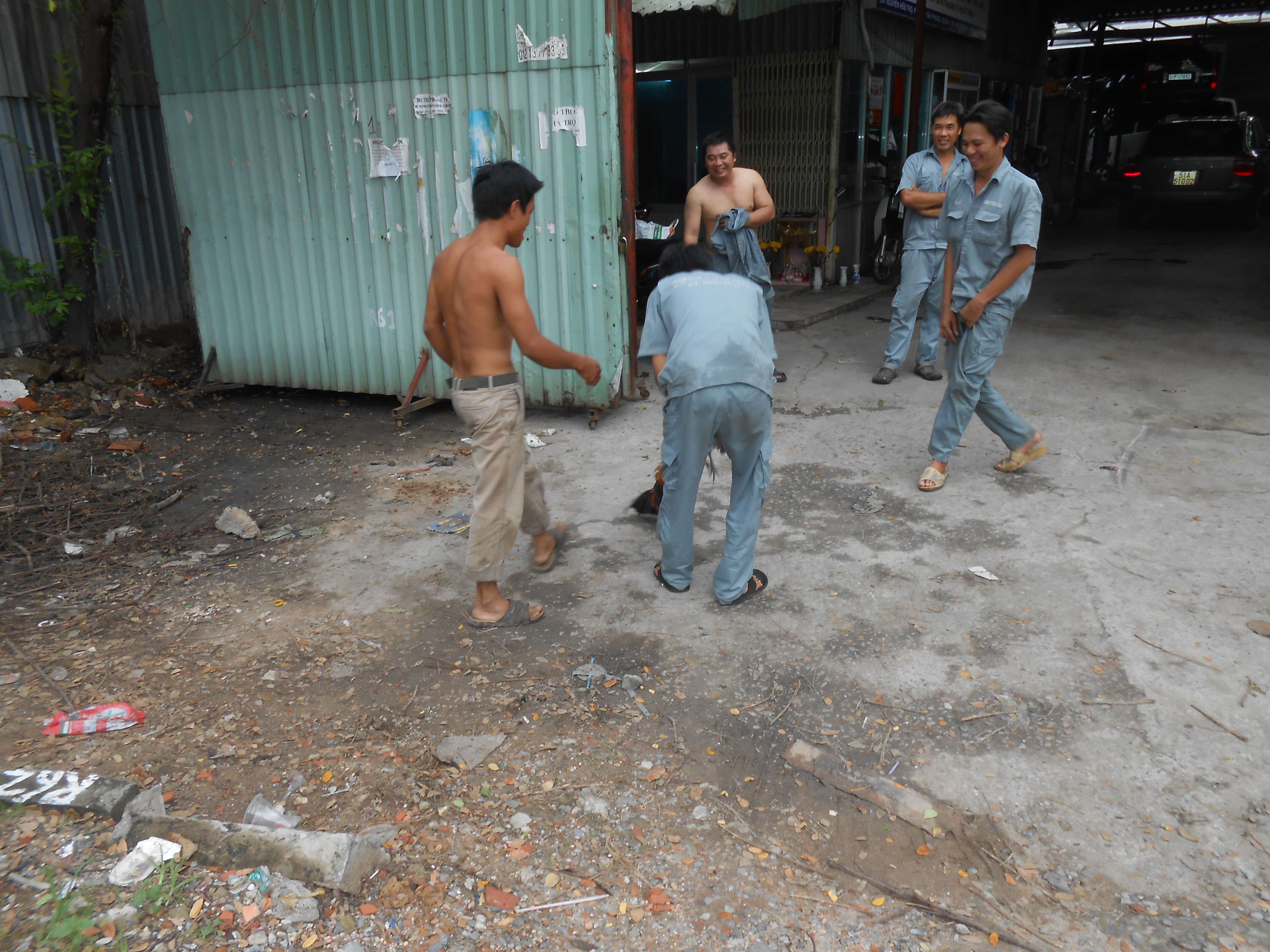
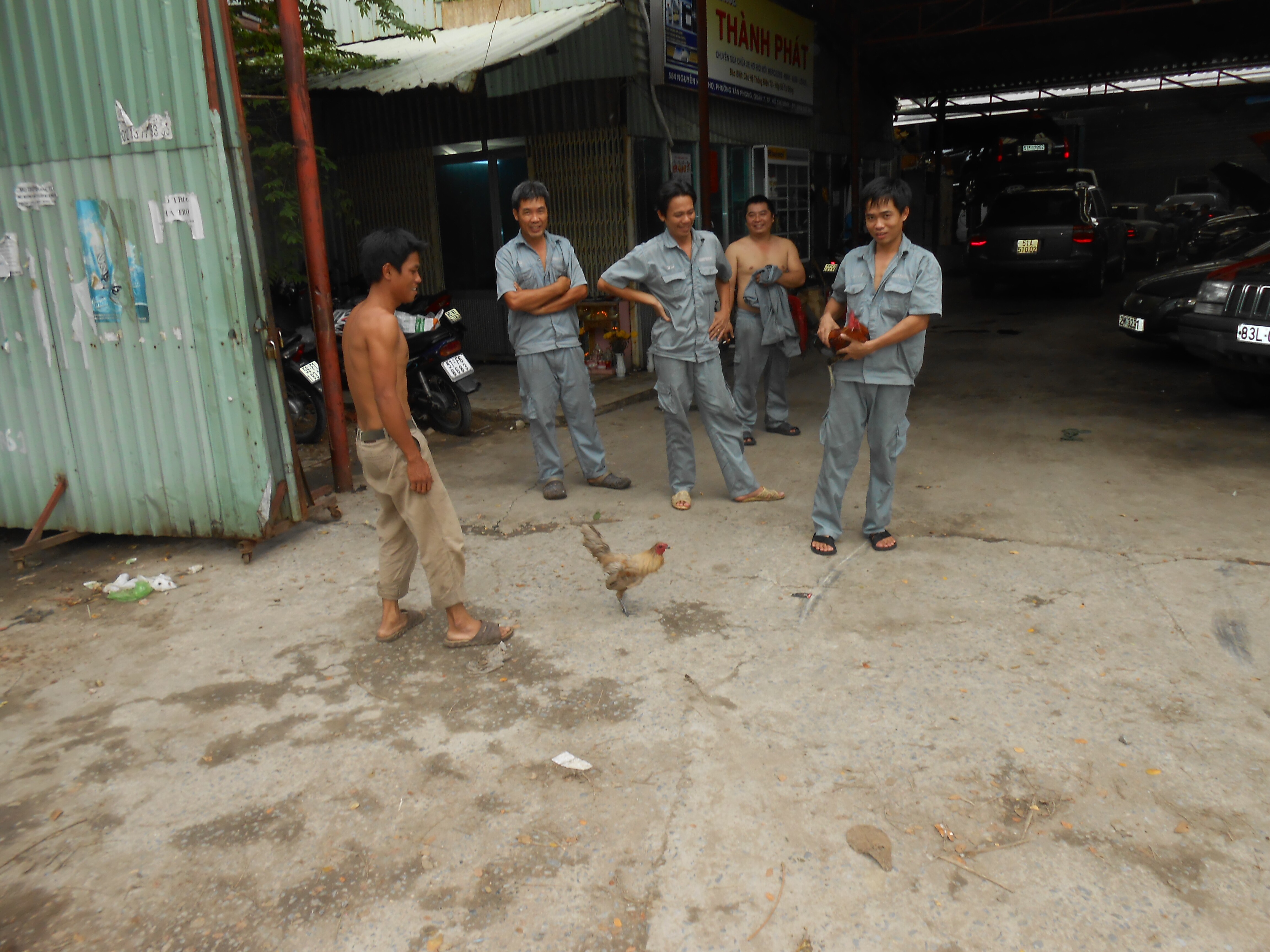
Next to that cafe there was a small cockfight going on. There are chickens all over the place, including in the dorm canteen which is one the ground floor and open air, and I assumed they were being helpful with bugs and crumbs, but here were two roosters that provided entertainment. The fight did not seem serious. The white rooster was allowed to run away.

    Cockfight 2        Cockfight 1

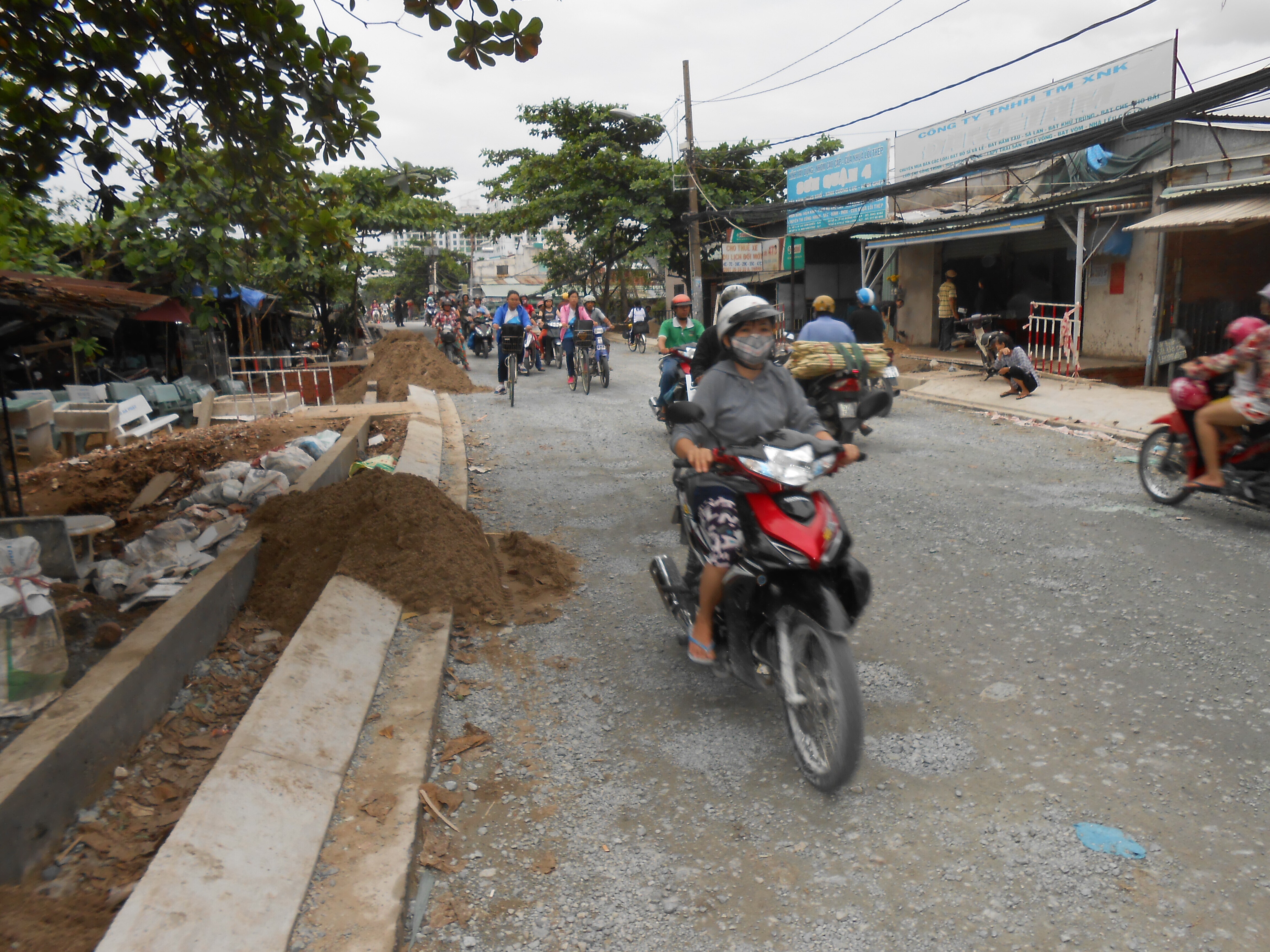
We came to the corner and turned left up Le Van Luong. This street is really one lane, with most of the traffic going all in one direction. Right now, it’s crushed gravel. They are building a new sidewalk on the east side, plus new gutters on both sides of the street. It almost looks as if the street itself is being elevated. One result of that is that in front of many of the shops, people have big piles of dirt that they are shoveling into their houses to raise the floors, which are dirt underneath whatever surface they’ve put on top.

At this point the day had been fairly clear, with no rain, but it was five pm and if you looked to the south you could see a black cloud coming. The people who had big dirt piles in front of their places were shoveling hastily. I saw a woman with a pearl necklace shoveling. In this picture you can see the new gutter, with a small pile of dirt, on the west side of the street, and in the right hand side of the picture you can see the new sidewalk. This is really a major upgrade of this street.

Sidewalk construction_1

My guess is that this is an old neighborhood that is only now getting sidewalks and paving for the first time. There are narrow alleys that run into this street that look like real neighborhoods. One long block away,the big boulevard Nguyen Huu Tho might have been an urban development project through what looks on the map like wetlands.

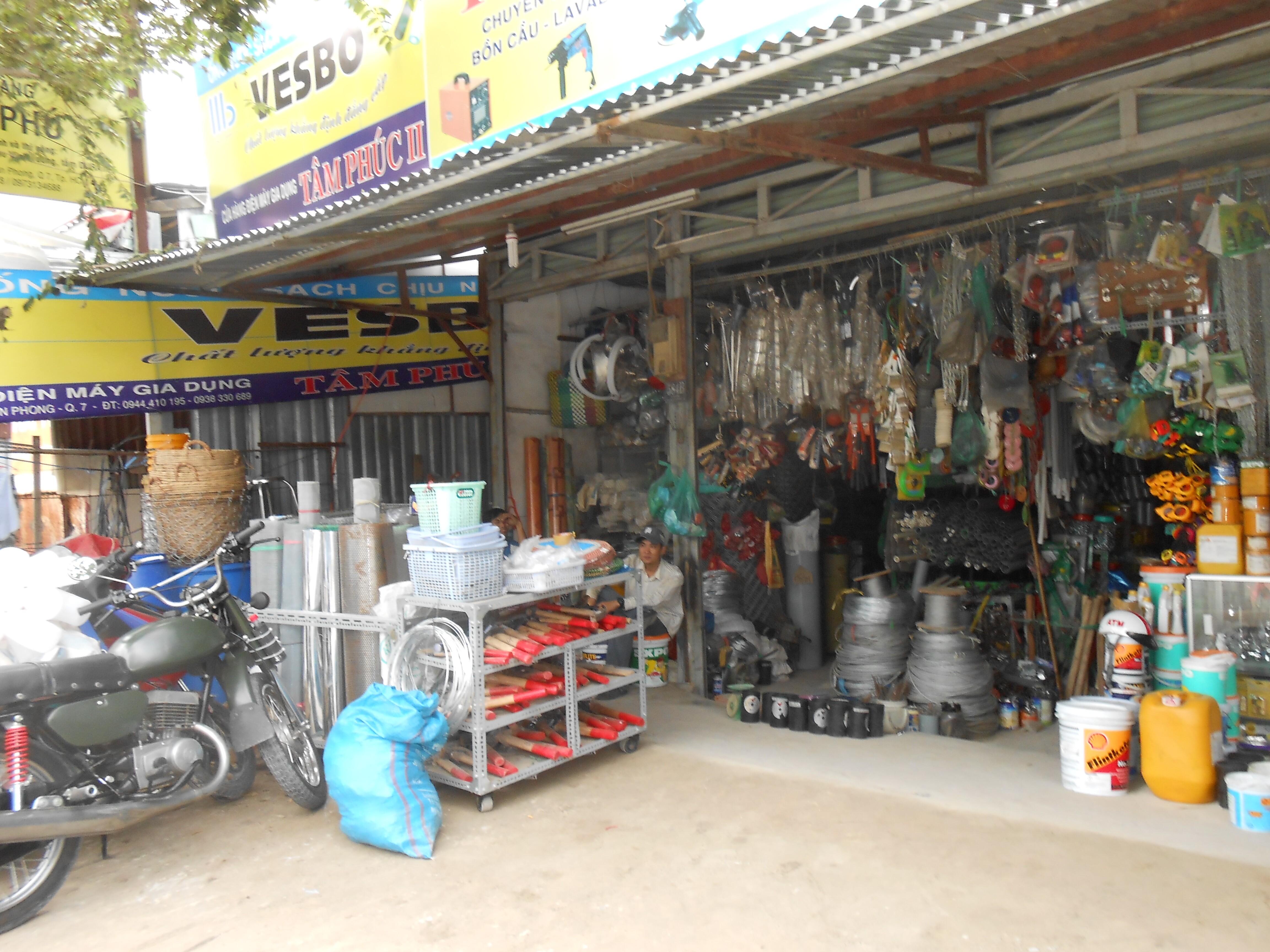
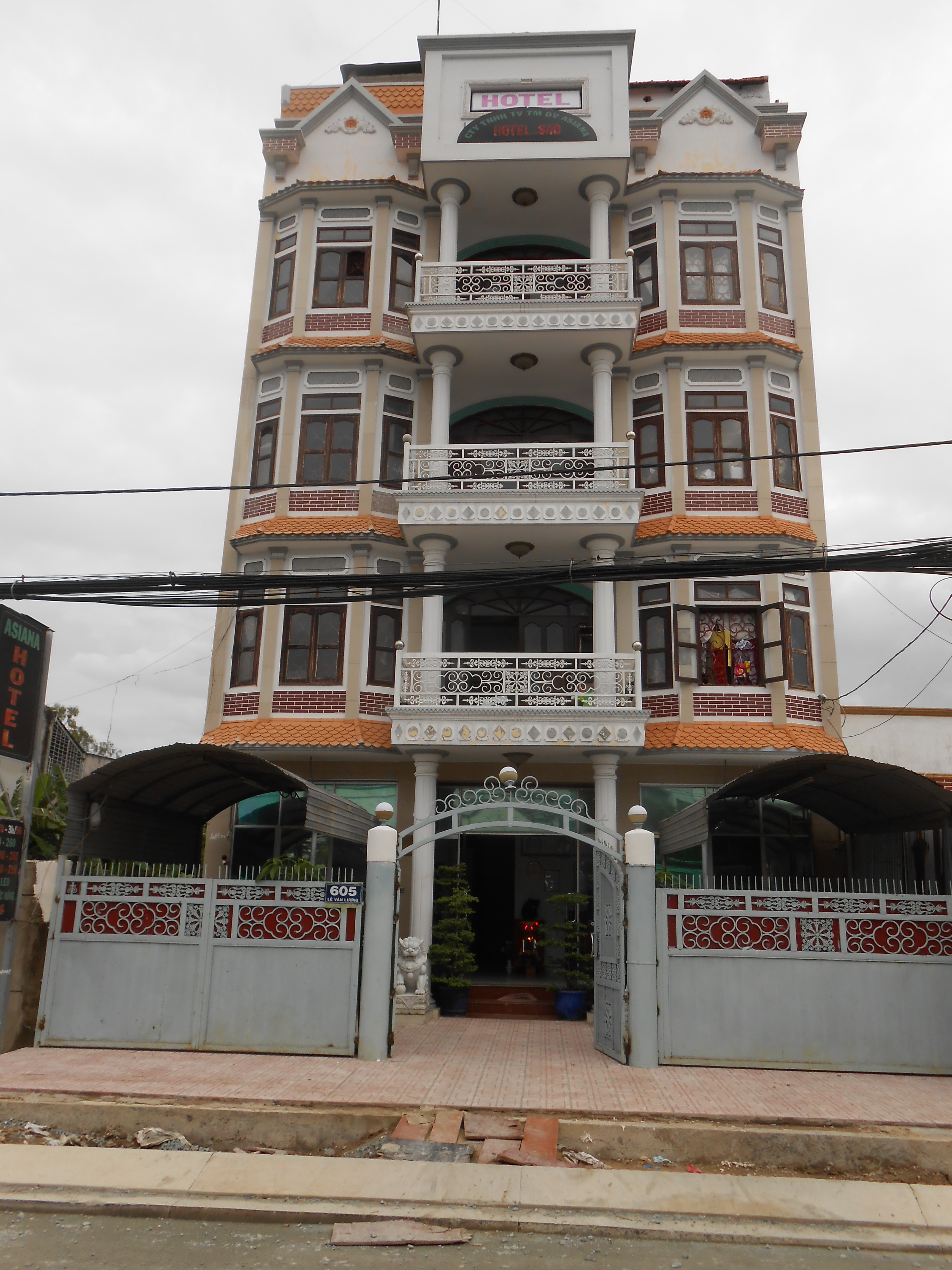
Le Van Luong street is full of cafes.  If there is one motorcycle repair shop, one construction materials shop, then there are two coffee houses and two restaurants, with a laundry, a taxi dispatch office and a hotel in between.

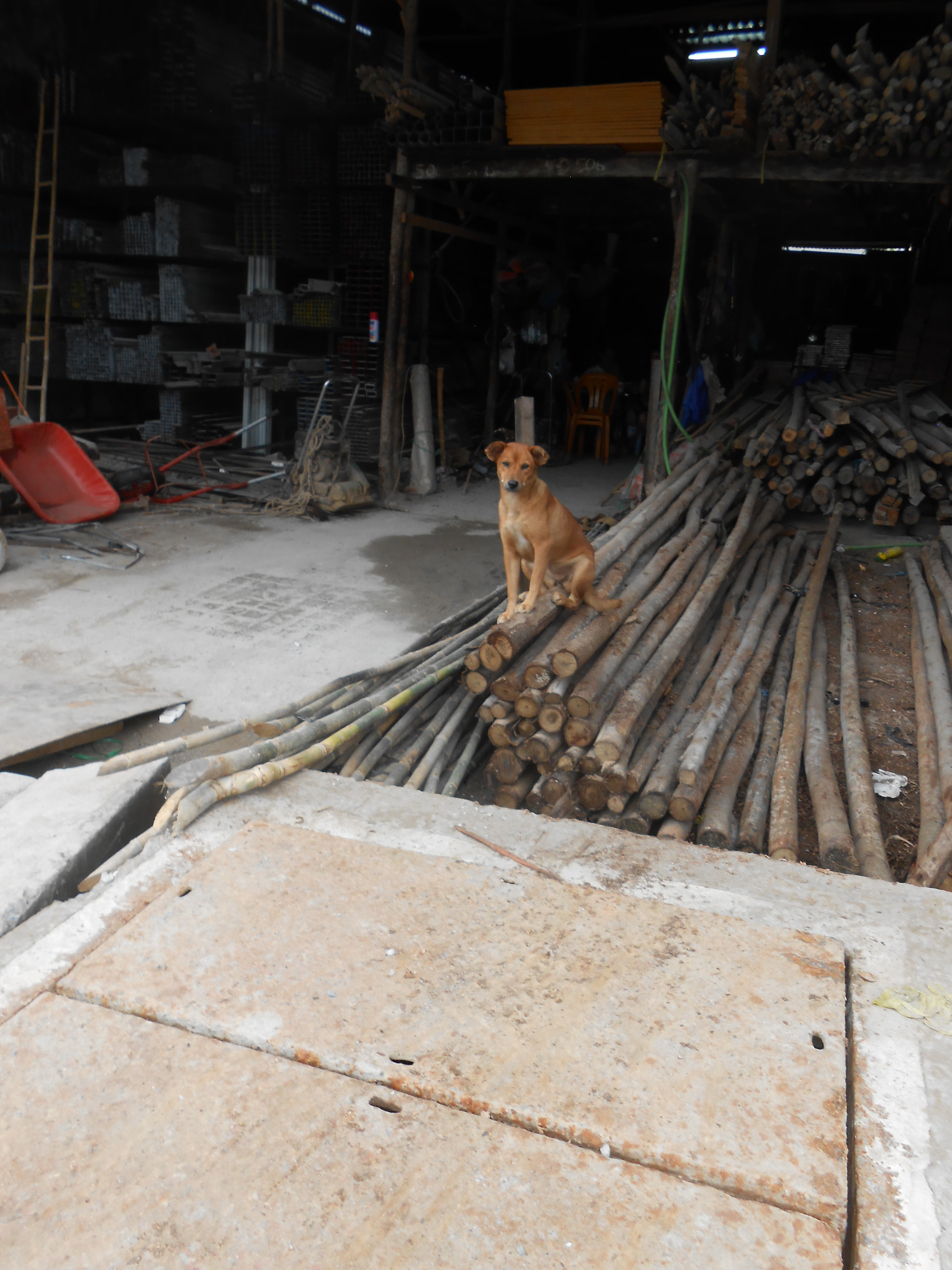
Here is a little yellow dog sitting on a pile of wooden poles in a construction materials shop. Saigonese dogs are all this same yellow short-haired mixed breed type. They are not the kind of dog you go up to and pat, although they may come towards you, sniff and then walk away. The guard at the gate near our room has a dog like this. In shops they are mostly sitting on piles of stuff. The poles in this picture are a basic construction item used for holding up roofs or constructing dams. The canal on campus is dammed up with poles like these, driven vertically into the muddy bottom and then banked with mud and sandbags.

Dog on poles

Next to the construction materials shop will be a hardware shop and then  a barber shop and then a hotel, one after the other:

Hardware

 Hotel

Judging from what’s hanging in the windows, this hotel looks as if people were renting rooms there for months or years at a time. They also advertise rooms by the hour, 18 hours and 24 hours. And on the left is a barber shop where Joe will probably get his hair cut soon. We decided not to do it right at that moment. the barber was using a straight razor and it didn’t look as if hurrying him with that other customer would be a good idea. Joe's barber

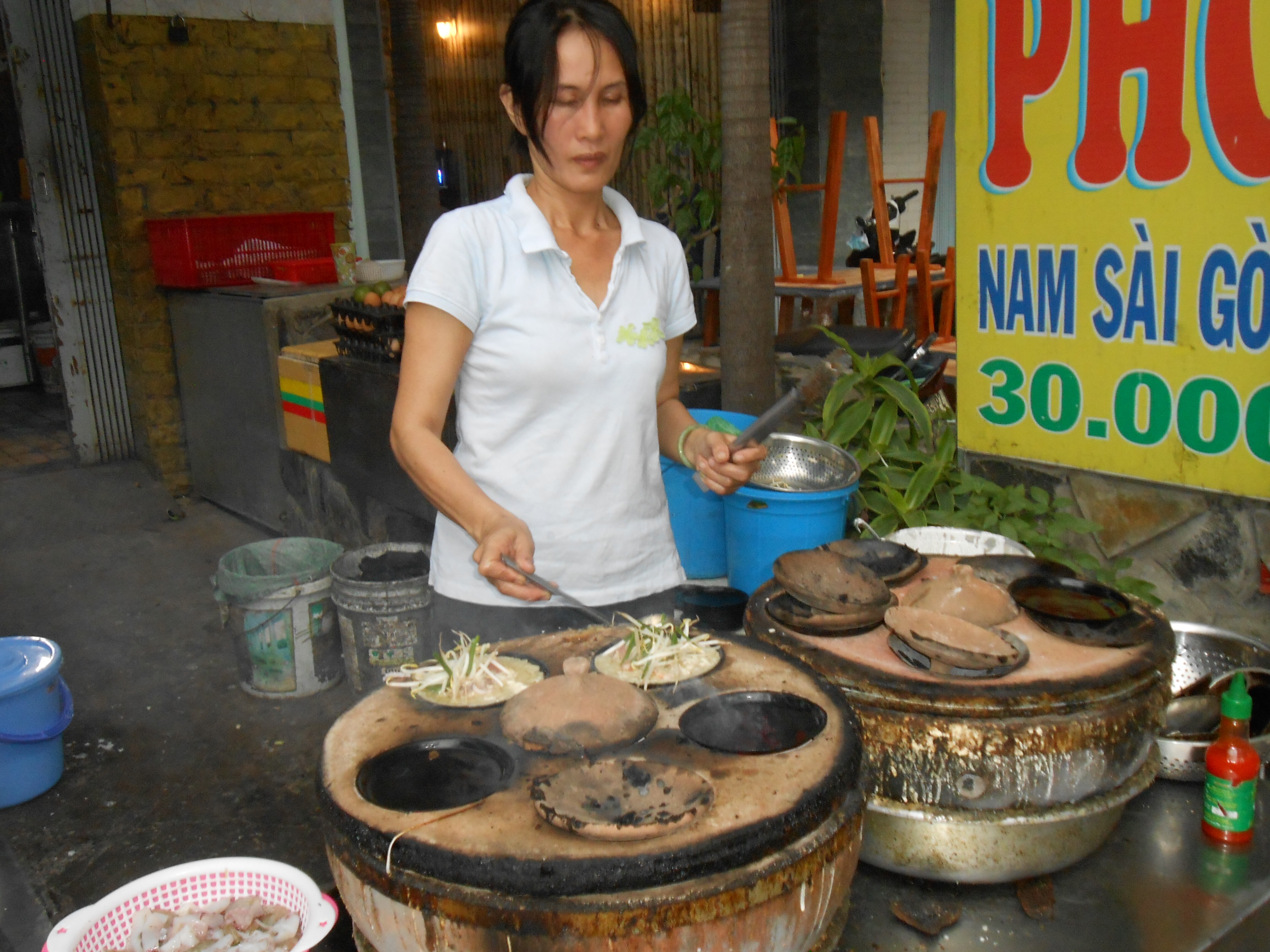
Here are two eating establishments. I asked permission to take these pictures, by the way. The woman on the left is cooking over charcoal in little hot clay plates. First she puts oil, then some maybe living seafood creature, and then some batter which bubbles up, and then she adds greens and veggies. I don’t know what happens next.

Charcoal pancakes

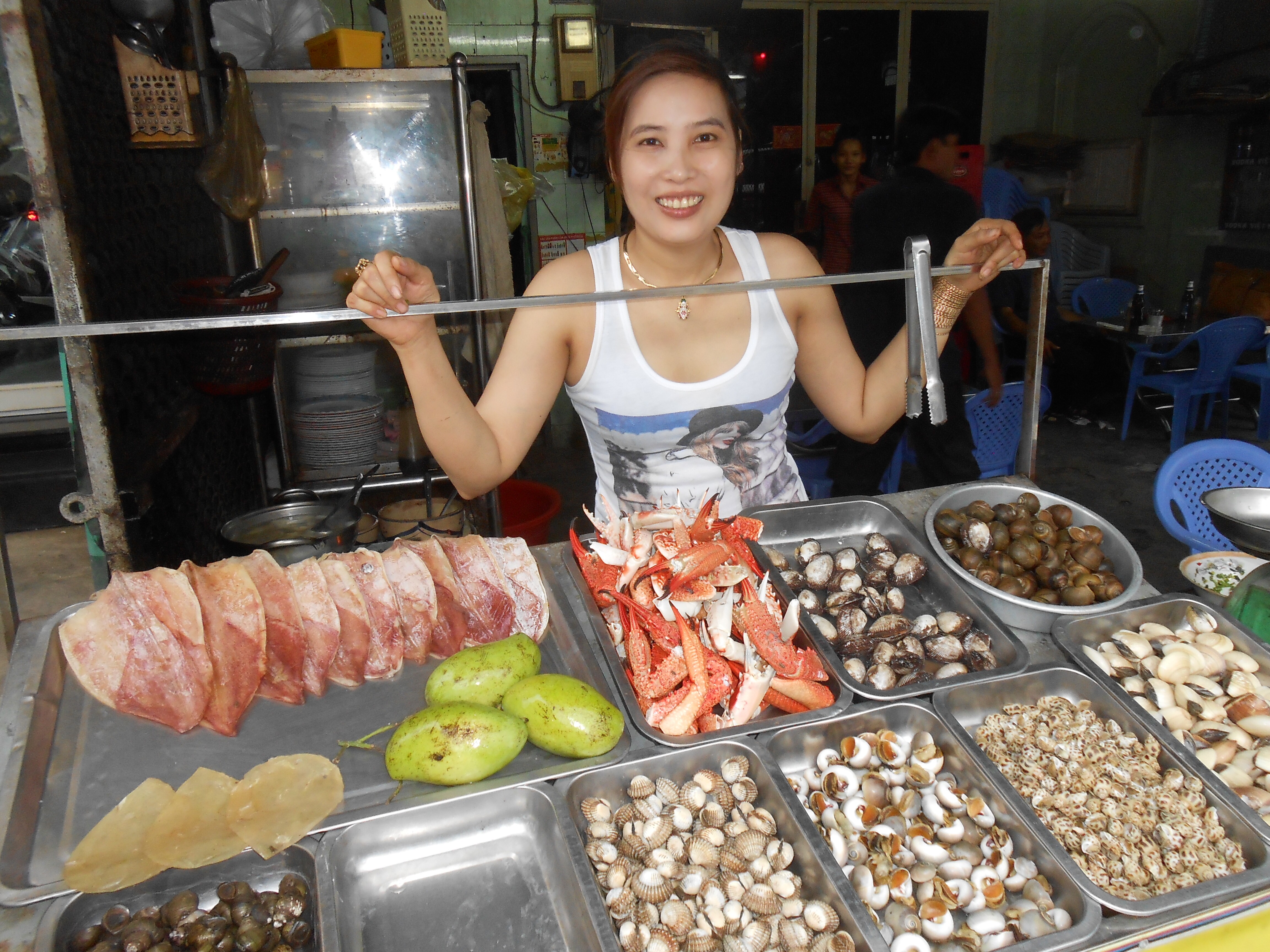
Right next to her was another place with a great display of other kinds of seafood:

Snails and seafood

And a bakery, where wonderful rolls were coming out of the oven and this guy was piling them into a basket as fast as he could. The sky was getting darker and people seemed to be focusing on getting things done, delivering things to where they were supposed to be.

Baker

Soon after this, a young man waved to us across the street and came over. It was one of my students, out having a coffee with his brother after class. This really made me stop and consider what it meant to be walking down a strange street in a strange country and be recognized by a student from one of my classes. This happened in Berkeley quite a lot when I was teaching at Peralta, and I loved it. It happened quite a lot in Chicago, too. But that was almost 9 years ago, and it’s been a while.

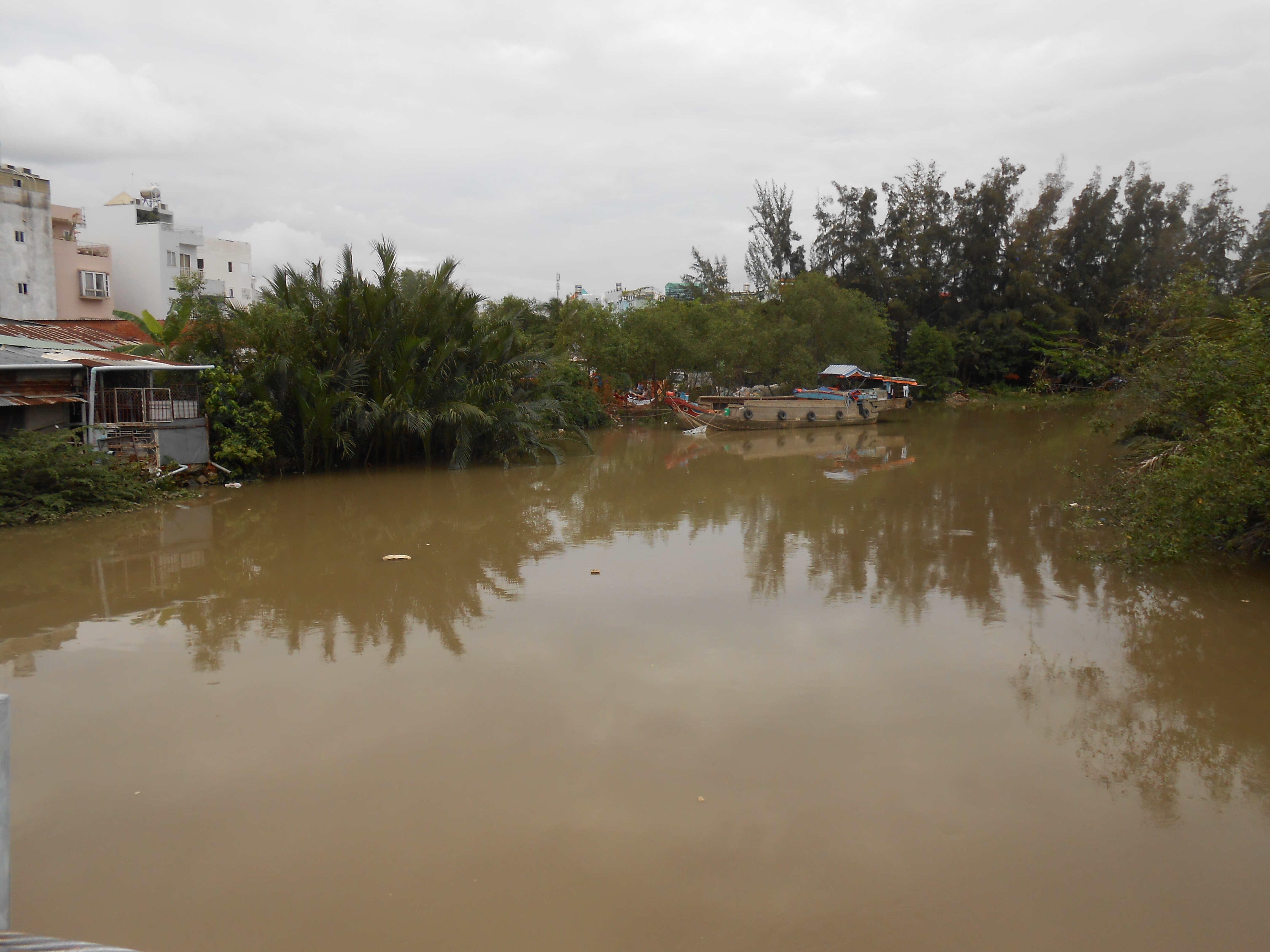
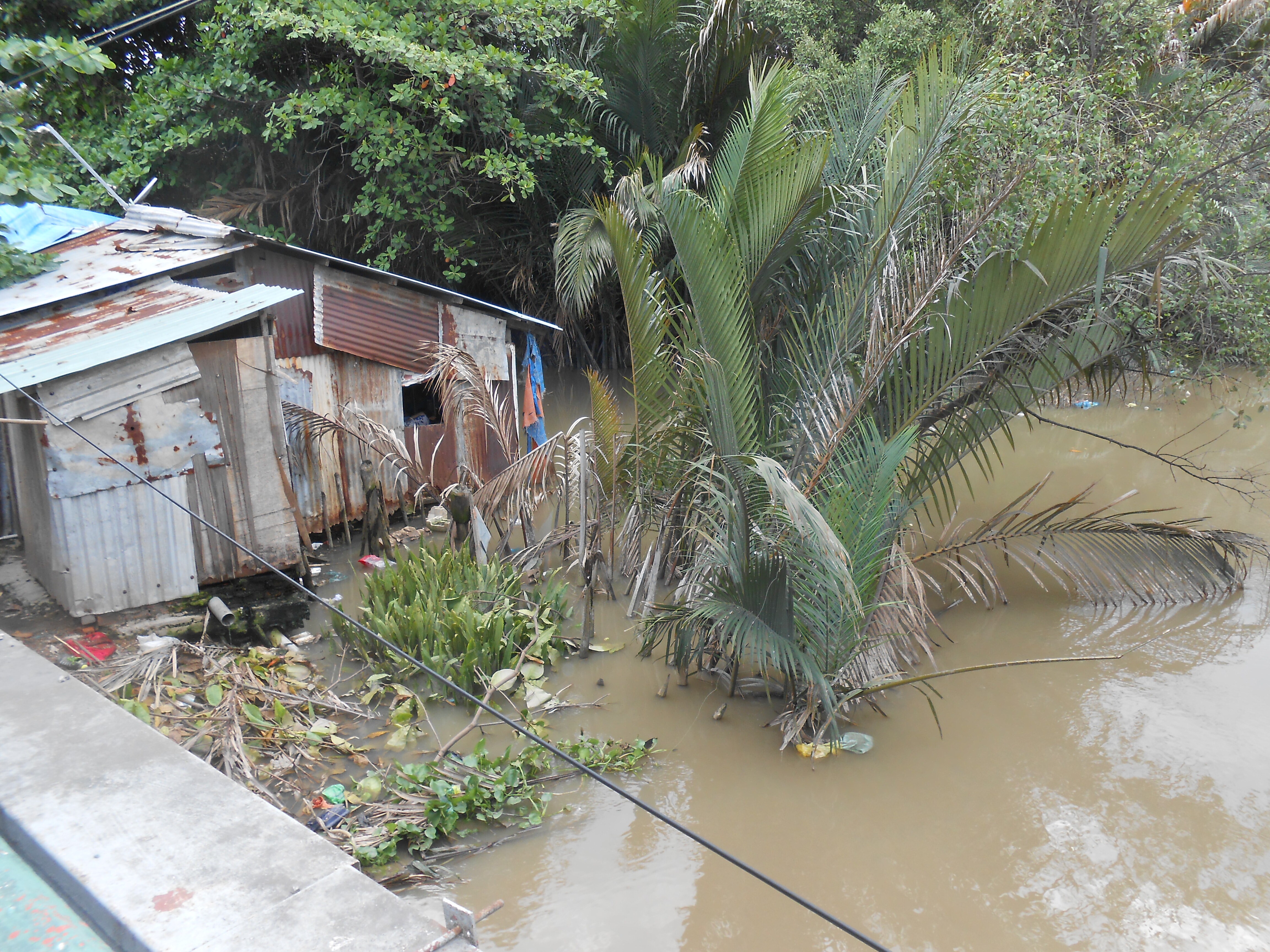
A little father up we came to a bridge. On the map, the bridge appears to cross over the Rach Thay Tieu, but this whole area is threaded with rivers so it’s hard to tell. The metal building half in the water on the right is the downhill side of a cafe that looks perfectly nice on the uphill side. The picture on the left shows a boat in the distance that has a dragon eye painted on the prow. You can click on these pictures to enlarge them, by the way.

Dragon boat Cafe in river

At this point, it started to really rain. We put on our rain gear and so did almost everyone else, motor scooters pulling over while drivers got out their plastic. People working the street cafes started setting up their umbrellas. Some people just decided to get wet.

We turned left onto Hguyen Thi Thap, stopped at the Lotte Mart and went to the bookstore where we found a copy of the memoir of Madame Binh, Nguyen Thi Binh, who was the foreign minister of the Provisional Revolutionary Government and head of the delegation to the Paris Peace Talks. There is a picture of Merle Ratner in it, showing her as a young woman with Madame Binh. Published in English in 2015 by Tri Thuc Publishing House,  same date for the Vietnamese version.

Rain, student projects

The rain has started. The mornings are sunny and cool, but mid-day a light wind starts up and by mid-afternoon there’s a downpour. It falls directly from whatever dark cloud is passing overhead, so it starts and stops a lot. The water in the canal is brown and the gutters are full.The rivers are flowing fast. But people seem a lot happier in the rain. A lot of sudden small groups running around barefoot. A team of gymnasts from some university in Denmark is here on a 5-day visit to “business opportunities” in Asia; the guys are out playing soccer in the soccer field, which is ankle deep in water, a lake, really. Falling down, whooping with laughter.

I bought a vast raingear item that I think is really meant to cover you and your whole motorbike, not just you.

Last night Joe and I went to Yummy Beer Garden over in the neighborhood east of the Lotte Mart. Lots of restaurants on that street. This was an outdoor place with many wooden tables under a green plastic tent, decorated with green umbrellas. Full of groups of hearty 30-ish men smoking cigarettes and drinking lots of beer, attended by pretty girls wearing sashes advertising Sapporo. Also an interesting group of middle aged women, also smoking and drinking. We had some rice with crinkly noodles, dried shrimp and chives; some mango and beef salad, and then something called “fatty beef wrap carrots and cucumbers fried” which was totally delicious. Walked home in the rain, felt proud about going on a walk by ourselves through traffic in the dark and rain, discovering a new place to eat. We toasted Richard and hypothesized that he liked this place.

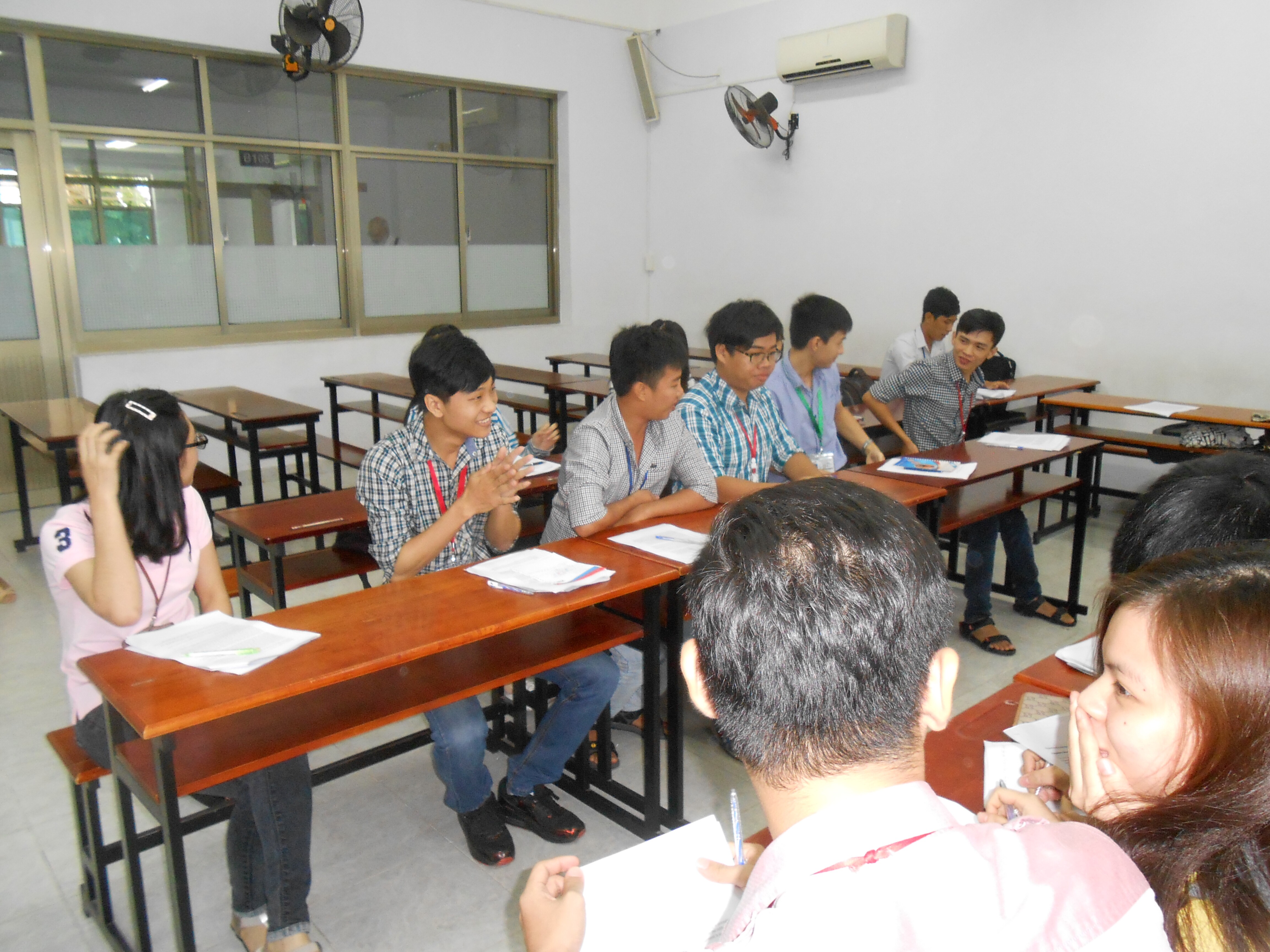
My cross-cultural leadership class for the International Business program went better. I had the students face each other in teams across benches placed facing each other. Each team represented a country cluster (from the GLOBE study). Actually, it worked best if they chose a country from the cluster. Then they presented their profiles. Still, a whole lot of rote numbers and lists, but at least everyone talked. Then they voted for the best team.

Student research project for the Art of Leadership is starting to warm up. Tomorrow is the day for presentations, but not all groups have come to see me.

So far: Group 2, Group 3, Group 7, Group 9, Group 10 and Group 11 have showed up for meetings with me.

——————–

Group 2 came first, the group that was going to study Pou Yuen, the shoe company. They went there, on a motorbike (about 40 KM) and stood by the gate but when they tried to talk to a worker, she wouldn’t talk to them. They could not get into the plant, either. There was a big strike there in March 2015, http://www.vietnambreakingnews.com/tag/pou-yuen-vietnam/

This was part of the big strike over social insurance, resulting in a vote in the Assembly to allow workers to collect their social insurance in a lump sum.

They are a bit at loss what to tell them to do.  Go back,  try to talk to another worker? It’s 40 K on a motorbike. Do some web research, read the labor press? This group may decide to choose another place.

———————

Group 3 is going to report on Tan Phu Trung 1, a kindergarten where the mother of one of its members works. They wrote down “Ca 1” which means the first shift or class period, which is 7 am to 9:15, so I set my alarm for 6 am and got to the office right before 7. I waited an hour and left. Vinh called me at 8:15 right when I was carrying the laundry over to the canteen and said that a group was waiting for me. I ate a quick pho breakfast and got back to the office to meet with the group. From now on I’m going to ask people to write down the exact time, not the “Ca”.

Group 3 doesn’t know anything about their workplace yet. They are going there today, to meet with the mother of their friend. They have a survey written up and ready to pass out, including the following questions:

1. Average working hours

  1. Salary
  2. Satisfied with salary?
  3. How about break times?
    5. What is the working environment like?
  4. Are there any problems at work?
  5. What is your relationship with the manager like?
  6. Has the manager organized any vacations for you?
  7. Are you satisfied with your jobs?
  8. What is your opinion about getting a better working environment?
  9. Can you live comfortably on your salary?

These are not good questions to start out with. These are questions about problems. It looks as if they are trolling for problems. They might get thrown out. I suggested replacing these questions with questions from the “Evaluating the Terrain” handout – how many people work there, who owns the property, etc. The “objective” employer and workforce aspects.

They left and headed out to this kindergarten. They hope to have more information by tomorrow.

——————–

Group 6 is studying Kentucky Fried Chicken, at 330 Tran Hung Dao Street, District One in HCMC. One of the members of the group has worked there for 2 years. After 2 months she got a labor contract. She started at 16,000 D and then went up to 17,000 D. She works 30-50 hours per week. She lives in the TDT dorm and is in her third year. She says that the salary is “just enough for her living.”

She says there are 140 KFC’s in Vietnam. There are 4 managers in her store and 25 workers, mostly students, part time.

There is no union at the store; if there were a union, the manager would “be” the union. He would hand out all the information that the union hands out.

The place is short-staffed. There is too much work to do. Everyone does everything – cooks, does the cashier, cleans the tables. Lots of people get hired but they don’t stay long because the work is too hard—to much pressure. However, there are many people there who have worked longer than she has. There are no benefits, although the manager takes them all on a picnic together somewhere.

She went into the kitchen and took photographs of all the cooking equipment, the sinks and tables and pots. She also got photographs of people working at the counter and customers hanging around. This will be part of their powerpoint presentation.

——————–

Group 10 was going to report on the lecturers who work at Ton Duc Thang but have changed their minds; they will report on Vietopia, owned by HIM LAM CO., which has one site in Ho Chi Minh City and a new one opening in Hanoi soon. It is a large site, about 14,000 square meters. It is sort of a childcare-child enrichment center that takes kids from ages 5-15. Parents accompany children under age 8; older kids come alone. Entry per month for a parent is 45,000 dong and for a child 280,000 ($12) dong. If a parent wants a 3-month card it costs 599,000 dong ($26). About 2,500 kids come to Vietopia. On a holiday, 2,000 kids are there at the same time.

All the workers are under 30 years old. They are from around Ho Chi Minh City, not migrants.

There are about 200 part-timers and 100 full-time workers. The full-time workers earn 3,800,000 dong per month, or 45,600,000 per year, That’s $169 per month, less than the $181 per month that Boulton gave as average for Vietnam. It includes lunch. However, the food is not good.

There are 5 supervisors, one for one area and two for the other two areas on the site. The supervisors are “unpredictable” and the workers don’t obey them.

One member of Group 10 works at Vietopia. She works part-time, eight days per month, for 4 hours per day and is paid 70,000 dong ($3.12) or 16,000 (71 cents) per hour. This is more than at Lotte Mart, where the pay is 12,000 (53 cents) per hour. Her job involves checking tickets and teaching children about jobs such as doctors, radio announcers, taxi drivers and firemen. She speaks some English.

The company gives her a uniform which she washes herself. Each play “job” has its own coat. They also give her 600,000 dong per month ($26) to spend to buy lunch. She does not have a labor contract, which means that she is not a registered worker and the company does not pay social insurance for her.

She says that the part-time workers are more or less OK about their work, as compared to the full-time workers who complain a lot and talk about quitting.

—————-

Group 7, which thought it had an appointment one day but in fact had signed up for a day next week, found me at the gym and we all went to the canteen to talk. They also are doing Vietopia, because two of the young women in the group work there.

Their information was about the same. Two additional pieces: The director of the company is a woman but the owner is “someone secret”. Investors include Pepsi and Apollo English Education in Vietnam, which on the web turns out to be a company run by a Khalid Muhmoud, who also runs something called the British University in Vietnam and other operations.

One of the young women in Group 7 went to get her pay for this month, which should have been 560,000 (8 x 70,000 D). Instead, it was 540,000. She says this has happened before and to other people. Where did the missing 20,000 D go? We talked about ways to approach the supervisor about this – always in a group, to start with.

The leader of that group is a young man who described himself as “intercultural.” He speaks pretty good fluent English and knows a lot about American culture, which he has learned from the internet and friends and cousins in Orange County (“Cam”, which is the word for Orange in Vietnamese). His mother speaks English, and his grandfather, who was in the South Vietnamese military, spoke English and French. His grandfather is now deceased.

I asked him our question about why students in classes talk with each other when others are speaking. “Because they don’t care,” he said. “They don’t know any better.” He expressed a lot of opinions about the Vietnamese education system, saying that many people think it is “garbage,” that the Education Minister doesn’t care and does nothing, and that everything has gone downhill since 1975.

—————-

Group 9 was originally going to study a garment factory where a brother of one of the members works, but they have decided to do something different and are quite emphatic about it. They are going to look at a furniture shop where another member of the group works.

The names of the shop is UMA (Anh Nguyen Company), website http://uma.vn/default/online-shopping/ Amazon carries some of their lighter stuff like little home décor items.

There are 10 shops in this business, one of them in District 7 very near Ton Duc Thang. They sell furniture – middle class, nice but not fancy furniture, the kind of things ordinary people can buy. Looking at the website, I’d say it’s IKEA type, pretty nice and not cheap. The owners are one Vietnamese and two Swedish people. Apparently there are lower taxes of some sort if a Vietnamese person is the “front” for a business; foreigners can then invest at a different rate. It’s been in business for about 10 years.

One member of Group 9 works here. She works second shift, from 2:30 pm to 9:00 pm (half an hour for lunch). First shift is from 8 am to 2:30 pm. She works 6 days a week, and also takes 5 classes, going to school in the mornings. She is “temporary staff” and has no contract.

There are six people working at her level (two women and four men), 3 supervisors, 1 manager, 2 deputy managers, 3 cashiers, 3 cleaners and two guards. The manager, deputy managers, and cleaners have labor contracts.

Her job is to pick up the furniture when it is delivered, check it against a list that tells what it’s supposed to be (inventory) and stock it. She says that everyone is involved in doing this, everyone except the cashiers.

She does not know where the furniture is manufactured. She says there is a warehouse where they do repairs and fix mistakes.

She earns 19,000 (85 cents) per hour and about 2,700,000 ($120) per month. After she has been there 6 months she might earn what the sales staff earns, which is 20,000 per hour. There is a lot of overtime and no overtime pay. There are no payments into social insurance. The company will pay for insurance if she has an accident. The company provides a refrigerator and microwave and she goes out to buy her lunch and dinner food, brings it in and warms it up and eats it there.

She comes from a province, Dong Nai, about 60 K from HCMC and lives with her sister in a rented room.

Right now they are re-building the store, moving all the furniture around and painting the walls. During the rebuilding, they are being given a 25,000 dong subsidy for meals.

She says that the workers at this place all say “I feel so tired.” They work hard painting the walls, re-stocking and arranging the furniture. It’s very physical work. They are not all very strong, but everyone does it.

The staff has “TINA” – (I explained the feeling of “There is No Alternative” in class last week). The manager will yell, “I don’t care how you feel, you need to complete this job.” They would like the manager to listen and not get angry. “He is a nice man, but he doesn’t know how to lead or improve his behavior.”

—————–

Group 11 knows someone who works at Starbucks in a nearby mall. It’s a new shop, just opened last April. She works part time, which in this case is 4 days a week, 8 hours a day from 6 am to 2 pm and also goes to Tan Duc Thang. She makes 15,000 D per hour. She lives at home with her parents who pay her living expenses and her school tuition. She can keep her earnings from Starbucks and spend them any way she wants.

She and a manager open the store in the morning. She prepares the machines, sets up the coffee and arranges the merchandise. Then she is a waitress and fixes drinks. Actually, all the employees do everything. They clean the tables, run the cash register and do accounting, which is how she knows how much money is brought in each day: $60 million dong.

All twelve employees (8 workers, 4 managers) are under 30 years old, maybe under 25. They like the job a lot. It has good benefits. She didn’t want to tell the group anything more about the benefits. Mainly, they get to speak English with customers. They gave her a labor contract even though she is part-time and they talked about the union with her, gave her the option of joining the union.

Starbucks is owned by Viet Food Media, which has an enterprise level union. However, the Starbucks workers don’t care about the union. They think that they are in a service industry and the union is not relevant. The union does not communicate; it’s form over content.

——————-

Commonalities:

No labor contracts (except for Starbucks and KFC, even though workers are part-time)

Pay below minimum wage

If no labor contract, no registration; no payment into social insurance

Students working long hours while going to school

Everyone is physically tired

No group that was attempting to talk to someone at one of the manufacturing plants likely to have participated in one of the big strikes is having success in getting anyone to talk to them.

—————–

Further hints about what we are supposed to be teaching

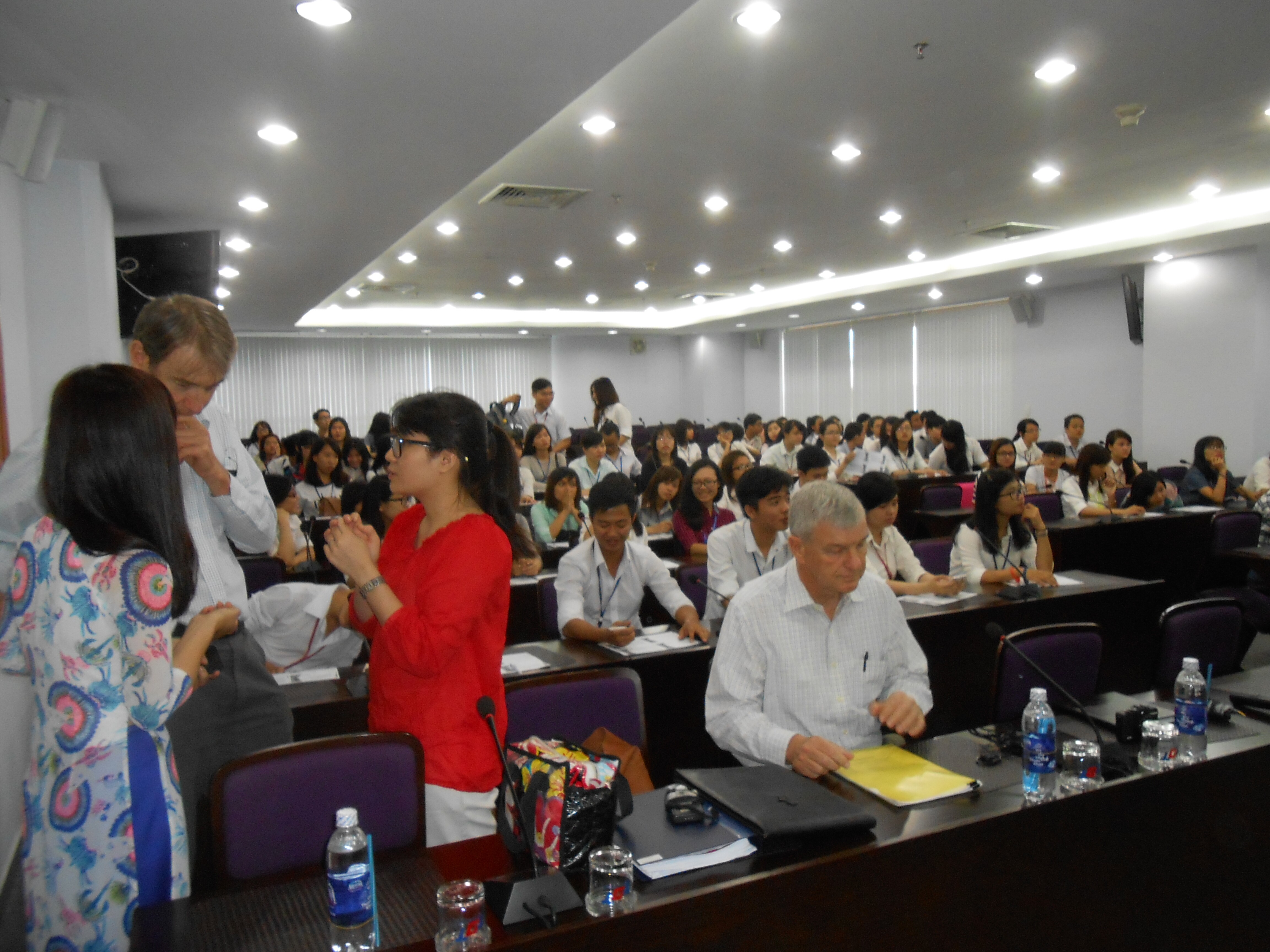
This morning there was a presentation to the faculty and students of the Labor Relations and Trade Unions faculty by Alan Boulton, who recently retired as a labor board judge in Australia, and Phillip Hazelton, who is one of the ILO country staff in Hanoi. It took place over on the top floor of A Building (presumably the first and oldest classroom building here)in a room that accommodated a couple hundred people, seemingly mostly students, in padded chairs on a raked floor. There was a microphone on the desk in front of each chair. The overall topic was the changing shape of the industrial relations structure in Southeast Asia, known as the ASEAN countries.

Vinh welcomed the speakers, who had brought their own translator from Hanoi. Ms La showed me and Joe where to sit, in the front row.

Vinh, Phi,trans, Alan

Vinh, Phillip, translator from ILO office, Alan

Boulton, who did most of the speaking, said that there is movement throughout the ASEAN countries to raise minimum wages, set up task forces on working conditions, possibly sign the ILO convention on freedom of association (meaning independent unions), develop stronger collective bargaining practices, use more mediation and overall increase support for the structures of industrial relations. In Vietnam, the wildcat strikes are the phenomenon that is driving this movement.

A letter of intent has recently been signed to do an ILO project to support industrial relations reforms in Vietnam in cooperation with TDTU. Phillip is the coordinator of that project.

The ASEAN countries are Brunei, Singapore, Cambodia, Malaysia, Indonesia, the Philippines, Myanmar, Thailand, Laos and Vietnam. Currently, the average monthly wage (presumably full-time) in some of these countries is as follows, in US dollars. He didn’t say whether this assumed that everyone who was working gets at least minimum wage or not, nor did he say anything about enforcement. Then there are all the people who don’t get counted, the informal sector that includes thousands (millions) of migrant workers. But anyway:

Vietnam — $181

Cambodia – $119

Thailand – $119

Laos – $119

Philippines — $357

Indonesia — $607

And Singapore – $3,547

Alan used Indonesia with its $607 per month average as an example of how fast things can change, as part of describing to us what the future may look like in Vietnam.

Alan’s audience this morning was mostly students who are taking these classes in order to become HR professionals with some who want to be union staff or government IR professionals. If these changes take place, the role of HR professionals will fundamentally change. If the changes include the clarification of the separate interests of labor and capital and the appearance of self-organized bottom-up activist unions, HR professionals will become clearly management and no longer likely to also be found serving as the union president.

Twenty years ago, Alan said, Indonesia was one of the ASEAN “Tigers.” The only concern was economic growth at any cost. Indonesian labor relations were under tight central government control. The Labor Ministry regulated employers. Compliance was required. Labor unrest would bring out the police and the military. Union leaders were arrested and disappeared.

Then in 1997-98 came the Asian economic crisis. It brought down the Indonesian government. There was pressure on the new government for change from the World Bank, the International Monetary Fund, the international community generally and from within Indonesia. If ASEAN countries were going to have access to world markets, there were going to have to be some changes.

“Sustainable economic growth is only possible with recognition of human and labor rights,” said Alan. The reason for the changes, he said, is that the old systems don’t work.

An industrial relations system needs respect for rights at work (ratifying the ILO convention on freedom of association, for example); effective labor market institutions (labor ministries, employer organizations, union movement organizations); dispute resolution practices and workplace cooperation. Challenges that face implementation of dispute resolution practices are going to be similar in all ASEAN countries and in fact for Europe and the US, too: you need good dispute resolution practices on all levels, both workplace and higher up (between union, employer and government, tri-partite level); strong labor inspection services; well-resourced mediation and conciliation services, and an adjudication/arbitration system with labor courts or tribunals.

He notes hurdles for Vietnam: The Vietnamese labor movement is quite strong, and in fact is part of the government. However, the question is how much it represents workers and if it is effective.

When he finished, students asked questions about migrant workers, one about wage theft (this from a student who had been staying with Leanna and Hollis) and the biggest challenges for Vietnam.

I raised my hand because I was starting to understand something. The movement toward change in Vietnam is driven by these wildcat strikes. That seems to be something everyone agrees on. These strikes are unpredictable, not authorized by the VGCL, not official and apparently leaderless – or at least the leaders cleverly make themselves unidentifiable. Compare this with the US, where preparations for a strike are public, debated, voted upon and publicized as much as possible. AFT 2121 (the faculty union at City College of San Francisco, that Joe has been a member and leader of for many years) took a vote and set up a very public emergency strike fund, for example. Some unions picket with picket signs saying “Just Practicing.” What’s the difference? One way to explain it is that the threat of a strike has power. If the union has a credible strike threat and the employer wants to avoid the strike, the threat can influence what happens at the table and elsewhere in union-employer relations. Whereas in Vietnam, there is no comparable strike threat. There are strikes, but no strike threat. A strike just happens and the employer loses production until the workers are brought back to the table. In the US, you don’t have the strike as often because the threat is enough. However, in order for the threat to be serious, the union has to be really strong and well-organized and it has to be a real threat. It’s true that real strike threats, not to mention real strikes, have been on the downturn in the US for decades reflecting unions’ shrinkage and weakness. But when strikes happen, they take place with lots of preparation and pre-publicity.

Vietnam: Strikes, but no strike threat. Unless you consider overall labor turmoil a general threat (and it’s having that effect, apparently).

US: Strike threat, but not necessarily a strike.

There are points at which organizing a strike threat has a lot in common with civil disobedience. I keep thinking of the Pittston coal miners strike. The message that civil disobedience sends it that unless someone (the employer, for example) stops doing something, violence will ensue. It’s a threat of violence but the violence will be performed by the other party, not by the people who are doing civil disobedience.

This relates to the collective bargaining scenario that Joe and I have written and sent to Vinh for translation, and which we will be running in about a week for a requested open simulation series. This is the first of 6. After asking around (Leanna and Hollis, Jan Sunoo) for some advice, we decided not to use any of the existing role plays that we’ve got but to write one specifically about bargaining for union power. So although it’s about pay, it’s about the structure of pay and it’s really about moving from a pay structure (piece rate) that undermines worker unity to a pay structure that unites workers (hourly). It’s based on a real situation that I encountered in Chicago, with the PACE Paratransit workers. Their employer was trying to move them from hourly pay to pay-per-passenger, and the union was in an uproar about it. They understood clearly that moving to a piece-rate system would be a threat to union power. They saw themselves as a body of workers who were essentially extensions of the healthcare system, moving disabled passengers from home to social life to medical appointments, sometimes even doing medical services, often working with people who were confined to electric wheelchairs. They were proud of this aspect of their work. Pay-per-passenger turned them into taxi drivers, solo operators, encouraged hurrying, undermined their identity as doing a socially necessary job that required more skill than just covering a route.

So this scenario takes this single issue and makes it clearly a power-of-the-union issue, including a building a strike threat with lots of preparation and publicity on the ground (getting clients to sign a petition, for example). Of course we begin with the technical stuff like how do you choose a bargaining committee, different roles, note-taking, caucusing, etc.

Listening to Alan and Phillip made me even more confident that we’d chosen the right thing to try to teach in this collective bargaining simulation. It’s not about conflict resolution, it’s about union power.

Exploring #4

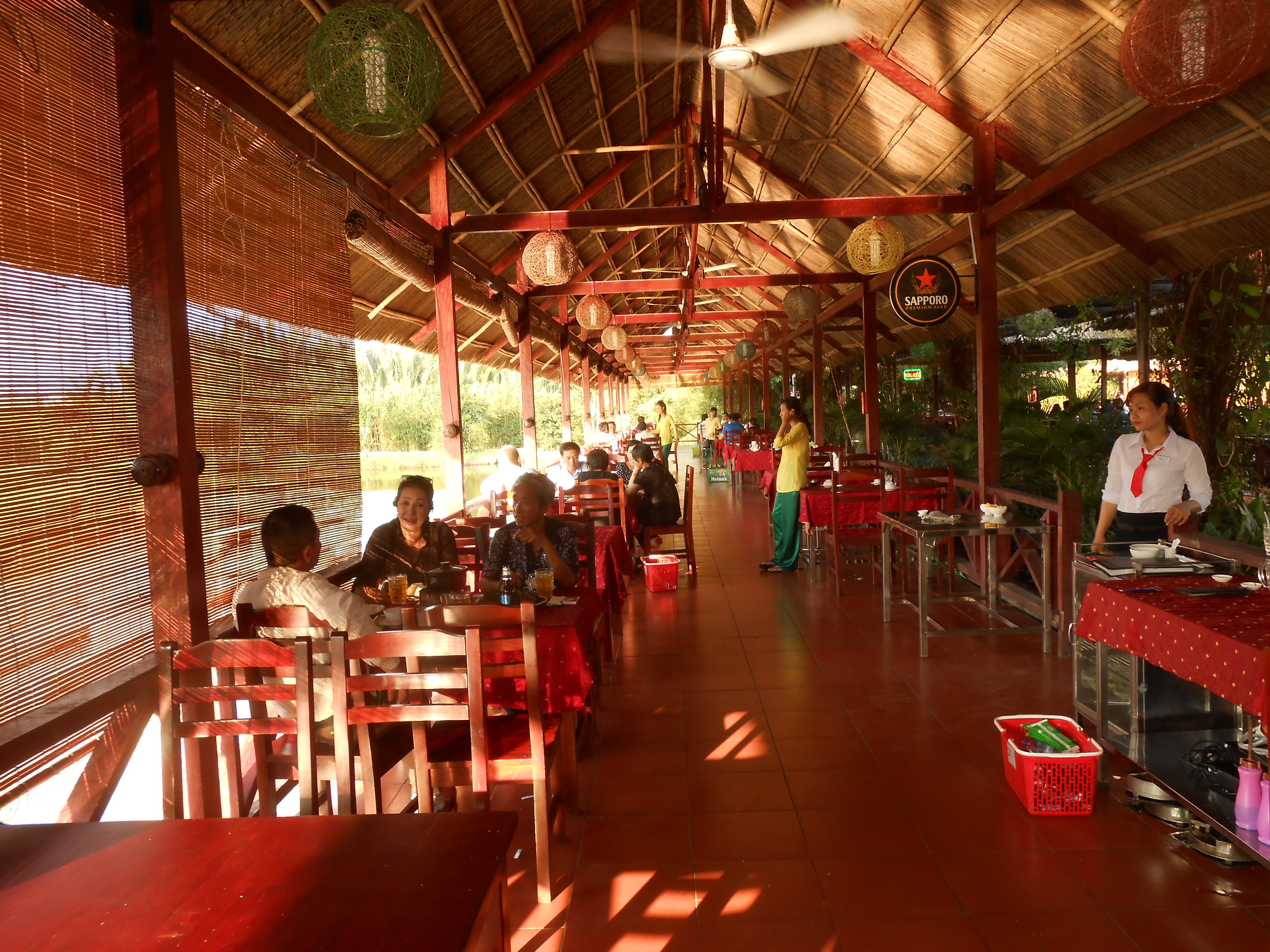
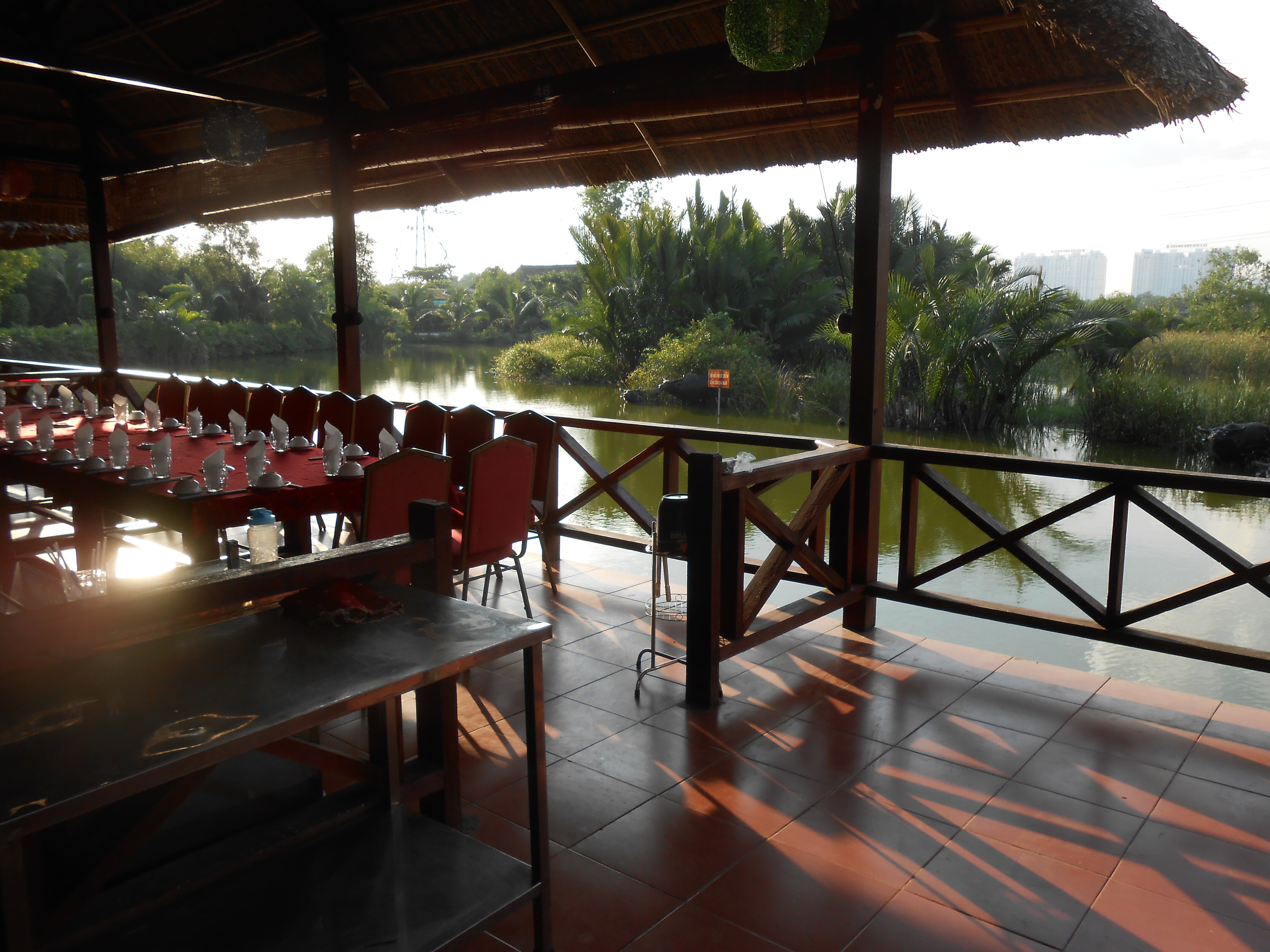
About 5 miles south of Ton Duc Thang (or a 100,000 dong taxi ride) is a place called Binh Xuyen. You eat there, but it’s not like any restaurant I’ve ever seen. It’s a collection of long bamboo pavilions going zig-zag over 5 acres, maybe more, with stocked fish ponds in between them. You can rent a fishing pole, catch something, and they’ll cook it for you. The pavilions seem to go on forever. I never saw all of them; they must be able to seat a couple thousand people. Some are private one-family pavilions. The slanted coconut-leaf roofs are high and big fans move the air. There are lifelike plaster water buffaloes in the ponds. Wait staff ride bicycles and go on roller blades.

Pavillion

Binh Xuyen has two locations, apparently. This one has been here “for a long time,” says Mark, who brought us here. His Vietnamese name is Tuan Nguyen. It is a traditional eating place that fills up on holidays and dates from back when the fish ponds used to flow into rice paddies. Now, along the divided boulevard that leads down here from the city, high rise apartments that will sell for $100,000 are sprouting up. You look out over the fish ponds and the wetlands, and see construction. This is where the new South Saigon will be.

Hi rise over rice paddy

Mark was born in Vietnam, moved to Houston with his family in 1995 when he was in eighth grade, and is now back in Vietnam to “be part of the new society”. He was introduced to us by Dean Hoa as someone who might be helpful with translating. He’s 34, has been here only ten days and has two jobs already, teaching English. In Texas he played keyboard in a Vietnamese pop band and toured Canada.

At our request he asked the young woman who waited on us some questions about her working conditions. She made 3.5 million dong ($155) per month when she started; she now makes more like 4 million. Our meal cost 995,000, or a quarter of her month’s wages, just for comparison. She works from 8:30 am to 12:30, then has two hours off, and back to work until 9 pm. On Sundays she works a double shift (although how that can be, I don’t know). It’s seven days a week. If she doesn’t take either of her allotted two days off per month, she gets a 500,000 dong bonus. She gets one meal from the restaurant every day. She and her sister came from the country and share a room. She does not get paid at the legally required higher rate for working overtime. This is “the new society.” Although Mark was generally familiar with how people live here, he seemed shocked by this specific example.

Joe and I have found that you can actually read the labor news, Lao Dong newspaper, published by the VGCL, , on line using Google translate. Negotiations are going on right now to raise the minimum wage. In fact, from what I can tell, it has happened. The Vietnam Chamber of Commerce opposes it, saying that 70% of all business in Ho Chi Minh City are not making a profit.

http://nld.com.vn/cong-doan/dung-cho-nguoi-lao-dong-an-banh-ve-20150902100642291.htm

The law on overtime is, like the rest of the labor code, very prescriptive. Here is what it says about overtime:

Article 104: Normal working hours

Shall not exceed 8 hours per day or 48 hours per week (Hazardous work 6 hours per day).

Article 105: Working hours at night (defined)

Work that takes place between 22 the night before till 6 am the following day. (8 pm – 6 am)

Article 106: Overtime work is work that takes place anytime outside of regular working hours.

Employer can request overtime with:

  1. Employee’s assent (Under what conditions can the employee decline to consent?)
  2. Must not exceed 50% of regular hours worked (ie, 8 regular hours plus 4 OT hours. No more than 12/day, 30/month, 200/year
  3. Must provide compensatory leave after “certain number of days of OT”

The following is summarized, not copied verbatim:

Article 97: Wages for overtime and night work

Time and a half for OT on regular days

Double time for OT on weekly day off

Triple time for OT on holidays or paid leave days

Night work: 30% of piece rate in addition to regular rate

Night work OT: OT plus additional 20% of regular rate

The pay for the young woman who waited on us at Binh Xuyen violates the labor code in several ways. For example, she works 7 days a week (7 x 8 = 56 hours) but does not get paid overtime for the hours above 48. It also looks as if she works 10 hours a day, not 8, even subtracting her two hour lunch break. So it’s 7 x 10 or 70 hours per week. Plus she does some night work.

However, enforcement of the labor code is not something you count on.

It takes a lot in any culture for dissatisfaction to rise to the level of a dispute. Workers have to get together and agree about what to do and at least threaten to use their leverage, which is always something collective involving their work, their “power at the point of production”. Pervasive violation of the labor code is something that you might think would do the trick. But once you see it and get together with other people and document it, what happens next? In some cases wildcat strikes, as have been common for the last 10 years here.(but seldom in retail or food service or tourism).

How disputes get resolved and how resolutions get enforced is not laid out in the labor code. Instead, it just says that “the resolution of labour disputes shall be initially implemented” – meaning that the dispute shall get resolved, period. And then it says who does that.

Here is the language — of course, it’s a translation:

Chapter 14, Resolution of Labor Disputes, Section 1 General Provisions says:

Item 5. The resolution of labour disputes shall be initially implemented through direct negotiation by the two parties to harmoniously resolve the interests of the two disputing parties in order to maintain the stability of the production, business and guarantee the public order and security.

“Direct negotiation” can mean anything from one-on-one dialog between a worker representative and the employer to a mass meeting. It could be something that was decided on the spur of the moment, oral rather than written, and not precedent-setting. It could also be something formal and structured. The main thing is that in “direct negotiation” parties talk to each other: it is not indirect.

Then, should the “direct negotiation” mentioned in Article 5 fail to produce a resolution, the law sends the problem up the ladder of authority to a third party:

Item 6. The resolution of the labour disputes shall be carried out by a competent agency, organization or individual when one of the two parties submits a request due to the fact that one of the two parties refuses to negotiated, or does not negotiate successfully, or negotiates successfully but reneges on the agreement.

The ‘competent agency” is MOLISA, the Ministry of Labor, Invalids and Social Affairs. It can levy fines, but they are small compared to the money saved by the enterprise by not paying workers what they are due. Some companies simply consider it a cost of doing business.

The law, in other words, is very specific and prescriptive about what the conditions of work ought to be. But the law does not establish a procedure that moves the situation from a violation of the law to a dispute about obeying it, to an agreement that it will be enforced and assurance that the violation will not happen again.

If all else fails, the law does make provisions for going on strike legally, but those provisions are apparently so complex that this tactic is never used. Instead, you get these wildcat strikes.

In our system the levels of actual enforcement (especially in the 90% of workplaces that are nonunion) are not actually much better than Viet Nam, unless workers take some collective action to bring attention to the condition. There is a path in our system through which both labor board violations and labor law violations can end up in Federal Court, but years go by while that process is grinding along.

The Lao Dong website says that there is currently a campaign of training local workplace representatives. There are photographs of large groups of men and women sitting and desks in classes; it looks like the labor extension classes we did in Illinois. I want to know what they’re studying and learning,

We have been asked to prepare a bargaining simulation exercise to be given to about 30 faculty and students next week. We have talked about how and if to try to make the enforcement issue part of the exercise. I am going to suggest that we try something else and stay away from enforcement.

Exploring #3

Saturday afternoon in Ho Chi MInh City

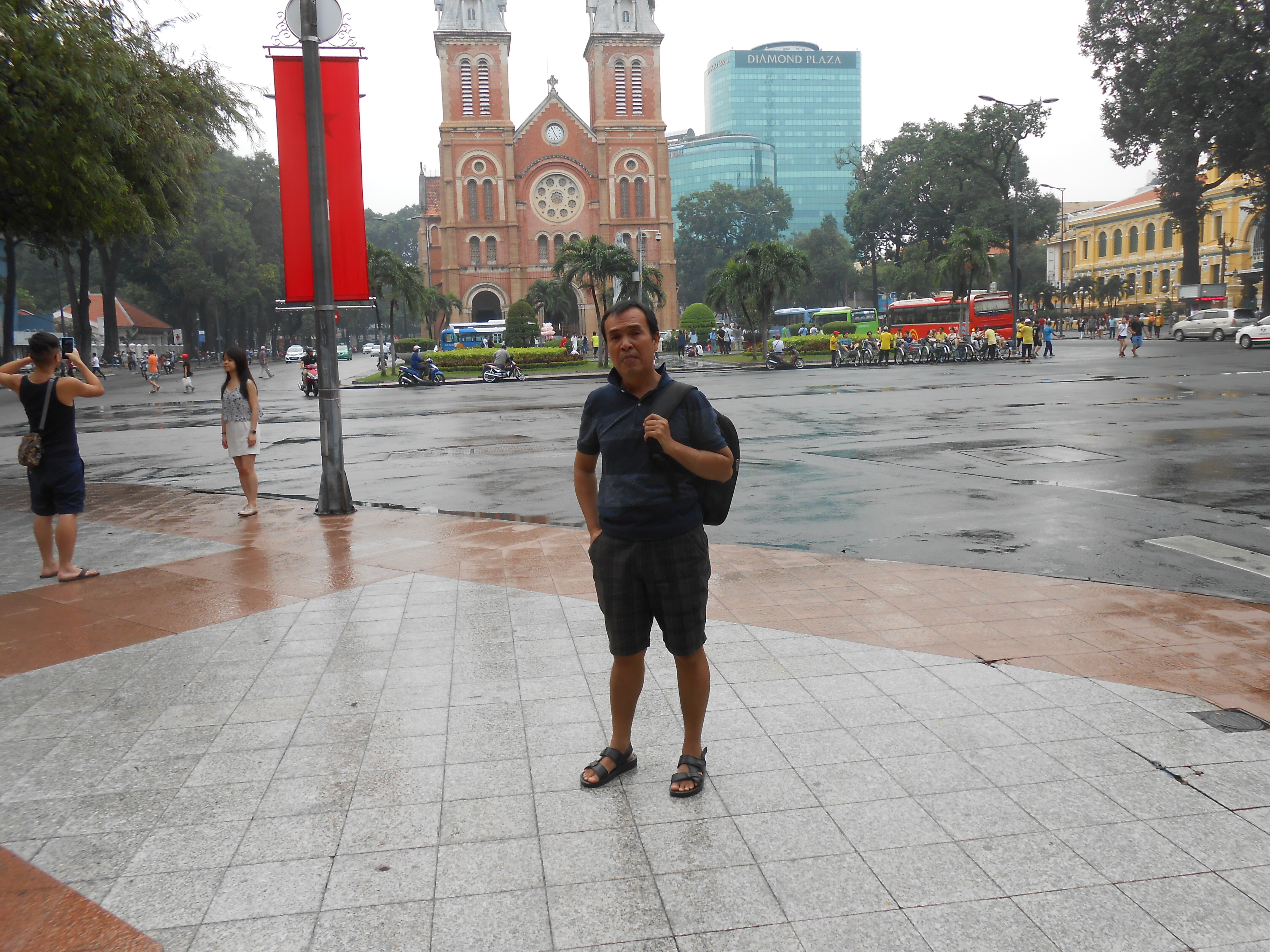
We went into the city on a bus with our new friend George, who lives in the same faculty housing as we do, only #9 (we are #7). He is Thai, the son of teachers, has been in every South Asian country, got his Phd in English Language Studies at Leeds University in Yorkshire and is now here in a tenured position teaching and helping them set up their English language graduate program. The church in the background is the cathedral. On the right, the yellow building is the Post Office.

   New friend George

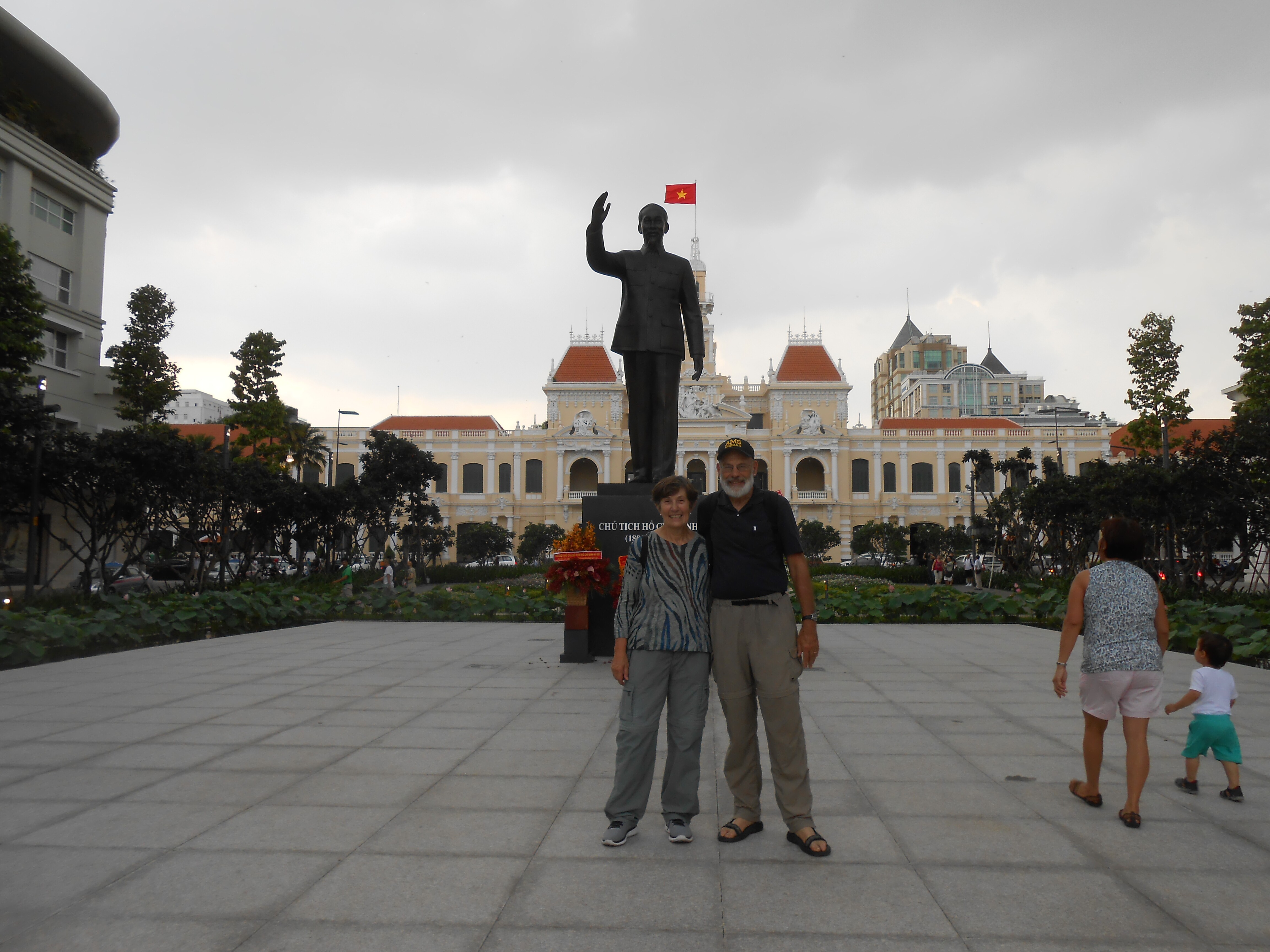
He took us through District 1 to an enormous pedestrian mall where a statue of Uncle Ho looks down toward the river. The mall is bordered by high-end international brand stores: Chanel, Hugo Boss, and splendid hotels. The building in the background is City Hall.

H&J Bap Ho statue

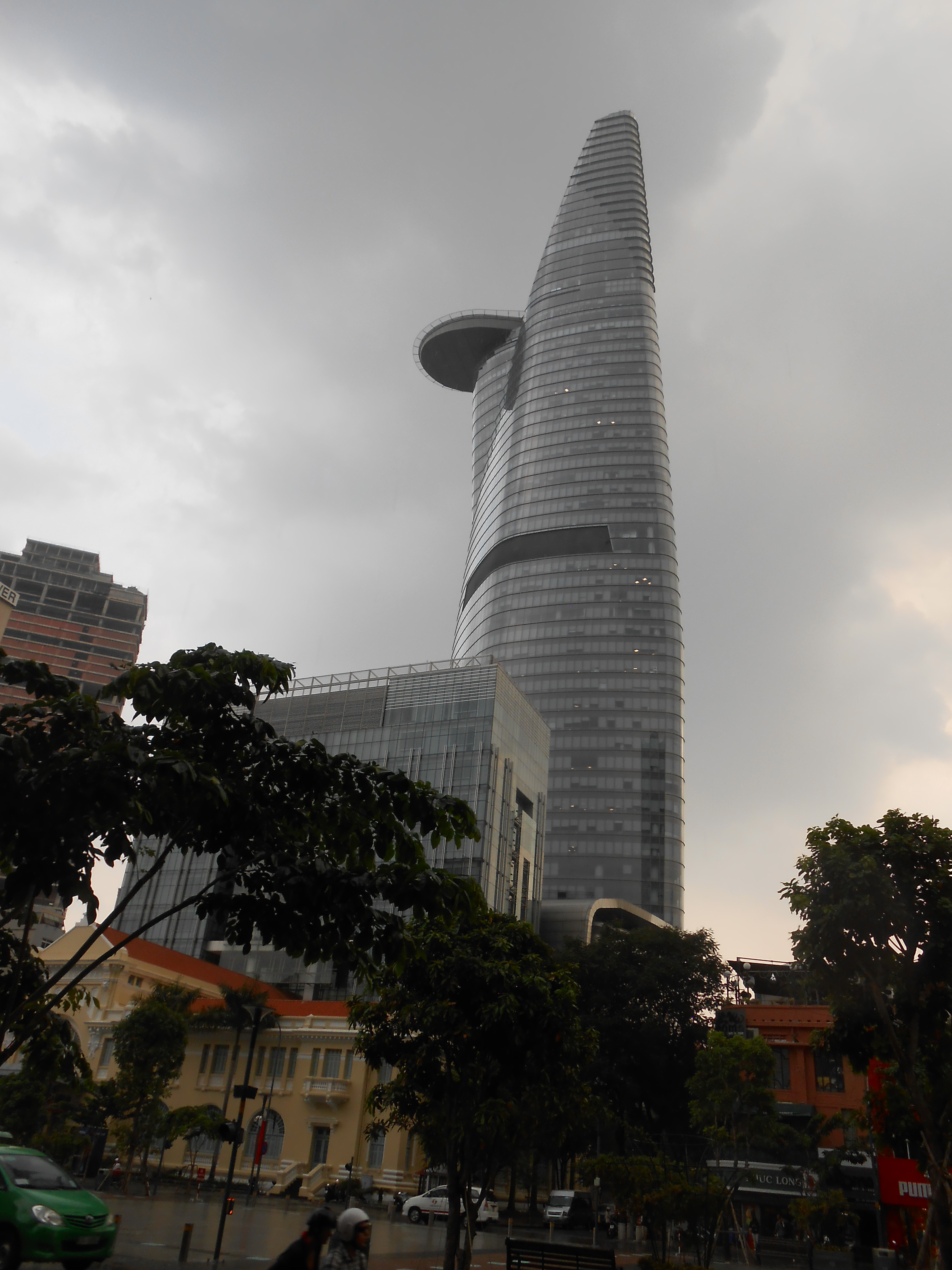
Down the mall by the river rises the spire of what’s called “the lotus building.” Supposedly there is a swimming pool and restaurant on the leaf of the lotus.

Lotus bldg

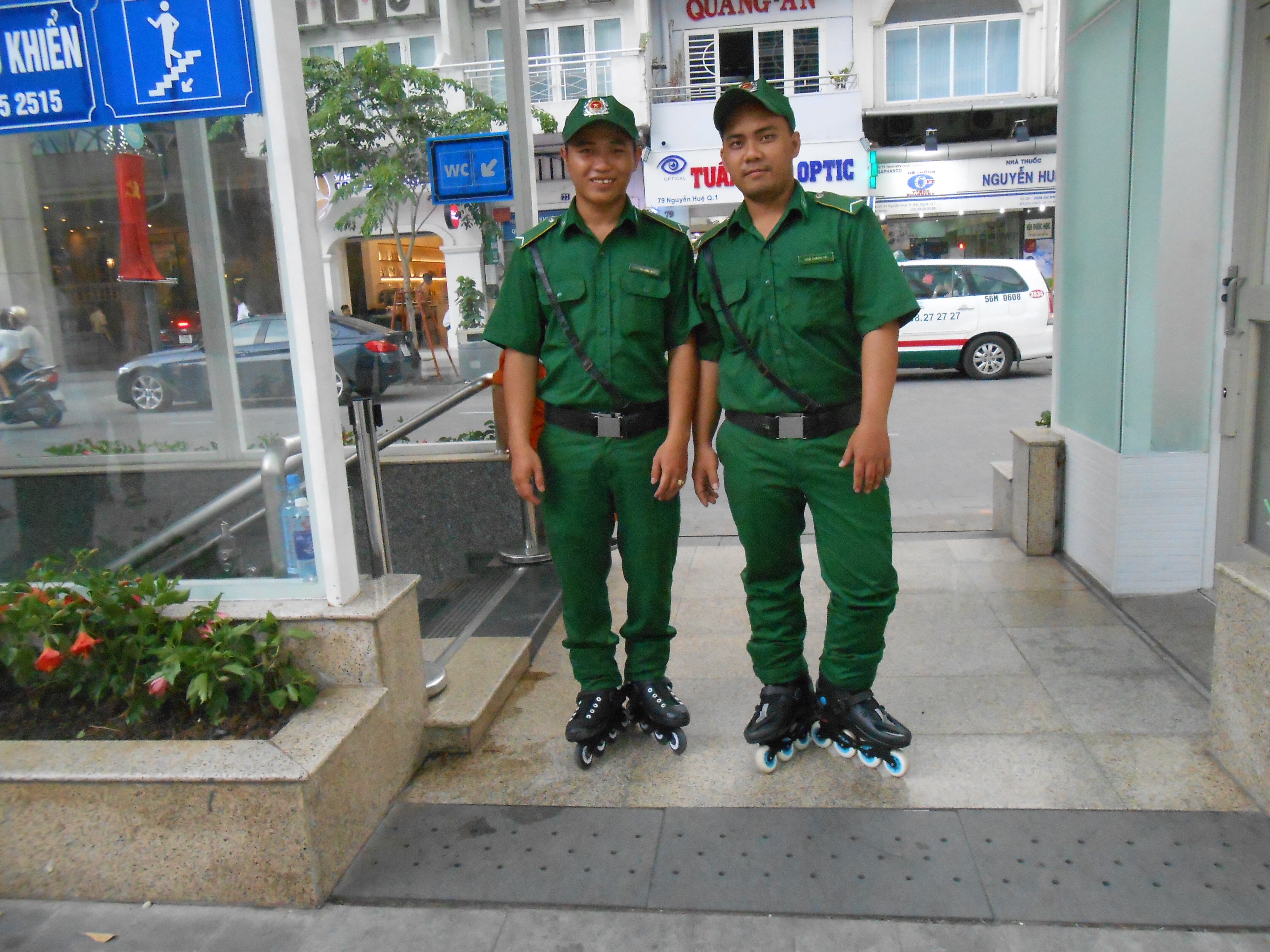
Guards in the mall go on roller blades. No guns – we haven’t seen any guns at all here, except in the War Remnants Museum

Guards on rollerblades

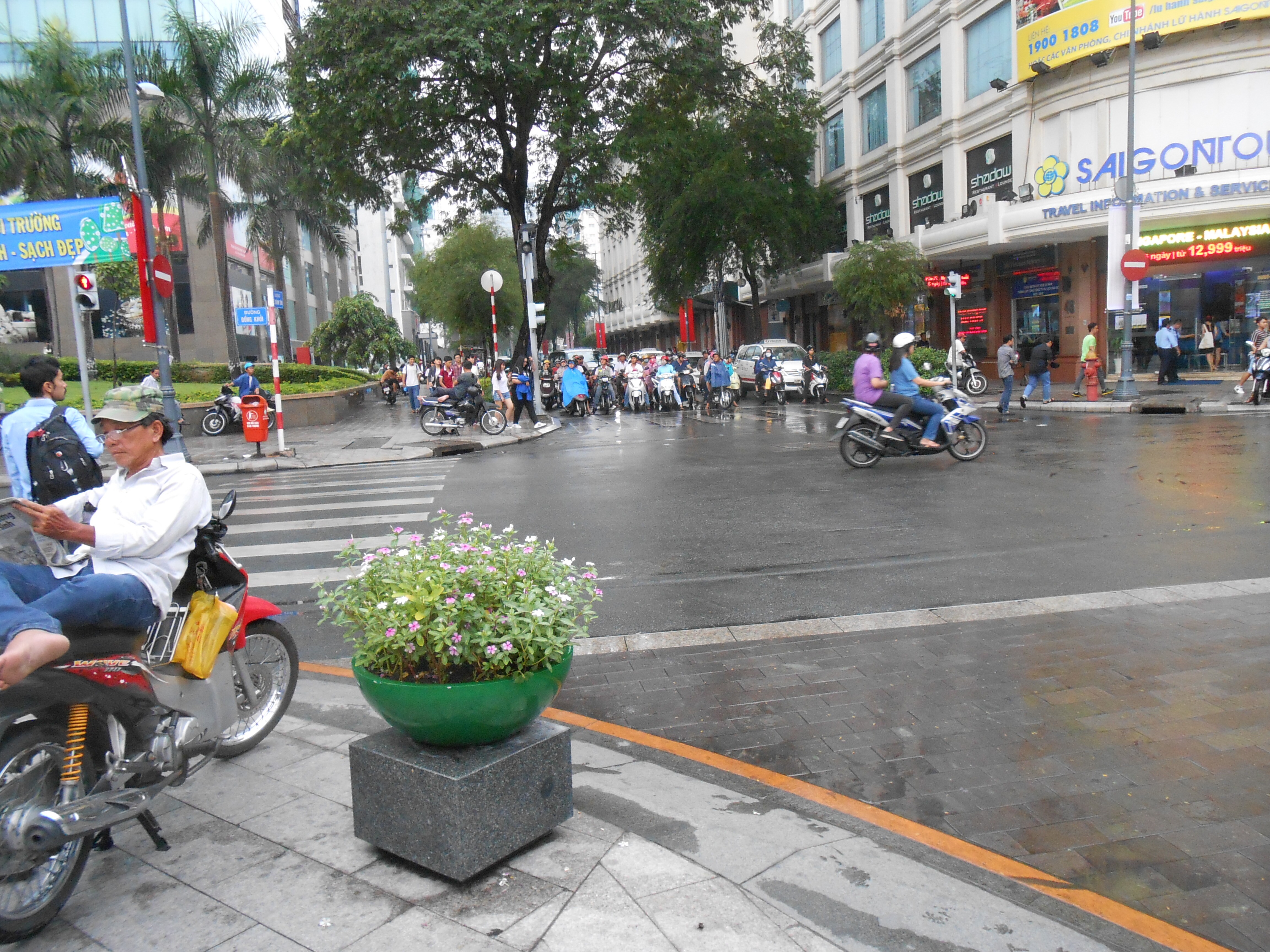
I’m trying to catch the color and flash of the motor scooter traffic, but haven’t really figured out how to do it. There are huge flocks of them, but they go slowly and smoothly and not more than 15-20 mph.

Scooters in intersection

Vietnamese Design

A couple of weeks ago a professor of landscape architecture from Italy, with his huge malamute dog, was here. He stayed a couple of rooms down from us, in one of these spaces tucked under the bleachers of the soccer stadium. He walked his huge fuzzy Malamute dog at night and I presume left it in his room with the air conditioning on all day. I asked him what he thought of the design of the campus and he laughed and said, “It’s very Vietnamese.” Since then I have been trying to figure out what he meant by Vietnamese design.

Based on this campus, I would say that it has to do with extremely efficient use of space. This campus is like a jigsaw puzzle. Twenty thousand students attend here, doing different activities weaving in and out without apparent traffic conflicts. There can be a regional soccer tournament going on at the same time as exams, a musical competition and the arrival of a new wave of students enrolling mid-term.

Multiple uses of space are a theme, too. People play badminton on the road around the stadium, rehearse dances on the apron in front of the gym, eat in the 11th floor faculty dining area carved out of the high roof of the student canteen on the 10th floor, and hold team study-group meetings on the broad covered terrace of the canteen. As is planning the whole thing out in advance, very carefully, which may be a Vietnamese character feature. The academic and administrative buildings are on one side of the canal and the housing and recreation is on the other. Overall, it’s a half-dozen towers, some terraces at the bottoms of the buildings, some roads and a playing field, all in the space of one New York City block. This includes the three gates, which have guard houses and guards at each one.

Although the campus is surrounded by soggy field that drain into tidal rivers, it is built as if it was going to be in the heart of a city. If you look down from the 11th floor dining room onto the open space to the west, you can see a barge pulled up along the riverbank and an excavator unloading the soil on the barge into a truck, which in turn takes the soil out into the field and dumps it, building a curving road. Hollis an Leanna say that when they were here two years ago, it was jungle. With a few months there will be buildings there.

Various 8 or 10-person delegations of students from Denmark seem to show up here regularly. We walk past them between the canteen and our room, Room #7. They are often assigned Rooms #5, #6 or #8, so we see them sitting on the threshold working their cell phones.

The most recent delegation was architecture students. Danes speak English very well. I asked one of them, “So, what do you think of Vietnamese design?”

One of them responded, “They do everything in teams so you don’t see much original creative thinking. They are very good at fulfilling an assignment, though.”

That rang an alarm bell in my mind. They do in fact do everything in teams. Our class has assigned the student projects to teams. I am not really sure how these teams work. We’ll see.


Who are our students?

We got our questionnaires back. Here are the highlights. Take into consideration that there was translation from the English into Vietnamese and then back into English. Mai translated and put it all into an Excel sheet.

Out of 65 students in my class there are 20 young men.

The biggest group, 12, is from here in Ho Chi Minh City. The next biggest groups, 4 or 5, come from Lang Am, Quaang Ngai, Dak Lat, Am Gian and Dang Nai. One or two students came from 17 other cities, with one from Guangdong, China.

One third, or 22, say their parents are farmers. I assume this means that they are people who live primarily from farming, and I think it’s subsistence farming, including growing enough rice to eat. Maybe they grow coffee. This number is a little fuzzy because several students didn’t list their parent’s jobs.

Nine students say their parents are workers. “Employees” is different – five say their parents are employees. We think that means white-collar workers.

All the students who say they are from Ho Chi Minh City say their parents are workers, teachers, employees, and business people. There is one government worker and one in the Army.

Some of the students from other cities – Hai Phong, Dak Lat, Kien Gang – say their parents are in business. But mostly, if there is only one student from a place, that student’s family is farmers.

Two thirds of them (over 40) have never worked. For those who worked in the past, the big job is wait staff: five waitresses and three waiters. They have worked at family restaurants, coffee shops, and KFC, which has many stores here. One worked at Lotte Mart, two worked in fashion shops, one was a “Product Promotion Boy.” Two worked in childcare. One helped her parents plant coffee, one was a handyman and one is a self-employed graphic designer who gets paid “sometimes.”

Right now, twenty one of them are working while going to school. These are all part-time jobs. There is a freelancer, a handyman, someone who works on line, one who works “in the HR room”, one at KFC, two selling coffee, a tutor, a model for a modeling company and someone who works for “an education company.” The others supply actual company names: a food company named An Nam, UMA Furniture, the Von Tron Do Company, Dau Tay Company, Vietopia, Broken Rice (a restaurant chain), a receptionist at World Gym, and one still working as a “promotion boy.”

As far as I can tell, there are no provisions made for being a part-time student.

Of the 21 students who are working, 16 are young women, 5 are young men. Two list their parents as “tutors”, one lists his parents are “labor,” and all the rest of the students who are working list their parents either as “farmers” (11) or “workers” (4). Three didn’t list their parents’ jobs.

None have been in a union or are aware of having been in a union, except for one young woman who is “staff in a Japan shop.”

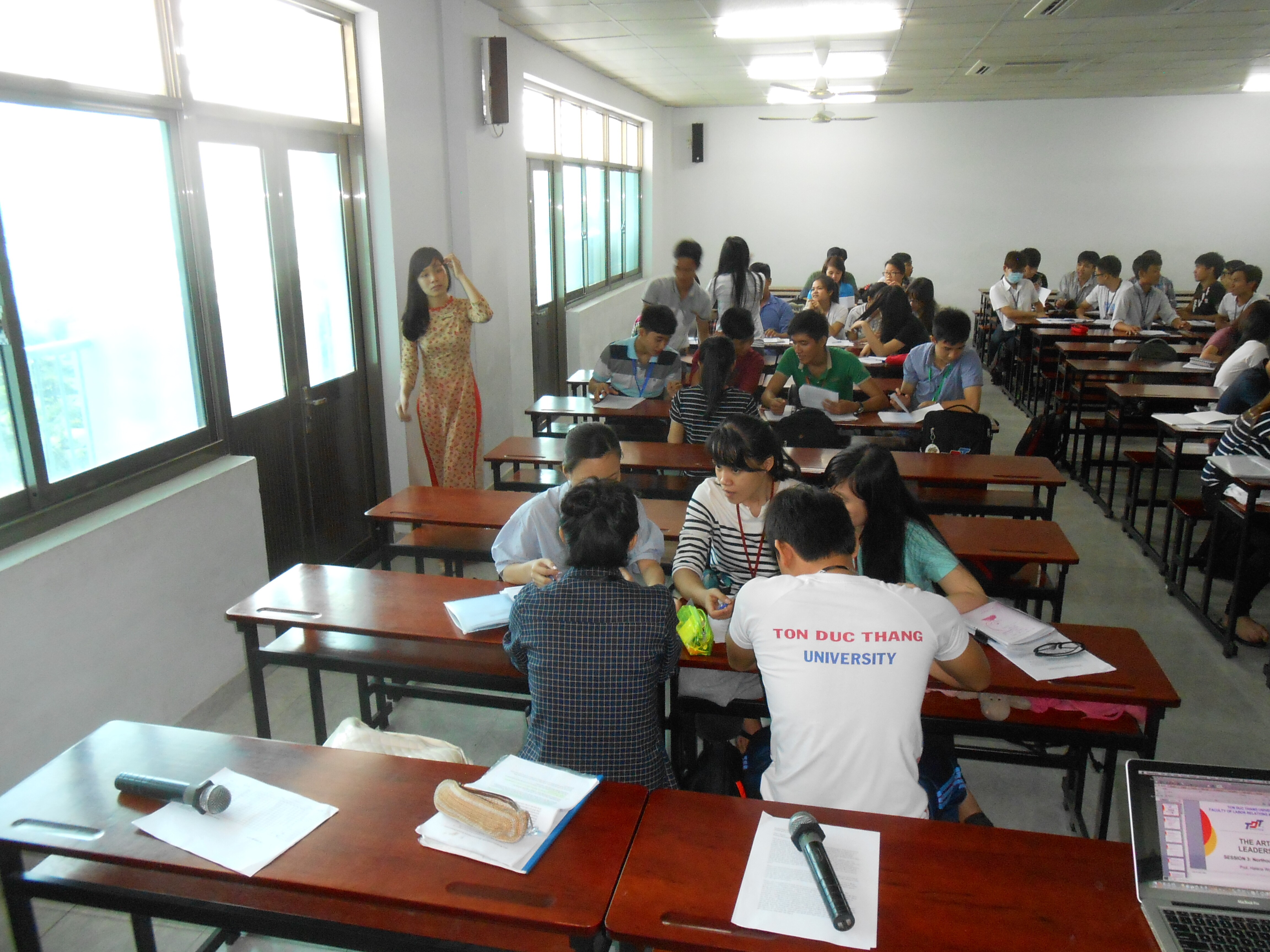
Vinh in my classroom

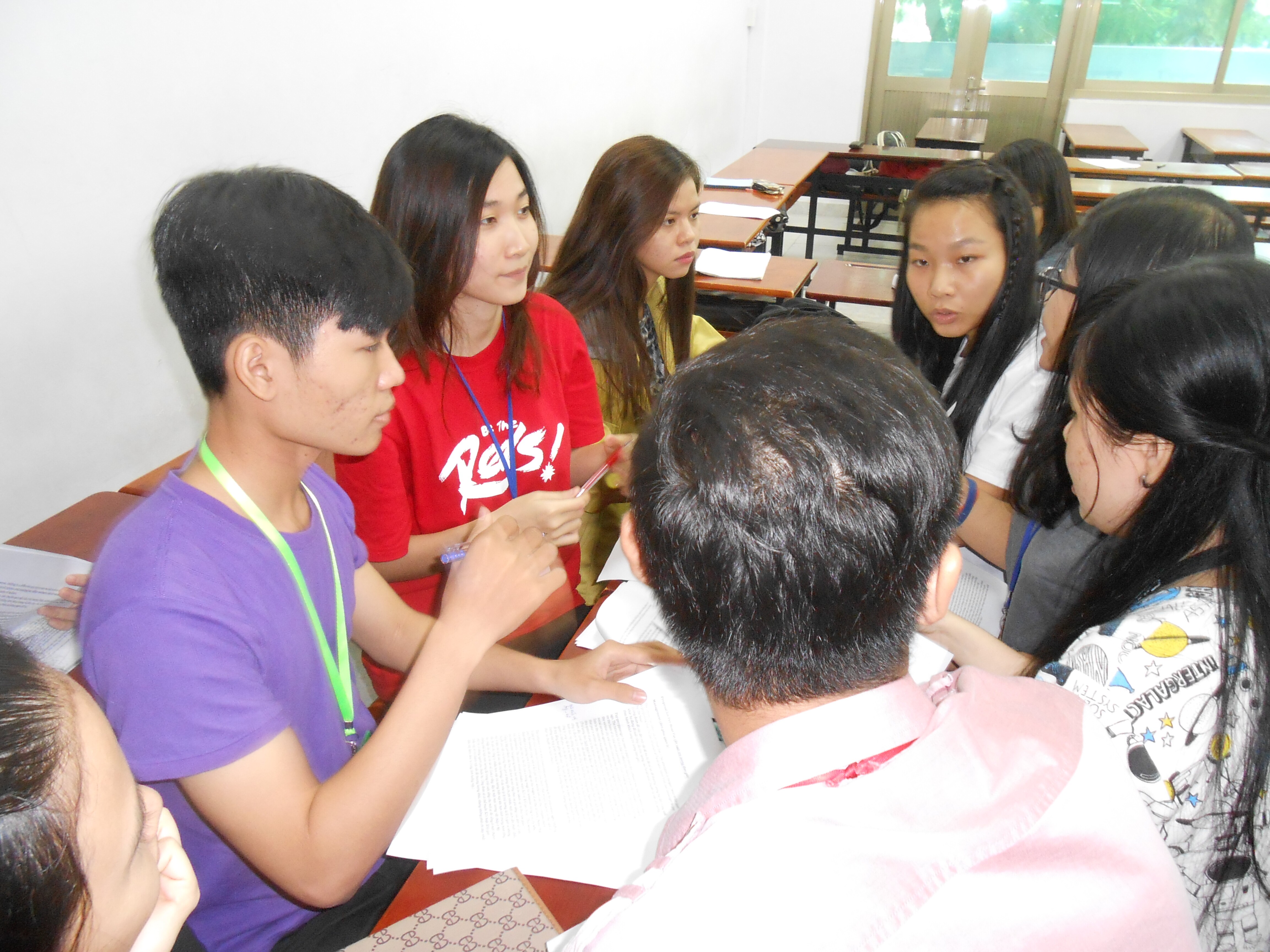
students working in groups; Vinh on the left

They are in the Labor Relations and Trade Unions program because they are generally interested, it’s a new program, and they want to protect labor rights and work “in the HR room,” which probably means office. They are taking this class because it’s required – oh, they also want to learn to think like leaders. What do they want from me? They love my voice (1), want to learn English (several) want to learn about the US labor experience (quite a few) and hope that the next class will be more interesting and funny.

So do I.

Starting to Explore 2

Adjuncts everywhere will recognize this:

The office next to ours has a sign, Faculty Lounge, over the door. It’s a square room like ours with glass interior walls, a window looking outside, air conditioning and a dozen upholstered chairs around the walls. This is the office for adjuncts. It also serves as an ad hoc meeting room.

This afternoon the archetypical situation of adjuncts was taking place in that room: In one corner, a middle-aged woman was grading papers on one arm of her chair while nibbling her lunch which was laid out on the other arm of her chair. She had a dishtowel on her lap to protect her dress. Her book was open on a chair in front of her. On the opposite side of the room a group of students were meeting about something.

I have often seen adjuncts sleeping in this office. They go to the same corner chair, pull a scarf or a jacket over their head, and lean against the wall for a nap.

We’ve been told that many adjuncts in the Labor Relations and Trade Union Faculty are union staff.

——————-

The immediate problem in labor relations (the term for the system of which “earning a living” is a part) Vietnam is these wildcat strikes. Quynh Chi Doh writes, probably in 2011, in The Challenge from Below: Wildcat Strikes and the Pressure for Union Reform (available as a pdf download from the web, just google it):


Wildcat strikes have become the central issue of Vietnamese industrial relations in the last five years. According to the official statistics of the VGCL, there were over 1,900 strikes reported from 1995 to 2007, and over 1000 strikes from January 2007- July 2008. As can be seen in Figure 1, strikes abruptly exploded in early 2006 and peaked in 2007 with 541 strikes involving over 350,000 workers.[12] As of August 2008, more than 400 strikes have been tallied. Strikes occurred first and foremost in the foreign-invested enterprises in labour-intensive manufacturing industries such as textile-garment, footwear, wood processing, electronics, and seafood processing (Figure 2).

A later document by Erwin Schweisshelm, from the Friedrich-Ebert Foundation office in Hanoi, gives updates with a graph of the wildcat strikes through 2013. See http://www.fes.de/gewerkschaften/common/pdf/2014_09Vietnamese_TU_in_Transition.pdf   He explains why there was a drop in the number of strikes in 2011 and what kind of progress toward an increased minimum wage there has been, among other things (read it). Friedrich-Ebert is a private German cultural and educational foundation associated with the Social Democratic Party.

Angie Ngoc Tran writes about the fundamental contradiction that motivates these strikes:

In Vietnam, the state centralizes control over both labor and capital, and it grants exceptions to accommodate global corporations’ demands, consistent with Ong’s “neoliberalism as exception.” …Moreover, the Vietnamese state maintains control over all facets of labor-management relations to ensure the labor peace and flexibility necessary for on-time delivery of goods for the global supply chain. But the state often – though not always – does permit the labor newspapers and local labor unions to report on predatory capitalist practices (pg. 262 of Ties that Bind: Cultural Identity, Class and Law in Vietnam’s Labor Resistance).

The contradiction is between ensuring on-time delivery of goods for the global supply chain and ensuring labor peace. Push too hard on the on-time delivery of goods, at a price that the global supply chain is willing to pay, and you get strikes. You lose labor peace. And if there is no active union which can choose an effective way to strike legally, these will be wildcat strikes.

If I re-wrote the first sentence of the paragraph above to say, “The contradiction is between ensuring on-time delivery of goods for the global supply chain and ensuring a decent wage for Vietnamese workers,” see how different that would be? However, that’s not what is going on, according to Angie Ngoc Tran. The focus is on addressing the wildcat strike problem to build legal, manageable avenues of dialogue that will enable resolution of the most urgent strike issues: labor peace. This involves education and training.

I think that this is where Joe and I theoretically have a small role- ensuring labor peace. Not, at least not directly, in ensuring a decent wage for Vietnamese workers.

Jan Sunoo, the ILO mediator who provided us with a Dropbox full of materials, included a guide for mediators who are going to talk to workers and employers where there is a wildcat strike. After the strike is settled, it says:

Most likely, the strike could have been prevented if the company had good ongoing communication with workers facilitated by an active union and active social dialogue mechanisms. Recommend training by the upper union or VCCI/VCA or IRASC or DOL to put such mechanisms in place.

This guide says the way to avoid wildcat strikes is by developing active local unions and training upper union officials and other government officials. That will certainly increase the capacity of local and upper level unions.

So what’s visible to me now is one prong of a plan, a strategy to deal with wildcat strikes by developing active local unions and training people.

My next challenge is to try to correlate this with what the students appear to know already. One problem (not the only problem) is that I do not know what they know, and that’s usually what a course starts out with. If it’s a course in a regular curriculum, you know what the pre-requisites are if there are any. If it’s an extension labor ed class, you find out in the first class. Here, my ignorance about the lives of my students is compounded by the language barrier.

But whenever I get a glimpse of what they know, it looks as if they know a lot. The young woman who came to my office to return the book certainly knew a lot about what the situation is. The students who made lists in Joe’s class about what people want from their local union certainly were clear about what local unions ought to be able to do.