Halong Bay

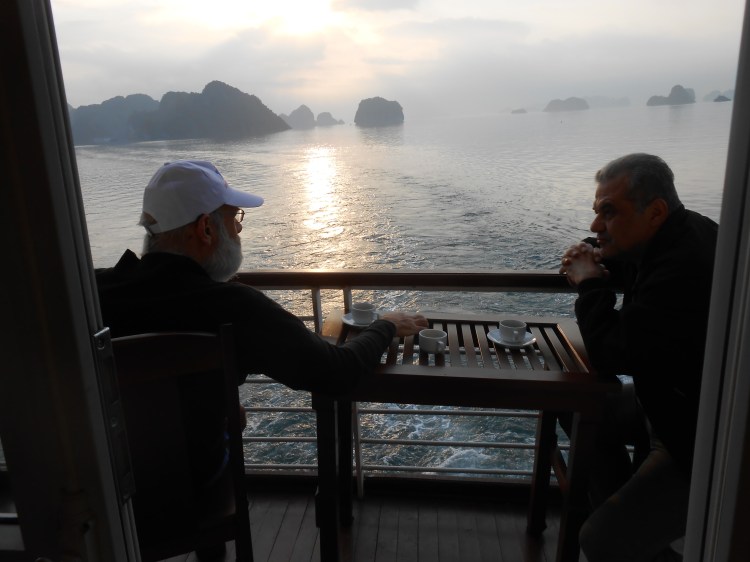
Joe and FaroukJoe and Faruk, having  a discussion.

Our last adventure in Viet Nam. We left Hanoi and went to Halong Bay, about 3 hours east, and got on a little cruise ship (about 30 people) and spent 3 days and 2 nights moving around through the most amazing gorgeous seascape I have ever seen, beyond imagining.

I will confirm this with pictures, but here is something I want to say that can’t really be done with picture: we had discussions. Some of them went farther than others. The other travelers were mostly young, many in couples, but some families, and English was the common language, with Germans, Swiss, Swedish, and Turks all speaking “global” English well enough to do pretty much anything they wanted with it. So we discussed things. At first I couldn’t figure out what was different, but then I realized: the center of attention was some topic (not just “Where are you from?”) and we were actually discussing it. Corruption in Viet Nam (an Aussie who runs software for mall tenants), virtual reality (an Argentinian who has just quit his job in a Maltese online gambling operation), academic standards at European universities, climate change, the tourism industry (Swiss), just for example.  This was not just one-on-one, it was the whole table. Eventually we spent the most time with a family from Turkey. Both the father and son were adept in English and wanted to talk politics, which led to long conversations. The mother was reading a book by Ursula LeGuin, in Turkish.

Throughout, I had the sensation of doing something I hadn’t done for months: a group conversation with each person putting in a piece, the whole thing adding up to more than the sum of the parts; none of us having the power to implement any of the big ideas on our own, although the Turkish father explained clearly how he does his activism.

It was not just because we all spoke English, although who knows? Unless I learn Vietnamese, I can’t know.

We leave for San Francisco on Cathay Airlines, tomorrow afternoon. I have very mixed feelings about leaving Viet Nam and the people we have made friends with. We will probably try to come back. We’ve been invited to come back and work with the War Remnants Museum in Ho Chi Minh City, where the combination of labor and anti-war work interests them. We have also been invited to come back to Ton Duc Thang. Right now I find that I can look neither forward nor backward very clearly. Saying goodbye feels like something that is happening to me; all I have to do is wait, and I will be on the plane. Coming home, saying hello, is something I will do. I can’t wait to see the kids and my brother, especially, who has been ill. But doing these both at once is complicated. That’s why it’s nearly noon, Friday February 12, and I am still sitting downstairs in the empty restaurant of the Charming II Hotel at 32 Hang Ga Street in the Old Quarter of Hanoi, typing on my computer instead of going out and walking to all the places I want to remember — Hoan Kiem Lake, the Temple of Literature, the Citadel, for example.

Onwards. Actually, Joe and I have a lot of work to do on our handbook, the compilation of all the modules we wrote for our students, which have been translated and will form a new curriculum for the post TPP labor classes.

Halong from Cave

Our boat, the Cristina Diamond, one was on these white boats. It was great. 


Floating village

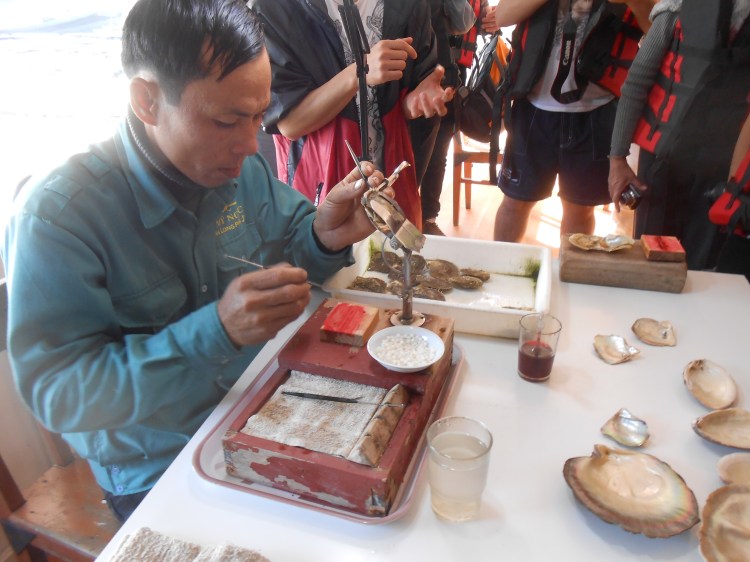
A floating village. Not many of these left. One of them grows cultured pearls. The man below shows how they do it: open the oyster, put it in the frame, drop a tiny grain of mother-of-pearl matrix into the oyster, place a small spherical base into it, close it, pop it back in the water, come back in a few months. 

culturing a pearl

Thousadns

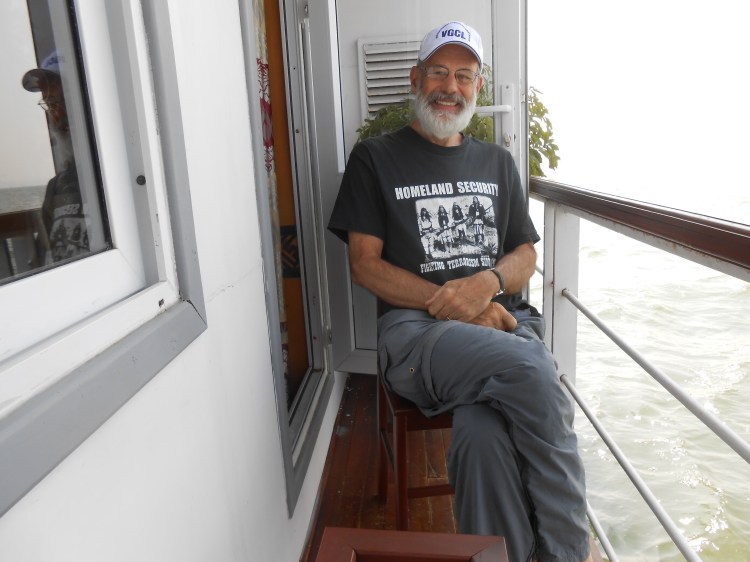
Setting sun breaking thruJoe on balcony boat

We had a great time.


Hanoi, discussions

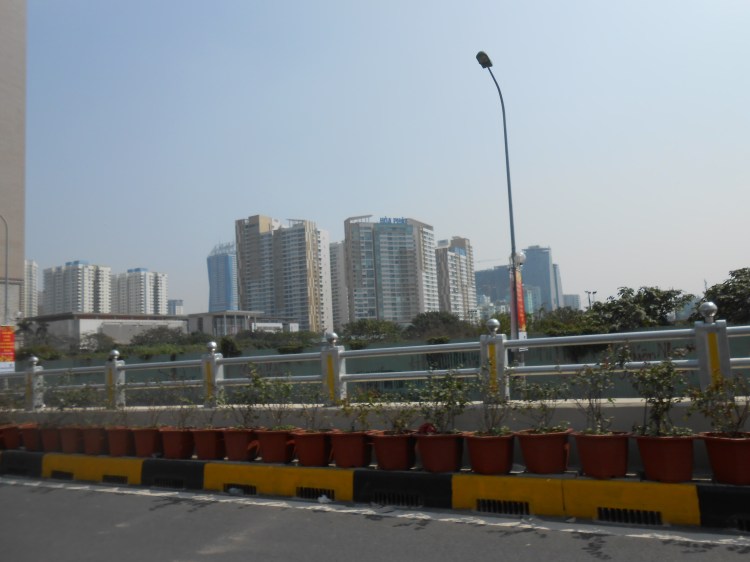
Apartm 1

Tuyen drove us around the north side of Hanoi on what looked like a new highway. Here is where the new developments are happening: huge apartment buildings that look like “projects” but aren’t. They are expensive and desirable. No streetscape, all high-rise, at least in this picture. This is called “Singapore-style.” Nearby, one developer, Vinhomes, has covered many acres of land with gated neighborhoods villas: http://vinhomes.vn/mua-ban/du-an/vinhomes-times-city

See my post Hanoi II, Realism, back in mid-December, for the painting that captures this.

We had dinner with a young couple who live in this area. These were agricultural lands. (You can still see this; cattle were walking along the road we are driving on, and rice is growing in between the developments.) The permit for their development was rushed through in 6 days, which also happened to be the 6 days before something in the law changed that would have stopped the development. It may have been related to how much the people were being paid for their land. They protested and were met with police action, and when the young woman we talked with tried to find out what had happened — since she had just moved into this development herself – she found herself being questioned by police.

City planning here is the product of centralized decision making. The decision is made at the center: by the time its impact is felt on the periphery, there is no way to push back effectively.

Christy Rogers in San Francisco sent us this link:

http://www.theguardian.com/cities/2016/jan/21/inside-hanoi-gated-communities-elite-enclaves-air-cleaner

Apart 2

What centralized decision making has to do with discussions

Tuyen was showing us something about the city he grew  up in, loves and lives in now. Of all our friends in Vietnam, he is the one with whom, for many reasons, we can discuss the most complicated issues. One reason is of course that his English is very good — not accent-free, but he has a good vocabulary and that comes from reading as well as conversations. You can have a discussion with him, in English.

During the last six months we have talked a lot, with many different people, about discussions. The whole concept of “discussion” is something to take a look at. First we tried to introduce it as something that would happen in our classes. How could we get students to discuss something rather than simply stand up and produce the correct answer to a teacher’s question? How could you get one student to respond to another student, and then a third weigh in, and let the conversation grow until something new appeared that hadn’t existed before?  I think it happened once, once only, that we got a student to respond to what another student said in class. (True, after a student team  made a presentation, students would comment — sometimes several in a row – which was good, but it never was actually a discussion. They said things like “I think you were not serious,” or they’d ask a question and then sit down.) The idea that certainty is on hold while different perspectives shine lights on different sides of something did not get conveyed to our classes.

Then the issue of discussions showed up when we tried to do the “academic workshops” and said that if you’re going to use George Borjas to teach labor economics (even if that is the title of the textbook) you have to situate the text itself in the discourse — the historic and current discussion — about labor economics. The purpose of this is not only to help students take a critical view of the text — who is he, where is he coming from, what does he want, who are his allies, what is the effect of his ideas? – so they can understand what he is reacting to, what he is building on, what the other branches of the tree look like. It is also to enable them to become part of the discourse (meaning the whole conversation, past and present) themselves, so they are not just consuming the learning, they are also producing it. If they are undergraduates, this will help them really become “global people”, as our colleague at RMIT said. If they are hoping to be academics, this is what they absolutely need in order to publish anything, worth reading or not.By publishing, you join the discussion, but in order to do that you have to know it intimately.

This approach did not go anywhere.

Then there was the TPP seminar, and our effort to move the event from being a sequence of papers presented to a passive listening audience to a discussion in which everyone who had an idea would participate. This didn’t happen. People who knew a lot simply sat there, explaining to me later,”I was an observer.” Side lesson for me: being deliberately provocative in a context like that is pointless. No one is going to pick up on what you say and refute it. See my posting of January 14 or so. You will be left hanging, having overstated something or made someone angry, and there won’t be an opportunity to bounce back. (That was partly what was so pleasant about the January 26 discussion when the IT guy and the math teacher started challenging each other. However, we noted that in that event very few if any administrators were present; it really was nearly all lecturers so there was no pressure to get things right.)

Surrounding these explicit attempts to ignite a discussion are the times when we have asked a question about a discussion and either drawn a blank or been told simply “No, it doesn’t happen.” We asked our colleague who is trying to develop an alternative curriculum for the moral philosophy courses, based on human values, if there was any discussion at the levels of government where such a new curriculum would be authorized: she, if anyone, might have been part of that discussion. But she didn’t know anything about it. Even though it would have been appropriate for her to be a leading voice in it!

What’s the problem with having no discussions?

When there are no discussions going on among people at the edges, the decisions that are made at the center come down unexpectedly and make the world seem unpredictable. Even if they are good decisions, even if they are what you wanted, the surprise makes them unpleasant. You feel helpless. It makes life more of a gamble. It’s like picking up pennies on the street.

This corresponds to my sensation of being in a country where walls go up and then suddenly come down. For example, we just found out that the President of the VGCL, Mr. Tung, has made it a condition of VCGL support for TPP that the VGCL have autonomy with regards to both its finances and hiring. (Currently, all union staff is hired by the government — the Party – and then assigned to the union.) These are huge demands, but utterly necessary. But when did this happen? Who knows about it? If TDTU is training undergraduates to become on the one hand, HR managers and on the other hand, union leaders and staffers, is there not a discussion here of which they should be a part?

So what does a discussion look like?

We are so used to “discussions” in the US that we are almost blind to them. It seems as if everyone we know (at least people our age) belongs to a “book club” where you read a book and discuss it. The library organized or supports these, but people also just do it. We go to the monthly discussions around Jacobin magazine, which draws a group of 20-25 young people from all sorts of left political tendencies. Then there are discussion lists, including my academic “home” list, XMCA, which has people from all over the world who have in common an interest in Vygotsky. So discussions are like wallpaper, invisible but all around us.

A good example: Joe found the following talk by Bill Fletcher on YouTube:


Technically, this is a speech, but in this case the speech is  part of a very important discussion. Fletcher is not a government official.He has no authority to made decisions. What he says about what we (the US and the world) ought to do is not going to result in legislation or the sale of a rice paddy to a developer.  But he can, and should, contribute to the discussion because he knows a lot, has a lot of experience, and can frame his ideas very clearly in a way that people can understand and remember. People want to know what he thinks/ So he contributes to the discussion. People (in this case, an organization, Justice Works) invite him to talk (maybe pay him), and he prepares a talk based on what he knows and people come — they probably fill the hall and stand in the aisles — and listen to what he has to say. Then they go off and talk about what he said and disagree or agree, or send the YouTube link to people they know, etc. etc.

The point is that although he has no authority to make any decisions, he can influence what happens by speaking out and shaping the discussion. This is not a problem. Not only is it not a problem, it is actually his responsibilty.

“The discussion” means all the different conversations that people are having, the ones before and after, the ones that refer to this, agree with it and the ones that oppose it. It’s the whole flow. If it’s a big discussion (like, right now, the presidential campaign) then it has many streams and threads and thousands and millions  of people talking to and over each other.  Within that discussion, people are influencing each other, and there will be an outcome that will matter.

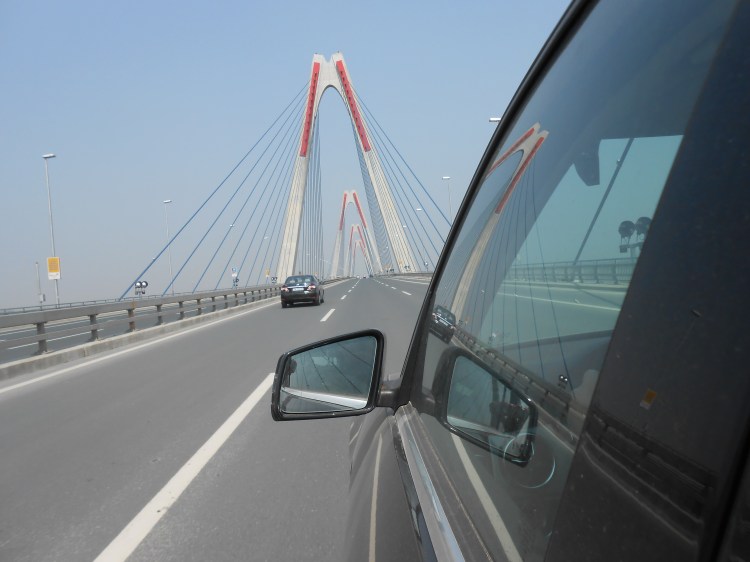
New bridge

New bridge over the Red River on the north side of Hanoi

Can you have too much discussion?

One of the arguments against allowing discussions is that it will confuse the public. Now that Bernie won New Hampshire by 20 points, the dirt is really flying. The New York Times writes articles about what Hillary says about Bernie; that’s the news. The NYT is like an old fat man trying to rise out of his chair to make a speech without spilling his drink. Beyonce seems to have said something political while dancing and singing at the Super Bowl.  This has made other people mad. It’s a mess.

Indeed, this is a problem. I remember when I worked for UNITE in Philly and wanted to used Schwartz’s Legal Rights of Union Stewards for teaching…well, actually, teaching the legal rights of union stewards. The president of the union, John Fox, forbade me to use it because “it will confuse them.”  After a few weeks he agreed to let me take it to the class but not to let them keep the book over night. Eventually, he let me give each person in the class a copy. Finally, they were so un-confused that they actually got it together to perform some direct action that won them their vacation pay, but that’s another story.


Sapa

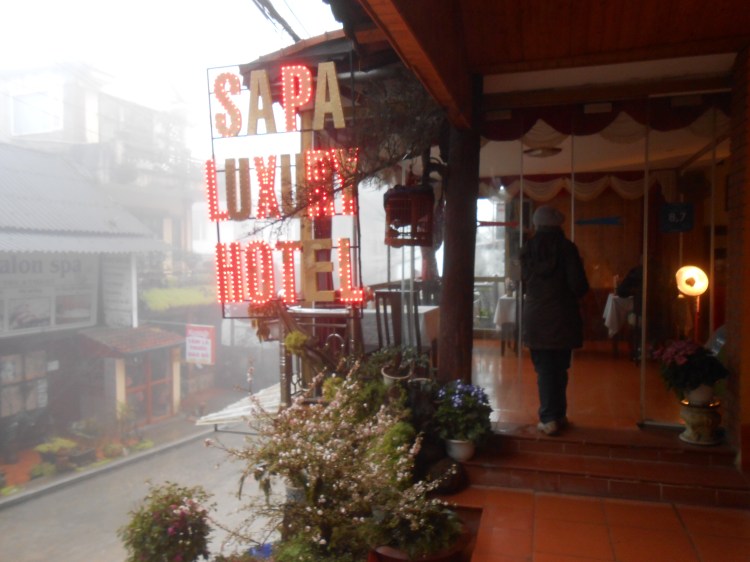
Sapa luc hotel

Looking into the breakfast room at the hotel

The Sapa Express train from Hanoi arrives in Lao Cai at 6:30 am. It’s still dark. There are vans in the parking lot and a lot of talking about who belongs in which van. Then uphill around hairpin curves for about an hour to Sapa. Sapa has been inhabited for many centuries but was “discovered” by the French only in the early 1900s. The French built a train to Lao Cai and a road to Sapa and it became the hill country resort for Europeans, especially the French military, for that part of Indochina.

We have an early check-in at the Sapa Luxury Hotel where there is a scalding hot water shower (adjustable) and an electric bed sheet to keep us warm under thick padded quilts for a nap. Then breakfast and our first expedition with the tour guide, Tuan. Somehow we bought a package from the Charming Hotel II in Hanoi and everything — everything! – is included. Even people to meet us at the train or van and to walk us from the hotel to the restaurant where our meal has already been booked and ordered.

Unusually cold weather

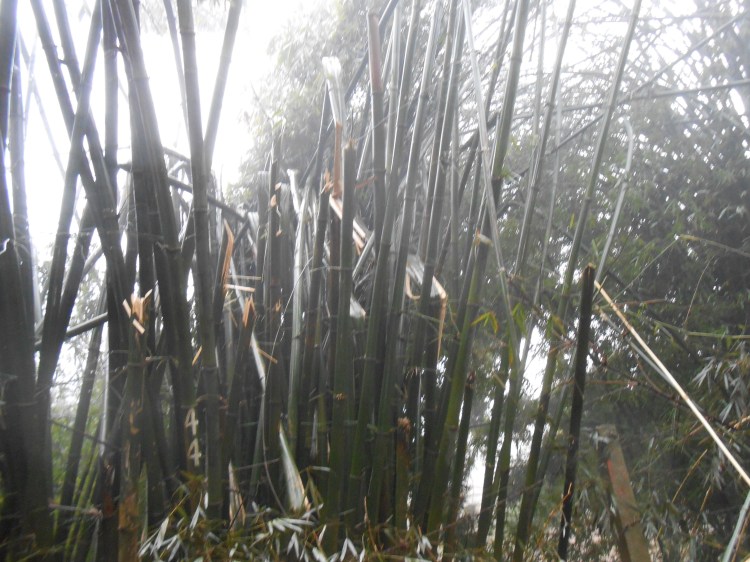
Last week it snowed; people came from all over in their cars, to see the snow, and were surprised to find out that it was also so cold that they could only stay a short while. Water buffalos died. We saw a young water buffalo, dead, tied onto the back of a motorbike. Stands of bamboo broke under the snow.

Frozn bamboo_1

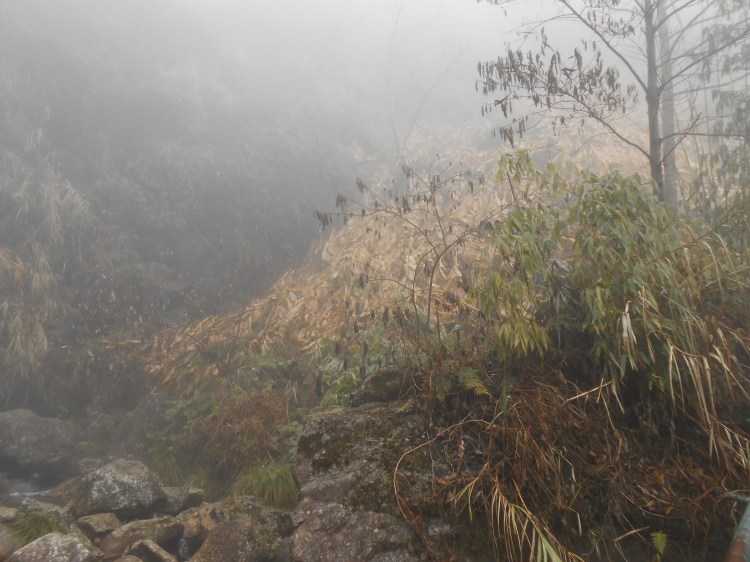
The wilted brown leaves are cardamom, frozen. This was on the way to one of the waterfalls.  (below)

If you have time, take a look at this article, which explains why the this is important as well as a lot of other things: http://www.mdpi.com/2073-445X/4/4/1030/htm

Land | Free Full-Text | “Nothing Is Like It Was Before”: The Dynamics between Land-Use and Land-Cover, and Livelihood Strategies in the Northern Vietnam Borderlands | HTML

Frozen Cardamom

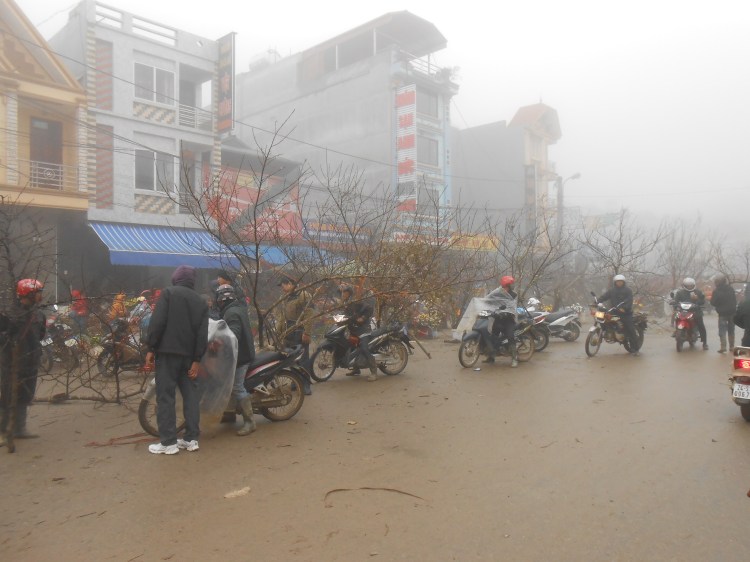
When we arrived that morning the snow was gone but there was cold fog, so thick that I couldn’t really see the roof of the hotel across the street. The fog actually gathers dampness into your clothing. None of the hotels are insulated to deal with this kind of weather. They use plug-in electric heaters, one in each room, but people also wear stuffed North Face-type jackets indoors and out and layers of pants one on top of another. Then, just for good measure, everyone leaves doors wide open which makes sense if you’re wearing your outdoors clothes inside.

Some restaurants where we ate warmed customers by placing a low charcoal burning fire pot next to each table.

This town feels like Gabi’s descriptions of Nepal. Streets are narrow and steep, tourists are everywhere, the shop fronts are either restaurants or selling handicrafts, which means indigo-dyed and embroidered cloth. The heavy fog blankets the ends of streets. Apparently there is a fabulous view of mountains, terraced rice fields and plunging waterfalls but we can’t see it. Go on Google and look up Sapa rice terraces for some ravishingly beautiful landscape photos. The tourists are mostly Europeans, at least near our hotel, which is in a quiet street. The Vietnamese, we are told, like a street with more clubs and karaoke bars.

It is, of course, just a few days before Tet. That means that many of the hotel and restaurant staff have gone  home to their family hometowns, but also that people are coming into the markets to buy food, new outfits, treats and flowers for Tet.

So what about the ethnic minorities?

Here, they are the Black Hmong, the Red Dao, and between 3 and 6 others, depending. Here is my summary, through American eyes: People (foreigners, tourists, including Vietnamese) come here for the cool weather, gorgeous steep mountain landscape of rice terraces, but most of all, to see the ethnic minority people. The ethnic minority people, wearing their traditional costumes and selling their handicrafts, are the tourist attraction. In the last 10-15 years, tourism here has boomed,and new hotels are going up all the time (including one huge government-owned 5 star hotel). But they depend on the presence of the local people in the streets and on the production of handicrafts. The tourism industry and the perpetuation of minority culture are interdependent. For this to work over time, under pressure of the changing economy, the arrangement has to be good for both parties. How much of this can I see with my own eyes?

Foreigners, trekkers and tour guides buy a ticket (about 30,000 D) to enter the area where the villages are. It’s like going into a park in the US.

Our hotel receptionist, who has been working at the hotel for 10 years, says that he is worried that the increasing crowds of tourists will bit by bit destroy the local people’s culture, until there will be only a sort of captive minority performance here, no real villages where real people live.

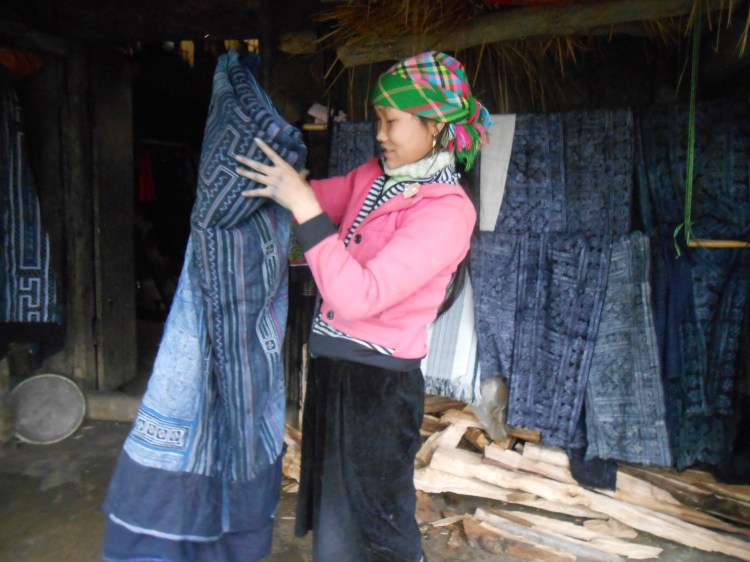
You have to admit that the handicrafts that they make, which are mostly woven cloth, indigo dye, and embroidery, are simply gorgeous and highly desirable. They make great gifts and are easy to pack. Indigo scarves were selling for 200 dong or $9. I bought a big embroidered tablecloth (see below) for 900 dong or $45. But the price that is right for the market does not equate with the hours of labor required to do the work. No one earns minimum wage making these handicrafts.

Our guide told us that many of these goods come across the border from China where they are made in factories; you can tell by the small stitches. Lao Cai, where we got off the train, is right next to the border. From there, no passengers into China, only freight, but you can walk right up to the border. Some Belgians we shared a cabin with on the train told us they went to the border to look, and saw a city of high-rise apartments right on the other side and many well-dressed Chinese crossing the border to shop in Lao Cai market.

On our second day, Tuan, our guide took us to the Sapa ethnographic museum which is where a handicraft club meets. This may be a link to that club: http://muonghoa.com/about/   The goods in the museum shop showed signs of having had some trained design work: beautiful wall hangings, clothing, things that were not available on the street. Prices were still low, though. Upstairs there was a museum of photographs of early French resort development, and meeting rooms as if for classes.

But what about minority people in other areas, far from Sapa? Places where no tourists with money arrive by the vanload and get trekked down into the villages? For example, the province to the southwest of Lao Cai, Lai Chau, is supposed to be the poorest and most sparsely populated in Viet Nam. Immediately after 1954 it was an autonomous area. In 1975 it became a province, but then Dien Bien (including Dien Bien Phu) was carved out of it in 2004. It is the home of ethnic minorities who speak four different language groups. Its economy is increasingly industrial: bricks, liquor, cement, and rare earths to be exported to Japan. Twenty percent of its roads are paved. How about these people?

On the other hand

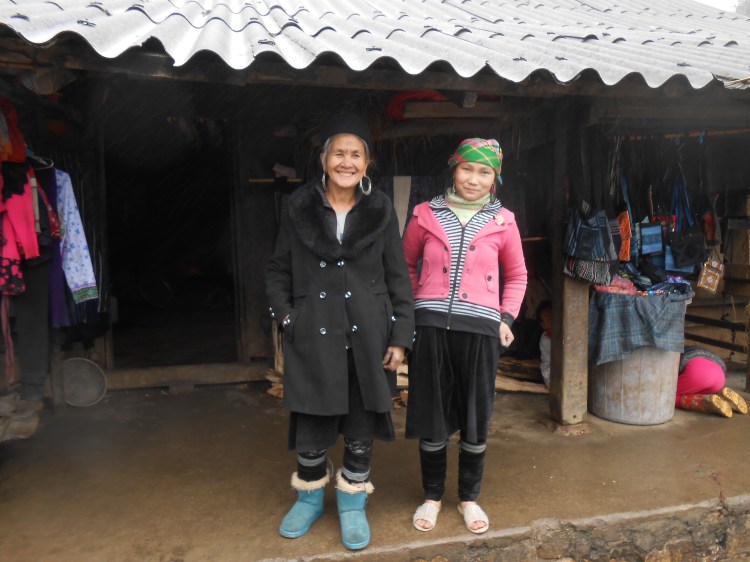
In the villages near Sapa, the Hmong and Red Dao people (the ones I could identify) are very handsome and look healthy. The children especially look healthy, wrapped up in what could be snowsuits and carried in slings on the backs of women who are out selling. Boys play rambunctiously up and down the stone staircases and go “Boo!” at tourists; girls stay near their mothers. The women especially wear the traditional black clothing layered with embroidered belts, tunics, sleeves, vests. Men wear the black knee-length trousers and a black cap. See how I fall into the ethnic doll description?

The minority villages have electricity (although very low-watt, not enough to read by), fresh water that comes in pipes and has been put through a purification process (although one must still boil it), concrete paths wide enough for trekkers and motorbikes, and schools. We saw three or four schools. We saw a little boy running to school carrying a textbook with the title, “Eureka!” These are all provided by “the government.” The government brings the cement and rocks and earth to make the concrete paths (like the ones in the Mekong). The local people build them. If these paths were just mud, life would be much harder.

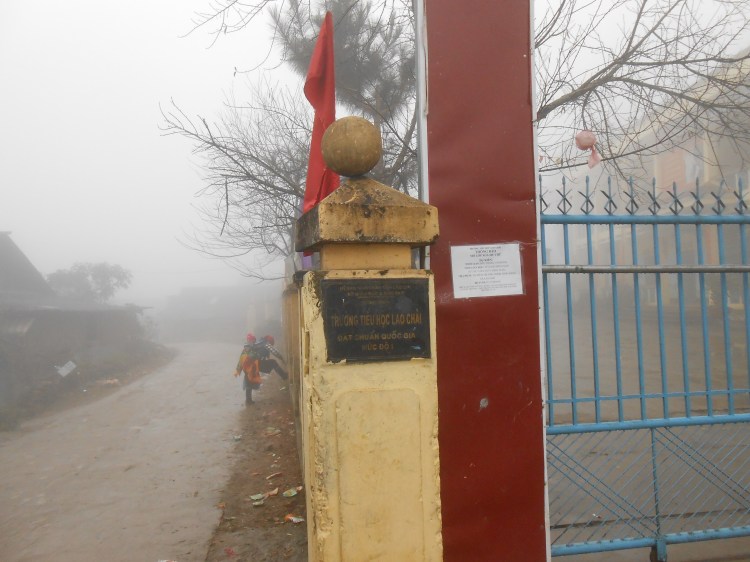
This is one of the schools, vaguely visible in the fog to the right. Primary school in the villages is free. Everything is taught in Vietnamese. If you want to send your child out of the village, it costs money, although not a lot. In the rear to the left is one of the women who “followed” us, carrying her baby on her back the whole way.

School, gir with baby

We saw three villages, Y Linh Ho, Lao Chai, and Cat Cat. Maybe we also were in Ta Van, but if we were, it ran together with Lao Chai. The first village was reached by a 6 K “trek” first down an asphalt road and then down a rocky path (rocks actually set in the earth). We were surrounded by fog so that I couldn’t see out over the steep slopes or down into the valley, but now and then I got a glimpse of the tiers of terraces that seemed to climb every slope. Cat Cat village was reached by an endless staircase.

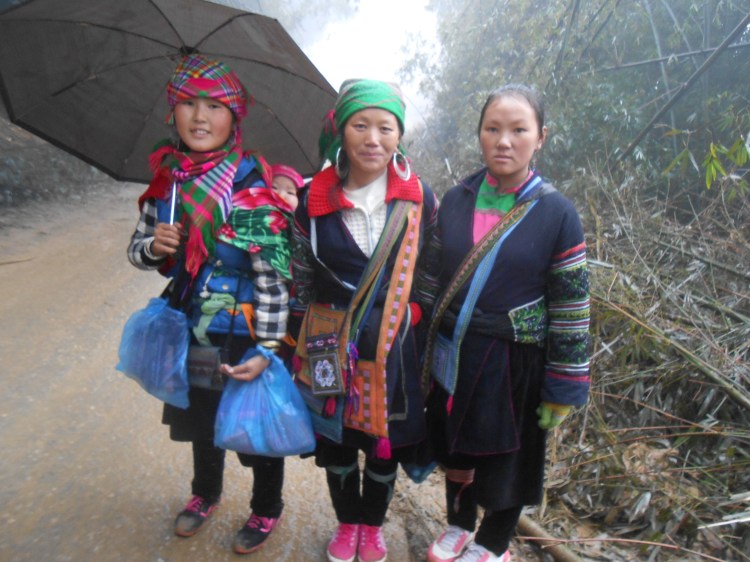
Our guide, who was a young (actually, 37 years old) guy with good hiking boots who had been working in Sapa for 15 years, said that we would be approached by women trying to sell embroidered goods and that if we talked to them, they would follow us. I didn’t know what that meant. It meant that they actually did follow us the whole 6 K all the way into the villages, talking all the time in limited English. “Following tourists” is a way of working. It’s also a way to practice English. Those are the three women at the beginning of the previous post. He also advised us not to buy from children. He said, and so did others, that children will run out of school to sell to tourists because then they can get money, but they don’t go back to school. Signs also warned us against selling to children. But children surrounded us, trying to sell us embroidered ribbon bracelets for 5,000 or 10,000 dong.

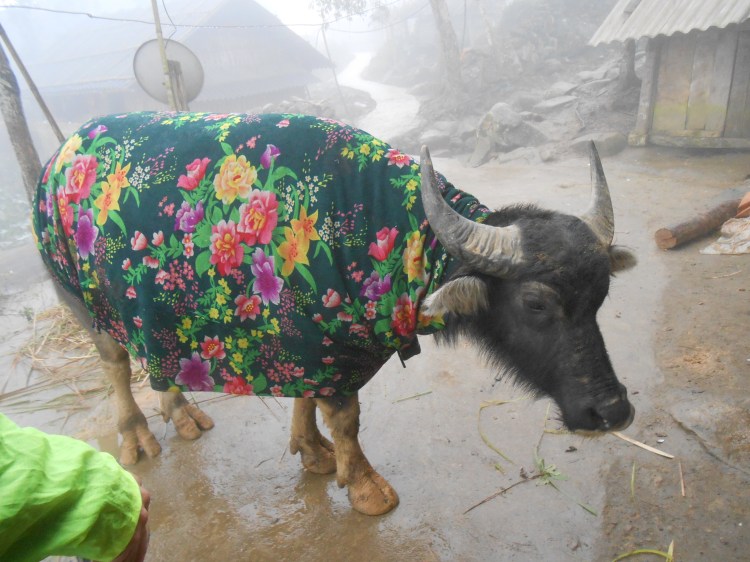
Flower buffalo

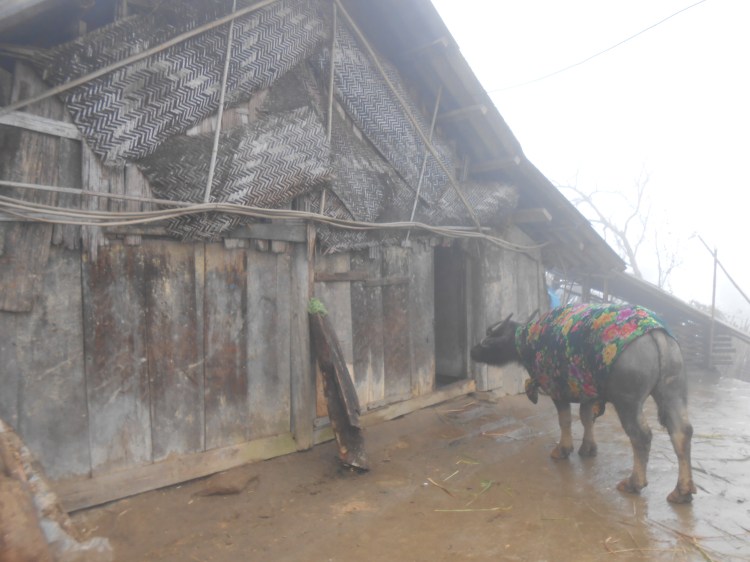
This water buffalo, wearing a flowered blanket because of the cold, belongs to the father-in-law of the woman who followed us with the baby on her back. She also let us look into her house, which is in the photo below. The inside of the house was too dark to take a picture. There were three rooms on the ground floor, not really separate from each other. The room to the right of the entrance had an open firepit, beside which a man was sitting. The second floor, really an attic, is for storage.  The floor of the house appears to be concrete, like the terrace on which the water buffalo is standing.

Hmong house

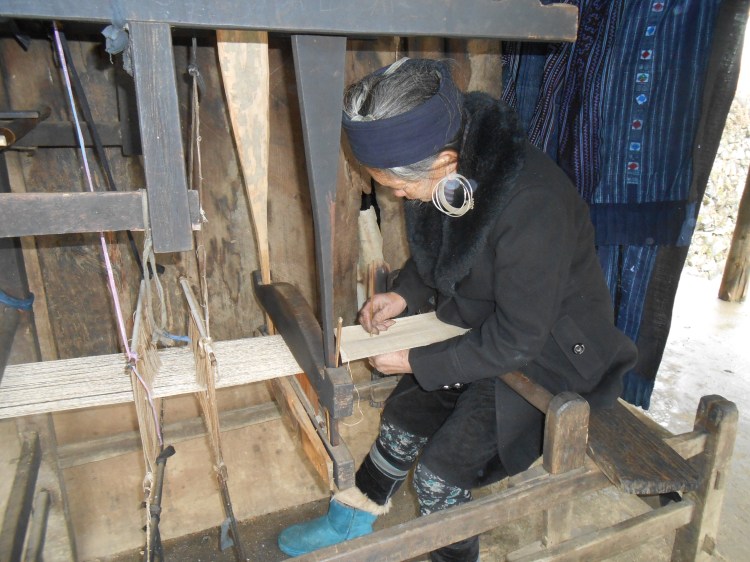
The weaver’s house

We came to a house where an older woman was weaving. This was on the third day, when we went to Cat Cat village, about 2.5K downhill from Sapa, via long muddy stone staircases. She is weaving hemp fabric, from thread made out of the stems of hemp.

grandmother weaving

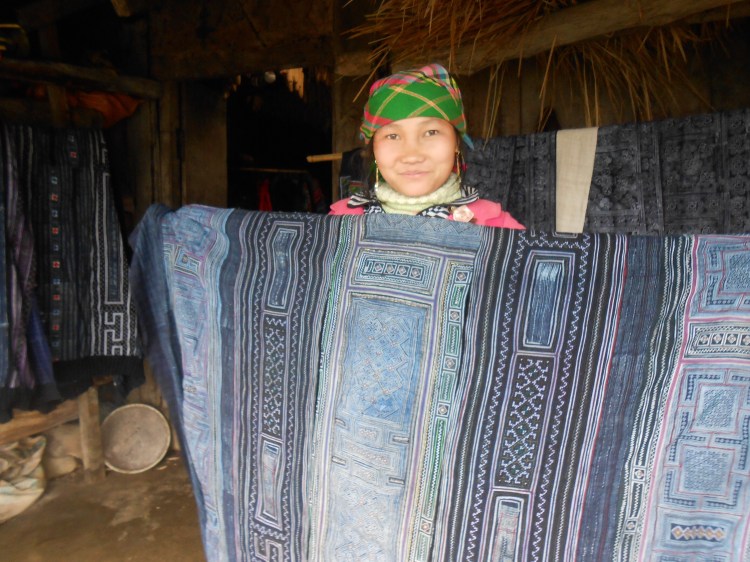
I looked at the blue dyed embroidered fabric and chose the one I liked best, for 900 thousand dong or about $45.  The older woman told me that it had been made by her son’s wife, who was inside the house, doing embroidery at that moment. I went in and took a picture of her. You can see the blue indigo on her fingers.

Girl embroidering

The house has an open charcoal firepit, like most of the houses, and a concrete floor. The choice is between working outdoors, where there is more light, or indoors near the fire. She is using a tiny headlamp to do the embroidery that is in her hands.

Holding cloth_1

She came outside and let me take her photo. Her name is something like Dzo.

Folding cloth_1

She is 27 years old.

Weaver and d in law_1

I think the mother in law was glad that the young woman made a good sale.

The market in Sapa

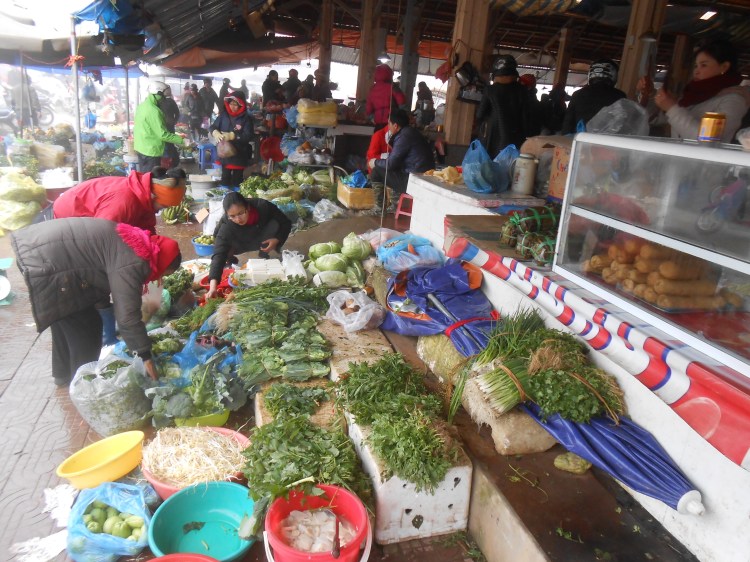
Tuan took us to the official market in the town of Sapa. People from the villages climb the paths and roads up to it with baskets on their shoulders to buy food, especially meat and vegetables, although there are many vegetable gardens among the houses in the villages.Vans bring fruit up from the South, through Lao Cai, to this market. This is a glimpse of the outside market. This stuff is grown locally.

Veggies local

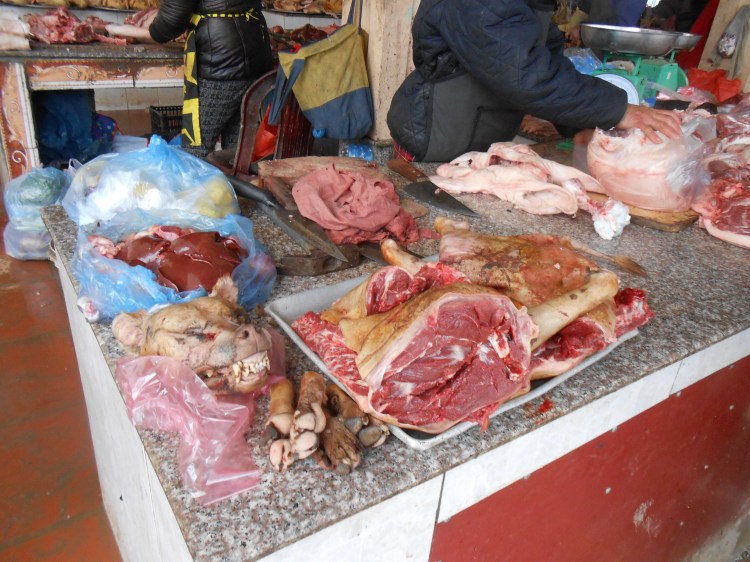
Dog is one of the meats sold by butchers. This dog looks as if he or she was once very much like all the other little dogs that you see wandering around. Maybe dogs are no different from pigs and chickens: running around loose, eating whatever they can find, multiplying until their time comes. All the butchers are women, incidentally.

Dog

The inside market, the official market, is nearly empty.The government builds the market and owns it. You pay to rent a stall here. Tuan said that most of the goods on sale here are from China. Maybe the market is empty because of Tet.

Official market

And outside, a row of men on motorbikes stand next to trees that people will buy for Tet. These are supposed to be peach trees. The men go up into the mountains to cut them; you buy one and set it in a big jar and see if it blooms. Some of the trees already have blossoms; those are good luck. A fully-flowering, moss-laden old tree can bring thousands of dong.

Peach trees for Tet

How about self-organizing?

For this, on the question of how much self-organizing goes on among the ethnic minorities, I have only what people tell us. Of course, they have to be people who speak English and they have to be people who are willing to talk with us about things outside of regular tourist talk. The stories that we have heard are scattered and do not make it look as if the ethnic minorities have much opportunity to take their lives into their own hands. We do hear a lot about “the government” as if it is a force of nature, not to be spoken to or with.

First, about the land. All the land in Viet Nam is owned by the government. What you get is a “red book” that says that you have the right to use and live on some land. But the government can come in and take the land for a project and pay whatever it has to pay, either a lot or a little. You can also sell your right from the “red book.” As we walked to the second village (which might have been Ta Van) we began to see much nicer houses, houses made of wood and concrete with real floors. These were Vietnamese houses; villagers had sold their land to Vietnamese who were moving in to build vacation homes here.

Hmong people have tried to move into an area in the Central Highlands, we were told. They bought land from the Bahnari people, who (we were also told) were rich, although we didn’t find out why. But when the Hmong tried to move en masse, they were prevented because everyone has to have a “family book” in which your family is registered in a certain place. This is how you get your children into a school or how you can register your address so that you can get a good price on rent or utilities. The Hmong who stayed in the Bahnari area have had to find alternate ways to get their children into school.

In the 1980’s, money from Hmong communities in the US was sent to Viet Nam to encourage the Hmong to unite and secede from Viet Nam. This apparently resulted in some police action. How this correlates with the period when Lai Chau was an autonomous area or when Dien Bien became its own province, I do not know.

When we ask what the life opportunities are for the ethnic minorities (sample question: “What would happen if a Hmong girl decided she wanted to be an attorney?) the first answer we are given is in terms of “education.” Some minority languages are in the same family as Vietnamese (like Hmong) and others are completely different. If your language is somewhat similar to Vietnamese, you have an advantage. Otherwise, it is hard. Students who start learning Vietnamese for the first time in primary school are well behind Vietnamese students by the time they are in high school. The disadvantage accumulates. We are told that minority people speak with distinctive accents and often never become really fluent in Vietnamese, which makes it hard for them to attend university. The barriers are not just geographic, they are linguistic.

They are also cultural.  The Vietnamese who talk to us emphasize that if there is a choice between getting money by “selling,” the minority people, children and adults, will sell. “They only think about today, not about tomorrow,” we are told. We have heard this from many people. The girls might go to high school, but they get married and have children and then it’s all over, they stay home from then on.

The tourism trap

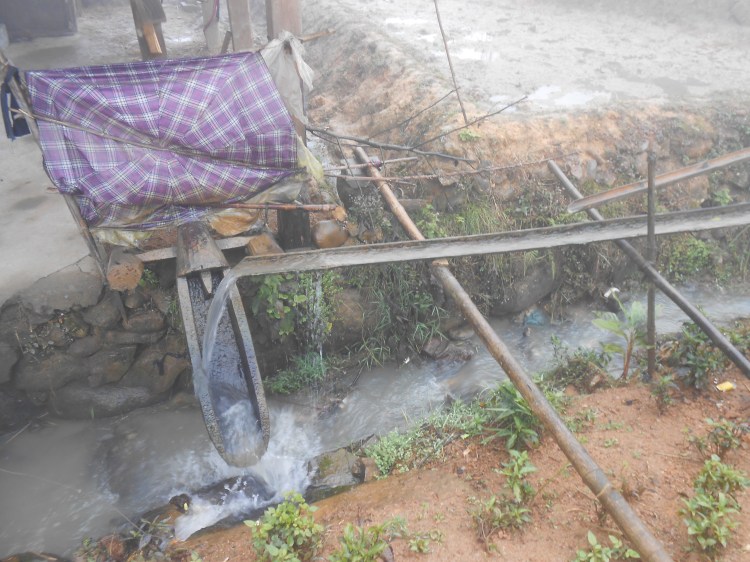
An example of old ways of doing irrigation, a display for tourists:

Irrigation

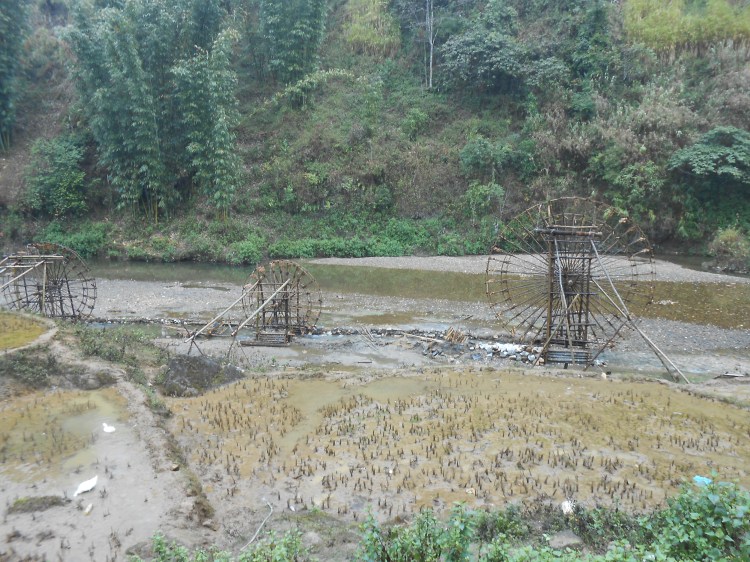
And another one: these water wheels are pounding rice. These also are built for tourists to see:

Water wheels

I would like to go to one of the towns in Lai Chau to see if, in an area where there is not much tourism, ethnic minority people have found other ways to become part of the larger world. Are there young ethnic minority people who aspire to being a “global person,” like the students at RMIT that our colleague spoke of, or like the students in our Labor Relations or the Business Administration programs? Can they imagine it?

If a village has a school and the students are not tempted out of it by the appeal of “following” tourists and trekkers, do ethnic minority people become serious students and study and ultimately go to university? Are there government programs that encourage this and build a ladder that makes this possible? Something like a serious affirmative action program? What goes on in the secondary schools in the cities — anything like this?

Or does the tourist industry depend so much on the girls selling beautiful embroidery that no one has intervened in this mutual dependency, the dependency of tourism on the presence of the “local people” who produce lovely goods, and the dependency of the handicrafts villages on tourism?

—————


Found the following on google, by searching for “ethnic minority languages Viet Nam.” It was published in a Korean journal the title of which I can’t read. But it should be accessible by the author:

The language policy of minority languages in Vietnam.  Ly Toan Thang, Institute of Linguistics,Hanoi-Vietnam


Questions that someone from the US might ask about the lives of ethnic minority people in Viet Nam

See update at end of post, about ethnic minority experience.

3 women and baby following

When we set out from Sapa, heading into the valley towards a series of ethnic minority villages, these three women immediately began “following” us. “Following tourists” is a job. They followed us the whole 6K , chatting in English with a very limited vocabulary, and only left us after we sat down for lunch at a trekker’s restaurant where, surrounded by other women selling embroidered goods, we finally bought three indigo scarves from them. 

Is there a problem?

On page 77 of Nguyen Kach Vien’s Vietnam: A Long History, he’s got a short section called “Ethnic Minority Policy.” Page 77 is near the front of the book, so we’re talking about the 15th century. Here it is:

Viet Nam comprises many ethnic groups: minority groups living in mountainous regions, while the majority group, the Kinh, are plain-dwellers. During the insurrection against the Ming, (1427) the ethnic minorities living in the highlands allied themselves with the Kinh to fight the occupiers. But after liberation, the feudalists in the delta resumed their policy of exploitation and oppression vis-à-vis the minorities. The Le monarchy ruled over the highlands through tribal chieftains upon whom it bestowed mandarin titles. These chieftains collected taxes. Control over mountainous regions was tighter than under the Tran (the previous dynasty). The Kinh mandarins ruling over the uplands also sought to exploit the ethnic minorities.

 This policy provoked frequent revolts among the mountain-dwelling minorities, and this was for centuries one of the weak points of the feudal monarchies. The Thai of the northwest rose in revolt in Lai Chau in 1432, in Son La in 1439 and in Thuan Chau in 1440; the Tay of Lang Son, Cao Band and Tuyen Quang also did on many occasions. In the western part of Nghe An, the head of the Cam family succeeded in holding out from 1428 to 1437.

 All these revolts were firmly suppressed by the Le troops. The secession advocated by the rebel chiefs also ran counter to historical trends, the deltas and the highlands being complementary economically. But antagonism among ethnic groups was to disappear only with the advent of socialism.

…and that’s it for the “ethnic minority policy.” That’s the whole thing.

“Ethnic minority policy” seems like a very modern sub-head for a historian to use in describing something that happened in the 1400s. Does he mean that from the 1400s up until the advent of socialism, the relationships among ethnic groups in Vietnam were antagonistic but now that socialism is here, it’s over, and there’s nothing new to be said?

The majority of the Viet Nam population is from the Kinh group: 85%. There are 53 other different minority groups that make up 15% of the population. They speak dialects of languages belonging to five different language groups. One language group – Australo-Asian – is similar to Vietnamese; the others are more similar to Sanskrit, Sino-Tibetan or groups I have never heard of. The Kinh are everywhere: “We are Kinh,” said a colleague, gesturing around the room to include his whole faculty. I asked how you could tell if someone was some other ethnicity: do they look different? Yes, apparently, but not in a way I can discern.

The Massachusetts Bay Colony, Pine Ridge, and Black Lives Matter

I started writing this post around Thanksgiving Day, 2015 and now it’s more than two months later, February 2016. Around Thanksgiving, this American has thoughts about the arrival in Massachusetts of my English ancestors, about Pine Ridge (https://en.wikipedia.org/wiki/Pine_Ridge_Indian_Reservation) and about Black Lives Matter. As inequality increases in the US, the lives of minorities get harder. Viet Nam is committed to an economy that will increase inequality. How will this affect the lives on minority people? However, mentioning this to Vietnamese in the context of ethnic minority policy produces the blankest of blank stares.

I have been hoping for some more clarity before posting my thoughts.

Are there prejudices that make minority progress difficult?

In the January 31, 2016 issue of Viet Nam News, the National English Language Daily, (obviously written for an English-phile readership, since there is a glossary on page 12 keyed to an article about the Sacred Turtle of Reclaimed Sword Lake, who died) there is a full-page article about how a tug-of-war contest, a traditional part of an ethnic minority agricultural festival, has been awarded UNESCO Intangible Cultural Heritage status. The description of the contest includes the following:

The local people believe that if the team that faces the south wins, the weather will be good throughout the year and they will get bumper crops. If the team facing the north wins, they believe that they will get only a good white bean crop, while the rest of will not be that good.

They really believe that? This is a statement from the same newspaper that has a full-page article explaining why Norway, despite having become rich from the North Sea oil, will not be affected by the drop in price of oil: the oil revenue has been invested at 4% and the interest, not the original revenue, is what Norway is spending. Do I need to put on a different hat to read each article?

Last night at dinner in Hanoi with a young couple who have been involved in education and education assessment in Viet Nam for a long time, we learned the word used by the Kinh people to refer to ethnic minority people: Dan Toc. With a hat on both the “a” and the “o” and a dot under the “o”, and the “D” is pronounced as a “z”. It means: those people, the local people, the stupid ones, those other people, the ones that can’t think very much. This word is used easily without self-consciousness in ordinary conversation.

The woman who told us this is Vietnamese but grew up among Hmong people. Both of them have experience working for the Vietnamese government and with ethnic minority communities in NGO-type poverty alleviation programs.

An Ethnic Minority Village and a Performance

Around Thanksgiving we went to Da Lat City with Vinh and Tinh. They took us first to an “ethnic minority village” and then to an “ethnic minority performance.”

The village, Cau Lan, was about 26 K out of Da Lat by taxi. Da Lat is in the Central Highlands. You bought a ticket to go in a gate and then down many steep flights of stairs through beautiful jungle, across a bamboo suspended bridge, and then along a small pretty stream past thatch-roof houses and out onto what looked like a big playing field. A jeep full of tourists came rattling down the stream bed splashing everyone and making mud.

From all the informational signs I could read, this may have once been an actual ethnic minority village. Now it is a retreat center used for conferences, team-building and tourism. There is a restaurant and a gift shop. To experience a stilt house, you climb up a ladder, but the top of the ladder was a large female boob, so to get off the top of the ladder you have to grab the boob. Inside the stilt house were some life-size wooden carved statues including one of a tiger apparently raping a woman. You could probably sculpt a tiger-woman sex scene that looked consensual, but this wasn’t it. There was a restaurant, a meeting room with Gaugin-esque framed paintings, and more carvings, mostly semi-naked women but one large monkey with a limp dick. I began to feel as if I was being entertained by fantasies of primitive sexuality.

The performance, that same evening,  took place in a purpose-built amphitheater. The other group there was a tour bus full of Russians, who had a great time. I was appalled: the ethnic minority members (who were apparently really members of their ethnic minority) first called the men from the audience into a circle and lit torches and started a bonfire, then had the men join them in a circle dance to pretend to go fishing and hunt animals, then had the women come and join a circle dance to do rice planting and getting water from the stream, etc, followed by some other dances. I thought: Is this really what you want to say about this ethnic minority? That it hunts animals and harvests rice? It was like watching a minstrel show.

I guess I was hoping to see something like a play by August Wilson.

“Ethnic minority” may be one of those English words used by Vietnamese because they can be pretty sure what it means to English speakers. I tried explaining “indigenous”, “First Nations,””tribal,” and “Native Americans,” but none of the more nuanced alternatives did the trick. “Local people” is frequent substitute for “ethnic minority,” but on our bike trip, “local people” also meant whoever was living along our route, whether or not they were ethnic minority.

Ethnic Minority Dolls: A book and the Ethnology Museum in Hanoi

We have a book called “Ethnic Minorities in Vietnam” which lists all 54 ethnic minorities, including the Kinh, and tells about where they live, what language group their language belongs to, what kinds of costumes they wear, what their handicrafts are like, whether they are matrilineal or patrilineal, and what their spiritual beliefs are, if any. All are treated equally – 3 to 5 pages for each. They range in population from less that 500 to over a million. Based on this book, you could make a set of dolls for each ethnic minority. No discussion of the anthropological studies that may be going on or have gone on, no evidence that any of the displays were designed by members of the tribes themselves. No mention of the integration or non-integration of ethnic minorities into the Kinh mainstream, loss of indigenous languages, schooling policy, economic development. Although I have heard that there are export processing zones in minority areas – with lower minimum wages – the ethnic minorities are 100% depicted as making a living from selling handicrafts.

We went to the Vietnam Ethnology Museum in Hanoi, which is organized in the same way as the book. It’s thorough. It’s got curving walls. Each minority has its display of garments, handicrafts, a map, tools, sometimes an example of a typical house, and a film of some key celebration. This museum is definitely worth going to. Every minority is treated equally, and each one with the same respect. But it’s as if the curators said, “Let’s stop while we’re ahead.”

This is as if to confirm what Nguyen Kach Vien said: “But antagonism among ethnic groups was to disappear only with the advent of socialism”, or, once socialism had arrived, antagonism among ethnic groups disappeared.

Two great antagonisms disappeared, in other words: the ones involving ethnic minorities vs the 85% of Vietnamese who are Kinh, and the antagonism between labor and employers.

Bringing my experience as an American to what I am looking at in Viet Nam, I feel anxious, as if something is missing.

We are due to visit Sapa, up in the mountains in the north West, along the border with China, in February. Sapa is a central town for a network of towns that are market places for ethnic minorities. I can’t believe that people choose freely to be simply the makers and sellers of labor intensive handicrafts for the tourist market. I can’t believe that we are not looking at a problem coming down the road.

———

I was so unsure of my reactions to this issue that I postponed posting it until we were actually in Sapa, February 4th (Lorenzo and Massimo’s birthdays!). I will follow it with some of the things I’m thinking now that we’re here.

This is the cabin we got on the Sapa Express. We had the lower bunks. The train leaves Hanoi at 10 pm, arrives in Sapa at 6:30 am. Joe slept fine; I don’t sleep on trains. I get up and wander around (not all that much) and look out the window and try the various bathrooms.

Sapa Express

Addendum written in April: Here is a link posted on Nha Thi Vu’s New Research on Development Issues in Viet Nam email distribution list included this link (this is the only thing I read, there are plenty of others). I read a chapter (#5, I think) on a study of Bihar people int he Central Highlands (probably near where we were in Dalat) that goes into this quite deeply, confirming my worst fears. There are some mentions of the state of things for the Hmong up in Sapa, too. Click on the link for the full free text of the book.

Connected and Disconnected in Viet Nam: Remaking Social Relations in a Post-socialist Nation.

Philip Taylor. ANU Press, 2016.

 Abstract: Vietnam’s shift to a market-based society has brought about profound realignments in its people’s relations with each other. As the nation continues its retreat from the legacies of war and socialism, significant social rifts have emerged that divide citizens by class, region and ethnicity. By drawing on social connections as a traditional resource, Vietnamese are able to accumulate wealth, overcome marginalisation and achieve social mobility. However, such relationship-building strategies are also fraught with peril for they have the potential to entrench pre-existing social divisions and lead to new forms of disconnectedness. This book examines the dynamics of connection and disconnection in the lives of contemporary Vietnamese. It features 11 chapters by anthropologists who draw upon research in both highland and lowland contexts to shed light on social capital disparities, migration inequalities and the benefits and perils of gift exchange. The authors investigate ethnic minority networks, the politics of poverty, patriotic citizenship, and the ‘heritagisation’ of culture. Tracing shifts in how Vietnamese people relate to their consociates and others, the chapters elucidate the social legacies of socialism, nation-building and the transition to a globalised market-based economy. With compelling case studies and including many previously unheard perspectives, this book offers original insights into social ties and divisions among the modern Vietnamese. Free full text http://press.anu.edu.au/titles/vietnam-series/connected-and-disconnected-in-viet-nam/.


Cho Lon and Last Days

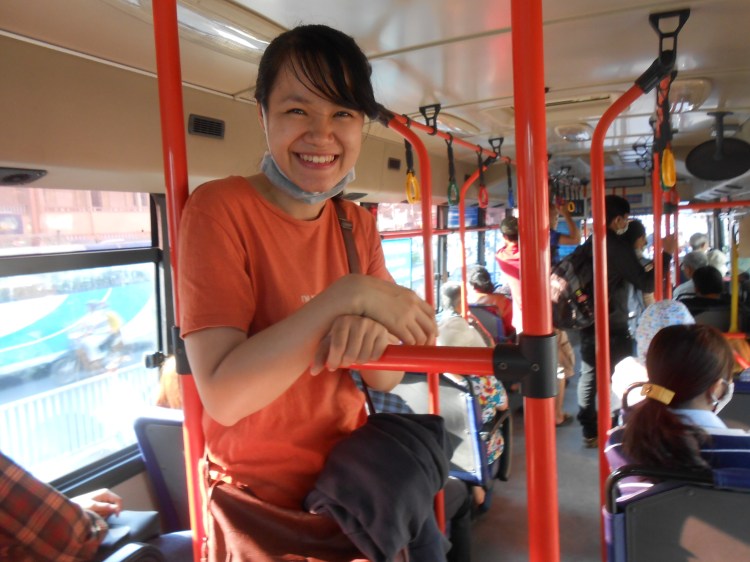
An on bus to Cho LonAn on bus #86

It turns out that the Ben Thanh market, which I found overwhelming, is not the real market. It is the market for tourists.

The real market is Cho Lon, which means “big market.” You go into HCMC on the 86 and get off at the Ben Thanh market stop, Then you change to the 01, which goes west about 11 K into District 3 and ends at a big bus station near Cho Lon.

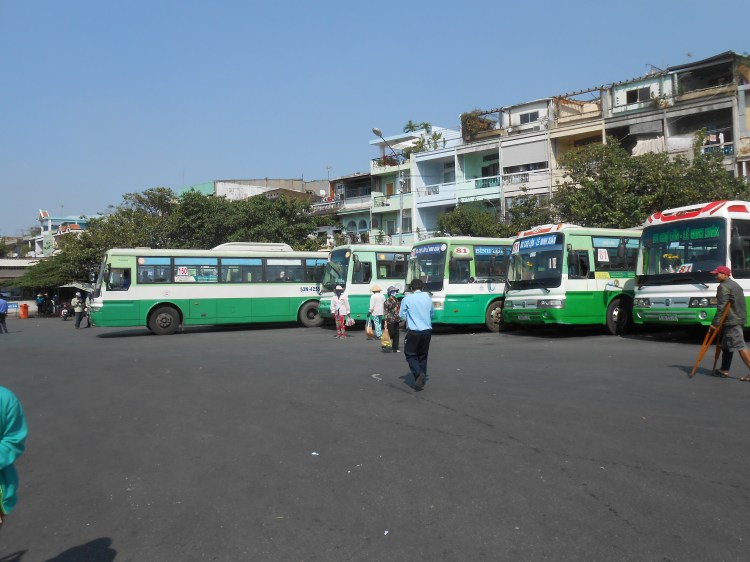
Cho Lon buses

There were maybe 20 buses in this lot. Most of the buses are fairly new and air conditioned, and full.

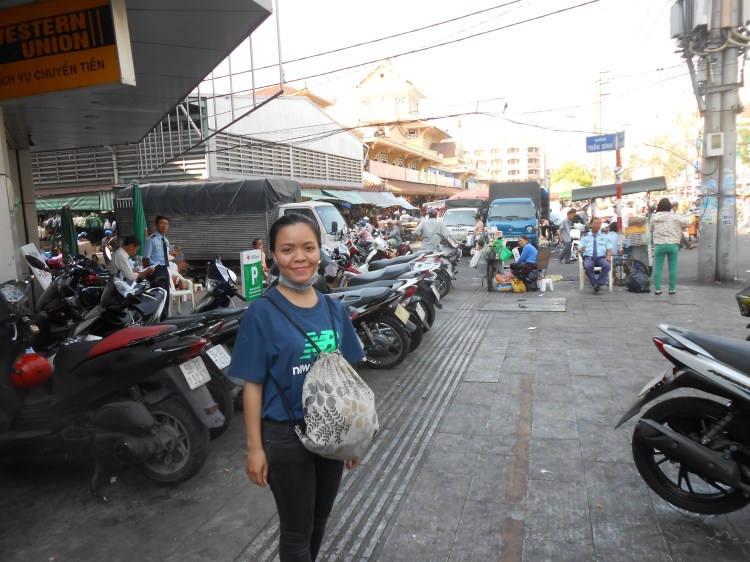
Vy and An took us there Friday morning. We met An at the 86 bus stop at 7:30 am and rode in, and met Vy who had come on her motorbike at the Ben Thanh stop. The yellow tower in the rear, behind Vy, is the entrance to the Cho Lon Market.

Vy near Cho Lon

Cho Lon was a separate city, the city where the Hoa (Chinese) people lived. They fought on the side of the Nguyen lords against the Tay Son in the 1770s and the place was burned in retaliation. During the American War, this was a center for deserters and apparently a big trade in contraband American war materials took place here. During the 1968 Tet offensive it was a staging area for NLF and North Vietnamese fighting units. House-to-house combat took place in the area.  It is still very Chinese; you see a lot of Chinese and Taiwanese in the  market itself.

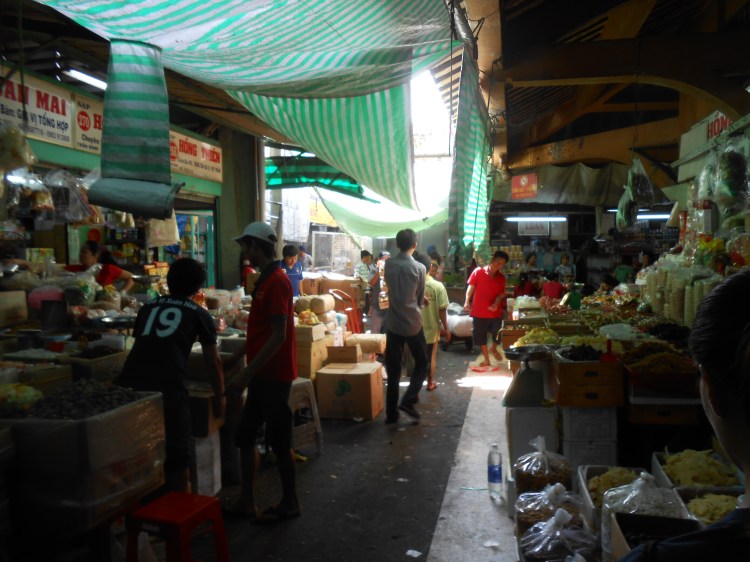
Interior of Mkt_1

The market itself is so huge that it’s impossible to give any sense of it through photographs. The goods are not tourist goods; they are commodities like cooking equipment, bolts of cloth, tools, pepper, shoes, candy, fish, vegetables, hats, baskets, flowers, crabs. If you can carry it on a motorbike, you can sell it here. You could have a life in this market; it’s a microcosm of the world. You could be a second or third generation stall-operator. Trade itself would become an art in a place like this. If you wanted to really study how a market works, this would be the place to come. Maybe this is market that people have in mind when they talk  with excitement about the Viet Nam economy transitioning into a market economy. If you could imagine that the global economy was one vast market like Cho Lon, densely woven with relationships and neighbors exchanging things, then I can see where the enthusiasm might come from. The invisible hand is not very invisible here, when you’ve got ten stalls selling pomelos one after the other.

In the center of the market is a courtyard with a small temple with topiary dragons, an altar, and some big concrete dragons spitting water into a fountain. It is in honor of the man who founded the market in 1929.

One way this market differs from the Ben Thanh market: the WC. At Ben Thanh, you pay 3,000 D and go into an air conditioned space with cubicles, toilet and toilet paper and actual classical violin music being played. At Cho Lon, the women’s room consists of a long room with doors. Presumably, behnd the doors are squat toilets (holes) but people who only want to piss don’t bother. They just squat down in the common space and piss on the floor. When I went in at first I didn’t realize what people were doing — all these women squatting? But then I got it. Afterwards, you just take a bucket of water and slosh it on the floor. You have to all slosh in the same direction, though.

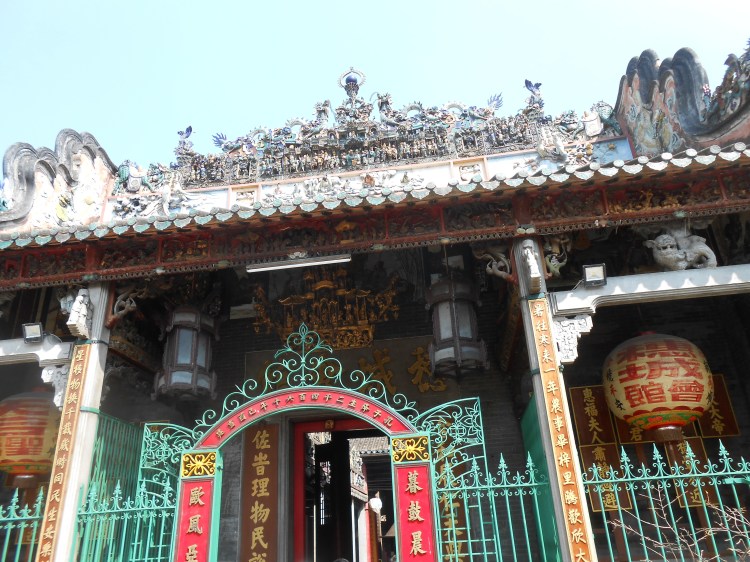
Nearby is the Quan Am temple. Throughout the temple are these pediments filled with small ceramic depictions of stories and characters from history. Hundreds of tiny figures all doing things, talking to each other, walking around.

Quan Am temple

Devils on pediment

The tourists in this temple are mostly Chinese.

An then goes off to work. She’ll work 8 hours today, on top of guiding us through Cho Lon. She will be doing an internship this spring at the garment company where Vy’s father is now a supervisor. Vy will be there, too. An will work at her job at the furniture store and then work 3 days a week at her internship. These internships are part of the regular curriculum; students write a report. They have a faculty person to work on their reports with them. Vinh doesn’t know yet if she will be An or Vy’s advisor yet.

Two more days in HCMC, then up to Hanoi, a few side trips, and then home.

How will we stay in touch with Vy and An? Vy has said she will send me things she has written. An has accepted some books; we have tried to give English books to other students, but they say “It is too heavy.” Even Dang, who did all that translation. But An has accepted some books.

Monday morning: Dean Hoa comes by at 8:30 am on his motor bike to say goodbye. He hopes his English will be good enough when we come back so that he can translate in our classes. Last night, at a huge meeting, the President told the teachers that they could get time off with pay to learn English. Afterwards there was a banquet with long tables of great food. The President came by our table with Mr. Tung, Dang Ngoc Tung, the President of the VCGL, so I shook hands with him for the first and only time in this 6 months.

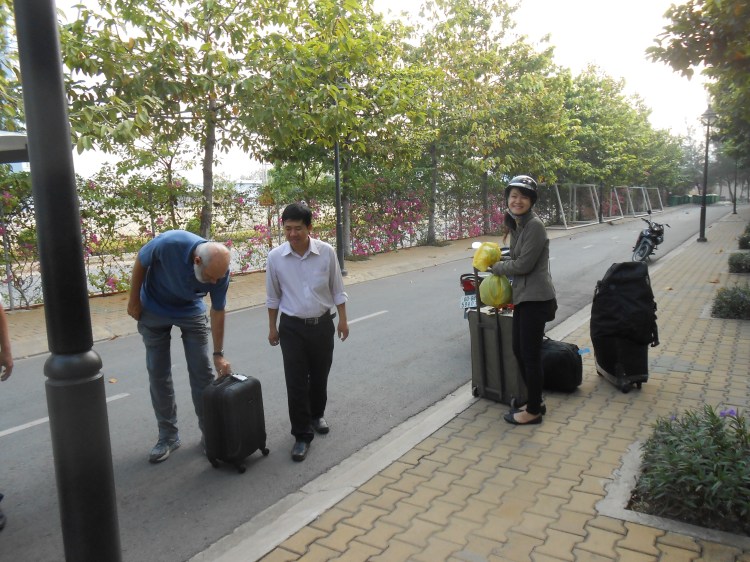
An came a minute later and helped load the taxi.

Dean Hoa and An help load taxi.jpg


Gofor it


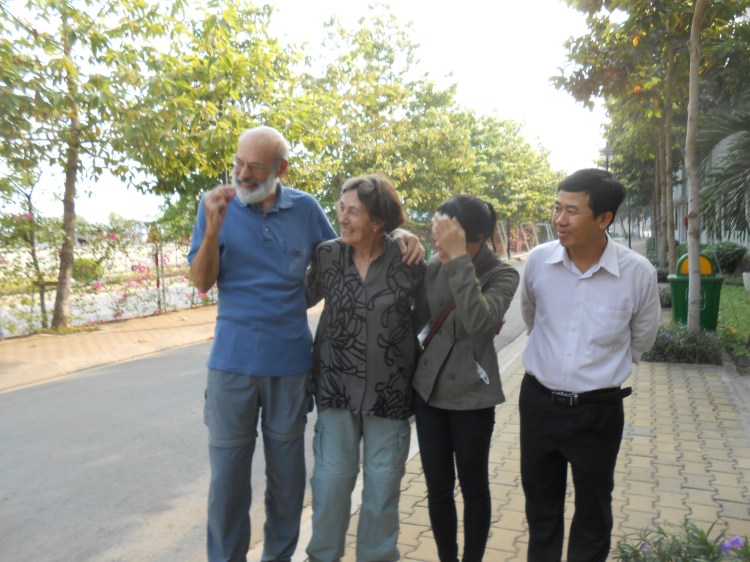
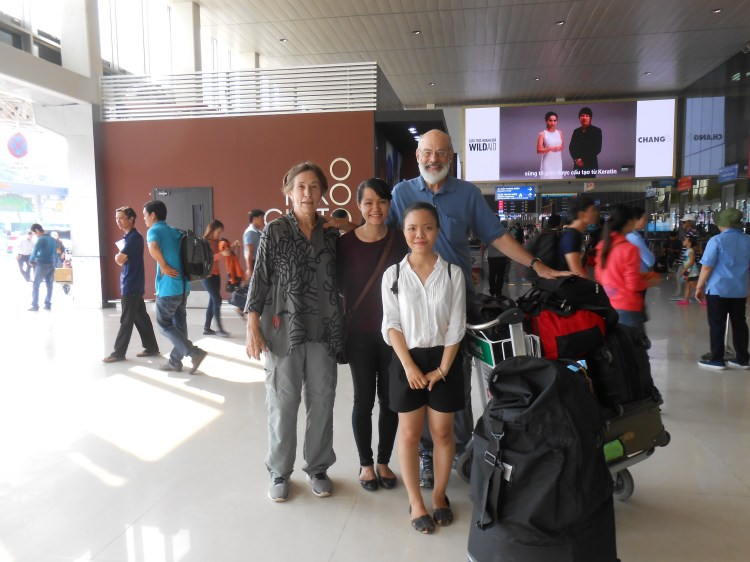
Then she rode behind our taxi all the way to the airport where she met Vy and they made sure we went and got in the right line.

An and Vy at airport

…………

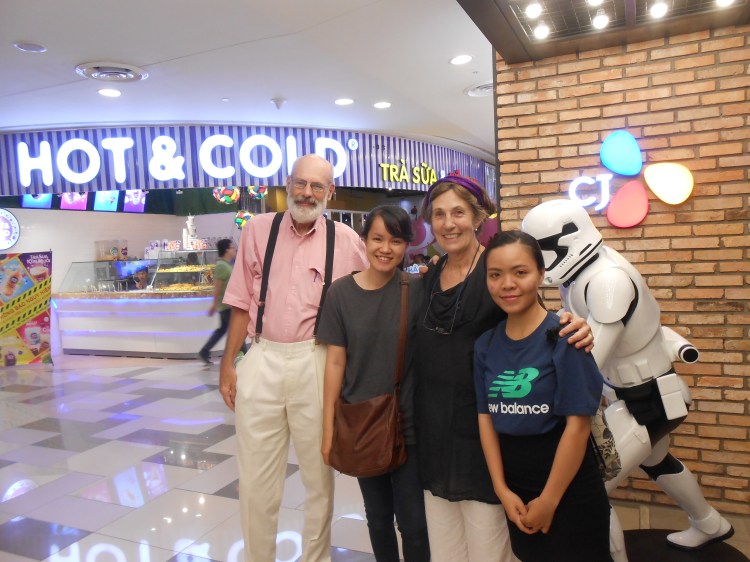
Star Wars at Vivo City IMAX

An, Vy, Joe STWg


We told An and Vy that we wanted to see Star Wars. They weren’t sure that we were serious. However, they looked up where it was playing and it turned out that it was at an IMAX theater a 10 minute walk from TDTU, at Vivo City, a fancy new enclosed shopping mall, and that there were discount tickets on sale (190,000 D, which is about $8.50). So we met An at the bus stop at 5 pm on Monday and walked just about around the corner to meet Vy, who had bought bottles of water for us and was waiting. I had no idea Vivo City was so close, but you can get to it by crossing the bottom of Le Vuong Street where they are creating new sidewalks and a driveway so that people can come to Vivo City on motorbikes. Previously, Joe and I walked to Vivo City by going all the way down to Van Linh Street and walking along a very dirty, traffick-y area where there are no sidewalks, or at least no sidewalks not filled with motorbikes and machinery repair equipment. You turn around once, here, and they’ve build a new street and started a new apartment building.


Of course I envisioned long lines of excited patrons. Instead, there were 8 people in the huge theater, two of them a young “foreigner” couple. The movie has been out since early December, said Vy.

Once it started I had misgivings. It was all about rockets and things blowing up and spaceships zooming around going rat-tat-tat or crashing. I thought, here I am, disapproving in my heart of the militaristic, nationalistic demonstrations that wake us up at 7 am with loud music in the soccer stadium, and now I take two young Vietnamese women to watch a movie in which nothing happens but bang-bang and chasing and shooting and crashing! Of course, as an American, I can look at expressions of Vietnamese patriotic behavior with a different eye because I am not Vietnamese. It can be right for them even if it is wrong for me. Or so I say! But then I say,”Let’s go see Star Wars!” and suddenly we’re sitting watching a crowd of desert-dwelling scavengers get mowed down by storm troopers with automatic weapons, which is supposed to be fun, while we eat popcorn? What’s going on here?

I asked Vy and An if they were OK and they said yes.

Then I got swept up in the movie. The music was the same music! It was as if I had never heard it before, yet I can remember putting an LP on the record player while Gabi and Katy played Princess Leia the Librarian. And the stars – meaning the things in the sky, not the actors – were the same, the huge basic dark screen full of little white dots, kind of low-tech for what gets done now, except that this time they were in 3-D. And there’s a knock and here come Han Solo and Chewbacca!! Where did they come from? You mean that piece of garbage is the Millennium Falcon? Of course! By then I was totally into it. They really got Harrison Ford and Carrie Fisher to come back and play their roles; amazing. All those people are still alive — wonderful! And that really is Luke Skywalker! I believe it! The girl holds out the light saber to him; will he take it?

It was like 40 years ago, but better.

Such an American movie, with all the rockets and things blowing up, and great symphonic music behind it all.

At the end, Joe, Vy and An were walking out during the credits and I just wanted to sit there.

They did say they enjoyed it, but I’m not sure that they really got it. Maybe you had to be there.

I am glad I saw it here, not back in the US. Back in the US, I would have felt that it was a completely incommensurable experience. I would have felt it was hopeless to try to explain. But An said she watched the trailer and understood the story, so it was at least partly commensurable.

The flow of information

TPP seminar

Setting up for the TPP Seminar on January 14; Kent Wong’s delegation on the right

I feel as if I am in a country that is like a box that is changing shape all the time. The walls are not at right angles to each other. Also, first something is a wall, then I walk through it and it wasn’t a wall. At first something was a rule, then it’s not a rule. A lot of the problem comes from not speaking Vietnamese, of course, but people who speak English with us also talk about rules and freedom, particularly in education. First there are a lot of rules, then there aren’t. Or there are rules here but not over there.

Of course, the rules really are changing. The 2012 Labor Code replaced the 2004 Code which replaced the 1996 Code, and the 2012 Code is still being worked on, as is the Law of Trade Unions. Ton Duc Thang “aspires” to be among the Top 100, or at least emulate them, so the curriculum is undergoing a complete revision. Over beyond Building C the new library is rising; it was a hole in the ground when we got here, and now it is a tower. Across the canal the land reclamation that I thought was going to be apartment buildings is now surrounded by a fine brick fence which will enclose a new private university.

First we thought that our presentation on teaching methods had been rejected because it talked about the necessary conditions for good teaching that do not exist at TDTU (small classes, academic freedom, etc). It was also critical of “elite” education in the US, the sky-high priced universities that are skimming off the top of the market for prestigious degrees.  To the extent that the “Top 100” program attempts to be an ASEAN version of this, we implied criticisms of it. When our presentation was rescheduled Dean Hoa told us to write a second version, just focusing on teaching, not on elite universities. Upon Vinh’s advice, I think, he then asked for a third version about the Student Research Projects. Over the weekend I worked on that while Joe finished up the minimum wage report project and sent it off. The women in the Accounting Faculty, where we have been going on Thursdays to speak English, said I should wear my ao dai so I did.

In the elevator going up to the room (A-401) this morning we agreed that we figured there was a 25% change that our presentation would be cancelled. But it wasn’t. We were first. They let us take more than the 15 minutes we were first given, and then there was a whole lot of comment afterwards and some very free and interesting discussion following the presentations of the other two lecturers, one from IT and one from math.
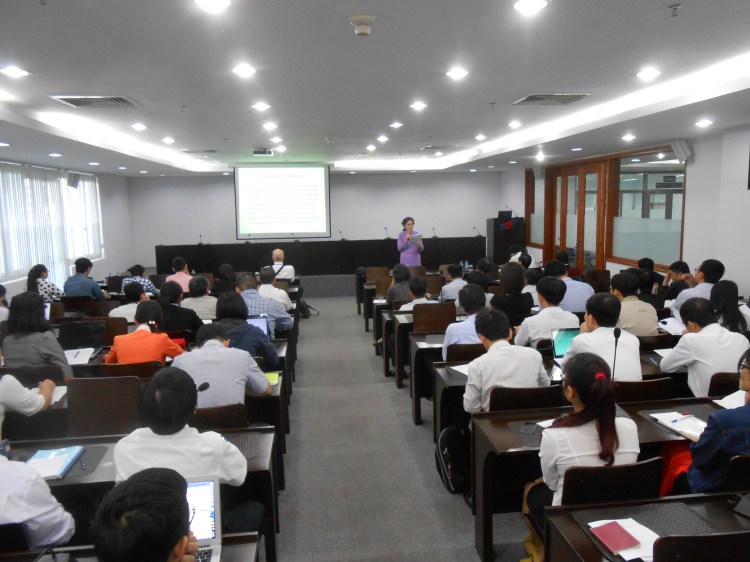
From rear of room

I wrote the presentation out in short sentences to put up as a Powerpoint on the screen, to make it more accessible to people for whom my English was going to be a barrier. We were asked to list our degrees on the first slide, as part of establishing our credibility as people familiar with “top” US educational practices. But from then on, it was pretty loose, in the sense of just saying what we thought was the case. During the discussion I even pointed out that they have a union and could conceivably bargain working conditions, such as class size, workload and private offices for confidential discussions with students. I’m not sure that was actually heard by anyone.

Lecturers at Jn26

Afterwards, the lecturers who had not already left grouped together for a photo.

In other words, that was a box that changed shape while I as in it. Here are some other things that look and feel like walls, or veils, and sometimes turn out to be something different.

The Moral Philosophy Curriculum

When Joe was preparing our students their Student Workplace Research Projects he realized that he had hit a bare spot. No one seemed to have any sense of what “social science research” meant. We wrote some handouts, but at the same time we decided to try to find out what prior exposure to social sciences they might have had. History? Philosophy? Psychology? Sociology? Political-economy?

We were assured that they studied all of these, all the way through high school and during the first years of college. Twelve percent of the curriculum was devoted to these. This was a requirement, a government requirement from the Ministry of Education and Training. We asked what subjects they studied. Overall, in college it’s called “moral philosophy,” which means Marxism-Leninism, Ho Chi Minh Thought, and Viet Nam history. It has different titles in high school, but it’s basically the same material from the same perspective and same methods.

We asked various colleagues and friends if they remembered studying social sciences in high school and college. Without a single exception, their response was a laugh. Sometimes a big loud laugh, sometimes just an embarrassed snort. “I slept through it!” “It was so boring!” “The teachers are old.” The classes are “school-headed,” meaning your head gets stuffed with the teacher’s words. “It was worthless.” Even the VGCL staffer sitting next to me at a dinner up in Hanoi responded with an involuntary smirk.

Joe pursued the question of “moral philosophy” so thoroughly that as a present at a going-away party for Leanna and Hollis, Vinh gave him a copy of the book, Ho Chi Minh Thought on the Military. It’s all mottos and slogans, and stuff like this:

Just after the foundation of the regular armed forces, Ho Chi Minh gave orders to engage in the first battle. Executing his instructions, the Vietnamese Brigade for Propaganda and Liberation won the battle of Phay Khat and Na Ngan, thus affirming the fair tradition of our army, “The first battle must be won.” (p 125)

The direct quotes from Uncle Ho are the best thing, even if often out of any useful context, but they are short and infrequent. Is this intentional? Would someone intentionally try to make Marxism boring?

One faculty member from another university told us that in graduate school, students writing a dissertation have to have a first chapter in which they acknowledge Marxism as the complete theory that covers everything. They show how their own work derives from Marxism. Then they can get on with their writing. This is true in every subject. Another colleague who teaches at a private foreign for-profit university says that one reason students enroll at her university is so that they can escape this requirement. I remember with amusement that I was told, at Berkeley, that I could reference Marx only once, no more, in my dissertation.

The reason this matters to me is because without a living Marxism, these kids are not going to be able to understand the capitalism which is rolling down on them like a truck. For US leftists, Marx and the whole broad tradition of Marxist scholarship, from Harry Braverman to Monthly Review, is what enables us to figure out what is going on around us. It’s the screwdriver that gets the locked door off its hinges. Many of us had to fight to get schooled in a bit a Marxism, or we learing it in the context of the various movements, not in classes, where it was mostly verboten. Here, Marxism has been turned into a glorious corpse. Actually Ho Chi Minh himself, who asked that his body be cremated and put in a simple urn, got embalmed instead and lies in state in a giant mausoleum in Hanoi.

We asked one senior colleague (at a different university and with a Western PhD) whether there is any discussion going on to develop a new curriculum to replace the Moral Philosophy curriculum that seems to have such a deadly effect. She replied that to do that, the Communist Party Central Committee – which she called the equivalent of Parliament or Congress — would have to pass a new law. New laws are popping up all the time, however. How about within the Party Central Committee – is there any discussion? What are people saying? Who is saying what?

Her answer went beyond “No, no discussion.” The question itself seemed incomprehensible. The idea of a discussion as a necessary step on the way to making an informed collective leadership decision seemed unfamiliar. I will come back to this. Also, she seemed to think it incomprehensible that an academic specialist in education, like herself, could be part of, or even aware of, such a discussion going on.

We heard about a 2009 seminar that took place in Hanoi, organized by Monthly Review, the leftist US journal of independent socialist thought. Some of their best contributors and editors were there:  John Bellamy Foster, Samir Amin, John Mage, Marta Harnecker, Michael Lebowitz, Jayati Ghosh, Bill Fletcher and Biju Mathew and others. They presented papers in English and Vietnamese and some papers were supposed to be published, but that didn’t happen. The person we heard about this from said that most of the Vietnamese academics did not agree with the Monthly Review perspective. Some of the participants from the military agreed, as did some of the civilian participants. We were told by the person who attended that there is a discussion — at least, disagreement –   within the party on “whether the emergent capitalist social relations are to be resisted and restrained, or are transitional and necessary and to be for the time encouraged, or are a necessary and inevitable part of a permanent model.”

Why this is relevant to labor education in Viet Nam

A more immediate concern, and this is related to the Student Research Project, is that if the VGCL is going to train a whole new generation of organizers, they will need to have a foundation in Vietnamese history. They will need to be able to go into a workplace, a village, an enterprise zone or fast food outlet and do some social science research, also known as figuring out what they’re looking at. They will need to know what questions to ask, how to discern the tensions and the direction things are moving or could move, and where the contradictions lie that can shake the whole arrangement. Dogma will paralyze them. They really need the dialectic and historical materialism and Marxist analysis to know where to start to look at things and what questions to ask.

The Ministry of Education and Training — a socialist urban legend? 

A colleague who taught in Canada, said of teaching at another, private, for-profit university “We do not have academic freedom here.” This is true of the for-profits in the US too, as Joe can attest, but the image of “real” higher education in the US is that faculty have academic freedom. Even contingents, who can be fired easily, believe that they have it and will defend it passionately.

Enforcing the rules that fence in academic freedom appears to be the job of the  Ministry of Education and Training.  We have been told that it also oversees the production of everything that gets written, published and of course taught in Viet Nam in public institutions. Some people we talked with are convinced that someone is sitting in an office somewhere, reading and marking up every sentence that gets published in the whole country, anywyere. Of course, they would read a new Moral Philosophy textbook. There are, actually, some really huge government offices. In Da Lat there are some fat white towers on a hillside that must have thousands of offices in them. In Hanoi, the same except these are old gray buildings.

Is this actually true? Or is this an urban legend of socialist countries? If a legend is sufficiently credible, it has the same level of impact as a reality, in the sense that people will self-police in the belief that they are being surveilled and that certain behaviors are risky.

We are told that MET has a presence at TDTU. Here, it is called the Department of Evaluation. Some people refer to it as “Department of Control.” Apparently the people who occupy the Department of Evaluation are not actually employed by the University. They are not academics but they have a lot to do. They are the ones who critique and edit your exams, sign off on them, grade them (or at least spot check them) and then archive the grades (but don’t tell the teachers the results).

They also supervise. This is the term used by our friend who speaks very good English who says it is the correct term. They sit at desks in the hallway, wearing purple shirts, and observe people walking along. They have stacks of blue notebooks, one for each class. After each class, the teacher or the class monitor records the attendance, which always comes out “right”, or at least not too bad, on paper. There is also a box where the teacher writes what was taught (in our case, in English) and then another where we sign our initials.

“We are under control,” one of our colleagues said.

The supervisors patrol the corridors and look through the glass windows to see what is going on. Apparently they can tell by looking if you are using the right methodology. If a girl is not wearing her ao dai on a Monday or a Thursday, or a boy is not wearing a white shirt and black pants, they will pull the kid out of class. However, in fact, girls wear all kinds of overshirts and hoodies on ao dai day, and boys bleach their hair red (and a few actually wear make-up, which is startling but attractive), and so far, I have not seen anyone pulled out of class.

Are there undercover police around? 

Some people also talk about the police. Since we have seen many relaxed young men wearing different colored uniforms, walking around in parks or guarding embassies, but no one with a gun, we asked how you could tell.  Do they wear uniforms? “They wear ordinary clothes,” we were told.

In the US, we also talk about gangsters, provocateurs, spies, etc. They are real, too. At a demonstration, the person urging violence or vandalism is likely to be an undercover cop of some sort.

A journalist for the English language press here in Viet Nam asserted, in an article on labor, that a labor activist went to jail. We emailed her and asked her for her source. The source she provided was as vague as her own article. We then asked if she knew anyone we would talk to. She wrote, “You mean labor activists?” Yes. She said she didn’t know any labor activists, only corporate lawyers. Corporate lawyers would not have a problem with labor activists going to  jail, but that doesn’t mean it happened — at least not that particular time. Maybe other times, who knows?

Discussion at the TPP SEminar on January 14

The TPP paper that I wrote and that Joe, Hollis and Leanna amended and signed onto apparently travelled far enough to prompt a seminar at TDTU on January 14. The idea was to engage the Cornell students, our students, Kent Wong’s delegation, our faculty and other persons who might have something to say in a discussion about the impact of TPP on labor and trade unions. Invitations were sent out. It was set for the day after we came back from Hanoi. Dean Hoa wanted papers; I argued that what was needed was a free discussion. What would happen with TPP was as yet up in the air, no one knew what the impact would be, let’s get some people with different perspectives in the room together and have a discussion and see if we can figure out what’s going on.

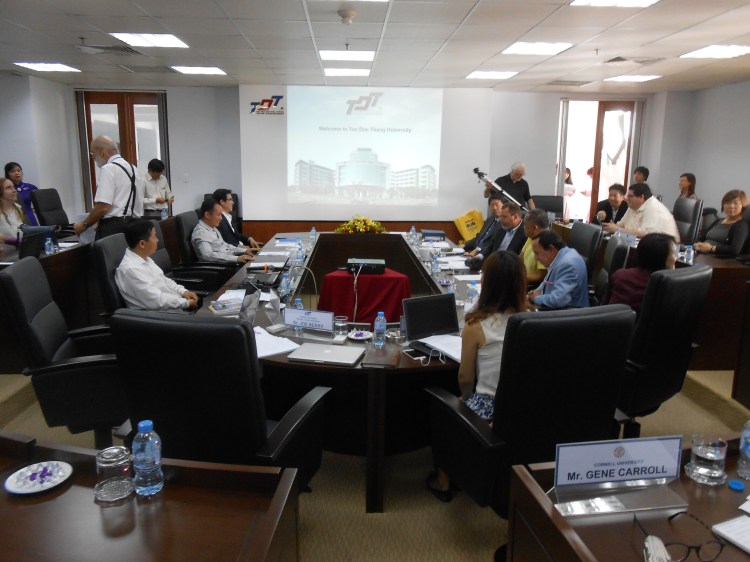
A fine seminar room with an oblong table and ranks of soft chairs and desks in Building A was reserved. Food was laid out on the terrace. The Cornell students, our TDTU students in full ao dai and white shirts, Kent’s full delegation and a few others came, including the Dean, Dr Ut from the Research Group, a University VP, a man from the VGCL who had accompanied us up in Hanoi, Vinh and Yen, from the ILO. Kent Wong, Richard Barrera from LA, Joe and I all made presentations. We took too long but that wasn’t the point. A worse mistake was that we failed to stop and make sure there was translation throughout, so our students were pretty much in the dark (later they told me they got some of it.) But that isn’t my point either.  When it was time for discussion, the US people had all talked plenty. Then we turned to the Vietnamese people to speak. Dean Hoa asked some questions about organizing, but no one spoke about TPP. Discussion simply did not happen.

Afterwards, I asked two of the Vietnamese – separately – why they didn’t say anything. They both told, me, “I was there as an observer. I was not authorized to speak.”

I was angry enough to say, “We did not invite any observers. We invited participants.”

So Dean Hoa was right to be puzzled by my insistence on discussion.
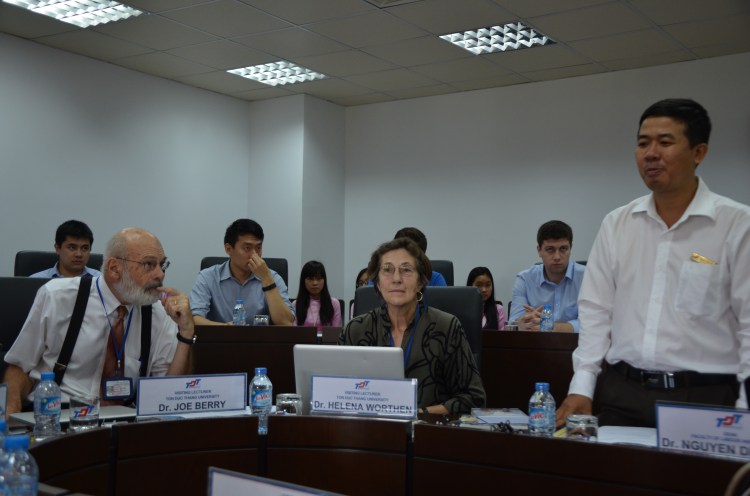
TPP Emil 1

Emil Guzman took this. Dean Hoa on my left, speaking. 

By late that afternoon, Joe and I had the flu so we missed joining Kent’s delegation when they had their last dinner together, Friday night. However, Vinh went. She said that the end of the meal, Kent called everyone together and had them each tell what they had learned on this trip. Everyone went around the circle and talked. When it came to the VGCL guy, he said he had never seen anything like this. At the end of their dinners, he said, they don’t talk; everyone just gets drunk.

Nonetheless, this morning, January 26, when we gave our report on all the teaching methods we used to generate the student reports (there are a couple of blog posts on that, back in December), there were plenty of questions and comments and the room, which had at least 100 lecturers in it, seemed full of energy, both about our topic and about the two topics that followed. To hear a math teacher and an IT teacher accuse each other of being boring or scary, and then see them defend themselves in a lively, spirited way, was exciting. People seemed happy about the whole experience.  In fact, it seemed like  a very normal interaction among teachers, talking about how they do what they do, but with even a certain stronger tone of cheery critique.

We are told that they plan to do a seminar like this every month. Teachers will share how they teach their subjects. Seems like a great idea to me!



Thanks for traveling with us

H ferry Mek

Joe took this on one of the first of ten or twenty tiny ferries that carried us back and forth among these islands. I was very proud to have been able to ride over 35 K that first day. The vegetation on the island behind me looks like jungle, but in fact it’s full of houses linked along a cement path about 4 feet wide that also serves as a dike. 

The Mekong Delta is huge, full of islands that rise at most 8 feet above the water, and both densely populated like a city and intensively gardened, all sharing the same space. It is not only the vegetation, orchards, chickens and fish that are form the ecosystem; human beings are part of it too, as in the catfish toilet system. Not far away, people bury their ancestors and raise tombs in the rice paddies. So it goes all the way up and down the food chain. Once you start thinking of humans as part of the plant-animal food circle, things look different.

I will tell the story of this trip in two ways, simultaneously. One accompanies the photos, the other is our response to the message from the bike travel company. This is to show how something can be both great and awful at the same time.

Dear Ms Helena,

We are very sorry to hear that the bike’s break didn’t work and the second one was too big for you, it made you feel not comfortable. And now, we decided to refund some money for you, are you happy with that?

I am so sorry again.

XXXX

Dear Bicycle Mekong Travel (not their real name):

Thanks for contacting us. We have some suggestions.

The 3 day Mekong Delta trip is wonderful, a great route through a unique landscape, with good food and good places to stay.

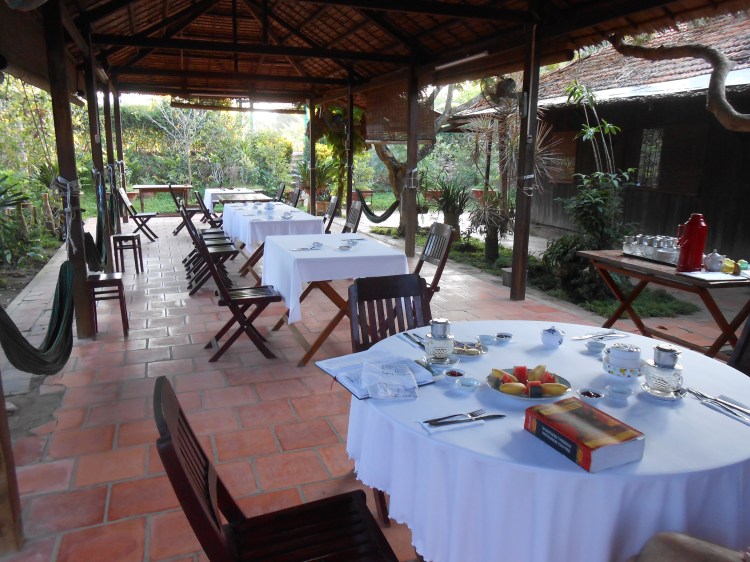
Homestay dining room

This is the dining space at the homestay (which is like a B&B) where we stayed the first night.

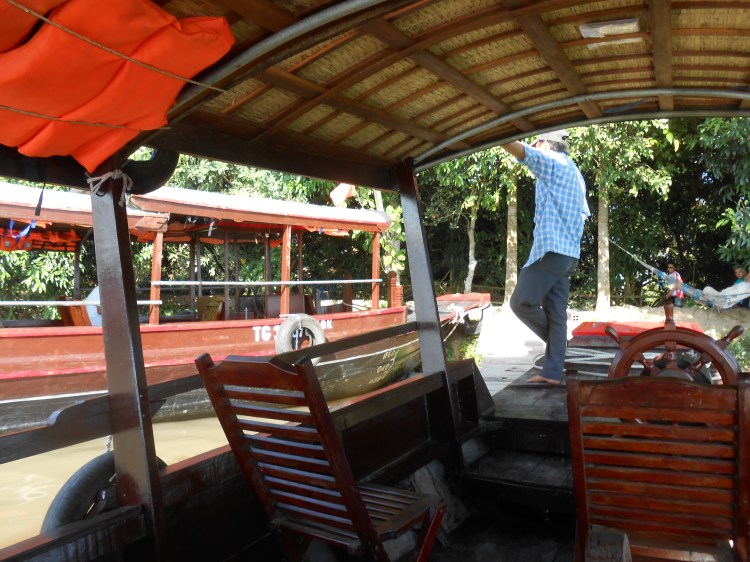
The numerous ferry rides were beautiful.

Little Ferry

The van and driver were good and the many visits were fascinating.  Our guide Hong was pleasant, energetic and knowledgable and did her very best to handle a group of 4 riders, two young active ones and two older, slower and more hesitant ones. That meant that she had to go at a slow speed to keep us all together, and because there were so many turns, the younger ones had to stick beside her instead of riding away full speed. Because of the hard tiny seat on my bike, my butt was in real pain and she loaned me her bike pants.

HOng and Mr Six

This is Hong, our guide, and Mr. Six (meaning 6th child) who, with his wife, operates a restaurant along the path on one of the islands. The group behind them is Polish. We ate in a gazebo over behind me. We were served what by now seems like the usual array of visually stunning dishes, including a crisp fish standing up on a fin as if it was still alive. 

All the bikes had tiny hard seats, by the way, not suitable for touring for most people.  I know that the website suggests that people bring their own bike seats, but that’s not realistic in many cases.

Our suggestions follow.

First, since both my husband and I had had the flu just before the trip, we emailed you four days before to confirm the availability of support. We did not hear anything back. We checked the website and saw that the ride would be fully sagged with the A/C van and that motorcycles would be available for pick up if we decided we had had enough. Based on this, we decided not to cancel. However, that information about constant sag support on your website is not actually true. You need to make sure that the information on your website is accurate, because people like us will check it and base our expectations on it. This is really false advertising and a safety issue as well.

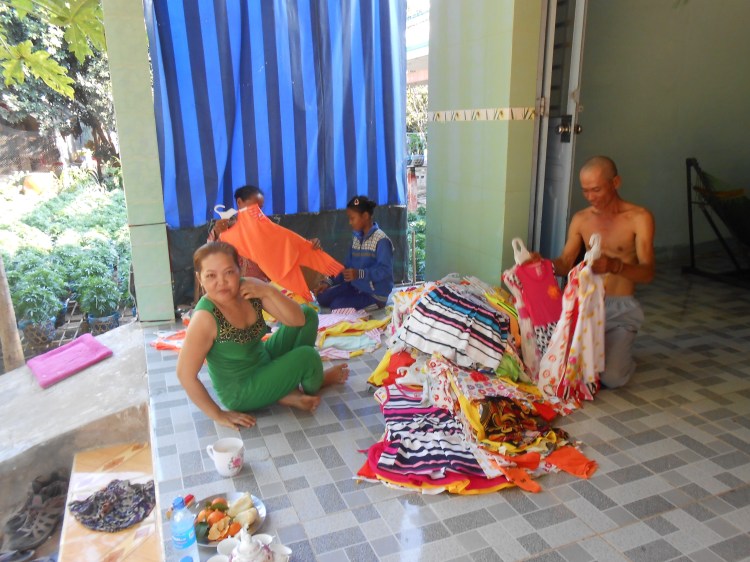
Monk and garments

This is where we had lunch the second day. The woman in green is the monk’s sister. She cooked the best chicken curry I have ever eaten. The coconut milk had probably in up in a tree that very morning. The man with the shaved head owns the house; he is a monk, and he has built a little temple nearby which has statues and images in it, as well as a toilet. He gives people advice at the temple. He also carries garments from a small local factory to the market, on his motorbike. The woman and her child in the back are going through the clothes to find some new things for Tet. They are probably Khmer; there is a Khmer village nearby. The bike tour company has invested in the monk’s house on condition that he serve lunch to riders from their company only. He gave me the most amazing backrub I have ever had. It made it possible for me to get back on my bike and go another 20 K. 

Incidentally, in previous bike tours that we have gone on, the vendor sends out a health/experience questionnaire in advance asking the ages, experience and condition of the riders. You did not do that, so Hong could not know that she was going to have to balance two 24-year olds with a 67-year old and a 72-year old. This is just a basic precaution, protecting both participants and vendors.

The bikes we were provided with at first were a problem in several ways. My first bike had no front brake and the gears would not shift. Only one of the bikes had racks, so people had to carry their packs and water on their backs. Joe was told that you had bikes that would fit him, and explained how tall he is. You said you had such a bike. The bike he was provided with was standard size, the same as mine. The seat could not be raised high enough and the front stem/handlebar set could not be raised at all. When we were provided with different bikes on the second day (also identical sizes for both of us), they were huge, heavy bikes with shocks, suitable for carrying at 250-pounder down a mountain or on a beach, but lousy for navigating tiny bridges or high narrow dikes facing motorbike traffic. Because of their shock system, the steering has a lot of inertia which makes it hard to get around narrow corners.  Both of use were contorted over to reach the handlebars, causing great pain in the necks and shoulders. We stopped riding on Day 3 largely because of these bikes.

Sewing machine woman

This woman is one of a set of neighbors (a hamlet?) along the dike path through a durian orchard. A durian is a fruit that has such a strong smell that you can’t take it through the airport; there are signs that say “No Durian.” The smell is either paradisical or nauseating, depending on who you are. The fruits are huge like basketballs, ellipsoid and covered with thorns. It’s hard to imagine what animal could get into them unless it was a tiger, with claws. The meat of the fruit is yellow and the substance that encases the seeds is what people either love or hate. I will decline to describe it. This woman opened one of these fruits for us and gave us some ice tea. Using the sewing machine behind her, she sews shopping bags, the kind we think of as recyclable.

We were expecting to ride the Specialized bike shown on your website, by the way.

Another suggestion: at the beginning of the ride, every rider should be provided with a paper map, at least a general map.  I have never been on a ride where this was not part of the basic orientation at the beginning of the trip.  I know there are no maps of all the tiny village roads on those islands, but some kind of general indication would help, with names of villages, for example, so that people have a general idea of how long the sections are and what direction we are headed in. The paper should have the guide’s phone number and the name and phone number of the hotel, homestay or factories so that in the worst case, you can just dump the bike and call a taxi. Lacking any kind of information about where we were going, we had to keep in eye contact with our guide and the other riders at all times, since we cannot either speak nor read Vietnamese. This was I’m sure stressful for her as well as for us. It also means that as you’re riding, you’re mainly looking ahead at the guide’s back, not around you at the scenery. Because there are so many little bridges and corners, losing her for a few minutes can mean everyone had to backtrack.

The bikes did not have odometers, and I don’t think the guide’s bike did either. This would have helped because then she would have been able to say, “It’s 5 K before the ferry,” which would enable participants to pace ourselves.

I am aware that we brought some physical problems (age, flu, size) to the experience that are not your fault. However, you should have been sure to find out about them (at least by replying to Joe’s email). Most bike tours do this as a matter of course, along with asking you for your next of kin contact information and any medical problems.

Can Tho floating mktThe Can Tho Floating Market

In the mornings starting early boats begin to gather a few miles downstream from our hotel. A boat owner will hang what he is selling from a pole on his boat. Boats are piled with fruit and vegetables and greens. Restaurants and hotels shop here. We puttered among them in our small ferry. There are many more boats than show in the picture; they are spread out all across the river. 

Finally, there was one part of the ride that was actually dangerous. Partly because I took a long time to rest after lunch and was given a wonderful back rub by the host, we did not leave our lunch on the second day until later than I’m sure Hong expected. This meant that when we got off the ferry into Can Tho, it was already dark. The van, for some reason, was not there to pick us up. Instead, we had to wander through the city to find the hotel. Traffic was heavy and we had to go down big streets, sometimes crossing through roundabouts. I don’t know how far we went like this. The hotel was not near the ferry, that’s all I can tell you!  Neither Joe nor I had ever ridden a motorbike, much less a bicycle, in Vietnam urban traffic, though we are both experienced cyclists who do not even own a car back in CA, USA. What’s more, our bikes did not  have lights. This meant that five unlit cyclists, at the end of a long day, were trying to find our way and stay together in the midst of rush hour traffic.

I salute Hong for not trying to have us ride the Can Tho Bridge at sundown after a long day when we were tired. It is not only very long (2.75 K) it is high, very high, and has two humps. When we drove back over it in the van going north the next day I did not see any bicycles on it, only cars and motorbikes. I would have had to walk up the hump. https://en.wikipedia.org/wiki/C%E1%BA%A7n_Th%C6%A1_Bridge

I guess I can sum up here: all bikes need to be appropriate — hybrids, for example, not heavy beach bikes. They need racks and odometers, if possible. They need lights. If you can’t leave a light on a bike in the daytime, they let riders carry them in their packs. And do not tell someone that you have their size bike when you don’t.

Hong is a wonderful guide. She is competent and strong and knows how to relate to people, even they are old and cranky and a little scared. But she needs the full support of the company — good equipment, prompt and responsive sag arrangements, a truthful website, paper handouts to give to participants when the ride starts.

Don’t worry about refunding money. It was a wonderful experience. We were just lucky that no one got hurt. Spend the money on updating your website to accurately reflect what you can do.

Helena

Joe and Lt

The second day was over 40 K and so on the third day, I decided I didn’t want to ride and persuaded Joe not to either. The bikes were too uncomfortable. Instead, the van drove us ahead to a place we were told was a chocolate factory. Since I have posted my letter of complaint already, I will now exit the two-story mode and tell this part of the story in regular non-italicized text.

The man with Joe in the photo above is the chocolatier. His family has lived on this piece of land on this island for generations. He is 67, the same age as Joe. HIs father, who worked for the French as an agriculturalist, went to Malaysia in 1960 and came back with 300 cacao beans. At that time, no one was growing chocolate in the Mekong. He told his son to plant the seeds and make chocolate. So they planted the seeds. When he was 16 he was in high school and the war started. The islands were villagers by day, VC by night. His family would get in a boat and go onto the river and hide somewhere, up a canal, to get away from their house at night. You could hear the shooting all the time. When he was 18 and the CIA murdered Diem and installed Thieu, all the young Vietnamese had to join the South Viet Namese army, the ARVN. He was chosen for training and sent to the US, to Texas, to learn to fly helicopters. He was also trained to maintain jet engines. He learned his English there, over the course of 2 years. Then he came back and co-piloted helicopters, both armed and troop carriers. It was a very dangerous job. Many of his friends were killed. After two years, he was able to quit and go to Bien Hoa to train other pilots and maintain the engines. He was a Lieutenant when the war was over. The Communists put him in jail for 2 years to “change his mind” through re-education. He did not change  his mind. Afterwards, he came back to his home on this island. His cocoa trees had grown. He got a book about how to make chocolate and studied it. He figured out how to do it from that book: how to ferment the beans, dry them in the sun, grind them using different grinding stones, roast them, make the powder, etc. He showed us the implements he  used when he was first figuring out how to do it: grinding stones, a pressure pump to separate the cocao butter from the chocolate, a rusty globe spinning oven, heated by charcoal.

Each fruit is about as big as my foot.

Cocoa fruit

Today he sells to Cargill. He watches the price of chocolate in NY on the internet and calls them when the price is high; if it is low, he keeps the beans in a stack behind his house. One year he made $20,000, which he said was quite a lot for a Vietnamese farmer, which is how he describes himself.  He has seven grandchildren. None of the wants to be a chocolate farmer.

The Danish government gave him some material equipment to set up a homestay: beds, pillows, etc. When people come to do a homestay with him, he shows them how to make chocolate.

This may be the only time we have heard one single continuous story from someone who survived the war. Our opportunities to get coherent stories like this are very narrow: they have to be people who speak English enough to talk with us, preferably without a translator, but they also have to be willing to talk with us. That’s not a whole lot of people. So to be able to hear a whole story, from the planting of the seeds to the making of chocolate, was wonderful.

I spent about 2 hours lying in a hammock under this cocoa tree.

Cocoa tree.jpg

The Khmer Village

On the second afternoon, we went through a Khmer Village. Apparently a lot of Khmer people came over the border from Cambodia during the war and settled here. Our guide, Hong, says that people sometimes think she is Cambodian because of how she looks. To get to this village we turned off the path and rode down a narrower path. The village was much like the Vietnamese villages except poorer, with unfinished houses and no gardens in front. She asked “the local people” if we could have some water, and one woman showed us where to park our bikes and then gestured across the path to a house where a lot of people were sitting around. We went there and sat and were given ice tea. One older woman said that her daughter, unable to pay back a debt that she owed, had killed herself by throwing herself off the roof of the house. She broke her arms, neck and back. This happened last week. That’s why so many people were sitting around – they were family who had come from other places.

An older man told us that he had no home. His sister had a home – this one, and his father had a home – that one next door, which was given to him by the government because he had been a soldier and fought the Communists – but that he himself had no home and slept in a different place every night.

At this point one of the older women started asking for money. Hong explained and warned me not to give money because then every time they came by, someone would ask for money. But she paid for the ice tea. Then a young man stood up from the table where men were eating and gave Hong the money back, saying that the older woman was not from their family, she was just a visitor, and that they do not take money from tourists.

When we went to get our bikes, which were parked in front of a different house, a man was sitting out on the porch of the house. He had no legs.

Hanoi Conversations (3, VTUU)

VTUU Vietnam Trade Union University

I appear to have lost my photos of the VTUU meeting on Tuesday, Jan 12. I will take some more when we’re up in Hanoi after Feb 1

Kent opened by referring to a conference that brought together TDTU, the TUU, and ULSA at the beginning of the partnership among the Labor Universities. We were then introduced to Sister Sung, Head of Organizing and a Deputy Director, Mr. Hoa, head of the Training Department; Miss Ha, Deputy Head of the International Department; Sister Lien and Mr. Tao, Deputy Head of Scientific Research Department. Apologies to those whose names I missed or got wrong.

Dr Phan Van Ha, Principal, spoke.

The VTUU was founded in 1946. It is thus celebrating its 70th anniversary. In the beginning, it only offered training for trade union officials. Then in 1952 it added a BA for students. So today it has two tasks: one, to train trade union officials, and two, to train students in the work of trade unionism. It is under the VGCL but also the MET, the Ministry of Education and Training. Every year they get a plan from the VGCL and and other one from MET for students to prepare them to take their role on society. At present they have a total of 12,000 students, including both trade union officials and BA students. Every year 12,000 – 16,000 people apply but they only take 2,000. About 1,800 students stay in the dorms; that’s all the room there is. The dorms are for non-residents, students from outside Hanoi. The other 200 have to rent a room somewhere. They have another facility under construction about 30 K away.

There are about 300 teachers. They still lack trainers and teachers. They have 9 departments. Trade Unions, Banking, Accounting, Law, HR, Business Administration, Social Work, Sociology and Industrial Relations. Their Law program trains on the Labor law, Labor Code and IR. Law has the highest enrollment, over 1,000.

The IR Department opened last year. It came out of the 2007 Committee on Industrial Relations. A lot of students registered to study this field. Training to meet the requirements of a market economy is very different. There is a high need for people to understand IR. They use materials from the ILO and other countries, collective bargaining and social dialog, but also grassroots organizing, collective bargaining skills, CBA’s, mutual benefit arrangements, harmonious industrial relations at the workplace.

They have relationships with other universities in Russia, China, Belorussse and Ukraine (these may be specific Research Institutes). They have an exchange of teachers: Two years here, two years there. In the future, they’re looking to enroll foreign language students. They would like to have the kind of cooperation agreement that is at TDTU. They have sent people to Germany, Italy and Thailand. They teach students from Laos and Cambodia, through the Laotian and Cambodian unions, like the VGCL.

They used to recruit workers to teach them to become union leaders, but now they only teach people who are already officials. This is because sometimes their students didn’t become officials, they would go do another job and it was felt to be a waste of money. TUU sends information about trainings to the District, Provincial and grassroots unions, and if they have people who are interested, they send them.

Questions are about how the curriculum has changed to adapt to new circumstances; what a bottom-up curriculum looks like; what the impact of TPP will be. “There will be competition in trade union activities. Workers will have the right to choose their union leaders. We are members of the ILO. When the union is effective, it will attract workers.”

Emil asks about the term “harmonious.” The Principal responds that the contradiction between corporations and workers always exist. “Some corporations only care abut profit. But if a corporation only cares about profit, it will not be stable, and that will be bad for profit. Harmony is necessary. If harmony dies, the enterprise will also not exist and the workers will lose their jobs.”

They ask questions about who pays union representatives and say they are interested in our materials. There is a brief conversation about language; “We speak Russian,” says the Principal with a smile. I ask if they are familiar with Vygotsky and get a smile from the Training Director.

Hanoi Conversations (3, ILO)

ILO meeting 1

Nguyen Thi Hai Yen, Director Chang-Hee Lee, Philip Hazelton, and two women whose names I did not get

After the meeting with the VGCL, we met with people from the ILO, but in the VGCL offices since some kind of construction was going on at the ILO office. Present were Nguyen Thi Hai Yen, the Project Coordinator for the Vietnam Industrial Relations Project, whom we had a long talk with last time we were in Hanoi, Philip Hazelton, IR Director who made many connections for us and gave us a long conversation last time and their Director, Chang-Hee Lee, a Korean, was there. He comes with a very positive reputation and we were eager to meet him in person.

Kent asked them to open with their priorities and their current projects. Director Lee responded. This is a summary from my handwritten notes:

The IR project, which went from 2002-2012, was about major law reform. For the future, the four years from 2012-2016 will focus on implementation of the new Labor Code and Trade Union Law. The reform included 20 different decrees, of which the ILO working with both the union and employers, supported 15.

Sixteen of the new laws involve new ways of operating and concern the relevance of the VGCL in the context of a market economy. In this transition, the VGCL will experiment with different ways of organizing and engaging in collective bargaining. Up until now it has been a social and political organization under the Communist Party. It is a large structure, big and slow to reform, with 9 million members in provincial federations and 20 industrial sectors. But workers are requiring it to perform a more representational role.

The ILO has been working in 5 different industrial zones – in the South, Central and North – to implement four pilot programs focusing on different ways of organizing and doing representation. They have also started a multi-employer collective bargaining pilot. These are difficult but exciting. They are in hotels, in an electronics company in Haiphong, in a Japanese electronics company in Dong Ngai.

The process undertaken with these reflects the practice of social dialog and is not fully bottom-up. It may be hard to scale up. There has been considerable interference by employers.

The ILO has also supported the National Wage Council, supported Business Associations in three provinces, and given workshops on Conventions #87, #98 and #105.

One member of the delegation asked about “autonomous, independent unions.”

Philip responded that it will be two years (2018) before the structure is set up to allow the possibility of registering new unions. After 2018, independent unions will be allowed. In 2032 they will be allowed to federate at the national level. The ILO won’t be able to work with independent unions until registration is possible. Even this is a short schedule. However, some new organizing may take place before registration is possible. The pending competition with the VGCL causes concern. Right now there is an 8 month period before the reform law goes into effect, so this bridge period is quite complex. The goal is to have labor that is strong, not fragmented; democratic not bureaucratic.

Viet Nam’s entry into TPP may be delayed if reform is not available.

In 2008, there were 1020 wildcat strikes. Right now, collective disputes usually turn into wildcats. A committee of government, VGCL, MOLISA comes in and gets a result. But this is a very sensitive area.

Three potential types of organizing might take place:

  1. The VGCL reforms quickly and develops a range of unions and representational processes;
  2. Some international unions and others outside Viet Nam present themselves and offer alternatives;
  3. Some employers may set up private unions which will block the organizing of new unions.

Overall, the social dialog mediation system has not done well. Referrals are not being made to the appropriate people to ask them to come and mediate disputes. This is partly because the Union isn’t taking cases and doesn’t bring cases to mediation. But the Union also has more challenges than just representing workers.

The Director summarized: there are lots of individual contracts out there, very few collective contracts, and a lack of understanding of how collective bargaining is different from social dialog.

We asked where the distinction between “rights” and “interests” came from. The reason for asking is that under the current law it is legal to strike over “rights,” although the process to get a permit to strike is too cumbersome to be practical. This is what encourages wildcats, which are strikes without a permit and no official union leadership. The problem is that since “rights” are what is in the law, and since 70% of the agreements (not really CBA’s, since there are so few of those) between union and employers just copy the law into the agreement, there is no steady platform for the union to strike for “interests” the  conditions of workers significantly higher than “rights”. Things that are defined as “interests” are the concerns that significantly improve the conditions of workers above the legal minimum and also increase the power of the union as a collective representative.

The Director responded that before 2000, the distinction was between legal and illegal and that the terms “rights” and “interests” were an attempt to create a different set of alternatives.

Then we went to the Vietnam Women’s Academy (formerly the Central Women’s Training School), run by the Vietnam Women’s Union. Leanna and Hollis have been working there for the past two weeks.