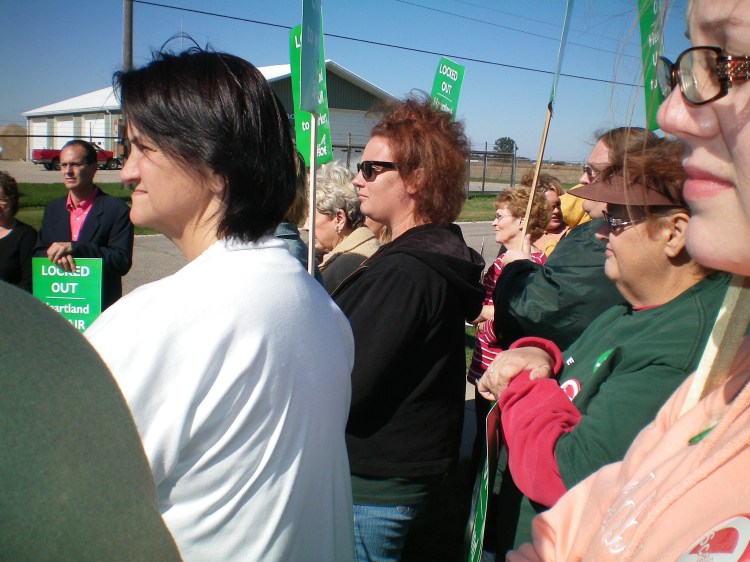
Thoughts Upon Reading the TPP Labor Side Agreement

Warning: This is a cold reading of the Labor Side Agreement by a US visitor. It is not a researched commentary that reflects the view of people in the know here in Vietnam. It is addressed to labor activists in the US. All the commentary coming from labor activists in the US, at least all that I have seen, has focused on the loss of US jobs and the investor-state complaint mechanism. This post, instead, focuses on the Labor Side Agreement.

The side agreement on labor from the Trans-Pacific Partnership trade agreement is titled: United States-Viet Nam Plan for the Enhancement of Trade and Labour Relations. The TPP is a trade deal that some people in the US describe as “building a trade wall around China” to contain China’s power in the global market. It will link 12 nations to “sew up” 40% of world trade in one agreement. It is part of a trade strategy that includes two other vast agreements, the TTIP (Trans-Atlantic Trade and Investment Partnership) and TISA, (Trade in Services Agreement).


In the Preamble, the side agreement document cites the ILO Declaration which in turn cites the labor standards, of which #87 and #98 are most frequently mentioned. Each party commits to “obligations” concerning its labor law as stated in the Declaration.The commitments, however, are all on the Vietnamese side.


How big a deal is this? Just like in the US, Vietnamese labor law has evolved and changed. Vietnam’s labor law operates in a way that was originally designed to frame a socialist economy. It was, even before TPP, evolving to adapt to a mixed economy. In 2012, a new Labor Code reflecting some of these changes was produced. More revisions are in the works. So this agreement will add changes to something that is already in motion.


But let’s look closely at those changes, as required in the Labor Side Agreement.


The Current Role of Organized Labor in Vietnam


Right now, there is one union in Vietnam. The Vietnam General Confederation of Labor (VGCL) is recognized in the Constitution as the representative of the interests of workers, guided by the principles of the Communist Party. It works by democratic centralism, but people at different levels of the VCGL may or may not be members of the Party. Overall, the VGCL is constitutionally guided by the Communist political agenda.


To understand what it means to have one union that is written into the national constitution, compare Vietnam and the US. In the US workers do not have a political party explicitly identified with them. In Vietnam, the Communist Party is the workers’ party (which was its former name). In the US we have many, many different unions that operate with no real political coordination. In Vietnam, the VGCL can pull all the different parts of the structure together into a single source of influence so that labor can have a more efficient impact and make the playing field more level. Compare what’s happening with the Bernie Sanders campaign and different unions in the US, how some unions are endorsing Bernie and some endorsing Hillary. Third, in the US, unions have no recognized role in government. In Vietnam, the VGCL is constitutionally empowered to represent workers to the government and in the management of State Owned Enterprises and government agencies.


Changing the role of the VGCL could change the whole political structure. I’m saying “could,” but that assumes that there would be no resistance to change. To make that assumption, or to predict what kinds of resistance will take place, would be a big mistake. The problem for Americans who are still horrified by our interventions in the lives of people in other countries (still ongoing) is that stuff like this brings up echoes of “regime change.” It’s tricky enough to be here teaching about labor as we know it in the US, without being associated with efforts to interfere with another country’s internal relationships.


This blog post, please remember, is not a message to Vietnamese people. It’s a message to my fellow US people: Don’t you want to be careful about telling other countries what they ought to do? Haven’t we learned that lesson?


Before we go futher, it is important to say that agreement is completely unilateral. It requires Vietnam to change its labor code and the role played by labor organizations in the internal political structure of the country. It does not require the US to match what is required of the Vietnamese. The stick behind getting Vietnam to do things is US money: the US may “withhold or suspend tariff reductions” (p 11, VII-3) if “the United States considers…”


How the Labor Side Agreement interprets Freedom of Association as described in Articles #87 and #98


According to the TPP side letter, signing onto Articles #87 and #98 means that independent and autonomous unions will be allowed. Legally, they will be equal to Vietnam General Confederation of Labor unions in terms of law and practice. Right now, all legal unions are part of the VGCL and have to be authorized by the VGCL. TPP requires Vietnam to allow workers to form a grassroots union on their own, without prior authorization. Once a new union is formed, in order to operate, it must register, but it can register either with the VGCL or some other “competent” government body. This probably means MOLISA (Ministry of Labour, Invalids and Social Affairs) or a DOLISA (Department of Labour, invalids and Social Affairs, the provincial branches of MOLISA).


According to TPP, these independent unions will be autonomous with regard to how they run their internal business and finances. They can join with other unions and form larger structures like regional organizations. They can get training and “technical assistance” from Vietnamese or “international organizations” (such as the AFL CIO, or other US groups, including NGO groups like the National Endowment for Democracy, which gets US government money and is the main funder of the AFL-CIO’s Solidarity Center, among other activities.


These new grassroots autonomous unions can organize, bargain collectively, strike and carry out “labor-related collective activities.” They can elect their leaders, employ staff and own property. They will receive the currently legally required 2% of total payroll costs that currently comes into the VGCL from every employer, based on membership, in addition to union dues paid by each worker.


What if there is already a union in a workplace but it doesn’t represent all the workers? Can they organize another union? It looks as if the answer is yes, because a workplace union does not have to represent a specified bargaining unit – that is, everyone at a workplace as defined by the union’s registration documents, constitution and bylaws, and/or CBA. Compare this with the way a union in the US has to represent everyone in their bargaining unit, member or not, with all the free-rider problems that ensue. In Vietnam, you can be a members-only union. If workers decide not to join their existing union, they not only won’t be represented but they may (meaning are permitted to) be represented only if the individual requests it. This could mean that workers at an enterprise who are unhappy with the VCGL will be allowed to form a separate union at the same workplace. So there may be more than one competing union at the same workplace. This is the situation already in many countries in Europe and elsewhere. This looks like an accommodation to a transitional situation.


What about the phenomenon of the same person serving as union president and the HR officer?

This is something that we were surprised to discover when we first learned about what we were going to teach here.  How can the HR manager be the union president?  (We also found examples of this from our student reports – see previous post). Well, under socialism, it makes sense. But not now.

No, the HR guy is not going to be serving as union president under TPP. Item E-1 says that “Vietnam shall ensure that, for purposes of protecting the interests of the employees, including in collective bargaining, that, in law and practice, it distinguishes between employees and those who have the interests of the employers.” This will affect many of our students, who forsee getting their first job in HR, despite studying labor relations and being politically pro-worker. The reason for this is that there are jobs in HR. This will also be a problem for many local union presidents who will have to choose what they are.


But what about all the “good stuff” that labor in Vietnam would get, that labor in the US doesn’t get?


Here is a list of the kinds of things labor in Vietnam will be able to do under the changes required by TPP. Where did this come from? Who came up with these items? This may all be just sugar-coating, designed to make the side agreement look democratic to US-based labor people. But is anyone lobbying to get these advantages for workers in the US?


Item II A 3-a allows workers to get technical assistance from worker organizations from overseas if they are “legally operating” in Vietnam. “Legally operating” may be key phrase that restricts who comes and who doesn’t. In practice, similar restrictions are at work in the US. The US Government certainly has barred foreign experts and educators, who were invited or employed by some US unions, from entry into the USA or denied them visas, based on their politics, “security” or other reasons. UALE (United Association for Labor Education) members will recall that it has been hard for some visitors from Mexico and even Canada – friends of ours, in one case! – to get visas to attend UALE conferences.


Item II -B-1, as we noted above, continues the employer’s required 2% of payroll contribution to the union treasury, in addition to membership fees, whether the union is a VGCL or a new grassroots union. In the US, employers do not make any contributions of direct cash to the union treasury. All the money in the union treasury comes from dues (or other union-generated sources). This 2% can add up to quite a bit of money.


Item II B-5 says an upper-level union may “assist” a grassroots union only if the grassroots union requests it, which would eliminate the US practice of imposing trusteeships on rebellious or mis-managed unions.


Item II D-1 requires that all members of the grassroots union E-Board be elected by the membership. In the US, while local union E-Boards have to be directly elected, under Landrum-Griffin, many of the bodies that perform collective bargaining duties in unions, district councils or national unions, are elected indirectly by delegate of even delegates of delegates.


Item II E-2 requires that Vietnam establish sanctions against anti-union discrimination and failure to bargain in good faith. Actual sanctions against anti-union discrimination? Right now in the US, “retaliation for union activity” leads to a ULP that travels a slow road through the NLRB. Failure to bargain in good faith? Right now, workers can call in a mediator but ultimately have to strike or do a public corporate or comprehensive campaign in order to make the employer bargain, if he doesn’t want to. What kinds of sanctions are we talking about? In the US, we talk about prohibiting companies from getting government contracts if they violate labor laws, but does that really happen? It’s more a matter of a public image (as in Vermont, with bargaining between the nurses and the University of Vermont).


Item F requires Vietnam to ensure that no laws are set up to undermine union activity. My goodness! Our 80 plus-year old labor law (the NLRA) basically just gives us a ticket to fight. It lets us climb into the arena. I have said this before, elsewhere in this blog. It says, “You can form a union, maybe get it certified, and the law then can make the employer show up to bargain with you,” but after that? From then on, you’re on your own, and the fight got harder and harder as laws and court rulings got more and more anti-union. Now there are a whole bunch of other labor laws and precedents that undermine union activity, like Taft-Hartley, for starters. What if we were required to eliminate laws that were set up to undermine union activity? That would really cause a waterfall of change. What if we shook off all those laws going back to the NLRA? For “union activity” the TPP makes a broad list, including organizing, collective bargaining and strikes, or assisting with these activities as things that should not be undermined.


Item G allows rights-based strikes. “Rights-based” is an ILO term; rights are contrasted with “interests”. Rights are things required by law, like minimum wage, length of workday or limits on overtime. “Interests” are things that workers want in addition to what is theirs by law. Since what is theirs by law is barely enough to live decently (and often not enough for that), strikes to get improvements in working conditions that go beyond what is law are not covered by this. The restriction of strikes to rights-based issues keeps the door open for wildcat strikes for things that are not “rights.” A rights-based strike requires the E-Board to approve 50% plus one. But it’s OK for workers at multiple enterprises to strike in a coordinated way. Also, oil and gas workers can strike! – and these are public sector SOE workers in Vietnam.


Item D and others: A tremendous amount of training is proposed: training inspectors, training criminal system authorities (this has to do with stuff about forced labor and child labor), training in IR bodies and “mechanisms”, personnel in MOLISA and DOLISA and everybody else, including researchers and people who will inspect this whole process. These people must also be hired. Item D says, “Vietnam shall launch an outreach program to inform and educate workers, employers and other stakeholders…” In the US, although there have been proposals for a nationally-funded labor education system, it never happened. Right now labor education in the US is mostly supported by unions with some shrinking public higher ed funding for programs in colleges and universities. How this would be paid for in a developing country is not addressed.


Item IV-B is about public comment and transparency of the whole process, including data on status and outcomes of application for union status, inspections and violations, fines and sanctions. What if we in the US had such a standard of transparency? And if it was easy to find and follow?


Who were the authors of this plan in the US?


I tried to find out where these ideas came from and what their purpose was. It almost reads as if the audience for them is US labor, not Vietnamese labor.


Apparently the AFL-CIO presented some ideas to the Obama administration: http://www.aflcio.org/Issues/Trade/Trans-Pacific-Partnership-Free-Trade-Agreement-


But were then locked out and misquoted. http://www.aflcio.org/Issues/Trade/Fast-Track-Legislation/Labor-s-So-Called-Seat-at-the-Table-at-TPP-Negotiations

It feels as if this side letter was written by one person, or a couple of people, who saw an opportunity and, given an assignment, took it and ran with it. I’d like to talk to them.
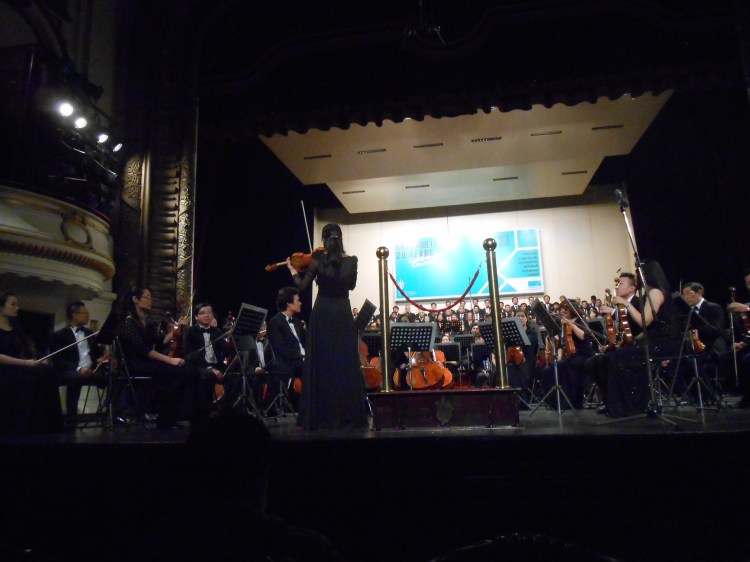


Hanoi (4) The Opera House

Concertmistress gives A

The Concertmistress gives the A

Honna Tetsuji is Music Director and Principal conductor of the Vietnam National Symphony Orchestra. He conducted a performance of Beethoven’s Ninth, complete with huge chorus, on Friday night Dec 18 at the Opera House. We went. It was great.

This performance appeared to be sponsored by a Japanese company. Older Japanese men in very good black suits sat in a row in the middle of the audience. One of them gave a friendly, gracious speech at the beginning, translated into Vietnamese.

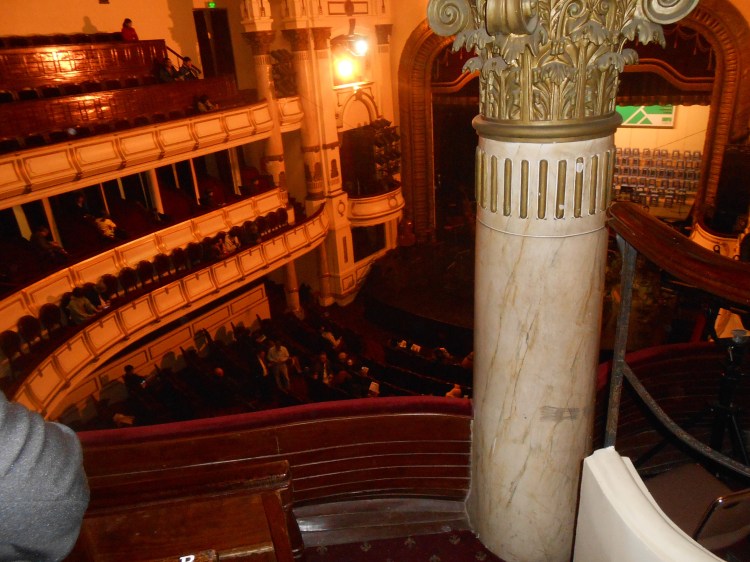
Hall from the top

You can just barely see Joe, wearing a light jacket, in the corner between the railing and the pillar. We were sitting in the 3rd row center.

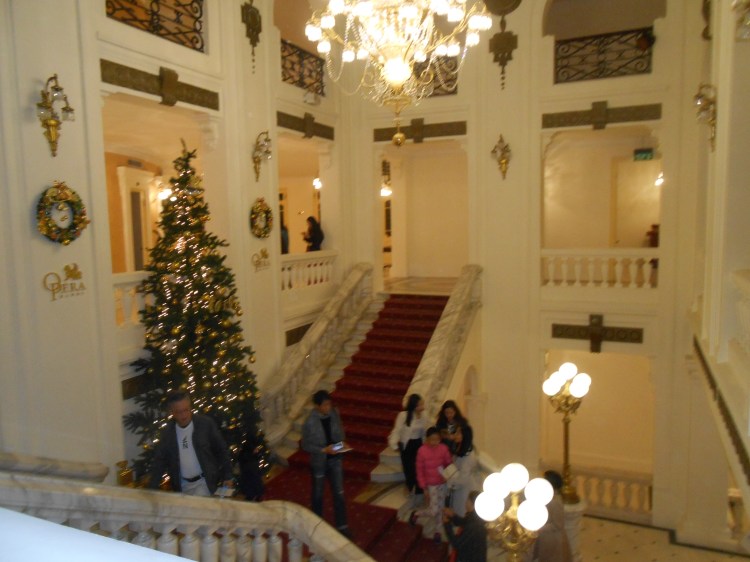
Grand staircase

The Grand Staircase. People walked up and down it, met and had conversations on it.

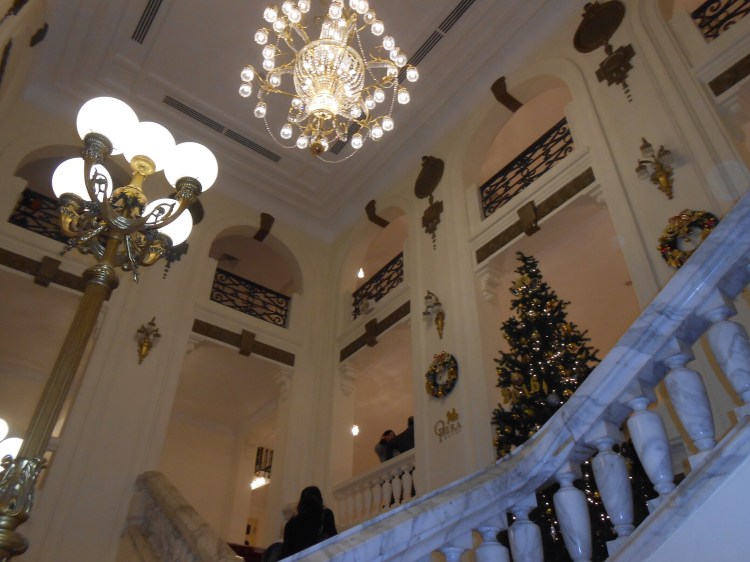
Lobby looking up_1In 1946, the first government of the Democratic Republic of Vietnam was formed. The Assembly took place at the Hanoi Opera House. In pictures, it looks very much now the way it did then. It has been carefully refurbished but not remodeled.

http://hanoioperahouse.org.vn/E_FontEnd/E_Lichsu.aspx

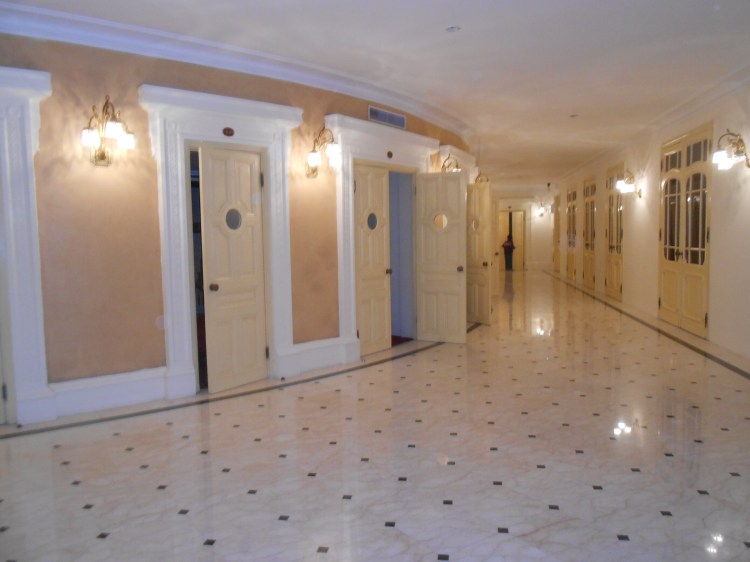
I took some pictures of the lobby and the halls at different levels, which are so shiny that they look as if they had been polished. The shine and polish goes all the way down into the basement where the restrooms are, but they are new.

Other hallway Opera_1

Dress circle lobby

It was an expensive evening: 500 thousand dong per ticket, or $22.40. There were a lot of empty seats down in front, but they filled in as the evening proceeded.Although there were quite a few “foreigners” (people who look like me and Joe) there, the only language I heard was Vietnamese, plus some Japanese.

The Beethoven was the only thing on the program; four movements, tremendous loud crashing and banging and thrilling drum rolls that seemed to go on forever. Great fun! The performers seemed a bit serious at first but as they played they loosened up. Maybe they saw the audience smiling. Christmas carols in the lobby

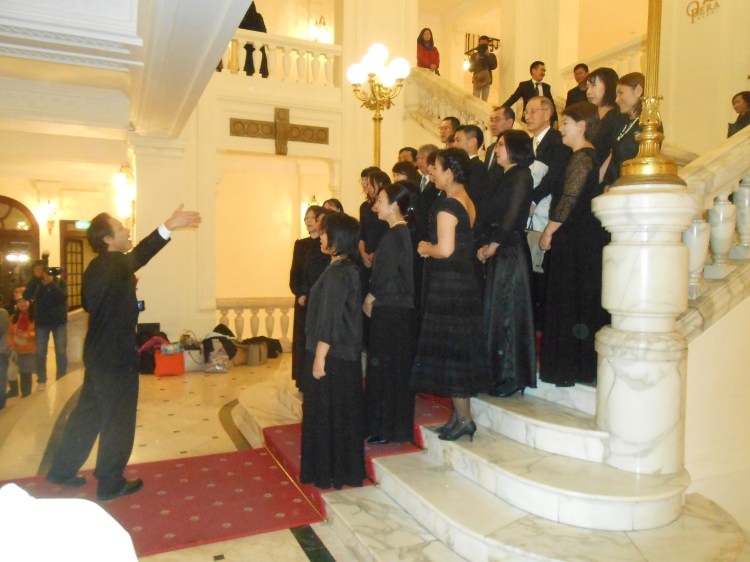
After the performance, some of the singers came out and gave a Christmas carol concert on the Grand Staircase. The medley of carols was new to me; strange dissonant  harmonies as they went from song to song.

We sat next to an Australian woman, an art historian, who told us that she had been allowed to look into it in 1999, when it was closed to the public, and there were bats flying around.

Opera house from street

Hanoi Conversations

VGCL

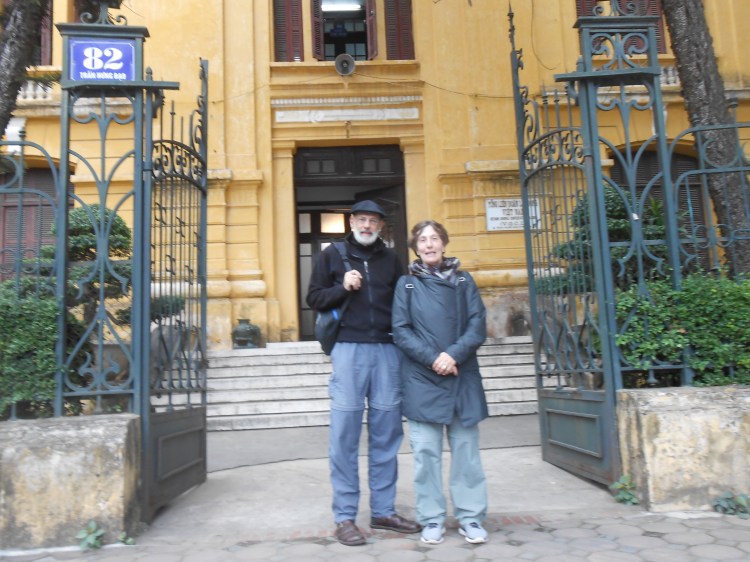
Not a great picture of me, but Tuyen took it, Joe looks fine, I’m wearing the scarf that An gave me, and the building in the rear is the VGCL

Nine days in Hanoi. Many conversations. Some connections made for us by Philip Hazelton from the ILO, whom we met at TDTU in September, and others by Tuyen Huu Vu, who was introduced to us at TDTU by Dean Hoa and who works at MOLISA.
 

These conversations have helped me put what we are doing, or supposed to be doing, in context. So here’s what I’m seeing now:


Vietnam started being more integrated into the global economy in 1986 with doi moi. (See Country-Led Development, John Erikssen – a case study on Vietnam done in 2001; this is an Oxfam project that finds Vietnam to be a great success story.) In 1996 the trade embargo with the US was lifted. A closer relationship with the US was inevitable. In 2006, Vietnam entered the Global System of Trade Preferences.

https://en.wikipedia.org/wiki/Global_System_of_Trade_Preferences_among_Developing_Countries


Capitalists who were looking to set up businesses or invest money would find it easy to build closer relationships, but how about relationships between trade unions in the US and in Vietnam? Part of the problem was that there was no experience of partnership between a US unions and a Communist labor union. However, through many channels about which I know little, contact at the level of labor education programs was made. The ILO may have played a role too.


In 2008 there was a wave of worker wildcat strikes. In 2009 the US Embassy, through US AID, put $2 million into an area project intended to build capacity in an industrial relations system for Vietnam. We have been told that this was specifically designed to address these strikes, which were producing unstable conditions. It was called the IRPP, Industrial Relations Promotion Project, and was also described as intended to support the implementation of transitional labor laws. Two other related acronyms are GIG, Governance for Inclusive Growth, and SIR.


MOLISA worked on this project for three years. The first project, the MOLISA project, closed in 2014. The US Department of Labor refueled it with more money in a second phase. There were essentially two projects, one US AID from 2009 and one through the ILO, a parallel project. This is the project that Philip Hazelton is working on.

There are three Vietnamese universities that offer labor studies programs – TDTU (Ton Duc Thang), ULSA (The MOLISA University of Labor and Social Affairs) and VTUU, the Vietnam Trade Union University. While the VTUU was started in 1940, even before Independence, ULSA  was founded in 1976, TDTU was founded in 1997 and the Labor Relations and Trade Unions Faculty was started in 2009 after the 2008 wave of strikes.

In February, 2011, these three universities prepared a report on their various interests with respect to cooperating with overseas universities and hosting labor educators, especially from the US, for teaching purposes.  Each institution said what their faculty needed and what kinds of support they could offer. This is in the document titled Report: An Overview of International Faculty Exchange Procedures at Ton Duc Thang University, the University of Labor and Social Affairs, and the Vietnam Trade Union University, by Van Nguyen. It was followed in February 2012 by a needs assessment, also by Van Nguyen, who may be someone who works for the Ministry of Education and Training Needs. That publication, titled Appendices for Assessment Report: On Faculty Training Needs and University Partnership Building in Industrial Relations Education in Vietnam, was prepared under the IRPP, the Industrial Relations Promotion Project, the USAID Project under Contract No. DFD-I-09-05-00220-00.


The roots of US AID and its predecessor entities go back to the Cold War and Point 4 of the Truman Doctrine. US AID funded all kinds of anti-Communist activity including paying for CIA interference in the governments of other countries in the developing world. To the extent that there is still outside money for the IRPP project, it has been moved to the US Department of Labor and passed through the ILO “to be less controversial.” I have heard this from several people so the source of the funding is apparently not a secret.


There are parallels with the NED, National Endowment for Democracy, which is US government money overseen by the Democratic Party foreign policy arm, the Republican Policy foreign policy arm, the Chamber of Commerce’s foreign policy arm and the AFL CIO’s foreign policy arm.


Michele Gonzalez-Arroyo, an independent program evaluator who works mostly in South America, came to TDTU to evaluate the impact of the US AID and MOLISA project back in September. The idea is that building capacity in an IR system will help stabilize the economy. From sitting in on her interview with Dean Hoa, it looked as if one surviving impact of that project was a labor relations textbook in Vietnamese this is still used. There were also visits by Greg Mantsios, Lance Compa, Katie Quan, Richard Fincher, Hollis Stewart and Leanna Noble, and the conference last April 2015 that Richard Fincher helped organize.


How much of these were done in the name of a partnership among the three universities is not clear. One of the people we talked with this week says that there is a national umbrella framework for the training and education of trade union leaders and Industrial Relations specialists, and that this framework has been approved but not implemented by the Ministry of Higher Education, so it is still just a framework.


The “needs” that were assessed in 2012 emerged from discussions between unidentified Vietnamese Specialists and Kent Wong in 2010 and 2011. The Report, although it is dated prior to the needs assessment, states needs quite clearly. It motivates the partnership among the three universities by saying that they all want to “participate in a faculty exchange at their respective universities in order to share practical experience and knowledge of industrial relations.” Currently, guidelines for setting up exchanges “are not standardized or codified, rather they operate flexibly depending on the relationships and ongoing communications.” According to this report, this flexibility is sufficient for the time being, as the partnership matures.


But each university does set out contact information, tells what it can offer by way of housing or stipend, and who it is looking for. TDT, for example, would like someone who can teach Industrial Relations Studies (Collective Bargaining, Dispute Resolution/Strategic Negotiations, Grievance Mediation, Labor Inspection, Social Dialogue, and Trade Union Management) or Organizational Studies (Human Resource Management, Organizational Psychology, Public Relations Management). TDTU can offer faculty housing and a stipend. The VTU can only offer housing in a guesthouse and is interested in a basic set of topics. ULISA also offers housing in a guesthouse and is interested in a broader set of topics, including qualitative research, statistical software and teaching methods.


I think that the idea was that the three trade union universities – ULSA supported by MOLISA and the VTU supported by the VGCL, plus TDTU which is supported by the VGCL but autonomous (has to raise, and can control its own funding) – were going to be the academic partners that would form a framework to flesh out an Industrial Relations field of study that would do research, hold conferences and train practitioners. Laying the groundwork for this was happening at least by 2009, at least, when the first delegation of Vietnamese labor people came to UALE with Kent Wong. Conversations were happening in 2010 and the reports and needs assessments were done in 2012 and 2012. There was another delegation led by Kent in 2012.


This makes me want to think about what an Industrial Relations system is. A system is something with many parts. There are relationships among the parts. Some move forward, others stay the same. In the US our Industrial Relations system has changed over time. In recent years – since the 1970’s, for example – it has changed so much that university programs like the one at Illinois, which was called and Industrial Relations program, are changing their names. Parts of our system would include the National Labor Relations Board, the various regional Boards, our labor laws, various state level public sector laws, the various union bodies at the national, state and local levels including Central Labor Councils, the FMCS – where do you draw the line? Is the Department of Labor or OSHA part of our IR system? I’d say so. how about the Federal Court system? The parts of the system relate to each other and support and critique each other back and forth in many ways. Although is always changing, this “system” has essentially been in place for 80 years. Because I am so used to hearing “industrial relations” in the US, as a labor regime that includes government agencies, public and private entities, organized labor bodies and a whole raft of other stuff, I have taken it for granted that there are corresponding systems in other countries.


But the point here is, as Tuyen noted, that it is not possible to match the idea of an IR system in the US to something parallel to it in Vietnam. There is no parallel. In Vietnam, there is one labor union, the VGCL, and it has a constitutionally recognized role in the government. Above all, developing an IR system in Vietnam can not mean copying the US IR system. As Lance Compa was quoted as saying, whatever it is, whatever system is built has to come from the Vietnamese culture and history.

To the extent that an IR system in Vietnam is developed for the purpose of stabilizing an economy, it will be shaped in part by whatever Vietnamese workers decide to do with the changes afforded by TPP.

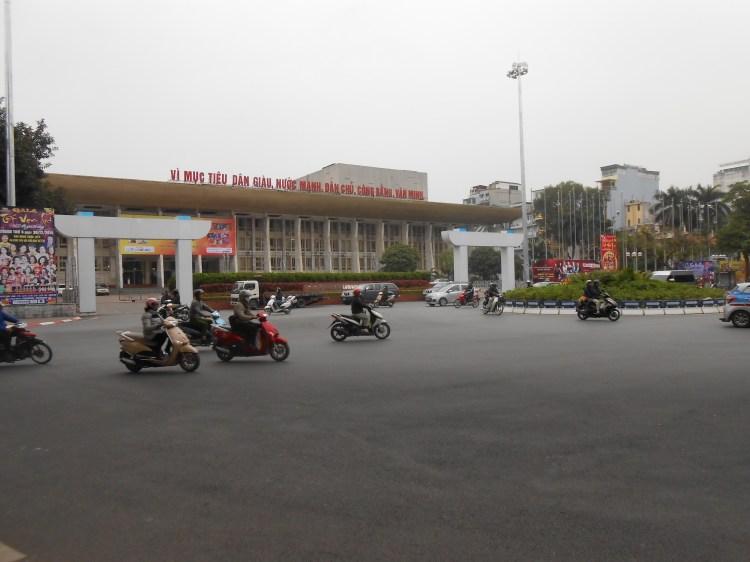
The VGCL building in Hanoi, one of those grand yellow French-style buildings with high ceilings and big windows, is going to be re-purposed as a labor museum when a new modern building for the VGCL office gets built. The new building will be over beyond the Soviet-built Friendship building, a huge concrete edifice that looks like a public library or a train station, and which is now used for cultural events.

Friendship palace

We suggested casually that a museum would be a good place to locate a research center, a place where the ongoing labor research could take place and bring together the three labor universities.


The Swimmer and the Sea

A teacher is teaching a boy how to swim. The boy lies on the ground and the teacher moves the boy’s arms up and over, to show him how they should go. The teacher lifts the boy’s feet and moves them up and down to show him how to kick. Then the teacher lets the boy practice. When the boy is ready, he calls the teacher to come back. The boy moves his own arms and kicks his own legs. The teacher claps and gives him an A.

Is there a problem here?

What has the boy earned the A for? He did what the teacher told him to do, didn’t he? Maybe there is no problem.

Some people would say that the problem is that he is not in the water, he is on the ground. He is not swimming. He is not swimming because he is not in the water.

But what if swimming is not the point? Maybe doing what the teacher says is the point. But then, why call it swimming?

What would happen if the boy had to take his A, walk over to the water and jump in and swim? Maybe he would drown. If he did, whose fault is it? The teacher? You can always punish the teacher, that’s easy. Or maybe the water is shallow and he doesn’t drown, he just stands up and paddles while he walks. In that case, no one will ever know if he can swim or not and the teacher will not be criticized, and there is no problem.

However, the water is just a figure of speech. It stands for something else. The student is not really learning to swim, he is learning to be a real person who can think and act intelligently. He is getting an education. I am thinking about our students at Ton Duc Thang, who are students at a big university that has ambitions to become one of the top 100 universities in the world, or perhaps one of the top 26 universities in ASEAN.

The ground is a metaphor for the classroom. It is an artificial situation shaped by a curriculum through which students are supposed to learn something that has value. In the classroom, the teacher tells the students what they are expected to do (swim) and shows them how to do it (moves their arms and legs). Then she gives them an exam to see if they have learned what they are supposed to have learned.

As far as I can tell, from my experience at this university in Vietnam, they do not go near the water. Maybe I only see a narrow slice of what is really out there. But what I see forces me to ask, what does the water represent? The water is a metaphor for what?

First, I want to call it the sea, not the water, because what I have in mind for “sea” is the real world, with all its chaos and complexity, history and danger and power and beauty. This is where the real swimming will happen. The students who are learning to swim are going to have to do their swimming in the sea, whether they like it or not. Sometimes they will be able to avoid the sea, but today in this world of rising temperatures and melting ice, the sea will come to them and they will have to swim in it or drown.

Pool at night

Hanoi (2) Realism

The Vietnam National Museum of Fine Arts had an exhibit called, at least in English, “Realism.” The wall poster at the entrance was not inspiring in its English translation. Reading it, my main reaction was that this was a pre-emptive effort to deflect possible criticism. It seemed to say that Realism (and it listed six or eight different types of realism, including both social realism and socialist realism) was a diverse, multiple thing; that each artist has to speak for themselves and paint what they are driven to paint, and that all these artists no matter how different from each other they are nonetheless all follow along in the great traditions and even in the light of love and God. In other words, everything and nothing. For sure, if you read this poster, you would skip the exhibit.


So I didn’t skip it, but it took me well into the second room before I started to think I understood what I was looking at. I also went out and got Joe and walked him through it. He is not sure that he saw what I saw.


The first three paintings were dark, green-blue still lives, as if painted in a room with the shades drawn. No sharp angles of light anywhere. The objects were all household items from the 1950s and earlier: alarm clock, a fan, a portfolio, suitcases, a scooter, a lamp. Stacked up. The paintings were about 24 – 26 inches high, maybe 3 or 4 feet long. A feeling of dust all over everything. The items in the pictures were definitely old. It wasn’t as if they were in an attic, though. It was as if they were present only in memory.

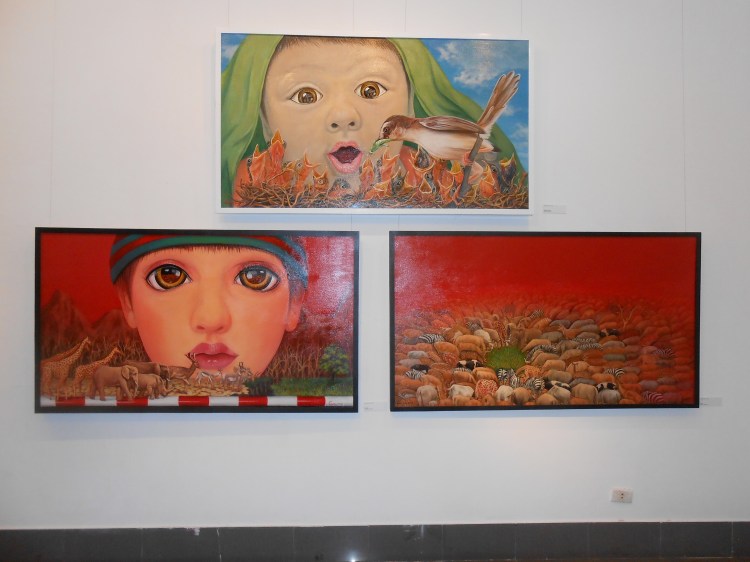
Next came three very frightening but initially cute-seeming  paintings. These are big paintings. Standing in front of them, my eyes were about at the level of the grasshopper in the upper painting. In the lower left painting, the image in the child’s eyes is a cracked dry mud desert. The animals moving from left to right are headed toward a deep crevasse. In the upper painting, that bird is feeding one live grasshopper to about 17 baby birds that are all screaming with hunger. The innumerable animals in the lower right painting are all crowding around a small patch of lush green grass that is about enough to feed one of them for one day. Behind them the desert stretches out as far as the eye can see. The tree has been stripped bare.

Global warming

There were some pictures that were technically extraordinary. I didn’t take photos of everything. I felt a bit conspicuous taking photos, although some other people were doing it too.

Three of these were splendid watercolors about water, or at least that’s what it looked like to begin with. One showed a seacoast, breaking waves, etc. Next to it was a closeup of a small waterfall, water running over shining stones. Here and there were glimpses of golden fish climbing the waterfall. All shiny and transparent and multi-layered. But the third one showed a display of transparent plastic bags, each containing half a dozen small gold fish, pinned up on a rack for sale. Goldfish and the water they live in have become commodities.

This one is a lovely scene of ducks swimming in a quiet river. Behind them n the distance, however, an army of towering apartment buildings is approaching across the field. This is exactly what is happening in the landscape of District 7 in Ho Chi Minh City. We could see it when we went with Mark Nguyen to that restaurant where you could fish from a pavillion and they’d cook the fish right there. In the distance, only nearer than in this painting, were miles and miles of these white buildings getting closer.

Encroaching apts

And then we get this amazing pair of paintings. How can you make the most expensive object d’art even more expensive? Take Van Gogh’s painting of his bedroom in Arles, when he was waiting for Gaugin to come and visit him. How can you make that painting even more desireable than it is? Well, one way to do it is to add something else desirable — just paint it right on top!!

Van Gogh

And if you still want to add something more, you can put in an apple. This is probably the same apple Eve used, even though we’re in Vietnam and Judeo-Christian legends aren’t well-known to everyone.


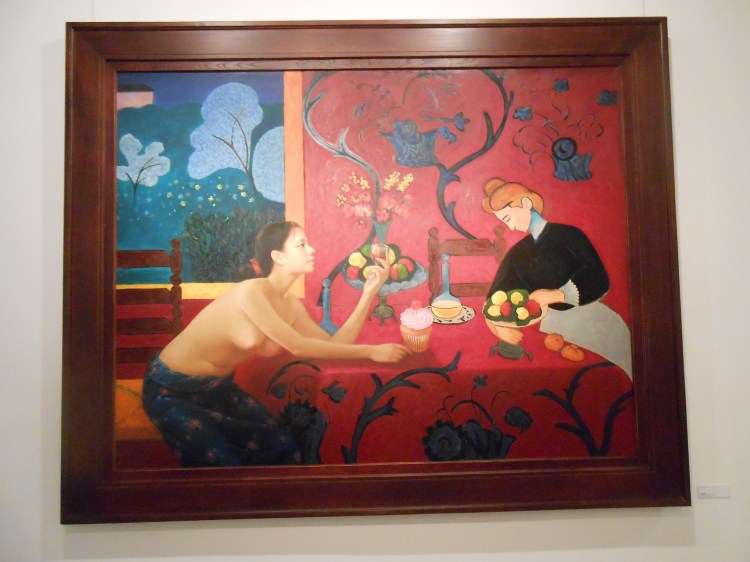
And while we’re at it, how about this? We can do it with a Matisse, also a famous painting. Let’s have the same lovely girl in this painting, too. Now nothing is missing! Can you see the cupcake?

Matisse

I feel as if John Berger is laughing over my shoulder. He explains how paintings, once they came off the walls of churches and could be carried around and put into people’s houses, could be used as sort of catalogs of what one possessed — one’s wife, children, horses, mansions. And of course all the things that you might want but don’t actually possess now, like beautiful girls.

https://en.wikipedia.org/wiki/Ways_of_Seeing


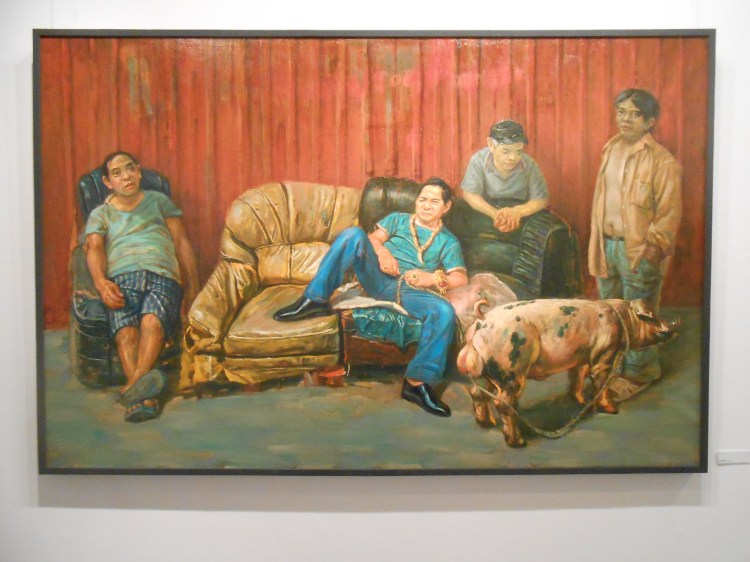
Then there was this painting, probably the most horrible, relentless, fearsome painting I have ever seen. What do you suppose this is about? Who are these four guys? This painting is about 3 feet high and 5 feet long. It’s not a miniature.

Four thugs

And now this: a boy holding a plastic action figure toy. The boy himself is held by someone who may be his father, whose hands and feet are visible: bare feet, blue work pants, lots of veins and muscle in both hands and feet. It’s three generations: the worker father, the precious son, the action figure. And behind is a turbulent sky full of clouds circling a bright moon.

3 generations2

And finally, this, that sticks in my mind:


Woman with plow and frog


The tool is a plow. Women used to pull plows like this. In the lower right of the painting we’re looking at a map, a seacoast. Behind the post in the lower right is a shadow that continues even when the thing that should cast the shadow is gone. There are layers of writing on the wall, one on top of the other. The woman seems to have one breast; that can’t be an accident. And what is that frog behind her right foot?


Hanoi (1)

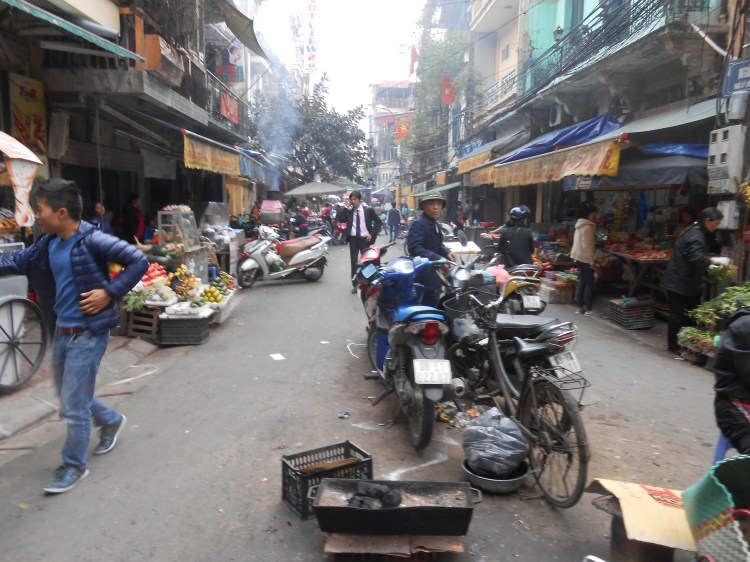
Marketstreets


Hanoi is the capital of Vietnam. Seven million people live there today. It feels like a combination of New York City and Paris. According to one guide book, space in the Old Quarter is the most costly per square meter in the world. Luckily, our room at the Charming Hotel II on Hang Ga Street costs only $38 per night, breakfast included.

Houses in the Old Quarter have narrow frontages, as little as three or four meters. Then the house runs back, room after room, courtyard after courtyard, sometimes all the way to the next street. Between the houses run shoulder-width alleys. You can just glimpse the households full of life down those alleys.

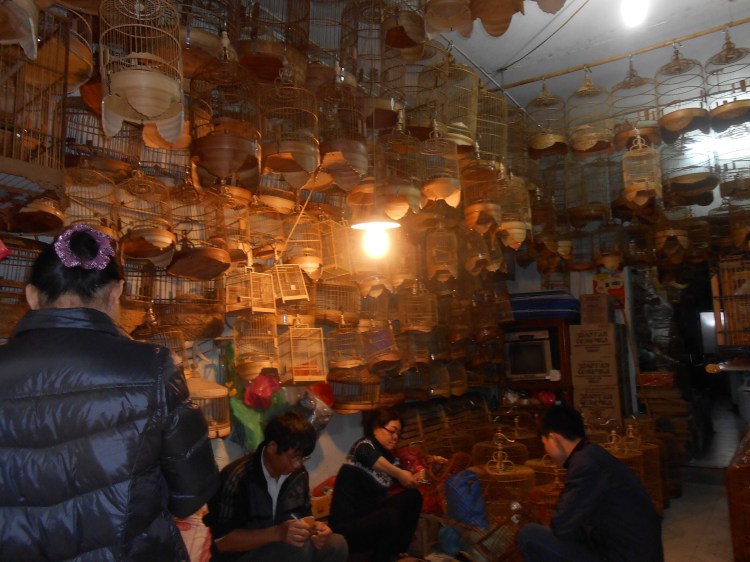
Birdcage shop

In the Old Quarter, parts of a street are named by what is sold in the shops there. So you have Silk Street, Coffin Street, Bamboo Street. Our hotel is one door away from a bamboo shop. They make everything from ladders to water pipes out of bamboo, right there on the sidewalk. Above is a birdcage shop.


Walking up past the night market we came upon a performance of Cheo, traditional theater and music.

Cheo perf

There is no way to convey the cultural richness of this city in a few photos. We arrived Friday night, met with contacts on Saturday, walked around on Sunday and walked around today, too, Monday. Here are some photos from walking around today:

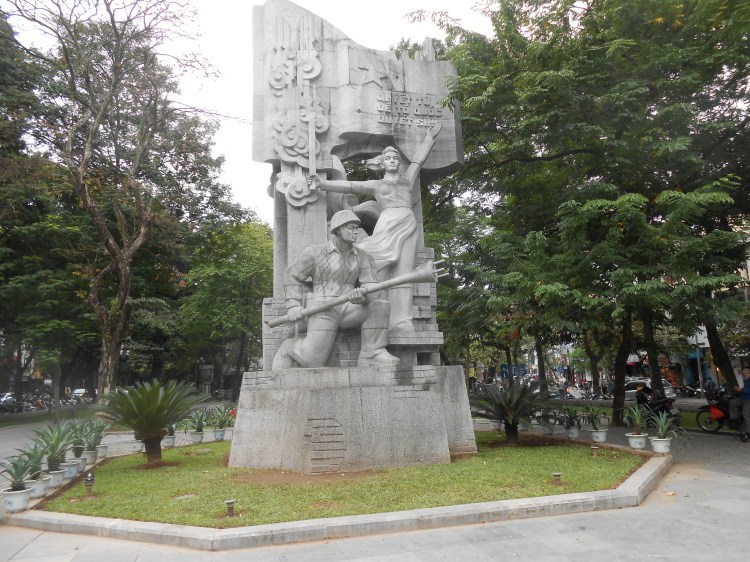
War memorial 1946

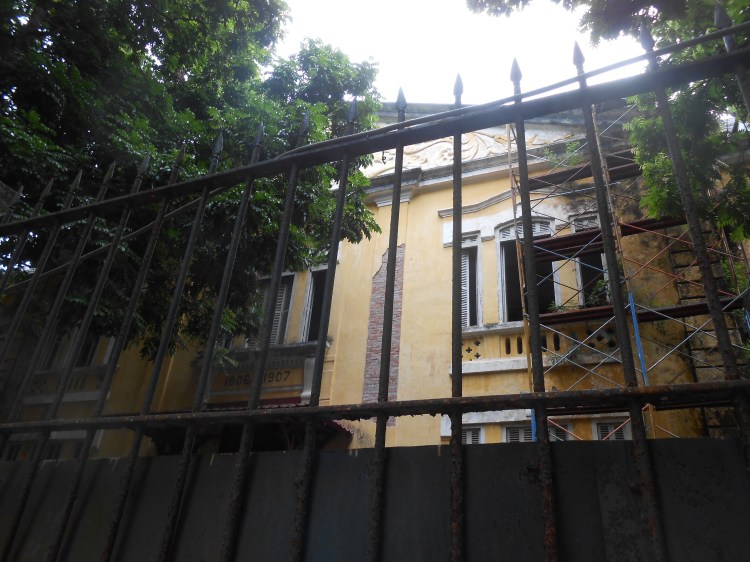
War memorial, 1946, on a tree-lined boulevard at the top of the Old Quarter. The trees have bark like plane trees, which are the trees of Paris (and a lot of Berkeley, too) but the leaves are different, so they are something else. Besides, they are much taller than plane trees. This part of the city was developed under the French, starting in the 1880s. Huge, elegant yellow stucco mansions with louvered casement windows.  Some in serious disrepair; others, re-purposed.

French disrepair

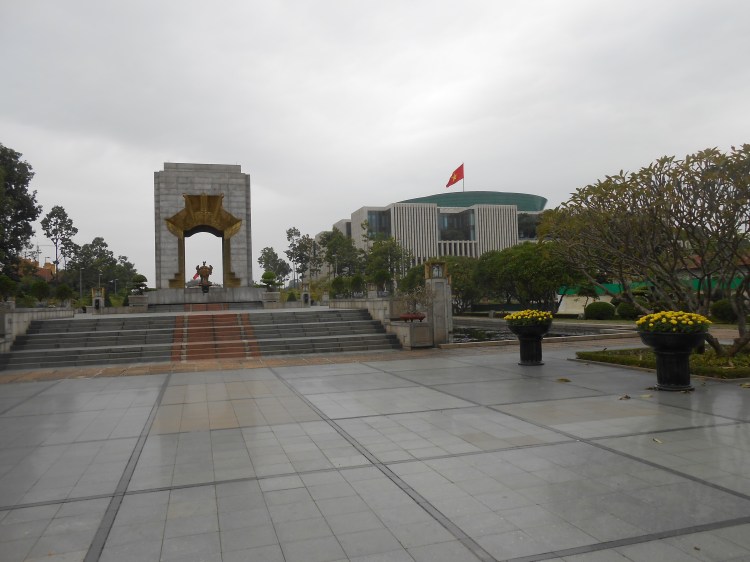
Here is the new National Assembly Building. The glass flying saucer effect in the right rear must be where the Assembly meets. You can’t see how big it is from this picture; it’s huge.

Govt

http://www.thanhniennews.com/politics/vietnams-delayed-capitol-building-to-finish-in-august-26627.html

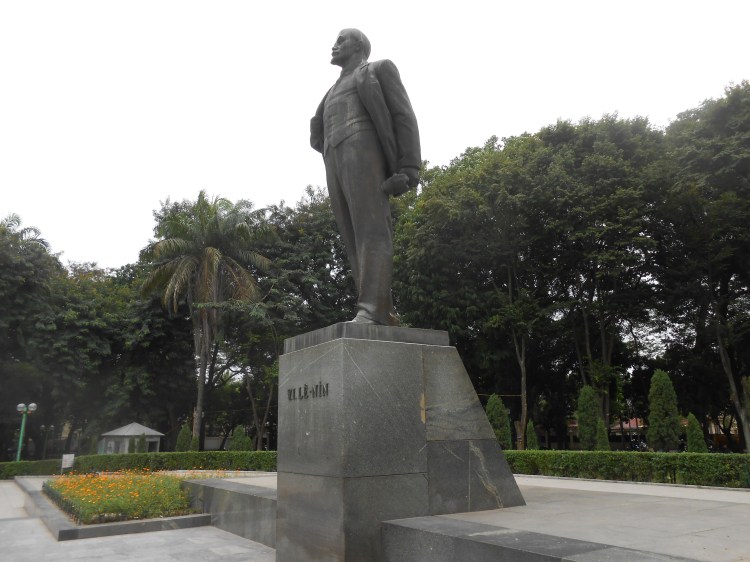
Lenin statue

You remember this guy.

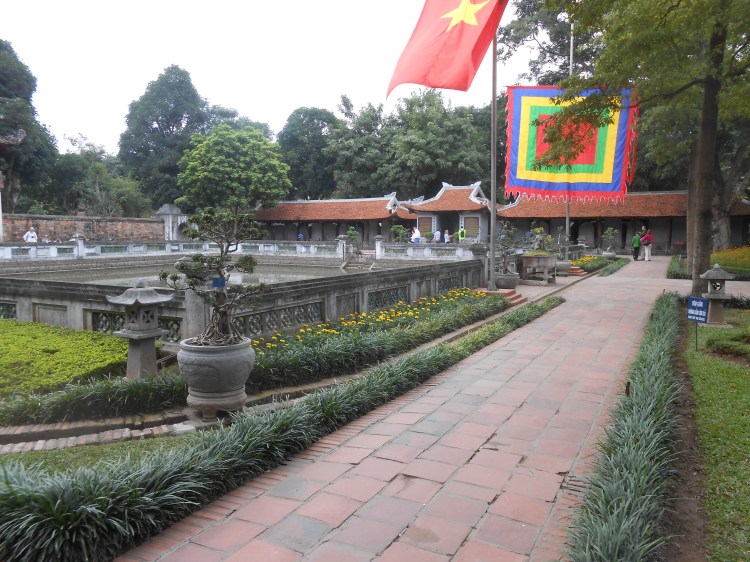
The Temple of Literature in Hanoi is actually a university. It was founded in the 11th Century to create a space where scholars could meet, study, live and teach. This is one of the central inner gardens.

Temple of literature garden

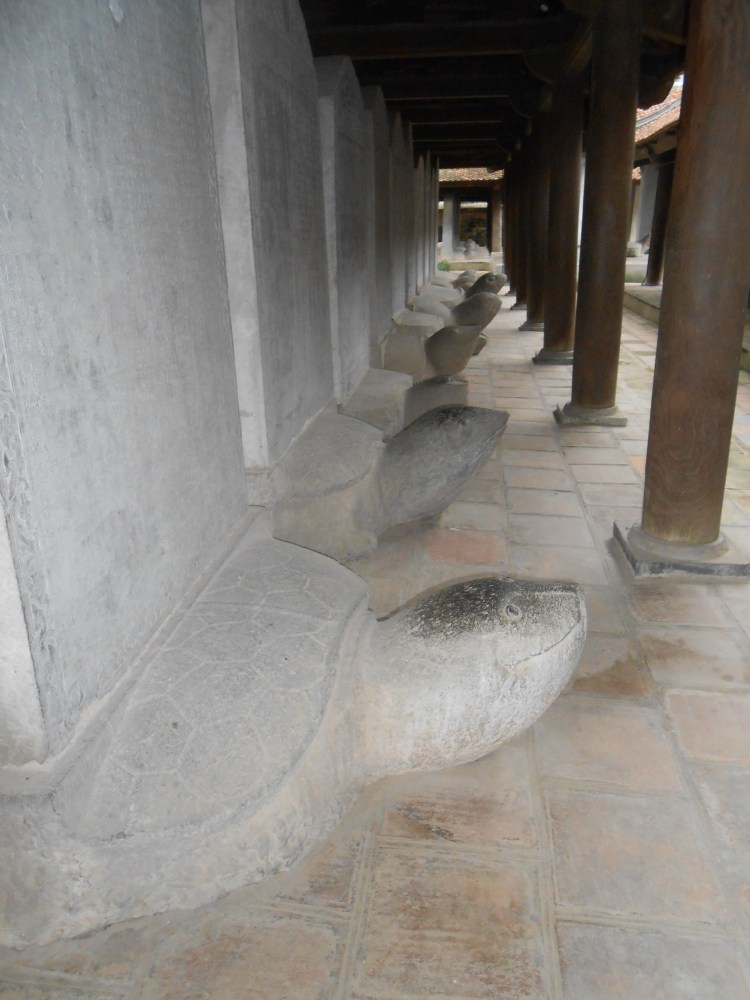
The great scholars who came there are honored with stone stellae erected in a long loggia. Onto the surface of each stela is carved the text of the essence of that scholar’s wisdom. Each stela sits on the back of a turtle, because obviously they were all Terry Pratchett fans, even back then.

turtles R

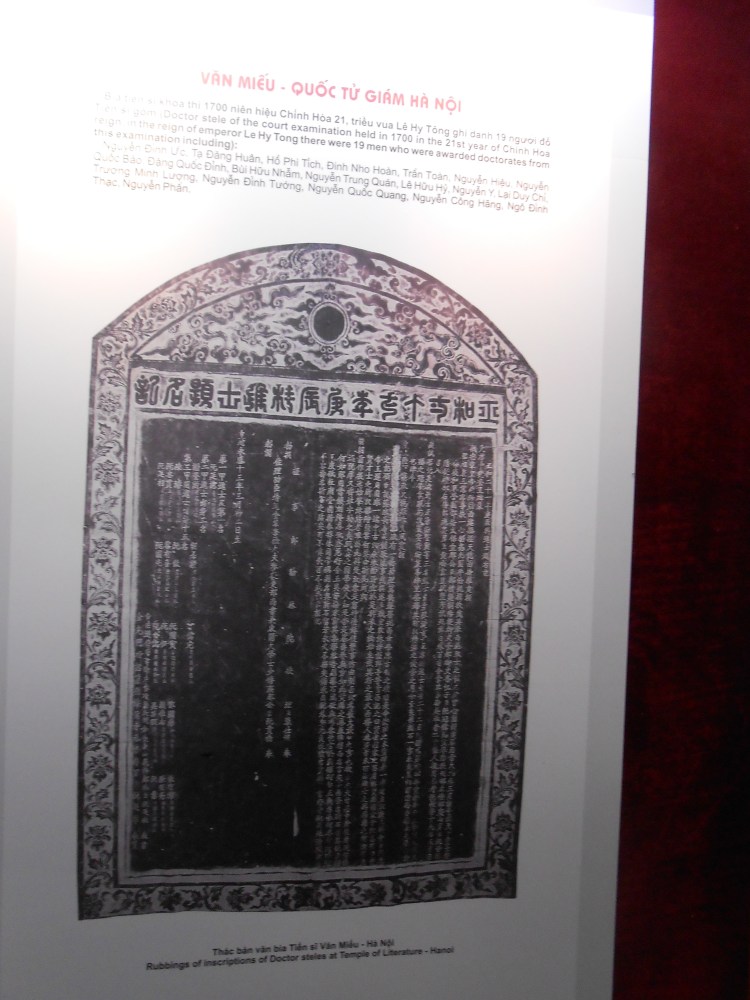
When the inscriptions on the stone stellae are rubbed and pulled so that they can be read, they look like this:

Stele text

The characters are Chinese, a form called “Southern” because it was adapted to Vietnam.

https://en.wikipedia.org/wiki/Ch%E1%BB%AF_n%C3%B4m

Vietnamese did not have its own written language until the 1700’s when French missionaries created a romanized script to convey Vietnamese, called Quoc Nur. Under the French, the language of education was French; after 1946, Quoc Nur became the national language

http://www.omniglot.com/writing/vietnamese.htm

We also went to the Hanoi Fine Arts Museum and saw a contemporary exhibit called “Realism,” or at least that is how the title was translated. This was such an interesting experience that I’m going to deal with it in a separate post.

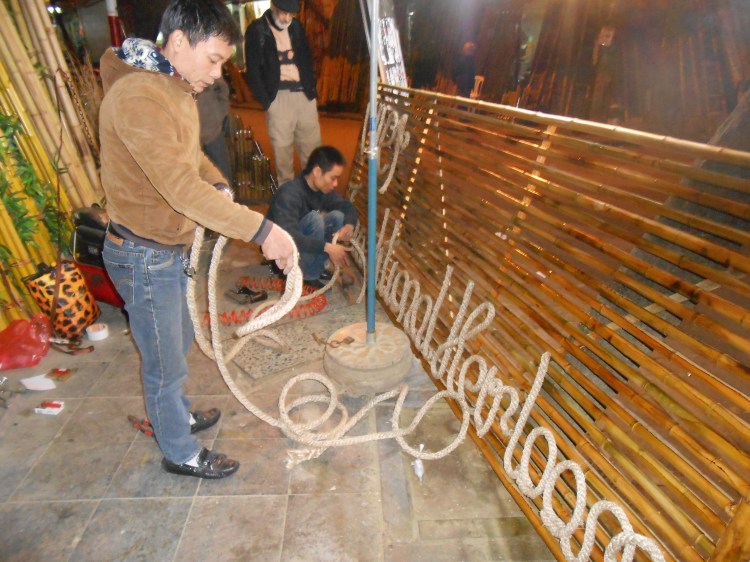
Our hotel is on a street corner where they sell bamboo. They make everything from ladders to flutes to water pipes to signs out of bamboo.

Rope sign bamboo st

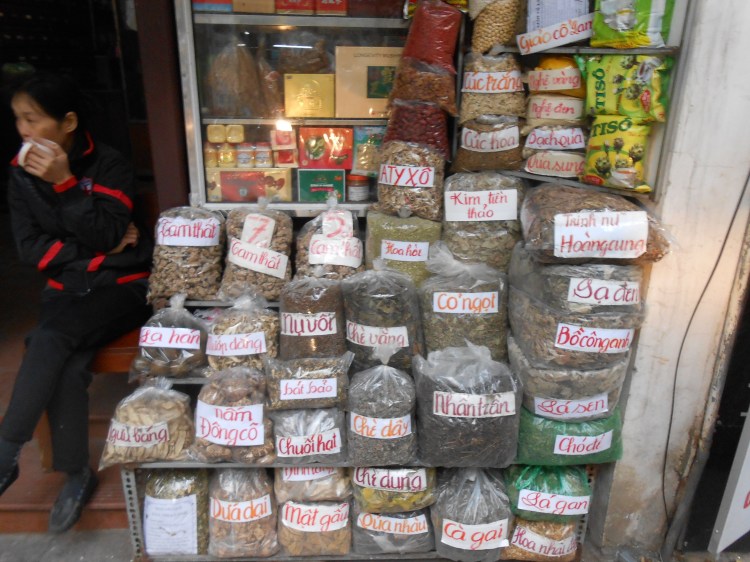
Tea or traditional medicine? Maybe both.

Meds or spices

Five-story coffee shop on a side street near the ILO:

coffee shop

Soviet-built Friendship Palace. Across the street from the VGCL. Now a cultural activity venue.

Friendship palace

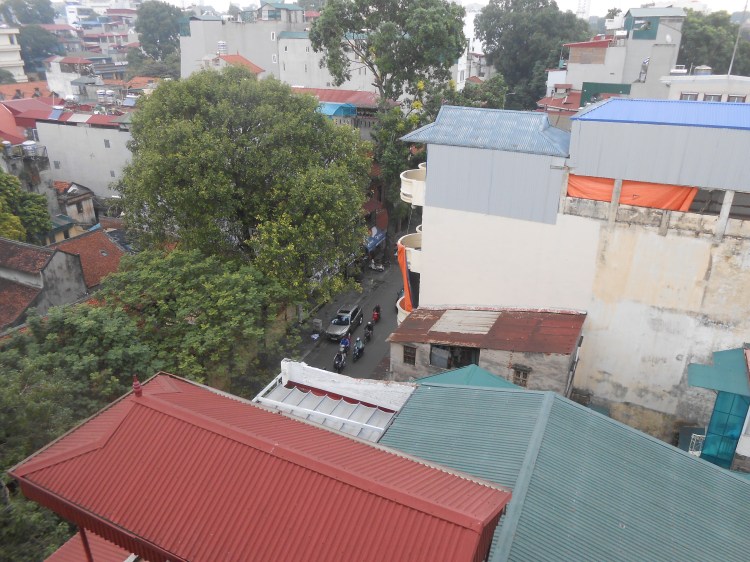
View from our hotel window:

View from hotel window


What Did We Learn from Student Reports? (2)


The students’ final presentations were supposed to be stories about what people did in the workplaces to make their work lives better. Theoretically, the stories were supposed to be about collective action: organizing or leadership. However, we emphasized that what was most important was to tell what really happened, not to make something up. If it wasn’t there, it wasn’t there.


They were also supposed to look ahead and explain what should or could happen.


These are some stories from Joe’s second class and my class. I either typed or took handwritten notes as fast as I could while Vinh whispered a translation into my ear as the students presented. Each student had 10 minutes. The presentations were the product of a team effort; each team would choose one or two students to present for the team.


Some overall thoughts, having to do with how to use these stories as the basis for teaching: What are they about? What do they show? What is missing? These are not meant to be criticisms of the students’ work. Instead, they are thoughts about what the students’ work tells me about labor relations in Vietnam.

Wrapped inside those thoughts is our perennial question, “What do they think we can teach them?” Do we actually know something that they need to know, and that we have the potential to teach?

  •             These are all stories about solving an immediate problem.
  •             The choice for the worker is often between solving the problem or quitting. For workers who have individual labor contracts, there is a process for quitting, but many of these part time workers do not have labor contracts. So the problem gets serious, at least for that one worker, before they try to do anything about it.
  •             If the problem gets solved it gets solved for the moment, not incorporated into something that will apply to others in the future.
  •             The solution is not written down.
  •             In workplaces where there is a management intermediary between the workers and the person who can make the decision, it is harder to get a problem solved. Passing a dispute up a chain of command makes it less likely that the problem will get solved. An example of such an intermediary would be the HR manager.
  •             Proposals for the future always mentioned strengthening the local union and usually educating members, teaching workers about the law. They did not talk about assisting or encouraging workers to organize and apply collective power.
  •             Neither the solution nor the problem is analyzed as an aspect of the overall relationship between workers and employers.   Therefore nothing leads to an overall change in that relationship.
  •             There is no general awareness of ways to count the value that labor contributes to the product. This would be a way to enter the issue of the political economy of a given workplace. We asked students, at a minimum, to ask whether a worker at, for example, KFC, could afford to buy lunch regularly at KFC. The answers were usually “No.” While this is beyond the scope of these stories, an awareness of the distance between what workers earn and the value of what they produce would give a different meaning to “problem.”

A student, reading this (and I know several will) might say, “But she didn’t ask us to do that.”  True, I didn’t, and neither did Joe. We asked them to tell us what they saw. If they didn’t see something, they weren’t supposed to make it up. There’s enough of a problem already with us suspecting that they try to give us what they think we expect. Their whole exam system promotes that, too.

But here are the stories. There’s the whole range of workplaces here, from ones with no union presence at all to ones with a union that seems to get something done.

Anh Tuan

At Anh Tuan, construction and development, the employer provides labor clothes (PPE) but they are not enough and workers do not know how to use them. Also, in 2010 the pay was three days late (this is a construction company that pays people by the day’s work, at the end of each week). The employees didn’t have their money so they started to break the tools. The supervisor got angry and yelled: “Any other person who breaks tools will get laid off.” They got paid two days later. But when the workers went away for Tet they got sick a lot. They don’t sign a labor contract for construction so they don’t enforce the law. They need a union to protect their rights and benefits.

Nguyen Kim

At Nguyen Kim (repair of electrical machines), the workers are from a lot of provinces. They had a lot of complaints about low wages. The union did not pay attention to the comments of the employees. The union seemed to be just for the leaders. The feeling of union members was not good. When the students researched the CBA, they found that it only followed the law. When the union members raised ideas or suggestions, they were shy and the weaker party, they did not know how to protect themselves. One employee proposed to collect signatures to ask for a raised wage, but only a few people joined in and the plan was postponed. If the employer does not solve this problem, the workers will get a stronger voice and it will affect the profits of the company

Nah Be Textile

At Nah Be Textile, there were three problems. There were workers who did not have enough skill and the employer found mistakes in the product. Those workers would get fined. Second, if they forgot to wear an ID or violated some other policy, the workers would get fined three days’ pay. Third, a lot of workers thought the restaurant did not provide enough food and was not clean. The union called for the opinions of workers and took the problem to a different level. After one month, the agreement was made that the employer would cover training costs for new products. There would be no penalty for the first time someone violated a policy, a reminder the second time, and only a third time would there be a fine. The employer would will also build new, clean toilets and have air conditioning. The union was talking about building a dormitory for workers. The reason to have a dormitory was that the workers came from different provinces and could not afford the cost of housing in HCMC.

Strawberry

At Strawberry, workers did not get paid overtime on a holiday. Many workers wanted to quit. Some of the others thought that the job was boring. They want to have a union but don’t know how.

NyDec COPAL

At NyDec COPAL, electronic manufacturing, 1,200 people stopped work for two days on the second of December, 2013. They have a CBA on paper but do not follow it. The current problem with overtime is that the employer arranges the list. The solution would be to have people register for the list.

Happy Cleaners

At Happy Cleaners, the cleaning company was about to lose its contract with TDTU. (TDTU was taking the work back in-house.) Here is the story of one worker who cleaned the downstairs B Building. He comes from the provinces,. He has to work a lot, especially on rainy days. He was about to lose his job. He talked with another employee who does cleaning also but who was employed directly by TDTU. They compared their wages and working conditions. He talked with his work leader and higher. So all the employees of Happy Cleaners went to work for TDTU. They saw the benefit of comparing wages with other companies. This union has some strong members who will learn the labor code. Other workers should compare wages and learn the labor code. All of the employees moved from Happy Cleaners to TDTU because workers at TDTU have a labor contract and a CBA.

Anh Nguyen

At Anh Nguyen, where they assemble and sell furniture, there is no union. This is a disadvantage to the workers. Most workers here don’t know what the union is. I (the presenter for this group) was the person working here. I publicized about the union so they have a more positive opinion so that they won’t quit this job, I explained about the union and social insurance for the workers. The goal of our research is to find the leader, the real leader. It is very hard for us to find a leader, because some they don’t have enough knowledge and skill to become the leader, or they are shy to lift their voice in front of the manager. For this research, we can learn more how to communicate with the leader, how to modernize them, portray them so they strengthen their voice in front of the employer, also to teach them how to do surveys and how to enforce the law in reality.

VCS Home Shopping

 At VCS Home Shopping, a call center for selling electronics and appliances, the company doesn’t have a union. The company set a target of 34 million; if you can get the target you can have the bonus of 5M for your call center. So we have to register for OT. It is not forced – they persuade you. We have a very large blackboard where they write a timeline with the target for each day. All of the workers try their best to do OT because also they will get paid for OT. But the bonus of 5M will divided up to 60 employees so it is very small. At the end, we go over the target, and we are very happy when we receive the bonus. We use the bonus to have a party. In the near future we will have a union here, because if we have the union we can share opinions. The emergent leader is Miss X, not because of her high position, but also because she is very respected by a lot of people and besides working hard she is fun and clever with other people. For example, when a worker makes a mistake, she doesn’t yell, she talks softly to her and reminds her. She has become the emergent leader. She ‘s the recruiter so she works in the HR dept taking care of payroll.

Tran Phu Trung Kindergarten

At Tran Phu Trung Kindergarten they are a SOE and they have a union. At the time the school was established, they didn’t have a union. A group of employees found an emergent leader, a person who could get the trust of workers.

TDTU Security Guards

The Security Guards have a union. In November 2013, when they had their health checkups, they found that most of them had a health problem (from breathing the pollution from the traffic). So they made proposal to union and the union talked with President of the University. The department of security researched different parking lots and proposed that the President make a policy regulation that all the motorbikes have to turn off the engines. Also, one worker wanted to meet regularly, not always officially, to eat or drink together and understand each other better. They face a variety of problems. One is that they often have to talk with foreigners, and can’t speak English. Another is their 24-hour shifts and their health. And the third is that the older workers expect to be replaced by younger workers who have more energy.

DeVoung Shoes

DeVoung Shoe Company is a huge shoe company, with a union. But people don’t know what the union does. In 2013, in the shoe line, there was a stoppage that was moving toward a strike. There were a lot of orders coming in and workers were told that if they didn’t do OT they would not get paid. Also, the meal was bad. The workers were very angry and they asked for union to solve the problem. They waited a very long time. After a while, they sent one representative directly to the Director to speak, and the Director threatened to lay them off. This made them organize a strike. It was very effective. It spread out into other companies. After that the provincial Federation of Labor came down to the factory itself. The learning point that we get from this story is that when there is not a presence of the union here, the union cannot solve the problem, especially if it is a foreign-owned company. The workers had to have the higher level intervene in the dispute. But it’s hard for workers to find workplace leaders because they don’t have enough education and knowledge.

For DeVoung, we (the team) propose five solutions for the union: First, a committee of the union has to be elected by employee, not decided by employer. We have to clarify the difference between outside leaders and emergent leaders. For now, they will assign a leader, but we propose that an emergent leader be elected by workers. Second, we have to organize to collect the workers’ opinions rather early about payment, pay raise, about working conditions. Third, the district level of the Federation of Labor has to go directly to the local union to train them and educate them and explain how to represent workers and strengthen their voice in front of the employer. Fourth is that we have to have a close relationship between workers, the local union and the district level Federation of Labor. Fifth and last, we must regularly hold social dialog to understand the workers so that in the CBA we clarify things like the value of the subsidy. We need to get very specific in the CBA. We must also organize an outside cultural communication stream between VN and Taiwan so that people can understand the culture of a foreign-owned company in Vietnam.

Kentucky Fried Chicken

Here is the story at Kentucky Fried Chicken (KFC). Just before TET, the employer announced that each person who worked during TET would get a 14 month bonus (two extra month’s worth of salary). This made workers want to stay at KFC. It was hard work, lots of OT, and stressful. After the end of TET, our friend did not get the 14 month bonus. She talked to other workers who also did not get their bonus. They went directly to the supervisor. The supervisor said that your friend did not make the target. That is why she does not get the 14th salary. But then our friend sees that full time workers (FT) can get the bonus but the part time (PT) cannot. She works part time. This shows that the union here doesn’t function as a proper union to protect the workers. Our plan for the future is to make a separation between HR and the union. Then, collect workers’ opinions regularly, have meetings and build a strong relationship between PT and FT. The next thing that has to happen is that union has make the policy clear to the workers because the employer just said 14th month salary, but didn’t say PT or FT. They don’t have a labor contract here. Most PTs are students, they turn over and they quit their job and just stay a short time, so it’s hard to find an emergent leader among them. So the end of the story is that they did not get their money. Will they get it this year? Not clear.

At KFC, the second story is that there was a lot of overtime. During the holidays, there was 90 hours of overtime in one month. Also Saturday and Sunday, you could not go home early. Also one of the problems is that the meal was not good. This caused a strike. Four workers gathered together and said, “We don’t want to work any more, we don’t want to work overtime and we want to increase our wage.” The four leaders got together and formed a temporary union to stand up to the employer and have a strong voice about overtime and also, if you work overtime, to get paid the higher wage. In the future, they will bargain with the employer about how to improve meals. They will use social dialog for this. They will mobilize people to join the union and the leaders will involve workers and have collective opinions with no discrimination.

Vietopia

Vietopia (1) has a union but HR is the union. We do not hear about social dialog or CBA. There are a lot of current problems. Here is our story. In December 2014 one of the workers was laid off, because she said something bad about the company on Facebook. In reality, she just shared that she had to work OT one hour but got no pay for it. She also said that the manager didn’t have a good policy. When she heard that she was laid off, she went to the company and she cried. I think that she cried not because she was laid off but because it was unfair to lay her off because she dared to speak out with the voice of the worker. She never got her job back.

Vietopia (2 and 3) also reports that HR is the union here. In December 2014, someone was laid off. So the person who takes care of the doctor’s role model section found that she had too many customers but no help. She couldn’t eat her lunch. She had no one to turn over her shift to. She was very angry and talked with co-workers, who were also angry at the short-staffing. She asked if they agreed, and they were friendly to her. They called two delegates to go with her to see the supervisor. After the two delegates talked with the employer, the employer apologized and agreed that they had given her too much work. This calmed the spirit of the employee. They solved this problem before the union became involved. The union doesn’t touch the workers. It’s very weak. Some plans for the union: the union has to collect and inspire the workers so it can solve the problem immediately, not make the problem bigger. The union must also organize different activities to make close relationship between workers and managers. Also the local union must contact with higher level of Federation of Labor to prevent the problem becoming bigger in the near future.

Highlands Coffee

At Highlands Coffee in 2012, there were two workers working here. At the beginning they just got paid 2M 400, not enough to live in HCMC. They decided to ask the supervisor for a pay raise. The manager agreed that when he met with higher level of managers he would ask for pay raise. The two workers said that if they didn’t get the pay raise they would quit. The manager wanted to keep these two persons until the end of the week in order to find another person to replace them. They quit the job.

The workers here they don’t know what a union is. They want someone to explain to them what is a union. There should be an organization to bargain for them. The store has to solve immediately the problem. It’s hard to find an emergent leader at a workplace like this where there are a lot of of middle managers who can’t make decisions. Now that we have TPP it is necessary to have the union to sign the CBA but it has to be h be a real functioning union.

Pou Youen Shoes

Pou Youen Shoes is a big company, total workers over 80,000-90,000, with a very strong union. But most of the activities that the union organizes just improve their spirits – singing, sport, to improve their health. They have entertainment outside working hour, but only workers who live in HCMC can join these events. Workers who live in apartments far away can’t join and miss some of the very real benefits. But the union gets money for the workers and also has policy of loaning to workers with difficulties, a good policy of social insurance and medical care insurance.

Our recommendation is that the union can propose to the manager that they give a bonus for seniority, so that we can have the policy for the benefits, so that the worker can stay longer for the company. Some of the persons who live far away from here, coming from provinces live in apartments far from factory. We organized things for them making handmade things such as handicrafts. For the kindergarten, inside their company, they want to lower the fee and give a 50% discount. Worker want to have more facilities to practice their health. These are all the recommendation and the meet of the works in Pou Youen.

In June 2013, there were several strikes at Pou Youen. The first strike was actually about a political issue: China had attacked Vietnam. Pou Youen is Taiwanese and there is something political here between the Taiwan and Chinese which the workers didn’t understand. So it was not a proper strike for the workers. But later it became a very strong union and publicized information relevant to the law so that the workers were well equipped with the understanding of the law. They were frustrated with the government about social insurance so they went on strike for the social insurance that year.

There was also the fire in Pou Youen in August 2013 in Building A-10. Now 42,000 square meters on floors 5 and6 were burnt. The reason here is that Pou Youen doesn’t take care of fire prevention. There are a lot of violations so they don’t have the safety about fire and they can get burnt. We have to train the workers who work here as well as the managers to know how to prevent the fire and build good exit ways so that it is easier for the person working here to not get burned.

_____________________

How much can we rely on these stories to inform us about what work in Vietnam is like? I think that actually, they’re pretty useful. I say this because the more we talk to people who have an overview of work, workers and unions here, the more it sounds as if this is a pretty good, if micro picture of what’s going on.

Joe’s class

Joes class c H


What did we learn from the student reports? (1)

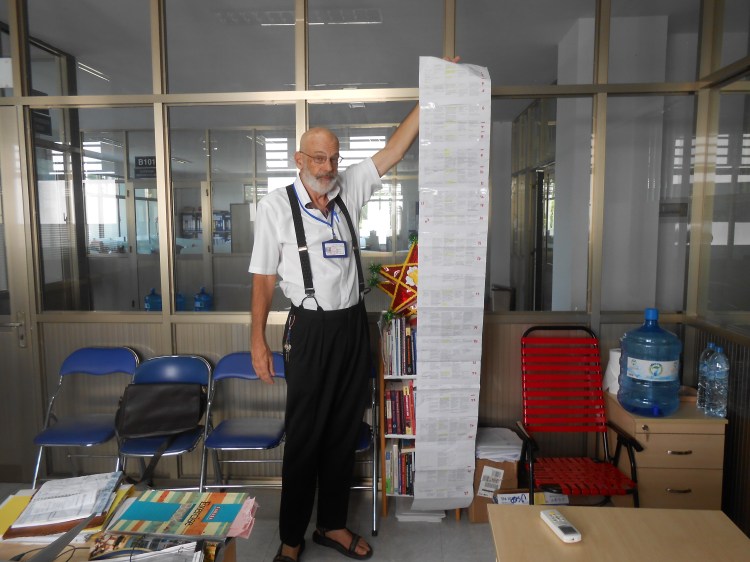
Joe and data

All the reports summarized and put into a table, printed out and taped together.


This will be the first of several posts on this topic. In this post, I’m just describing the  initial sorting process that had to be done with all the student reports when they came in.

Combining Joe’s class and mine, we got 33 total reports. Each report represents the work of a team of five to seven students. Setting aside the workplaces chosen by more than one team, there were 26 different workplaces.


The workplaces that were studied are:

01. Anh Nguyen Furniture (sales, export)
02. Anh Tuan (construction and development)
03. Banyan Luggage (retail)
04. Bluelin Health Mgmt (exercise machines, sales, women’s spa)
05. California Restaurant (restaurant)
06. CircleK (convenience, like 7-11)
06a.CircleK
07. DeVoung (shoes)
08. Dominos’ Pizza
09. Dungo Bank
10. Golden Hope Cooking Oil (Food processing)
11. Happy Cleaners (cleaning service)
12. Highlands Coffee (coffee shop)
12a. Highlands Coffee
13. KFC (fast food)
13a. KFC
14.Nah Be Textile
15. Nguyen Kim Machine (repair, electrical)
16.NyDec COPAL (electronic mfg)
17.Phong Phu Textiles
18. PouYouen (shoes)
19. Starbucks (coffee shop)
20. Strawberry (childcare)
20a. Strawberry
21.Tan Phuy Trun Kindergarten (SOE)
22. TDTU Security Guards
22a.TDTU Security Guards
23. TST Insulation (refrigeration for seafood)
24.VCS Home Shopping (tech internet sales)
25. Vietopia (childcare, entertainment)
25a. Vietopia
25b. Vietopia
26. Wise Solutions IT (tech service)


Seven workplaces were studied more than once: Strawberry, Vietopia, Highlands, TDTU Security Guards, CircleK, and KFC.

We asked our students to report what these Vietnamese workplaces looked like from the workers’ point of view. This is basic organizing research: what an organizer has to find out about a workplace. For Joe’s class, it was about organizing directly. For my class, which is supposed to be about leadership, it is about what kinds of leadership emerged when there was a problem.

They did a lot of survey questionnaires. Actual observations were not common, unless they had a team member working in one of these workplaces. But in some places they interviewed workers after work. They did some media research. They found company brochures and company videos. There were some elements of participant action research (PAR) where students were also workers. Each group met with Joe or me twice.


So the sample is small, opportunistic, and has no independent variables or statistical value. Nonetheless, it is descriptive and can be considered a snapshot or maybe a pilot research exercise. The most important thing is that the stories that came out of it tell what people actually did and said. This is not looking down at workforces from a helicopter.

Stud rep Eng 1

From an English composition teacher’s point of view, however, the student reports were all plain data. There was no analysis, nothing about implications, no conclusions, no connections made between what the students were observing and what they had learned in other labor relations classes. The presentations were accompanied by skillful Power Points. The paper reports that were handed in with each presentations copied those slides, so we saw pie charts and bar charts, photos of workplaces and lists of employees and organizational trees of how the company or, in one case, how the union was organized. We had of course not thought to ask for anything more. I hadn’t occurred to me that they would hand in raw data without any analysis at all.

When I met with Vy and An and asked them what the problem was, they understood my question. They explained that Vietnamese students are trained to respond to what teachers say they expect. So we had made a list (a handout which we called “Evaluating the Terrain,” which I may post) of things you have to look at in order to prepare for organizing, and they just followed the list.


The problem, which is a major problem for our experience teaching in Vietnam overall, is this: If the students think that teachers want them to give back just what the teachers gave them in the first place, how can the teachers learn anything? Do you suppose that these reports simply mirror back what we told the students we expected them to find?


That would be pretty unfortunate. However, let’s keep going.

Stu rep Vtnm 2

The fact that the reports were sheer data, without any analysis or conclusions, meant that when I sat down with the stack of reports, I had to start from scratch. The first thing I had to do was decide what questions I was going to ask of the data. There were many possible questions to ask: role of women workers, effectiveness of unions, pay at manufacturing plants vs pay at retail operations, impact of foreign ownership, etc. I didn’t have time to work through all 26 reports and answer all the possible questions, so I picked what seemed to me like the most obvious one to start with.

What workplaces had a union?

Theoretically, all workers can be and are supposed to be represented by a union. This is the Vietnam General Confederation of Labor or VGCL. But whether there is actually a union in a certain workplace is another matter. So, out of 33 workplaces:


  • 9 had no presence of a union at all. Many workers did not seem to know what a union was.
  • 4 workplaces had a union leader who was also the management HR officer
  • 5 had a union, but described it as ineffective. I included in this 2 workplaces where there was an enterprise union at the head office but no one at the branch worksite had any contact with it.
  • 8 workplaces had an active union


Here are the 9 workplaces that had no union: Anh Nguyen Furniture, Banyan Luggage, Bluelin Women’s Health, California Restaurant, Domino’s Pizza, VCS Home Shopping, and Wise Solutions. These are all small retail or service workplaces.

There were two exceptions: Happy Cleaners, which did the cleaning and housekeeping work for TDTU and where there was a union for the office workers only), and Anh Tuan Construction, a large company that had but no union and where workers are hired by the day. Happy Cleaners hired older women to do the actual work (older than 40; there is a lot of age discrimination here!) and had a union for the office workers only.


Here are 4 companies that have a union leader who is also the HR manager: DeVuong shoes, KFC which has many branches in HCMC, TST Insulation which manufactures equipment for refrigeration, a hugely important aspect of the seafood industry, and Vietopia, which is a semi-Disney childcare and entertainment facility for upwardly mobile families and kids. This arrangement would fulfill the letter of the law.


These 5 companies had what looked like, when you read the reports, weak unions: CircleK, where there is a union for full time workers only; Donga Bank, Highlands Coffee, where there is enterprise union at headquarters, no local union; Starbucks, where there also is an enterprise level union but no local union, and Strawberry, which is a smaller version of Vietopia, an entertainment/education facility for children.


Finally, these are the 8 workplaces that appear to have active unions. Golden Hope manufactures cooking oil; Nah Be is textiles; Nguyen Kim produces electrical machines; NyDec COPAL manufactures electronics; Phong Fu also does textiles, Pou Youen manufactures shoes, the Security Guards work at TDTU and Tran Phuy Trun is a state-owned kindergarten that was founded back in the 1980s.


Six of these last 8 workplaces appear to have collective bargaining agreements (CBAs), although I couldn’t be absolutely sure: the TDTU Security Guards, Phong Phy Company, Golden Hope Cooking Oil, Nguyen Kim Electric Machine Repair, Nah Be Textile and NyDec COPAL , which is owned by a Japanese company.


Note that in Vietnam, you can have a CBA or (maybe and) individual labor contracts. There is a whole section of the labor code dedicated to individual contracts. So a company where there is a union but no CBA might have individual labor contracts for the workers. I do not know what the role of the union in troubleshooting individual contracts or setting them up would be.


Doing this kind of thing is a good way to find out what questions to ask.


What do workers make for wages?


I did a quick scan of what workers make, if they work full time. Four million dong (4M) is $178. Minimum wage in HCMC (it varies by province) as of September 2015 was 3.5M dong; in rural areas it was 2.15M.


PouYouen: 4.1M

Tan Phuy Trun: 3.0 – 6M

KFC: 2M – 3.5M

Vietopia: 2.8 M

Wise Solutions: 6.5 – 10M

Phong Phu – 4.5- 10M

Highlands: 4.5M

Nguyen Kim: 3.5 – 5.5 M


So with the exception of Vietopia and maybe Tan Phuy Trun, these jobs pay just above minimum wage. Apparently, when a union negotiates a CBA, the wage that is negotiated is rarely much more that minimum wage. The legal minimum wage is the wage.


To see what it was like to live on these wages, students asked workers about their budgets. They got answers generally like these:


Typical budget for single person: 5.5M

Many workers cannot support a family (need 6.5M)

Many workers cannot save

Many workers depend on OT, commissions, subsidies, bonuses

Were they satisfied with their jobs? No, “Not satisfied.”


But Vy pointed out that the questionnaires that most reports depended on did not separate out reasons why workers were not satisfied – it could be a bad day, or they didn’t like their supervisor, or the work was too hard; you couldn’t tell from the questionnaires whether wages were really the problem or not. The questionnaires were too simple.

students examnning rawdata

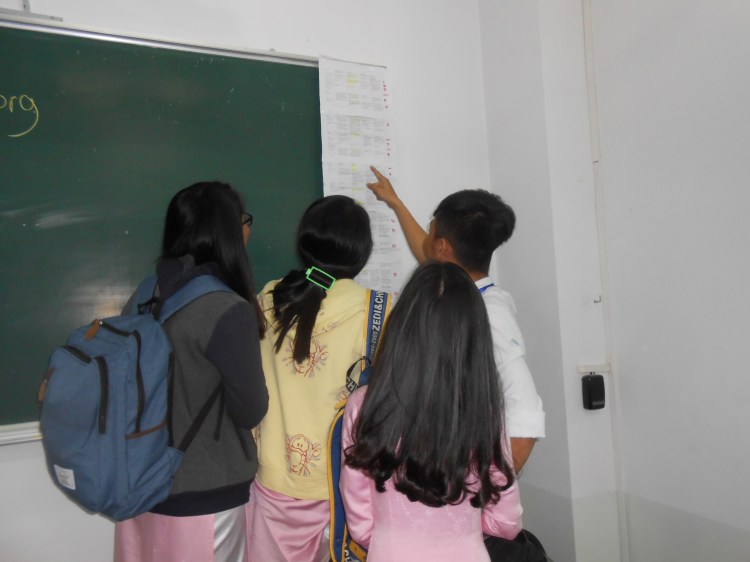
I posted the long sheet of all 26 reports and students came and looked at it.

 Student work


One thing we found out is that many of our students are working, some of them up to 30 or 40 hours a week (full time work is supposedly 48 hours a week; it is not clear to me whether someone could work 48 hours a week and still be considered part time). They do this while they go to TDTU, which amazes me. KFC apparently even recruits through TDTU!


So I wanted to compare how much money they are earning at the different places they work. There is no mention of part time workers in the labor code except for one brief section, and there is no separate part-time minimum wage. Employers just divide the full-time wage by the number of hours employed, which can vary even more because some hours-worked-per-month are based on 26 and some 27 days. Or, more realistically, they just offer whatever the student worker will accept. The labor code does state that part-time workers are entitled to all rights, benefits and privileges. Under Vietnamese law, part-time is not automatically assumed to be temporary or casual.


But here is what part time pay looks like. 20,000 is 89 cents; 11,000 is 49 cents. This is per hour.


VCS Home Shopping: 20,000 D/hr

Bluelin Women’s – 20,000 D/hr

An Nguyen: 19,000 D/hr

Banyan Luggage – 17,000 D/hr

Strawberry – 17,000 D/hr

Vietopia: 16,000 D/hr

Starbucks: 15,000 D/hr

Highlands: 14,000 D/R

KFC: 13,000-17,000 D/hr

Domino’s: 13,000 – 15,000 hr/

Circle K: 12,000 – 15,500 D/hr

California Rest. – 11,000-12,000 D


Bonuses


However, in addition to your hourly wage, Vietnamese workers, full or part-time, get a lot of side payments called bonuses. They can get a meal subsidy, often 15,000 D; an extra meal subsidy if they do overtime. They use this to go out and buy food and then sometimes there is a microwave where they can heat it up. At many large workplaces, the employer has cooks and a kitchen and prepares a meal. Many complaints are about the quality and quantity of the meal. You can get a gift of some sort – an umbrella or a gold ring – after a certain number of years. You can get a transportation bonus, a parking bonus, or a subsidy to help you pay rent. One of the most important bonuses is a 13th month bonus at Tet, which provides people with enough money to go to their hometown for the holiday. One place – KFC – as we found out, actually offers a 14th month bonus. You can also get rewards for meeting targets of sales or production and commissions if a whole group meets a target. And the employer can pay accident insurance or medical insurance for you.


Of course, shifting compensation to bonuses reduces employer tax liability and social security revenue. So does the failure to register workers, because not until a worker becomes registered, by having a labor contract, does the employer have to pay social insurance on him.


So now, looking through all these reports, I have to go back and ask, “What kinds of information have I found so far that would help in organizing or create opportunities for leadership?” This is always assuming that organizing efforts and leadership are most effective when they come from the bottom-up.


What kinds of problems do workers face in these workplaces?


One way to construct an answer to this question is to go through the student reports and ask what kinds of labor laws are likely to go unenforced. If a standard exists as a law, then organizing to make the employer obey the law is likely to be understood by workers. Issues such as this are “rights” issues in Vietnam, as compared to what are called “interests,” which are not matters of existing law but involve addressing what workers want above the minimums. Some people say that the distinction between “rights” and “interests” is just a red herring.


Examples of laws that are likely to go unenforced include laws about individual labor contracts, such as the one that says all workers must have labor contract after two months and the law that says limited duration contracts can roll over only once and the employer must offer unlimited duration contact after one limited duration contract.


I looked at the reports to see what workplaces had labor contracts, and found that in many workplaces, workers simply do not have labor contracts or else get them after 3 months (not two) or after a combination of training contracts or probationary contracts.


Laws about overtime are also likely to be violated, such as that overtime (OT) earns time and a half pay, that “excessive” OT is prohibited, that prep and cleanup time should be paid and that there should not be any coerced OT.


Laws about wages are another example. There are cases of low wages, wages that don’t rise to minimum wage, missing money (wage theft), and of course no pay for prep or overtime or improper pay for OT fall into this category.

Employers also scamp on payments into the social benefits fund (taxes). They should pay in on all registered workers’ wages. However, if a worker is unregistered – if a worker does not have a labor contract, in other words – then no money is paid on that worker. Also, it’s clear that employers are shifting payments into meal subsidy, the OT extra meal, parking, transportation, housing subsidies, rewards for meeting targets, commissions, the Tet bonus (a thirteenth month’s pay) and medical insurance and accident insurance. Shifting compensation to bonuses reduces employer tax liability and social security revenue.


Other possible targets for collective action include unfairness of any kind, age and gender discrimination. Women over 40 are often unable to get hired except as cleaners or other lowest-wage workers. They lie about their age to get factory jobs. As a woman well over 40, I noticed this. There is also an absence of clean toilets, water, decent and sufficient meals. These seem to have been the most frequent triggers of collective action of any.


I put all of this into a 35-slide Power Point which I asked Vinh to email out to the students, and then made a 15-slide version that I showed to the class the next day, before they started giving their reports.


While they told their stories, Vinh whispered translation into my ear and I typed as fast as I could. I will provide some of those stories in my next post and I will also try to pull out some of what they mean, from where I’m looking at it.


Design at TDTU

MOdel 1

I have mentioned walking through the terraces on the ground floor of the buildings and seeing displays of work done by the various design departments. Early in our days here, we saw fabulous gowns and sharp costumes. We also saw what was apparently an architecture final project that involved designs for resorts, something that I didn’t realize was such a  big piece of economic development until we started going out to beach towns. We saw ceramics, designs for manga, things made out of wire, and big bulletin boards with brightly colored printed posters. All very sharp-edged and contemporary.

I have talked to students who say that they are majoring in industrial design.

Last week we saw a display of things built out of wood. Behind each one was an explanation, done in sketches, of how the design for the object evolved from an image of an animal. Lamps evolved from birds, tables evolved from tigers, etc. I was especially enchanted by a rocking grasshopper made out of rubber wood. The wood was kind of soft and good to touch, and you could see the grasshopper clearly in the overall shape. I would have gone into debt to buy it.

Unfortunately, I often don’t have my camera with me and so I can’t take photos. To make up for that, here are some photos of architectural models. These seem to be country houses, except for the one that has a high wall on one side, which might be a city house.

However, most city houses that I have seen — new ones, I mean — are narrow, at least three stories high, have a wide central climbing staircase and big open walls to catch the wind, so that the upper floors are kind of like terraces. When we went to Vinh and Thinh’s new house for dinner last Sunday we saw new houses like this built right in the middle of a warren of tiny, hidden streets, some about six feet wide, just wide enough for a motorbike to pass you. Deep in these “neighborhoods” you are away from the pollution (the carbon from traffic seems to drop to the ground about 15 feet from the street) and the noise but also still in the heart of the city. Vacancies in these neighborhoods are rare; the same families hang onto these buildings generation after generation.


Just standing in one place on one of those narrow streets and looking around you, you could write a novel from what you could see.

Model 7


Model 8


Model 6


Model 4_1


Model 2

Effingham

Trumka and Gr 2

Rich Trumka, AFL CIO President, with locked-out AFSCME 3494 workers.


Effingham: From Organizing to Contract


I never expected to hear the word “Effingham” pronounced in the middle of a sentence in Vietnamese, but it has now happened numerous times. I used the Effingham story, in which the workers at Heartland Health Services organized as AFSCME 3494, to tell the story of a US union organizing effort from start to finish, and it seems to have made a strong impression. The first reaction of students was that they couldn’t believe that workers could survive a struggle that lasted four years. Some of them said they felt it wasn’t worth it. The next wave of reactions was about how severely adversarial labor relations are in the US. Since it looks as if under TPP, labor relations in Vietnam are going to become more like labor relations in the US, this was a lesson worth teaching. So now I hear the word “Effingham” spoken now and then, in a way that makes me smile.


The fact that we had pictures probably helped make the strong impression. The pictures in this posting are ones that I took while it was going on. Our labor ed program at Illinois was actively supportive of this struggle. The women leaders whom I mention came to our POlk Conference, which is another story which I won’t tell here.


This is the handout that we got translated, by Tony Dang (thanks, Tony!) and distributed on the day we presented this story in Ms. La’s class. We later handed it out in other classes, too.

Teaching points:

The importance of local social context and politics

Why the workers started to organize

Forming a local union and contacting a national union

Bargaining with an employer who does not bargain in good faith

The importance of building community support and mobilizing it

The role of the mediator

The role of the Labor Board

The workers go on strike

The workers are locked out

Appealing to the legislature

The workers win a decent contract and go back to work

What did the contract do? Changes in the collective relationship

What did the contract do? Changes in individual relationships

Was it worth it?


The Social Context: A politically conservative town with a right-wing local government


This happened between 2005 and 2009.


The town of Effingham, Illinois, is a working-class, low-income town of about 12,000 located in Central Illinois. It is surrounded by farms that grow corn and soybeans. At one time these were family farms. Now they are owned by big agricultural companies. It is a very white town – only a generation ago, it was a “sundown” town where Blacks were not welcome after dark.


Although the average income is low, there is a wealthy upper capitalist class. These are the “town fathers” who own business that have been located in Effingham for many years. They are so anti-union that when a company that made brakes for Toyota cars offered to come to town, the city council rejected its application because the pay for workers would be higher than the average wage and this would create pressure to raise other wages.


The workplace where this struggle took place is called Heartland Health Services, an officially nonprofit, but private, enterprise. It provides a broad spectrum of mental health services to people in the region, with money contracted from government at various levels. Counseling, drug addiction, and developmental services are provided. There is a residential program. There is a class difference between the people who use Heartland and the families of the “town fathers.” Heartland patients are mainly low-income, working class people. The wealthy families send their members out-of-state to fancier hospitals in big cities.


Workers at Heartland are working-class, too. About 160 people worked at Heartland when the union was first organized. Jobs at Heartland were steady, reasonable jobs and people said Heartland was one of the few places in the region where you could get a good job. You could work there and believe that you were helping someone. Some of them had been working at Heartland for twenty or thirty years. They had many friends in the community.


This picture was taken the day Rich Trumka, President of the AFL-CIO, came to Effingham to talk with the workers. This is in the AFSCME 3494 office. The man on the right is Henry Bayer, Illinois state-level AFSCME president.


Meeting w Trumka


How Changes in the Healthcare Industry Impact Healthcare Delivery and Workers in Healthcare


Two things were going on in the healthcare industry at this time. First, the cost of healthcare was increasing at about 12% per year. These changes affected regular people, who could not afford to buy insurance to cover medical costs and could not afford to go to a doctor at all without insurance. They also affected companies that provide healthcare. Many insurance companies stopped covering mental health. They also increased the kind of paperwork required for a healthcare provider to get reimbursed from an insurer.


Second, the government, which paid for a lot of the healthcare costs for veterans, retirees, the disabled or the unemployed, was cutting back how much they would pay. The fees paid to doctors for seeing a patient, for example, were cut.


In order to adapt to the rising cost of healthcare in the face of government cutbacks, many directors of healthcare facilities changed how they billed patients and how they paid workers. They also changed the ways they supervised workers. This allowed them to pass on the costs of delivering healthcare to the workers, by cutting pay, intensifying work and placing the burden of uncertainty on the workers. Examples of this would be not paying a therapist if a patient cancelled an appointment, or requiring a worker to keep his or her cell phone nearby all night in case of an emergency call, without pay.


The Director of Heartland made a strategic mistake when she decided to implement many of these changes all at once.


Why the workers started to organize


In the US, if a workplace does not have a union, the employer can do almost anything they want. While we have a minimum wage and some fair labor standards, we rely on collective bargaining to give workers real protections and make sure the minimal laws we have are enforced. Without a union, an employer can fire you without warning and without giving any reason. There are a few exceptions to this, but this is mainly the case. So when the Director decided to implement many changes in the workplace at once, she was legally allowed to do that because there was no union or CBA there.


Workers still talk about the day when the Director “dropped the bomb.” The Director obviously had not expected a friendly reception to her announcement, because she told all the employees to meet in the basement and then called the police to have them waiting upstairs outside in case there was “trouble”.


She told the workers about many changes that she was making. All of these were her own decision, done without consulting the workers. People who had accumulated a lot of vacation days by working many years and not always taking all the vacation they had accrued would lose most of those vacation days. People who were part-timers would lose their health insurance coverage. Instead of being paid for every hour of therapy that was scheduled, workers would only get paid if the patient showed up. Since many depressed or drug-troubled patients miss appointments, this meant that the therapist would be fined for something that he or she couldn’t control. Also, workers would be ‘on call’ all night, but only get paid if they were called, and if they were called and had to work at night, they still had to work in the daytime. These were just some of the changes.


The Workers Form an Organizing Committee and Contact a National Union, AFSCME


The workers were very angry. The fact that the Director had summoned the police was very insulting. For several weeks, no one knew what to do.


Three or four of the workers had either worked in a union workplace or else knew someone who had. This information was very important. People are not taught about unions in school, so unless someone knows someone who has been in a union, they probably don’t know what it means. So these workers got together and talked. Then they went around to the other workers and explained what a union would do and why they all needed a union. They formed an organizing committee of about 12 people.


Other workers got the idea quickly. When most of the workers had been talked to, the organizing committee telephoned the office of a big union, AFSCME (American Federation of State, County, and Municipal Employees) and asked them if they would help. AFSCME’s regional director said yes and came to meet the organizing committee.


With AFSCME’s help, the workers started collecting signature cards, authorizing the union to ask for an election. Under US law, if 30% of workers sign these cards, the organizers can file a petition with the Labor Board and ask for an election. However, most organizers will try to get 80% signatures, because, out of fear, many workers will change their minds at the last minute in response to the employer’s anti-union campaign, which is legal. Also, some workers will lie to the union organizing committee and say they are in favor of it but in reality, they don’t know what they will do when it comes time to vote.

Employers usually run a very aggressive campaign against an organizing effort. They try to scare the workers into voting against the union or else promise them good things if they vote the union down. This director did not do that. She didn’t believe the union would win. She didn’t think the workers knew how to organize. She was wrong. The election was held only four months after the Director “dropped the bomb”, and 80% of the workers voted to have a union. The Labor Board certified the union.


Now the workers had a union, but no contract. In the US, workers have one year to bargain a contract with the employer. If they can’t get a contract, the employer may try to decertify the union by forcing them to hold a new election. So the first year deadline is very important.


Trying to Bargain With An Employer Who Does not Bargain in Good Faith


Under US law, union and employer have to “bargain in good faith,” meaning that they have to seriously engage in bargaining that moves towards agreeing on a contract. They are not legally required to reach an agreement or settle a final contract, as is required in some countries, including Viet Nam. Unfortunately, the Director at Heartland did not understand what it means to “bargain in good faith.” She would try to meet only once every two weeks. She would cancel meetings. When she came to a meeting she would say, “I’m sorry, I didn’t have time to read your proposal, we’d better postpone this meeting.” Months went by and the one-year deadline approached and nothing was being accomplished. The workers’ negotiating committee was careful to always show up for meetings prepared so that she would not be able to blame them for the lack of progress.


AFSCME had opened an office in downtown Effingham where the workers could gather and talk with each other. They held open trainings for members, so that all the workers understood what was going on. They also assigned two staff people to work with the organizing committee. One of the staffers would participate in the contract negotiations when they took place, although the President of the union, an older woman and senior worker named Louise Messer, was the chief negotiator. Several other workers, Anna Beck, Gail Warner, and Azure Newman, played important roles as organizers and leaders.


This is Gail Warner, leading a song on the picket line.

Gail speaking

AFSCME knew that this was going to be a long struggle because of the politics of the town and the region. They knew it was going to be hard. But it was important for them to win and get a good contract because they represented workers in public healthcare all over the US, and Heartland was a case of work that had been public but now was privatized, a trend that is part of the neoliberal agenda. So this was a case of “chasing the work” across the line between public and private, something that AFSCME has had to do more and more. There are parallels in Viet Nam between work that was state-owned (SOE) and has been equitized (sold in shares, sometimes to past employees and sometimes to various kinds of investors).


The Union Builds Community and Labor Movement Support


The workers organized within the town and regionally to get public support for their struggle. They talked with their patients and got them to understand what the problem was. They organized meetings at their churches. They printed T-shirts that said, “We want a fair contract” and sold them to raise money. Workers wore buttons at work, to let people know they were involved in the union. They held pot-luck dinners at the union office to keep their spirits up.


Because AFSCME is a very big union, the workers at Heartland were able to reach out to other workplaces where the workers were represented by AFSCME. These included cities and county office workers all over the state as well as healthcare workers. Members of the organizing committee learned how to speak at rallies and big public meetings. They came to workers’ events in Chicago. They got on TV and on the radio. They invited the president of the AFL-CIO to come and meet with them in Effingham, and he did. This made the national news.


But none of this forced the Director to come to the table and bargain in good faith.


The Workers Invite a Mediator to Come and Help


After a few months, AFSCME called up the FMCS (Federal Mediation and Conciliation Service) to see if they could help. The FMCS was established in 1948 as part of some labor legislations known as Taft-Hartley. The purpose of the FMCS is to help unions and employers deal with problems that can be solved by good negotiations. This is to prevent strikes and the other disruptive troubles that can be caused by labor disputes. When workers go on strike, they lose wages, people lose services, employers lose production and the overall economy becomes unstable. Therefore the government is interested in preventing crises like this. The FMCS will send a mediator to deal with a situation where there is a crisis and will make suggestions that both parties should be able to follow. This is similar to the function of a mediator in Viet Nam with an important difference. In Vietnam, the mediator’s proposal must be implemented. In the US, the mediator’s proposal is advisory.The Vietnamese word that is translated as “mediator” actually means a combination of mediator and arbitrator (arbitrators in the US work in a separate, private system, and their decisions are binding, not advisory), although since the decision of the mediator/arbitrator in Vietnam can be appealed through government channels, it is not strictly binding.


The mediator came to Heartland. He listened to the workers and to the Director and, based on these conversations and his own experience dealing with many other union contracts in similar industries, he proposed a whole first contract. This contract would have covered the whole relationship between workers and the employer at Heartland. It did not merely resolve one type of problem.


However, when the mediator made a suggestion for a contract that was acceptable to the workers at Heartland, the Director rejected it.


The Role of the Labor Board


The mediator agreed that the Director was not bargaining in good faith. Under some conditions, the failure to bargain in good faith is clearly a violation of labor law and a charge can be filed with the Labor Board as an Unfair Labor Practice (ULP). If the Labor Board agrees that the employer is committing a ULP, it can extend the clock so that the union has more than one year to get a contract. It can also issue a bargaining order to make the Director bargain.


However, the Labor Board did not agree that the employer was committing a ULP. The Labor Board actually refused to accept the charge and respond to it. This was at a time when, under President George Bush, appointments to the Labor Board had become extremely politicized and this particular Labor Board in St Louis, Missouri, had a very right-wing Board. Exactly why the ULP charge was rejected was never discovered.


This left the union with no alternative but to go on strike.


The Workers Go On Strike


The Heartland workforce is mostly women, fundamentally caregivers rather than fighters. Within the span of two years they had gone from being a fairly satisfied workforce to being angry enough to go on strike. They set up a picket line outside the Heartland building and staffed it every day.


During the strike, most workers stayed involved. Only five crossed the picket line. Some workers had to get other jobs and could only participate a few hours a week. But others made the strike the center of their lives. They made the union office downtown a second home. They cooked dinners there and shared food and news. They held rallies, spoke with the local media, got on the radio, passed out flyers, and went door-knocking through the town. Teachers from the teacher’s union, who had an office near Heartland, walked their picket line, let them use their bathrooms, and gave them money. Community organizations brought food to the union office, donated money, provided other kinds of help.

As winter came, workers set up a strike hut in front of Heartland and staffed it. They had propane heaters once the snow fell. The few employees who had crossed the picket line, and the new employees who had been hired since the strike, had to drive past the strike hut and workers on strike would go and try to talk with them.


The strike got a great deal of publicity. Legislators in the state government were aware of it and were following it closely.


Workers Offer to Go Back In and are Locked Out


According to US law, if workers and employers cannot agree on a contract by one year after the union is legally recognized and certified, the employer can force another vote. This time, only the people who were still working would vote. All the workers who were out on strike could not vote; the people who were inside, including the new hires, would vote. In a vote like that, the anti-union forces would definitely win. If this happened, the union would cease to exist as a legally recognized organization.


Therefore the workers offered to stop their strike and go back in.


On the last day before the end of the year, the workers marched back in together and stood in the lobby at Heartland. The union president announced that they were willing to go back to work without any conditions.


The Director told them that they were not welcome and that they should get out. They were “locked out.”


The workers, shocked and surprised, went back outside and gathered at the union office downtown to decide what to do.

Picket 1


The Workers Expand their Strategy: Appealing to the state legislature


The workers did not give up. They continued to picket and staff the strike hut, which had been vandalized and painted with obscene graffiti. They also expanded their strategies. Busloads of fellow AFSCME members from Chicago came down and held rallies. Since many workers in Chicago are Black, this meant that there were crowds of black people in Effingham, a city that was unfamiliar with seeing Black people.

They also searched for other community health organizations that might take over the work of Heartland. They found one, in a nearby town, but it was too small to handle the patient load.


They appealed to the State of Illinois to stop funding an agency that was abusing labor laws. After all, most of the funding that Heartland received was government money. The State responded by doing an audit of Heartland and found that in fact, there was a substantial amount of missing money. The state then withheld some funding. This made news and embarrassed the Board of Directors.


Effingham was also made “the poster child” for a new federal labor law proposal that would have required that first contracts go to arbitration, if not settled at the bargaining table and both parties would have to sign. This law was called EFCA, The Employee Free Choice Act. The AFL-CIO invited activists and leaders from the Heartland struggle to come and speak at their national convention. People all over the country knew about Heartland.


All of this made news. The local paper and TV showed people marching, holding rallies, and speaking to the state legislature.


Finally, the Board of Directors of Heartland Health Services did something that made a difference: They fired the Director and replaced her with someone who was willing to negotiate seriously.


Workers Go Back to Work with a Decent Contract


Within a month, the new Director signed a contract. It was very much like the one the mediator had recommended two years earlier. So four years after they started the struggle, Heartland workers finally went back to work.


By now, Heartland only employed 50 or 60 people. It had lost money, patients, and workers. It had been a hard and costly fight on both sides. Some people had dropped out or the fight, found other jobs, moved out of town. While some people felt that the struggle had been “the best experience in my life,” others were burned out from stress.


The ones who went back to work had to work side-by-side with people who had either crossed the picket line or had been hired while the rest of the workers were on strike or locked out. The emotions that were felt by everyone were very strong. Who would sit with whom at lunch? How could they work as a team? Tempers sometimes burst out and people said and did things in anger or sadness.


The four years of the struggle divided the old and new workers not only by what they had done but by what they had learned. The workers who had gone on strike had seen what employers will do to retain control; they were not innocent any more.


Anna Beck, one of the leaders of the striking workers, reported that after they went back in to work, the hardest thing was to convince that employer that they really had a contract now and the employer had to respect and follow it.


What Did the Contract Do?


A great deal of suffering could have been avoided if the union and the employer had just signed that contract.


But what did the contract do? What did it provide for the workers?


It provided two kinds of changes in the social relationships between workers and employer. The first kind was changes in the collective relationship between all the workers and the employer. The second kind was the changes between individual workers and the employer.


            Changes in the collective relationship between workers and employer


A contract usually starts out by defining “the bargaining unit.” This establishes who is represented by the union. The bargaining unit has a relationship with the employer that is defined by law and implemented by the union through bargaining. What happens to the bargaining unit matters to the union.


Most importantly, the existence of a recognized union with a CBA commits the employer to treat workers as members of a collective. As members of a collective, workers have certain rights that they do not have as individuals. The employer may not set up new practices impacting workers and/or the union without giving the union an opportunity to bargain over them first. When the employer “dropped the bomb” back in 2005, she was changing all the working conditions without bargaining them, which an employer can do if there is no union. This would never have happened if the workers had had a union.


Under a union contract the power of management to manage has been somewhat constricted and a bit of that power now resides with the union, if it can remain strong, active and organized enough to take that power. For example, all members of the collective must be treated equally. All members of the collective have the right to representation in a labor dispute. All members of the collective are protect against retaliation by the employer for engaging in union activity. In Viet Nam, workers also are protected against retaliation.


This contract as bargained also gives the union some resources needed to carry out its responsibilities. The union gets ten days per year of paid time to send members to conferences and conventions, which they union can distribute any way they like.


The contract sets out some aspects of how the union will do its work. In the case of AFSCME 3494, the union got to choose four stewards, or worker representatives, who got paid time to work on problems involving workers, called “grievances.” These stewards could be chosen by election, by volunteering, or by appointment. Under US labor law, the employer cannot interfere with who is chosen or how. The stewards have access to a phone and a private meeting place, and the employer has to meet with them and work on the problems. If the steward and employer can’t resolve the problem, it can be sent to mediation and ultimately arbitration, which is enforceable. This is called a “grievance procedure” and is often what the union gets in exchange for agreeing not to go on strike over the life of the contract. Not surprisingly, there was a no-strike article in the new Heartland contract.


The Heartland contract also required four meetings per year between labor and management, at which five persons from each side should be in attendance. This is rather like the social dialog process in Vietnam.


These changes gave the union a substantial legitimate presence in the workplace and significant responsibilities for representing all the workers, whether they choose to join the union or not.


Changes in the relationship between the employer and individual workers


The most important change that affected workers individually was that the employer would now respect seniority. Working on holidays, assignment to overtime, asking for paid time off, promotions, opportunities for training and assignments to premium-pay work like the suicide hotline, would all be done be seniority or, if the work is not desirable, by reverse seniority.


Discipline is another important change. In the past, with no contract, the employer could fire, suspend, re-schedule or re-assign a worker without giving any explanation. The employer could just say, “You’re fired,” and that was that. Under the new Heartland contract, discipline is progressive. That means that punishments progress from mild to severe: an oral reprimand, a written reprimand, suspension, and then discharge. Discipline is supposed to be corrective, not punishment. It is supposed to teach, not intimidate.
This shifts the balance of power between management and worker toward the center and reduces the role of fear and intimidation.


You can see that the first Director at Heartland thought that she could change anything she wanted about the way the enterprise was managed, without ever asking the workers if they agreed.

Discipline and work assignments can also be challenged – “grieved” – with the help of the union steward. The contract also says that discipline must be carried out “in a manner that will not embarrass the employee.” This is like what’s called a “respect and dignity” clause in other contracts: an agreement that the workers will be treated with respect and dignity.


The workers got a significant raise in pay and the part-timers retained their health insurance coverage. An increase in pay, however, although it looks important, is not as important in the long run as seniority and a grievance procedure.


Was it worth it?


This was a huge, long-term struggle, but it is not unusual in US labor history. A small group of workers self-organize in order to confront a bad boss. They call in a national union that helps them. They vote, get a union, try to bargain, and then have to develop a strategy that includes publicity, getting legislators to support them, and bringing the community together in order to put pressure on the employer to get them to sign a contract and end the labor dispute. It’s a painful and emotional experience.


Many people who engage in the struggle itself do not benefit from what is won. They get other jobs, get burnt out, move away. They may ask themselves if it was worth it, if they didn’t benefit from it themselves. If they are among those who lose their jobs during the organizing drive, they may feel bitter about it.


But many others answer yes, it’s worth it. It’s part of the big fight for a better society for working class people, even if it never pays off for someone personally. To know that these workers who tried so hard finally have the security and peace of mind that comes from working under a union contract makes it worth the fight for many workers who become activists.


And besides, if you happen to get a job where there is a union, where the boss can’t fire you for no reason and where you can solve problems by bringing them to the steward, then you are very lucky. But someone else had to do the hard, dangerous work of organizing the union that protects you now.