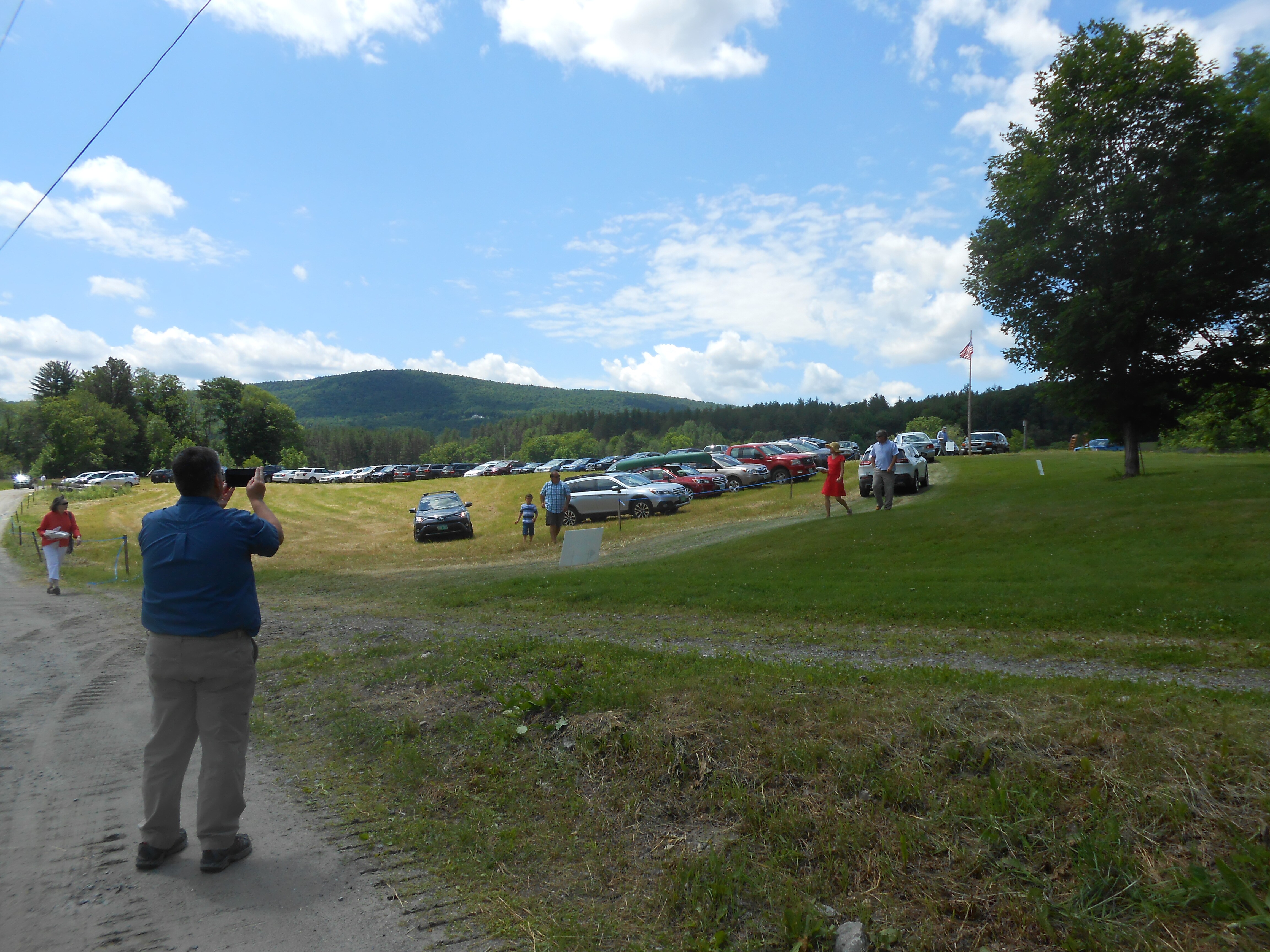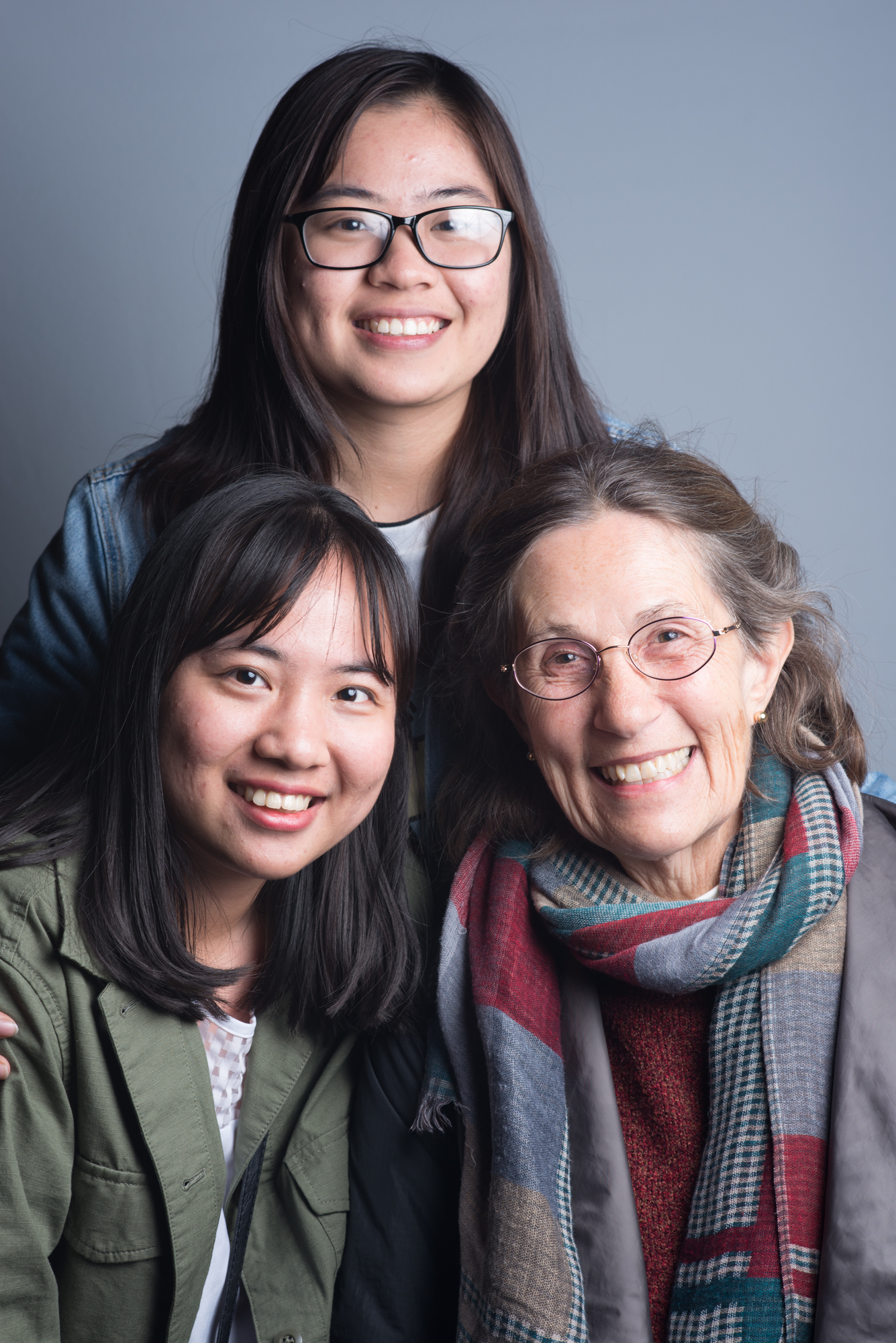
Hansea next week

barg team

Joe is giving management’s response to a rather brilliant move made by the TDT team representing Hansea workers during the negotiation of ground rules. 

Dean Hoa told us about 10 days ago that there was a request from Hansea, which has a huge factory up in the Cu Chi Industrial Zone, to have us go teach there on September 28. This would be one session in a multi-week sequence that TDT is already doing as extension labor ed. Apparently pressure from USAS (United Students Against Sweatshops) in the US at places like Cornell and U of Washington has caused enough college bookstores to drop their Nike contracts to get the attention of the Korean corporate headquarters of Hansae, which makes the product for the brand.  (Nike is the “brand” — the manufacturer is Hansae).

Most of the criticisms of the management of the plants involve things like wage theft, heat over 90 degrees and no cooling, abusive supervisors, forced overtime, impossible productivity targets, etc., but one of the criticisms  is that there is management on the union executive board — par for the course in Viet Nam. But in the US, students see this as a problem.

Which of course it is. With management on the union E-board, no real negotiation is going to happen because the union will not really speak for the workers. Workers won’t trust management to negotiate on their behalf, and management won’t be able to find out what workers really think. Instead, problems will get solved one at a time, whenever workers get mad or desperate enough to go on strike. Then the company has to meet with local authorities and the lead workers to agree to some immediate fix in order to get them back to work. This has been the pattern for years now.

Hansea has operated in Viet Nam since 2001, but also has factories in Myanmar, Guatemala, Indonesia and Nicaragua. What follows is taken from the Worker Rights Consortium Assessment, Dec 6,2016, page 4: The plant in Cu Chi has 12 buildings, each with 500- 1,200 workers. In 2015 it had “sales of more than $1.4 billion and an operating profit of $125 million and sends 93% of its production to the United States. It also produces for Gap, H&M, Hanes, Inditex (Zara), JC Penney, Kohls’, Macy’s, Children’s Place, Polo Ralph Lauren, Target and Walmart.

The invitation came to TDT through a contact, Jeffery Hermanson, who once worked for UNITE. He has worked in the US, Honduras and Guatemala at, for example, Fruit of the Loom. Now retired, he has a  501(c)3 NGO called the International Union Educational League through which he does labor education consulting.  https://www.linkedin.com/in/jeff-hermanson-0822208

Katie Quan had actually mentioned him to us when we last met with her before we left in August, but I didn’t process what the connection was. Hermanson has a solid reputation for efforts to sort out cross-national disputes about labor standards.  A quick google mentions him in a situation in Bangladesh:

Our first act was to contact Hermanson, by Skype. He gave us quite a lot of background. We then got the various reports from the Workers Rights Consortium, etc. As of today, Friday the 22nd of September, we have been reading these various reports and preparing our teaching plan. A fundamental question, of course, is: Who will be in the room? Will they be all management? Workers? Supervisors? Anyone  from the union?

Dean Hoa went up to Cu Chi yesterday to teach in this sequence. He rode the whole 45 K on his motorcycle, leaving at 5:45 am. To my mind, this was an excess of bravado: 45 K on a motorbike in dense, polluted traffic (they don’t even call it traffic, they just cut to the chase and call it “traffic jam”), prior to a full day of teaching on your feet by yourself, would be a brain stupefier. Just riding in an Uber a couple of weeks ago through that traffic made me toxic for the day. But he did it, and came home the same way, with the report that the participants like a lot of interaction and active learning, that they are mostly “team leaders” and that they start at 8, end at 4:30, and take a two hour lunch.

A two hour lunch suggests that they are mostly management.

Using Hansae at TDT as a teaching case study

We have decided to use the Hansea situation simultaneously in our TDT class as well. On Friday mornings we have been doing a collective bargaining simulation up in a presentation room in the new library, and since the role play we wrote originally was set in a garment factory, we simply shifted a few items and used the real one. The problems at Hansae — pressure to meet unreasonable quotas, toxic cleaning liquids being sprayed, bad food, forced overtime, wage theft, abusive supervisors, rate-setting in the pattern department under ideal conditions, refusal of legally established leaves and breaks, etc etc – are similar to the ones we dreamed up in our simulation, based on my memories of working in Philadelphia for UNITE, except a little bit worse. Examples of things that are worse: pay of around 6M dong per month ($294) and no air conditioning — in fact, the kind of cooling equipment that is used is water-drenched cooling pads, which increases the humidity. And even these are not installed in places where the heat is over 90%. Workers are fainting at their machines and being taken to the infirmary where they may rest a little, but then go back to work.

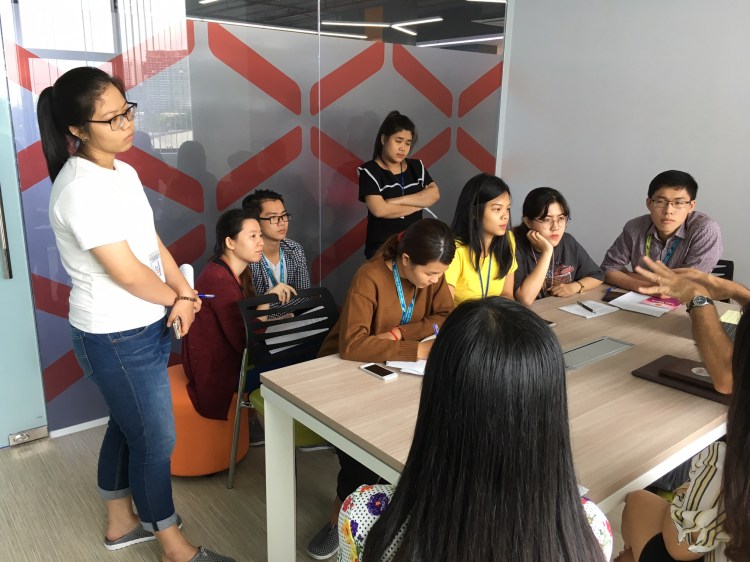
The students really got into the role play, so much so that it seemed logical to try to make a connection between TDT students and Cornell students, especially since Cornell is one of the USAS sites that started this whole thing. So Joe wrote to Richard Fincher:

As you may remember, Helena and I were tapped to do a class in Cu Chi, sponsored by the local VGCL and Hansae (biggest Korean garment contractor and biggest private employer in VN at present), at their factory to basically tell them how to get the American students and WRC off their backs about labor standards in their factories in VN where they have contracts with Nike. Nike has already pulled some work from them, so we have their attention. The class is next week and we have it pretty much planned, even though we do not really know exactly the composition of the group (management, managers who are also officers in the union, “group leaders”(?), actual workers, etc?).

We have shared much of this preparation with some of our students here with whom we are already scheduled to do a series of 6 collective bargaining simulations from preparation for bargaining through negotiations on to enforcement of a CBA. We decided to use the actual Hansae situation as the case and the TDTU students have really gotten into it. We drew many of the details and the conditions and possible demands from the Workers Rights Consortium (WRC) report issued just last December. (Available on their website.)

Upon doing the research for the class, we found that Cornell is one of the universities where the local of United Students Against Sweatshops (USAS) has successfully pressed the administration to pull out of the agreement with Nike to sell Cornell-logo goods. We also noticed that some of the national leaders of USAS are students at the Cornell Labor School. Therefore, I had the bright idea to see if you could facilitate some direct contact between our TDT mock bargainers (representing the mythical worker-controlled union at Hansae, with us teachers posing as management) and students at Cornell, maybe in ILR school, who have been part of the USAS-led struggle there. It would be great, I thought, for both groups to be able to communicate (email, Skype, etc.) directly and learn from each other. Also, we will tell the Hansae folks that we are doing this mock bargaining based on their situation, and it might put a bit more pressure on the company to straighten up their act, especially as it pertains to their managers dominating the existing union.

If you could supply me with some contact information for some of the right students (maybe including some who might come to VN in the program this year?) I think it might be a great real-work learning experience all round. Our students in this (about 8-10) are very good ones and most have pretty good English too.

Looking forward to hearing from you ASAP since we have a mock bargaining session set for Friday, Sept. 29.

Hope you are well. We are extremely busy and have many projects in the fire, as you might expect.

Joe

Richard wrote back that he would do so.
pre-bag

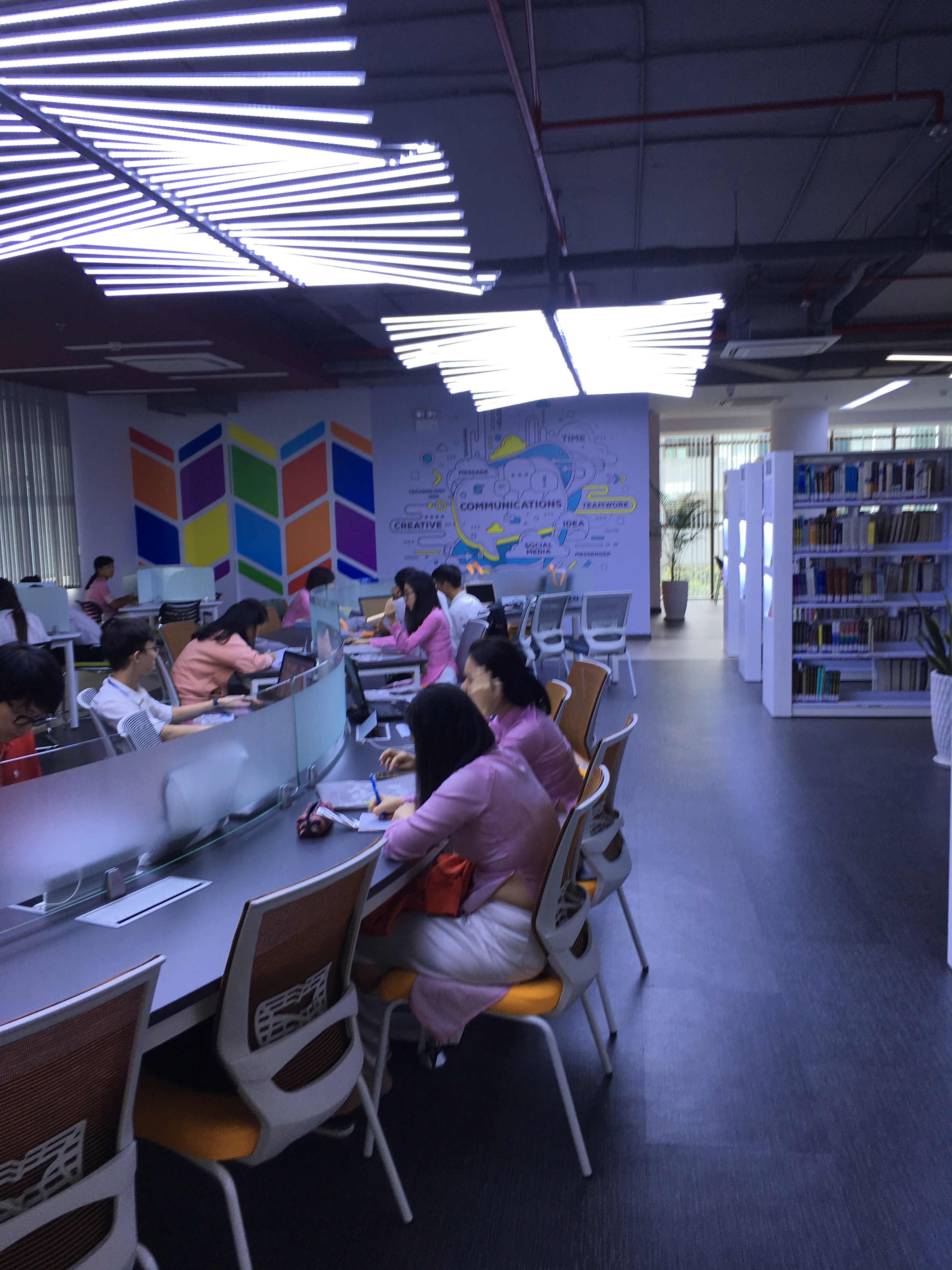
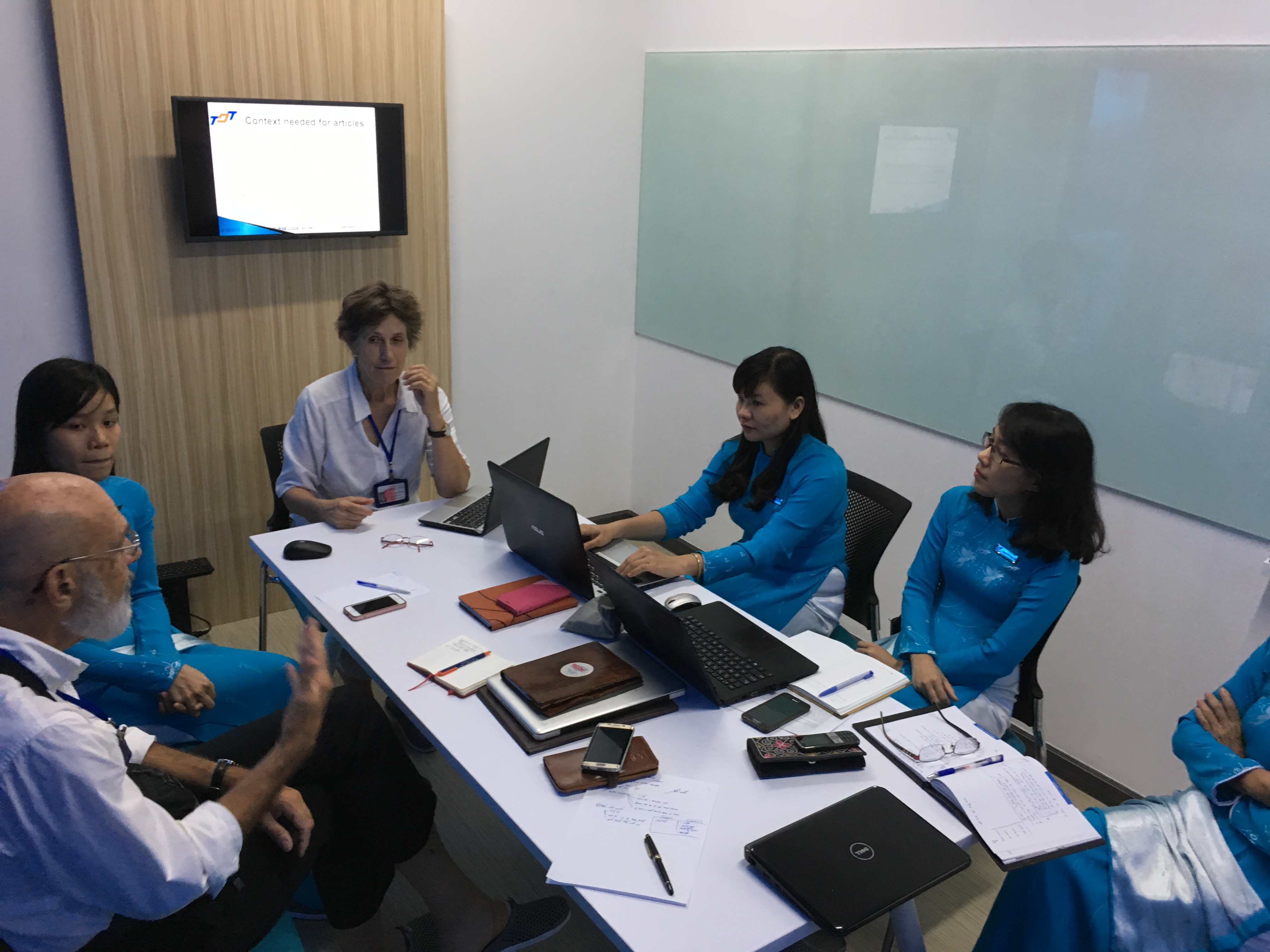
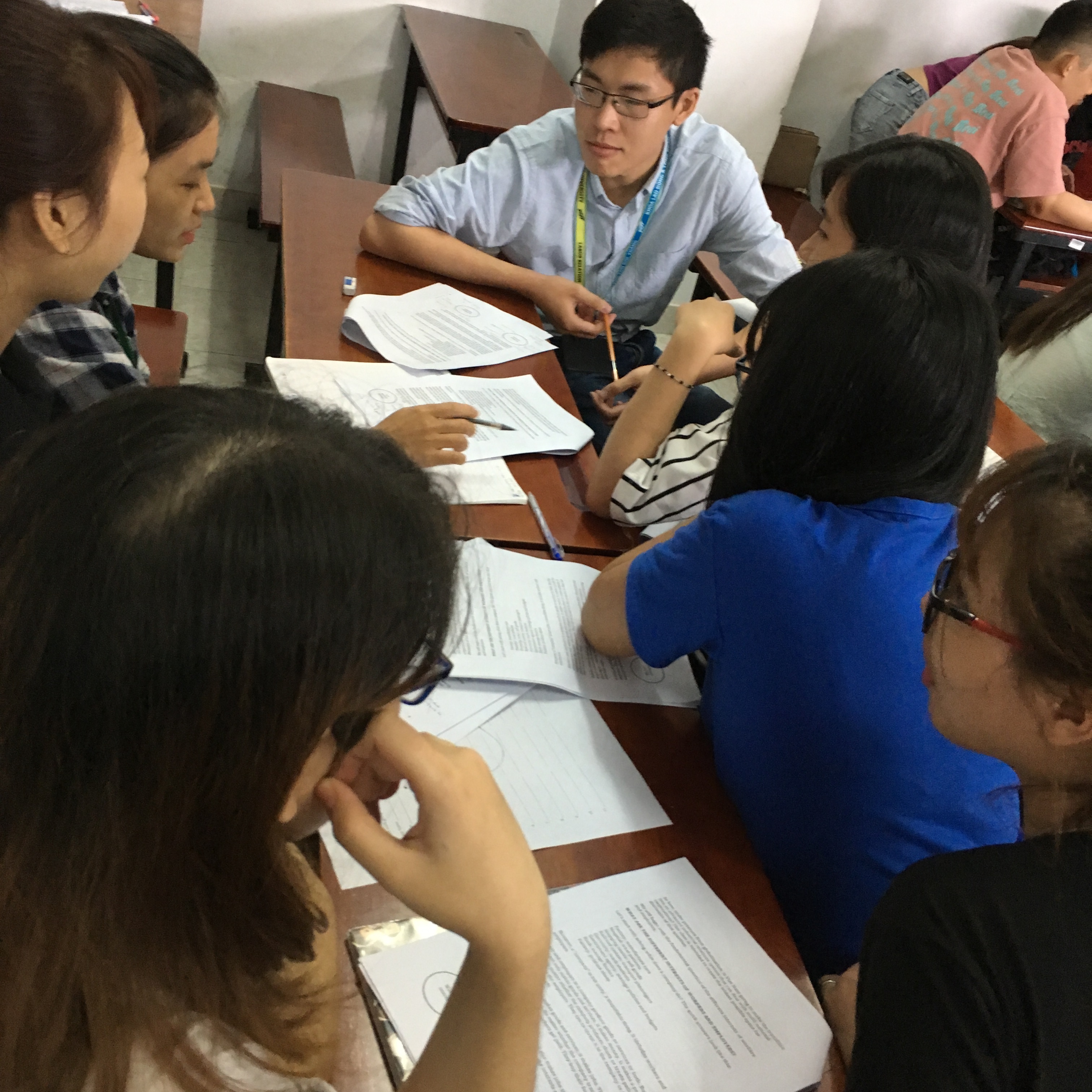
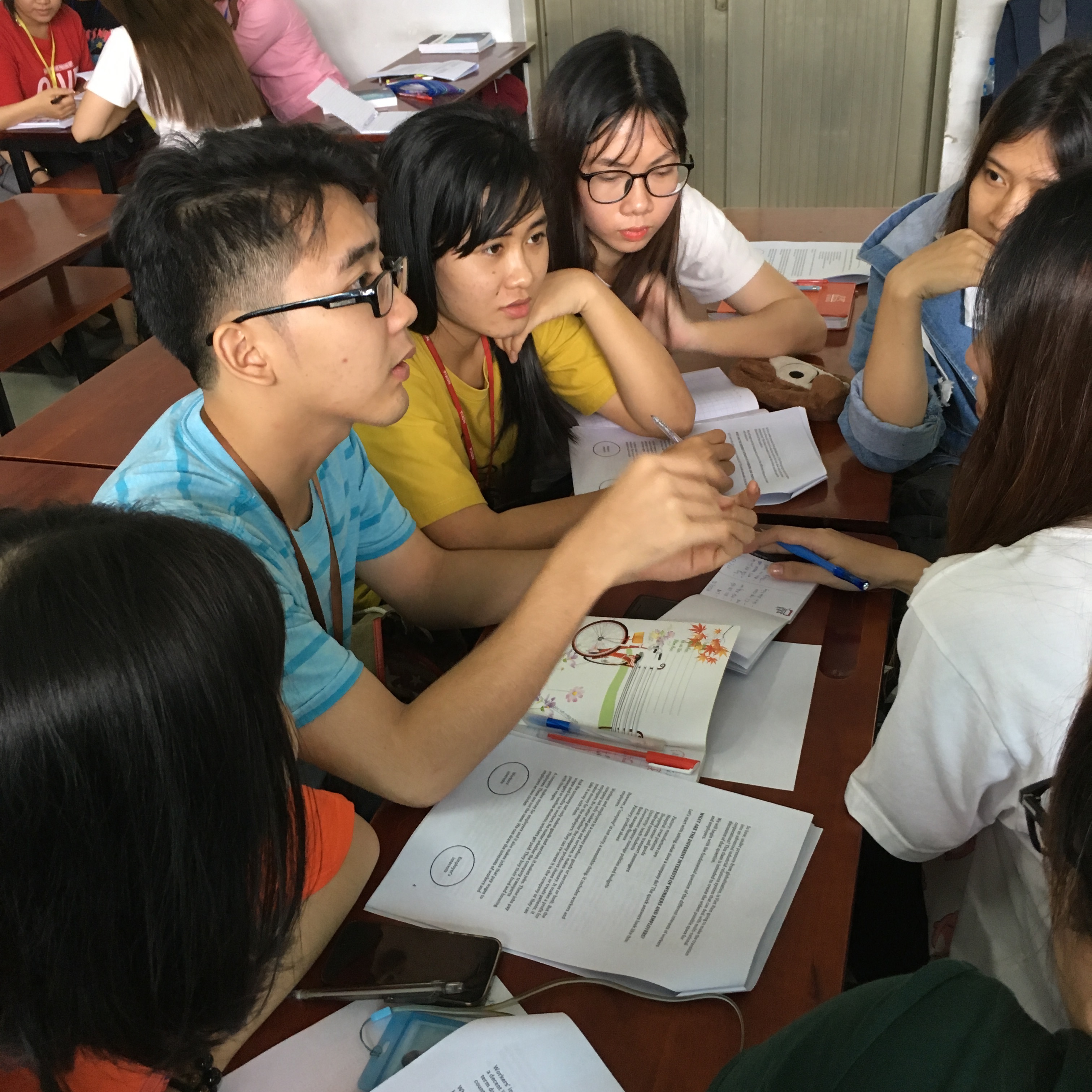
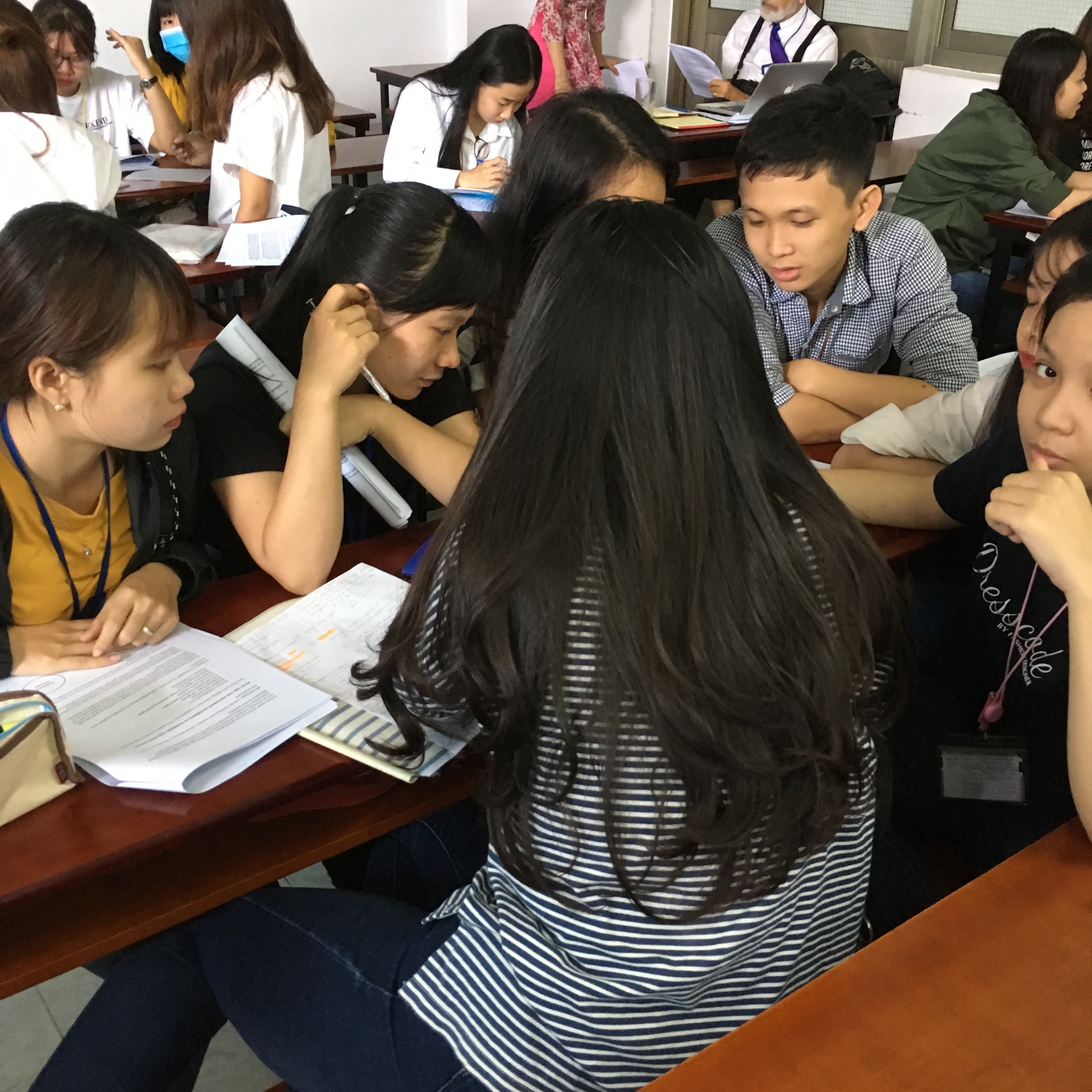
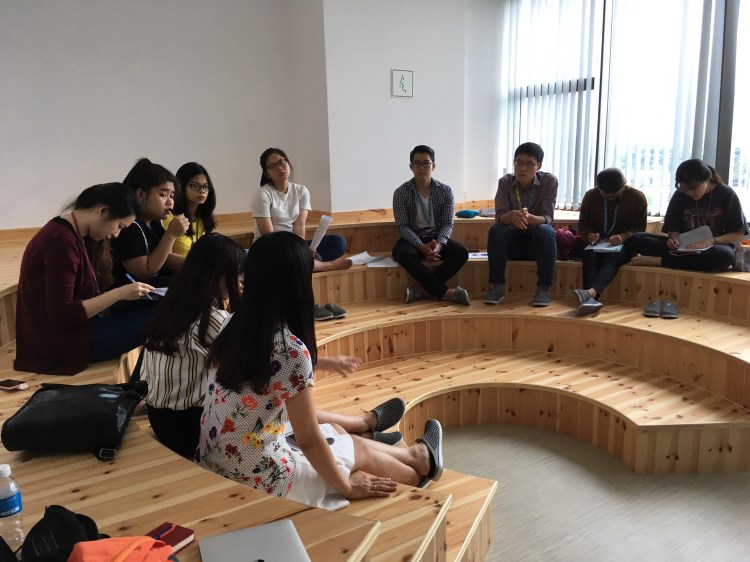
Students preparing to bargain in new library “presentation room.”

Some teaching materials

Readers of this blog may go a little cross-eyed at the idea of my posting handouts on the blog, but here is our class plan. Just be thankful that I have not (yet) posted the 14-page table of first steps in analyzing the worker interviews from my Labor and Globalization class. I will do that soon enough. It’s pretty interesting..

This version of the class plan, re-constructed after we found out about the two hour lunch, does not have VN translation (yet). Please note the challenge at the end of the session.

One-Day Workshop

HANSAE, Cu Chi, September 28, 2017

Joe Berry and Helena Worthen, Instructors

Ton Duc Thang University

INTRODUCTION TO COLLECTIVE BARGAINING

NEEDED:

            Two separate spaces so that groups can have some privacy

            Power point projector and screen; computer setup

            Moveable chairs

            At least 2 translators (Korean-English? Vietnamese-English?) who can rotate                                    once an hour

            Note-taker

            White board or chalk board, flip chart

            3 HANDOUTS to be translated into VN and passed out

                        #1. Timeline (pass out as people enter in morning)

                        #2. List of complaints found in the WRC report (pass out before lunch)

                        #3 Union vs management leadership; Collective decision making

45 minutes. H&J

Introductions of people in the room. Have people interview each other and introduce. Name, position, office location. .

8:45 – 9:00

15 minutes or less. H&J

Background of instructors: Teachers, activists and elected leaders in American Federation of Teachers. Both have worked for unions: SEIU, UNITE, AFT. UNITE represents garment and apparel works in the US – sewing machine operators, pattern makers, finishers, ironers, etc etc. Both have also done labor education in Mexico, Peru and Canada. Introductions of translators and others from TDTU if present

Joe: Explanation of our understanding of the invitation. It was requested by Hansae top leadership to labor union educator in the US, Jeffery Hermanson, who has worked with companies and unions in the US, Honduras, Guatemala, etc. Hermanson recommended TDTU FLRTU and our collective bargaining training. The request came about because of strikes, starting in 2015 then in 2016, protests by USAS in the US, and their impact on Nike contracts at universities.
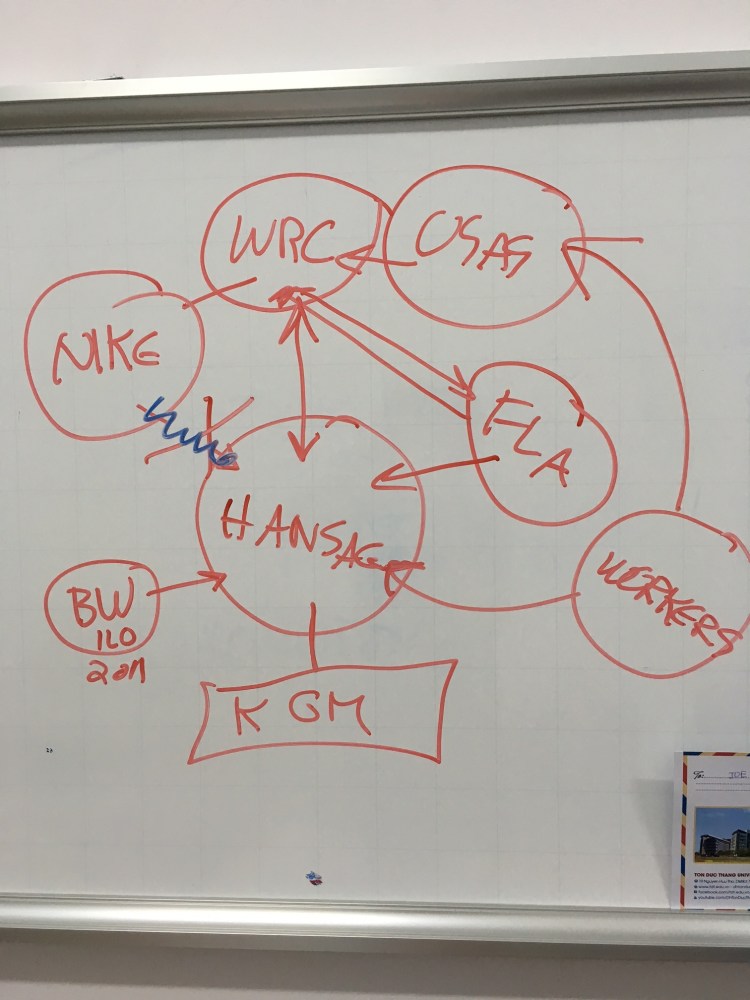
diagram

Today’s task: Vietnamese labor relations occupy a special position in history. In the socialist past, managers and workers in Viet Nam were on the same side. Now, both management and workers have to deal with pressures coming from competition along a global capitalist supply chain. Vietnamese managers today find themselves on the opposite side of the bargaining table from workers and the workers’ union. Workers, on the other hand, have to learn how to build a union that can come to the table prepared to bargain from a position of strength.

9:00 – 9:30 Thirty minutes, Helena

Overall question: How can Hansae Vietnam lift pressure from brands (Nike) and avoid labor disputes at the Cu Chi factory? Overall answer: By allowing the development of a strong union and engaging in collective bargaining.

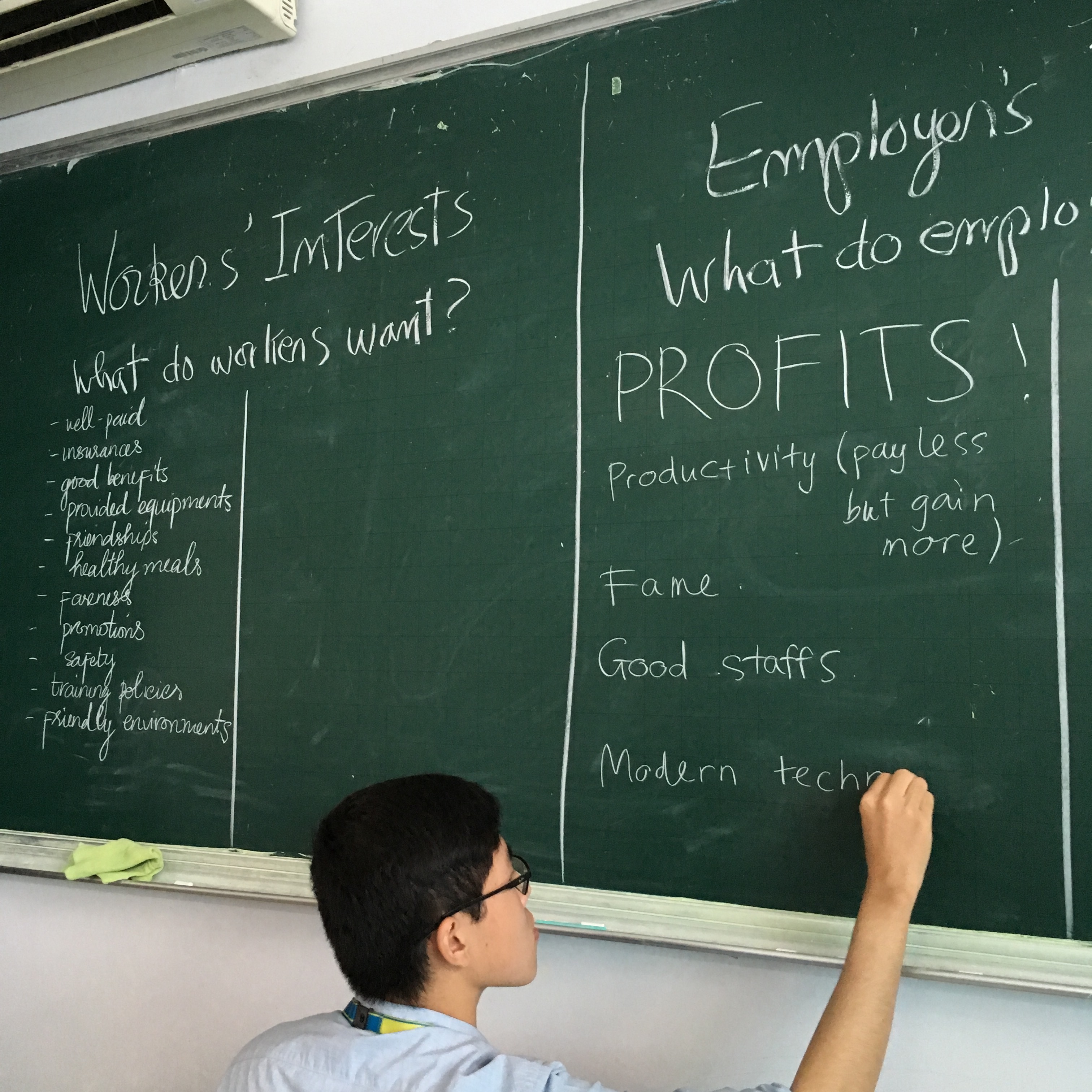
Blackboard or whiteboard: Draw circle of workers’ interests, employer’s interests. Note area of overlap. Point out how the area of overlap can be big or small. This is the zone of negotiation: where issues are negotiated and agreed upon. What happens when little or no agreement takes place? Both workers and management turn to their economic weapons. What are the economic weapons on the workers’ side? What are the economic weapons on the employer’s side? When does the use of these weapons, or the threat of them, lead to more effective negotiations? When does it lead to failure?

Message: Know about economic weapons and how to use them, but choose to negotiate instead if possible.

Suggest that participants read HANDOUT #1 during break. Point out that the items on this time line are all “economic weapons” – whether strikes or reports or boycotts.

FIRST BREAK AT 9:30 – 9:40

9:40 – 10:00, 20 minutes, Joe Berry

Creating and sustaining a “negotiation zone” requires collective bargaining.

What does it take to engage in collective bargaining? On the workers’ side: A strong union that is:

  1. Not dominated by management;
  2. Legitimately has the trust of the workers because the workers control it.
  3. Has the capacity and power to mobilize workers for action. (ILO definition)

Here are some English definitions based on international labor vocabulary, to help with the proper translation so we all know what we mean when talking about a grassroots local union. (This will use ppts; need to be translated in advance.)

“Union member” means any worker who has agreed to join a union, pays dues and/or who is covered by the collective bargaining contract.

“Union staff” in American English is someone who works either full-time or part-time for the union for pay, not just volunteer. This might be someone who operates a sewing machine 4 days a week and works for the union 1 day a week. In Vietnam, confusion comes from the fact that the employer, not the union, pays union staff for union work. This is a problem that is well-recognized.
“Union officer” means someone who has been elected by members of the union or appointed in some democratic manner. This is not someone who is appointed by management. Only members of the union would be able to vote for union officers. The union officer should be a member of the union (not management). When students in USAS can’t accept the idea that a manager is also a union officer, this is what they are talking about.

“Union leader”. This could be a union officer or it could be someone who is a “natural” leader, a worker who is trusted by the members and whose leadership is respected. He or she does not have to be a union officer. They may well be a volunteer who gets no pay for union activities (or perhaps only their own expenses reimbursed). This is a term that is appropriately applied by looking at what happens at a workplace to see who is actually doing the leading.

“Labor education”. This term usually means training/education for union workers, leaders and/or staff which helps them be more effective in the union and increases the capabilities of the union to fulfill its mission of representing workers. It is not training for the job or how to increase productivity.

Note that none of these include people who are in management positions or who are not actually employed by the company, though union staff might be hired from outside, usually someone with union experience.

Preparing for bargaining. PASS OUT HANDOUT #2.

10:00 – 10:20, 20 minutes, Helena

At this point, acknowledgement of who is in the room is necessary. Ask people to raise their hands if they are part of management. Raise hands if they are workers. Raise hand if they are from VGCL or local union. Group leaders and union leaders?

Present list of problems that were raised by the WRC during the 2016 investigation. These are problems brought up by workers. They are in order as listed in the WRC report. Keep things on list even if they have “been solved” at present, because this is an exercise in preparing for bargaining. Have group read list aloud, one line per person.

Discussion: Any others to add?

Explain that in collective bargaining, problems are not solved one at a time, as they come up. Instead, they are all negotiated together and agreed to in one written document that is signed by both parties. The collective bargaining process is continuous. What happens at the table is just one piece of it. It goes from the first contract to the second (several years later) and the third, and onward. So you have to deal with all these problems as a single set of relationships. This takes preparation and leadership.

10:20 – 10:50, 30 minutes. Helena

Tell people they are half management and half workers (union). Put people into 6 random groups of 7 (6 x 7 = 42 people). Groups 1-3 are workers. Groups 4-6 are management. Ask them to bundle and prioritize issues, as if preparing a bargaining program.

10:50 – 11:25 35 minutes, H&J

Report back from union groups first.How did you group the problems? What priorities did you set?

Report back from management second. How did you group the problems? What priorities did you set?

11:25 – 11:30 5 minutes, Helena and Joe (transition to lunch, question to think about)

How do you move from recognizing the problems to actually bringing them to the bargaining table?

11:30 – 1:30, Two hours

Lunch

1:30- 1:50, 20 minutes, Joe

All of the following activities are what a union does to prepare for bargaining. They require trusted union leadership. Give each of the 6 groups one of these tasks involving preparation.

  1. Research the employer (its financial, legal, political situation, position in supply chain, other factories making Nike, competitors)
  2. Find and educate local union leaders, one in each work group if possible
  3. Communicate – with members, the public, on social media, at USAS, etc.
  4. Research problems at the workplace (history of problems; look for patterns). Look for witnesses, testimony
  5. Choose a bargaining team and educate them about bargaining as well as about the issues
  6. Preparing a pressure campaign among workers to show the employer and the public their level of willingness to use economic weapons

For each of these, the purpose is “To get the best deal possible for workers.” It is not, “To increase employer profit.” After the contract is signed, if the workers honestly believe that the union has gotten the best deal possible, they will not protest.

1:50 – 2:15, 25 minutes, Joe

Reports on preparation for bargaining. The point of this part of the exercise is to show the amount of work required by the union as it prepares for bargaining. Only trusted union leaders, free from interferences from management, can do these..

2:15 – 2:25, 10 minutes, Helena –

Mini lecture.  First set of contrasts (2 total). Union leadership vs management leadership. Distribute HANDOUT #3

2:25 – 2:35 10 minutes

Choosing what goes onto bargaining program.  Groups 1-3 (union) will choose items that will be part of their bargaining program, based on the priorities that they set earlier. Groups 4-6 (management) will choose what they will present as part of their bargaining program. Note: we will not get to hear management’s proposed language. We are only going to hear the workers’ side presented in the upcoming role play.

2:35 – 2:45 10 minutes  Joe – second Mini-lecture

How did you make your decisions about either priorities or language? Second part of HANDOUT #3: Types of decision-making: oracular, consulting, majority, consensus. “Consultation” is the typical management type. But if union leaders have to lead bottom-up activity, decisions have to be made democratically and collectively. Important point: in either majority or consensus decision making, all participants or voters have to belong to the organization as equals. Otherwise decision will not survive the test of practice.

Discussion: Management decision making (efficient); collective decision making (powerful because it creates commitment). Management, for example, could simply make the decision to pull all managers out of their union positions. Then the union could develop its own candidates and workers could decide how to have its election.

2:45 – 2:55 10 minutes,  Joe, third mini-lecture

Dealing with fear. Message: as long as workers are afraid to speak honestly about their issues, they will resort to disruptions of work rather than face-to-face bargaining. If the goal is to avoid disruptions, workers must not be afraid.

BREAK 2:55- 3:00 five minutes

3:00- 4:00 One hour. Helena and Joe. “Fishbowl bargaining.” Furniture: table with 3 chairs on each side, other participants in the round.

Explain that first issue is ground rules: Where will bargaining take place, who will pay for time, how often will the parties meet, whether the process will be public or confidential, etc. Union is moving party. 

Role play. Each group select one person to negotiate at the table, one recorder, one advisor, but may call in “experts”. There will be 3 from workers, 3 from management. Negotiate ground roles, then Group 1-3 present worker demands, then group 4-5-6 asks clarifying questions, examples. Then management group goes to caucus, returns to table. Management makes response, union caucuses.

This is all we’ve got time for. We are only showing worker side proposals because that is what triggered this class.

4:00 – 4:30 Helena and Joe, thirty minutes

Analysis and final discussion, instructor response to bargaining process.

Explain that TDT students are doing this same exercise using Hansae as a real-life case study example.
Note: when TDT students were first asked the identify the most important characteristics of a good union, their top priority was “democratic.” Note that when TDT students did this bargaining exercise, they made a strong choice when negotiating ground rules.

Challenge: Do the people in this group understand the value of having a grassroots union that is free of employer interference? What could management do to create a situation where the union was free of employer interference? 

Who among this group could carry that message to corporate headquarters?

4:30 close

Wish everyone good luck and offer to come back and consult.

Various other kinds of preparation going on

Joe went to the barber on Vin Luong Street:
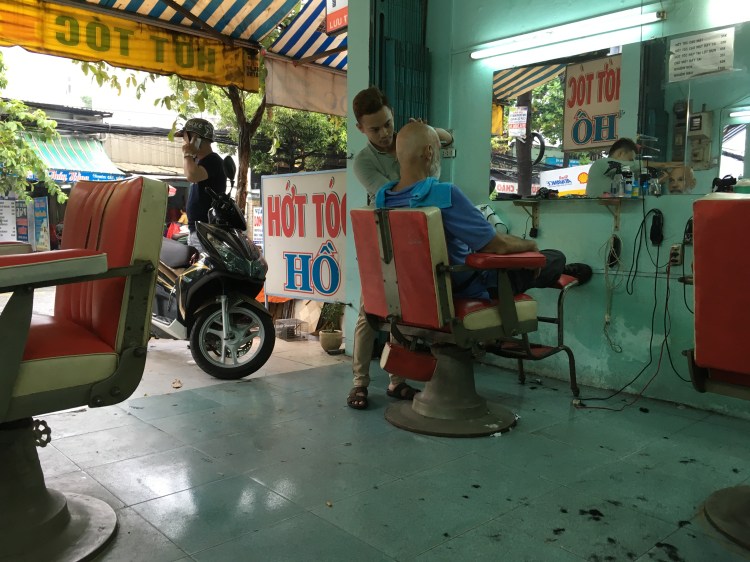
barber

And I have  been given a scholarship to a class to learn Vietnamese: it happens every night, Monday-Friday, from 6:45 to 8:30. Here is our teacher (or rather one of them; we’ve had three so far, all excellent).
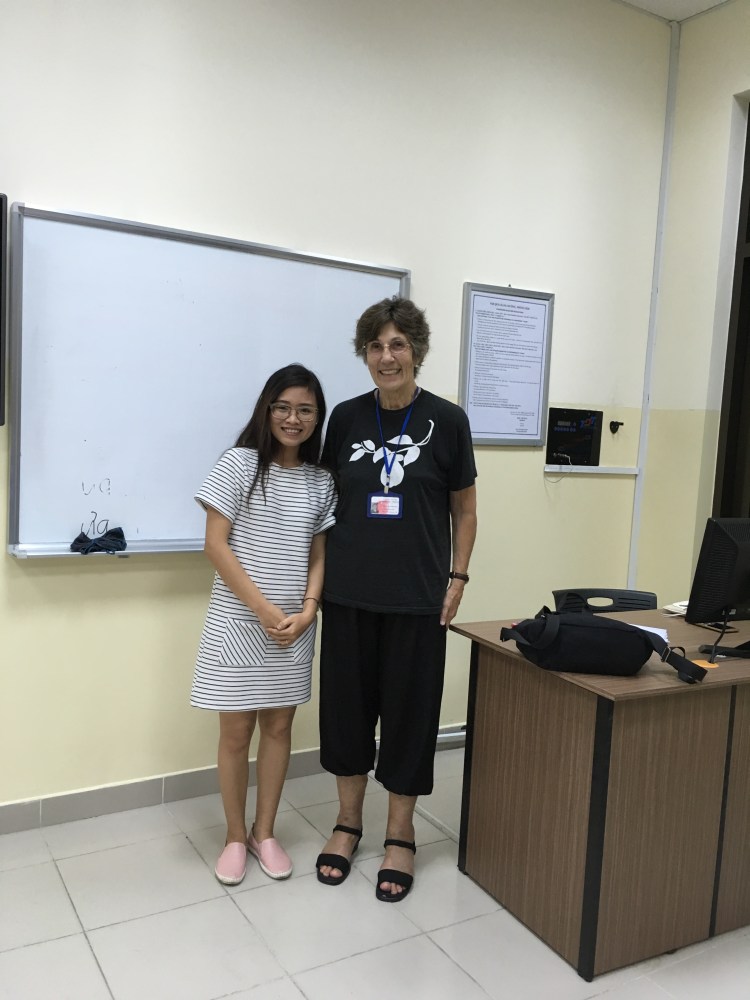
 

VN teacher


Cu Chi, Independence Day, Vy and An

An and Vy Cu CHi

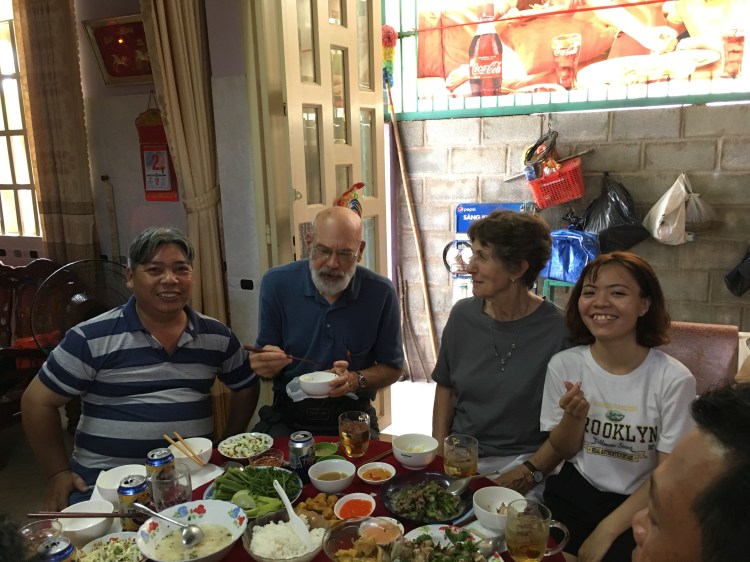
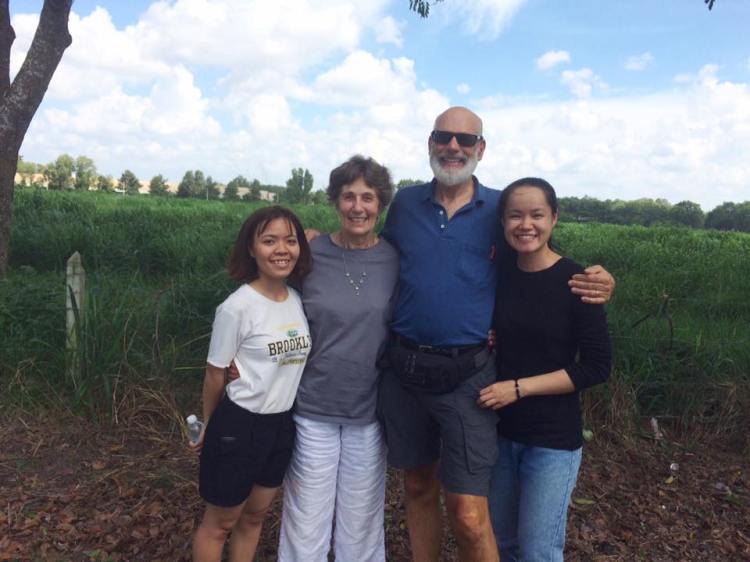
After lunch with Vy’s family, we went on a walk around the neighborhood. A wonderful day. Thanks to An for carrying her camera and asking a neighbor child to take this photo.

This is the wind blowing the curtains in the room at Vy’s grandmother’s house where we took a nap after an enormous lunch.  The laughter in the background is the ongoing eating and beer drinking of a whole extended family, but primarily men doing the beer drinking and staying at the table. I am posting this to try to convey the sense of peace and ease at that house, the wind coming in over the fields. Next door is a sort of lumber yard; across the road in the back is a field where grass for cows is growing.

Vy’s grandmother had 8 children.  She was a factory worker in HCMC. In the 1980s, the government opened up this area around Cu Chi for people to come and settle in it.  Vy’s grandparents wee among the first to come. They had to fill in the bomb craters in order to build, and often found bombs. Their first house was made of poles and thatch. They opened a shop (Vy remembers going with her grandmother on a bike at 3 am to buy things at the market for the shop), made a little bit of money, then some more, started building a house of concrete, and now have a solid three-bedroom home with the typical ceramic tile floors and surfaces, nice wooden carved furniture, at least one big TV and two fat geese in the back yard.

Vy’s grandmother is now 84 and blind, and spends most of her time lying on her bed in her room fanning herself and listening to the radio, but doesn’t seem unhappy; in fact, she giggled and laughed when she was talking with us, held my hand and asked how old I was, and seemed positively relaxed and content. She said she thought she might live until Tet. She gave the impression of being someone who no longer has to take responsibility for anything at all — and she’s right about that! –  she just lives one day at a time and feels comfortable.

The convenience store is in the front of the house, facing onto the road, in the space that many Vietnamese houses use for parking motorcycles or even cars. Vy’s aunts , cousins, uncles and sons-in-law (“third aunt” — “fourth uncle”) live around the neighborhood. One aunt’s daughter is the chair of the People’s Committee. Relatives kept coming in and out and sitting at the table and eating and drinking, then leaving, so I was losing track of how people were actually related. There were quite a few very pretty children, too, mostly wearing yellow.

Note: When Vietnamese men, brothers and cousins and nephews etc, get together to drink beer on a holiday and talk, the sound of their voices is not loud and threatening: it’s soft, easy to listen to, full of laughter. At least in this case. You can hear them in the background while you watch the curtains blow.

That’s VY on the right and her father on the left. Notice the “snap” gesture, which is what Vietnamese young people do now instead of the V sign. I am petty sure An took this picture. There is a good picture with An that she put on Facebook; I’ll try to get it from her.

Lunch Vy


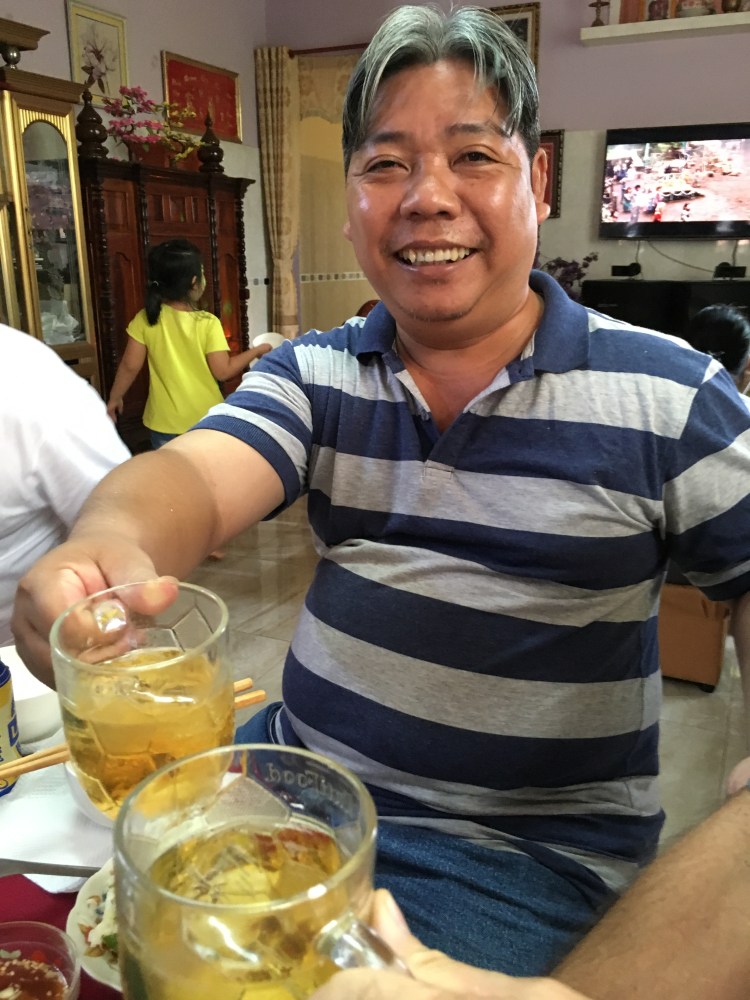
Vy’s dad. He is, I believe, a production manager at a big factory in HCMC — I think it makes New Balance running shoes.

Vys dad

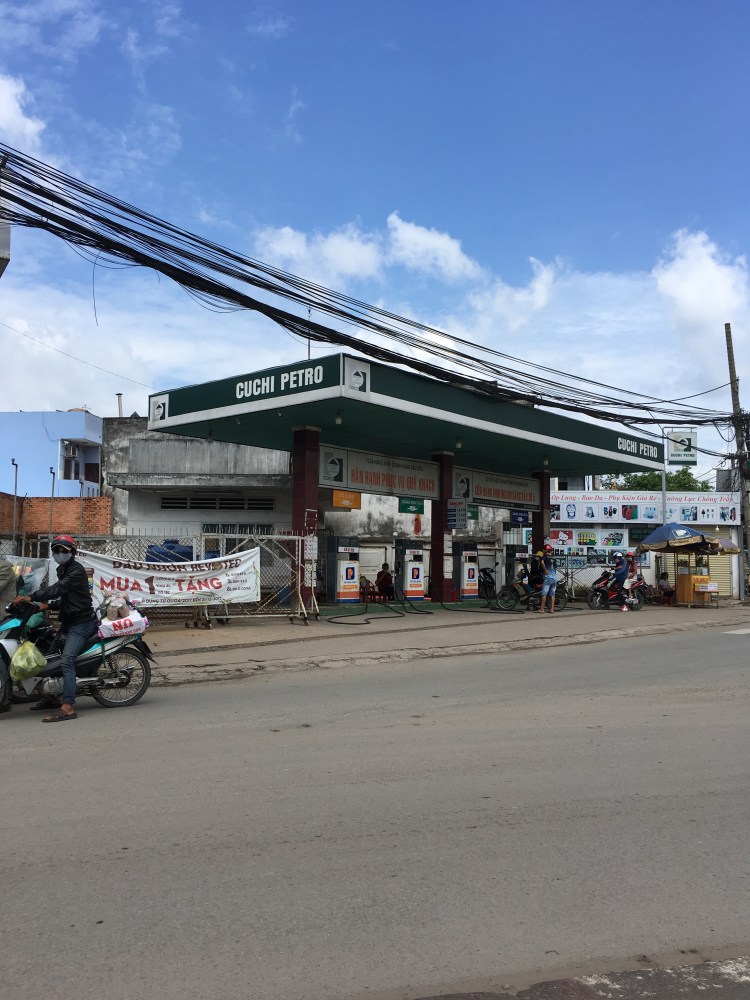
For those whose sense of history can stand a tweak, here is the Cu Chi Petrol station:

Cu Chi petrol

Too much going on

seafood

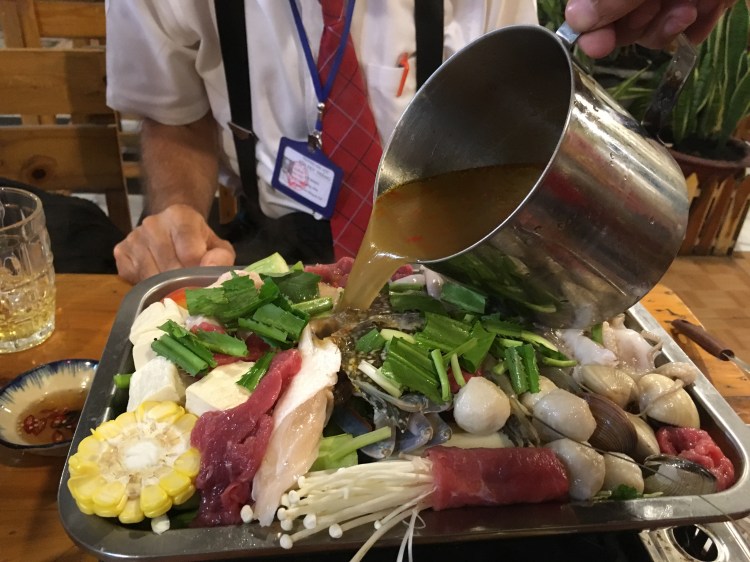
This is at the “new” restaurant that had just opened two years ago, down the street from TDT, the place where the huge eel escaped from the tank and the chef had to go chasing it under people’s tables and brag it and whack it like a whip. It has by now settled down into a sports and seafood place where they do hot pots for whole teams of soccer fans. The waiters are boys in their early teens wearing red T-shirts. A TDT student works there and helps us order.

menu

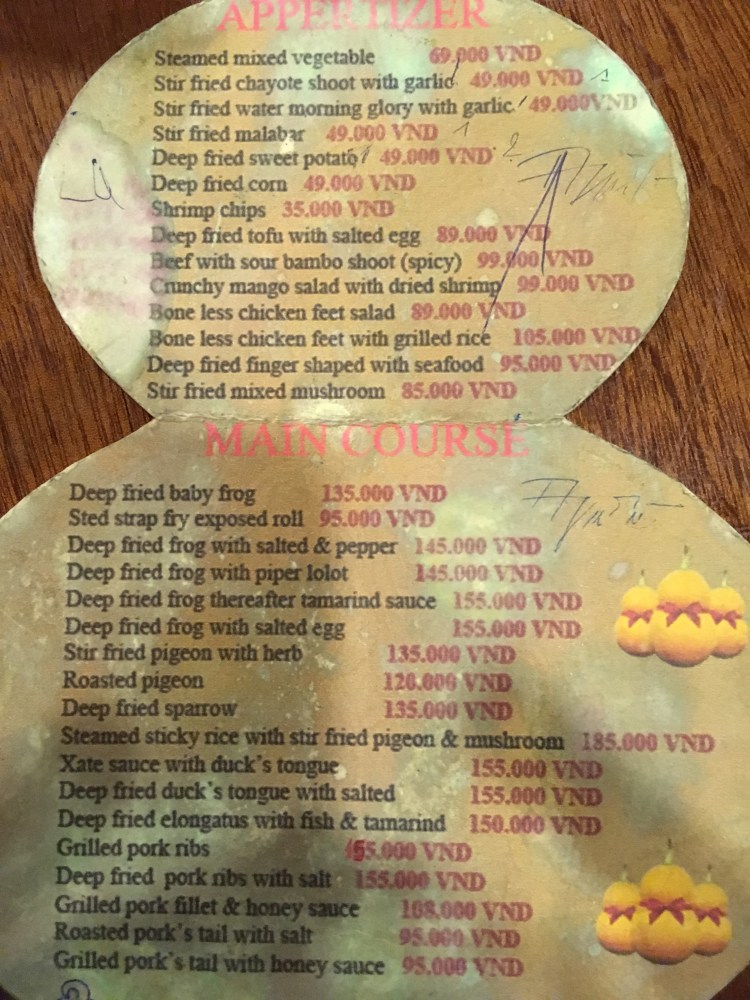
This is the menu from Ho Lo Quan at #78 Vo Van Tan Street in HCMC where we met Jonathan Luu for dinner on Thursday last week. We had the mango salad, deep fried pork ribs, something called “chicken knees,” and several other things that don’t seem to be on the menu, and it was wonderful. He works at an asset management company (he’s from Austin, TX but went to Temple in Philly, was a PhD candidate there in Philosophy but came to VN to investigate community organizing here; speaks some VN but was not raised to speak it) and “leads two lives” — the other one in Hanoi where he works out in rural areas with a friend who organizes a pepper-growing cooperative. Stories of the contrasts between these two lives will emerge eventually.

cows

This is a barn near Vy’s grandmother’s home in Cu Chi. Brown cows are for meat, the black and white cows are for milk, and just down the street is a building with the sign saying “Bring your raw milk here and we will take it to Vinamilk,” which is the big milk company. Also down the street and out back are fields of grass for the cows to eat.

There is almost too much to say about that trip. It was wonderful to see Vy and An again and spend some extended time with them. Vy’s family is a whole story in itself. An met us at TDT and we rode up to Cu Chi in an Uber. It took 3 hours and I could hardly breathe going through the city because of the pollution, even in the car. The drivers’ story:  His other job is transporting water hyacinths from the Mekong delta, where they are grown (in the water, of course) up to a more central province where they are dried and woven into baskets, mats, just about anything you can imagine. He showed us a photo of one of the final products: a basket that I actually bought at Target in Massachusetts as a wastebasket, two years ago, for about $17, off a shelf full of products from Viet Nam. The total return is 30,000 or about $1.20 per basket, which is split among the weavers, the driver, and the people who haul the water hyacinths out of the river and dry them. Cost of an Uber each way: 600,000 – 650,000 or about $27.

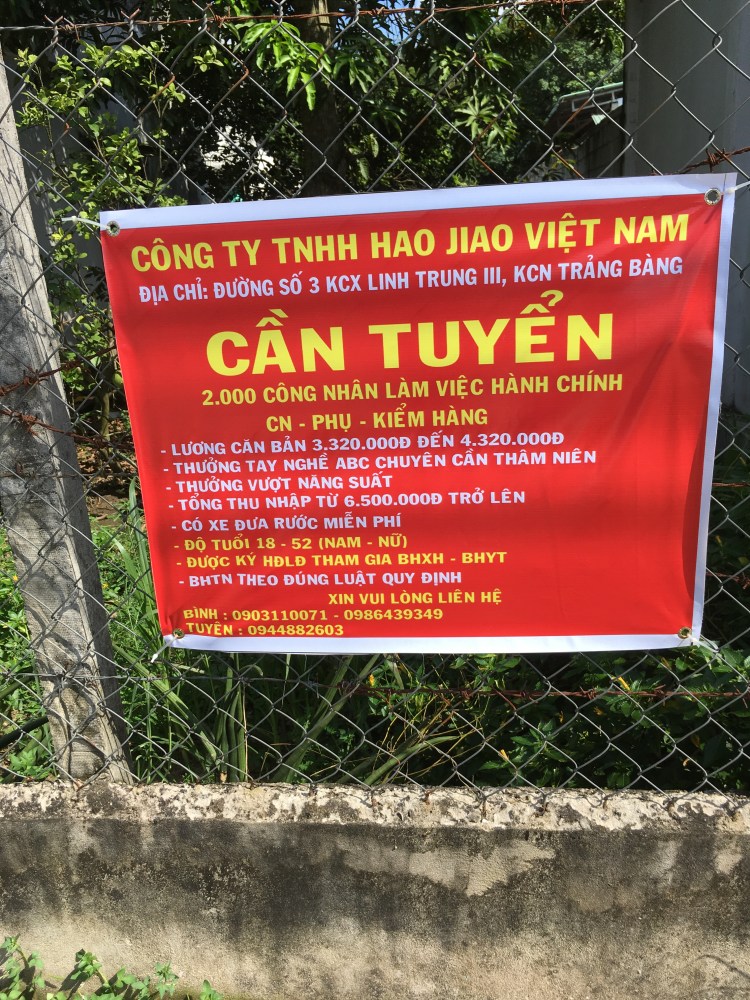
Below is an ad for workers to come and work in a textile factory, posted on the road near Vy’s family’s home. The employer will send a bus to pick them up. Men and women over 18 should apply. Wages are in millions of dong per  month. Current minimum wage according to http://tradingeconomics.com is 3,750,000. Living wage for an individual is 4,011,373 and for a family it’s 5,790,475.

ad for wrks

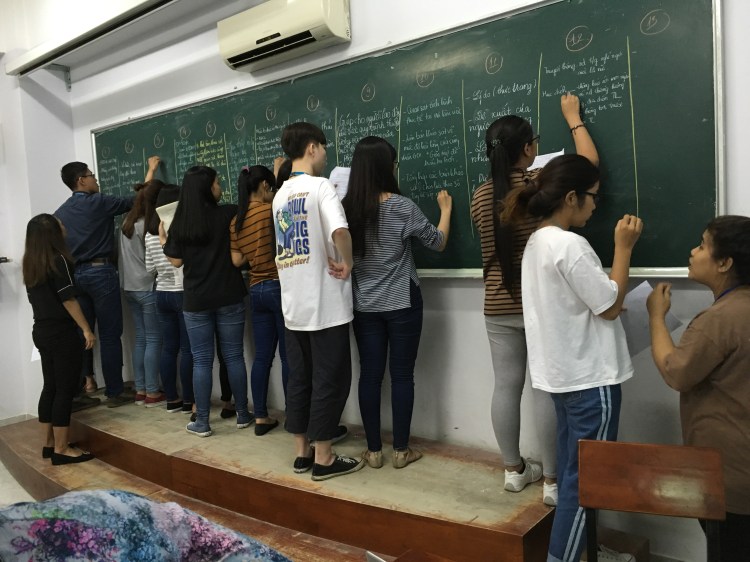
We can use this photo in the collective bargaining simulations which we will start this coming Friday. The class plan will be a version of what we did in Ms. La’s class. In Ms. La’s class, we told a simple description of a factory (handbags, so that we could have some health and safety issues with cutting equipment and needles) and then asked them to develop a plan for handling 13 different kinds of things that have to go on pre-bargaining.  Here is a photo of them putting their plans on the board:

Board.

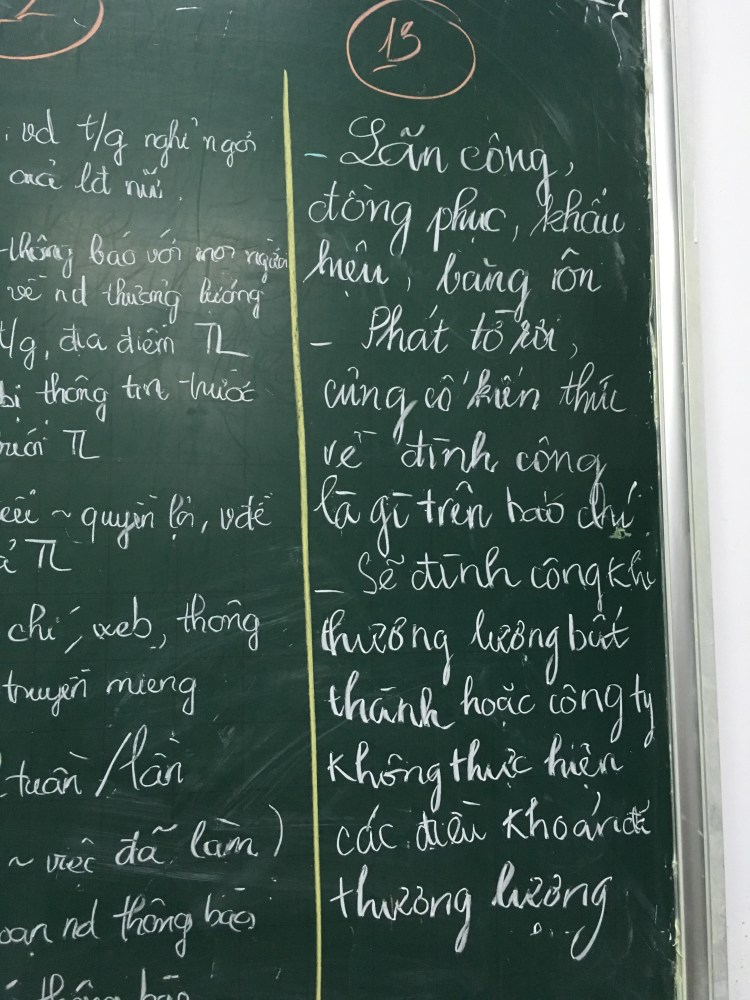
And here is a closeup of the last one before bargaining starts, creating a pressure campaign — there was some question about whether these were legal in VN or not.

13

When we start the simulation series we’ll do 1 session on preparation for bargaining, then maybe three on actual bargaining (including one on caucusing) and then two on  enforcement. The point is to emphasize that collective bargaining is not just table skills; it is an arc of activity that goes from one contract to the next and involves constant internal organizing of the “collective.”

We are also each teaching our own class, plus these 2 sessions of Ms. La’s class, two of Mr,. Triet’s class on health and safety (sounds as if there is a lot about PPE in that one — maybe we’ll do body mapping), one in Vinh’s class on labor relations, and then the Journal Club and…

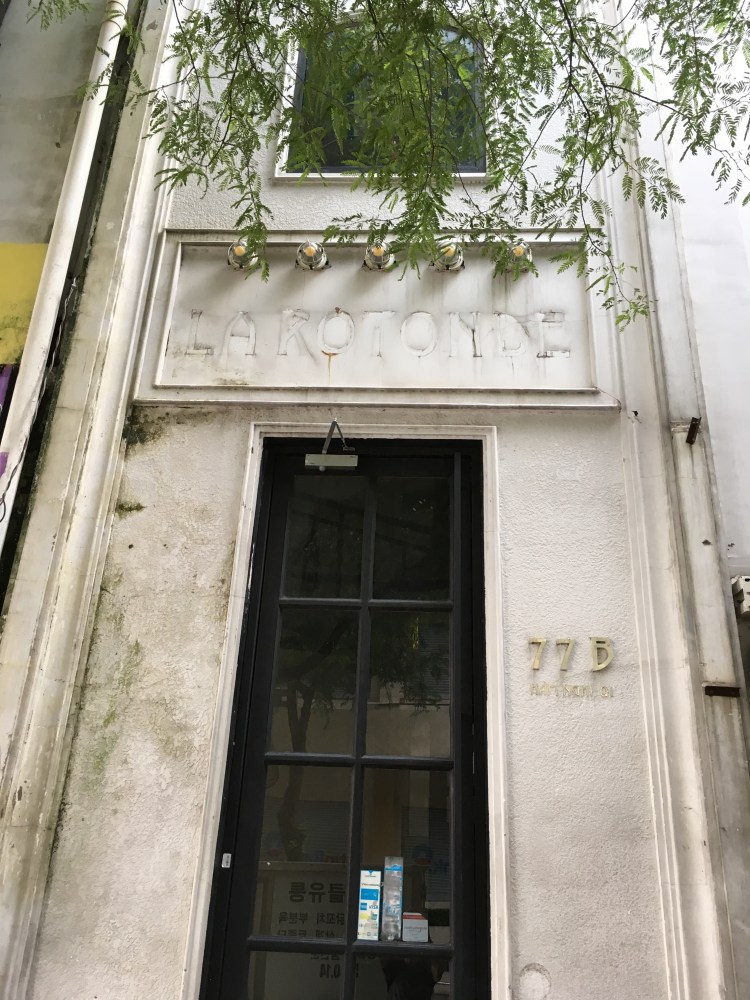
Cafe LaRotonde

We were going to meet Lien Hoang, the journalist, at the Cafe La Rotonde at 77b Ham Nghi but it has been closed. The sign remains. Must have been quite a place.

La RotYou can’t quite hear the music or the clink of tea cups…
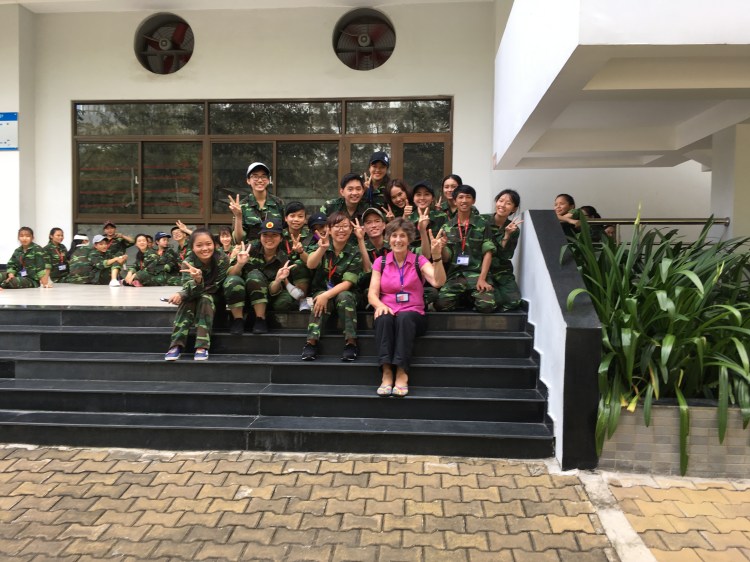
Every morning we hear “Mo, Hai!” — one, two! – outside our door, and walking to class we go past groups of about 40 students in various degrees of military clothing and equipment. This has been going on all month. They are getting military training. First they were trying on their uniforms, then marching, giving each other orders, learning to bandage heads and legs and arms, then taking guns apart and putting them back together, then stalking along with their guns through what looks like high grass, and also creeping along on their stomachs with their guns pointed. The teachers are mostly older men wearing uniforms with a certain amount of red and gold decoration.

It is definitely something to think about, as the Ken Burns movie impresses its version of the war into the setting plastic of popular memory, when you have to step over girls racing to beat each other assembling rifles, on the way to breakfast…

girl rifles

The “V” with fingers stands for Viet Nam, I was told. Also “victory,” and so maybe the upside down “v” that the boy is displaying is like that whispered comment made to me once when I remarked on how hard the students worked: “That’s why we won.” In this case, the teacher saw me taking a photo and invited me, quite effectively, to be part of the picture, which was exactly the right thing to do. I am happy to be in this picture, flashing the V sign.


Hsoldiers


Library, Research Club

temple

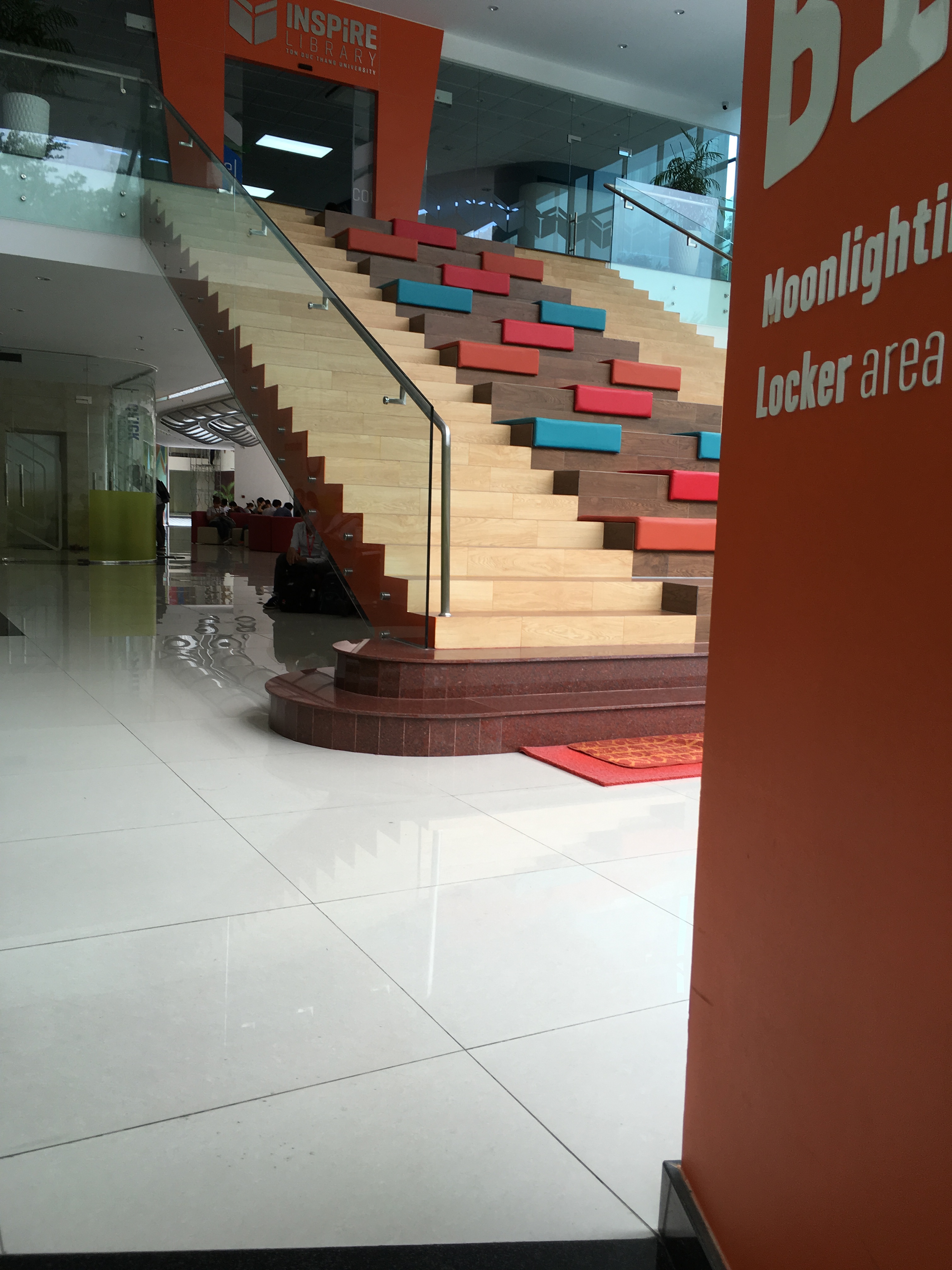
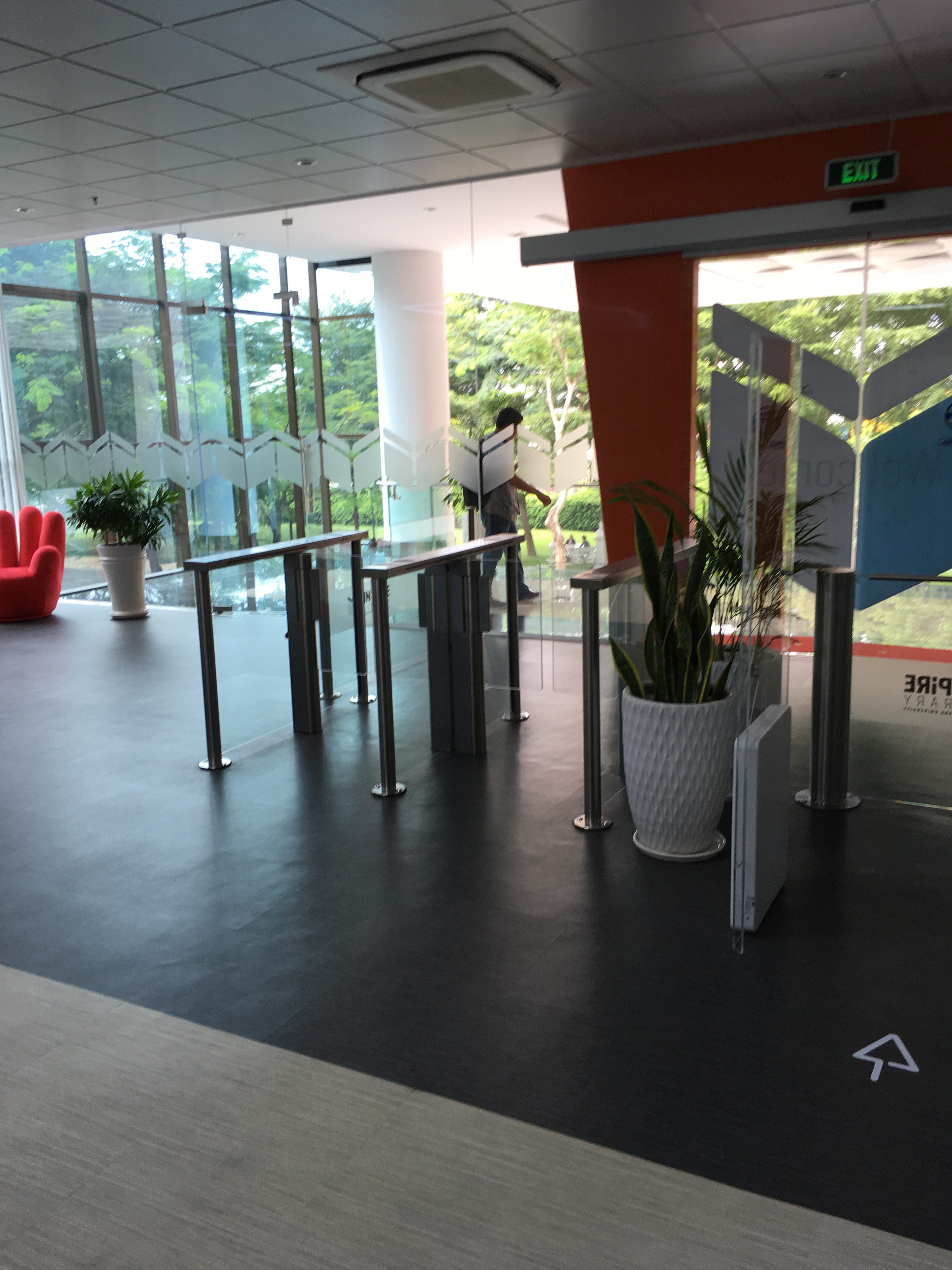
Main entrance to the new library. An elevator for disabled students exists. 

We go to bed at night saying, “Well, we did some work today!” Now if we could only get some exercise….

So this post will be about the library, research, and the faculty research program. I have a lot of photos of the library, which I hope will speak for themselves. But the research program? The current state of our role in their research can be summarized by saying that when two complex culturally-rich systems smash into each other, little fragments fly all over the place.

shoes

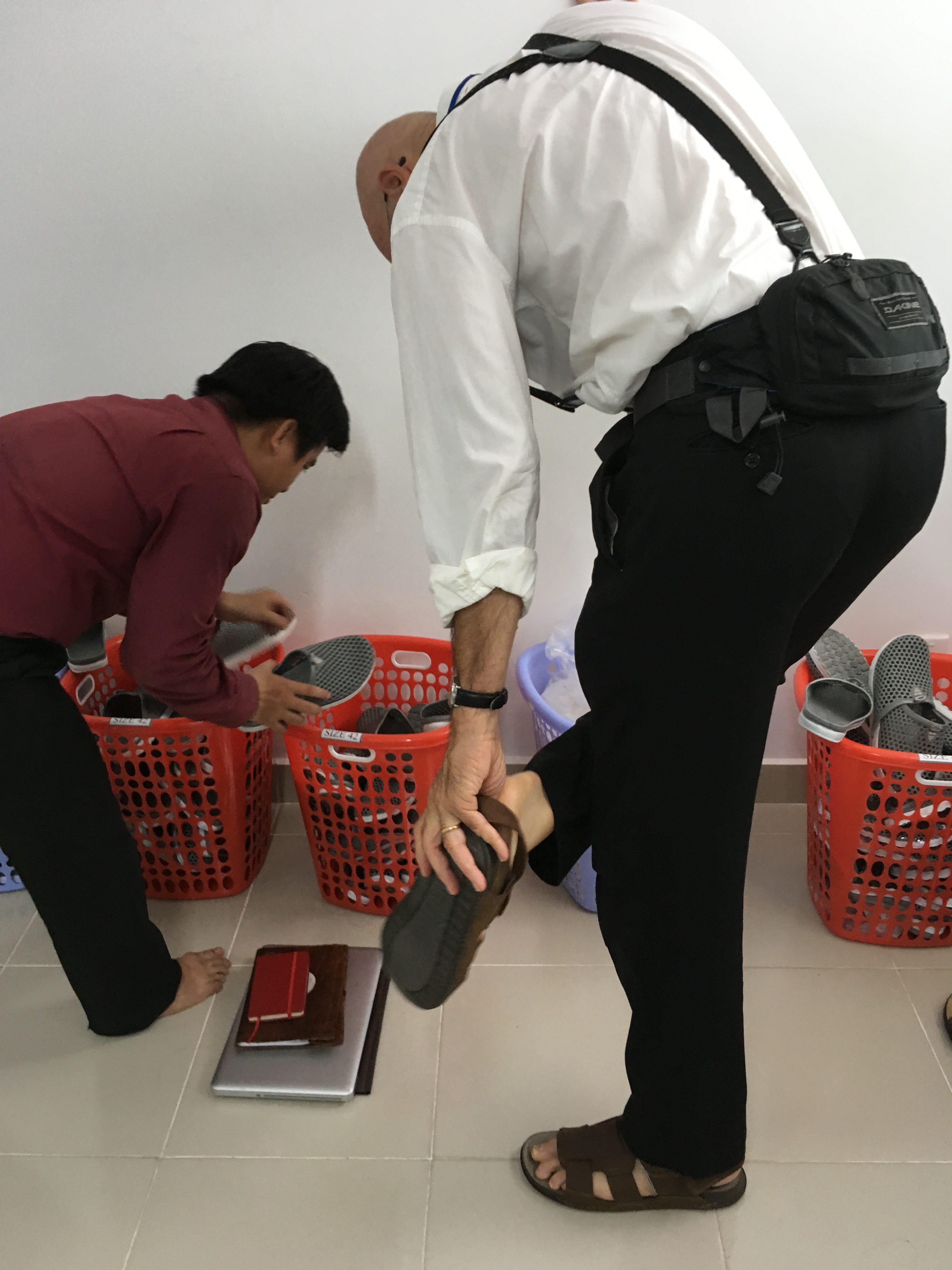
For the protection of the new floors in this hot, wet, climate, people exchange their shoes for slippers down a spiral staircase at the entrance of the library. Joe is a 47; the biggest slippers are 43, which is OK for me. 

A call for proposals

I saw a call for proposals on the Vietnam Studies Group list promoting a conference to be held in HCMC in December-January 2017-18 that was linked to the Journal of Vietnamese Studies. The call came from a Liam Kelley at the University of Hawaii. This was a second or third time around call, so it had a short deadline, Thursday August 31. This was Monday August 27, so that’s 3 days. I wrote him a quick email and he replied that they could be flexible but that it would be a good idea to send in something, which is the answer I hoped for.

The Journal Club at TDT

That same afternoon there was a Journal Club meeting scheduled from 2-4. This meeting was going to be in a “presentation room,” in the new library, equipped with a flat screen and set off from the main floor by glass doors and a code.

The reason the Journal Club has been created is because it is the intent of TDT to become known as a research university. This is in addition to its goal of having all the lecturers learn English, plus teach in English and using the TOP 100 curriculum, which I have described. The astonishing thing is that this seemingly impossible goal seems to be happening.  For example – just a note – Mr. Triet came walking down the road on the way to the Journal Club and he greeted us in English with a truly credible, rather Oakland-ish accent. He has been studying in a class called “Little UK,” where one teacher is a Scandinavian named Anders, from Denmark, who teaches English using African dance. But Mr Triet probably has a particular gift in this way. If you don’t remember, he is not only the Labor Protection (health and safety) instructor but he performs internationally (in Germany, Eastern Europe) as a clown and magician. We have seen several of his performances and he is truly great.

So the Labor Relations and Trade Unions Faculty wants to get organized and do some research and Dean Hoa called the meeting of this LRTU Journal Club to do this. Joe and I decided to propose that we respond to this call for proposals at this meeting.

However, there is the looming issue of where or work should get published.

Isign

Lots of high-graphic English signage

The approved lists of places to publish

We have already been made familiar with the TDT official policy, promulgated by DEMASTED, or the Department of Management, Science and Technology,  of “counting” only papers published in journals that are listed on a certain database. First, I understood the approved list to be SCOPUS. I got an Excel sheet showing all the journals on SCOPUS (I forget how I got it). I went through it and did not see Labor Studies Journal or WorkingUSA (now called the Journal of Labor and Society) on it. I emailed the editors of both and asked if their journals were on the SCOPUS list. At first they didn’t know what I was talking about but then they both said yes. Since both Joe and I have published in those journals, we would know how to shape an article for submission. We are also both on the editorial board of JLS. I mentioned this to Ms. Vinh and we did apparently get permission to submit LRTU research to those journals.

But there are other lists, and we also hear that it isn’t SCOPUS, it’s ISI. I have accounts at and passwords for Taylor and Francis, which maybe the same as Scholar1, Wiley, E-Journals at McGill and I seem to remember Emerald.. So what about Sage, the publisher of Labor Studies Journal? I began asking, “What are these lists? Are they in some way an indicator of quality of research? Or are they just a database of all the journals published by a certain publisher?”

inside

Open stacks, reading room — similar to other floors. 

I begin to look into the various lists

Publishing journals is a huge business, one business among many that sees education as a vast, well-organized, rich market, comparable to healthcare. In fact, education can be viewed as a “desperation” market like healthcare in the sense that academics have to publish in order to get promoted or keep their jobs (see the tenure system in the US). The vitality of this market is demonstrated on the one side by the huge loans that people in the US are willing to take out in order to pay tuition, often at second-rate for-profit colleges and universities. It can be seen in the cost of textbooks ($100 or more) and the frequency of new editions (so you have to replace the old one). In micro, you can see it in the moment when I observed, in the mail room at the University of Illinois, a senior professor joking with pride about being asked to pay $800 “fee” in order to submit a paper! There are innumerable ways to milk money out of the free work of researchers, editors and peers who produce these articles. The prices charged to libraries to subscribe to certain journals is so high that some journals are being dropped.

This makes academic research seem like a hustle. But an undistorted (is there such a thing?) research culture, which supports collaborative exploration of matters that are of shared interest to an intellectual community, followed by sharing the results and debating and evaluating them among one’s colleagues (peers) is the product of centuries of trial and testing, and I actually do believe that it can be counted on to produce an understanding of the real world. Thus the true value of good research exceeds anything money can buy. Yes, it has been infested with rent-seeking, but that only distorts it; it does not invalidate it.

If I am a bit hot under the collar on this topic, it’s because of the anti-intellectual wave sweeping the US under Trump, along with his appointment of Perry, a climate change denier, to head the Environmental Protection Agency, where he is dismantling an already weakened regulatory agency. (We worked with the union of scientists at the Chicago EPA and heard horror stories about recommendations ignored or disputed by Bush administration – appointed managers.) The news is full of this while Hurricane Harvey dumps three to five feet of rain on the oil refineries in the harbor of Houston, Texas. I also saw that the requirement that employers keep records of worker injuries for 5 years has just been eliminated, to “ease the burden of regulation on employers.” This is like running a bulldozer over a crime scene. (We’ve been watching a lot of police procedurals on Netflix.) It is like looting the museum in Baghdad or destroying Palmyra.

terrace

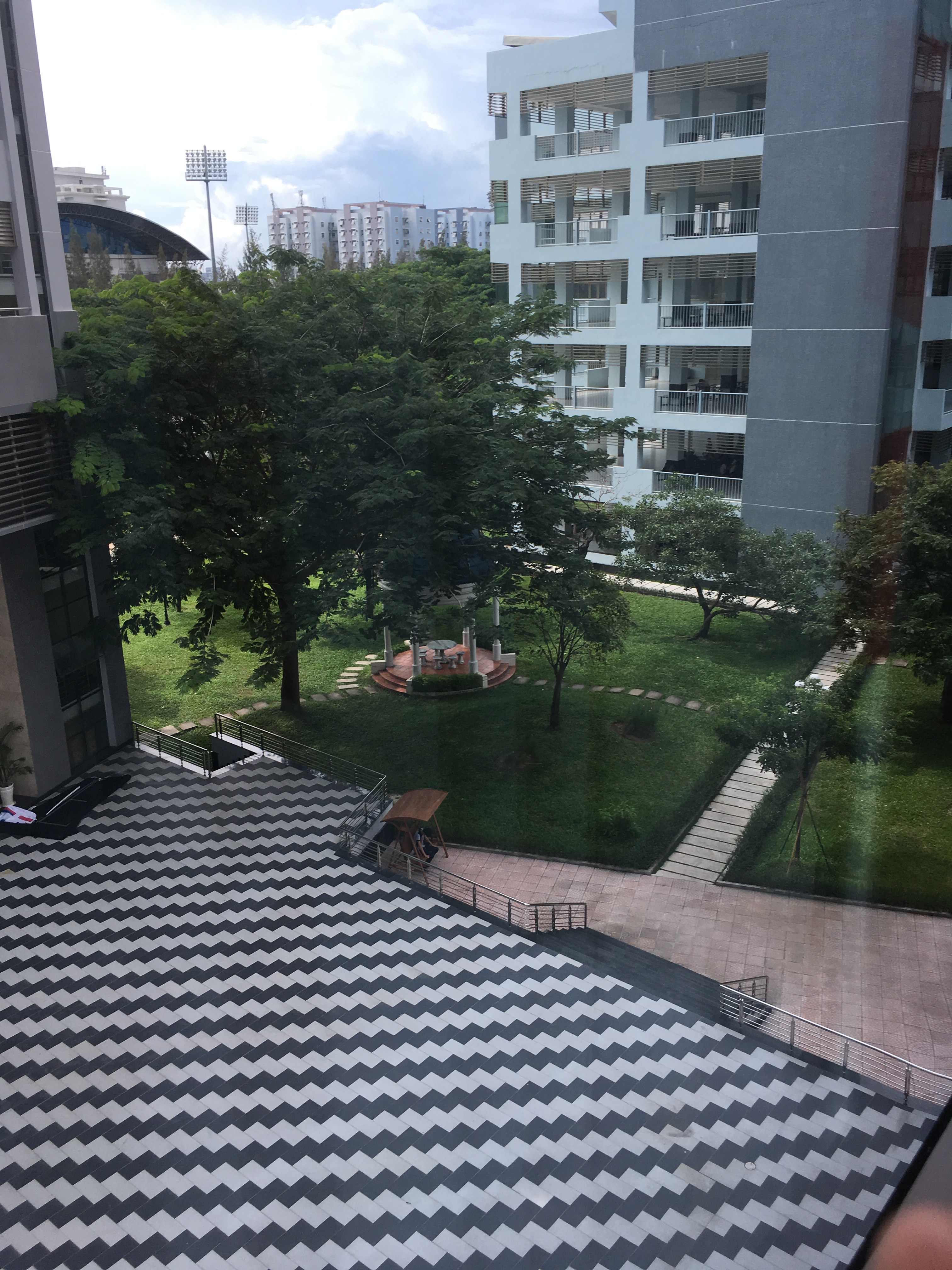
View from presentation room window; that’s Building E across the terrace

Detour

I am writing this in the midst of Joe’s class on leadership. The students have just made a presentation and it was really good. I have to say, I am surprised at how good it was. In their written report (in English) there is a section titled “Analysis” which actually does analyze the commonalities among 10 different interviews. This is followed by two exemplary stories. Also, there are a lot of challenging questions from the floor, which appear to be answered by various members of the team, not just one person. Two years ago when I taught a previous version of that class, their reports were full of data and graphics and totally lacked analysis. They were also shy about discussion after the presentation. Something has happened! This is the early face of research.

Back to the research question – leading up to the meeting of the Journal Club.

I have passwords and accounts at the following websites where journals get peer-reviewed: Francis and Taylor, Wiley, Scholar1, Emerald, and E-Journals McGill. I put all these into a search and found out, more or less, that Wiley owns Sage, that Thomsonreuters owns Elsevier and Emerald, that Francis and Taylor, which includes the Routledge list, merged with Informa in 2004 and consolidated their lists of publications. The ISI list was originally produced by someone named Eugene Garfield at the Institute for Scientific Information, which became Thomasonreuters and is now “Web of Science” which hosts Clarivate Analytics that tells you the impact rating of your research, based on the number of citations that your article gets. Merge, buy and sell, trade journals as commodities.

There are also Scopus and a set of sites called SCI (Imago), SCIE, SSCI and ISI. There is a website to go to if you want to know whether a certain journal is found on one of those lists

www.philippe-fournier-viger.com

Philippe Fournier Viger, if he is a person, is located at Harbin Institute of Technology in Shenzen, which is probably another university that prizes publications in high-ranking English language journals. Also on that website is an ad trying to get people to submit their articles for a data mining activity. For free!
And then here is a blog that makes it look as if I can submit actual questions to people who know about this stuff:

entr

Going out the front door down the temple stepsResearch grp

So, what to do at TDT?

My position, of course, is that the main task for these researchers at TDT is to find a way to enter the discourse – join the discussion, have their voices heard among people who care about workers’ issues around the world. This includes not only academics but also – here’s an example of a place where Vietnamese workers were definitely not part of the discussion – for example, the AFL CIO, when it took its firm stance against TPP.

So now we move back to the Journal Club meeting. Present were the two young women who earned MAs in Taiwan, who are both graduates of TDT themselves, Ms. Vang and Ms Truc, Miss La, Dean Hoa, Mr Triet, Vinh, Joe and me.

Joe and I had a powerpoint. First, we talked about working collaboratively. Then we talked about our first overall proposed project: What are the changes that have taken place in worker education over the last 80 years? Ms. La said that 50 years was more appropriate. She’s right. We discussed collecting numbers (who received worker education, how many, where, etc) and interviewing teachers and workers. We talked about the difference between training (job skills for productivity) and education and the difference between classes for union leaders, union members (who are partly workers and part-time on union staff) and workers. The latter is mostly about the law and how to make sure that the law is being followed.

This was all followed with head nods and smiles but no one seemed excited. It seemed like work.

Then we went on to the Vietnamese Studies Journal proposal, and talked about writing about the workers’ experience in the tourism industry, especially hotels and restaurants (Miss La’s suggestion), maybe picking one major hotel chain that would be accessible in HCMC. Dean Hoa volunteered to work on numbers and demographics; Mr. Triet could work on health and safety issues; others said they could interview workers. Someone volunteered to do a scan of existing materials in Vietnamese about this topic. Of course, Joe and I had in mind the work of Pamela Vossenas at UNITE HERE regarding muscular- skeletal injuries of housekeepers, and the efforts to get CALOSHA to adopt a standard.

More enthusiasm was generated by the conference vetting process. The organizers are going to divide papers, after the March 31 2018 deadline, into “A” papers and “B” papers. “A” papers are those suitable for going out to peer review as is; the “B” papers would be invited to come to a workshop in the summer of 2018 to learn how to make papers more peer-reviewable. We communicated this information to the Club and it was received with curious interest. I would actually hope that the papers from the TDU Journal Club would be “B” papers and get the benefit of this mentoring.

After the meeting, however, Truc (one of the young faculty) came back to our office and asked us to come to Dean Hoa’s office right away, because he had looked up the Journal of Vietnamese Studies and found that it was not on the ISI list. Both Joe and I went over there. Let me summarize by saying that I got quite hot under the collar and made some arguments. His question was, is it worth it for the whole faculty to do all this work if it was going to be submitted to a journal that was not on the approved list? Isn’t that a waste of time? I said, among other things, that for the administration to fail to approve this project on that basis was to put an obstacle in the way of young faculty who were trying to enter the global conversation about the conditions of workers and the role of unions, etc etc.

At the end of my heated presentation, he agreed with me. But there are still steps to be taken.

Two sides to the broad question

For future discussion of this highly charged and important matter, it is critical to keep the broad question of what the lists actually represent (a publisher’s bundled inventory? a sign of quality?) separate from the short-term question of the value of submitting something to this particular conference.

Challenging and discrediting the authority of these lists does not leave one with a practical alternative. After all, there has to be a way for a university that has not been accumulating endowments for 400 years (like Harvard) to enter the global education game (sorry…there are aspects of it that are a game). Also, it’s going to happen, so there has to be a way for it to happen, even if we break a few eggs in the process.

So there has to be some way to give guidance to young researchers, or new researchers, so that they don’t waste time writing for pop-up journals or trying to go to conferences that are really just a perk for people on a big grant. There has to be some quality control. If you don’t read English, and if every time you go to the library to look up an article, they have to create a budget for you to access each journal, what are you going to do? Wouldn’t it be great if you could trust these lists?

Submitting a proposal to this conference is an act that expresses the position that the measure of quality is created in an ongoing way through participation in the discourse, over the course of many years. What is desirable is meeting people, listening to new authorities (and old ones), venturing new ideas, picking up hints in the course of informal discussion, collecting business cards, remembering faces, getting on discussion email lists or into research groups, developing the shared vocabulary (register, discourse, at whatever level) of the discipline, learning the edges and norms of the discipline.

This is the long term, for sure. And the long term is hard to incentivize. From the administration’s point of view, how would you incentivize this? Right now, they are saying that if you publish an article in the approved journals, then the next semester you will get a reduced workload as a reward and can sign up to keep researching, in the hopes that you will publish another article. But lecturers are teaching 4 classes per semester; they are busy. What would incentivize them to carve research time out of their schedules in order to do this? Is it even possible?

To be continued.

The New Wrapped in the Old Wrapped in the New

IMG_0142


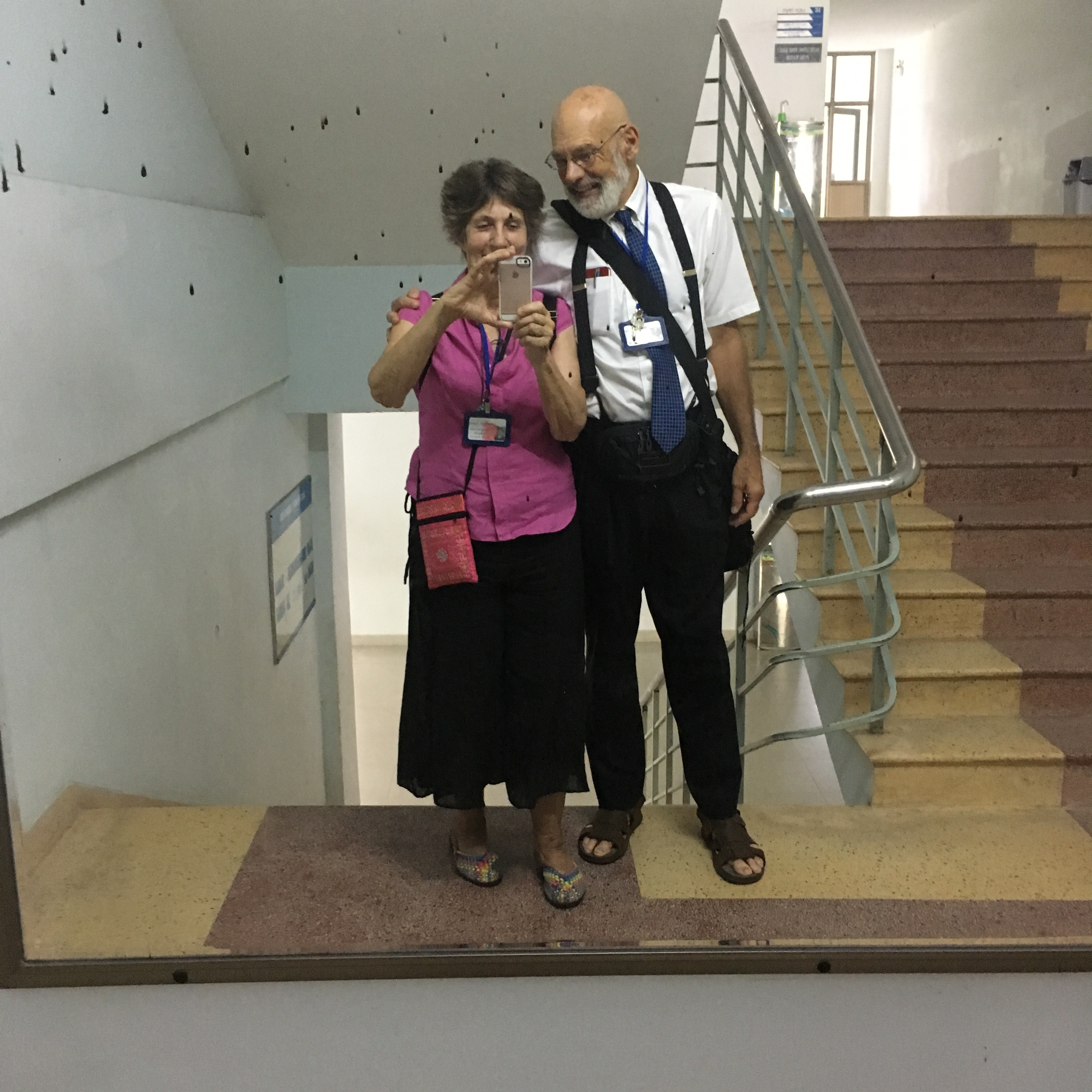
Us on the stairs going up to our office in C building. The spots are on the mirror, not on either the camera or me.


Joe’s class starts at 9:25. It is now 9:48. The reason why it hasn’t started yet is because the publicity people came to his classroom right at 9:25 and asked if they could video the class. Why not, sure? I mistook the question, “May we film your class?” to be a question about copyright, permission to record your face and words, as in at the beginning of a theater performance, when they tell the audience that recording of any kind is prohibited. The work of the artists belongs to them.

No, that’s not what this is about. It’s about moving us to a room on the 4th floor of Building A, with fixed but purple cushioned seats and microphones installed in the tables, Joe up on a podium above the room. It’s the same room in which we made a presentation to lecturers two years ago. The computer has to be set up again to show the powerpoints.

Joe has prepared a pretty dense class with a lot of activity, closely timed, including reporting back on the interviews, so losing 20 minutes plus is pretty serious. There is a great deal of chaos at first, with new students (people who missed last time) having to form two new groups, and the other students not realizing that they are supposed to sit in groups. But the class gets going. The camera, I see, starts filming when Joe is talking. It does not film Vinh translating. The “camera” I am referring to is mounted on a frame, which is held up by a thin, tall, strong man; the frame seems to use a gyroscope to hold the focus steady even when he is swooping and dipping around Joe.

But despite this, once the class gets going it feels as if this is actually a better room for the class, at least for the teacher. Joe can stand down low below the screen and walk around.

Except that….. ooops, there is no blackboard. No place for students to write and collectively read material, construct a collective text, work on building an image, etc etc. Lots of wall, but no flip charts. No whiteboard. Joe wants to write “Freire” and “For whom, by whom, and for what purpose?” somewhere, but that’s not going to happen.

The good news is that Thi from Vung Tau is in the class – looking older and sophisticated. When Joe asks a question about the difference between leadership and management, she answers well, in very good English. Composition of the class today: over 50, of whom 8 are young men.

By 10:15 or sooner, the cameras and publicity people are gone. I had actually expected that they would film the whole thing so that students could watch it and take the class or review it that way. I assumed that what they were interested in was the logic and method of the whole thing.

Curriculum

It occurred to me this morning that between Joe’s class (this time around; the Northouse text plus the Handbook that we wrote, combined into a class about leadership from top down, leadership from bottom up) and my class, we’ve created two full classes that are now in the system, being offered on a repeated basis. Not unlike writing a play, that gets produced once here, then there, then in other places, each time with a new audience. You write it once and it is re-produced many times. So we are writing the shows that get produced in these classrooms (or at least two of them), with enrollments of 80 and 90 students. We are also writing guest lectures for Miss La and Mr. Triet’s classes, and an arc of 6 simulations about collective bargaining that will be offered on Thursdays or Fridays later in the semester.

I think this is what Dean Hoa actually meant two years ago when he would say, “We want you to help us create a curriculum.” This plus all the material Leanna and the UALE people have gathered, which hasn’t been integrated yet.

Website, E-Learning

More technology adaptation: the e-learning website is up and running, so for my class the whole Katz, Kochan and Colvin book is being scanned and all my powerpoints, class plans and extra handouts are being posted. Students will have a great deal of material to read on line. Will they do it? Yesterday Joe and I reviewed and edited the website blurb for the Labor Relations and Trade Unions Faculty and sent it back to Vinh and the two new teachers. The new text, at least at the moment, describes the subject matter of the Faculty as being interdisciplinary and designed to prepare students for work in unions, enterprises, and government. This is comparable to what I heard while doing the interviews with labor programs back in 2014 – I’m thinking of Cornell and Athabasca – when I asked, “What do your students do?” Answer – they go to law school, into government, into unions, into businesses as HR managers, and into NGOs. Missing here in VN is the NGOs.

Library

I will have to take a lot of pictures of this library. It has a name: INSPIRE. From outside, you see a huge orange column, wrapped in blue and gray tile, and bands of blue windows. The actual entrance is like walking up to the top of a Mayan pyramid, only in bright orange, blue, gray, and wood. Before ascending this tower you have to go down a narrow spiral staircase to the basement (which we are told is open 24-7, for students to study all night) where you put on some soft gray clogs, which we are assured are washed once a month.

The library inside is a dream of lime, lemon, cream, glass, smooth bright floors, labels in English. We go into a “presentation room”, one of many which we can apparently book, with a flat screen TV and risers made of bright smooth wood, in a “c” shape. The young man who delivers the presentation shows us the home page of the website of Hollis, the Harvard University website; tells us that the TDT website and software were designed in Israel; that the interior of the whole library was designed by industrial design students at TDT (and it is the most student-friendly hive of spaces that you can imagine), and that books are filed on shelves in alphabetical order by title, because the title is easier for the students to read (bigger letters) than author. This stumps me for a while until I go into my email to send a message to Dean Hoa and see what happens when you look someone up by “Nguyen.” Our group includes two other Asian men and a young woman from Estonia who is here for a year and we are told we do not have to take a test. It may take a month to get a library card, however. The young presenter assures us that someone will deal with all our needs and questions. A goal, working with Julie Brockman at Michigan, would be to set up some kind of international partnership for improved access to academic material.

There is a museum in the library. At its center is an architectural model showing the future of TDT. That whole piece of land beyond the second canal, it turns out, is going to be TDT. That land that was being bulldozed and excavated and drained two years ago, and now is overgrown with head-high tropical grasses (elephant grass?) is going to be full of giant white university buildings. The vision is gigantic. It makes the existing TDT right now seem tiny. There will be more dormitories, of course. ONe of the big buildings is a Finnish-Vietnamese high school, being planned jointly with Finland.

Construction has been held up by “red tape,” says the library presenter. We had also heard that RMIT was going to build on that land.

Changes
Weirdly, this place does not really feel foreign any more. Is it because there is so much new, high-tech stuff? So much evidence of hard work towards developing this into a real major university? I don’t think it’s just that. I think that having read the Appy book, American Reckoning, helped me find a place in the history that has brought me here. But also, the traffic doesn’t astonish me this time. The food of course – pho twice a day, with something with rice and spinach soup for lunch – is a change from what I eat in the US, but it does not feel foreign. Maybe a little too much fish.

Last Sunday night we had dinner with Vy and An. They have grown up a lot. They wore elegant little dresses (a particular Vietnamese style that depends on being slender) and have interesting jobs. An left the furniture store and is now a vegan and at her new job (something about social media that has a lot of connections with France) she is assigned to create a “green office,” which she is taking very seriously. (We went to a vegan restaurant.) Vy, who gave herself a trip to Hanoi last spring by herself, teaches in a pre-school but is applying for an HR or purchasing job. They looked older; I felt older; I am just glad they are both well.

The Big Difference

The biggest difference is that we are actually teaching collective bargaining and using that term. I don’t hear the word “social dialog” around at all. Joe’s class, half Northouse and half our Handbook, really got down to the contrast between corporate and union perspectives today, explicitly. You could see that when the students reported how they filled out a version of Fred Glass’s contrast table (his is about communication; Joe adapted it to leadership). There must have been a sea-change somewhere. We are doing collective bargaining simulations (a series of 6, with only 3 dedicated to table skills), two classes in CB in Miss La’s class, two in Mr. Triet’s class and session of my class in Vinh’s class. Then we will be meeting with faculty to discuss research, and it seems as if we will be able to devise a research project (such as how labor education has evolved here over the recent past) which will involve them. If we have their participation, this research might actually be possible.

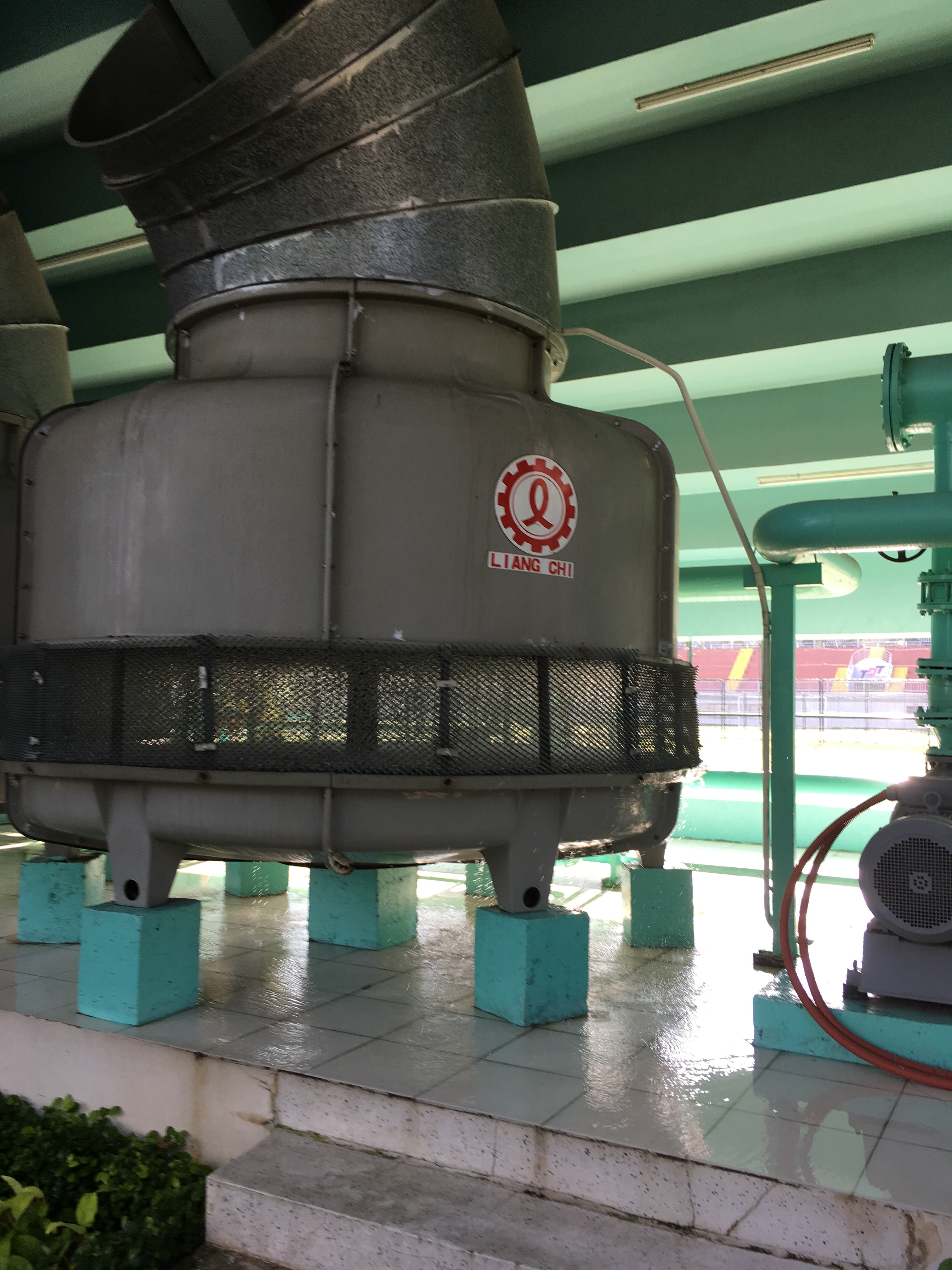
The photo below is the air conditioning unit, which inspires me a lot, too — maybe as much as the library. This morning it was groaning and overflowing, with torrents of water pouring down the steps.

airc


First day of semester, August 2017

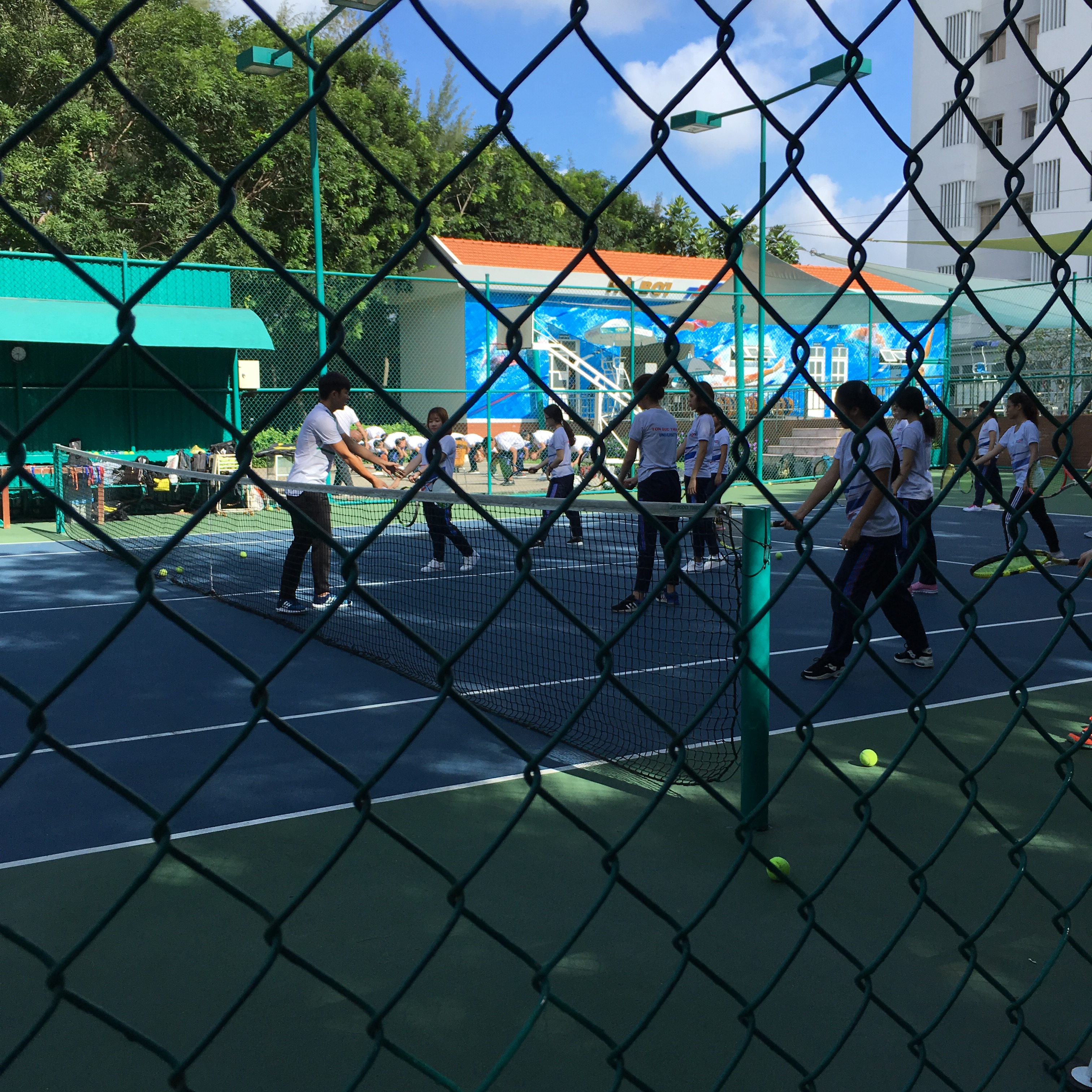
tennis

The semester starting at TDT is like a huge machine coming to life. Outside our door starting soon after 6 am there were classes in the swimming pool, tennis classes, something else in the background, martial arts in the gym. Lots of mothers sitting on the benches while the young students found out where their rooms were. Suitcases were all over the place. The cafeteria ran out of food — nothing left but eggs and bread! Next to our room is the copy shop, which was going great guns into the night; I could hear them pounding the leaves of whole books into glue-backed covers, boom boom boom! and can vouch that they go home at midnight. Our classes will be huge — Joe’s is 70 but the first day it was 45, mine was supposed to be 99 and was 82. 

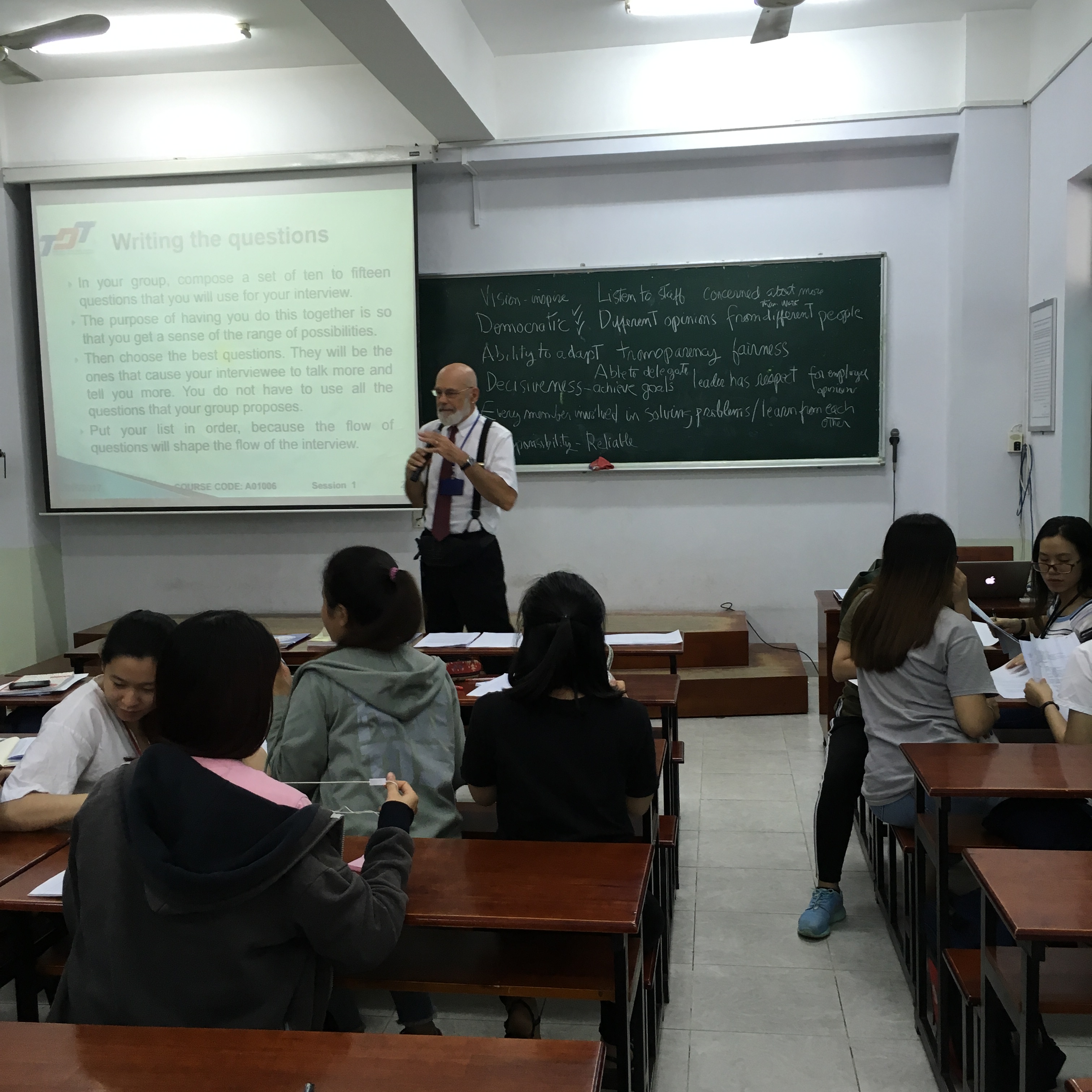
Joes 1st class

Joe’s first class, on Tuesday morning, went very well, after the technology got set up. About 45 students showed up, overwhelmingly young women.

As an exercise he asked them to make a list of the characteristics of good leadership. the winner above all was “democracy” or “democratic.” We didn’t actually expect this. Hmmmm. Things are moving along.

Vinh translated for both of us. There were two microphones. She stood in the back of the class.

My class, today, also went well. I’m using Katz, Kochan and Colvin’s Labor in a Globalizing World (I think I’ve mentioned this before) and trying to get students to focus on “Who is ‘us'”?  WHo can act? Who judges? Who enforces? And follow those questions through the various IR systems that we study. We will start with trying to understand the work experience of the elders of some of them. There were 82 students in the class, who formed into 13 groups. Here are some pictures of them doing the first group exercise: figuring out what else is produced at a workplace other than the product — things like jobs, benefits, a place to meet people and make friends, a way to make a decent living — etc.  The idea was to make the maximum list, then divide it into things that workers want and things that employers want.

group d 2group dis 3Group disc

Then they went up to the board and sure enough, they got it!!

List

We drew lines from things on the “workers want” list to items on the “employers want” list, and back again, to show how come things are a shared concern — things like training and health and safety. But wages and profits did not get a connecting line. A good job is a place where there is a lot of overlap. In a bad job, anything from slavery on up, including some of the bad workplaces in Viet Nam, there is little or no overlap. Very little of what workers want is also wanted by the employer. My argument is that labor wants the maximum number of their needs to be negotiable — to be in the “labor peace” zone, where the two lists overlap and you don’t have to be fighting all the time. When the way these issues are handled are settled through negotiation and agreed to in some enforceable way, there is labor peace. Workers want that because they want to have steady jobs and a decent life. Employers want it too, but not if it cuts into profits, so unless labor takes up some of its economic weapons, everything but profits will go by the way. So what are these economic weapons? Both sides have them, and they can use them to manage the size of the zone in which there can be labor peace. Sit-ins, strikes, demonstrations, lobbying, political leaders, public shaming, going to court, showing solidarity — these are the weapons of labor. On the employer side, capital flight, lockouts, layoffs, replacement of workers with automation, and then individual penalties like demotions or suspensions.

Now we can talk about the way countries develop IR systems to regulate the conflict between workers and employers over these issues.

Their first assignment is to interview an elder worker and see if they can understand his or her work experience using the questions, Who is ‘us’? Who can act? Who judges? Who enforces?

We’ll see what happens. These students are very sharp. Also, I notice that they come to class with pens and notebooks. This is new. Two years ago, students didn’t take notes; they had phones but no note-taking equipment.

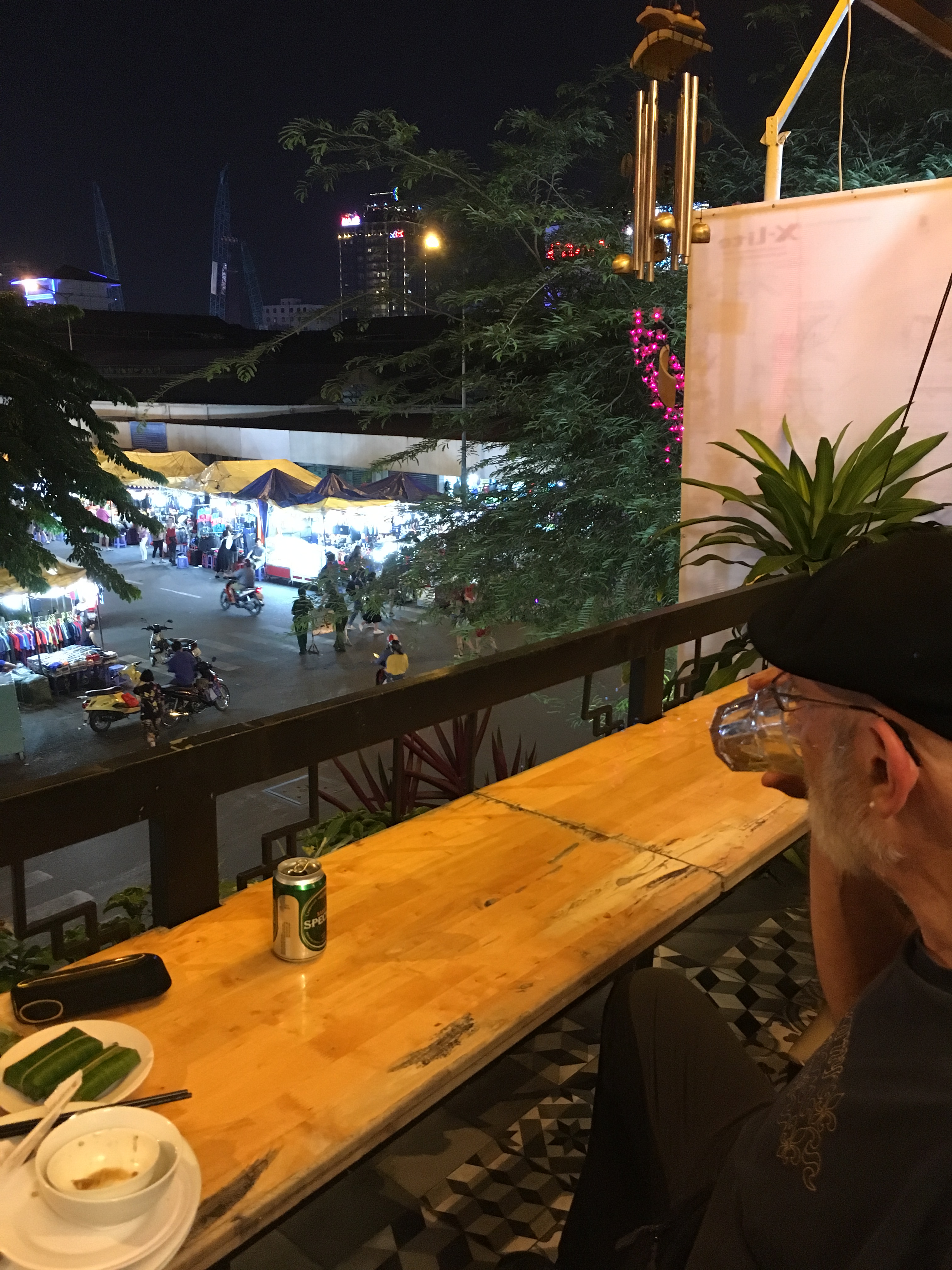
Wednesday after my class we went swimming (pool open for lecturers from 5-6 pm) and then took the 86 bus into center city, the Ben Than Market. I had heard abut the diggings for the new Metro but what’s going on there surpassed my imagination. It’s a vast mess, but the Market is still there. We at dinner on a balcony at a Hue Food restaurant up an alley  overlooking the market. On the way home in a cab I began to have a very sharp sore throat, which I attributed to the pollution, but it turned out I was actually sick and spent the next 36 hours on my back in our room, sniffling and feverish. Vinh brought oranges, Ensure and kiwis and some kind of Vietnamese oatmeal.IMG_0121

It’s all good.

Sunday morning after sleeping nearly 18 hours, maybe more

COFFEE

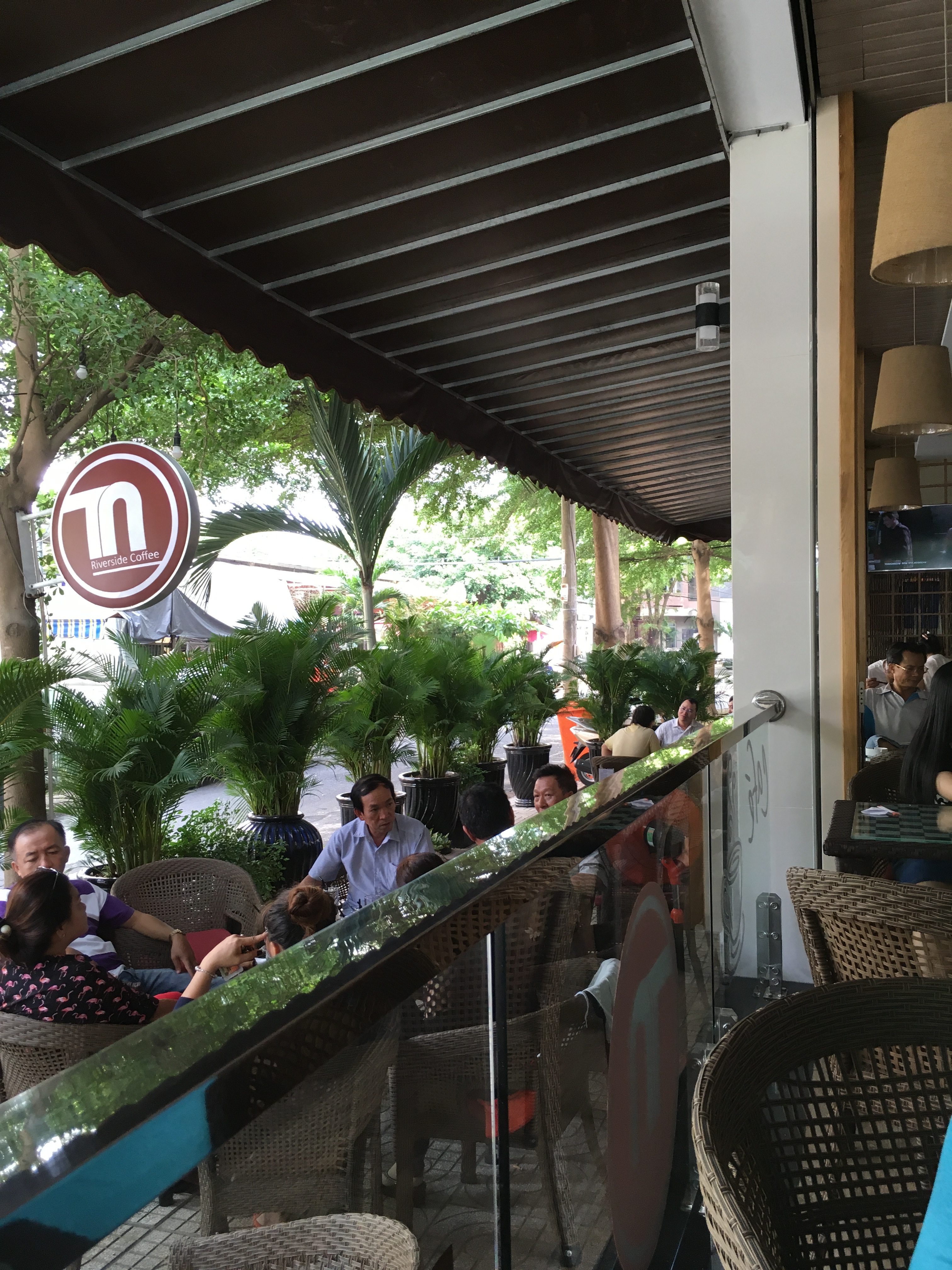
Coffee shop in the Duong So 8 neighborhood; houses worth $1M, occupied by state employees and businessmen. Along the river; across it, we could see the orange-red tower of the new TDT library. 

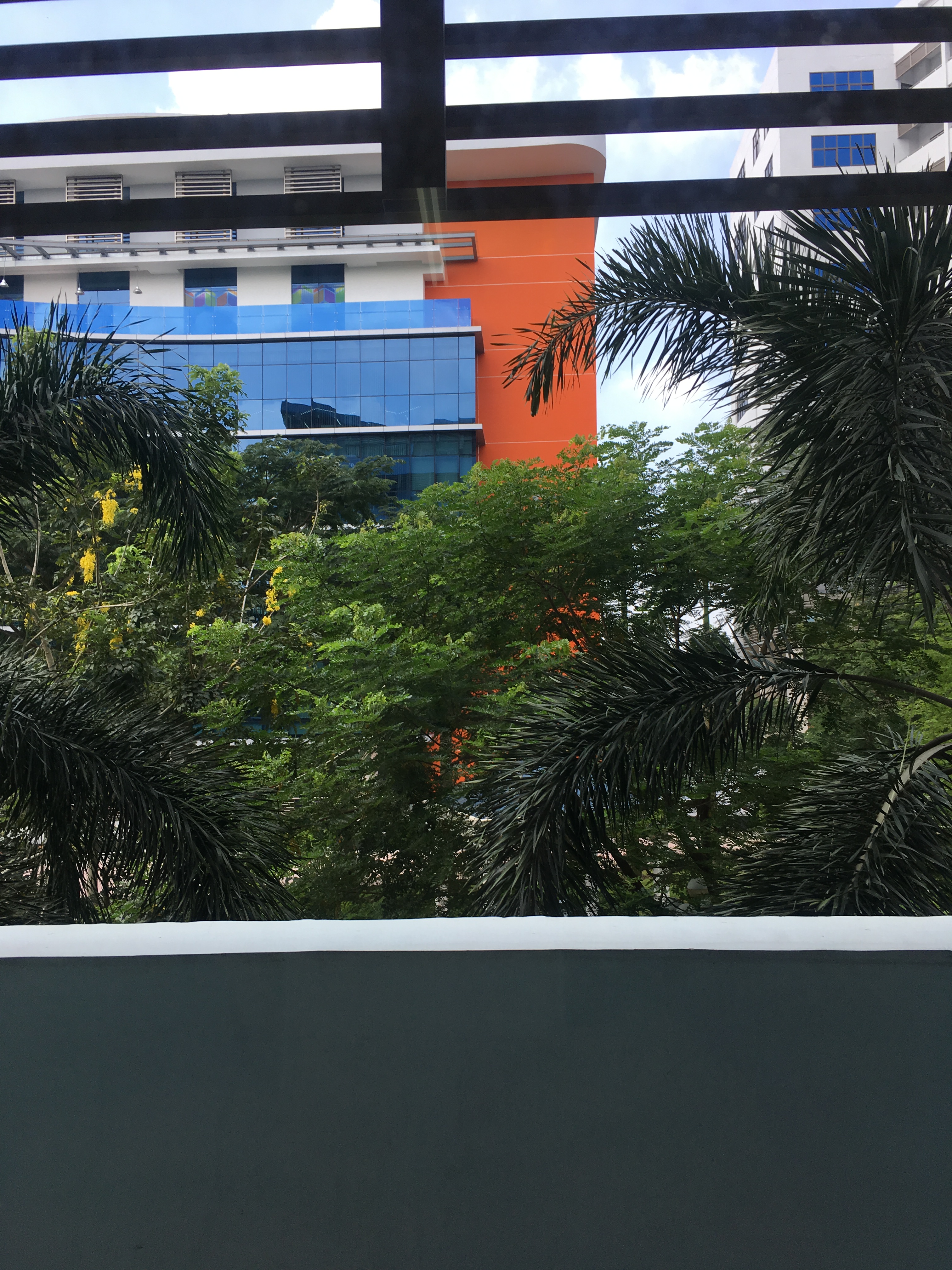
Friday was very full. We “the foreign experts” have a very fancy, brand new office over in C Building, room 206. Four comfortable armchairs, beautiful dark wood desks, new computer WITH PRINTER, padded desk chairs! And the elegant tea set that I thought only Department Chairs had. View right out onto the new Library, of which more later.

We met with Vinh at 8:30 am and she set us up with TDT email accounts and then dove into Joe’s class, which is a combination of the Northouse-text-based Leadership class (all management-side perspective) and the Handbook that we wrote with Vinh last time but never quite finished (it needs another swipe of translation and some cuts, plus Joe is hoping that Vinh and Ms. La will put a chapter on VN labor history in the front.) I learned the email system while they went week by week through the class. I mention this because this is a different way of vetting the class than last time. Very cooperative and productive, and Vinh has VERY good, fresh and positive teaching ideas.

Classes still have to be submitted and approved by the representatives of the Ministry of Education and Training office, so everyone being on the same page about the purpose of each session is critical.

Dean Hoa came by about 11:30 and organized us all to go to lunch, via taxi, at a very good Hue-style restaurant down in a neighborhood somewhat to the southeast. We were joined by Kim Scipes and Valerie (Vandy) Wilkinson who is here in VN on a research venture and wanted to report on her teaching experiment last March with the English teaching faculty. She teaches in Japan, and had never encountered a situation in which she was asked to teach a group of 300. She split the groups into 60, drew 90 for each group, did 6 different presentations and managed, using “dojo” one-on-one conversational exercises, to actually get some participation despite the size of the group. She took this plan back to Japan and used it in an engineering program, then wrote it up and will present it at a conference in Romania!!! The theoretical value of this process was a little opaque to IR people but it is a recognizable unit of analysis for sociocultural-historical people. We ate phenomenal food; Vinh and Dean Hoa ordered something that was encased in lotus blossoms.

Then back to the office where I went through the same vetting process about my class, with both Dean Hoa and Vinh. My class was originally approved based on a different text; last April, when I started working on it, I decided I would just plunge ahead and “do it first and apologize later” rather than try to get permission for something pretty fancy. I chose the 2015 Katz, Kochan and Colvin text on Labor in a Globalizing World. I sent Dean Hoa a copy and he approved it; from then on, I simply wrote the class the way I thought it should be done. We sat together with Vinh and went through the whole process. I was very happy that they both approved the class student research projects  which begin with interviewing the oldest working person in their family. Vinh stepped forward to pick up the aspects of comparative labor relations that are specific to Viet Nam, which will be a share (30 minutes plus) of each class. The overall result is that our approach was approved, including making the Katz book the official  class book, but Dean Hoa has to re-submit some paperwork for approval. I have a lot of work to do this weekend (I had not finished the powerpoints) and Vinh volunteered to put them on the TDT logo slides for me, which is asking a lot, since she’s supposed to be away and busy all weekend.

Altogether it was quite exciting. I felt that an entirely new level of flexibility and possibility had been achieved, in the matter of accommodating the MOET approval process and allowing innovations from someone from outside. I have also NEVER had a Dean be as genuinely interested in the design of a course I was teaching! Mostly, as long as I took care of everthing, they were happy to know nothing about what was going on.

Friday night we had dinner with Kim Scipes at one of the street food places across from TDT, then came home and crashed. Saturday (yesterday) we sat with our computers all morning, trying to get our classes under control, and then took the bus to the Lotte Mart to spend some of our 9M dong wages! I bought a pair of comfortable leather sandals with thick padded soles, for about $48, much like the ones I bought last time which I  now wear daily, but which cost 900,000 dong or $39. Followed by dinner at the Beef Noodle place that is always a fallback favorite and a short walk around some of the streets surrounding. Almost every street front seems to be a coffee shop now, with lots of greenery under the awnings.

Changes, the appearance of new wealth

Which leads me to the issue of money and wealth. In the nearly 2 years since we were here, there seems to have been quite a bit of money flowing around, at least in this district. The physical plant at TDT is maybe 20% larger, with two new buildings including the library which specifically is like something from a Hollywood movie. There are other signs: more cars, compared to scooters. Only a few silver bikes, ridden by old women carrying loads of various kinds of goods. Seemingly less traffic overall, and less pollution (maybe we just were out at the wrong time.) The Lotte Mart is significantly up-scaled! The upper floor of the market has been re-habbed into a high-end coffee pavilion with wooden floors. The lower level is fully built out into a deli where people are sitting and eating. The fish market is where the fruit market was. And all the little shop spaces are full — no empty ones. While it’s true that some of the checkout clerks still look as if they didn’t get enough good food while growing up, the general appearance of people is healthy and well-fed. Fewer women wearing “women’s clothes” are on the street –there were so few that I started noticing it. Also, the sidewalks seem to have been cleared. I read something that said there’s a campaign to get small vendors off the sidewalks, with a controversy thereabout, but it sure is different to be able to walk along the sidewalk instead of having to go into the street and dodge traffic.

Then Monday we got another perspective on the sidewalk-clearing issue from a friend who lives here and speaks Vietnamese. He says that the way it works is that someone makes a phone call and says they’re on their way, so everyone throws all the tables and chairs back into the restaurant and people help the vendors try to clear things away, but if it’s not all clear when they come, “they” being police, things just get swept away.

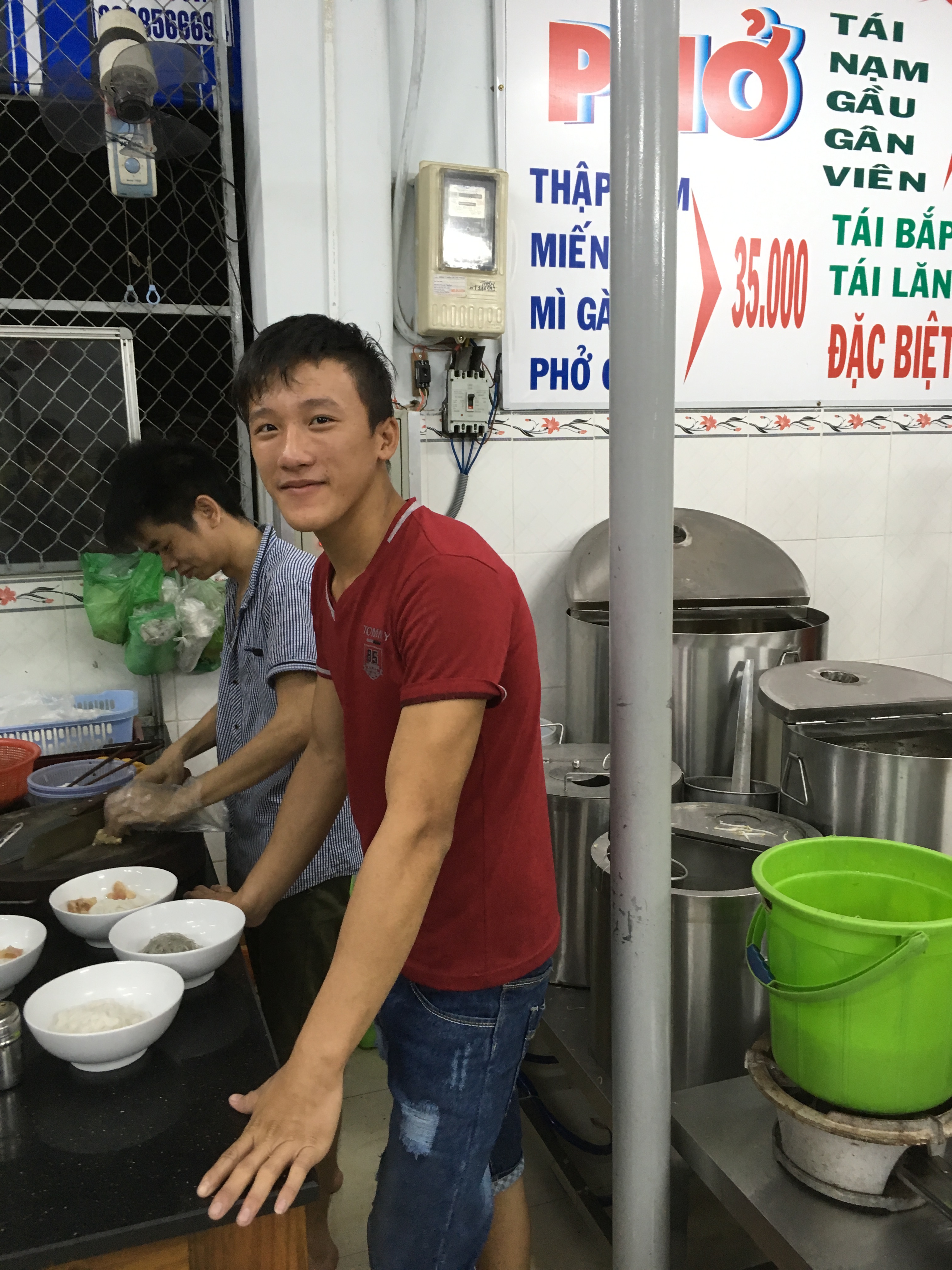
We had dinner last night at 24/24 Pho down the street. Nghia took us to this two years ago. Taxi drivers eat there, and sure enough, there were taxis pulled up on the sidewalk. Two years ago it had concrete floors, a few tables, and a metal cart out near the sidewalk where the pho was cooking. A bowl of pho was 25 dong. Last night we saw a place with white ceramic tile floors, walls that went from floor to ceiling and were clean, maybe freshly painted, there were at least 2 new long shiny aluminum tables with plenty of chairs plus two long wooden tables, real furniture, with chairs. The cooking table had been moved back into the shop and sat on one of the nicely-made wooden tables. The young man who brought us the pho, which was excellent, looked well-fed. A child about 4 years old came hopping down the spiral metal staircase from what must be a living space above. And the pho was now 35 dong.

Pho

Notice the huge pots on the stove. That’s how you make pho. It cooks forever.

So maybe the economic growth rate is spilling some money into the denizens of District 7. How far this goes we can’t see, and I can only guess what is going on in the mountains and outer provinces. The big worry, of course, is inequality. In the US I am so used to seeing everything get worse as inequality increases. You just know that streets won’t get re-paved, libraries will have to rely on private funding, parks will charge fees, no one is repairing the bathrooms in public schools. To see things actually looking better makes me blink. But what else is going on? Is it possible to manage inequality?

Christian Appy’s Book, American Reckoning

Last point, and then I’ll quit — On the way over I read Christian G. Appy’s 2015 book, American Reckoning: The Viet Nam War and our National identity, Penguin/Random House. This is an essential book for Americans. It places the Vietnam War in our history in a way that makes sense to me in a way that nothing else has. It tells a coherent story about US national identity starting post WWII (my era; my dad fought in the Pacific, in the Navy) and up through Obama, with the “Vietnam experience” as the pivot around which our economy and culture tilted. It is a much better way to understand Trump voters than, for example, the awful Hillbilly Elegy. Appy wrote Patriots, a compendium of interviews with people from all sides of the war; out of this he taught a class in the Viet nam war at Amherst, and you can tell that he has really hammered this topic through conversations with students, many of whom probably had no idea how their own sense of being American had been formed by the Vietnam war. This is the first time I have ever read a full history of the last 60 years in which I could place myself consistently as a participant and actor, warts and all, and the lives of people I’ve known, from draft resisters to college classmates to hedge fund hoppers and people who couldn’t tell whether they were for or against the Iraq war — all into one coherent story. I really hope that everyone on this list buys that book and reads it. I feel that it changed my sense of who I am here in Viet Nam –it kind of drew a boundary line around myself as an American. Maybe it’s putting things a bit strongly, but I feel less guilt and more admiration; it frees me to smile when I think of one particular student who, when she came up with something that must have taken a whole lot of work, whispered just loud enough for me to hear: “That’s why we won.”

Ha Do came by and picked us up to go to a lovely coffee shop along the other side of the river, and tonight we will get together with Vy and An. In the meantime, I have to make a whole bunch of powerpoint slides.

RIVERThe curved rooftop shape in the distance across the river is the gymnasium at TDT.
Back to Viet Nam August 2017

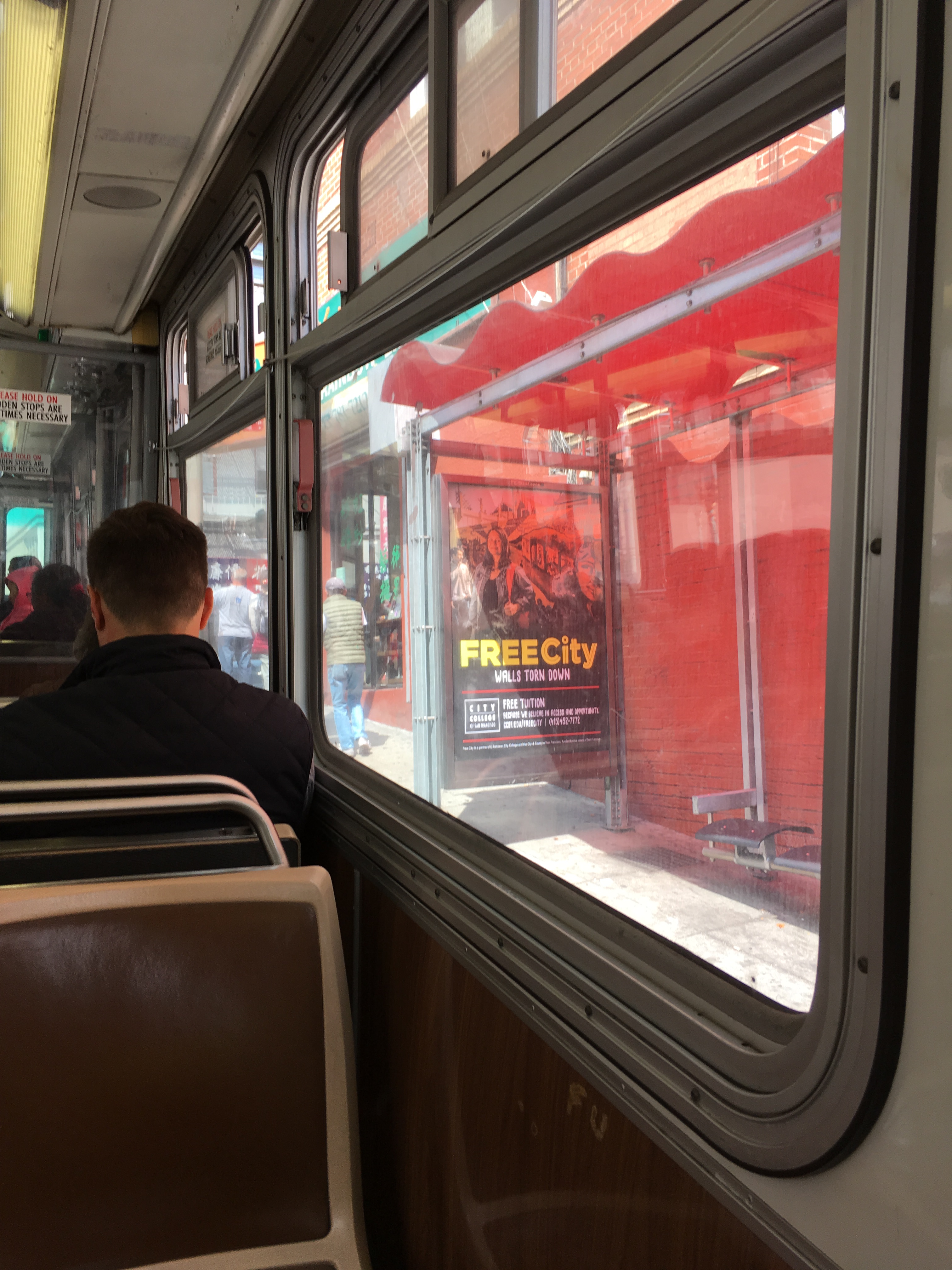
Last image from San Francisco, taken out of the window of the bus as we go to the Viet Nam consulate to get our visas (business, $110 each): it’s an ad for “FREE CITY,” which refers to the fact that for San Francisco residents tuition at City College is free this semester (and for the future, too, maybe). This was an idea that actually occurred to Alyssa, recent past president of the AFT2121 teachers union, out of the blue. What do to for an encore, now that so many of the battles against the ACCJC seem to have been won? What would winning really look like? Well, it would look like a whole lot of students coming back to CCSF and being able to afford it!! So a whole lot of lobbying and arguing and organizing took place and it happened. Apparently, the phrase “FREE CITY” is well known and seems to mean not just free tuition at City College but also that the college has been liberated and maybe the City itself is experiencing some new freedom.

IMG_0039

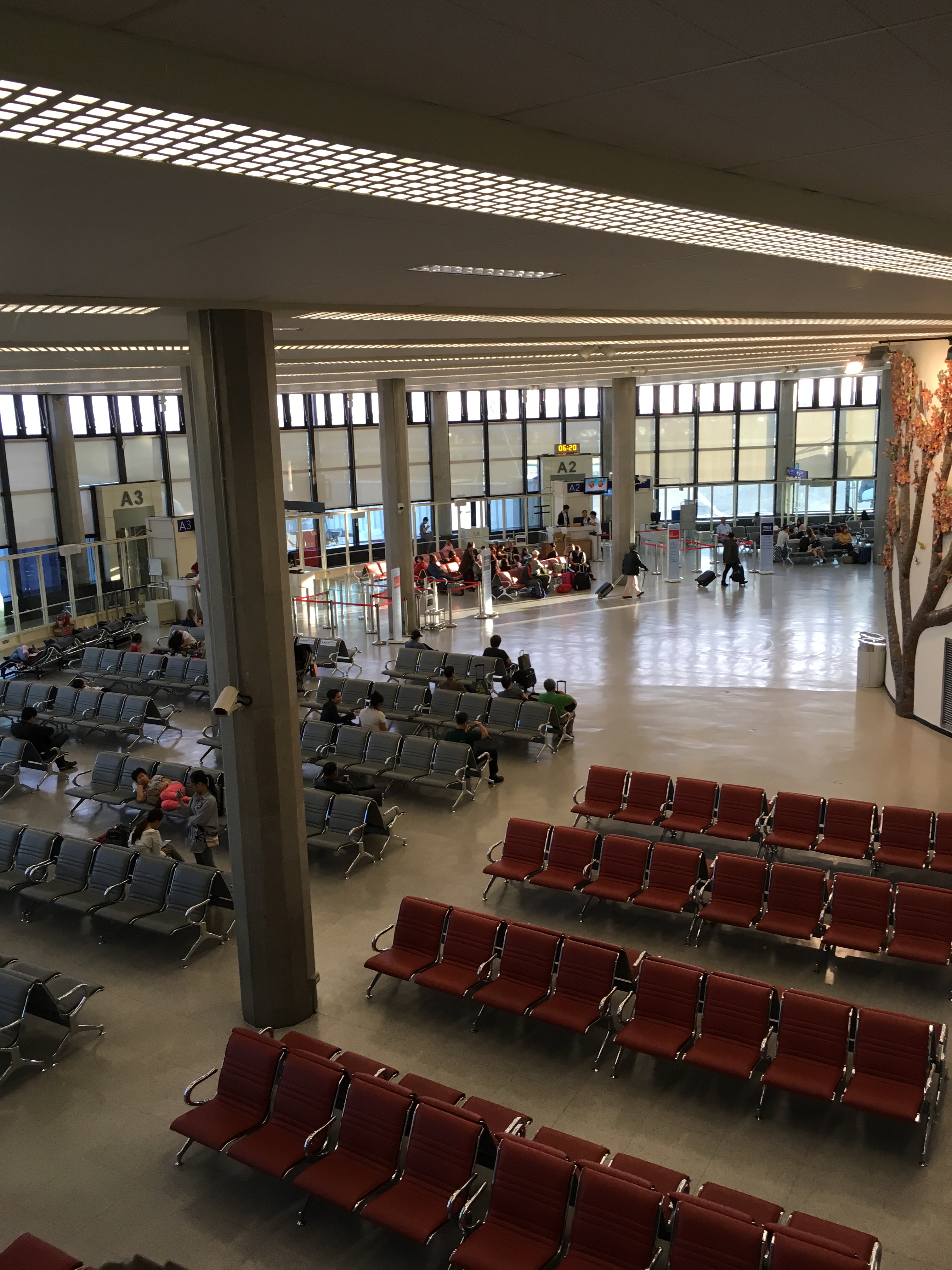
Then we packed (I forgot several important items) and took a Lyft to the airport (this is new since last time) and got on China Airlines to Taipei. I was listening to the book about Daniel Ellsberg — The Most Dangerous Man in America by Steve Sheinkin — on my phone (this is new — using Overdrive from the Berkeley library to download books). I listened, at vegetarian airplane food (good) and slept until dawn broke over Taipei:

Taipei

.. a feeling of being nowhere in space and time, among a lot of other travelers floating here and there … and then a quick 3 hour flight to HCMC where we easily went through customs and out onto the sidewalk in front of the airport, where we waited only a few minutes before Vinh came running up, very excited and happy to see us.

I have too much work to do to prepare for my class to spend much more time on this, but  here are a few things. It feels overwhelmingly familiar. But they’ve done a lot of work. Everything seems a bit, or a lot, upgraded. Here’s a photo of the new library as seen from our fancy new office (four armchairs, two revolving desk chairs with arms, nice heavy wood furniture, new printer and computer, good internet and air conditioning):


ILibraryMG_0057

The orange and blue are just a hint of the explosion of color once you get inside. It’s kind of French; makes me think of the Pompidou Center when it was new. Makes me think that it might win prizes for architecture. You climb brightly colored stairs to the entrance (like climbing the Mexican pyramids). But at the top, you have to put on slippers to go inside. You also have to take a class and pass a test before you can use it. We are signed up to get the training a week from yesterday.

The work dedicated to making Ton Duc Thang a top-ranked university seems to be paying off in more than just physical plant, however. They have hired two new teachers — lecturers –for the Labor Relations and Trade Unions program, young women who comes with MA’s from Taiwan. They introduced themselves as Rose and Vivian. They are going to hold a research workshop that Joe and I will conduct. I’ve see one of Dean Hoa’s research papers so far, and talked a bit with Vinh about the topic for her dissertation. We got up Friday morning and went to our new office and met first with Vinh about Joe’s class (working out all the why’s and wherefores of the combination of textbook chapters with the chapters from our Handbook). Then Kim Scipes (yes, our friend from Chicago) and Vandy Wilkenson (from Japan, from XMCA, who teaches English and had a research project at TDT) all went to lunch with VInh and met Dean Hoa at a Hue-style restaurant. This was followed by my meeting with Vinh and Dean Hoa about my globalized labor class, which, as a completely new class with a new main text, took quite a lot of discussion but worked out well. I was very glad that I had made a decision back in April, when I started working on it, to try to really do it right according to my way of teaching. There is an important co-teacher role for Vinh in it, which she stepped into happily.


More computer work — getting on line in various places, getting a TDT email address, figuring out what has to be done in the next couple of days, getting keys – and then we went swimming. The same fuss about male bathing suits, but the Swimming Pool Boss let us swim!  Dinner at a place down the street where we ate last time, the place where a giant eel escaped from its tank and the chef had to run all over the restaurant chasing it in order to kill it and cook it! – except that like everything else it has morphed and become more complex. It seems as if there is a lot more money here than there was two years ago. Joe noted more cars, compared to motorcycles.

I am going to spend some time recommending Christian Appy’s book, American Reckoning, The Vietnam War and Our National Identity (Penguin, $18.00). I couldn’t put it down. The magic of it is that it makes sense, it tells a coherent continuous story that carries us all the way from the end of WWII through Viet Nam and into the Reagan and Bush years, the Iraq War and up into the Obama presidency. I have never heard this span of history told as one continuous story that made sense, that carried me along in a way that I could find a place for myself at every point. I was saying, “Yes, that’s what it was like! I didn’t know that but now that you mention it, it makes sense, I remember wondering about that…” Etc. I feel as if I’m looking at Viet Nam today with new eyes.

I actually finished it on the Vietnam Airlines flight into HCMC. I am extremely glad that I read it; it helps me understand my own feelings about the war, the men and boys I knew who fought in it or fled from it, and also my parents’ role as protestors at the time.

Enough. I’ve been up since 4 am. Joe is still asleep. I’d better wake him up and go get breakfast and coffee at the canteen next door. Then I have to sit with my comptuer and do powerpoints.

One, two, three, what are we fighting for ….


That’s Country Joe McDonald sitting down in the middle. He’s the one who wrote:

And it’s one, two, three,
What are we fighting for?
Don’t ask me, I don’t give a damn,
Next stop is Vietnam;
And it’s five, six, seven
,
Open up the pearly gates,
Well there ain’t no time to wonder why,

Whoopee! we’re all gonna die –


And sang it at Woodstock. This should link to the Woodstock video.


Notice that the kids — that means people like me at the time; I wasn’t there but my best friend Betsy was there with her husband whose band Quill played; I was out in California leading a different part of the same life — notice that the kids in the video are not smiling. They look worried, and we were all worried. On the one hand, there was all this great music everywhere, playing in stores, parks, in people’s apartments; on the other hand there was this war going on all the time.

So last night we went to Freight and Salvage to hear Country Joe and his band; of course it’s different people in the band now.

http://www.sweetwatermusichall.com/event/1486539-country-joe-mcdonald-mill-valley/

He is a year older than I am, so that’s 74.  Amazingly, his voice is still great. He sang loud and clear through the whole long show. This was one of a series of 50th anniversary performances. The first part of the show, he came on stage alone and talked and sang some songs, including the “I Feel Like I’m Fixing to Die Rag,” above.  For the last verse, he put down his guitar and just sat back in his chair and let the audience sing the whole thing while he soaked it up, smiling.


The audience was made up almost entirely of people my age, me and Joe. Lots of long hair and sandals, but in fact, a very healthy looking crowd. Other than some people who looked as if they spent too much time sitting and looking at their computer screens, these are people whom you’d meet if you were hiking in Yosemite.

At the end of the show he said he never thought he’d be playing this music again. He seemed very happy to be surrounded by this music. True, he sat down in his chair during a lot of the show — but his voice was loud and strong.

He grew up in Berkeley; his mother was Florence McDonald, on the City Council. His parents were Communists; in an interview he said that he rebelled against them by joining the Navy. “It seemed like a good idea at the time,” he said, quoting a friend who reportedly took off all his clothes and jumped into a cactus bush.

The concert was a bitter sweet love fest, some dancing, a lot of memories. He did one Trump song — “Come out Donald with your hands held high” — and, for an encore, did “This land is your land, this land is my land.”

Going back to Viet Nam in about 10 days now. I’ve been working on my class since May or maybe April and I’m looking forward to trying to teach it. It’s complicated: what I’ve basically done is prepare a set of scaffolds that go from powerpoints, which are intended to provide focus to class lectures; then behind them is a class plan with discussion questions both from the text and as applied to Viet Nam; behind them are summaries 3 or 4 pages long of each chapter in the text; behind that is the actual text, Labor Relations in a Globalizing World, by Katz, Kochan and Colvin. In addition, there are some articles about IR systems in general.

Everything but the text itself will be up on a Google drive.  I got the impression that someone was going to scan the book and put it up too, somewhere where students could get at it, but I’m not sure about that. I will wait until I get there to confirm certain things that may be technically and technologically tricky.

For the students there is a three-part research project having to do with designing an appropriate IR system for Viet Nam.

Kim Scipes has been there this summer teaching Qualitative Research, but not to the same students that I will have. Kim says that his students wrote essay exams in English, but that they were not a “select” bunch like the ones to whom I taught the cross-cultural leadership class back in 2015. Joe and I are going to be doing research workshops with the LRTU (Labor Relations and Trade Unions) faculty. I will start with a focus on the importance of the research question. You want a question to which you really don’t know the answer; a question that can be answered in the real world; a question for which the answer, once you find it, will make a difference.

I do not know how to avoid being tough on these matters. I can be complementary and respectful and sincerely impressed and grateful in many situations, but once I get started criticizing someone’s writing, I don’t have any flex. It’s either right or wrong, it’s either just fine or not good enough. “Just fine” is a higher standard than “publishable,” too. There’s a lot of crap that gets published.

We’ll see how this goes.

June 26, 2017: Mapping apple trees in Southern Vermont

cars on hillside.jpgThe hillside above the Coleman farm, on the day of Ralph Coleman’s Celebration.
Ralph Coleman died in November 2016. By noon today, when the celebration was scheduled to start, there were hundreds of cars up in this field. He was a farmer. He cut lumber, made maple syrup, and officiated at weddings. He was licensed to inseminate cows with bull sperm. I’m not sure what he grew, in addition to a lot of different kinds of vegetables. Hay, probably, and other things to feed cattle. His brother was the dairy farmer, not Ralph. He was a father and husband, army veteran, college graduate and deacon in the church. “Farmer”  has a very broad meaning up here. You know how the word “geography” as an academic discipline has grown to encompass all the ways we occupy and make use of the surface of the earth?  Maybe farmers practice applied geography. . In this village there is usually a handful of tent-pole people like him, men or women, who stand at the center of a network of families and friends. The networks interact, overlap and intermarry. They are both the centers of gravity and the gears of change. Their names are on old dirt roads. There is Coleman Hill and Coleman Pond Road, for example. Then there are the roads named for the Ameden family, the Chapin family, Worden family, Gilfeather (this is the guy who bred the Gilfeather turnip) and others.

Some friends and relatives of Ralph’s made a map of the old apple trees on Ralph’s farm and his brother’s adjacent farm which were once both part of their father’s farm, just uphill on the mountain. Some of these apple trees were over 100 years old. I had noticed them, the various times I drove past on my way to visit Ralph and Kathy. They made you wonder: black knotty fist-like things with bright green wands sprouting out of thick dead limbs. Turned out there were 24 different kinds of apples in that orchard, including some that were “natural,” in the sense of being a variety that had not ever been documented. They gave this map to Ralph as a gift the week before he died.

Originally, of course, this whole area was Abenaki, a Native American tribe that has only recently won “registration” status.  Over time many Abenakis married into settler families, so it’s not unusual to meet someone from around here who is at least part Abenaki.  We have friends in the village who fit this description. As a people they were also decimated by settler battles and then back in the early 20th century, by the eugenics movement (that’s another story). But mainly, for the last 200 years, Vermont has been a long way from major battlefields. Vermont sent the highest percent of men of any northern state to the Civil War (where they died of diseases to which they had no previous exposure or immunity), but the battles themselves didn’t happen here. You could have an apple orchard planted 100 years ago and it would still be here. Houses have burned, fields cleared for sheep have gone to woods, floods have changed the shape of the valley, but nothing has been bombed into ruins or flattened by war machines.

Therefore things have fallen down or been abandoned to decay but nothing has been purposefully destroyed for the purpose of erasing it. The ancient roads are still here.  You can consult history, here. You can see where the old railroad went, where the bridges were. You walk along in a forest and there’s a wall and nearby, a cellarhole. Yes, things have changed, but the past is not gone. There are Abenakis here, too, the original people who lived here — not many, but some.

Here is a photo of the stone steps, built by who knows who, that lead down to the pool below the Pikes Falls waterfall. How long have they been there? They could have been there as long as anyone wanted to climb easily down the steep slope to the pool at the bottom of the waterfall, and that would be a long time.

PIkes falls stairs_1

Here is a poem about what can be done in the absence of war. I wrote it a while ago, six years after my mother died. No one was living in her house, the little house where I am now, at that point. I had come to check things out one late fall when the leaves were off the trees and everything was gray and cold. The war of that moment was our invasion of Iraq, which was already a disaster.  People in Baghdad were up on the roofs of their houses watching “surgical” bomb strikes get closer and closer.Within days of our invasion — hours, actually — the museum had been looted. That was nearly 15 years ago; this month’s city to be destroyed was Mosul.

But when I came up to the door of this little house in Vermont and put the key in the lock I found that the key worked and the door opened. I was overwhelmed by what a unique gift that was.  In this world where houses were being blown up, doors kicked open, for me to be able to travel a thousand miles, walk up to a door, put a key in a lock, turn it, open the door and go inside and close the door behind me and find everything just as I left it was something like a miracle. Not like an apple tree that has been fruiting for 100 years, but similar.

Here is that poem:

OCTOBER, 2005. My mother’s house in Vermont is an old cottage on a river-stone foundation in a river valley village under a mountain. Before my mother, it belonged to my great-aunt. For now, it stands empty, but I have the key. Wind has blown the trees bare. There is ice on the roads, snow on the fields. Two thousand U.S. dead in Iraq, so far.


LOCK AND KEY

I. Travel a thousand miles or more

Take out the key, open the door

A lamp on the table

A cloth on the table

The rooms are chilly but it’s all there.

See what is possible In the absence of war.

II.

Rain, snow,

Rain, snow,

Rain, frosted gray leaves on the yellow grass,

Slush, weeds, brambles, dry raspberry canes,

Out back, a cold barn full of old things put up there by people long dead, and beyond that is the river, while up on the mountain there is a graveyard

Where these same long dead and the newly dead are still resting.

They have not moved or been moved.

 See what is possible.

See what is possible in the absence of war.

III.

My key turns in the lock

Because we agreed

That this key should turn this lock.

The agreement, not the key

Opens the door.

IV.  

Things I need here: Matches. Paper. Dry wood. Blankets, although blankets will not substitute for matches, paper and wood, or vice versa. Light, preferably electric, or if that fails, kerosene or candles. Something to eat. Cooked, if possible.

I have these things! Here is a section of the New York Times from last summer. Here is wood that has been on the porch for a couple of months, protected from rain and snow, and even more wood that has been brought into the house and dried, and some more that my father put down in the basement before he died, twenty years ago. There is a big bucket of good kindling.

In the bedroom there is a blanket chest and in it there are blankets, threadbare but plentiful, some of them woven by people who lived in this village back when people spun and wove, and sheep grazed on the mountains.

The stove works, the oven works, the toaster works. Even the refrigerator, which uses too much electricity, works. If I want something else to eat, I can go out the front door and up the street to the store and buy it and come back and cook it. It’s all here. Nothing has been disturbed.

See what is possible.

V.

Up on the street, in the store, I run into Betsy. She and Bill were friends of my mother. Betsy tells me, “Bill misses your mother. She was such a wonderful musician. You know, we have given up singing. He has given up the flute.”

I say hello to Bill who has been waiting outside in the car. He says, “I have given up the flute and we have given up singing with our singing group. W will never have to go out on a Wednesday night again, never! Never drive down the mountain in rain or snow or whatever! Never again!” He seems happy, or at least proud.  He bangs the steering wheel with his left hand. “You know what?” he says. “I was just in there – “ he gestures to his right, in the direction of the town offices – “to see if there was any space left in the Wyndham Hill graveyard. They said it was getting pretty tight up there. Back when I didn’t think about those things, there was plenty of room. Too bad, it’s near us and would be convenient.”

In the absence of war, an old man can decide to give up the flute and choose his own gravesite. See what is possible.

All around us, ordinary life goes on:

Jenny’s son has a wheat allergy and has taken up smoking.

A tree fell on Grant’s car last night when he was driving up Route 30.

Susan’s son will join the Navy.

The town hall has been painted the original color, red.

Holly Kron has brought the general store and will start selling hot “to go” items as soon as she gets her license.

There is a special scholarship for the children of volunteer firefighters.

Woody shot a moose and ate it.

The names on the gravestones tell who is lying beneath. It is not only the rich whose names are written down and remembered.

 See what is possible.

VI.

There are the three rivers: big, small and tiny, that flow together through the town. There are three bridges. One was nearly washed out in the flood of 1976 (we are due for another). Three rivers, three bridges, three roads, and the rooftops, the church steeple, the smoke rising from chimneys, the flock of birds circling in the wind, the snow, the clouds over the mountains, the sun on the clouds.

From a distance, in this case, from Chicago where I have a job, a thousand miles or more away, the village is so little, covered in snow, surrounded by mountains under a gray sky; it is like a picture.

VI.

Now look at this other picture: it is a book with a photo on the cover. The photo shows an old woman who stands in front of her house. Like my house, there is a mountain in the background but it is a different mountain, a different country, yet there in the foreground you see the same snow, the slush, the gray weeds and brown brambles, just like here.

She is wearing a knitted hat, a sweater, a coat, boots, red gloves and an apron and over it all, a shawl. She looks out of the picture at me.

The photo is about her house, which has been smashed by a bomb. Chechnya, where the young and the old lie unburied, the mass graves unmarked. Where no old man chooses freely to give up singing, to stop playing the flute.

VII.

In a quiet world, the the lock and key keep something in place.

The lock stays with what stays, behind the door. The key travels.

Do you have it? No, I have it. This is the key.

When this key turns in that lock, that door opens.

Put the lock on the possibility of an uninterrupted life. Put a lock on the choice of an old man to give up playing the flute when he decides it is time to give it up. Put a lock on the graves that show the correct name of the people buried beneath, the graves they have chosen. Put a lock on the three rivers, On the basic necessities, On the lamp lit at evening, On the cloth on the table, On the chilly rooms, On the door of the house that has a roof intact and a wood stove inside, Blankets and kindling and even a piano, “He misses your mother, she was such a wonderful musician.”

Put a lock on her memory, Betsy’s memory of my mother, the musician. On the door of the future. Put a lock on these, and give the key to those who will come. Tell them, “We who placed the lock, agree with you that that is the key.”

IX.

You can go now. Take the key.

When you come back, everything that you left behind will all be here. See what is possible in the absence of war.


Food at Ralph's

Food at Ralph’s celegration, plus a grill, a cooler of drinks, and a dessert table


A current photo, with students from Ton Duc Thang

Here are two students from Ton Duc Thang who came to the US and are studying in San Jose, preparing to go to college here. They are both named Mai, so one is called Judy, and they are sisters. Judy is studying law and Mai is studying labor studies.  They drove up to Berkeley one weekend. Both of them have been in the US for nearly a year – maybe more — and their English is quite good. They were able, for example, to tell me that the word for “demonstration” and “strike” are the same in Vietnamese. This is the kind of thing we should know.

Mai and Judy and I went into the City to go to a concert at the San Francisco Conservatory of Music. On the way back, we came out of BART and a young photographer named Matt Wong was taking pictures for his portfolio. Here is our portrait:

me, mai and Judy