Final Exam: What did you learn?

I gave the sixth and last session of my Cross-Cultural Leadership classes on October 14. My final exam was one question, basically “What did you learn in this class?” It’s a take-home, due next Tuesday the 20th. Here’s the exam itself:

  1. Name and explain three things that you learned in this class
  1. How did you learn them?
  1. How do they relate to what you already know?
  1. How do they relate to what you are really interested in?
  1. What do you need to learn next, and how will you learn it?

This final exam is worth 40% of their grade. Thirty percent is based on four team reports, one due each week from week 2 through week 5. The last 30% of their grade comes from the midterm which consisted of 20 questions with multiple choice answers. I wrote about this previously in the post titled Zero de Conduite.

I was asked to do this class during our second week here by a lecturer in the International Business Program which has offices right across from our “Visiting Expert” offices. The class would be in English, the students all spoke English, and the course outline and instructor’s lecture notes had already been written, based on a course given at “a university in Massachusetts”. The class was scheduled for 6 4-hour sessions on Tuesday afternoons. I would have an assistant who would come to all the classes. They insisted on paying me for doing it, 2 M dong. Since Joe and I came here thinking we’d be working 24-7 and doing whatever we were asked to do, pay was not an issue, but it was an interesting idea. I asked Dean Hoa if it was OK for me to teach this class and he said yes, that it would in fact help him because it would show the President that people brought to his program were useful for other programs, too.

I looked up the link they gave me. It was to an MIT “Open” class, probably dating from the time that MIT put all its courses on line. Putting the whole MIT catalog on line was interpreted as a strategy to scoop the for-profit course offerings during the MOOC craze. After all, if classes with the MIT brand were available for free, why would anyone pay tuition at Phoenix? I knew other places where administrations were urging faculty to get everything on line asap. So I assumed I was looking at a product of that strategy. It also looked as if the instructor had done it in a hurry.

This MIT Open class  was designed for the kind of students you’d get at MIT: elite students from all over the world, speaking good English. Africans, Asians, Norwegians, Brits and Brazilians. The idea was that the instructor would put them in clusters by region and draw course content from the depth of their personal awareness of their own culture. My students, of course, were all from Vietnam and spoke modest English; they probably read and wrote better than they spoke.

The MIT Open syllabus included week by week readings, some from journal articles and some from books, linked to how to buy them from Amazon.There was no way I could order these books from Amazon, pay for them myself, get them shipped to Vietnam and then photocopied for students to read.

I found a bunch of journal articles on line, however. There was also a chapter about cross-cultural issues in the Northouse book on leadership that I’m using for my Art of Leadership class. I used that for my first session, power points and all, and photocopied the chapter. I am aware that that’s a copyright violation but that is simply one battle I don’t think is worth fighting here. The Northouse book cost me $100 and is designed to make huge profits for SAGE. Enough is enough. In my Art of Leadership class, I gave them the book to copy and about 14 of the 60-plus students bought one, paying about 100,000 dong or $4.50. And for kids who make 17,000 D an hour at their part-time jobs, that’s a lot already.

The IB Program also gave me a link to a 166- page book by Aksana Kavalchuk, called something like How to do Business with Germans: A guide, that turned out to be very good. It covered all the different dimensions of cross-cultural communication that were needed, and more. I emailed it to the class monitor, who had the class list and emailed it to the class.

I whipped up my own syllabus, including the way I was going to grade students. It got approved.

This is very important. Once the syllabus is approved, apparently I was licensed to simply teach the class according to the syllabus. If it was on the syllabus, that was what would happen. This is the license I am using to give a single question, no-wrong-answer essay for the final exam. We shall see.

I designed scenarios to dramatize the different aspects of cross-cultural communication and conflict, one for each session.

So the class began.

In the first class I assigned students into teams to adopt country clusters. The clusters were from Northouse’s chapter which describes the GLOBE study (look it up). There was some resistance to assigning the teams randomly. Students sit together in class in tight bunches of friends with the best, most active students in front and the reluctant ones in the back, sometimes with their heads down or talking. After they were assigned, they set about researching their country cluster. This was internet research. I gave them a broad list of things to find out: geography, mineral resources, political process, Gini index, corruption index, military history, etc.

This class, like all the other classes I’ve seen, had a monitor, a young woman student, in this case, who acts as a go-between for the students and teacher, does any photocopying, calls roll at the beginning of class, tells the “guard” who keeps the records at a desk out in the hall if we need to up the fans or air conditioning, and keeps the student email list in case there is anything I need to send to students. Whether these monitors are elected or appointed I can’t tell. Among the most active students, she was the only girl.

In the second class they presented the profiles – economic, political, military, geographic, etc – of their country cluster. Many of the papers they handed in were clearly cut-and-paste jobs. I talked about citations, paraphrasing, quoting, etc.

In the third class they had their first cross-cultural conversation. Teams met and tried to accomplish something despite cultural differences. This went pretty well; people seemed excited and laughed and clapped at the end.

For the fourth class I used a collective bargaining scenario, plus some information about export zones. This was the class that got the most interest. Knowing something about labor practices in other countries is cross-cultural information, right? Although they weren’t really clear on the issue of conflicting interests of labor and management.

The first hour of the fifth class was the midterm exam, a multiple choice 20-question open book test. I wrote about this elsewhere. I followed it with a rather severe lesson on how I correct their English when sentences are unintelligible and I have to go through a guesswork sequence to figure out what they’re talking about. We closed with a short scenario on interviewing a new hire that they carried out patiently but without enthusiasm. I could tell they were bored with scenarios by now.

In the sixth and final class I was planning to give back their last team report, in which they explained what happened during the collective bargaining scenario in Week 4. I had sent the class monitor a rubric explaining my grades. I probably sent it to her too late; she didn’t get my email in time to forward it to the class. I had attached the TPP summary on labor conventions and the two ILO conventions, 87 and 98, that will go into effect (sort of) if the TPP passes. But none of this made it out to the class.

So I did a short 45-minute lecture comparing the US, Russia, Vietnam and China across various labor-related dimensions, using the Pringle and Clarke book, then put them through one last scenario, a project evaluation. They came up with some wild projects: one Japanese group hired Brazilians to rebuild their nuclear plants, a Anglo group had problems with an Italian company that wanted to market coffee to Brits, and the Qatari were trying to get some Venezuelans to build a mall out of gold, which the Venezuelans refused to do because it was a bad use of resources and not ecologically sound. In retrospect, it sounds pretty cool, but at the time I saw them as cooperative but not really learning anything.

So, some notes: The only thing I think students read was the Northouse chapter that I photocopied for them. They did not show evidence of having read the Kavalchuk book. They did not download and print it. They don’t have printers. They don’t have much paper. They don’t have paper file folders; they use plastic covers, probably because of the rain. Many of the students don’t even have laptops; they have phones. So whatever they read, they read on their phones.

On the midterm, most of them got 8 and 9 points out of 10 for reasons which I will not say aloud. On the team papers, how do you know who did what?

So the single question no-wrong-answer essay final exam is my way of trying to find out whether they really learned anything or not. I hope they understand that I want them to tell the truth. Maybe that’s the real test.Do they dare tell me the truth?  It is due day after tomorrow, Tuesday the 20th of October.

I look forward to reading the essays. Even though there will be more than fifty of them. And this was a small class!!!!

Actually, I’m a little nervous. I am banking on my sense that “the students are ahead of the system” which is the idea that keeps coming back to me as I learn more and more about the way students are graded and evaluated. The evaluators — which are sometimes called the Department of Evaluation and sometimes “the control”– have a way of deciding what is a good class. A good class is a class where passing is 5 out of 10 and most of the students get 7 or 8. “They are looking for a curve like this,” explains Vinh, drawing the curve, with “5” to the left of the hump.

This system evaluates how well the teacher can predict what got through to the students.  A “good” teacher guesses what the majority of the students will get 70% of. The evaluators see a snapshot of the teacher’s best guess. if the teacher guesses wrong (guesses low, for example, and the students get 90% of what she taught), then that’s a problem for the teacher: the exam was too easy. If she guesses high (the majority of the students only get 30% of the multiple choice answers right) then the exam was too hard. Either way, it’s the teacher’s problem. The way you fix this is you learn how to write an exam that expresses a better guess at what will produce that curve with the hump at 7-8.

Other things you could fix: your syllabus, your text, your teaching approach, your goals for the class, the size of your class, the pre-requisites for the class, the time of day of the class…etc etc.

So I look forward to getting back the exam papers from my cross-cultural leadership class. I’m keeping my fingers crossed.
Food

DSCN2074

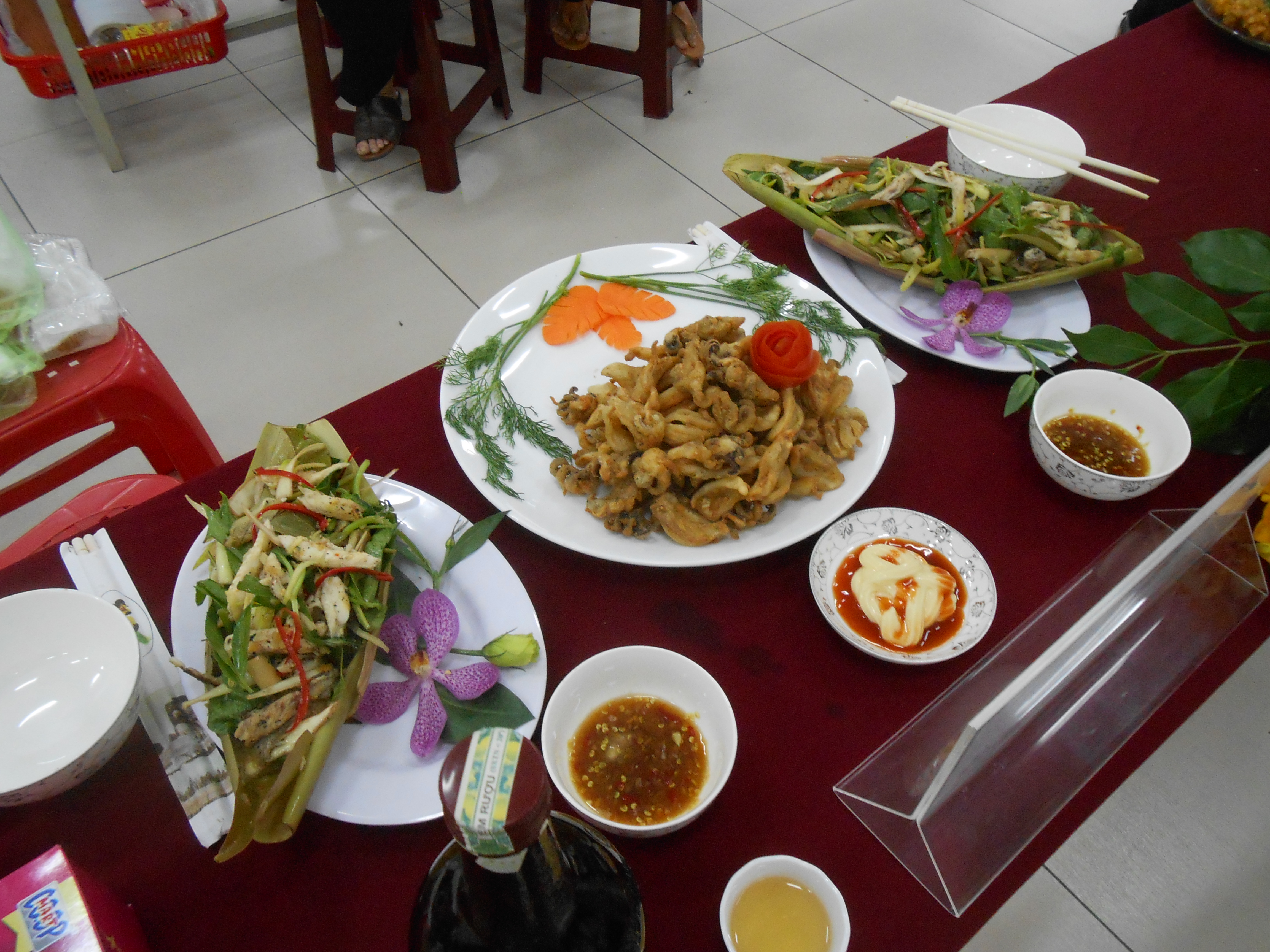
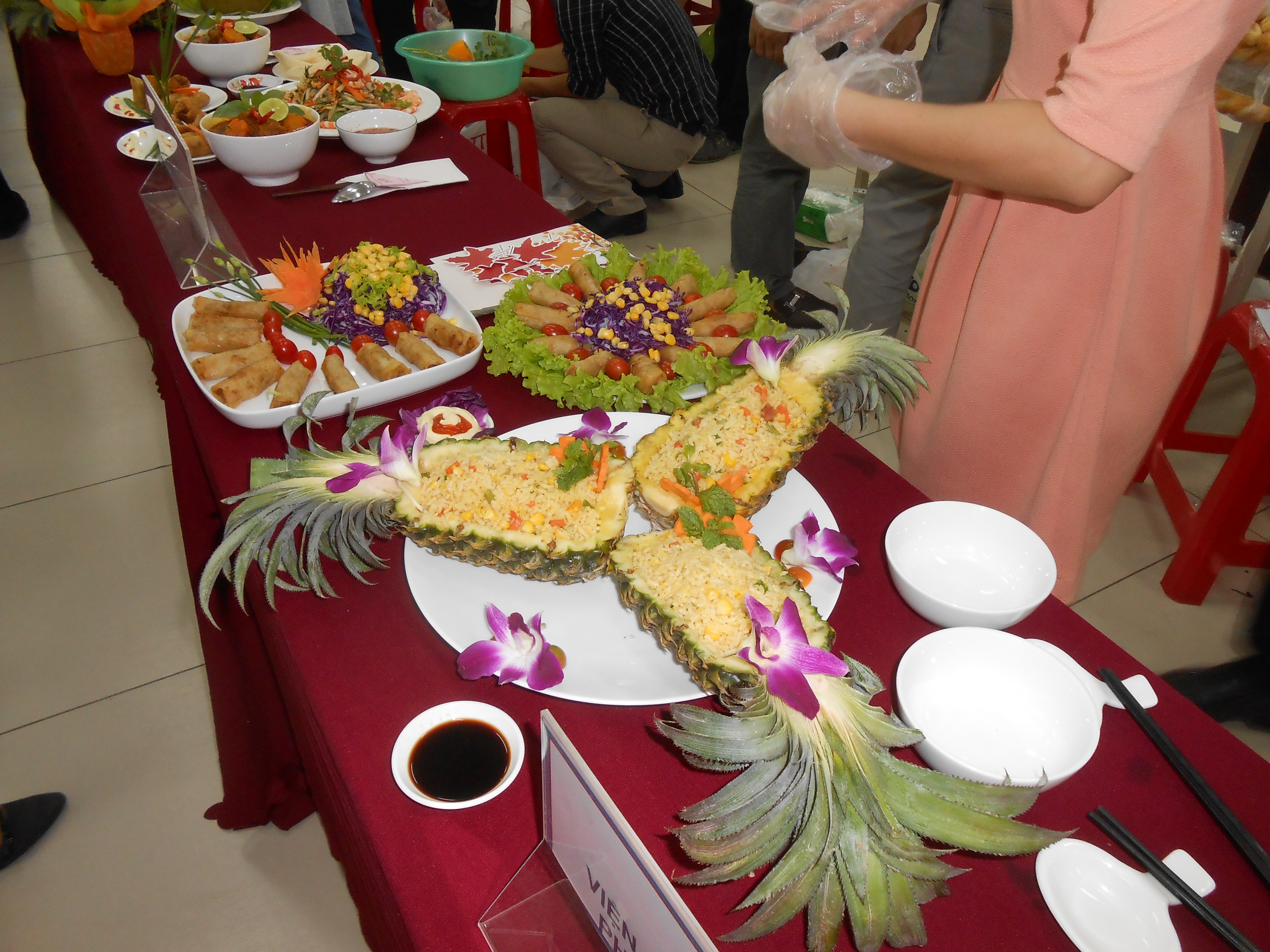
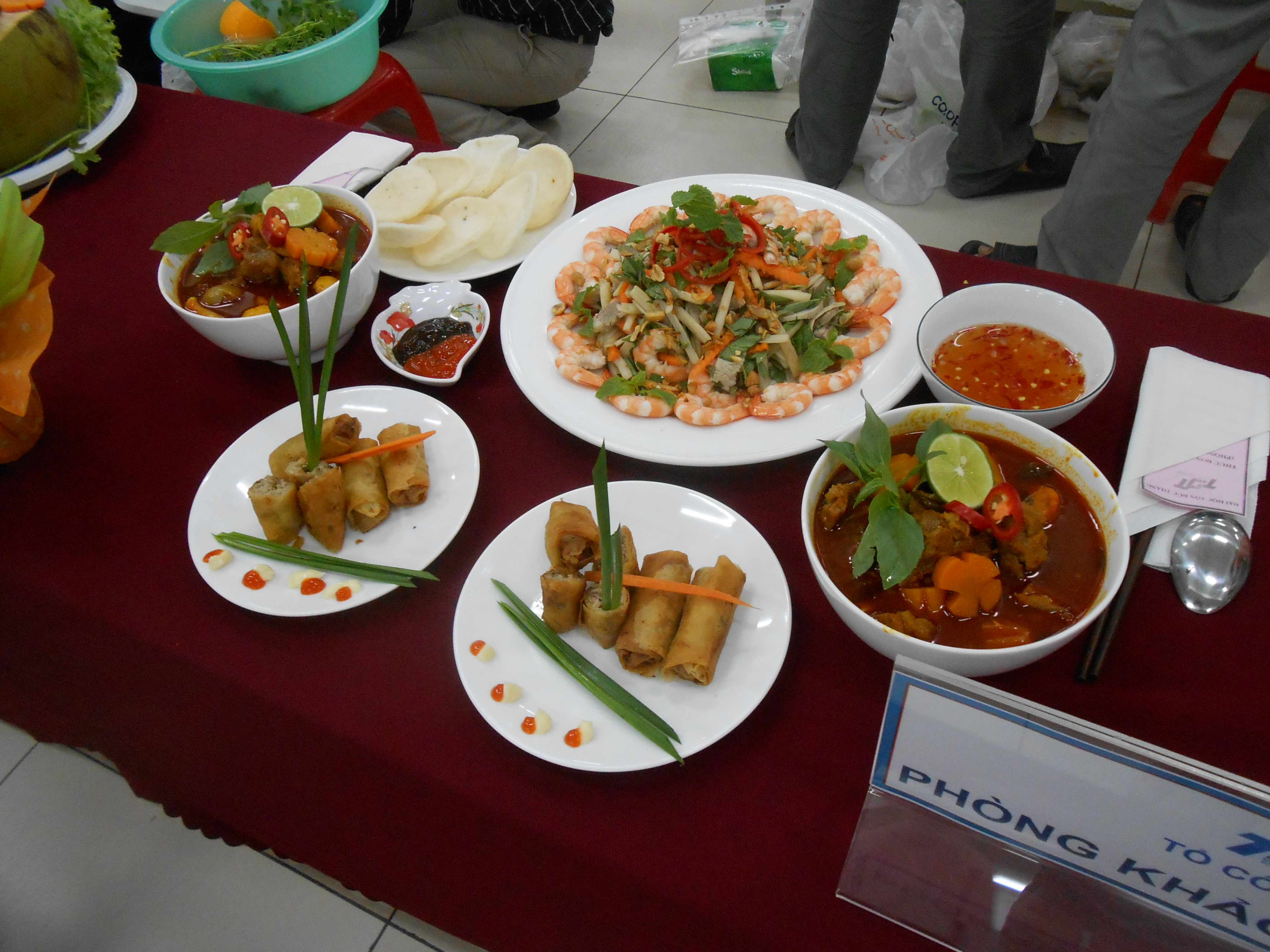
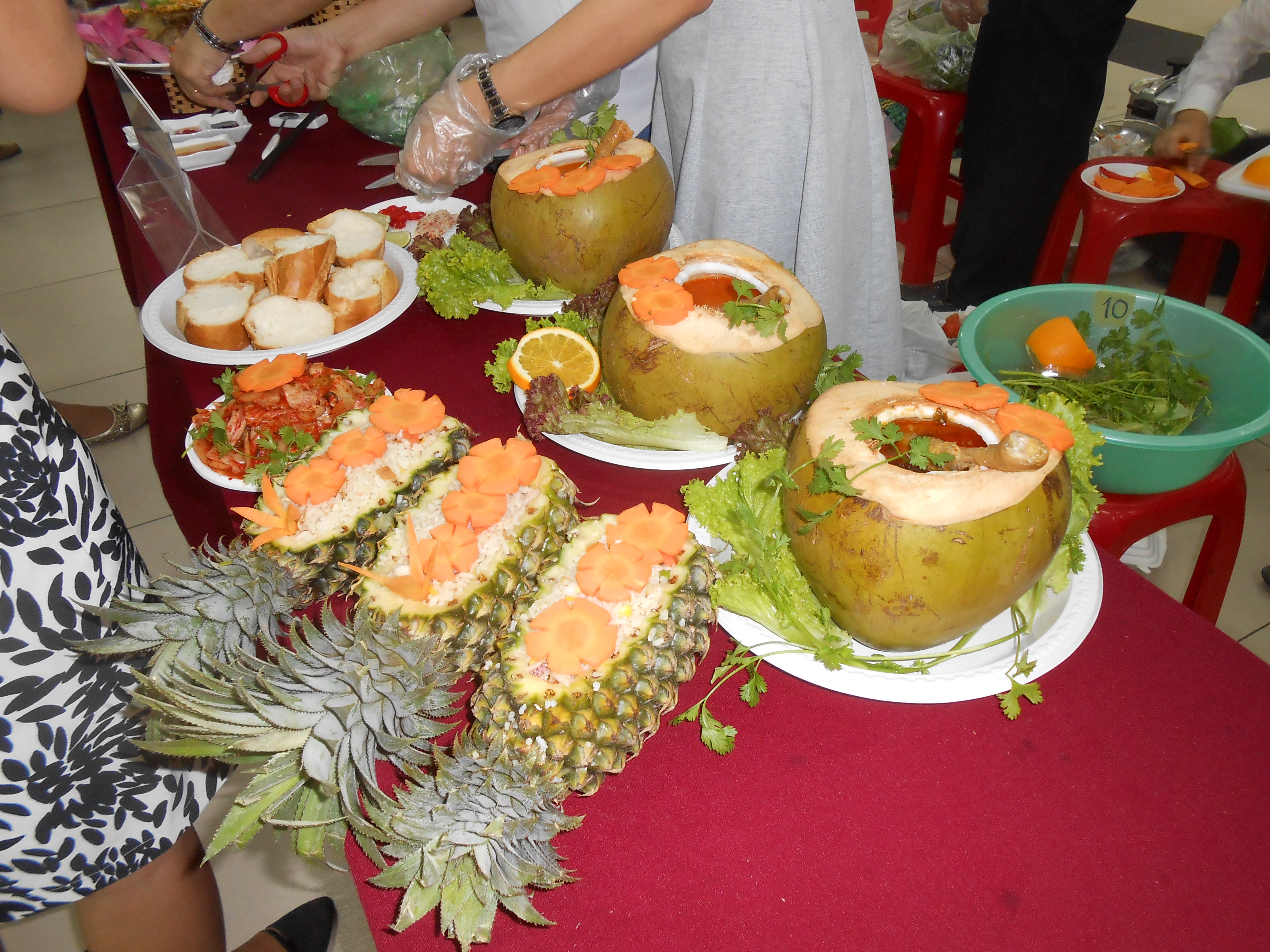
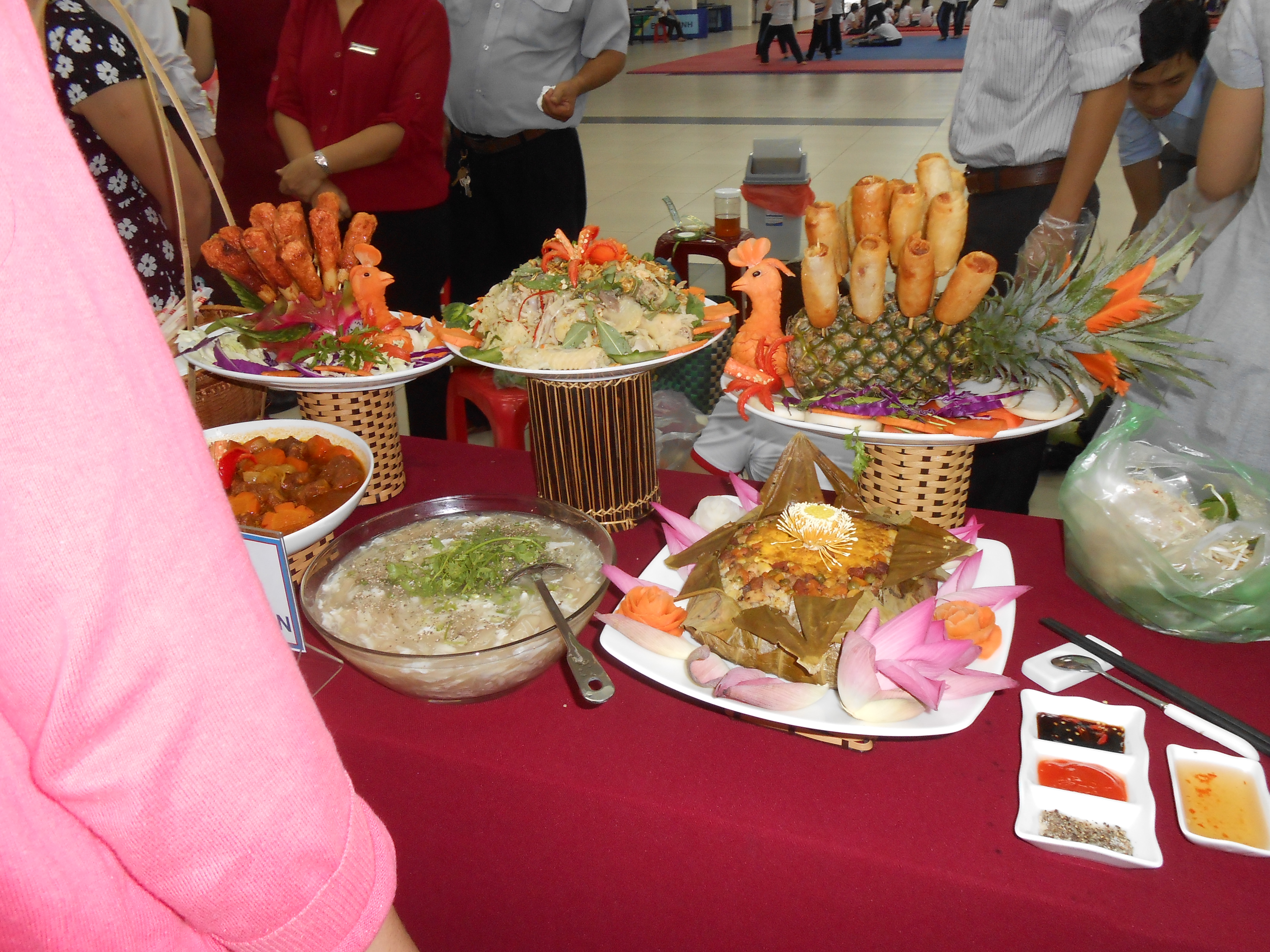
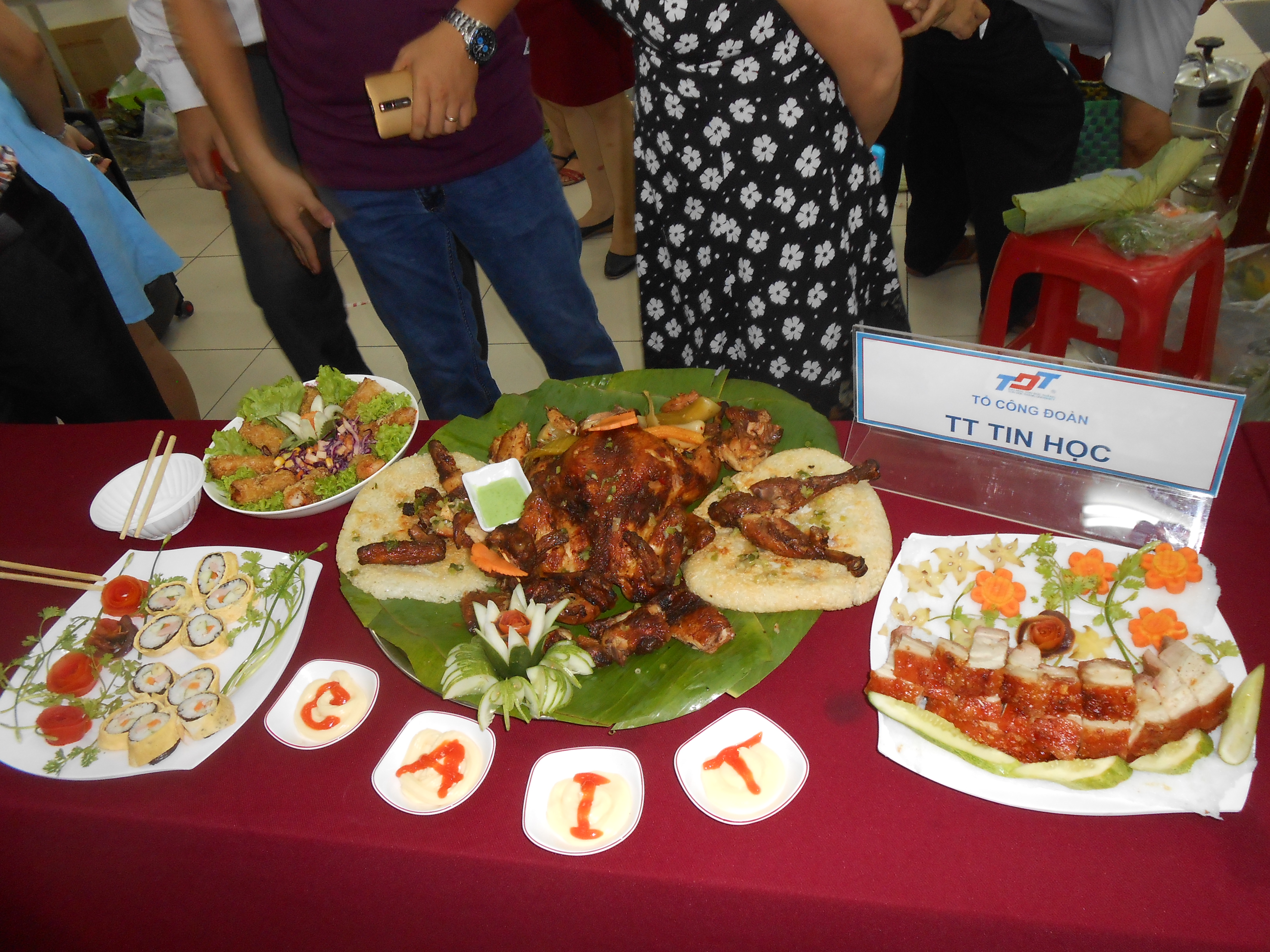
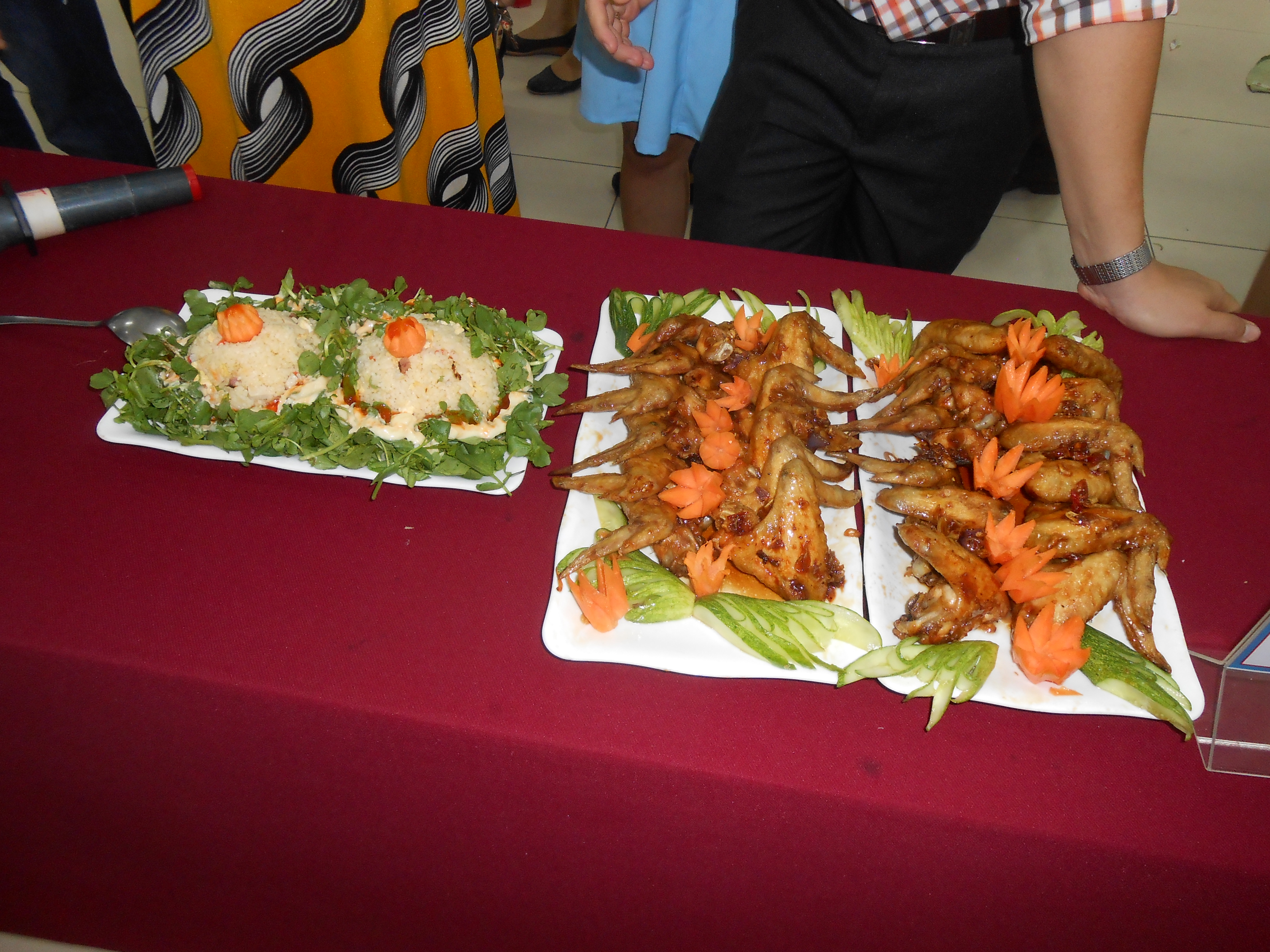
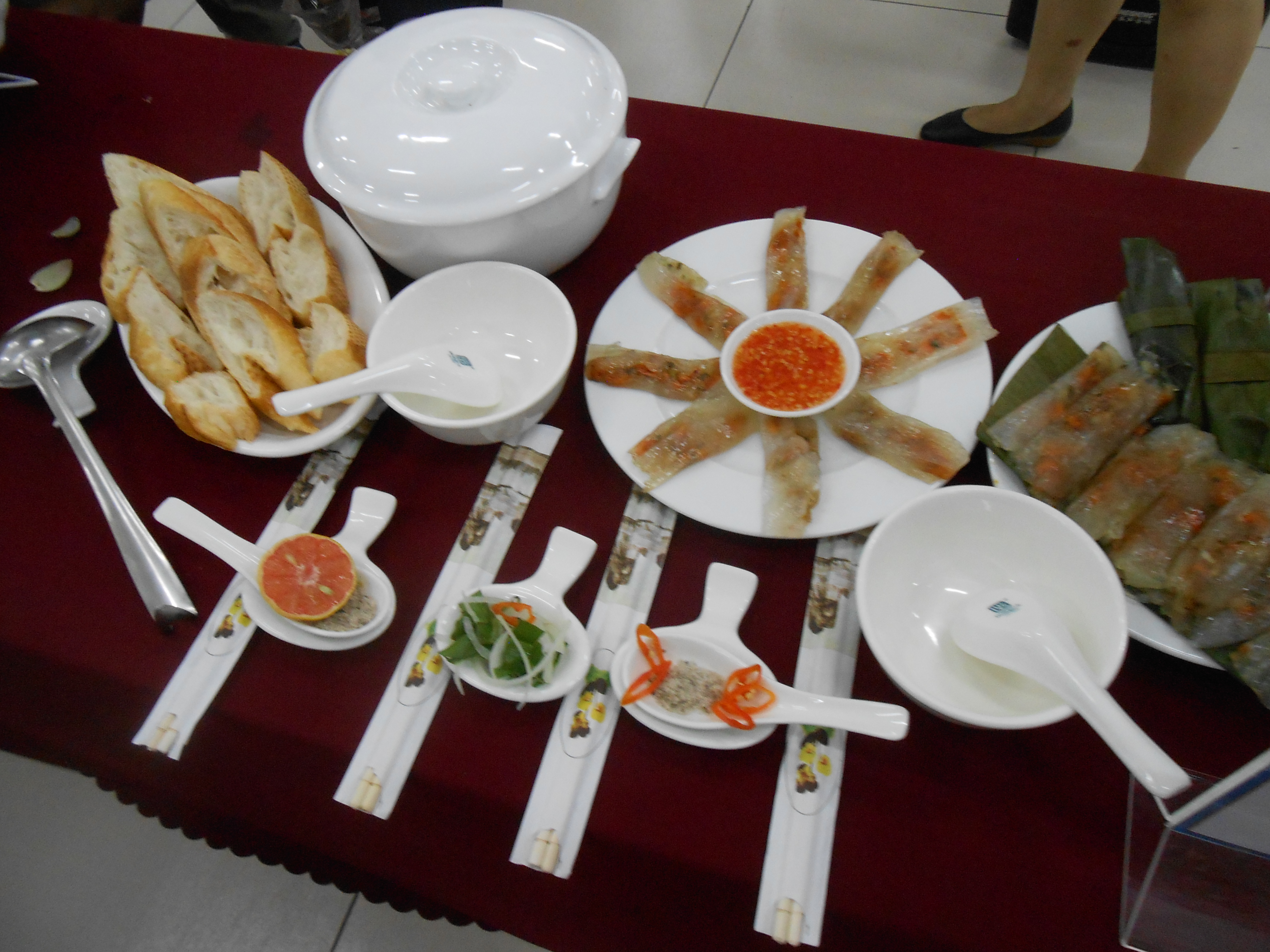
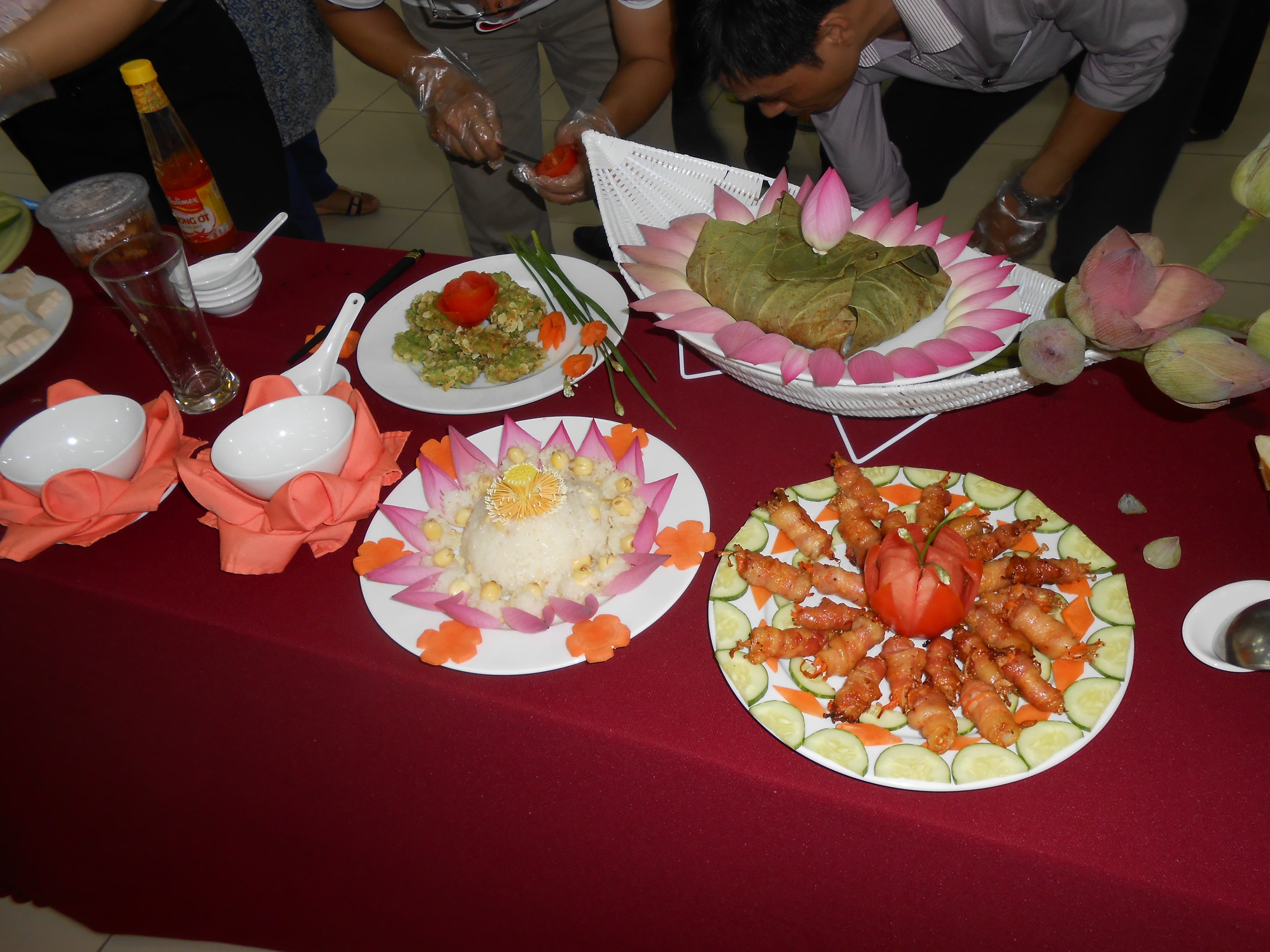
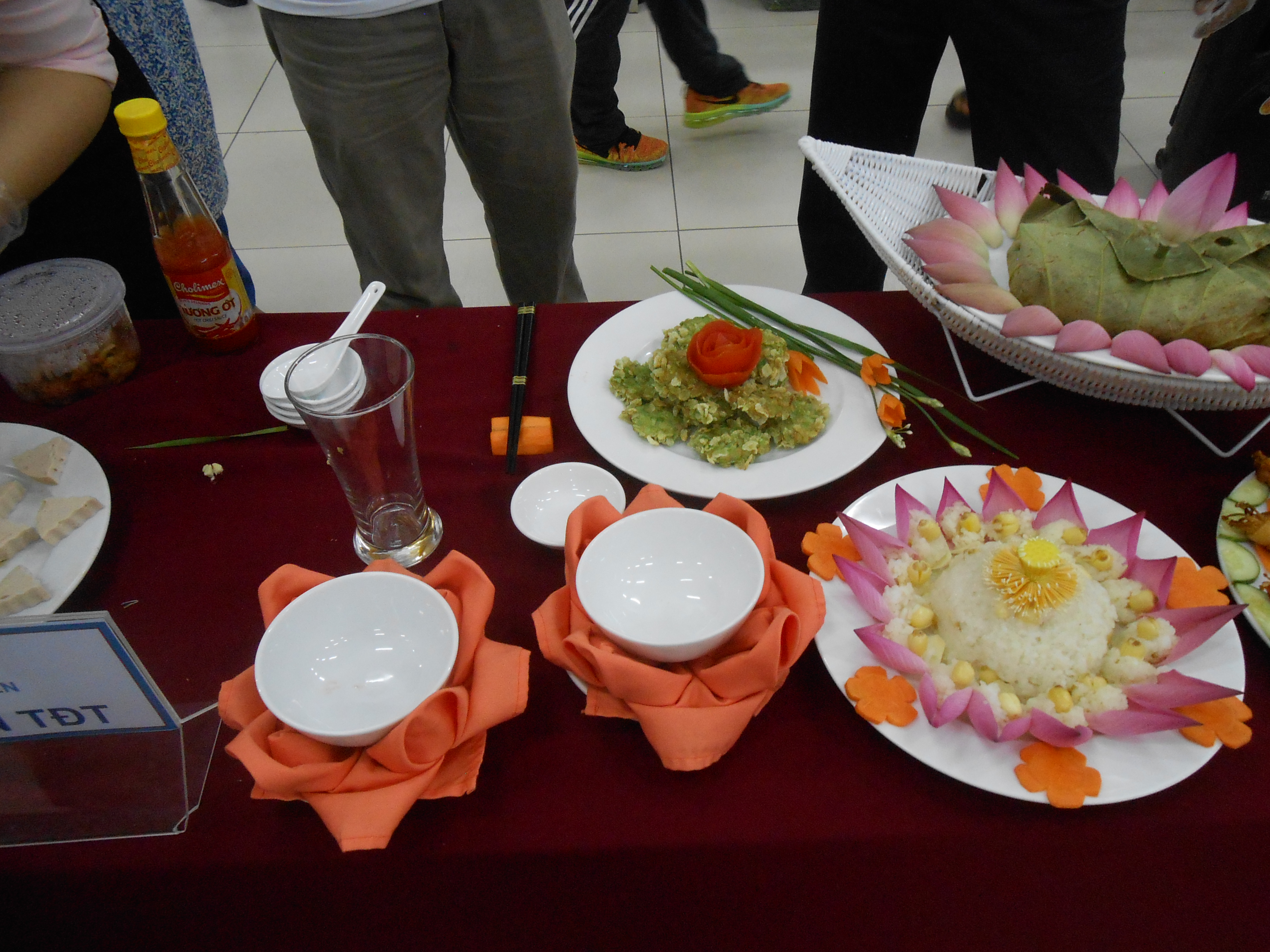
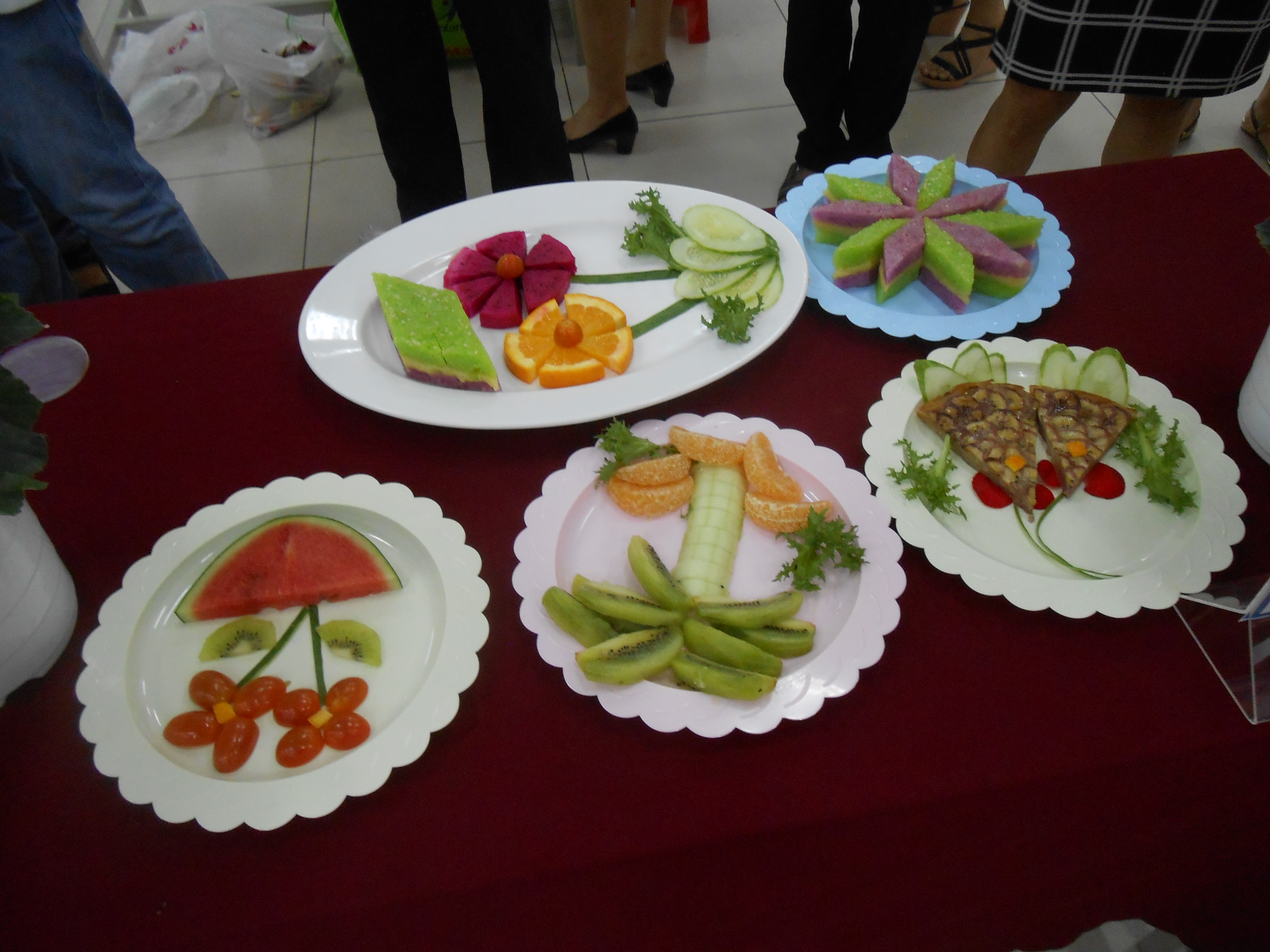
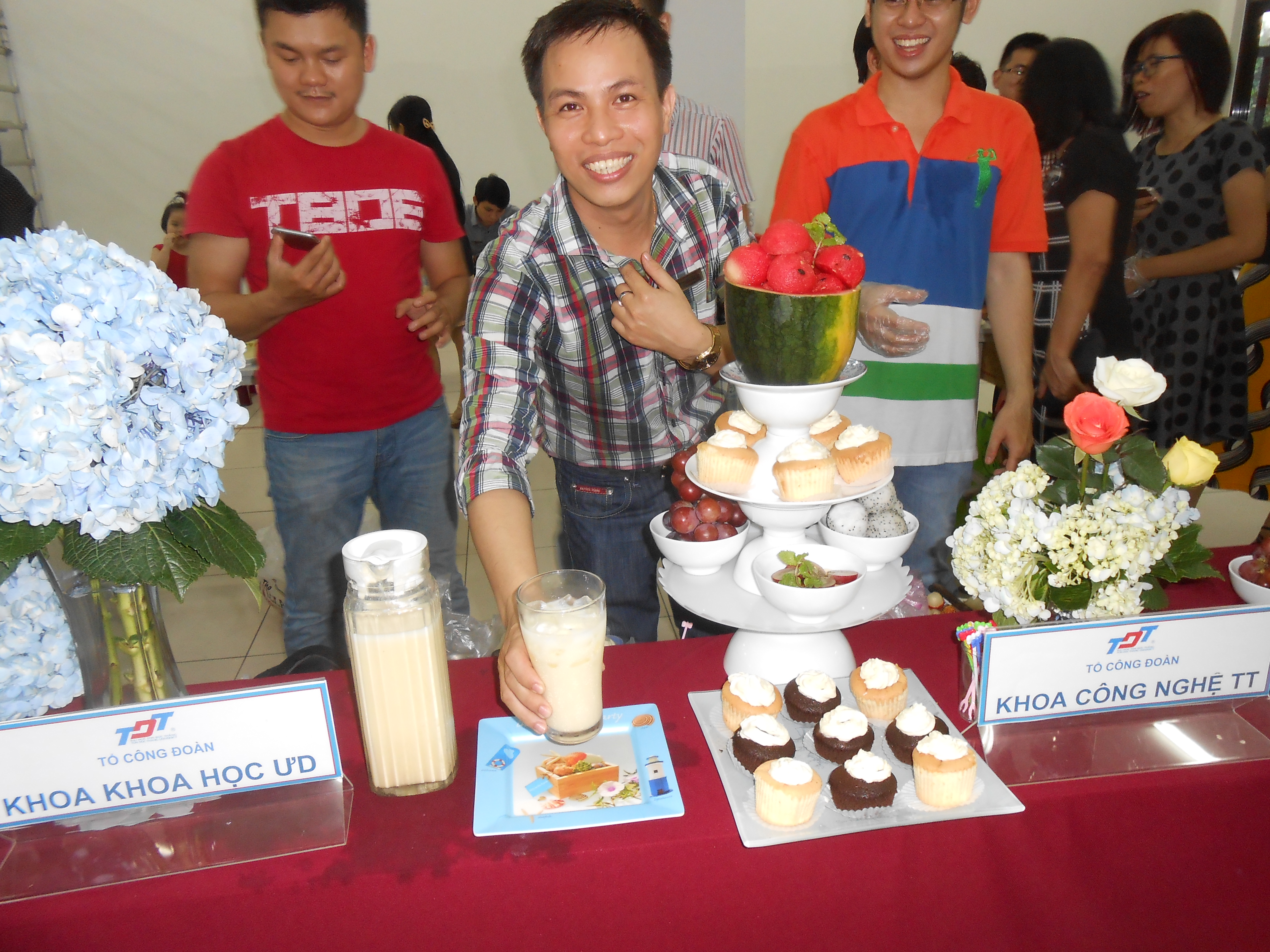
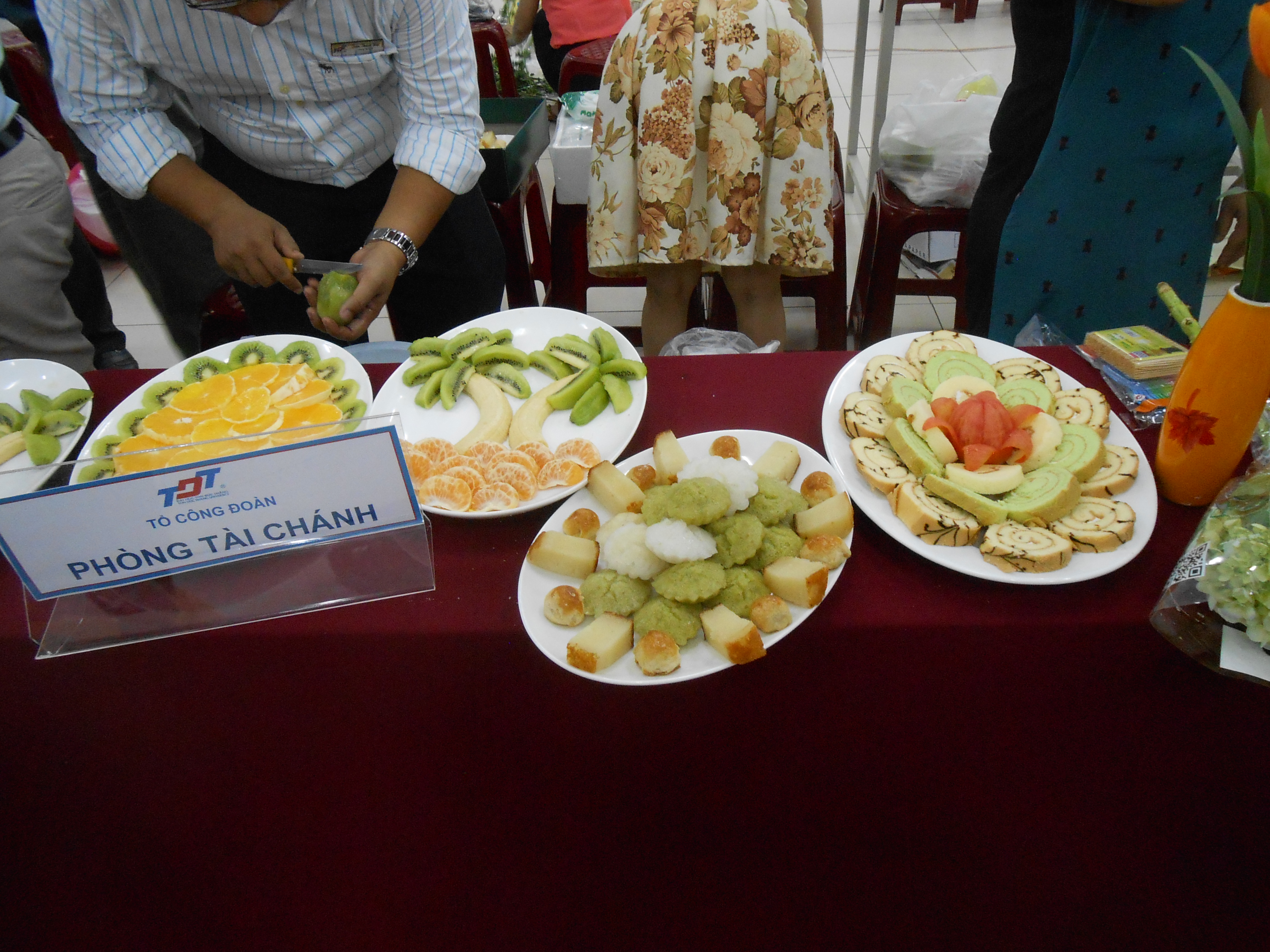
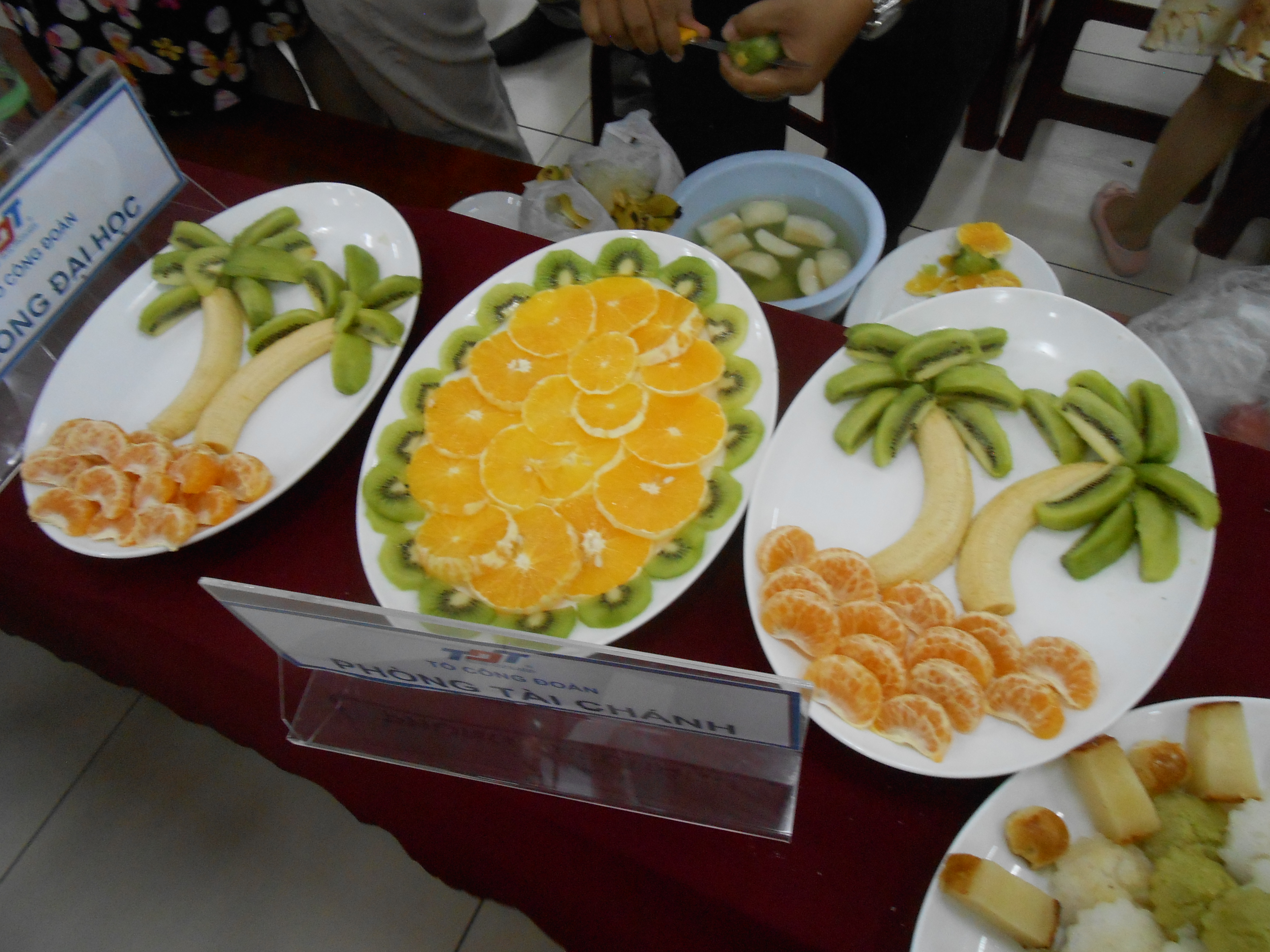
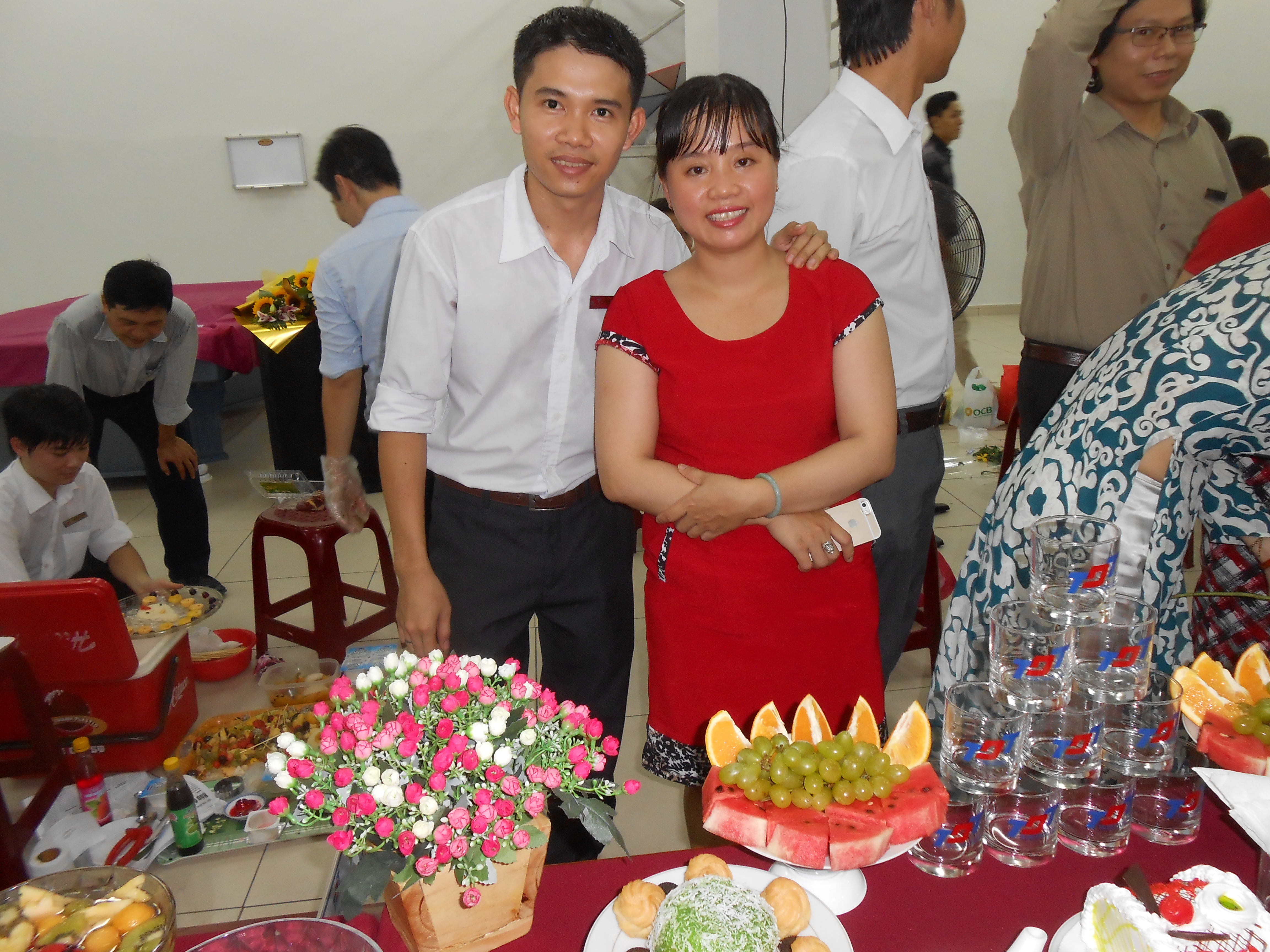
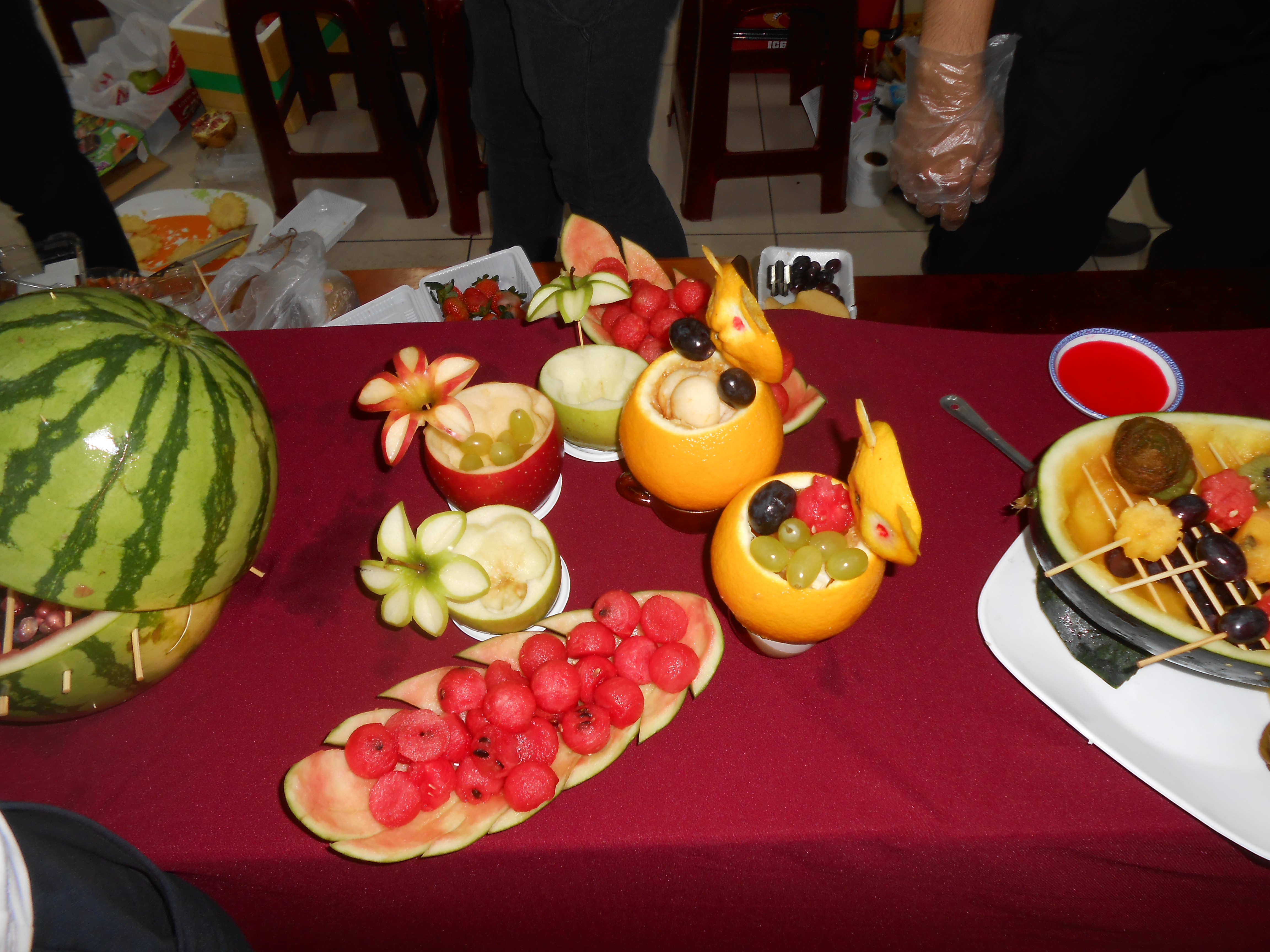
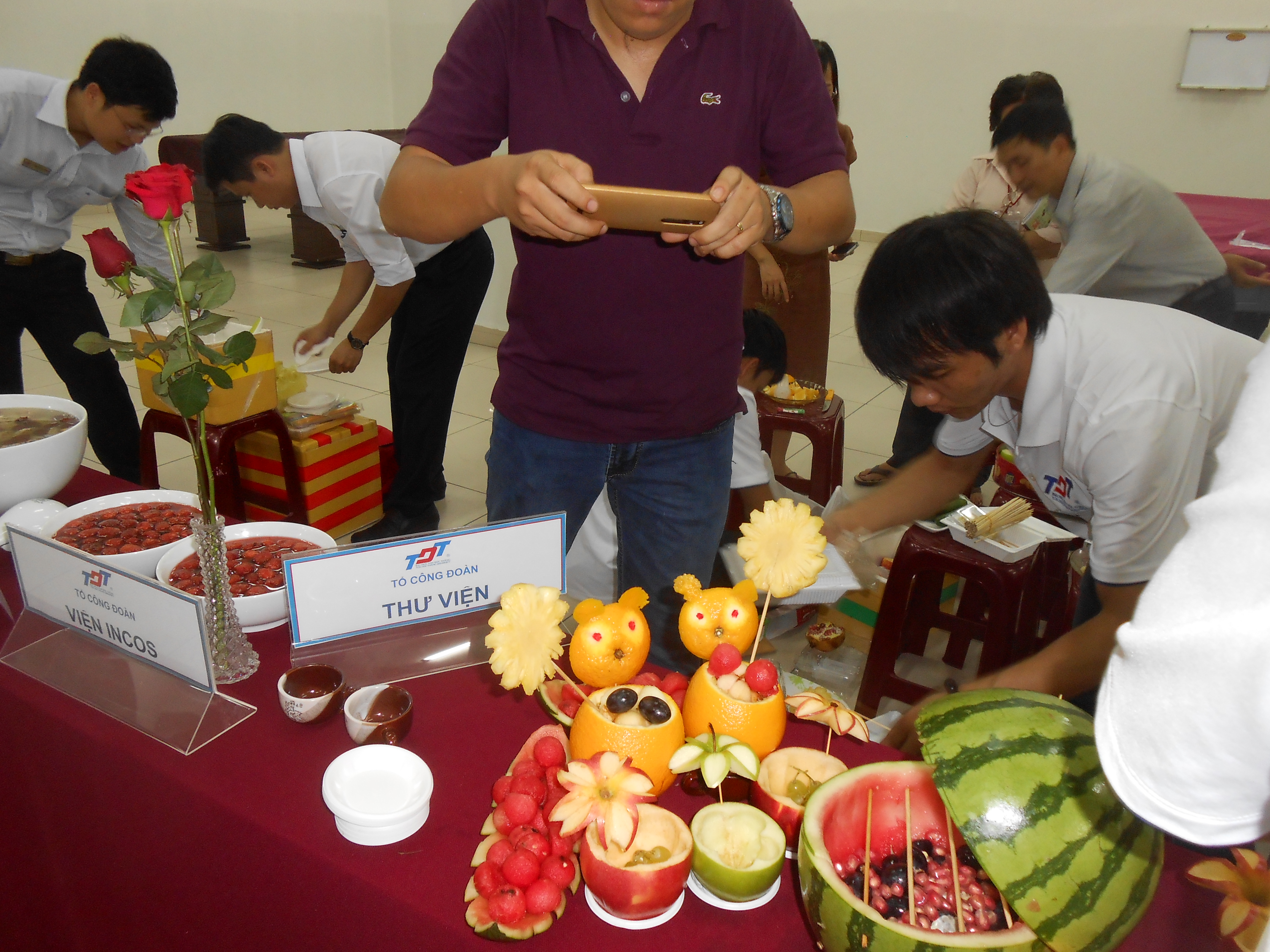
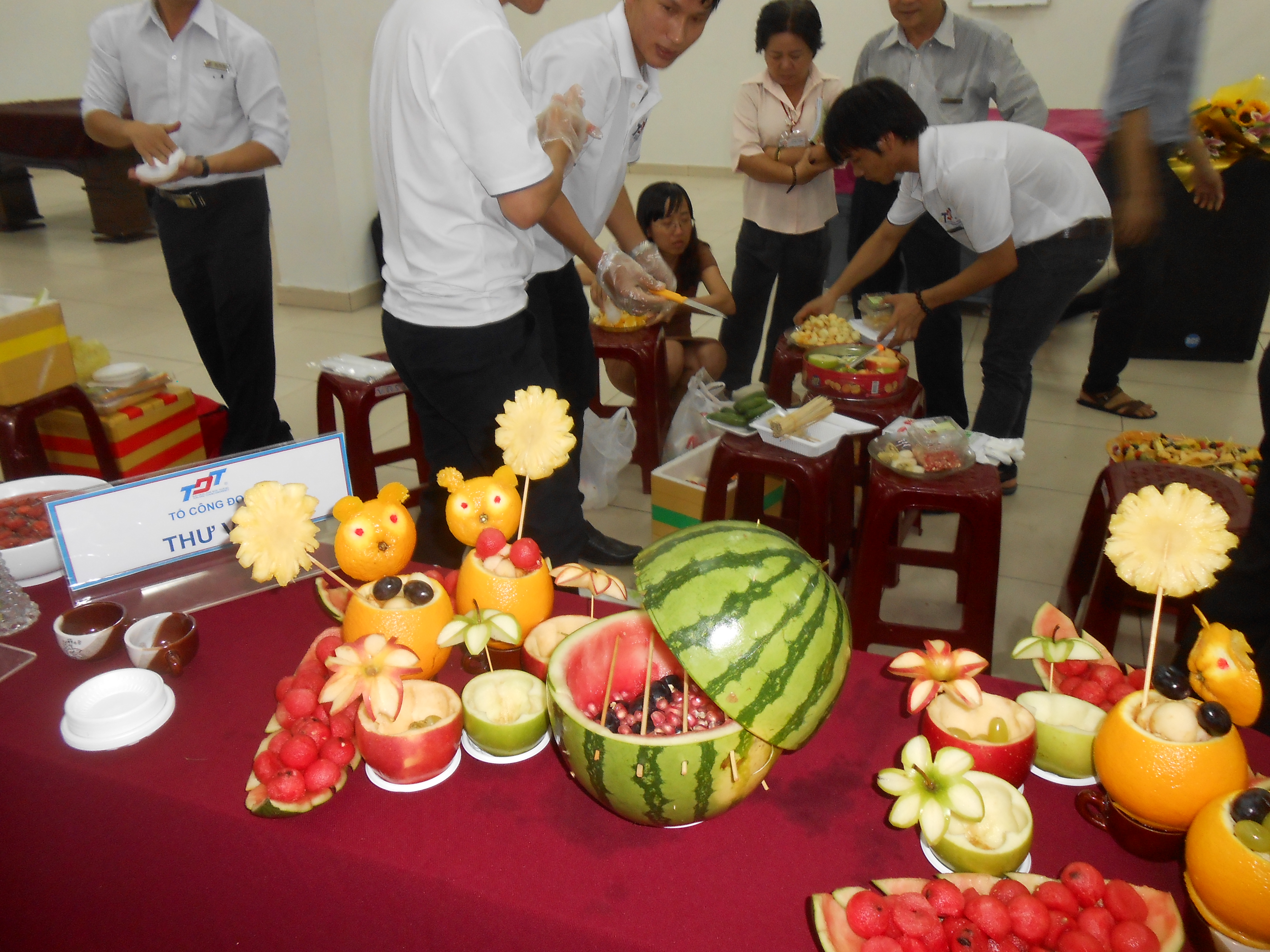
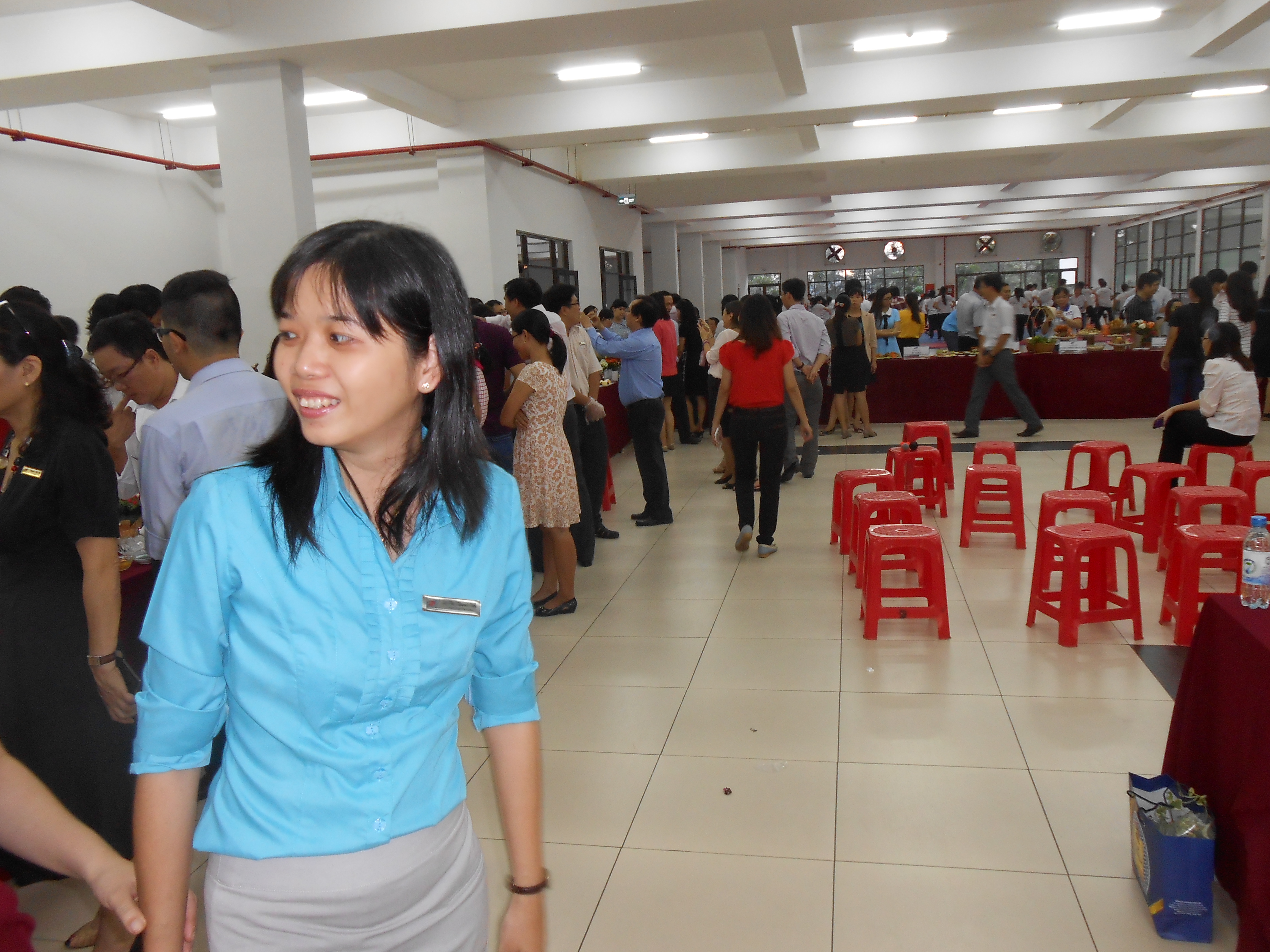
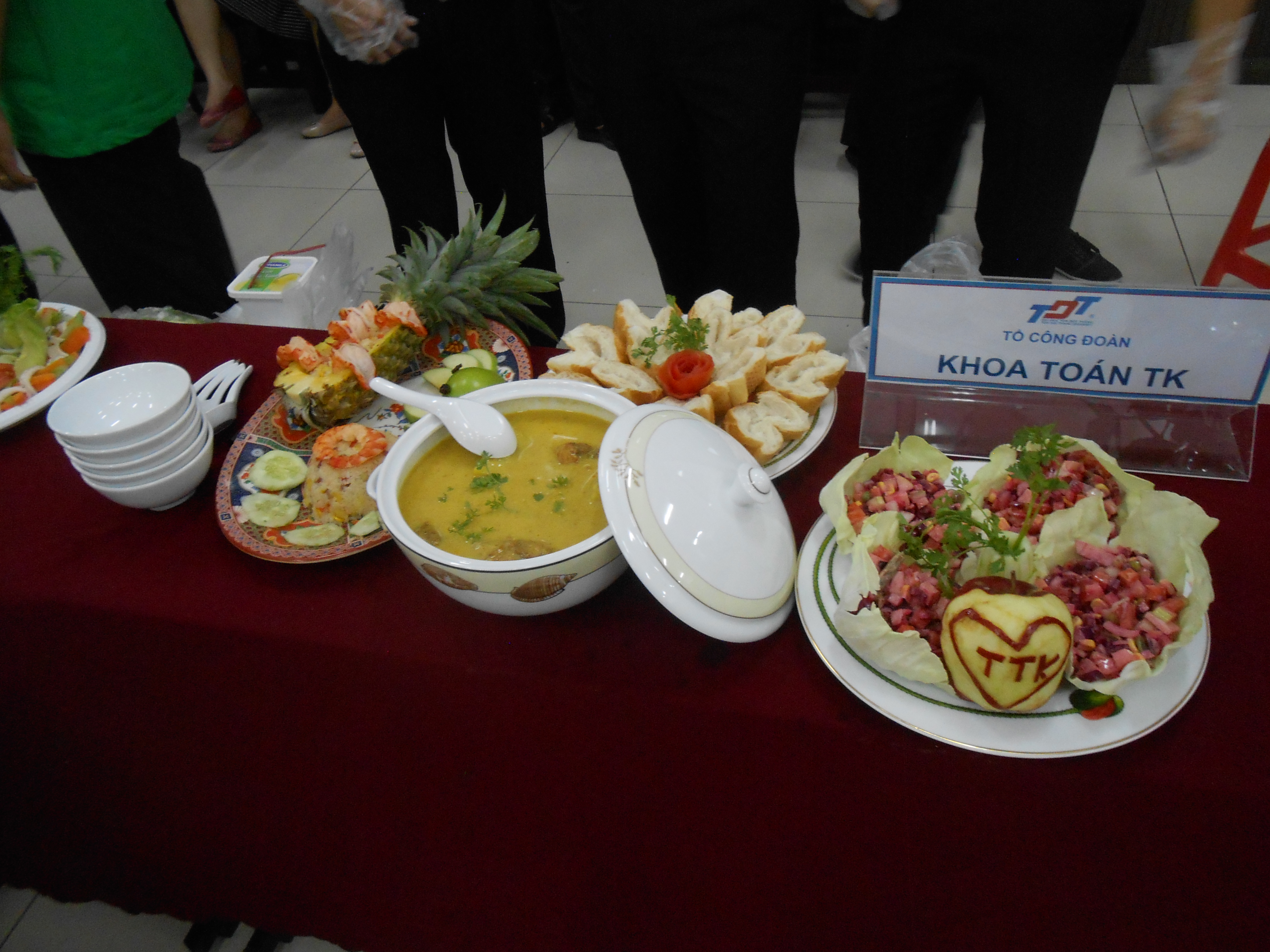
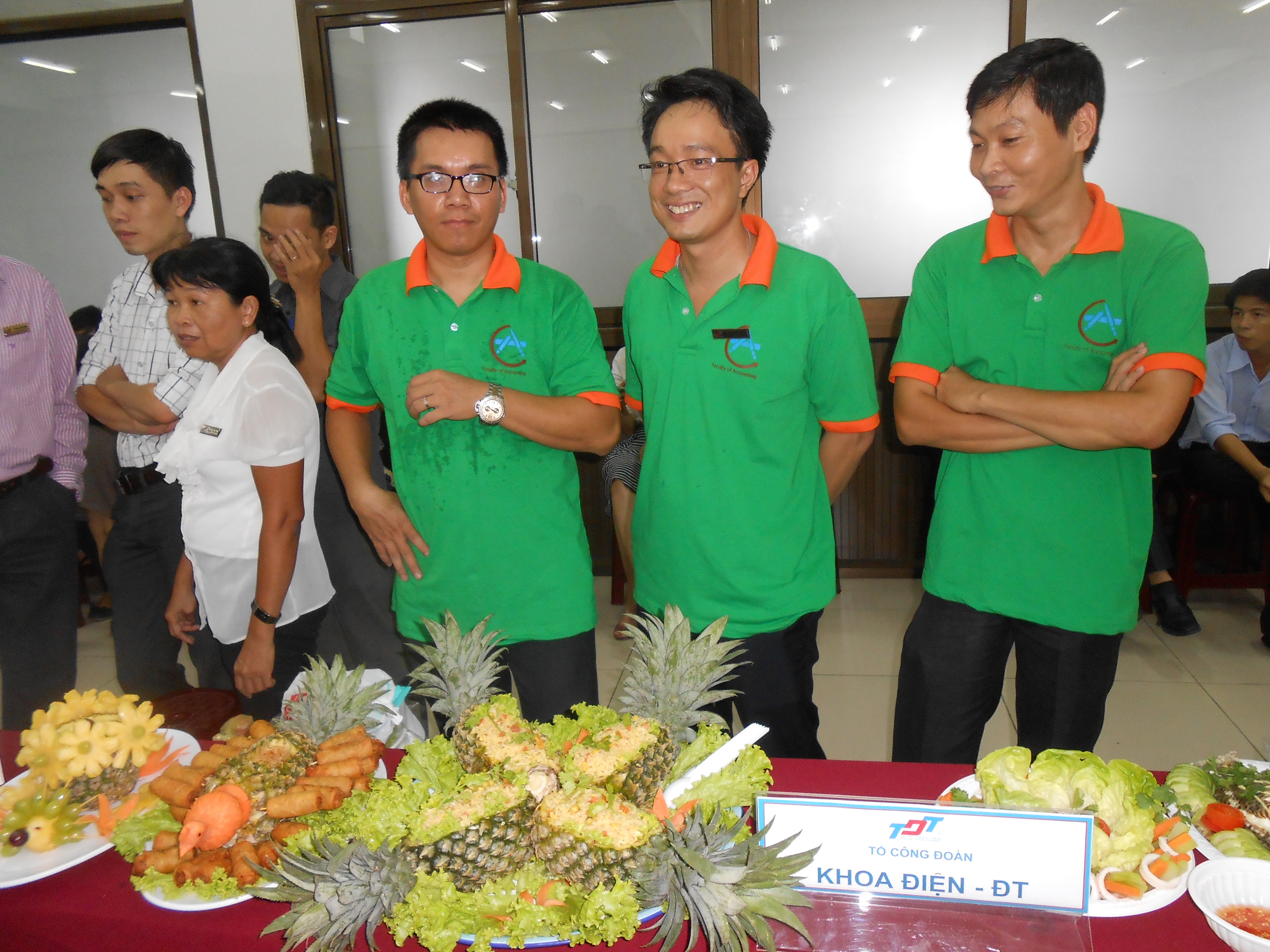
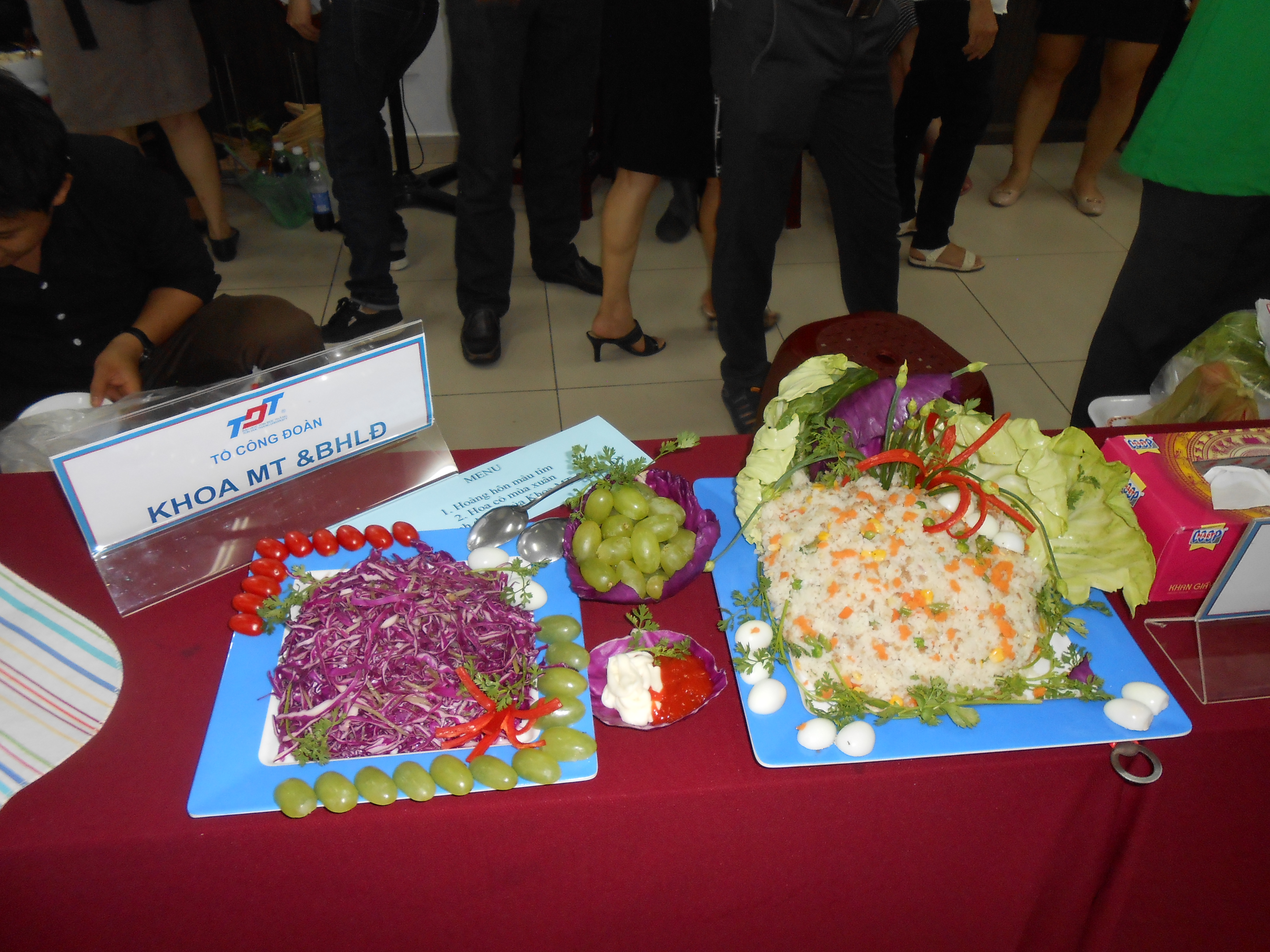
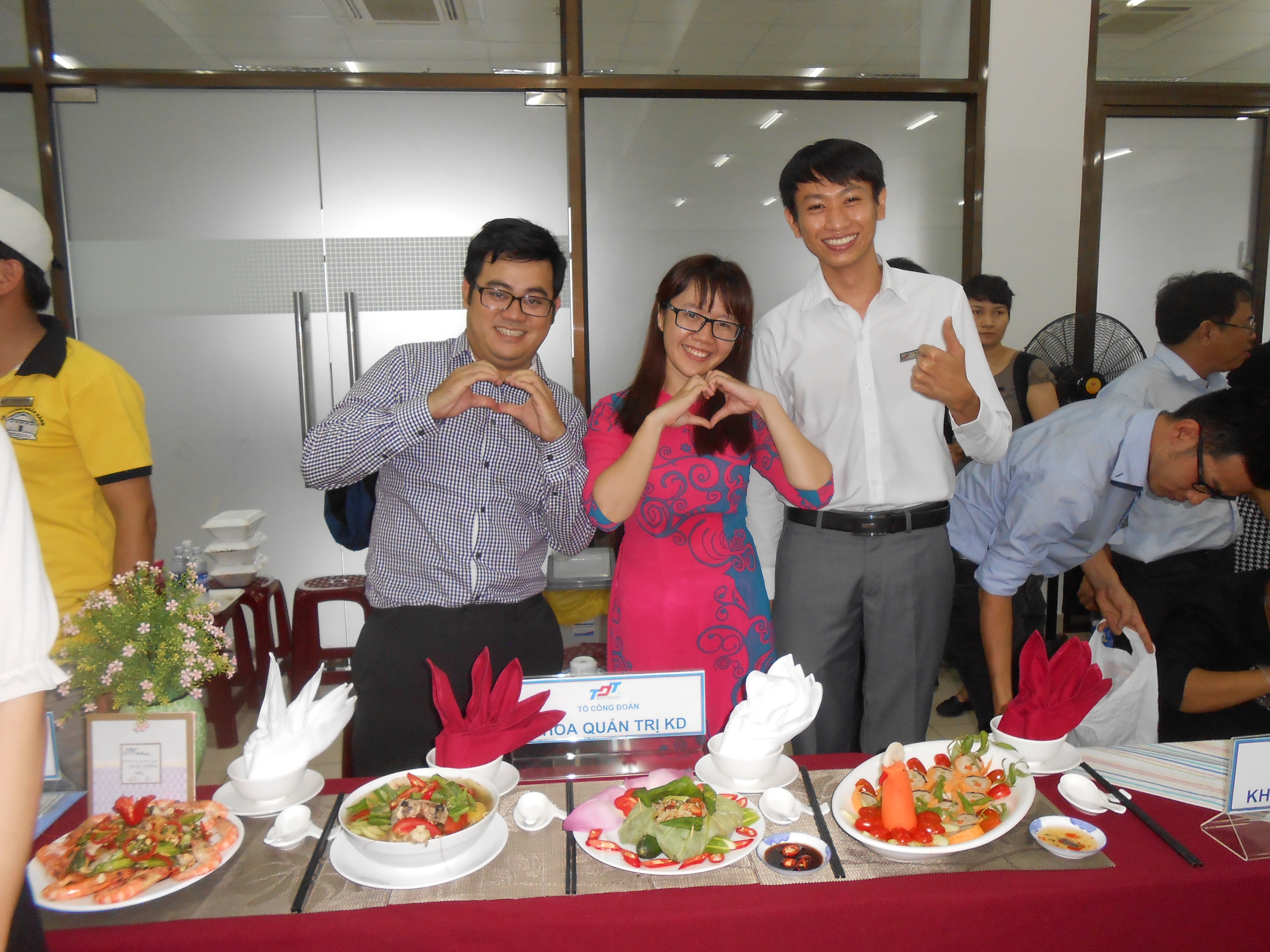
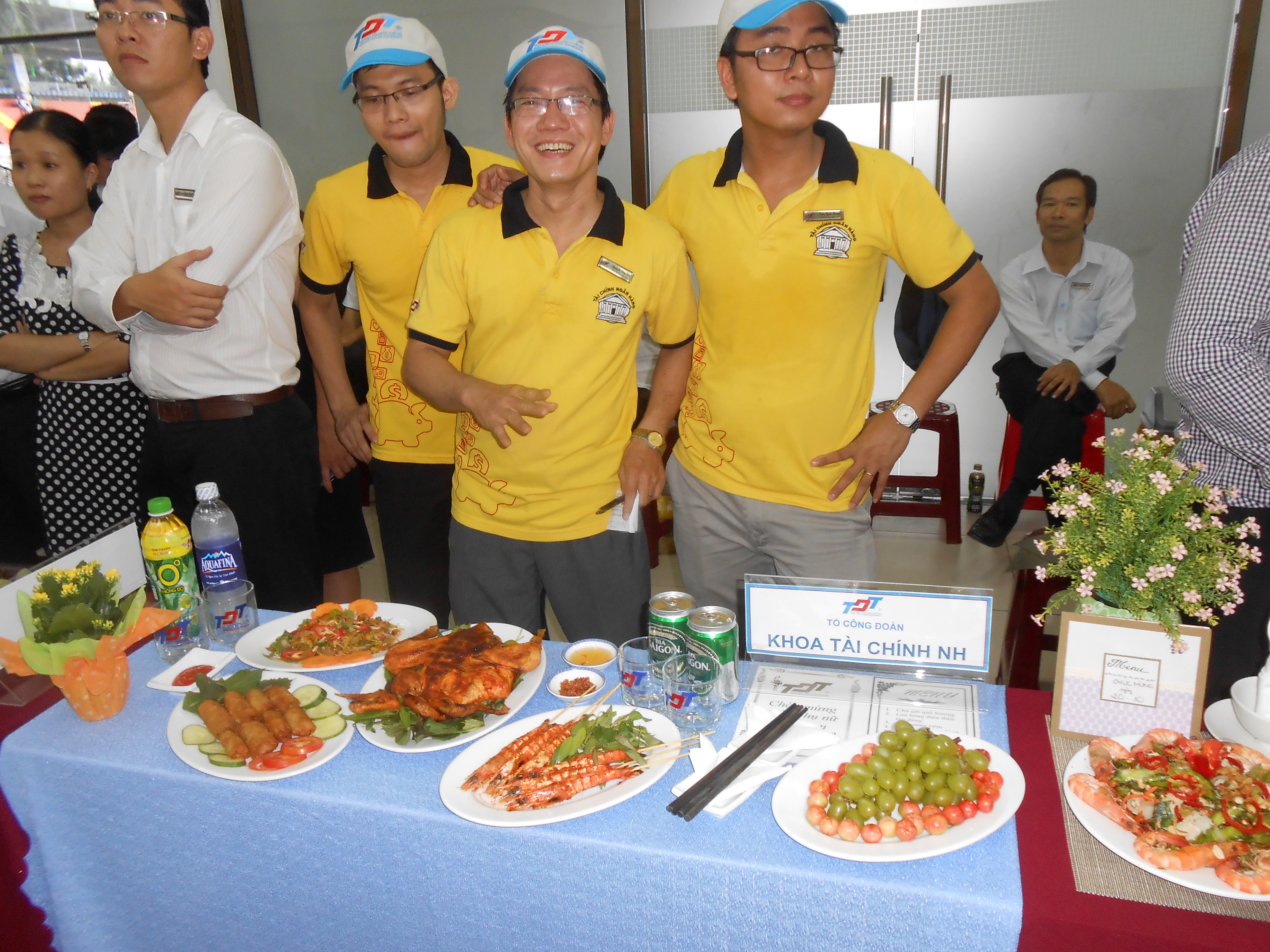
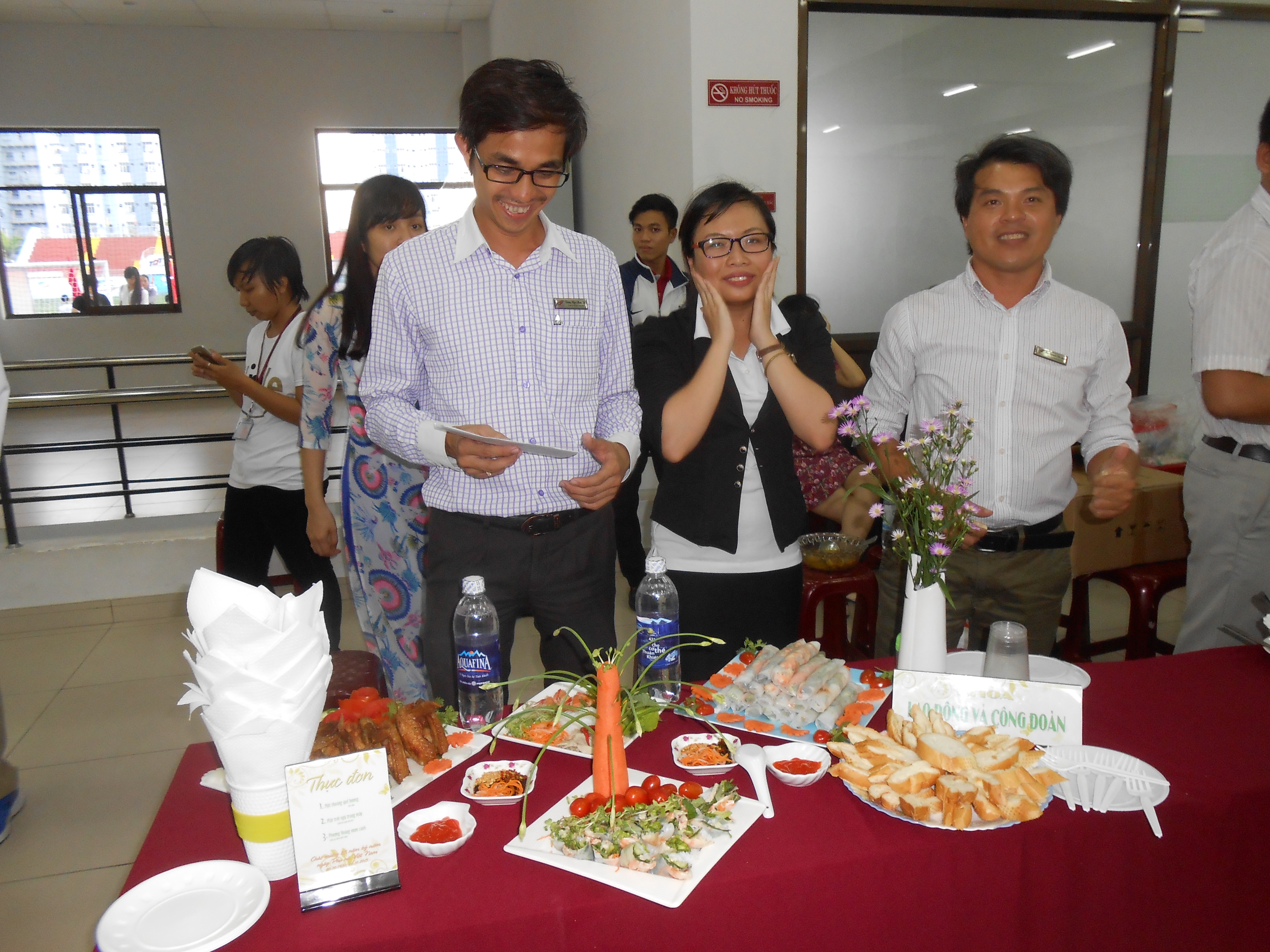
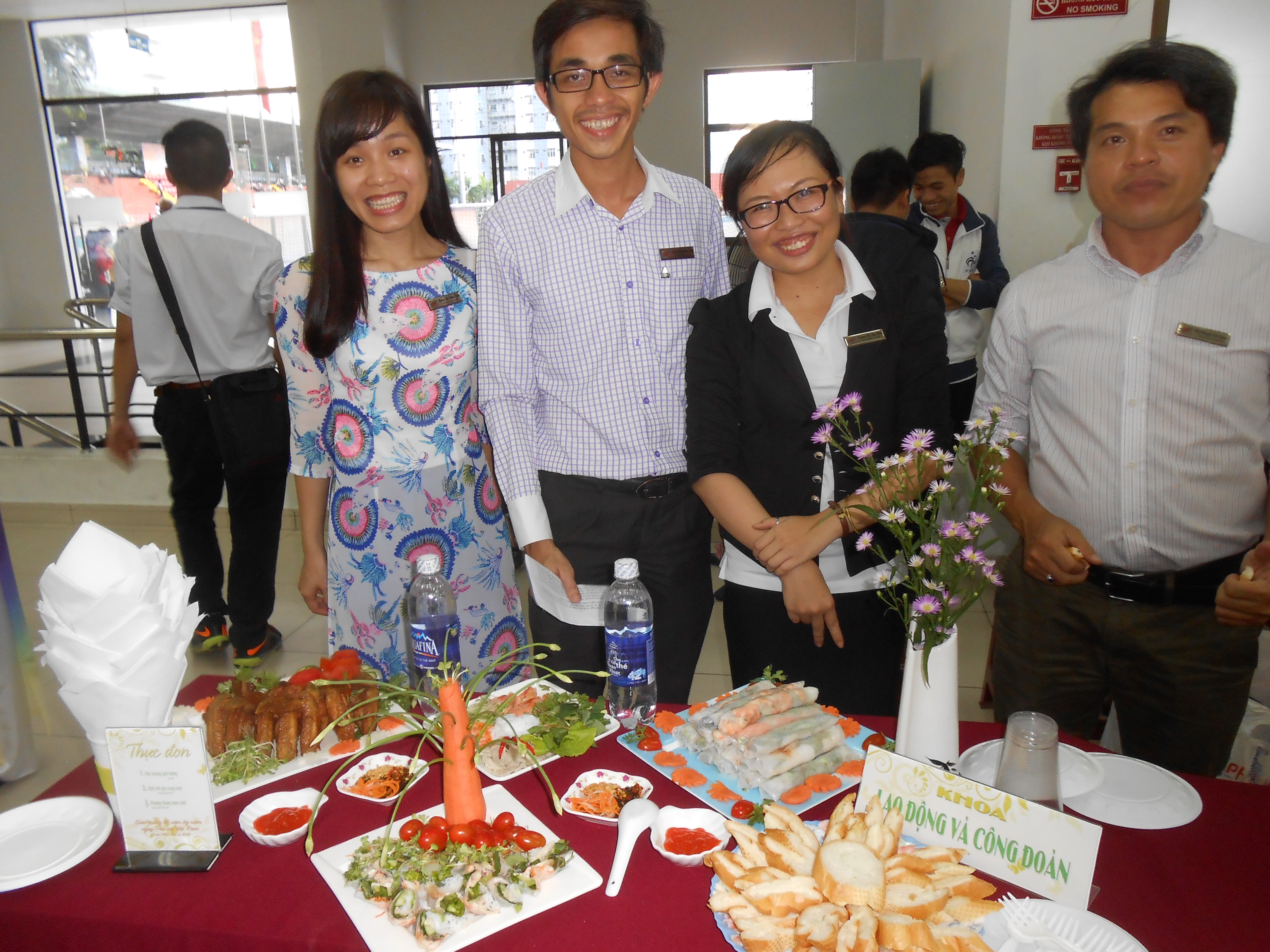
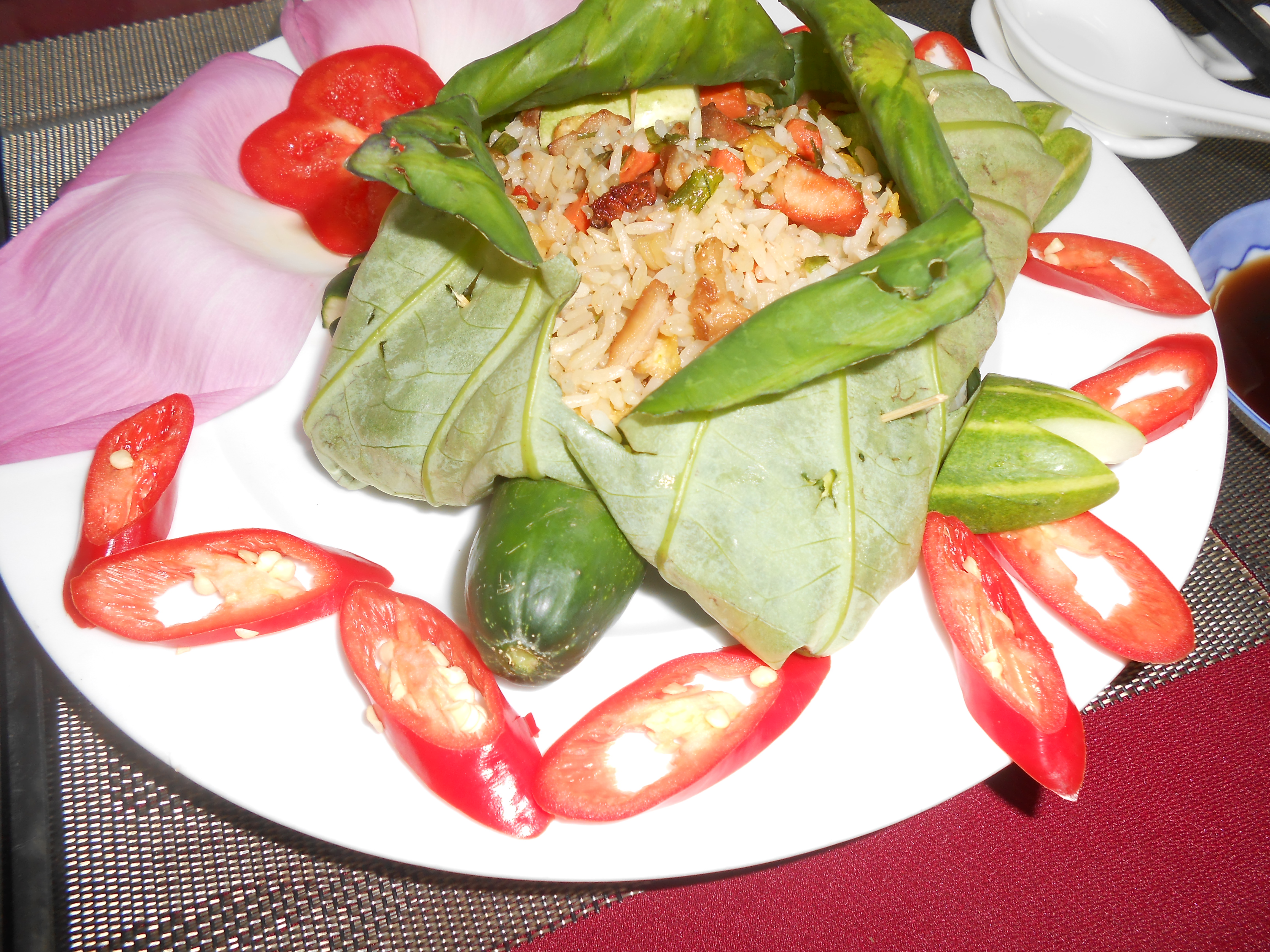
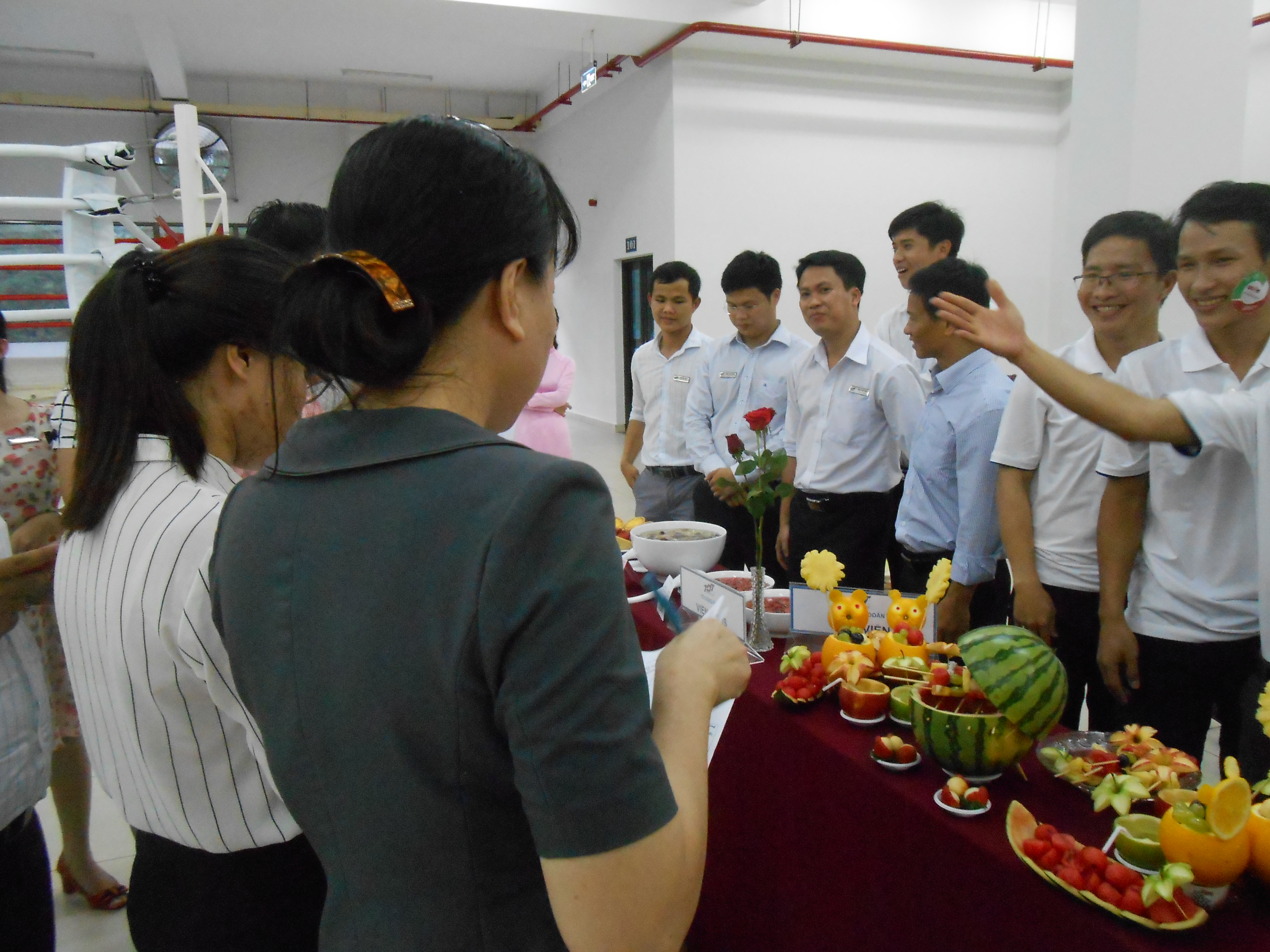
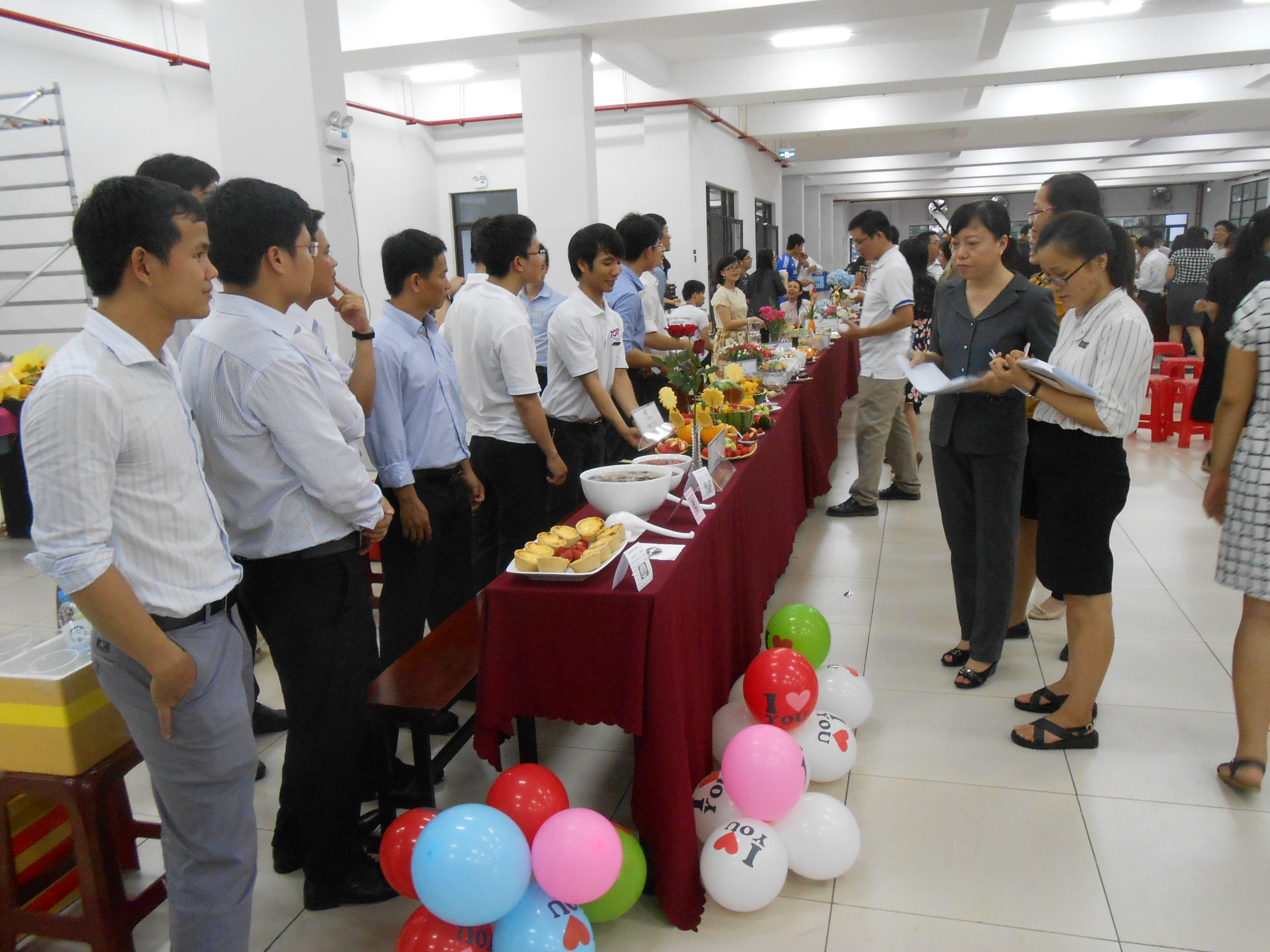
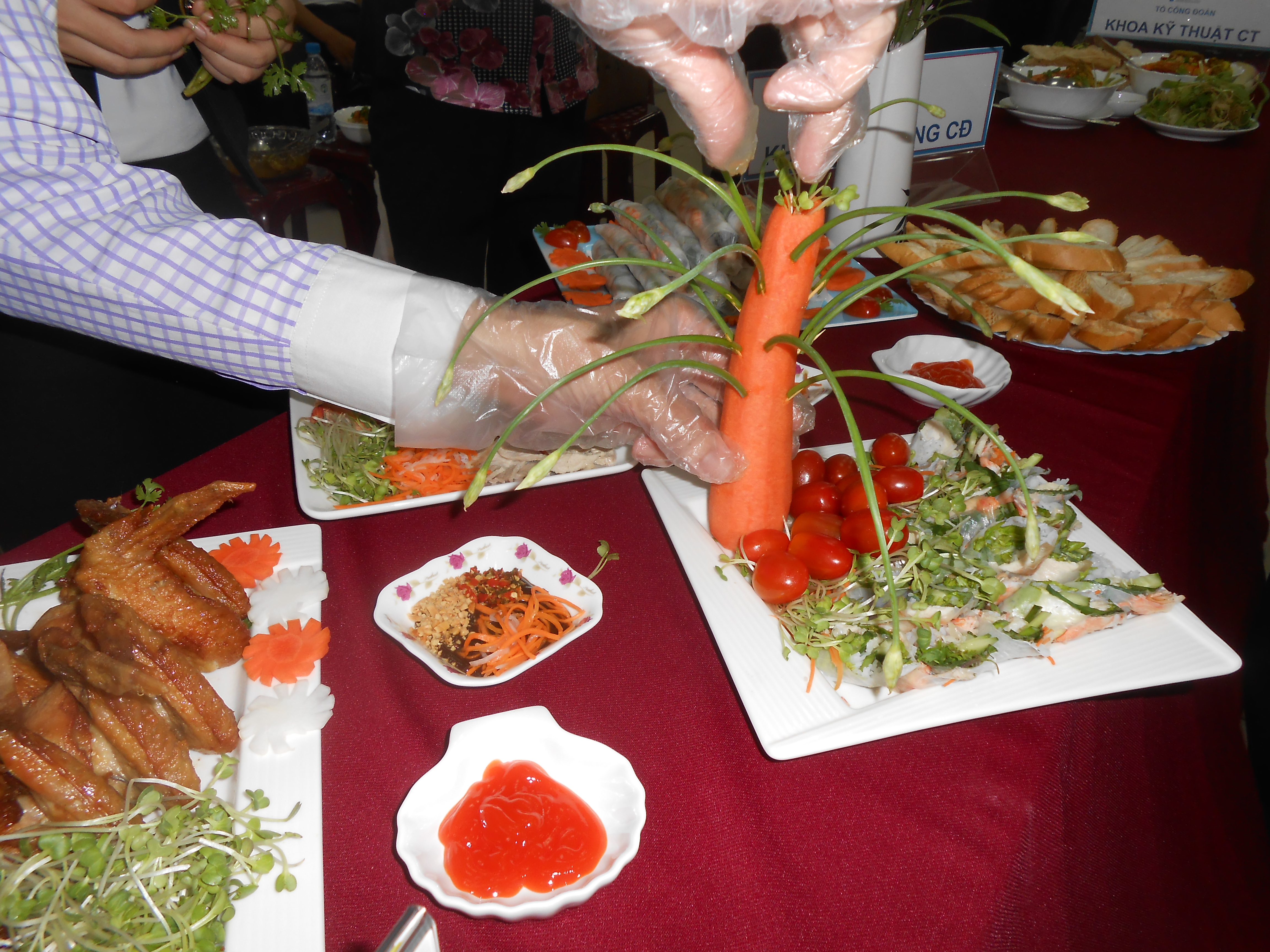
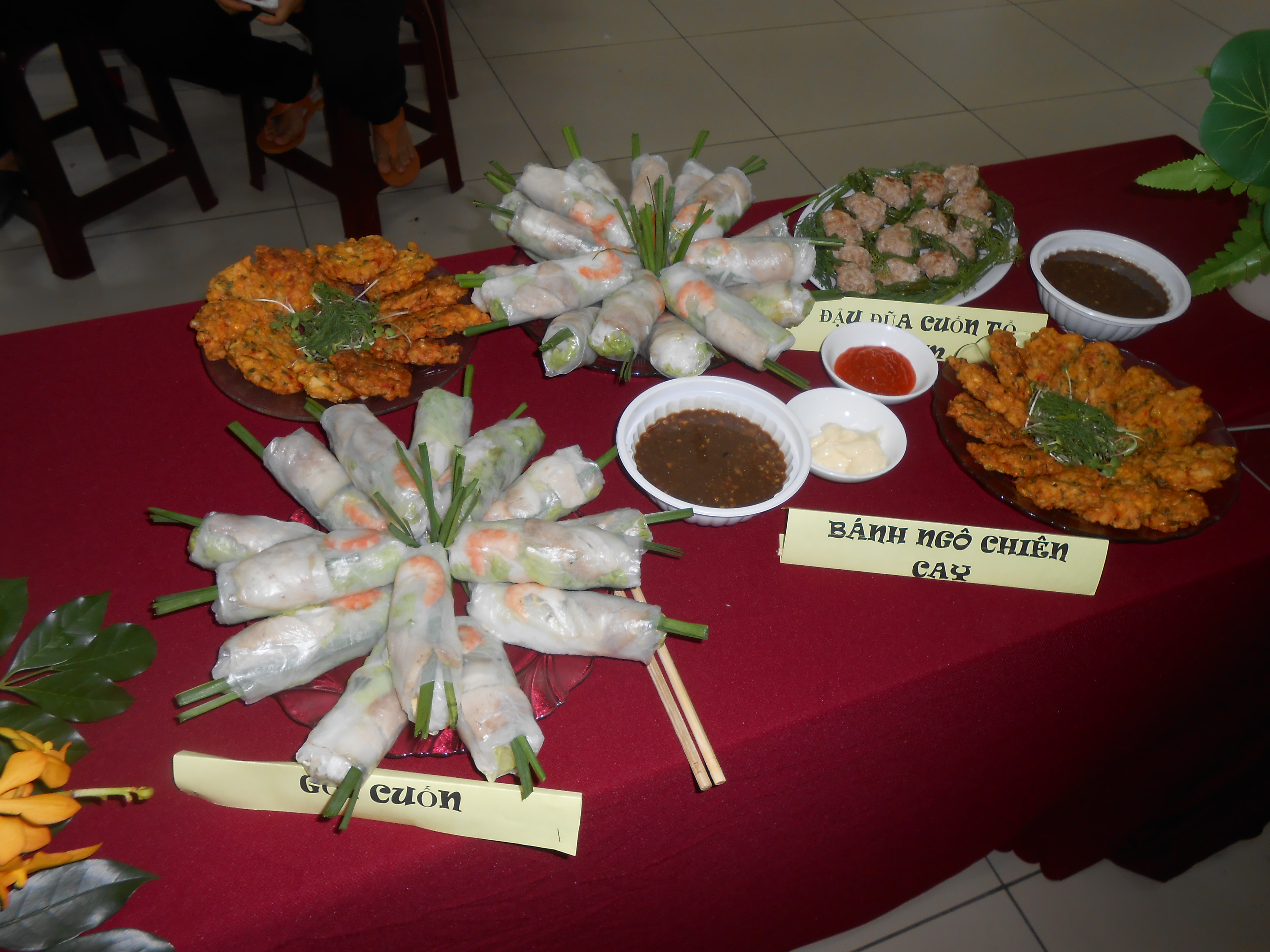
Today, October 16, is Women’s Day celebrated by the TDTU union. The way they celebrate it is with a food contest. Every department competes by bringing food.   You cook it at home and bring it in with your serving dishes and take it to the gym, where tables are set up in a U-shape. Then three people, of whom only one can be a woman, prepares your department’s food for presentation. This is men doing women’s work. An outside famous chef and two other people serve as the judges.

At a certain point someone says “Go!” and it begins. They get something like half an hour. While they’re working, we walk around and watch. Then the judges call time and go around and judge. Then they award the prizes.

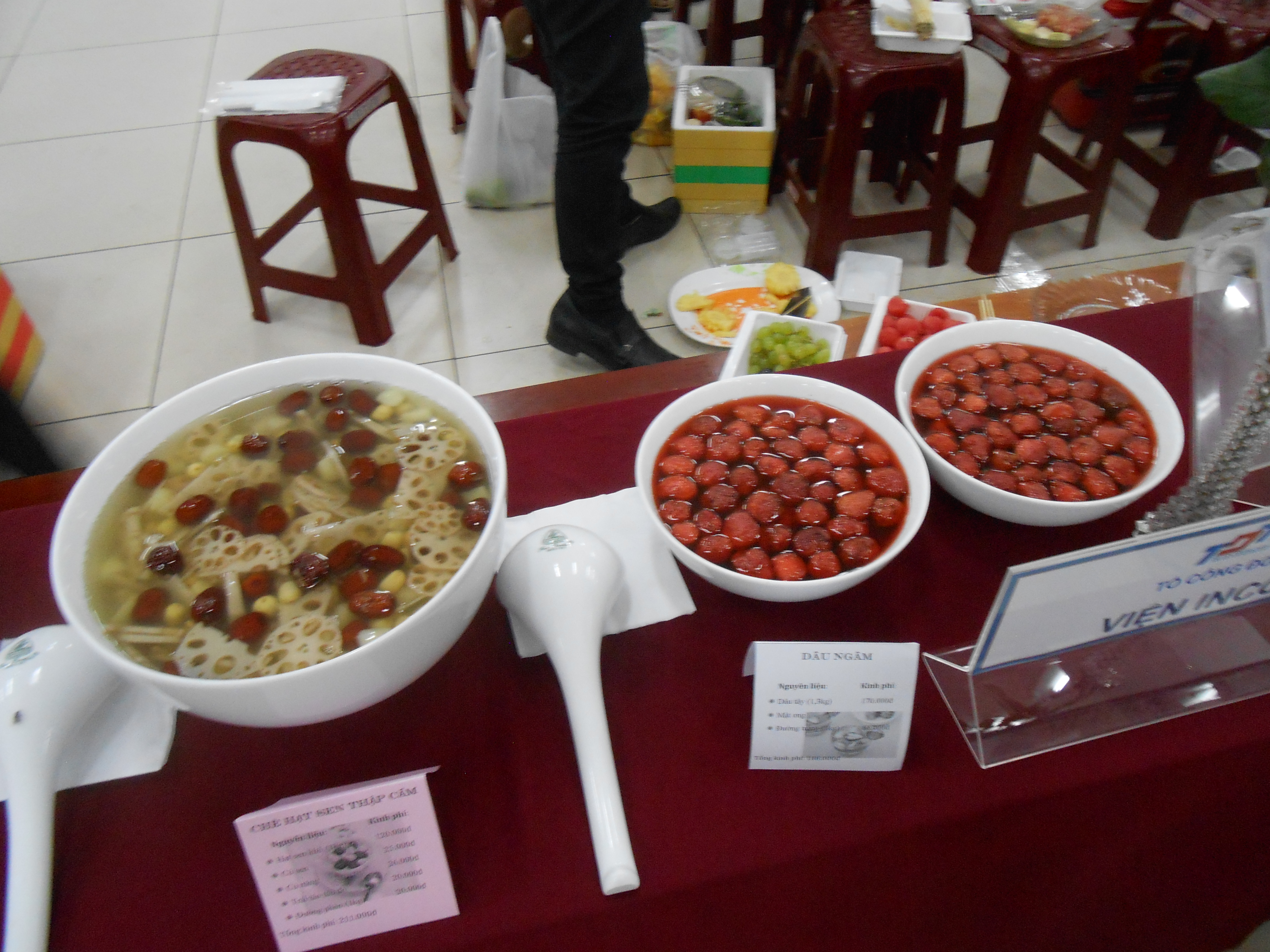
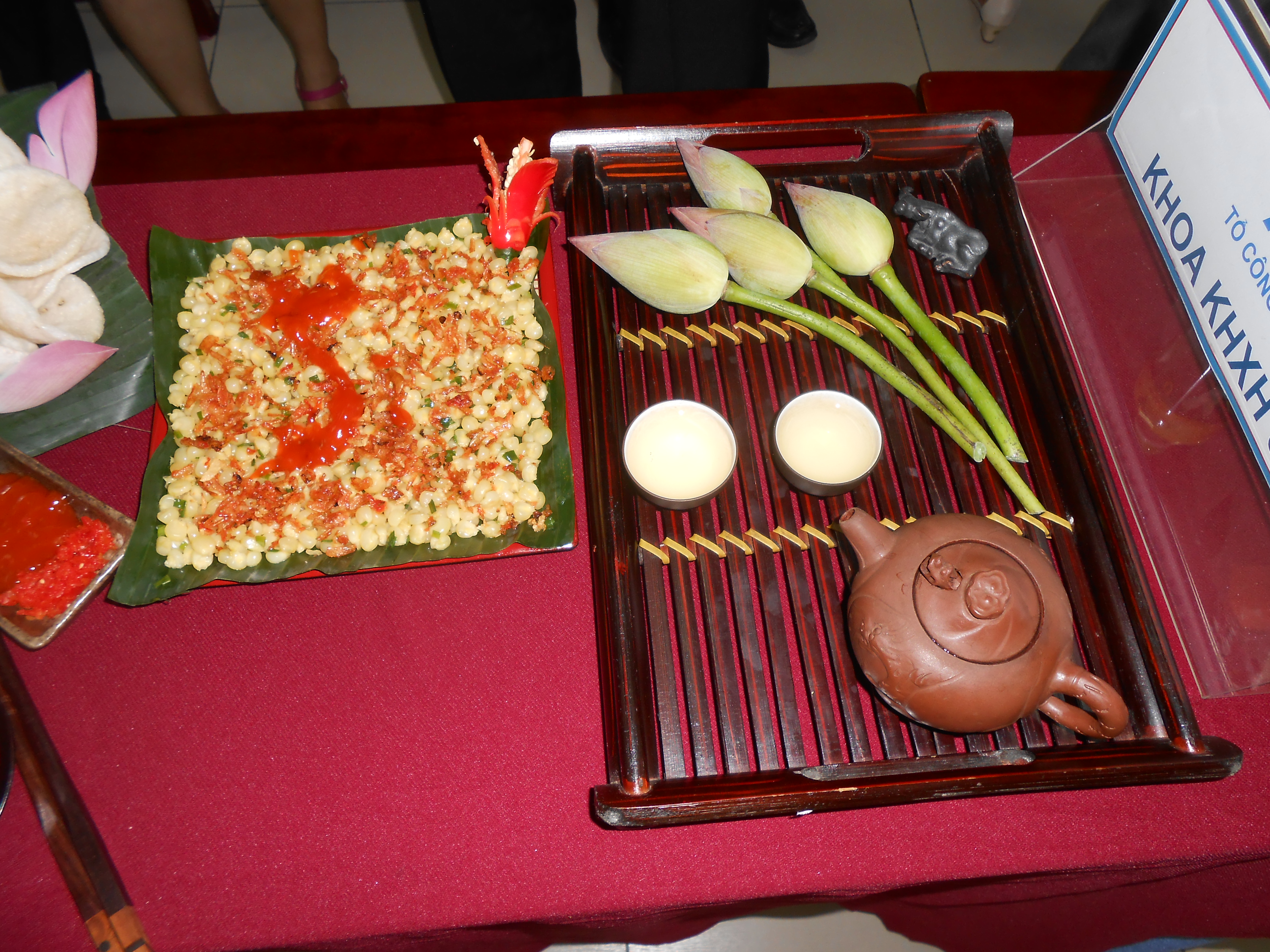
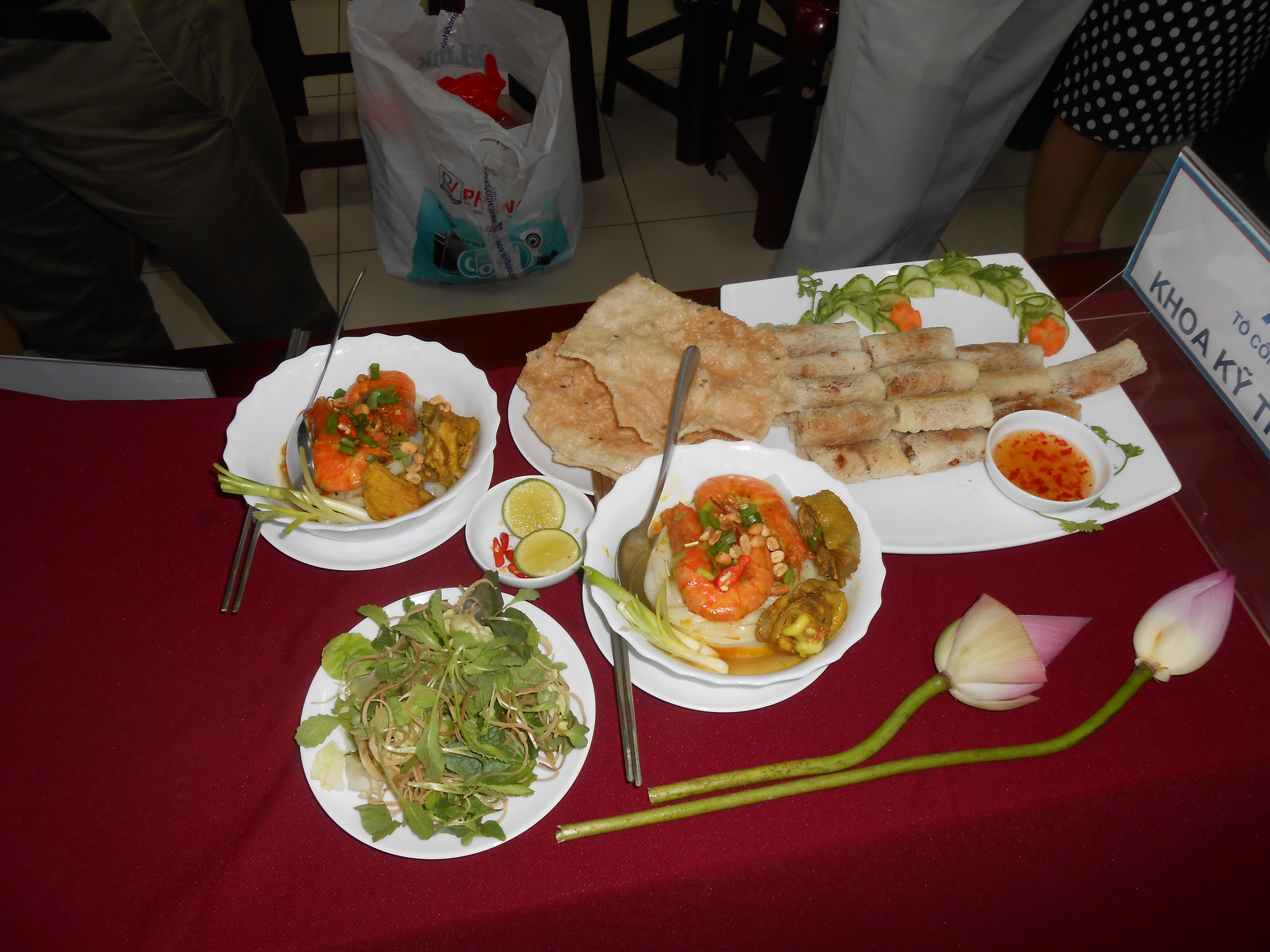
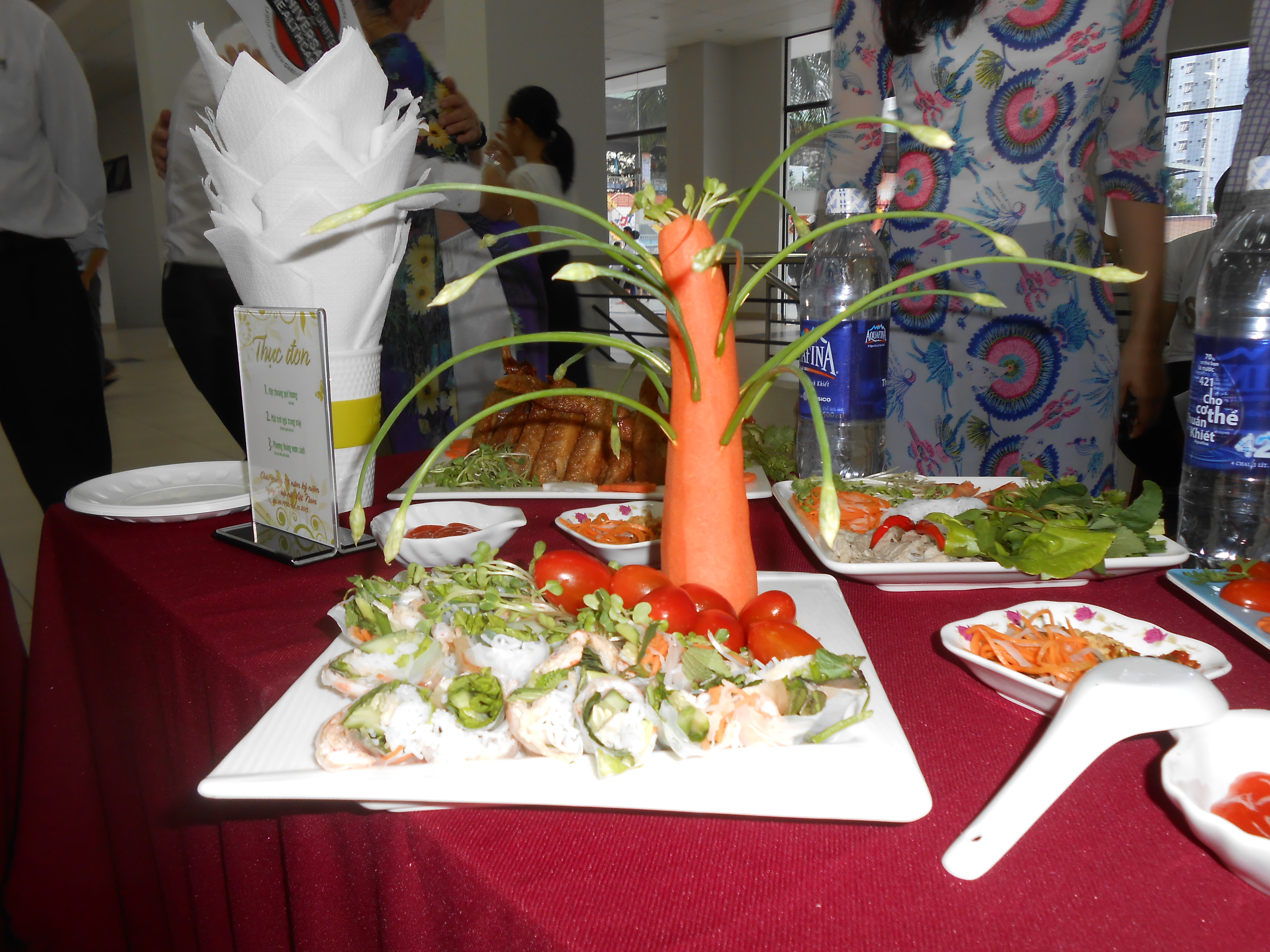
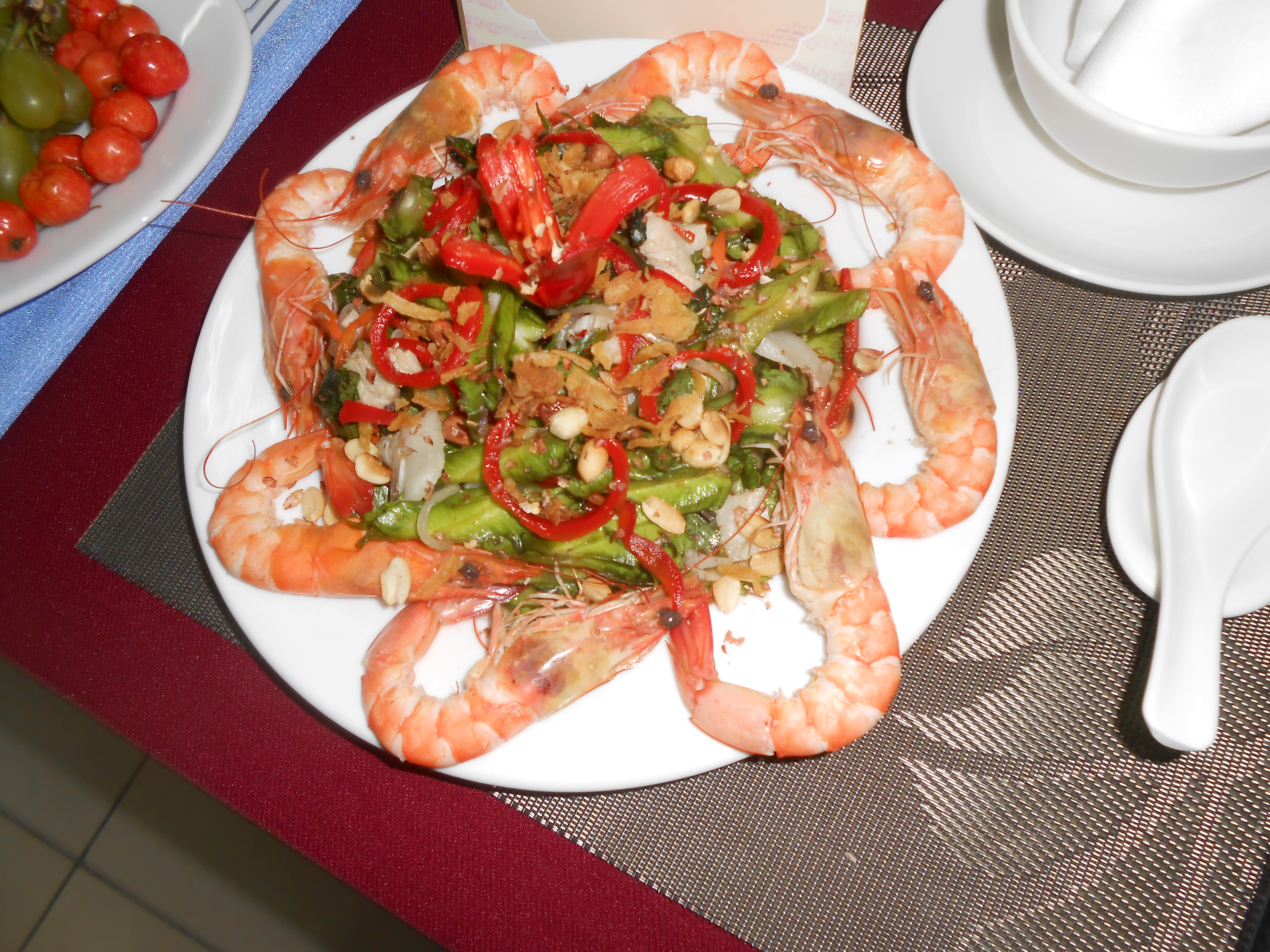
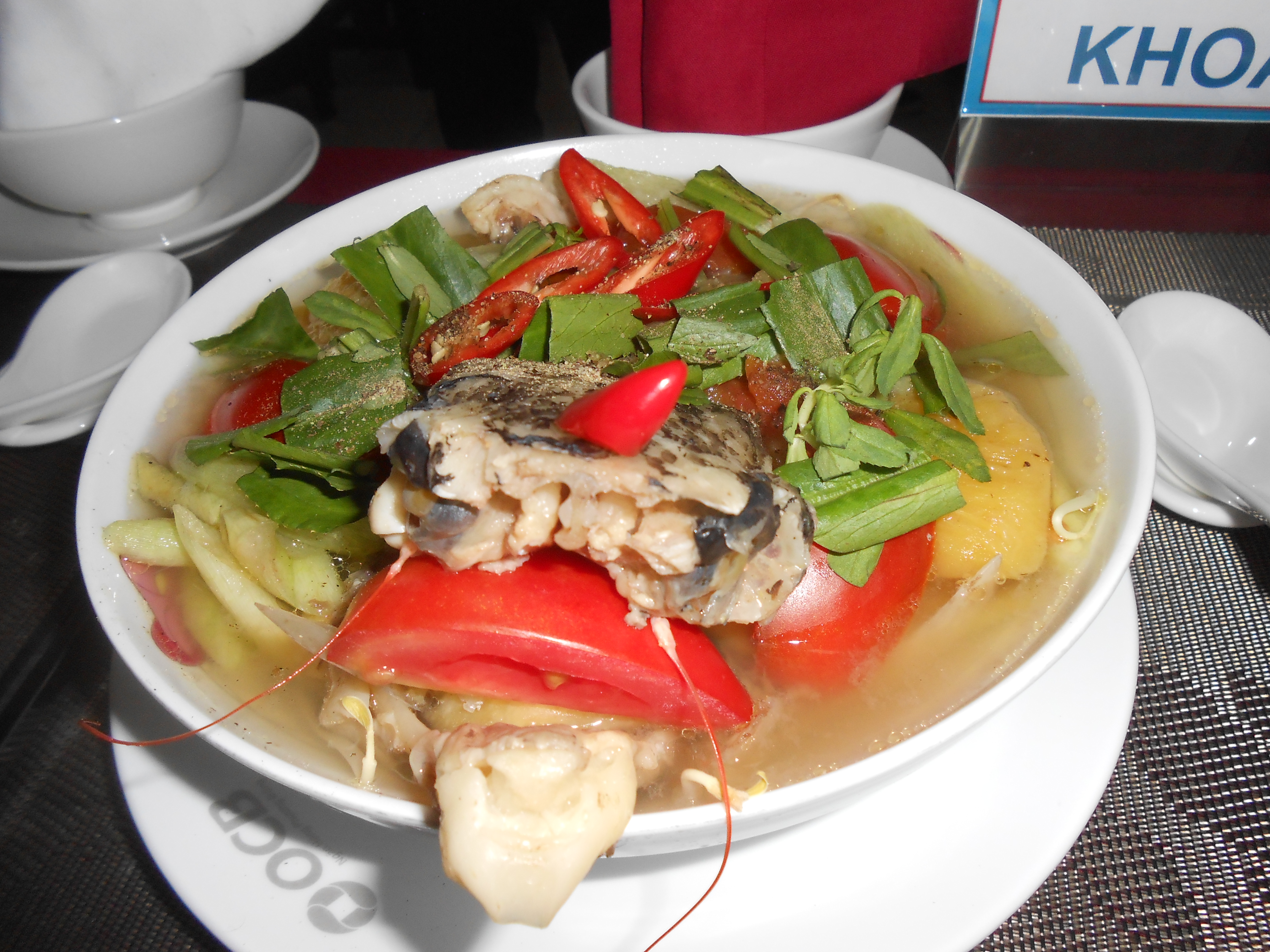
Here are some photos of the food.

DSCN2075 DSCN2076 DSCN2077 DSCN2078 DSCN2079 DSCN2080 DSCN2081 DSCN2082 DSCN2083 DSCN2084 DSCN2085

Purple flowers are lotus blossoms.

DSCN2086

DSCN2087I tasted this. It had coconut in it and was great.

 DSCN2090 DSCN2091  DSCN2093

Something chocolate getting lit on fire.

DSCN2095

One of the officers who supervises the dorm, and his wife.

DSCN2097  DSCN2099 DSCN2100 DSCN2101

This drink is made with lotus blossom pods, sour plums and something else. I wanted to try the strawberries but so did everyone else. The department that prepared this was “the researchers.”
DSCN2103 DSCN2104

DSCN2106

 The accounting department’s entry.

 DSCN2108 DSCN2111

The International Business department. Helen in the pink ao dai and Hieu on the right.

DSCN2112

The banking department.

 DSCN2115 DSCN2116 DSCN2117 DSCN2118 DSCN2119

This is the entry of our department, the Labor Relations and Trade Unions Department.

 DSCN2121 DSCN2122 DSCN2123 DSCN2124

First time around, I missed the Four Magic Animals: A Dragon, a Unicorn, and Turtle and a Phoenix. This is from the Accounting Department.
DSCN2125 DSCN2126

The judges come to look at the Research Department entry.

DSCN2127

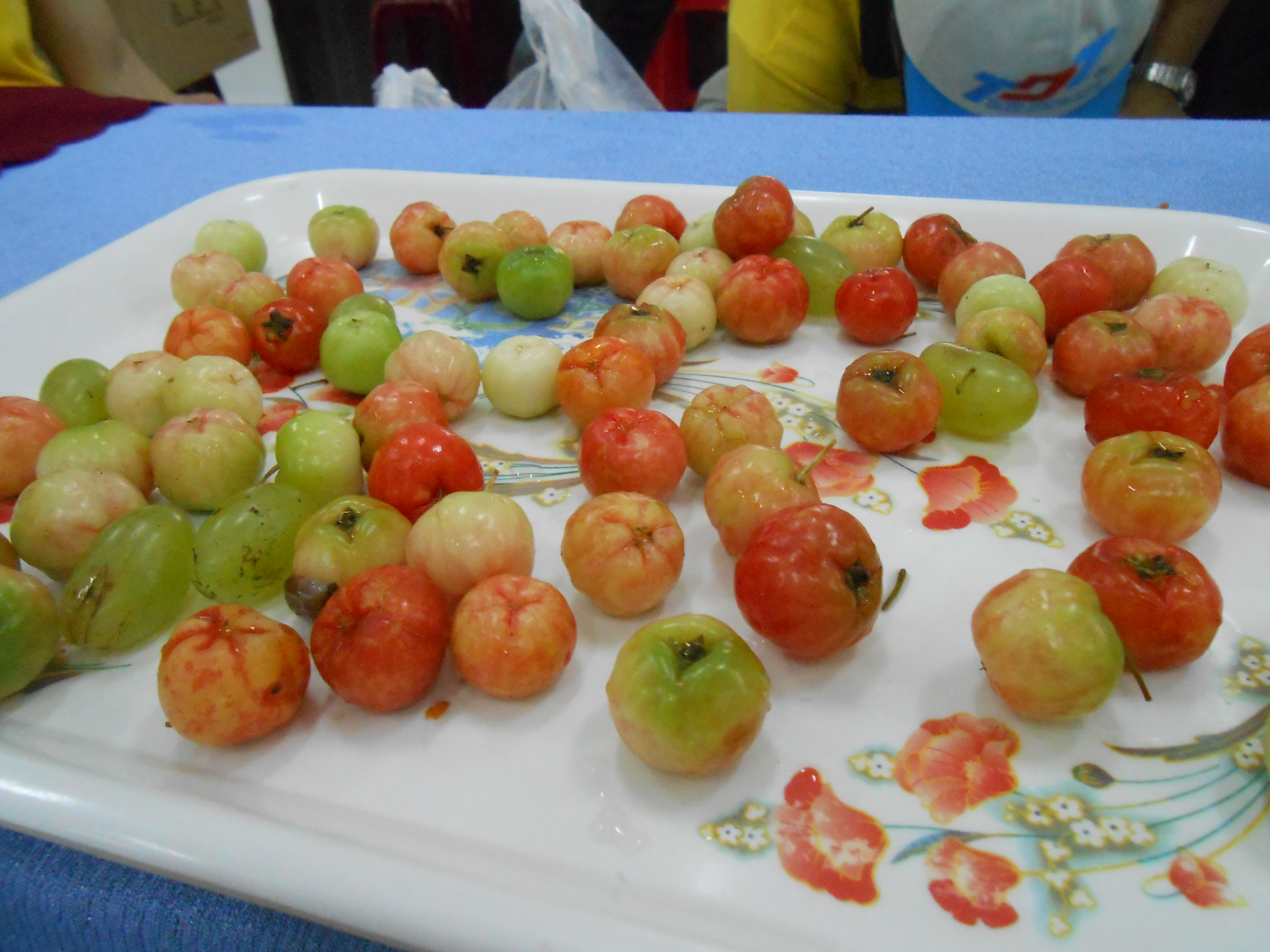
What are these?They are not tomatoes. They are sweet.

Final conclusion: US and European people do not understand food. Here are the facts about food.

Human beings are part of a food chain. Look down the chain to snails, leaves, algae, bugs, and whatever. Look past what you can see to microscopic life forms. This is all food. Look across to our close relatives such as pigs, cattle, monkeys, buffalos and dogs. These are also food. Anything you can dig up, grab, chop, capture, chase and run down is food because they are all alive or were once alive. They all make life out of molecules of carbon bonded with other elements like oxygen, nitrogen and hydrogen. Also, all parts of these life-forms are food. Not just the outside, or the soft parts, or the parts that don’t wobble.

Sometimes you have to do things to food before you eat it. Human beings have lots of ways of treating food to make it edible. Many things only need to be boiled. Other have to be dried, left out in the sun, buried in a jar or soaked in some strong chemical. Sometimes one part of a food is edible while the other part is poison. That’s a different project, quite do-able.

Most of the time, we ourselves are not food until we are dead, and then what eats us is worms and bugs. Sometimes we get grabbed or run down but this has not led to food prep traditions that I am aware of.

And that’s the whole story. There are no forbidden animals (like pigs, for example) or forbidden combinations (like meat and milk).

Shopping for an Ao Dai

Vinh took me and Joe shopping for ao dais to wear at her wedding in Hue later this month. The picture below shows just a small piece of the beading and embroidery on one of the ao dais that Vinh’s mum is going to wear. I like that green; I asked Vinh if it was all right to choose a very similar color. She said it was not a problem, and that you couldn’t be sure which ao dai her mum would wear anyway.

VInh's mum's ao dai

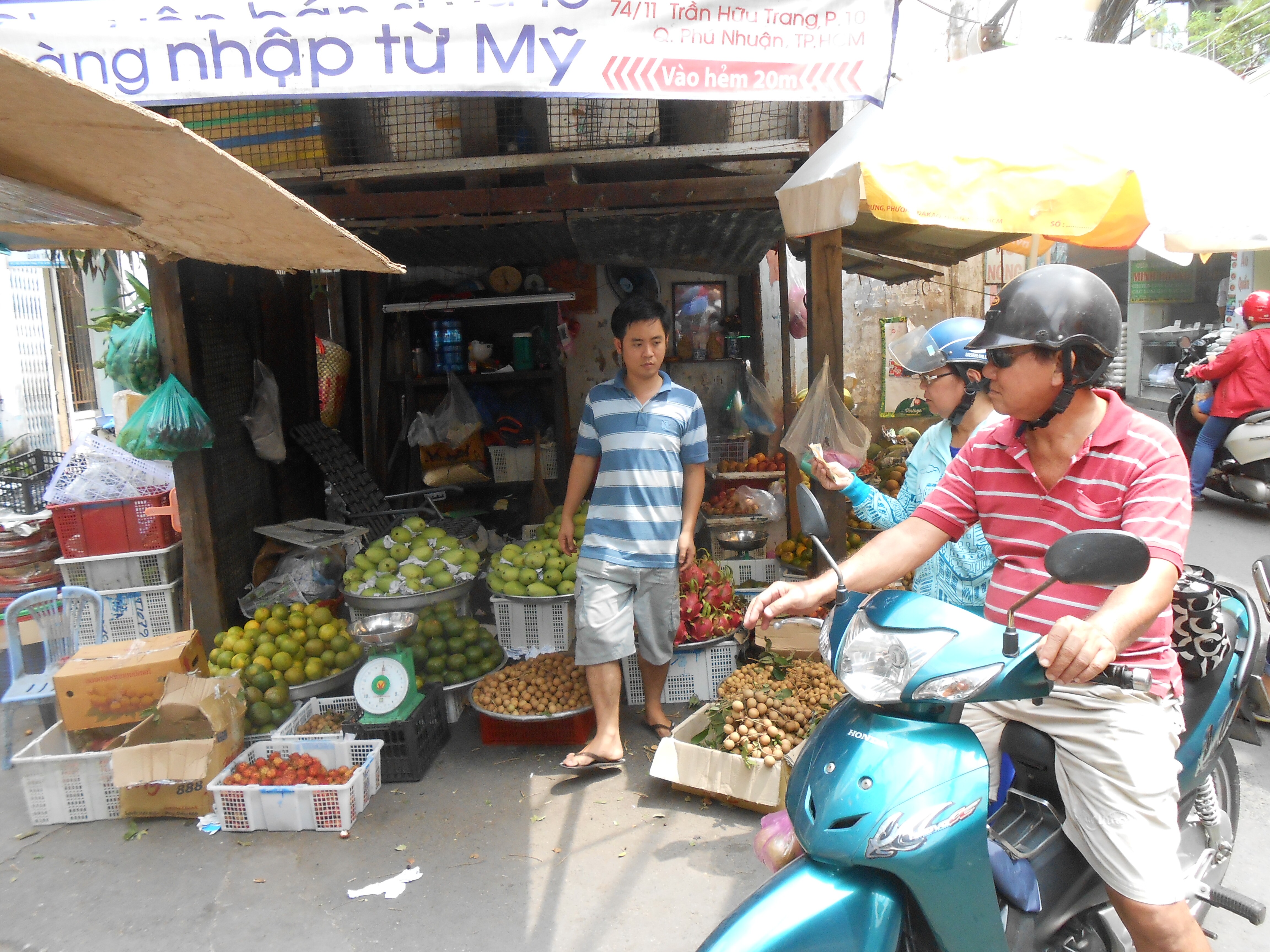
We went by taxi into the city, to a certain market that Vinh knows.  It was down a long narrow street, too narrow for cars but just right for motorbikes, near the train tracks. This picture is outside the market, which was huge and dark. A market is apparently not just a collection of people on the street selling things. instead, it is a specific, purpose-built large covered building where you rent a stall. It is not an activity, in other words. It’s a place. A bunch of people selling things does not constitute a market. I have actually not understood that. I only just figured it out.

Market

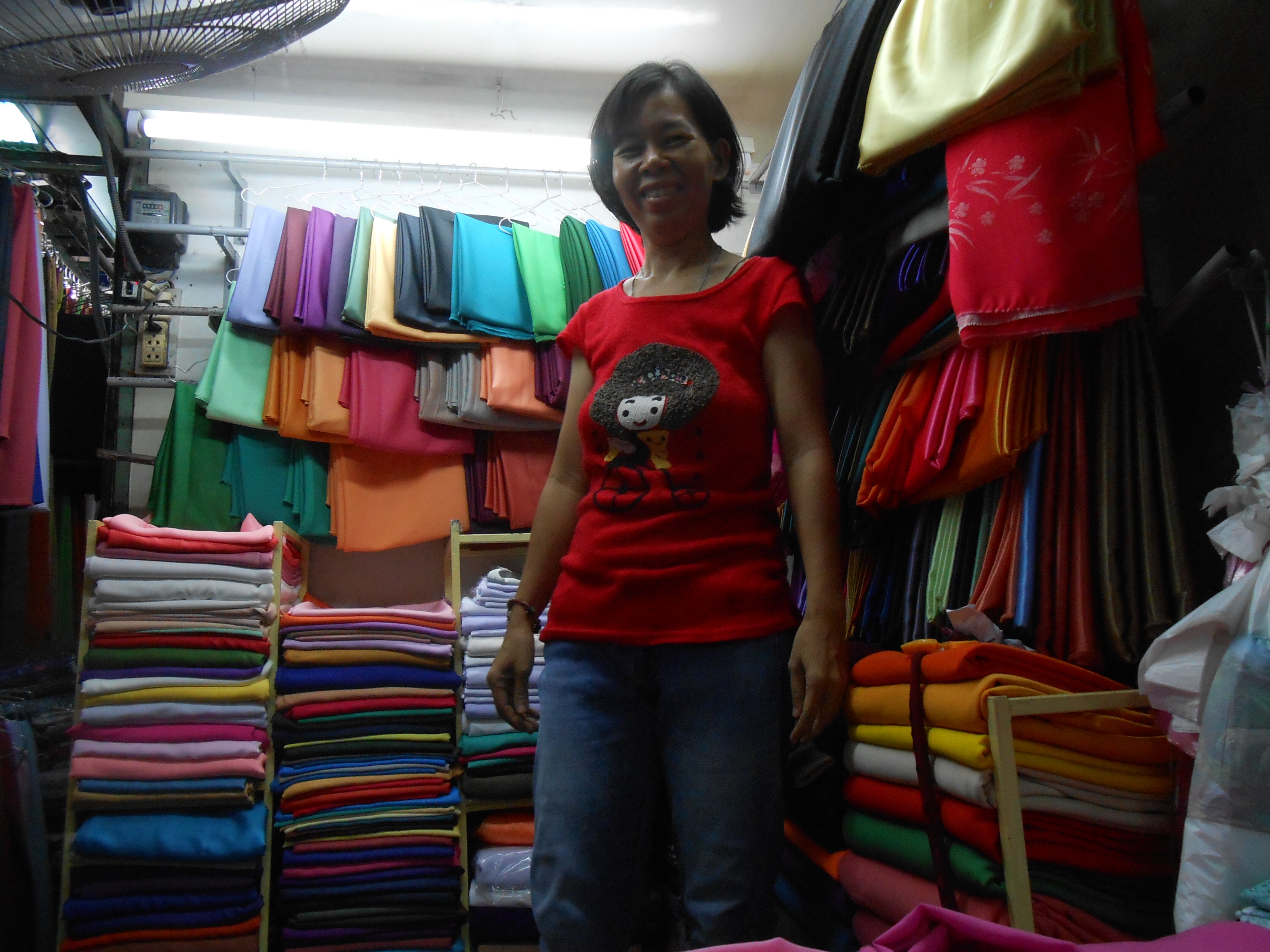
Vinh took us to a stall where she had bought fabric before and she knows the woman who owns the stall.  I know that the picture is pretty dark; so was the market.

Fabric vendor

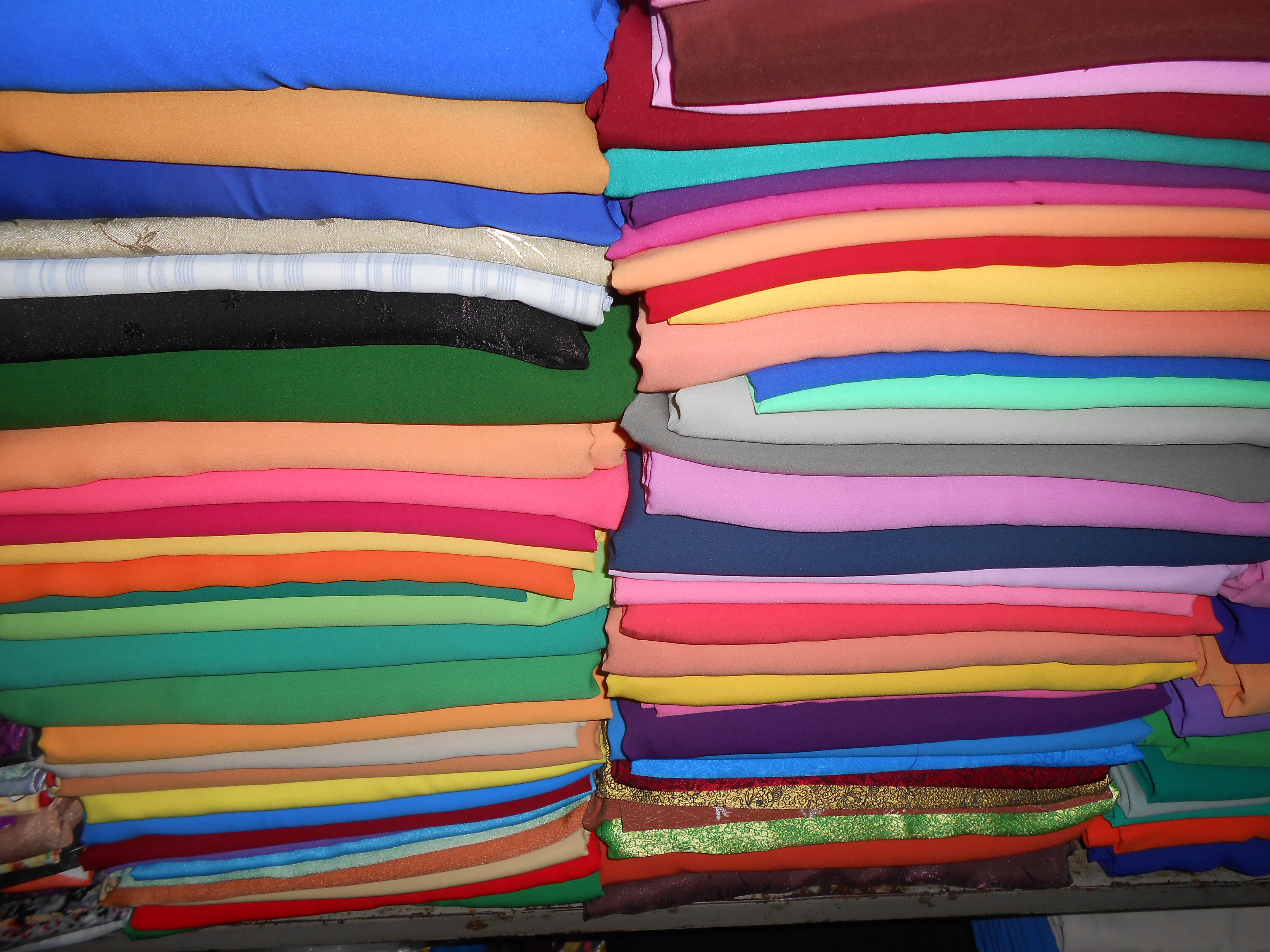
As usual, I was overwhelmed by the colors and textures of the market and could hardly calm down and choose a fabric. Joe didn’t have much problem choosing the fabric for his ao dai. He chose a dark blue cloth with gold bosses and a dragon in the weave. He also chose white polished cotton for the pants.  I took much longer. I didn’t really understand how to choose the patterned fabrics, especially the ones with enormous floral shoulder-to-hem patterns. Finally, I chose two fabrics. One of them is the lower of the two shades of green in the left hand pile. The other is a purple and silver overall small floral pattern, double-sided. I chose a kind of creamy white silk for the pants. Total cost for the fabric for 3 ao dai: about $70.00

Ao dai cloth

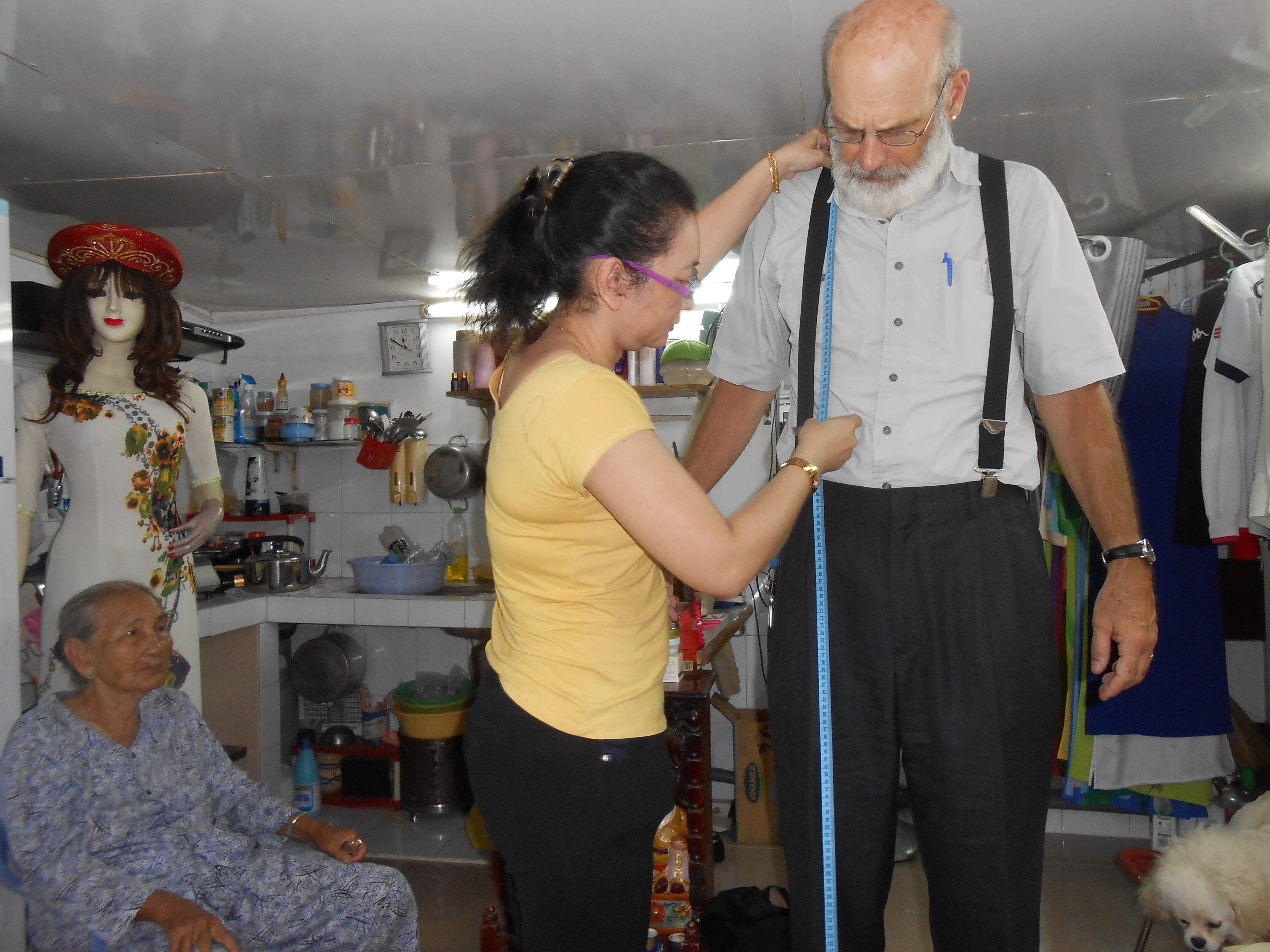
Then we walked back to the main street and got a taxi and went to Vinh’s tailor. She measured both me and Joe.

Joe being measured

The woman in the lower left is her mother, who lives nearby.

The ao dais will be ready in about 10 days.

Here is the tailor’s sewing machine, a Butterfly, made in China.

Sewing machine

Then we went and had lunch, vegetarian, near the pagoda. It started to rain really hard. That’s not exactly a red wagon in the rain, but it’s a red scooter and it’s equally beautiful.

Rain during lunch

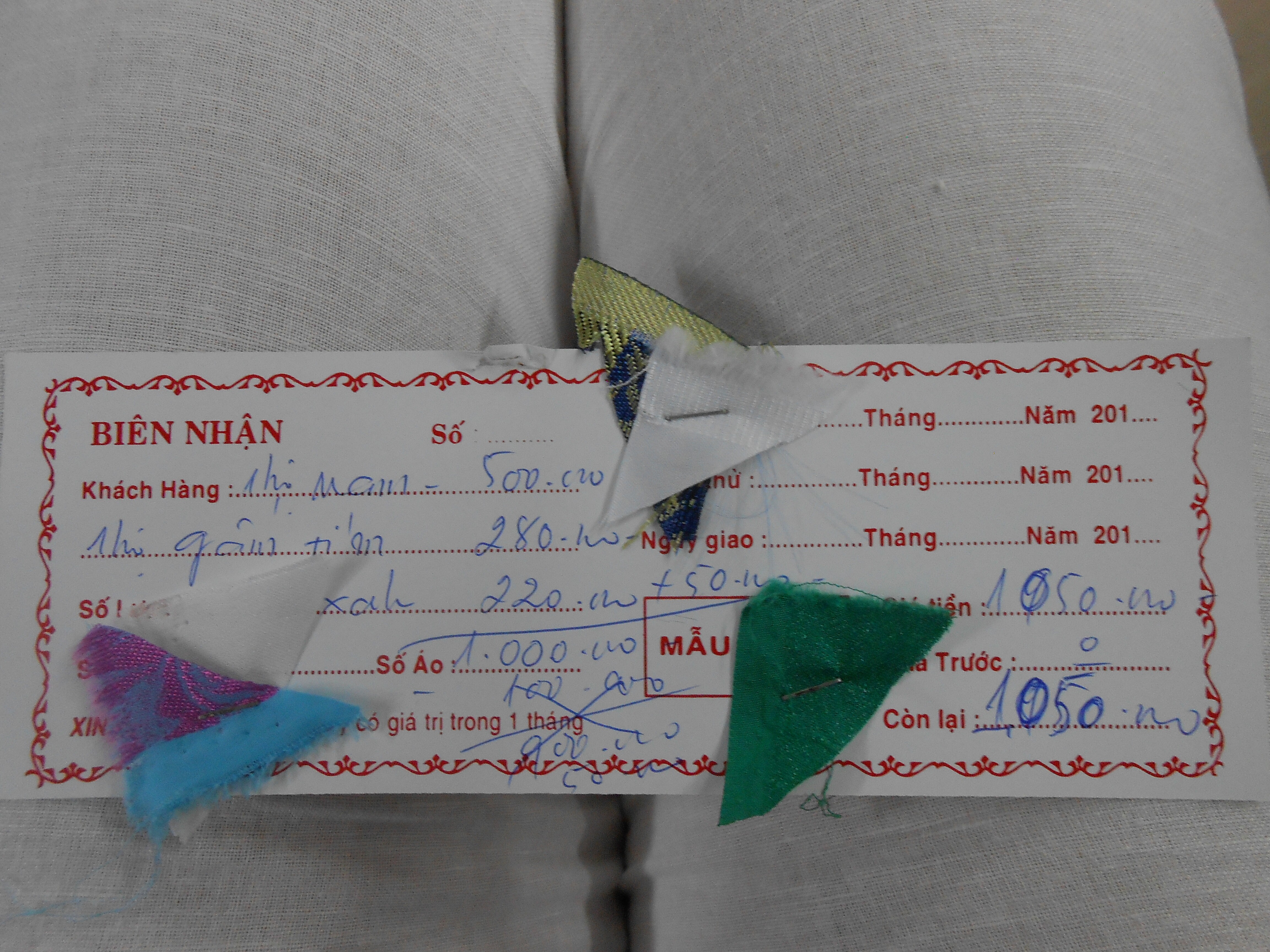
The receipt, showing the different fabrics stapled onto it. Altogether, 3 silk ao dais with 2 pairs of pants made to order will cost about $110.

Receipt

We got a taxi and went back to Ton Duc Thang, where we met with the Accounting Faculty for a session of English practice. They are a very friendly, good-natured group of people, young like everyone else here. Their English grammar and vocabulary are much better than their pronunciation, so we are probably supposed to help them most with pronunciation. They seemed to get along well with each other –lots of laughter – and were very welcoming to us. They gave us presents — mugs with the image of Ton Duc Thang on them. I am drinking ginger tea out of mine right now.

Gave my Midterm in Cross-Cultural Leadership Yesterday Afternoon

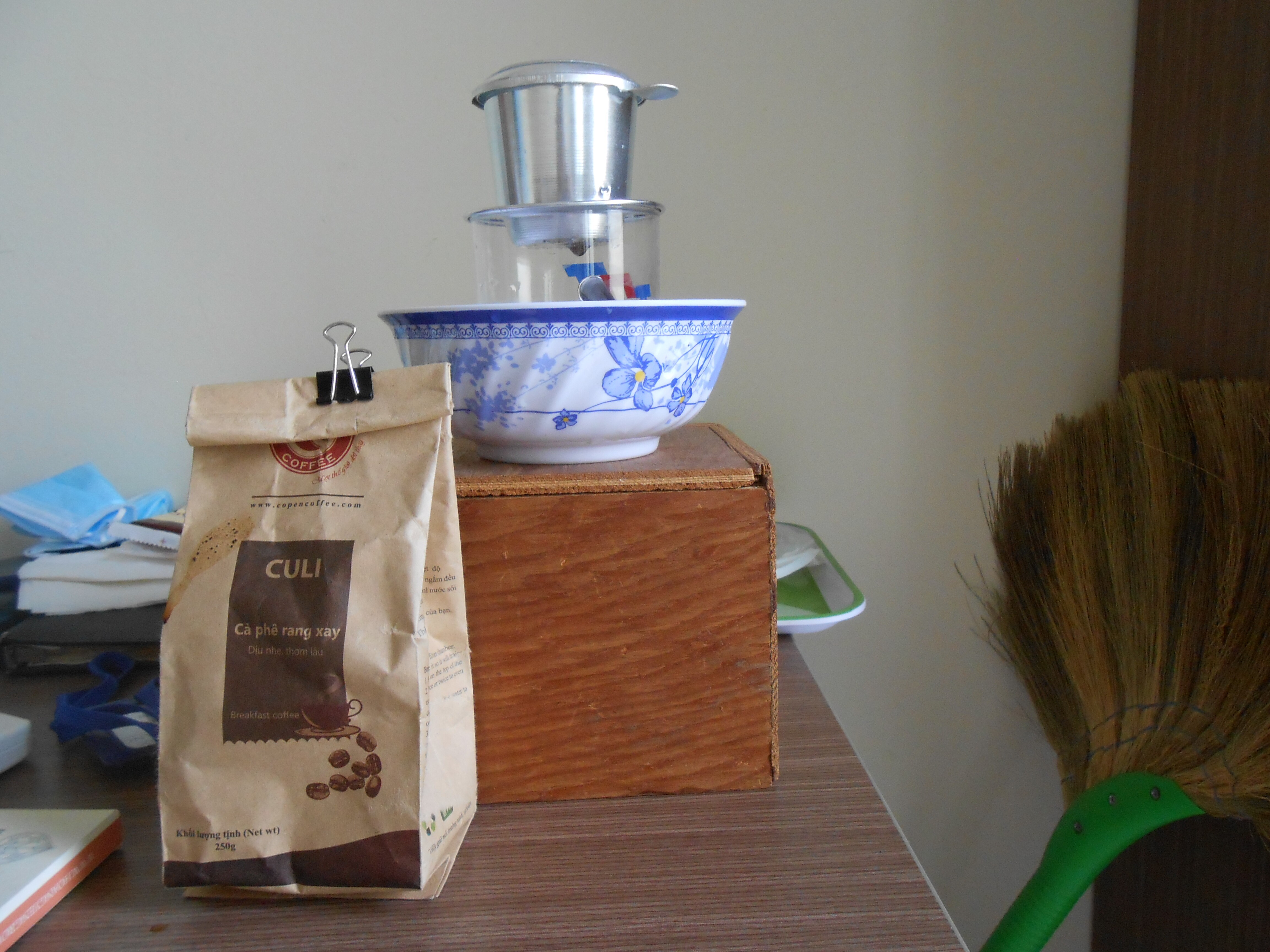
  How to make coffee

Coffee making equipment

 I wrote 40 multiple choice questions which were to be divided into two tests each with 20 questions. I had to also provide the answers. The answers had to be from either the readings, the handouts, or my power point slides. The two tests with answers would then go to the Department of Evaluation for checking and approval. The D of E would also grade the tests, using the answers provided.

I was told that I had to write two tests in case something happened, like the electricity went out. However, after he put the tests into the proper TDTU format on special exam stationary, Heiu suggested that I use both tests and go one-two-one-two, alternating them down the row “because they sit so close.”

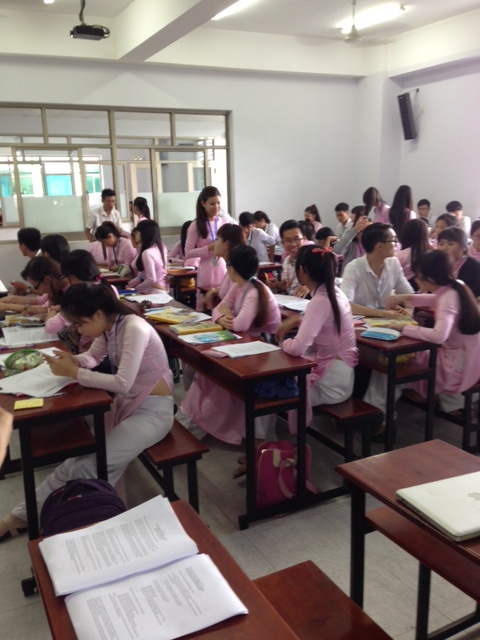
The exam was held in a different room from our regular classroom but the same kinds of desks. Three or four people sit elbow to elbow at these desks. Nhu, the class monitor, handed the exams out. There weren’t enough so she had to run go get some more, and this created a Group Two of the students who started 10 minutes later.

It was an open book test. Not just book – it was also open laptop, open phone, open notebook. Also open friend-sitting-behind-you, which pretty much defeated the purpose of one-two-one-two. To say nothing of the fact that laptops were shared – often a whole row was sharing a laptop. I noticed a couple of kids — boys — who were sitting at the ends of rows and didn’t really get a look at the common laptop. They looked a little lost.

As soon as the tests were distributed there began a constant murmur. Some of it was people reading aloud, but other parts of it were people simply having conversations, discussing the questions (but in Vietnamese, of course, so I didn’t really know).

The test was supposed to be one hour. They finished early. We struggled through some other exercises and then I let them go 10 minutes before class was supposed to be over. I hope the Department of Evaluation doesn’t hear about this.

This evening I looked up Zero De Conduite and watched it. Made me feel better.

https://archive.org/details/zero_de_conduite#

I now have students from this class friending me on Facebook, which sounds like “futhbow” when spoken by a Vietnamese. If any of you are reading this, go watch Zero de Conduite.

Hieu saw me in the hall this evening and told me that he had graded the exams (not the Department of Evaluation  – I must have misunderstood) and that they turned out very well. Most students got nearly 10 points. The lowest was a 7. He also said that he noted that some people got the same wrong answer.

When I walked down a hall later I saw students taking an exam. they were sitting one person per bench, zig-zag so no one was behind someone else.

I am going to have to learn something about classroom discipline. I am really at a loss for what to do. I keep telling my self that I don’t care if they all get good grades, all I care is that they’re learning something.

I am also going to re-read Madame Binh’s description of the way the educational system was set up following the American War. That was only 40 years ago. This is a young educational system!  She was Minister of Education starting in 1976. In the North, education was a priority even during the war. Illiteracy had been nearly eradicated. In the South, illiteracy was high and schools existed only in the cities and in some places along the national highways. She writes:

We organized a major mobilization to send northern teachers to support the southern provinces…During 1977 and 1978, several thousand teachers from northern provinces answered the ministry’s appeal and volunteered to serve in the southern provinces.

By 1983, she says, the Ministry had a network of public schools in every southern province, district and commune. But getting enough teachers trained was another matter. They had a word for it when a teacher had students who were only one grade or less below them: “Rice dipped in rice.”  This reminds me of the literacy campaigns in Nicaragua and Cuba. She visited the Ha Noi Pedagogical Institute and says she “immediately felt uneasy. The students’ situation was impossible. They had to eat standing up, for there were no chairs. Each table had a pot of rice, a dish of salted vegetables, and a bowl of “pilotless” [meatless] soup. Each student had a bowl and a spoon. That’s how they ate!”

Teacher’s living conditions were very bad. “We were desperately poor,” she says. “People had nothing” (354). One school got permission from the local authorities to plant 10 lychee trees at an educational office. That was enough to “improve teacher’s livelihoods” (342). Other sites copied this idea.

In this midst of all this came the attacks from Pol Pot in Cambodia against southwestern Vietnam and the Border War with China and conditions got worse.

But in 1983, vocational training schools were established. “All teachers and students both studied and did manual labor.” The idea was “take productive labor into the schools: (353).  Students planted trees, built factory schools and planted experimental agricultural fields and gardens for traditional medicine. A”study and work” model of schooling had in fact been started in Vietnam back in 1974 to enable older rural youth to get some schooling. This model was followed by Cuba. Students at these schools produced things ranging from cassava to pottery to educational materials and kindergarten toys.

But in the midst of the extreme poverty shared by everyone, “anyone making even the smallest profit from a creative enterprise suffered from police watchers and became the topic of malicious gossip”(355).

Unfortunately, instead of seeing the movement’s larger meaning, some people intervened and stopped the students’ activities because these initiatives were “beyond” the very strict socio-political-economic limits enforce by the “economic police” at a time when we had an extremely rigorous model of socialism (348). 

The days when the “economic police” could shut down a school because it was supporting itself by selling vegetables are gone. Now there seem to be universities everywhere. This is in the span of time since Gabi and Jake were kids going to school in Berkeley.

But when we got our exams back, in big brown envelopes sealed with tape and with all the names of students torn off, it turns out that the Department of Evaluation doesn’t actually grade them (even though we provided answers so that they could grade them). Instead, we grade them and then the Department of Evaluation picks out one or two randomly and checks the way we grade them against the answers we previously provided, and compares them with the answers we provided, to make sure that we are not corrupt and giving good grades to students who don’t deserve them.

If they should happen to choose a paper that has an answer that we didn’t forsee, and we gave credit for it, what will they do?

High Rise and just plain highs

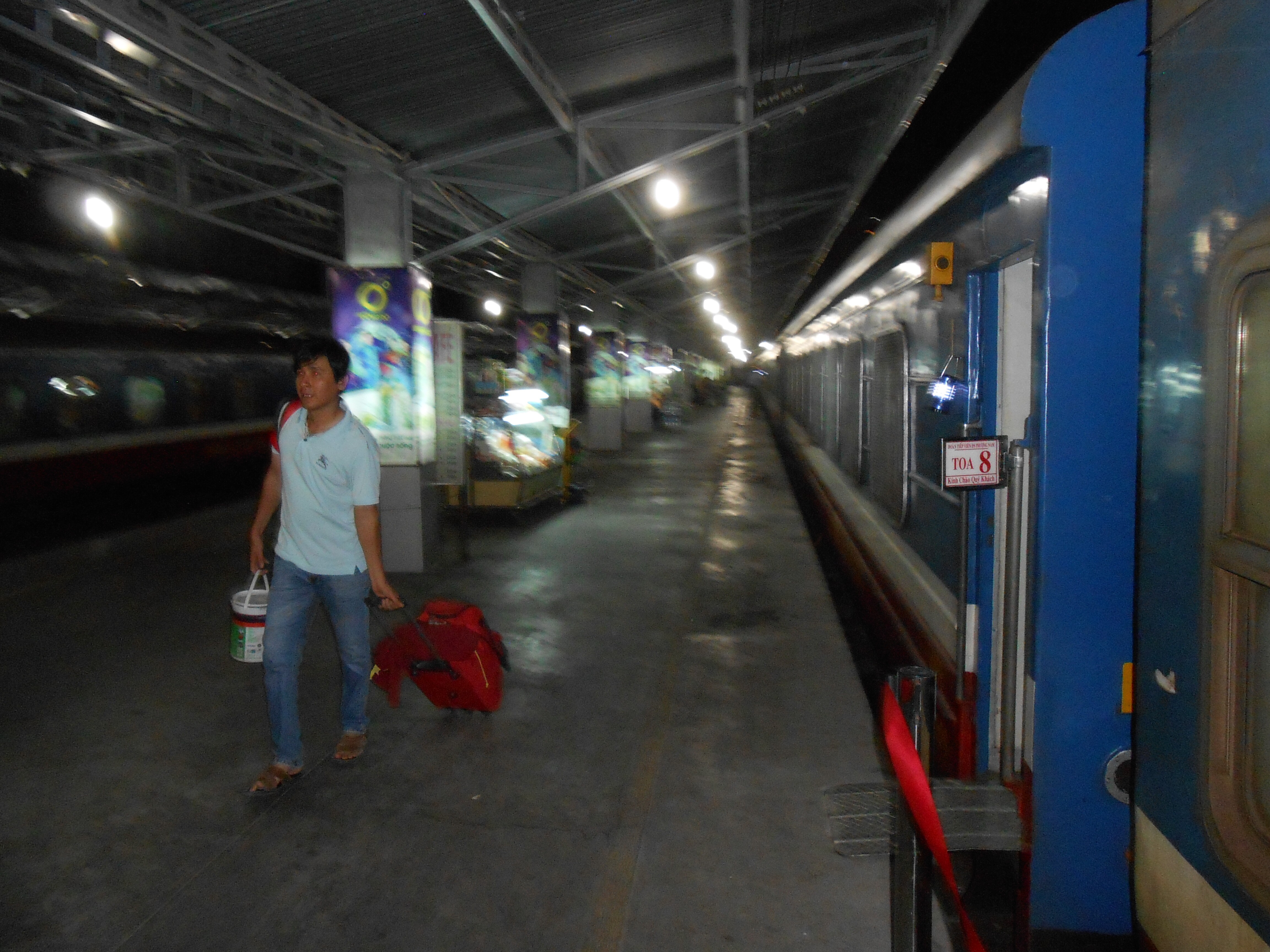
train platform

Night train from HCMC to Nha Trang

Dinner Wednesday night Sept 30th with Shawn Shieh, pronounced “shay,” who is the Director of Development and Operations of the China Labor Bulletin, http://www.clb.org.hk/en/,

a regular online publication coming out of Hong Kong that covers labor in China. His background is working with civil society organizations in China, although he was a tenured prof at Maris University in New York at one point. He’s married to Betsy Shieh, who works for the US consulate in the commerce department, finding ways to sell US made products in Vietnam and thereby keep US jobs in the US. He lives in Hong Kong, she lives in Ho Chi Minh City, and they visit back and forth. Joe had made contact with Shawn via a Vietnam study group discussion list.

We met in their apartment in District 1, right along the Independence Palace Park. Up on the 6th floor, overlooking the city. It had a terrace large enough to serve dinner for 20 and a living room to match. I’m mentioning it because it was definitely a different side of our Ho Chi Minh City experience, in fact, an outlier on my spectrum of available housing options. It could have been plopped down from a brand-new, very nice condo building on Lakeshore Drive in Chicago. It’s provided by the consulate, furnished with dark wood furniture that is half-Asian half American-comfortable.

Long conversations ensued. Overall, Shieh is interested in developing labor-side collaborations among southeast Asian nations, including Vietnam, Cambodia and Bangladesh. There will be more conversations.

On Thursday afternoon, after a meeting with three spokespersons from the Accounting Faculty (they want some help with their spoken English and Dean Hoa has indicated that this would be a helpful thing for us to do), I went to the Lotte Mart and bought two pairs of thong sandals, one plastic but white, the other black leather with soft, padded soles. Both were in men’s sizes. No-where in the Lotte Mart did they have a women’s shoe size 42. I spent nearly $45 on the leather ones, which felt criminally expensive, but in the US these would have cost $145.

Anyway, I was very glad to have bought them because the next thing that happened was our trip to Nha Trang and I wore them all the time.

It is not going to be possible to describe everything we did on that trip. Nghia and Vy (pronounced Vee) came to our door at 5:30 pm. We were ready. The taxi was late, though, and there was a lot of worry as we fought our way through the incredibly polluted traffic, picked up Anh who was waiting in the fumes near Lotte Mart, and headed for the train station, the Ga Sai Gon, which may be the old Gare Saigon as in Gare du Nord. Vinh came on her motorbike. This is a trip Vinh started planning back last spring and sent to us all written up in our contract which we got in July.

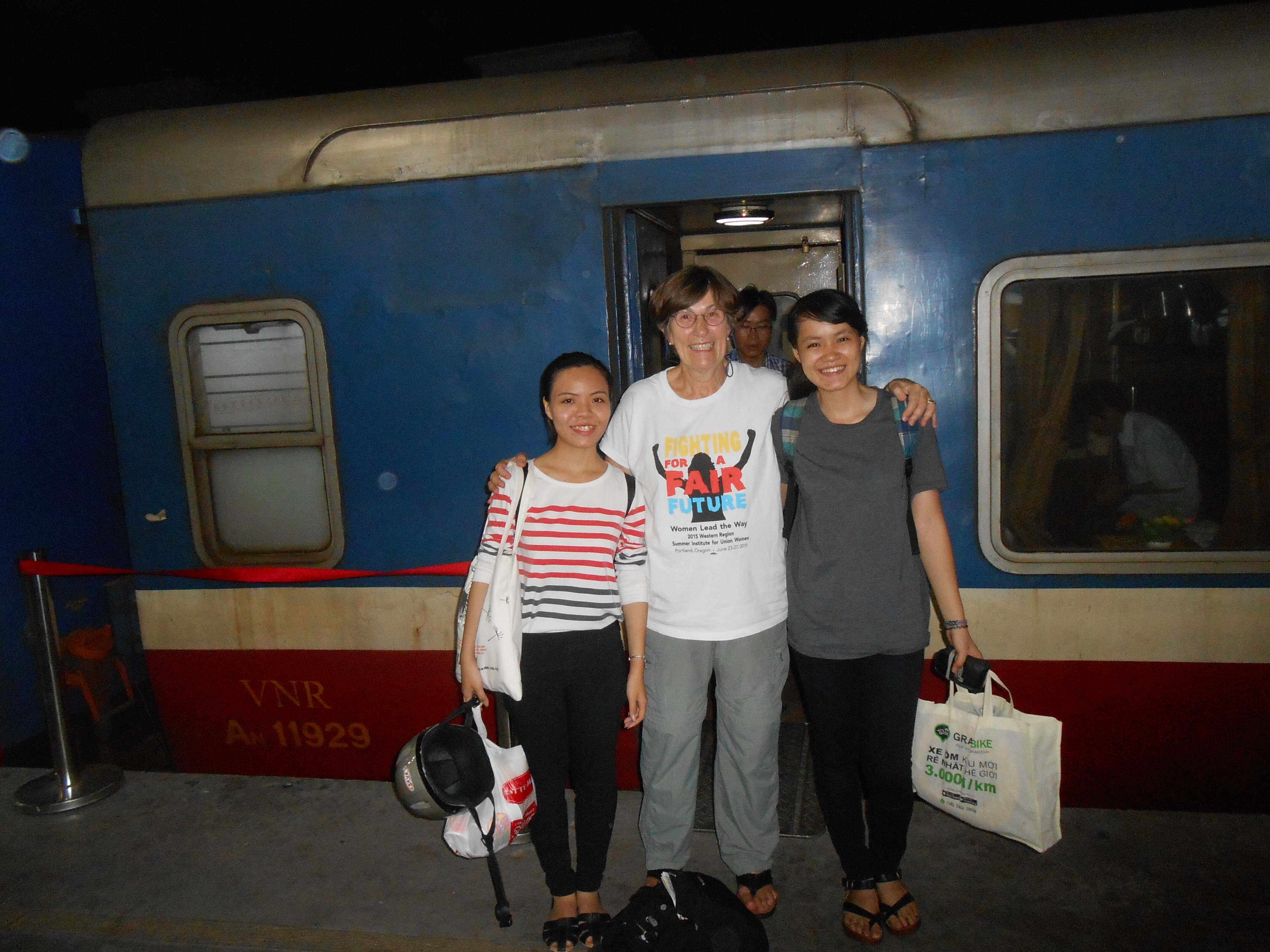
Getting on train

Vy, me, Anh getting on train going north to Nha Trang

How to describe this?

Nha Trang is a beach town with blue green mountains in the background and islands out in the bay. It’s very beautiful. The mist comes down between the mountains. The islands in the bay make it look as if some of the mountains just kept on marching down into the water.

We saw more “foreigners” on one block there than I’ve seen in a month here. Big blond women in bikinis, striding along the street, sometimes wrapped with a silk shawl. Nha Trang was a Soviet vacation destination and all the signage is in Vietnamese, then Russian, then maybe English. The beach is golden, the water is bathtub warm and ripples.

We stayed at the Ton Duc Thang campus dorms in Nha Trang, which were before 1975 a Catholic institution (nuns? Monks? Large, clean rooms with tile floors). The university is up high on a bluff overlooking the sea with great views. Right next to it is Nha Trang University, producing what felt more like a campustown with multiple coffee shops than anything around TDT in HCMC.

In three days we ate incredible amounts of seafood of sorts that I hardly recognized, saw tourist destinations, including the 9th century Cham towers, a giant Buddha that overlooks the whole city, and a Catholic church (Anh is Catholic) where couples were getting their wedding photos done. That’s just the tip of the iceberg.

Friday afternoon we rode out a long road that led uphill to a mud bath. Yes, a mud bath. Acres of gardens, pools, shower rooms, locker rooms, and then these tubs that they fill with slimy clay-y warm mud while your whole party sits in it together and you spoon mud all over each other. Incredible.

We traveled from place to place on motorbikes, rented by Vinh because they were cheaper than taxis. Three motorbikes, driven by Vy, Nghia and Anh, with Vinh and me and Joe on the back. Joe looked like a stepladder laid crosswise on Nghia’s back saddle; his knees stuck out, and since these vehicles stream through traffic like fish, anything sticking out is an accident waiting to happen. But we drove here there and everywhere, not too fast but pretty fast, and all was well. Yes, we wore helmets.

All day Saturday we spent at VinPearland, which is an amazing place, hard to describe. It is on an island in the bay. Look it up:

http://www.vinpearlland.com/vi/content/vinpearl-land-nha-trang

It used to be a prison island, according to Wikipedia. There is a Buddhist pagoda on a high point of the island, away from the amusement park.

The easiest comparison is to Disneyland. But you get there in gondolas over the bay, strung out over the longest cable car wire in the world (so I was told) and the piers or towers are lit up like Eiffel Towers when you come back in the dark at night. Once you’re there, you can go on all the rides and into all the shows, no special tickets. The only thing you’d buy is food, which is not all from one kitchen.

Huge water park with slides. Merry-go round. Roller Coaster. “Games.” Dolphin and trained seal show (Russian trainers, blond). A “European carnival” in which all the performers are “foreigners,” meaning people like me. A real beach. Shops for silks and pearls, probably for rich Russians, since I heard quite a bit of Russian being spoken. A really beautiful, well-done aquarium, light on science but really great on displaying amazing fish and reptiles, including a giant Red Iguana, and with a walk-through-under-the-water central pool with huge fish. Turtles, spiders, bearded dragon lizards. Many sharks including a whole school of white ones called “incandescent”. A whirligig that I rode on. A little girl with pigtails rode on it after my turn was up. She was about 6 years old, wore a pinafore type dress, and was almost alone on the ride. We were sitting at a café nearby and could look up and watch her. She was in seventh heaven. She was like Joe in one way — they were incredibly relaxed up there, just flying through the sky.

More things that I couldn’t keep track of.

On Sunday morning we met the Vice President (who couldn’t meet us on Friday morning because he was out sweeping the grounds with other university officers). He is a martial arts expert and looks it. A quiet, soft-spoken small man who makes James Bond look like a sissy. He asked us if we had some ideas for teaching labor classes at TDU Nha Trang and unfortunately I had more questions about the university, and we didn’t get a chance to answer him.

But the main thing that I will remember, once all this starts to blur into memory, is that when you are traveling with three students in their early 20s, and their chaperone is 26, you get up early, get going right away, eat a whole lot and stay till the place closes. You have amazing amounts of harmless fun, laughing and rushing around, talking a mile a minute, making up silly games just for the purpose of having more fun.

I am so serious!! Joe and I are so serious together!!! We work all the time. I couldn’t believe that we weren’t going to be able to do a couple of hours of computer email and writing and studying and grading papers every day when we got up in the morning! No, it was up and out and onto the motorbikes and get some breakfast and then off down a list of adventures, including things like riding out to an island in a gondola for no reason at all except to have fun. No one was getting any work done at all! Even though Nghia had two exams on Monday, and the others had exams the rest of the week.

The train going up was not so great, although Joe and I each had a full upper bunk in a 4-person cabin with only one other person in it. The bunks were long enough for Joe. There were actually two sitting-up cars, one with padded fold-back seats and one with wooden upright seats like pews. Beyond the hard-seat car was the dining car, with a full kitchen but not a lot of people eating. After you had stepped over the kids, babies and grandmothers who were spread out under the seats on the floor of the hard-seat car trying to sleep away the miles, it didn’t make you want to proceed further and order dinner.

A civil engineer who asked if he could practice his English with me said that this train was 100 years old, which made sense. The floor of the corridor was wood planks about 8 inches wide. The cabins looked as if they had been re-built many times.

Of course I stayed awake all night long looking out the window, especially because halfway up the coast we came to the region where they turn on the lights for the dragon fruit at night, to stimulate another crop. Nghia says that you can get four crops a year out of the bushes that way. It’s as if whole fields are lit up with Christmas lights. Also, we got to Nha Trang at 4 am Friday morning.

The train coming back was the national train (the one that goes back and forth between HoChiMinh City and Hanoi) and was a little fancier. It had potable water, reading lights and the mattresses had fitted sheets. Joe and I will probably take that train up to Hanoi in December. I walked the length of the train and saw the hard seat car but didn’t walk through the people to get to the dining car. Vinh had brought a whole lot of “local specialties” on board after a made dash to the market, anyway.

For dinner on Saturday night,  we went to a huge seafood open restaurant with tablecloths.  In all these seafood restaurants the creatures are swimming in basins and you choose which ones you want; they get weighed and then come to your table as a dish. Vinh, an inveterate bargaining, would always get “the best price.”

The students had paid for their own train tickets, which actually meant they were supposed to stay in the hard seat car.

At the end of the trip, coming back down into HCMC, we played a game where everyone had to make an animal noise. The rules were complicated. There may be no way to assign 6 numbers to 6 people — randomly. We couldn’t do it.

I have to say, I do not want to forget this kind of silly fun. It really is a different way of being in the world. It makes me look at a lot of the kinds of things that people do for fun differently.

Working as an adjunct in Vietnam

What is it like to be an adjunct (part time) English teacher in higher ed in Vietnam?

Jessica, (her English name) came by our office at Ton Duc Thang University this afternoon. I had sent her an email asking permission to write down some information about her working conditions and she offered to drop in and answer some questions.

She is a very tall (for a Vietnamese) young woman who dresses elegantly in business clothes and speaks very fluent correct English, although without the relaxed intonations of a native speaker.

The Office Next Door

The office next to ours, as I mentioned before, is a generic meeting room with 10 upholstered chairs, air conditioning, and some small wooden coffee tables. It serves as both the gang office for adjunct lecturers (part-time, not full-time “regular” teachers, who are also called lecturers) and for meetings for whole faculties such as the Business Administration faculty which is across the hall from us. Another use for this office, however, is for sleeping. Adjuncts push two chairs together and lie down across them and sleep. One day last week I saw five women (they seem to be all women) sleeping quietly this way. They also eat lunch here, spreading a napkin out on a table, and grade papers and talk on the phone.

Jessica was one of the sleeping lecturers once when Joe walked past that office. A few minutes later I met her in the ladies’ room and she said “Hello,” in her very good English. So we talked and I asked her to come into our office and talk some more. Joe loaned her a copy of his book, Reclaiming the Ivory Tower, which is about organizing adjuncts, and she kept it for two weeks, actually read it, and told Joe that she saw herself in it. Thus ensued a long conversation and probably more to come.

I thought it would interest some people who are reading this blog if I wrote down what her working conditions are like.

When she dropped in yesterday, she had just had observers in her pre-intermediate English class. These were new teachers, coming to learn her teaching techniques, which was fine with her except that she had had no warning and therefore had not had a chance to prepare the most appropriate lesson or inform her students.

I don’t need to explain how she felt about that, do I?

Two Jobs and Looking for a Third

She teaches at two places right now, at the TOIC Center at Ton Duc Thang and at Studylink, a private English Center. She is going to apply to the Open Minds English center, which is a separate private organization but it’s located in Building E at Ton Duc Thang.

She has been teaching English for 6 years. When she started teaching, she had only a university degree from the Ho Chi Minh City University of Pedagogy. Now she is working on her MA at the Open University in Applied LInguistics.

There are two different courses of preparation for English teachers in Vietnam – one is Applied Linguistics and the other is TESOL (Teaching English to Speakers of Other Languages). Either one of them is OK for English teachers, Jessica said, but in TESOL they pay more attention to methodology and in Applied Linguistics they pay more attention to research. She chose Applied Linguistics because the classes were offered at times which would fit with her own schedule.

She is 28 years old and lives with her parents. She is self-supporting to a certain extent; she gives her parents money for her food and rent, but what she gives them is probably not enough to cover their actual expenses. When she was a student, she worked as a tutor for high school students.

Job security, income instability, and lack of benefits

The problem (the same problem as for all contingents) is that her income is not fixed. It depends on how many classes she has each month. Typically she makes 12 million Vietnam Dong (MVD) per month ($533) but in order to earn that much, she has to work 7 periods per day of in-class teaching, plus whatever she needs of her own time to prepare the lessons, which is about an hour a day. In order to get 7 hours a day, she has to have two or three different jobs.

Right now she doesn’t have that many classes and her salary has gone down to 9 MVD ($400) a month. (By the way, this is the amount that Ton Duc Thang is paying each of us as stipend/expense money while we’re here. We find it sufficient given that we’re getting free housing and laundry, and can eat at the dorm canteens for $1 or $2 for a nice pho or rice-and-veggies plus meat meal. We spend about as much on taxis as we do on food. If we had to really live on it — pay rent, utilities, health insurance etc. out of it –  we would not make it.) The average wage in Vietnam these days, just for comparison, is between 3.1 and 4 MVD ($130-180).

In the previous semester she had 6 classes. That was the semester she made 12 MD. This semester she has 4. She said that she was expecting some more classes, but they didn’t give her any more. This information was not given in advance. The lecturers only learned it when they came to the school to start to teach. The official who made this announcement explained that the school changed their policy and now would not give lecturers more than 4 classes per semester.

Teachers talking about the problem

Jessica has talked with other English teachers a lot. They are all in the same situation. They are all affected by the lack of job security. But when they think about what to do about this new policy, they think it is “mission impossible.”

“No one is listening to us,” Jessica said. “Even the director of the TOIC center said, ‘It came from above.’” Someone up the administrative ladder makes these decisions and then the director just does what he is told. They don’t have the right to question it.

In one meeting, Jessica and some other colleagues asked the director about getting an increase in salary and some benefits for part timers who work mostly in the TOIC center. He said he couldn’t do anything about this.

Although lecturers have talked together about this policy and the lack of job security in general, they seem to feel that is impossible to “unite and raise our voice for benefits. It seems like nobody’s listening. People feel that there’s no use doing this – it won’t work.”

If part-time teachers teach 6 classes per semester, how many classes do full-time teachers teach? Full-timers have 720 periods (8 classes) per year. Also, the full time teachers have to spend more time at school – maybe they don’t have to teach, but they have to stay in their offices in case a student has any questions, prepare tests and observe part-time teachers’ classes. If Jessica were teaching 12 classes per year it would be 1080 periods. She would make the same money, but still wouldn’t have any benefits.

Why cut class load to no more than four classes?

What was the point of this change in policy, limiting part-time lecturers to four classes? Her guess is that they want teachers to spend more time on preparation for their classes. However, she said, this was not logical because if a teacher’s income is low, they will spend less time on preparation for classes because they have to find other jobs. This way they will lose even more time because they have to travel to those classes.

In the US, because of the new healthcare act, if you work less than 30 hours a week, the employer doesn’t have to provide heath care. This does not apply in Vietnam. But another motivation for cutting load is that when a substantial number of people teach at one place for a large percent of their load (not just one or two classes), there is always the possibility that they will get together and organize. Spreading out classes over more adjuncts would reduce their ability to organize, by forcing more of them to get more jobs.

Jessica speculated that maybe the administration didn’t want them to identify too much with the university. When lecturers have so many classes here, and spend most of the time here, the administration may fear that they will ask for some benefits.

Benefits

No benefits such as insurance come with the job. No office, no computer etc. There are computers in their classrooms, but lecturers can only use them when they are in class. When the class is over they have to get out.

Jessica buys her own benefits at 500,000 D for health insurance for a year. If she had to use it, she would go to the hospital near her place. It’s cheap but the quality is poor.

For lecturers who work part-time there is very little professional development. In the past, there were some workshops for part timers but this semester she didn’t hear anything related to that. They changed the director of the TOIC center and maybe the new one doesn’t want to hold those workshops.

A union?

Does she belong to a union ? No, she says, because she is not a full time teacher in any school. The union only represents full time workers. She has never heard of anything they could do for part-timers.

When I told Jessica that we have some students who work part time and are also union members, she was surprised. Jessica asked if they have any proof. In fact, this information came from our student research papers; some students who work part-time and are reporting on their own workplaces say that they think they are union members. However, Jessica has no papers that say she is a union member. You need those papers in order to get benefits. When she buys insurance they ask her if she works full-time for any company and when she says no, that affects the price. If she was a fulltime worker, the place that she works would buy the insurance for her. But she doesn’t work for any place full time so she has to buy it on her own.

The future

After the war there was a lot of migration in the country. Most of the immigration was from the Northern part of the country to the south, for work. People from the north, rural areas especially, moved to the south to new places where they would have more land to grow crops. Originally her family was from the north but moved to the south to Thu Duc District, an area where people are from everywhere. Jessica can speak with many Vietnamese accents.

When and if Jessica gets married to her boyfriend she will probably start her own private English classes. The province where they will live is remote. Most of the people who live there are farmers. It’s a very, very beautiful province but the population is quite small, so there won’t be enough students for her to open a real English Center. She would be teaching high school students. When they graduate from high school, they would probably go to big cities to study in universities.

When Jessica came by this morning to drop off her corrections to this entry she told Joe she was working on getting some people together. He has ordered more copies of his book.

How to Comment

If you are receiving this as an email from me, you won’t see the button that allows you to comment or follow. You have to go to the website (helenaworthen.wordpress.com) and sign up there. Then you’ll see a hot link line at the top of each of my posts that says, “Leave a Comment.” You also get a button that says, “Follow” if you want to follow.

There is a comment button at the bottom, too. If you follow, you get everything that’s added to the blog, both my posts and comments. But if you want to comment on those, you still have to go back to the blog website.

I appreciate comments. Some of the stuff I am reading is sent to me by people who are commenting. It all helps.

Now, for example, I have to go teach a class on Cross Cultural Leadership to a group of students from the International Business Program who speak pretty good English. This class is taught in English. I am going to do a collective bargaining scenario, as an example of a business practice (and also because the midterm exam won’t be ready until next week). This was not in the original syllabus and it isn’t exactly on the list of proposed topics.  I’ll introduce it using ideas that Sergio Finardi sent me.

PS It went really well. I added two elements — a meeting between managers and investors, to clarify where management priorities should be, followed by a meeting between union leaders and members, to find out if they really had the support of workers. This made it a lot easier for the bargaining teams to stay in role. The class ran from 1 pm to 4:40, whcih gave them enough time to actually propose, caucus, counter-propose and respond, and they very nearly came to an agreement about 4:15, much to my amazement. But then it all broke down — they couldn’t see how close they were, even though I drew a matrix on the board and kept pointing at issues they were close on. They had a good time.

Another Way to Think about Vietnam Compared to the US

I get blank stares when I tell students that the situation in the US is not all it’s cracked up to be. Saying that our Gini index is 41 compared to Vietnam’s 35 (down from 39 a few years ago) doesn’t do the trick, nor does the fact that one in 100 people in the US are in prison, and that the police shot and killed over 700 people last year. Their police don’t have guns.

Here’s a different way to explain it.

This comes from a document put out in August 2015 by the UN Industrial Development Organization (UNIDO) Country Office in Vietnam: Economic Zones in the ASEAN: Industrial Parks, Special Economic Zones, Eco-Industrial Parks, Innovation Districts as Strategies for Industrial Development.


They present five different kinds of economic zones as strategies for development and argue that picking the right strategy depends on understanding the stage of development of the country or region. The category “technology park” is left out of the title. The following is paraphrased from the first chapter.

The Industrial Park is for the lowest-developed country or region. It’s simply a tract of land broken up into plots, probably with water and electricity or other services, for the use of industrialists.

Special Economic Zones are areas where there are special laws, tariffs, quotas or duties imposed on (permitted for) the industries that are situated there.

In an Eco-Industrial park, businesses cooperate together to do as little environmental harm as possible. This is a US EPA definition.

A Technology Park “manages flows of information among universities, R&D institutions, markets” and provides high-quality spaces as well as value added. Likely to be located near a university or in a city.

Innovation District – an urban Technology Park. 22@Barcelona is given as an example. The neighborhood around MIT in Cambridge MA would be an example.

Someone named M.E. Porter wrote an article in the Harvard Business Review [Porter, M. E. (1990). The Competitive Advantage of Nations. Harvard Business Review, 68(2), 73-93] that this report quotes repeatedly. I agree that his categories are worth thinking about, so I’ll summarize.

On page 14 they quote him saying that there are four stages of national   competitive development, and that choosing the correct strategy will depend on matching it with the right stage of development. The first three stages are steps in successive upgrading of a nation’s economy and will “normally be associated with progressively rising economic prosperity” (p. 14). The forth stage, they say, is one of decline. That’s us. The basis for each is:

Stage 1: factor-driven. Depends on what kinds of raw inputs there are available: resources, energy, minerals, agriculture, low-cost labor. What factors are there on the ground now? This would be a stage of development where you would expect to find an industrial park. The investors would build the plant, bring materials designed elsewhere (for assembly, for example) and train the workers. The big capital investment is going on elsewhere.

Stage 2: investment-driven. The government is able and willing to build infrastructure and create education systems to attract investment long-term. Moving to this stage depends on the creation of business-friendly practices, growing an educated workforce, protection of contracts, access to capital, banking systems. Vietnam is right now moving from stage 1 to stage 2.

A comment here:

“Porter (1990) has noted that the investment-driven model requires a national consensus that favors investment and long-term economic growth over the current consumption and income distribution. The competitive advantage of the nation comes from the efficient production of standard products and services” (1990, 14)

Can you move to stage 2 without taking care of income distribution? He’s writing in 1990, right after the fall of the Soviet Union and at the very beginning of market globalization. A lot has happened since then. The question for Vietnam is, does long-term economic growth have to take priority over current consumption and income distribution? Is it really “required”, as Porter said in 1990, that you let investment come in and immiserate the workforce? In China, the answer is clearly yes. But does it have to be that way? I don’t think so. Here’s what the debate in Vietnam over raising the minimum wage is about.

3rd Stage: Innovation Driven. We can look back at Japan in the 1960s’ and 1970’s and remember what it was like to watch another country go from making what we thought of as low-quality junk to just about wiping out our automobile industry. Same with Mexico, after NAFTA, when only Ross Perot and Harley Shaiken saw that Mexican factory workers could build cars just as fancy and hi-tech as Detroit, along with everything else. So at some point in its economic development, a country ceases to just produce things that are designed and invented elsewhere, and starts inventing them and manufacturing them itself.

4th State. This stage is wealth-driven. Now we are looking at the US. The country no longer innovates, they mainly seek to preserve the wealth that they have. How true is this of the US? Well, for most people, the standard of living has gone down and wages have gone down over the last 45 years, since about 1975. The big money comes from the stock market and is blowing in the winds of speculation. I think the US is a wealth-drive nation, and to that extent, is actually in decline. When you look at our infrastructure, the punishment our educational systems are taking, our battles over a $15 an hour minimum wage, you can see it.

This shapes the way I talk about the comparison between the US and Vietnam in my classes. I know I often sound like a sour pickle, talking about things that are not great in the US. The cost of tuition (unaffordable) and obesity, which comes up when we talk about Vietnamese food, are other examples. I’m surprised that none of our students have asked, “Then why are you here? Why aren’t you back there doing something about it?”

Just now I was collecting photos from my study of the not-to-be-named power plant, to tell the story of workers pushing to boost the budget for infrastructure repair. The photos show an old, old facility – built in 1949 and fueled by something that should be outlawed. But the struggle was still the right thing and it was successful.

Phan Thiet with Nghia

BoatsGetting out of town was a really good idea. Bottom line: Nghia invited us to his house for lunch on Sunday. His house is a really beautiful place. His mom is lovely. His little sister is lovely. His grandparents, ages 94 and 92, are worth a book in themselves. I have a photo of his grandfather. Yes, I asked permission, although it was all in gestures.

Phan Theit is not a “small city,” unless you consider Oakland a small city. It used to be small, about 20 years ago, when Nghia was growing up. Now it’s gateway to a tourist beach resort center (Mui Ne) and there is an industrial zone nearby.

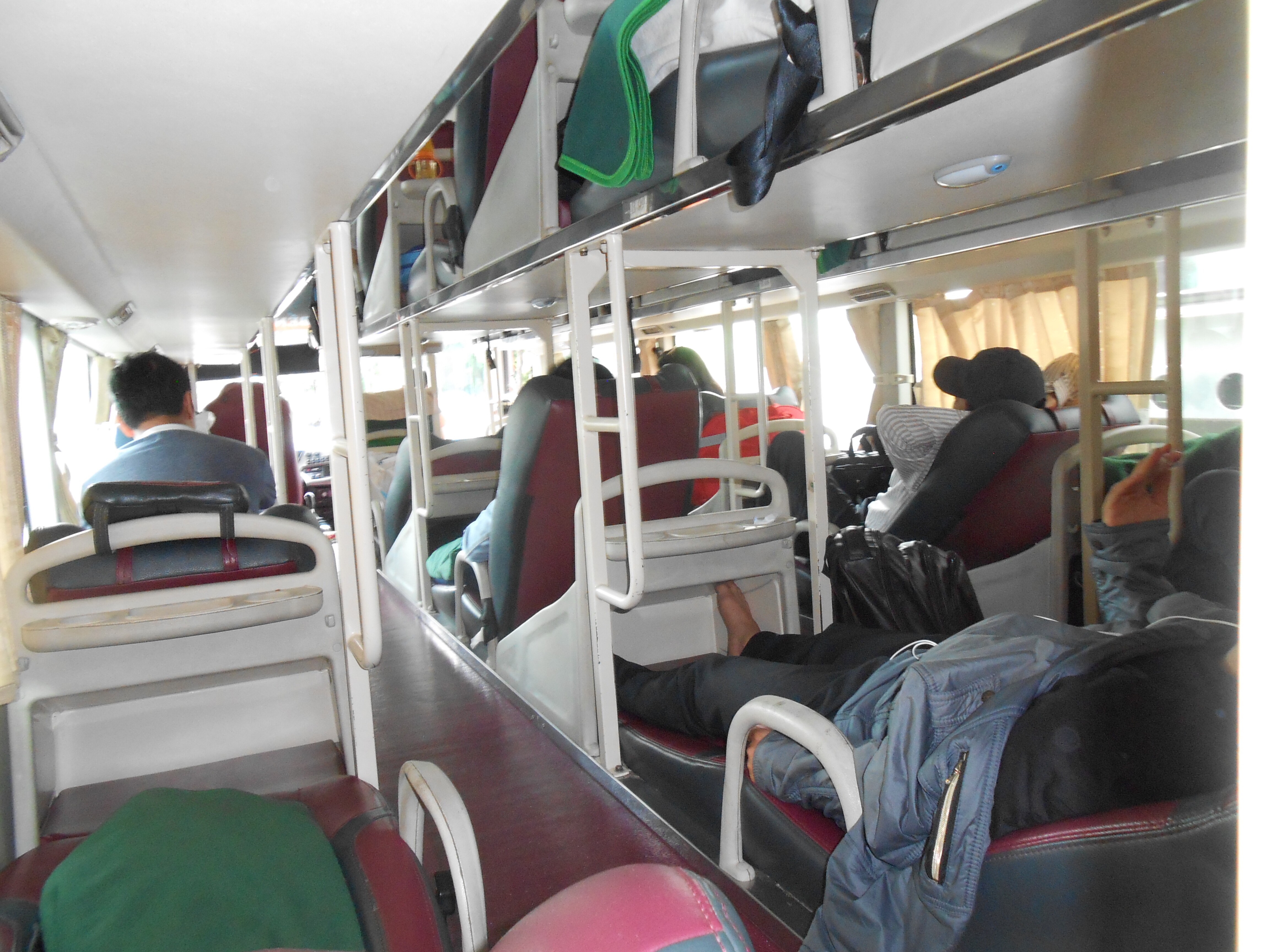
We went by bus. Picture below. Cost, 130.000 dong per person one-way. Yes, what you see is a double-decker sleeping bus with what are sort of like fold-down cushioned beds. Made in Korea, for people 5 foot 5 and under. No bathroom on board, but they give you bottles of water. It was a 5 hour ride, because traffic keeps the speed down around 30 mph. We will not do this again unless there is no alternative. Two rest stops each way. The first rest stop was at a nice open eating place that seated about 300 people at tables. Rest stops on the way back was also big, did not smell good.

Bus

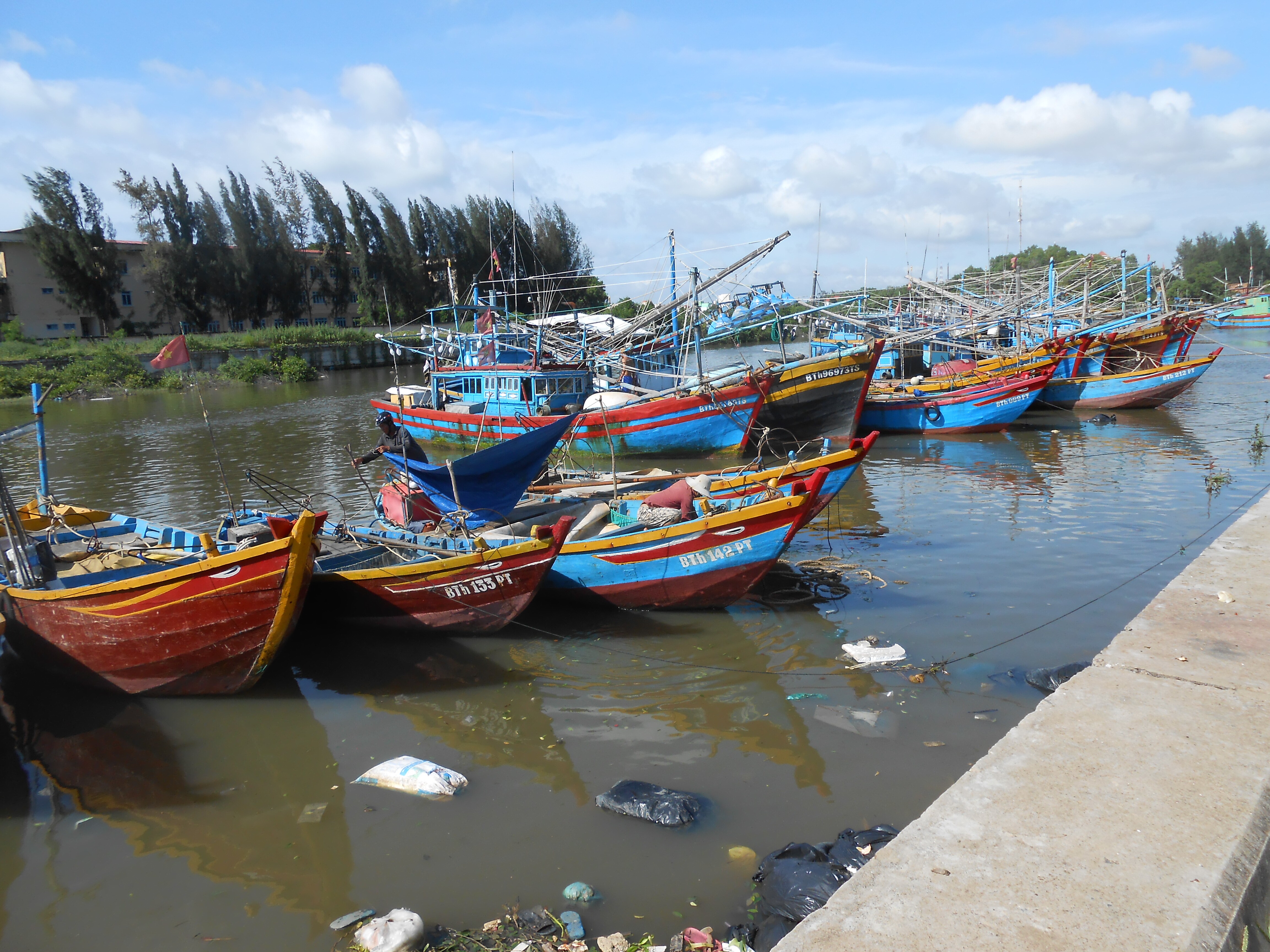
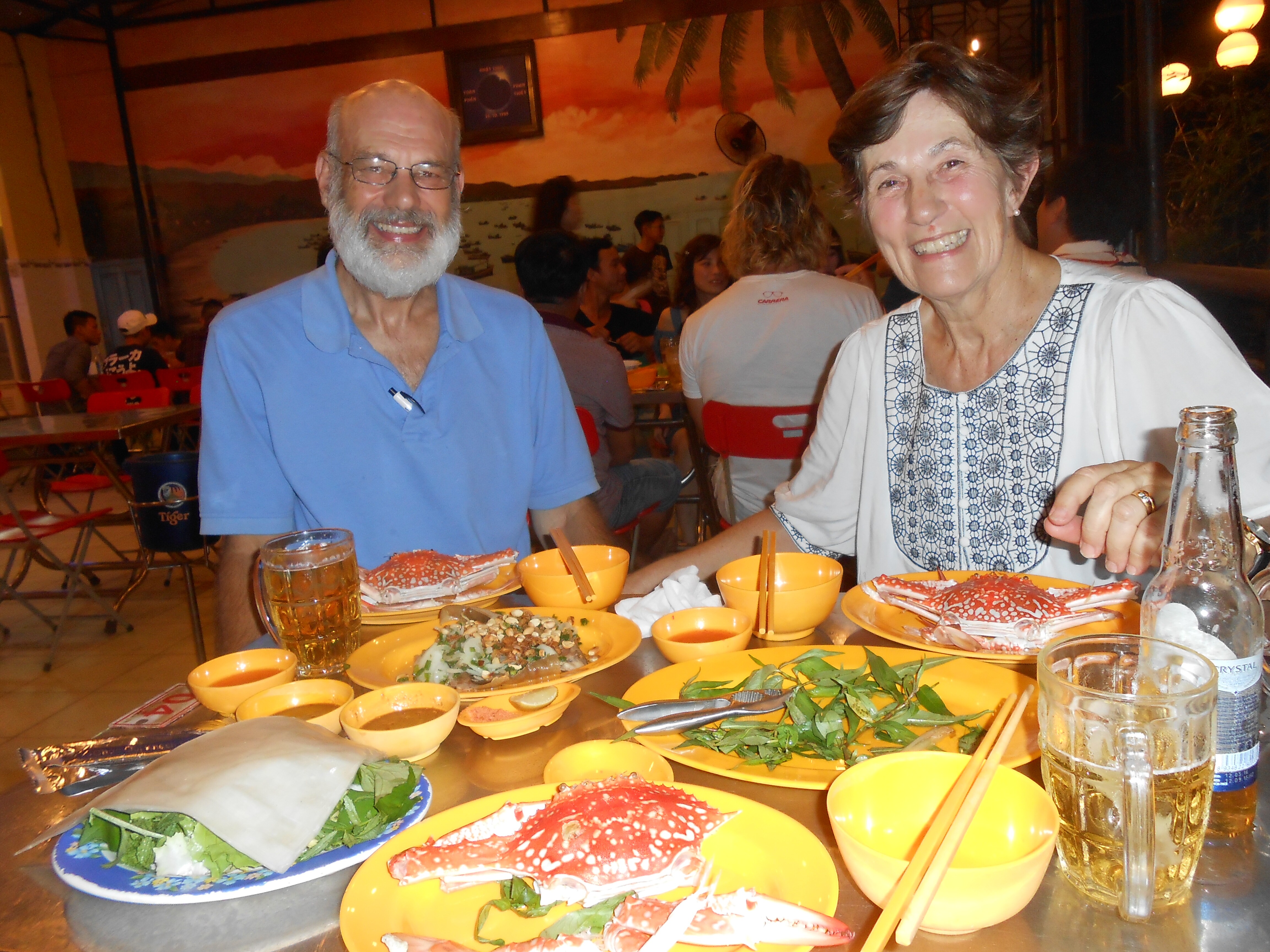
In Phan Thiet Nghia helped us get a room for 180,000 dong that had a perfectly clean floor, bed, air conditioning, bathroom with toilet paper. Then his mom picked him up and took him home; he came back a few hours later on his motorbike, wearing shorts and smiling. He took us out to dinner upstairs in a restaurant overlooking the river full of bright red, blue and green fishing boats, showed us how to eat crab (“Breakdown”), wrap rice paper around veggies and some other fresh fish, and eat a rice-corn-fish soup. Nothing we ate was more than a few hours out of the sea. Maybe the best meal we’ve had since we got here.

Crab diiner

The next morning he met us again at 7 am and took us to a place to get “local” pho and then to a Truong Nguyen coffee shop (it’s a chain) and had the best coffee ever. Very strong, very smooth, from a little tin drip. Then off we go on a round of amazing experiences.

First, the beach at Mui Ne, where a vast new Miami-Beach type resort climbs the hill over a little harbor where Vietnamese fishermen (and women) clean their nets after a night out on the sea (“Way out, several kilometers” says Nghia) in little hemispheric boats like custard cups – half domes, painted blue, powered by oars. They are people who can’t afford a fishing boat. They fish all night, sleep in the boat, come inshore and then clean the little fish – about 6 inches long, silver – and put them in piles that the women then take to the market.

Litte boats

The water was warm like bathwater, not like ocean water in California.

Second to something called The Wine Castle. I am not kidding. A group of Napa Valley wineries has gotten together to turn Vietnam, a beer country, into a market for wine. They are going to do this by constructing a giant “castle” with four crenellated towers on a hilltop in this resort district and then creating a whole theater of wine culture to educate the local population about not just the taste of wine but how to be a wine drinker and how to live like wine drinkers. Inside the castle is a courtyard with a Cinderella – type gold plated chariot and a bunch of suits of armor. Above it are three floors of Castle Experience. This is a local tourist destination. Young couples were photographing each other. People probably have weddings there. As a piece of marketing this is overwhelming and brilliant and way, way too close to the edge for me.

After all, what do I think about when I sit on the deck in California and look out at the sunset on the Golden Gate bridge and have a glass of wine?  Just the wine?

Tickets are 180,000 each, and include a glass of wine.

My first reaction was, “You have got to be kidding.” This is Hearst Castle in Vietnam, only it’s a marketing ploy. I was really going to turn around and go away.

But we bought tickets and went in – down windy stairs into a cool dark room where a large crowd of Vietnamese people were sitting on benches holding wine glasses and swirling them and sniffing. It was an actual class in how to drink wine. Then we watched a movie about the Napa Valley and all the happy beautiful people who go to it and drink wine. Just like me, whenever possible.

However, since I am on a serious not-drinking campaign, both on general principles and because of my afib meds, and am happy with 2 beers per week, I was not about to drink wine at 9 am, even if I could pretend I was in Napa. But Nghia had never tasted wine. He tasted the wine in his glass and nearly spat it out. He said it tasted horrible, but he continued anyway.

Creating a market for something people don’t know they need takes a lot of teaching, starting with basics. You’ve got to teach people to want to be someone else. I guess it’s not that hard. There is by-the-bottle sales room, including some listed for very high prices, in case you wondered if this was cheap wine or good (expensive) wine. You can buy wine glasses, in case you don’t have any. There was also a big room with table settings, showing how you set the table with wine glasses.

I was reminded of the upper floor in the Independence Palace in Ho Chi Minh City that held the President’s (Diem and Thieu) private quarters, including a dining room. The dining room was set up as if for a French dinner party, with two wineglasses at each plate. No chopsticks.

I googled RD and it has an enormous website at

http://www.rdwinery.com/catalog.pdf It doesn’t say directly that it’s a trade group, but it sure looks like one.

Nghia really had a good time. He took a lot of photos and posted them on Facebook, including one on MY page showing me waving a wine glass and looking plastered. By morning, I had a couple of “likes.”

Up the tower

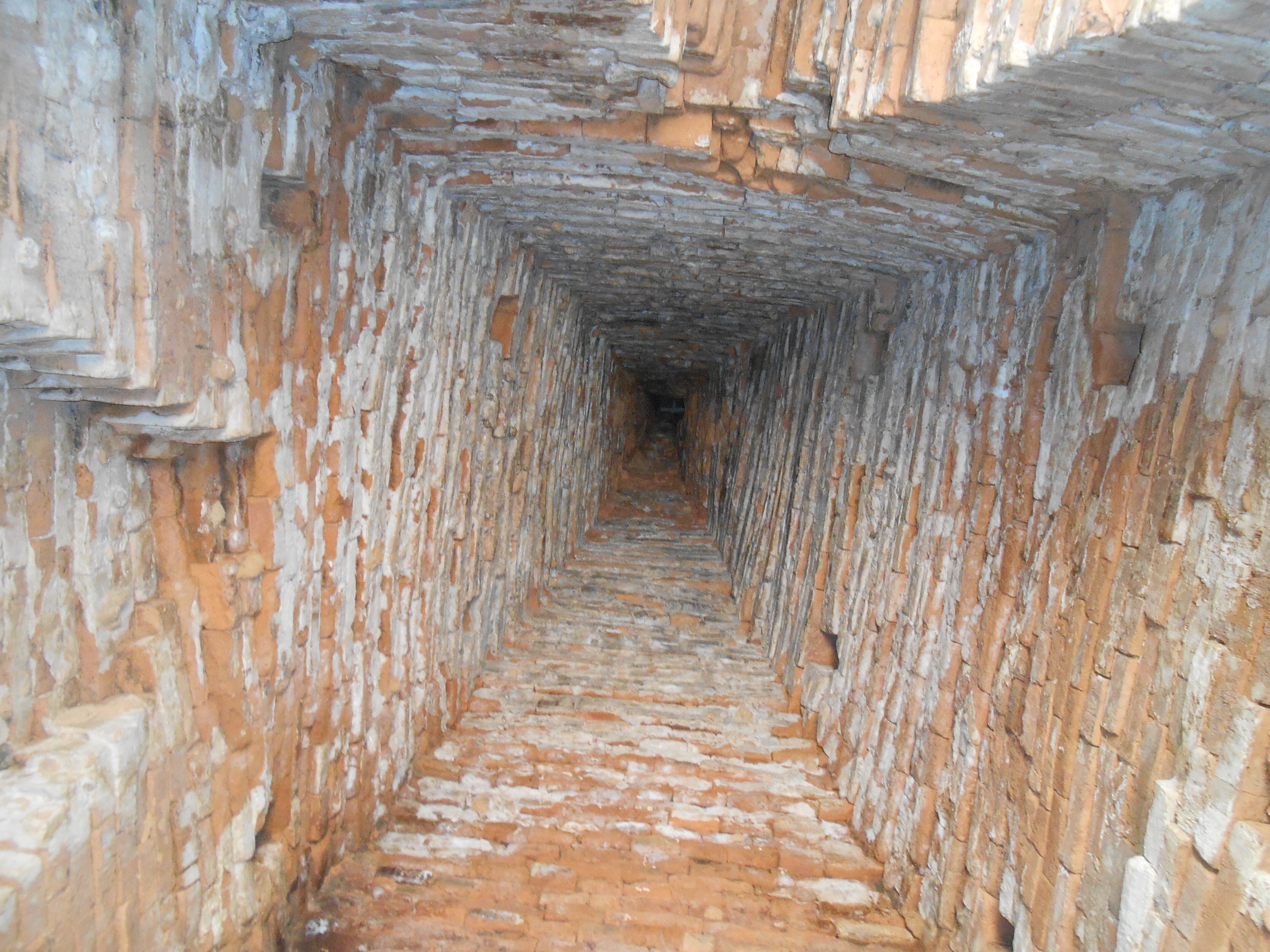
Then we went to the Cham towers, built in the 9th century by the people who lived here before the Vietnamese. They’re a UNESCO site. Cham people still live in this area. The four towers are unmortared brick, each a site of worship for different dieties. They picked the best site on the whole coast for these towers, looking south along the shore where the river opens out into the ocean. This picture is inside one of the towers, looking straight up. No earthquakes around here, obviously.

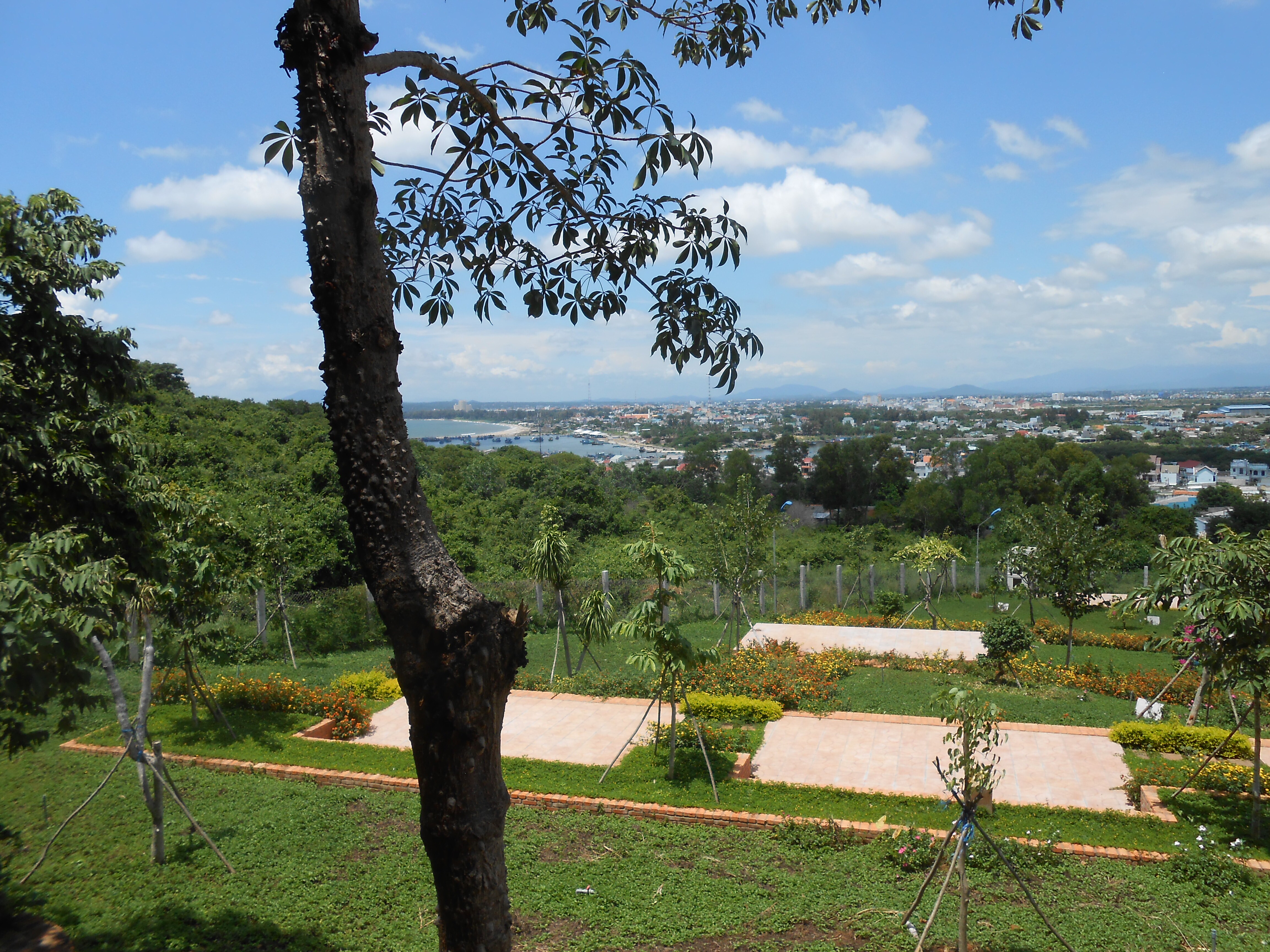
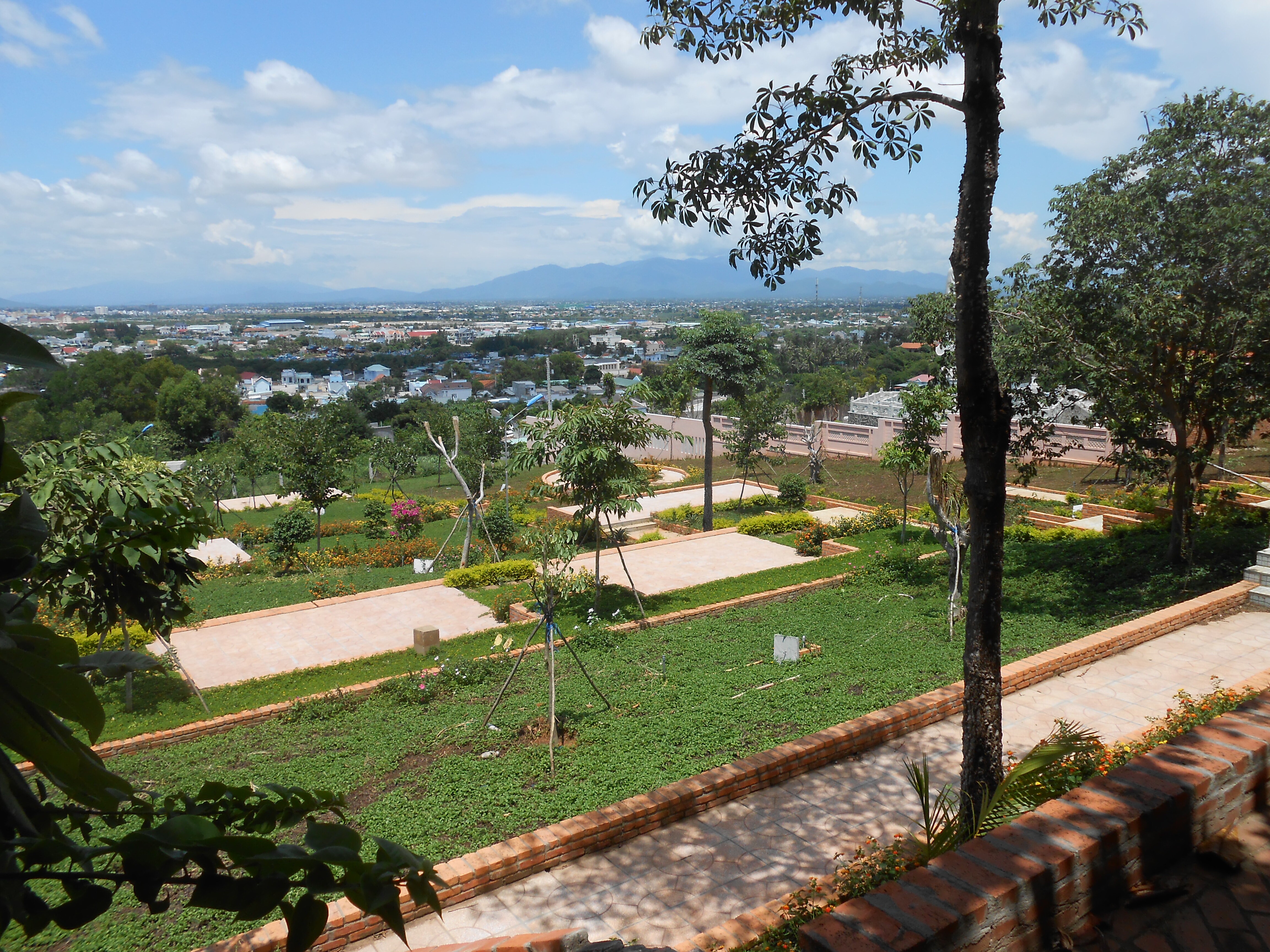
Here is the view from the park behind the towers, looking out over Phan Thiet:

View from Cham tower park View 3

By now we were ready to take a break from tourism and Nghia took us home to his house for lunch. He said, “You will be astonished when you see where I live.” He was right.

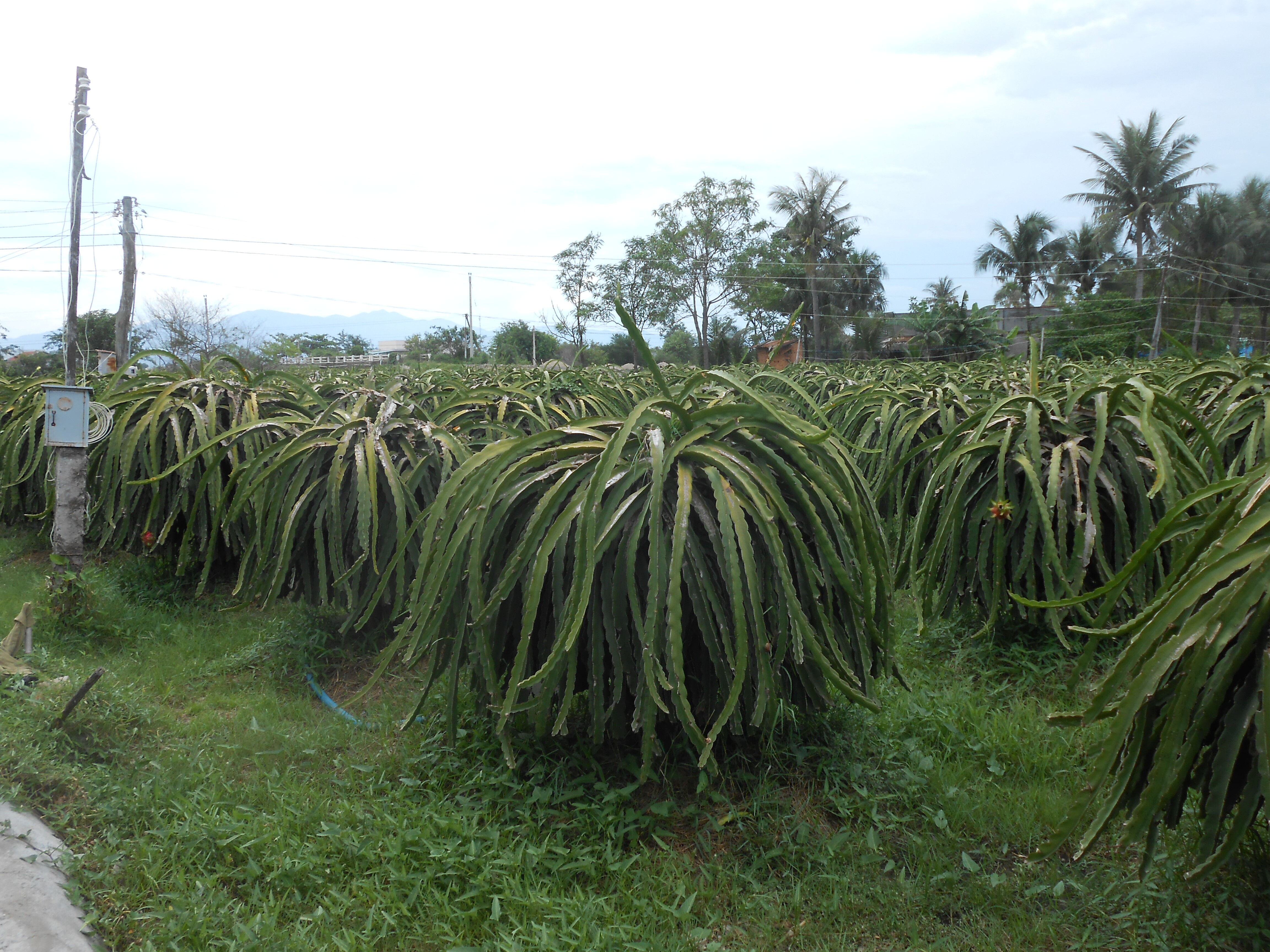
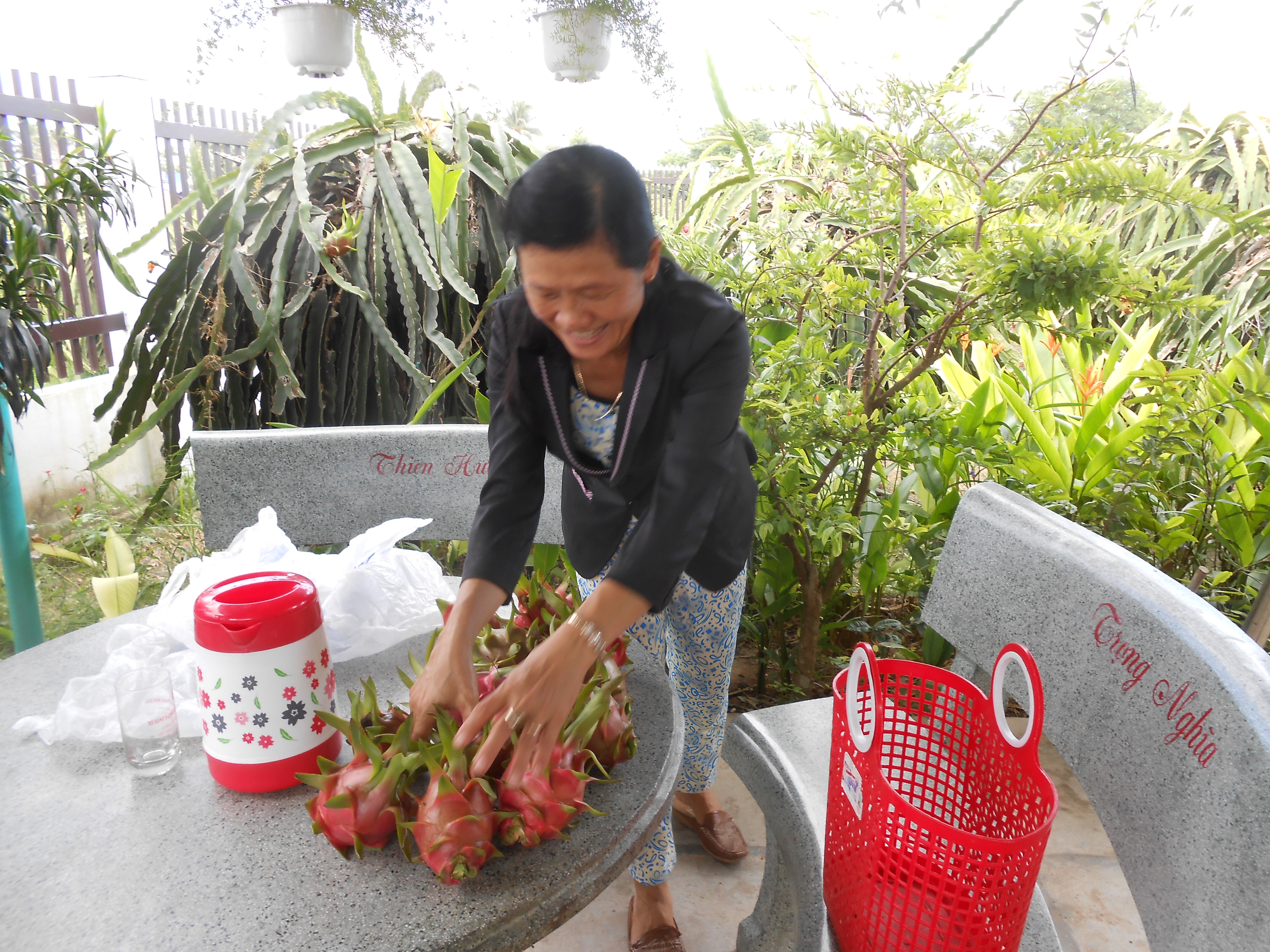
In his village, which is about 5 K from Phan Thiet, people grow dragon fruit. It grows on chest-high bushes that look like the kinds of succulents people put in pots at home.

His mom is a primary school teacher in their village. His father died last year, of cancer. His mom also farms the dragon bush plots.

Dragon bushesTo approach his house, you walk along a 2-foot wide raised dike between the dragon bush plots. The house is beautiful, incredibly peaceful, open to the wind in all directions and therefore cool. His grandparents who are 94 (grandfather) and 92 (grandmother) live with them. They look to be in perfect health except for being very, very old. His mother obviously is terribly proud of her son and happy that he is getting intensive English practice (which he is). Nghia’s little sister was shy but very sweet.

When we walked in the house, Nghia’s mother asked me (through Nghia) if I would like a shower. What a great thing to offer someone who is unspeakably sweaty!!! So I went out back and had a shower in a separate room that looked out onto the fields of dragon bushes.

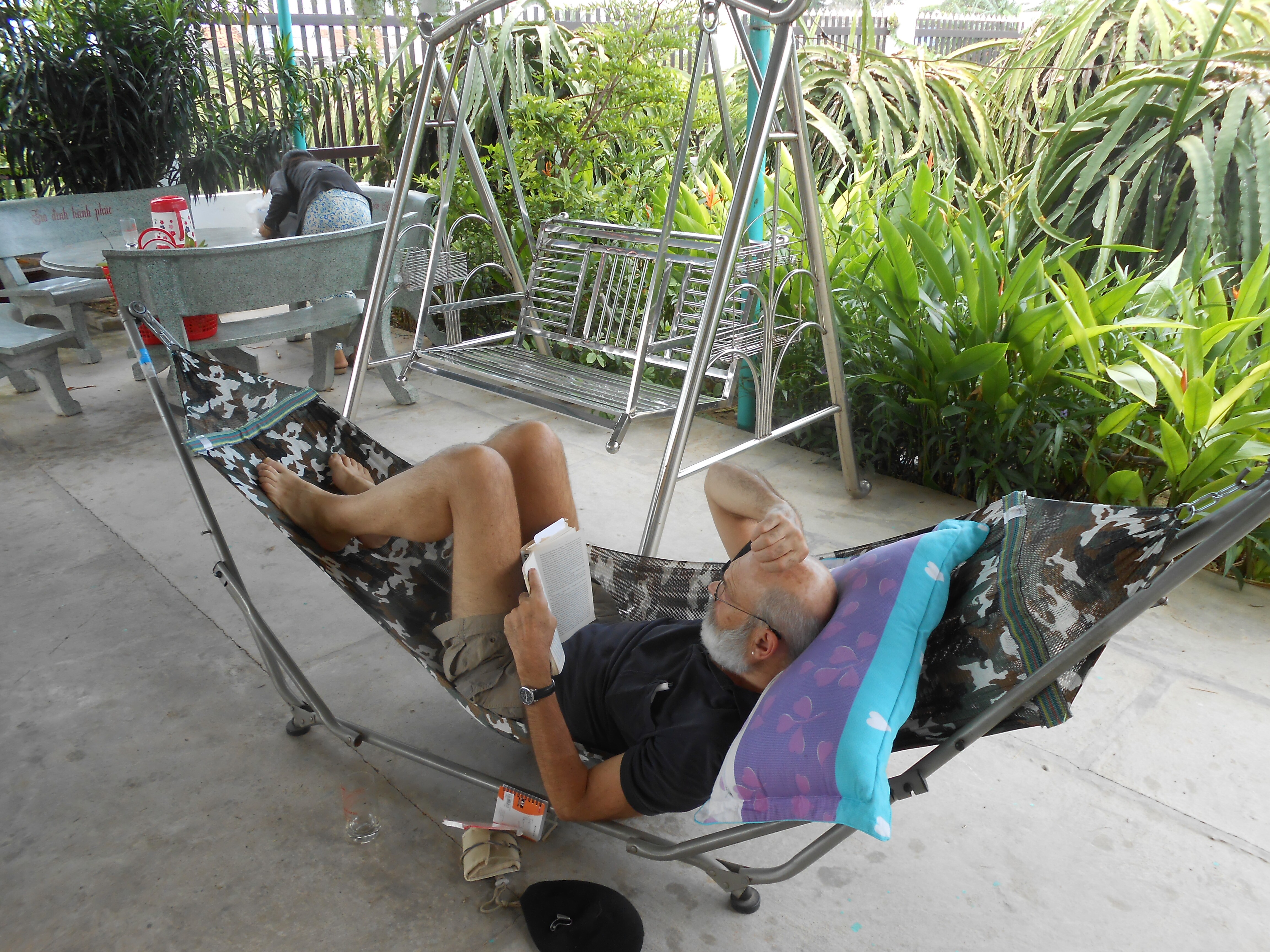
After lunch, which ended with pomelo and salt, we rested; a hammock appeared for Joe and a flat foldout bed for me. I fell asleep, ready to stay there for the next twenty years and get old like the grandparents.

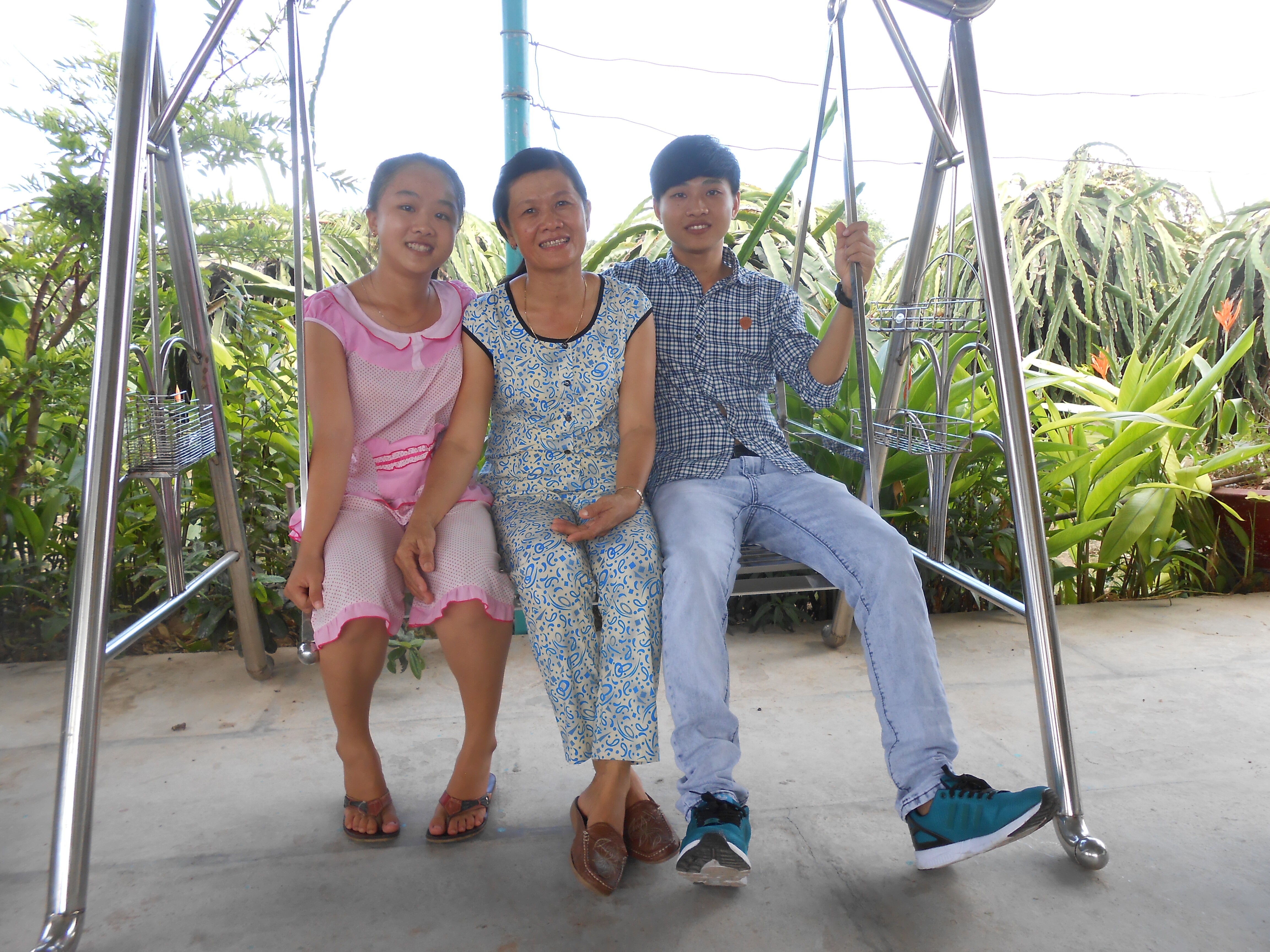
Ngha, mom, sister

Nghia, his little sister, and his mom on the front veranda

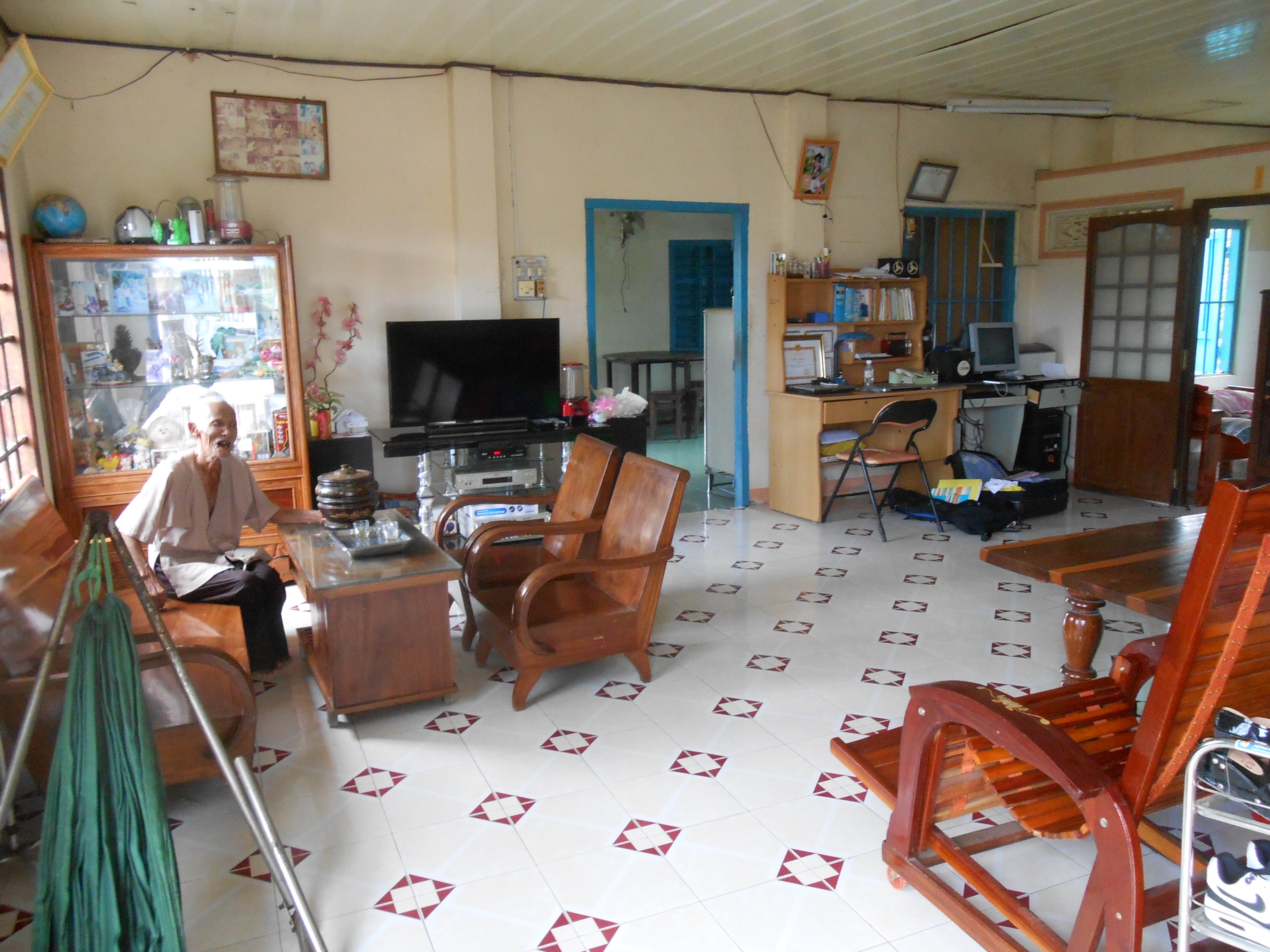
Living room, grandfather

Living room. That’s Nghia’s grandfather on the left. His grandmother sits on the high table to the right, but she’s not in this picture.

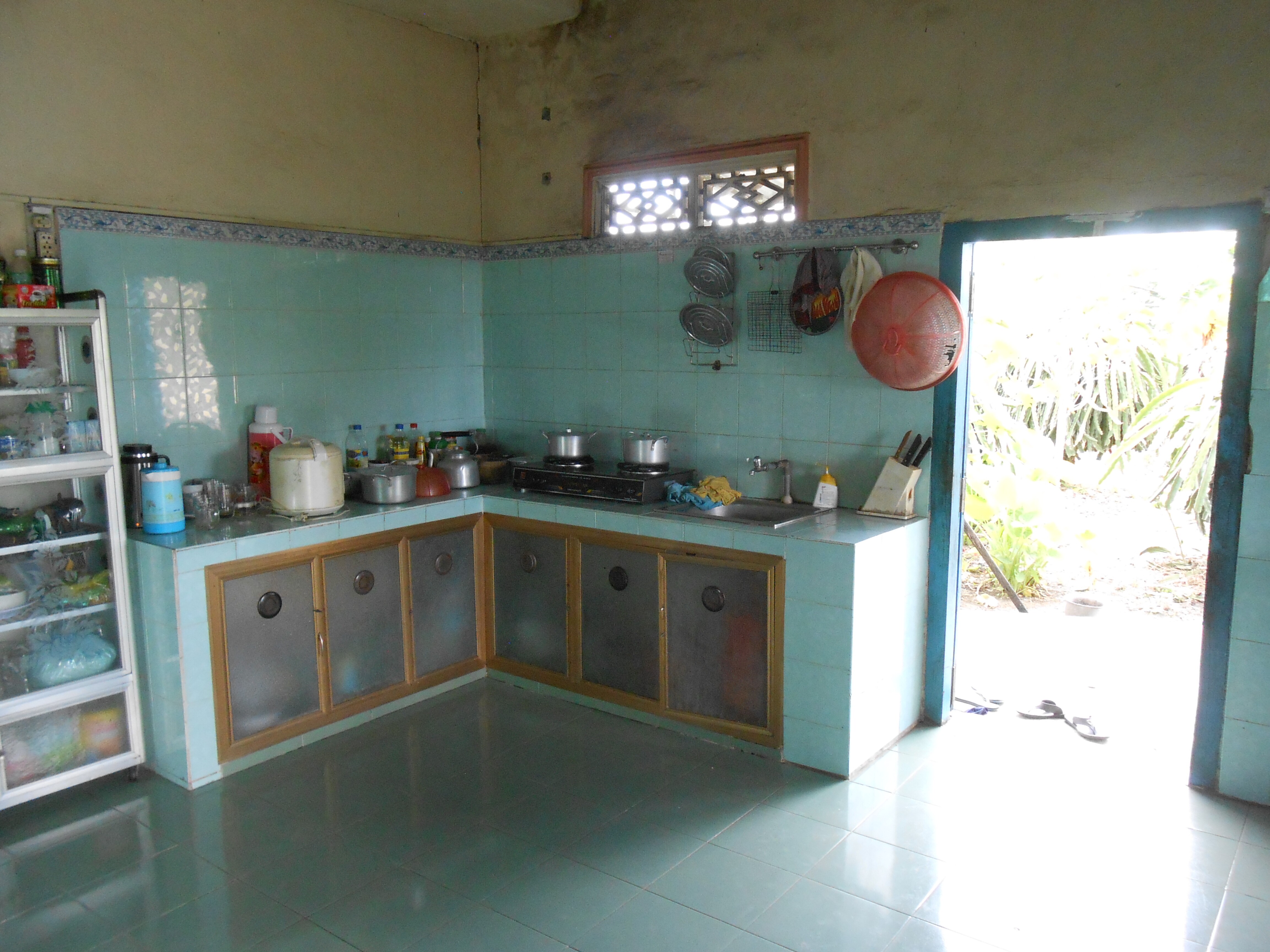
Kitchen

Kitchen, looking out into side area with more dragon bushes.

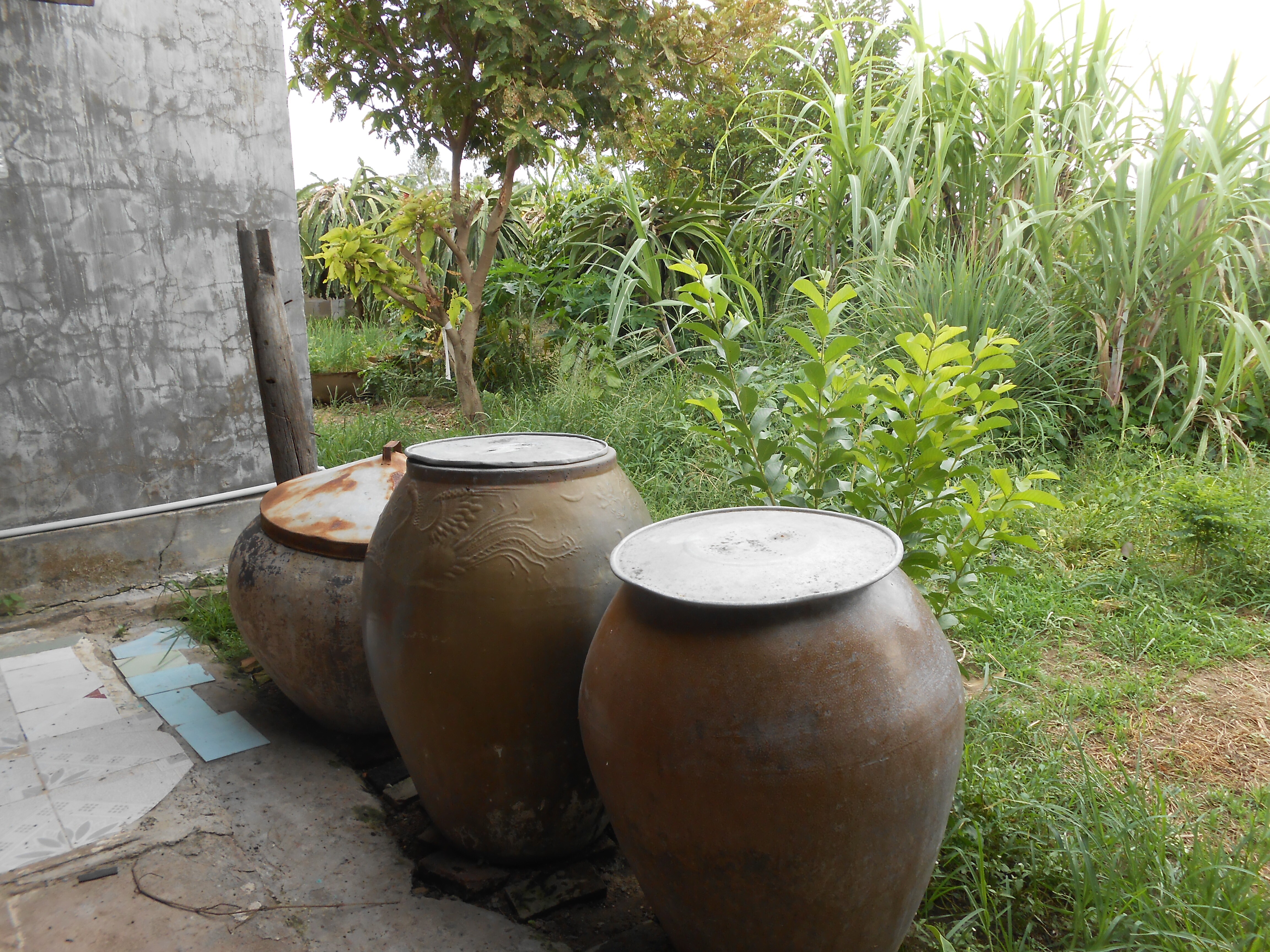
jars

A few of many cisterns. When rains start, they let the water run for a while and then direct it via a long pipe into various cisterns.

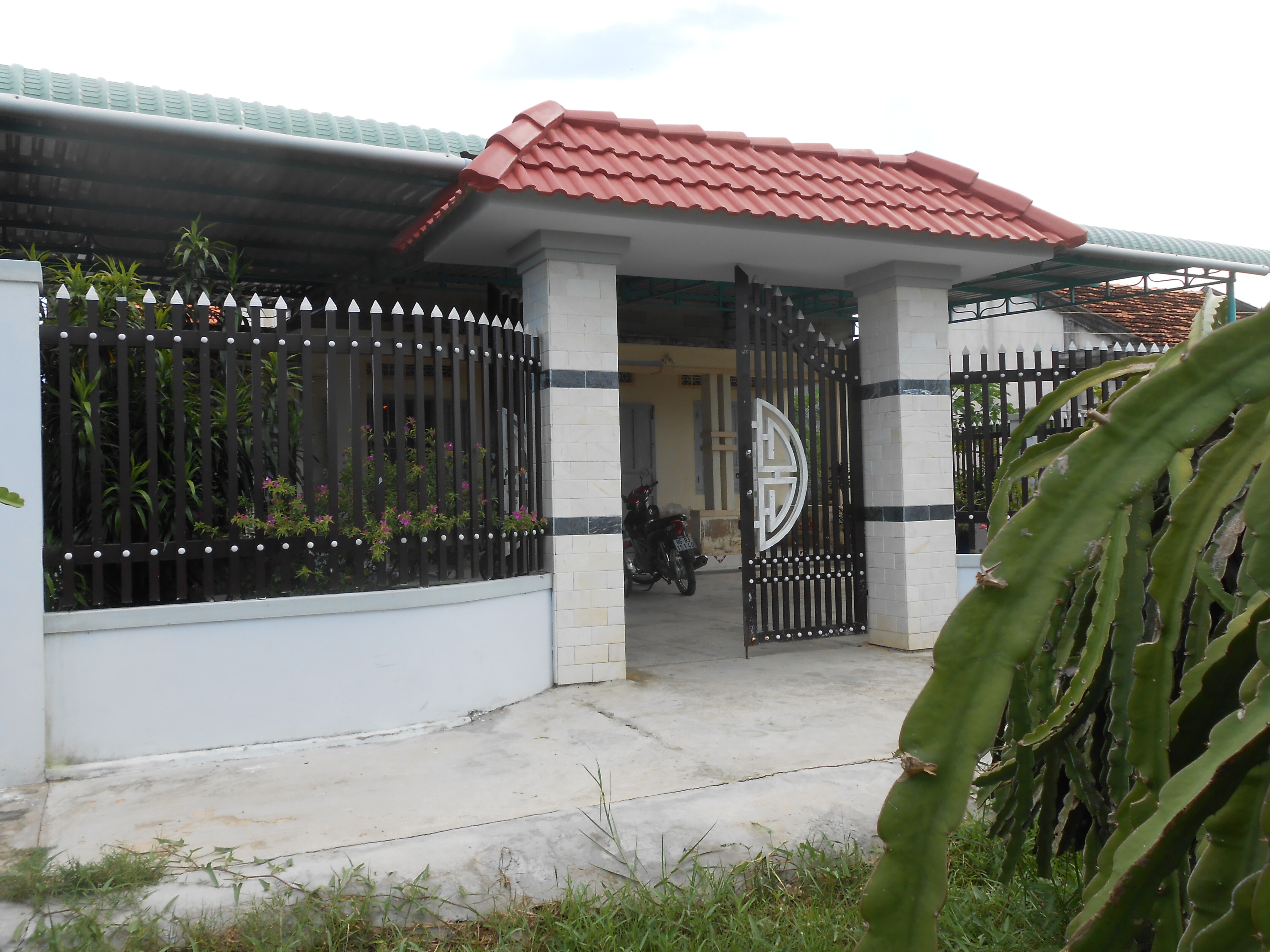
front gate

Front gate

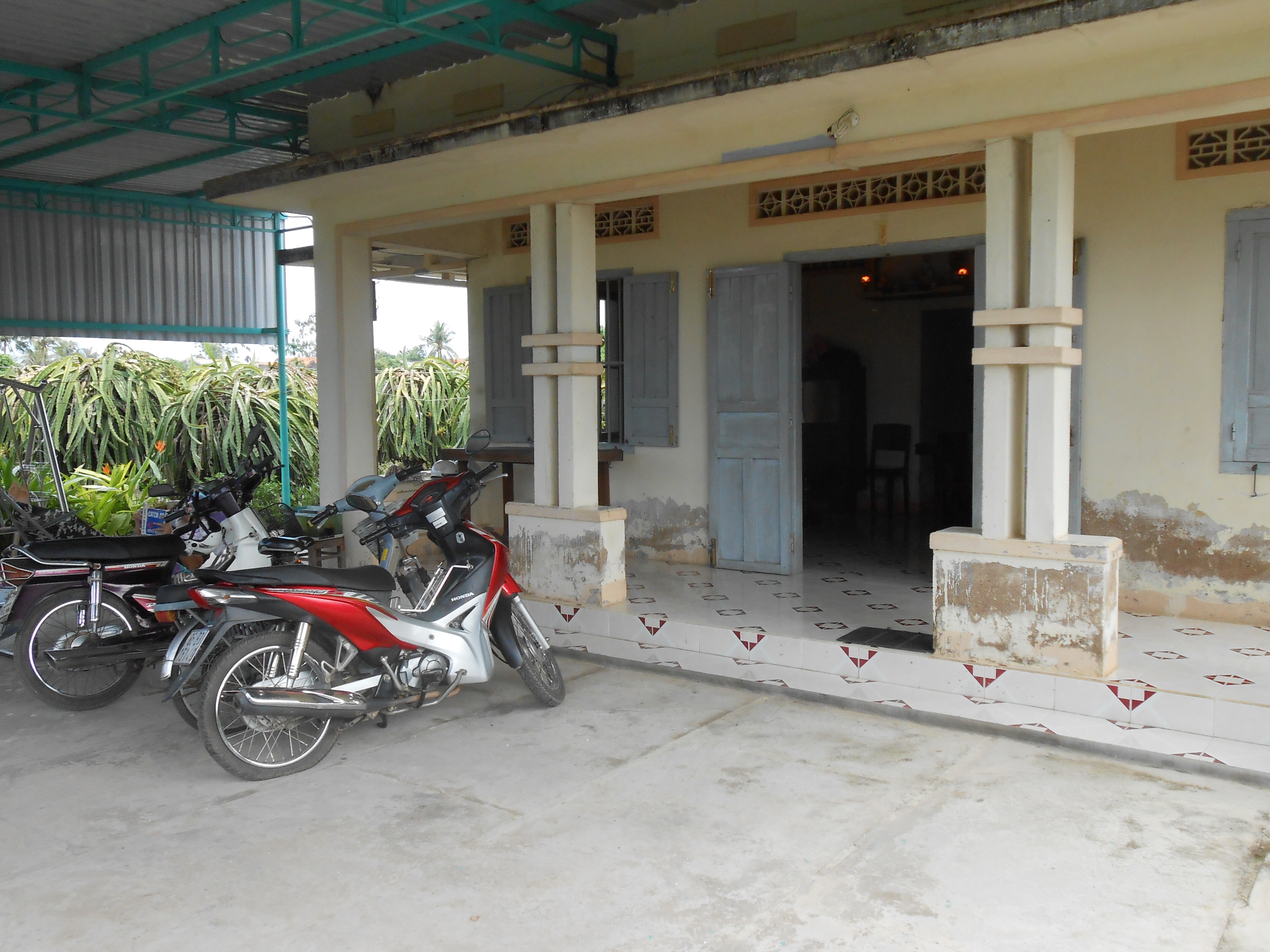
front of N's house

Inside front gate

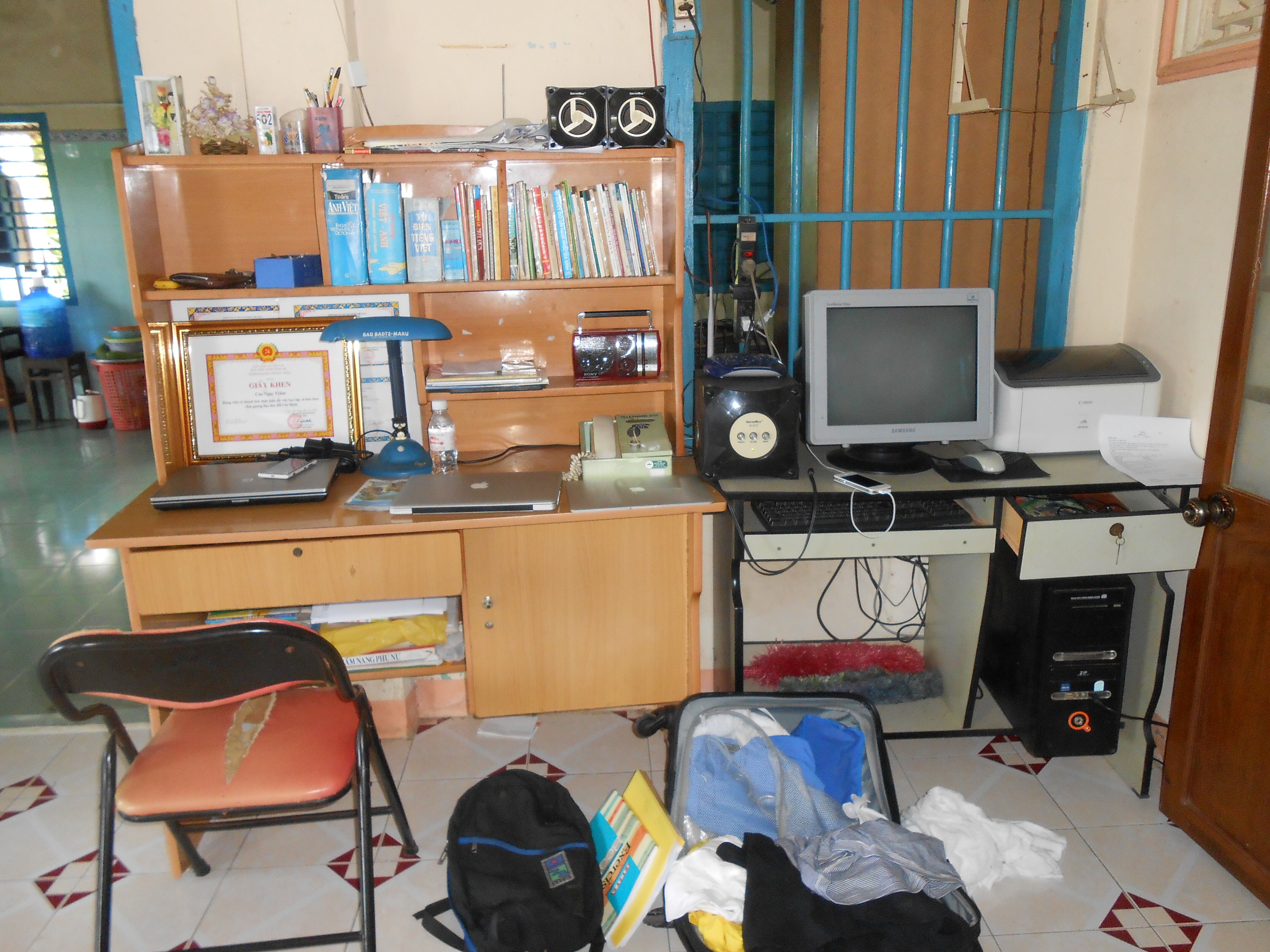
COmputer desk, my suitcase

Lots of electronics. That’s my suitcase on the floor. Most diplomas and certificates are all displayed up high along the top of the wall, but this one is on the desk.

back yard

Neighbor

Joe in hammock

Joe in the hammock after lunch. I fell asleep.

Dragon fruit

Nghia’s mom rode her bike to their dragon fruit plots and came back with some for us to take home.

On the way back to the bus we stopped at the Ho Chi Minh museum which was almost closed; windows shut, no air conditioning. But across the street was the elementary school where Ho Chi Minh taught for a year before getting on a ship and working his way to France. It had small open single story whitewashed buildings, rows of desks like the ones at Ton Duc Thang today, a garden and a well.

The bus going back to the city was faster than coming down. Most people slept, including Joe, but I stayed up and read Madame Binh’s autobiography and watched the TV at the front of the bus, which was playing  some obviously famous show with a handsome young couple singing first traditional Vietnamese music and then, after many hours of that, some pop and Hollywood stuff on a high-tech Vegas-type stage.

Great weekend. Memories of Nghia’s home will get me through the next blue period.

Mid-semester tunnel syndrome

Joe class pink

Joe’s class on a Monday, when the girls wear the ao dai uniforms

I was beginning to get cabin fever, combined with mid-term tunnel syndrome, which is when you’re halfway through the semester and can’t tell if your students are learning anything. The idea is that you’re swimming down a tunnel and have come too far to go back but still can’t see the other end yet, plus you’re holding your breath. Sometimes called mid-semester blues.

So I suggested that we go to some nearby city and see if things look different when we leave this giant megalopolis. District 7 was starting to seem like a small waterlogged strip mall lost in a fog of gasoline exhaust. As you can see, my attitude was starting to slip, which was affecting other things. But Joe is still coughing (ever since early August) and when we take a walk at night and go to a restaurant his cough gets worse. Now I see why there are no other pedestrians!!! And why people wear masks. Going for a walk along a big street with clouds of exhaust billowing at you is not the same as going for an evening stroll.

Joe said OK, so I mentioned it to Vinh, who said maybe Nghia would take us to his home town, Phan Thiet, which is 4-5 hours on the train or bus and is a “small city” with a beach. She said he might agree because it would be a way for him to get home for a night and he could translate and make sure we wouldn’t get lost. Vinh called Nghia and Nghia said yes, so he’s gone to buy our tickets. We’ll buy his, too. We’ll leave tomorrow, Saturday.

In the meantime, this afternoon, Friday afternoon, when we came to the office following the Class of 2015 graduation ceremony, Vinh said that a woman named Michelle Gonzalez was coming. She’s an evaluator, a freelancer currently working for the Department of Labor, looking to see if there are any long-term impacts left over from a USAID/DOL program that took place 3 years ago. Her card says, “Evaluation consultant, International Labor, Education and Health.” Her current project in Vietnam is motivated in part by the expectation that the Trans Pacific Trade Partnership will increase the pressure on Vietnam to adapt to international labor standards, sign onto the ILO conventions on freedom of association, 85 and 98, and actually begin to have real collective bargaining. So has there been any progress toward that end, specifically as a result of that USAID/DOL program?

We had a chance to visit with her for 15 minutes before the meeting started.She went to Berkeley, worked with their LOHP program, and we knew a lot of people in common. Then were invited to join Vinh and Dean Hoa in the meeting, which took place downstairs in a very nice, fancy conference room. This turned out to be very interesting.

Apparently the project in Vietnam was awarded to a group called DFI in Washington DC. It was supposed to update labor studies programs in Vietnam. “Labor studies” was her term; the TDTU program is called “labor relations”. I don’t know if the distinction is clear to either party (labor studies is academic; labor relations is applied). Phase 1 was funded by USAID. Then Phase 2 was picked up by the US Department of Labor. The focus was on training MOLISA labor inspectors, who are usually the people who do mediation. However, they don’t have training as mediators, and they are already busy doing wage and labor inspections. This is fine with employers who feel that the whole requirement to engage in social dialog on a quarterly basis is a burden, so they would rather just pay the fine, since it is not large.

The project was a two year project, but MOLISA did not approve it until the first year was gone. These projects require you to spend all your money during the project, so that meant that two years’ worth of money had to be spent in one year, cutting short the time available to do the project right. One activity of the project was to work with labor studies programs.

Her assignment now is to evaluate that project several years later, to see if there was any lasting impact.

Dean Hoa said that the first phase, the USAID phase, did help them do some work. They invited Kent Wong from UCLA to come over, and someone from Harvard. They shared this with two universities in the north where there are labor relations programs like the one at TDTU. They also wrote a textbook in Vietnamese, about social dialog, collective bargaining and mediation, which was shared by all three university programs.

As far as the second phase went, Dean Hoa said that it enabled them to invite experts to share labor relations knowledge with students. This included Richard Fincher, Katie Quan, Jan Sunoo and another person whose name I had not heard. He added that even though the experts only shared knowledge and experience from the US, they still benefited because they learned skills and process.

Back and forth about the reluctance of both the VGCL and the VCCI (Chamber of Commerce) to engage in social dialog and mediation at all, and the need to educate the next generation of HR professionals to appreciate mediation. Dong Ngai Province seems to be having some success, for example. “We need to have more case studies of social dialog, so that employers are not scared.”

Gonzalez asked what Dean Hoa would like to see happen. He would like to send their students to the US to get their MAs and have a cooperation agreement with a US university. He would like TDTU students and lecturers to be invited to participate in ILO research projects in Vietnam and the ILO could hire TDTU students as interns.

I spoke up about a basic, immediate need: the need for translators: translators for classes, for materials, for library books, for curriculum, pointing out that right now, all translation goes through Vinh who is overworked.

Gonzalez remarked several times on how different the US and Vietnamese models are. I am less and less convinced of that, the more I learn. Once you get away from what happens at the table, they are not much different. What matters the most is the quality of the support for the union among workers and the preparation that the union has done prior to getting to the table.

This is what we’ll emphasize with our students.