Hanoi Conversations (2, VGCL)

Article in Lao Dong about this: http://laodong.com.vn/cong-doan/pho-chu-tich-tong-ldldvn-nguyen-thi-thu-hong-tiep-doan-can-bo-cd-my-414628.bld

VGCL Meeting 2_1

Kent Wong’s delegation of US labor leaders and labor educators arrived in Hanoi Sunday January 10. We met them in the lobby of the Rang Dong Hotel (Trade Union Hotel) and went to dinner at a place called Wild Rice, very elegant and full of what appeared to be groups of foreigners.

The people who came with Kent made an impressive bunch. What made it impressive was the number of significant leaders, the diversity of unions they represented, and the important political positions some of them held. I am not confident that the Vietnamese who hosted us at the meetings over the next week understood what putting this group together meant in terms of political capital. There were two leaders of Central Labor Councils from Southern California, Los Angeles and Imperial County CLC’s (Richard Barrera) and Orange County CLC (Julio Perez). Orange County is “Cam” or “Little Saigon,” the biggest community of overseas Vietnamese, who exert considerable influence in Vietnam. There were two Viet-Khieu, Vietnamese-speaking US citizens, both coming to Vietnam for the first time. One was An Le who co-edited the Organizing on Separate Shores book with Kent. The current president of huge UFCW Local 770, Rick Icaza, came with his wife Adele and two staffers, one being John Grant and the other Nam Le, the other Viet-Khieu. Emil Guzman, a retired SEIU organizer, came, so there was someone from the CTW group. Then there were two university-based labor educators, Howard Kling who was filming the whole thing and Gene Carroll from Cornell’s Workers Institute. Kent’s wife Jae, who works with NGO’s in LA, came.

Different personalities, different geographical homes, but all of these people would either have known each other for years or else be one contact away from everyone else, which is also an indication of shared political outlooks, evident in the conversation at meals which sounded a lot like catching up with old friends.

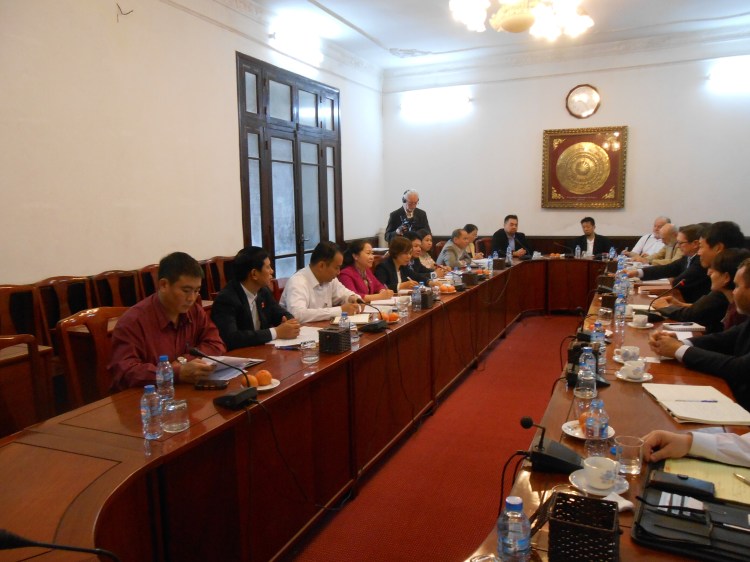
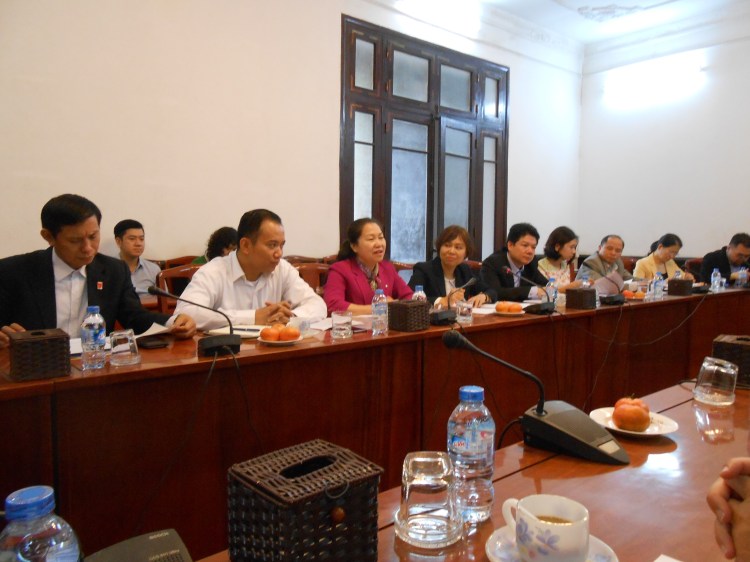
Meeting at the VGCL 8 am Monday Jan 11


VGCL meeting 1

Center: VP Nguyen Thi Thu Hong. To her left, Lan, translator and our general helper throughout; on her left, the Director of Organizing.

Summarizing what was said by the Vice President who met us and chaired the meeting, VP Nguyen Thi Thu Hong:

The VGCL is 86 years old, founded in 1929. Every five years we hold a Congress; this will be our 11th congress. The hope is to build a bridge (ladder?) for low-wage workers. Along with TPP, we have signed a lot of bilateral agreements. Right now the GDP has been rising at a rate of 6.8% for the last 8 years, when our target was 6.4%.

The VGCL has 5-year plan strategy covering 2013-2018. There are four areas of action. First area of action: Organizing and recruiting, to reach 10 M members. Now we have 8 or 9 million members, 4.9 M of which work in enterprises (Industrial zone enterprises?) We want to organize in 120,000 enterprises. Second, training for trade union leaders about union activity for our members. Third, increase in the number of CBAs. Fourth, training in skills for workers, to work with more productivity.

We also must participate in amending the trade union law and the Labor Code. The VGCL is a member of the National Wage Council. We have proposed a wage increase of 12.4% as of January 1, 2016. We are also interested in the meals provided by the companies, especially where there has been food poisoning. The Trade Union will sue employers who feed poisoned food to workers.

We have two universities: TUU and TDTU. We hope that you do training at TDTU and develop training manuals for improvement of training for universities and share models of assignments for workers.

Kent responded by saying that trade unionists in the US have the same four points, organizing, training for trade union leaders, collective bargaining agreements and increasing skills. This makes sense because our economies are becoming more integrated, with production in Viet Nam for US export. The President of the VGCL attended the AFL CIO convention and was welcomed by President Richard Trumka.

Questions: Rick Icaza asked what the official position of the VGCL on TPP was. Gene asked about climate change, with an intro about the last 40 years and what it meant to be here; John from the UFCW asked if, looking backward, would they have done doi moi differently.

Response: Officially our position is that our trade union in general is in support of TPP but we are also clear that joining TPP provides opportunities and challenges. We support the negotiation of TPP and international integration into global trends. However, there will be competition in terms of quality of products and reduction of cost. The agreement also provides for the creation of workers organizations at the enterprise level. They must have a permit from MOLISA according to requirements of Viet Nam. We need to improve our role in representing and attracting workers to our union. The law also has to be revised to accommodate the agreement. Our view is that we have to take advantage of the opportunity created by the agreement.

She responds to the climate change question with an “action plan for the green south,” and the OSH law of 2014, effective 2015, from the National Assembly, a law on natural resources and the environment.

Regarding doi moi: We have had 13 -15 years of liberalization to take Viet Nam from a centralized to a socialist market economy under a policy of developing state, non-state and FDI enterprises. We saw some areas where there is no need for the state to control specific economic groups important to the economy of the country. The view is to continue socialist oriented market economy and continue to improve work quality and social subsidies to people. Most important need is for the different sector to develop but not interfere with harmonizing the interests of both sides. The trade union participates in the Government on this matter.

Joe asked about informal sector and described our student projects and what they uncovered. The person who responded to this was from the Organizing Department:

Our main target is the formal sector. Of our 9 M members, only a small % are in semi-formal work, like taxi drivers, moto drivers. We do not have enough people to approach non-permanent workers. We have 9 M members in 120,000 workplaces and only 7000 FT union officials. In the context of TPP we have to revise the Trade Union Statute to recruit them into the union. Most difficult is how to get the workers to volunteer and organizing a union. Vietnamese do not have the habit of organizing for themselves. They rely on the upper level to send down the direction. It takes time to change these workers to be aware of organizing by themselves. Even in the formal sector, not all workers want to join the union. It is even more difficult to approach workers in the informal economy. In this area we want to learn experience of other countries. This group is important and expanding.

Joe: Union officials in the US are often surprised at how workers can organize when given some support and resources. The challenge is great but not so different from the formal sector. Offers to share student reports.

Rick asks about trafficking, workers going to work in other countries.

Mr. Quang responds: VN wants to send workers overseas because they will get training. The law specifies conditions under which this takes place: pre-departure training, language, worker centers, Ministry of Labor, job protections. The new law on social insurance from Jan 1, 2016 covers workers working abroad.

Vice President Nguyen asks what is the biggest challenge for organizing in the US? Answer, from Gene, fear, plus the union avoidance industry. John from UFCW describes how a private equity fund bought a 160-store grocery chain, sold the property, laid off all the workers and did not have to be responsible for workers losses. Also foreign companies set up US companies as shells so that foreign companies do not bear responsibilities for crimes they commit.

The head of the International Department, I believe a Ms. Tang, asked directly how many members are in unions in the US and how many unions we have, but her questions did not get answered and she had to leave.

Photos, followed by van ride to a lavish lunch in a buffet place on the second floor of building overlooking the Opera plaza.


Ladoda Bags

Ladoda fac floor

Kent Wong’s delegation made a visit to a Vietnamese factory on Tuesday afternoon.

We drove out in a van to a town perhaps 45 minutes outside Hanoi  toward Haiphong, but still with the Hanoi address. This company is 24 years old, founded in 1992. It is a joint stock company; its capital is all Vietnamese. The workers are shareholders. I couldn’t tell if they were all shareholders.

The village where the factory is located might be one of the traditional leather villages. The Old Quarter of Hanoi, organized by crafts gathered on certain streets, is also the market for traditional craft villages, and this would have been one of the leather villages. This goes back to the 15th century. So here in this village, 60% of the workers work for this factory.

I am sick right now, with cough, fever and aches and pains, so I’m not writing a lot. I’ll just put up some pictures. I think I caught this from one of the US delegation who came down with all the same symptoms about a day ahead of us. None of us got flu shots this year, since we left in August, and so we have no resistance. Joe has it, too. Leanna has it up in Hanoi (we’re back in HCMC now) and she was in the room at the Women’s Union University when we were there.

Dinh Quang Bao Chair of MB

This is Mr. Dinh Quang Bao, Chairman of the Management Board.

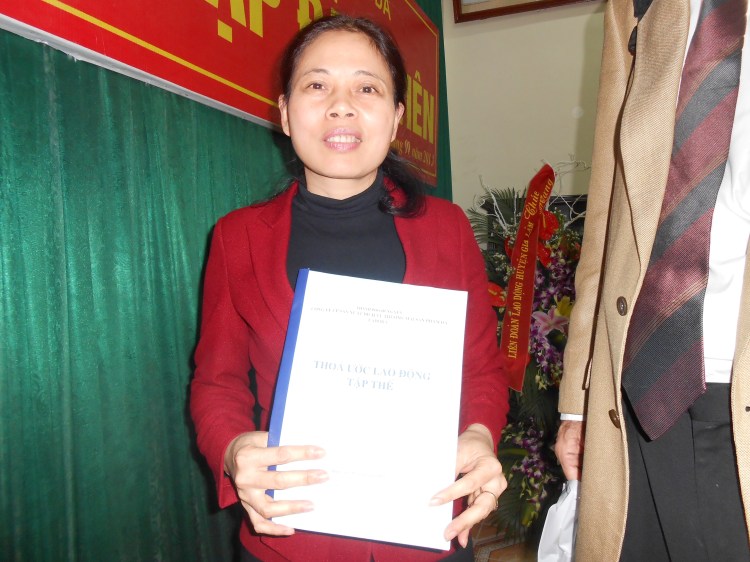
I asked Mr. Bao  if they have  a CBA and he said yes; I asked if I could have a copy of it, and they made me one. This is the first Vietnamese CBA that we’ve seen. The woman below is the head of the local union, and that’s the CBA.

Dinh thanh Ha, LU Pres

Ms. Dinh Thanh Ha, Operations Manager and Chief Accountant, also Local Union President, holding a copy of their CBA which she then gave to me.

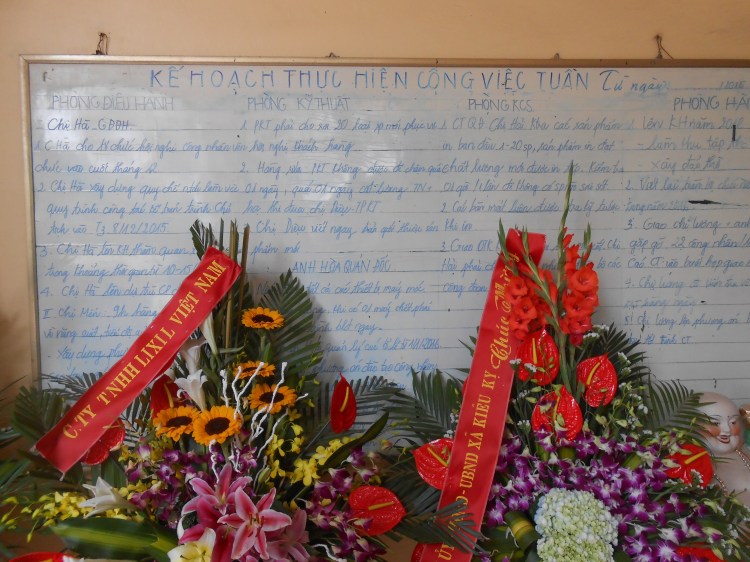
Below is the weekly schedule of meetings. The flowers were just stored there for the time being.

Weekly meeting schedule

From my notes on the Chairman’s presentation:

The Ladoga bags are a top brand in Viet Nam. There are two other factories that produce this brand. They have 370 outlets and do ISO 2008 standards. Outside Viet Nam they ship to Hungary, Germany, Poland, the US. Thirty percent of their output goes to the US. They also make the bags for the Party Congress.

At the factory, they have the Trade Union organization, the  Youth Organization, the Party Organization (even though the factory if private), the Women’s Organization, and an organization to set up activities like sports and athletic events. They do emulation eery moth and classify workers on their performance. 80% get an A, 50% get a high level and a bonus, and about 25 workers are recognized as top workers. If someone is an “emulation soldier,” they get a bonus. The Vice President of the Leather Shoe Association of VN is (either on the board of Ladoga or else holds some other position) as does the President of the Leather Shoe Association here.

They employ about 400 people. Workers come from 25 provinces. Housing is supplied, free. They have trained between 3,000 – 4,000 workers. In 24 years, they have never had to discipline a worker. The company pays 50% of a wedding. Unskilled workers make 4.5 M per month. Women retire at 55, men at 60. If you take early retirement, you get 1 month’s salary for each year of work. The company pays 22% for social benefits and workers pay 11%.

Walking through the factory floor I saw people working hard and steadily, but not hurrying. A young girl doing gluing had a mask, but the smell from the glue spread out across the floor. It wasn’t dusty. Some of the motions required for shoving and pulling a large canvas bag through the sewing machine take a lot of muscle, though, and doing them over and over again all day long would hurt. The workers seemed young, not as young as our students but certainly in their 20s, and physically strong, especially the young men.

The sewing machines are mostly Unicorn, a South Korean company.

Felix Greene in HCMC

WR 2

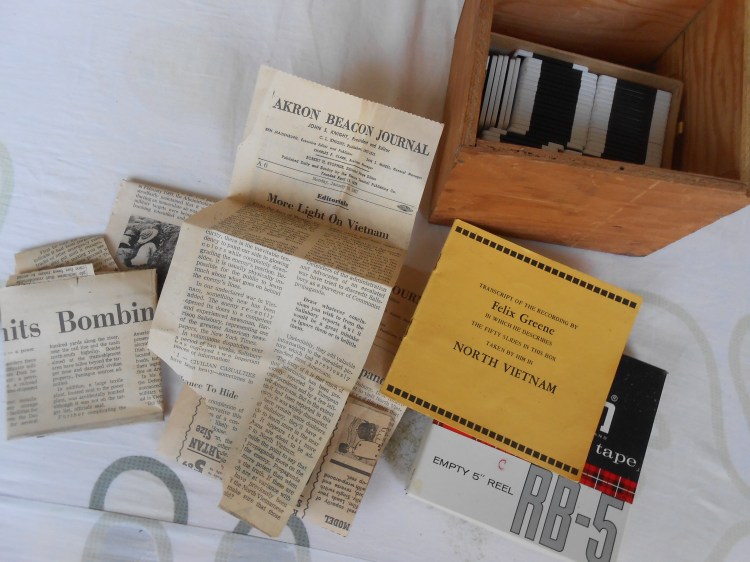
Last summer Joe and I were going though things in the barn attic in Vermont and found this small wooden box in the old file cabinet. When we opened it, we saw  glass slides, a booklet, a stapled pack of typed pages and a reel-to-reel audio tape. The slides were photos taken by Felix Greene in Vietnam in 1965-66. The box was one of many that were distributed to people in the US who would then hold a meeting in their living rooms or churches or schools to teach friends and neighbors about who the North Vietnamese really were and what life under the American bombardment was like.

On the cover of the box of slides, in my father’s handwriting, was the note, “Slide #50 is missing because it was taken by the FBI and the ONI as evidence.”  That slide had a picture of Felix Greene and Ho Chi Minh. ONI stands for Office of Naval Intelligence; my dad was in the Navy in the Pacific in WWII and retired as a Lieutenant Commander.

In the photo above, that’s Ho Chi Minh in the background.

We also have a copy of my father’s FBI file. I remember Mom telling me about that visit. “I fed them cucumber sandwiches,” she said. A neighbor, someone who lived across the road in Lake Dunmore, Vermont, had turned them in after they had shown the slides one night.

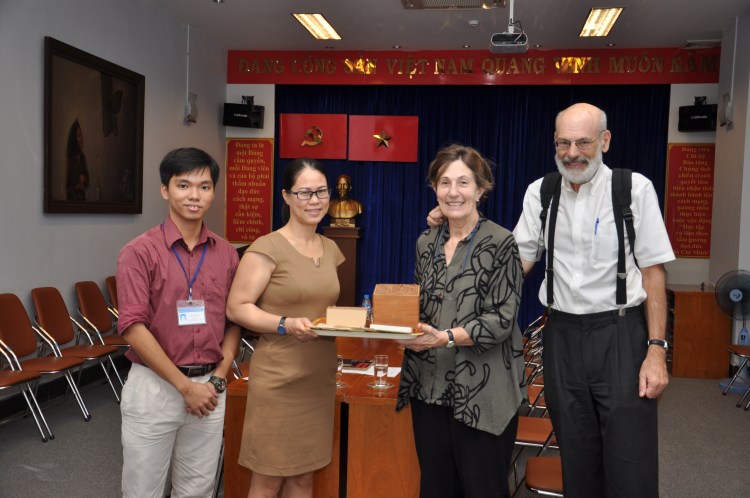
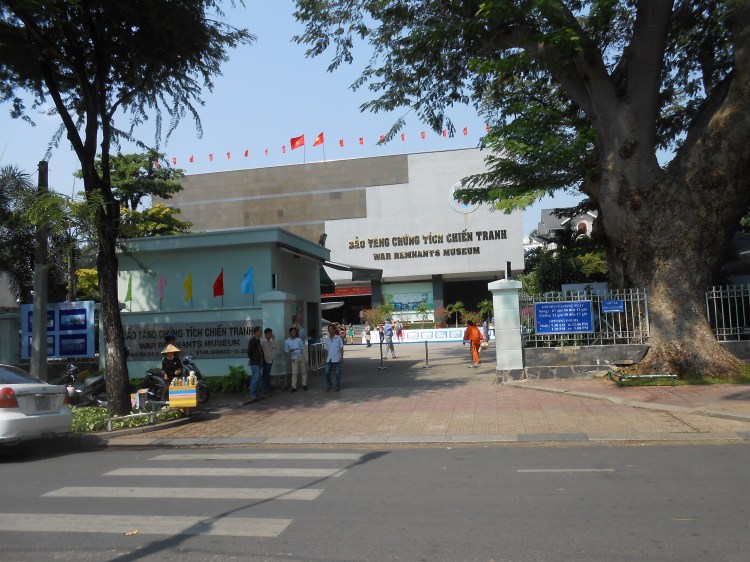
It was Joe’s idea to donate the box to the War Remnants Museum. I was doubtful that they’d have room for them; surely everyone is bringing evidence of their anti-war activity and trying to get the Museum to accept it. But they accepted it. Someone had already brought them a copy of Felix Green’s book, Vietnam! Vietnam! – a 1966 edition, very banged up and well-read. WR 3

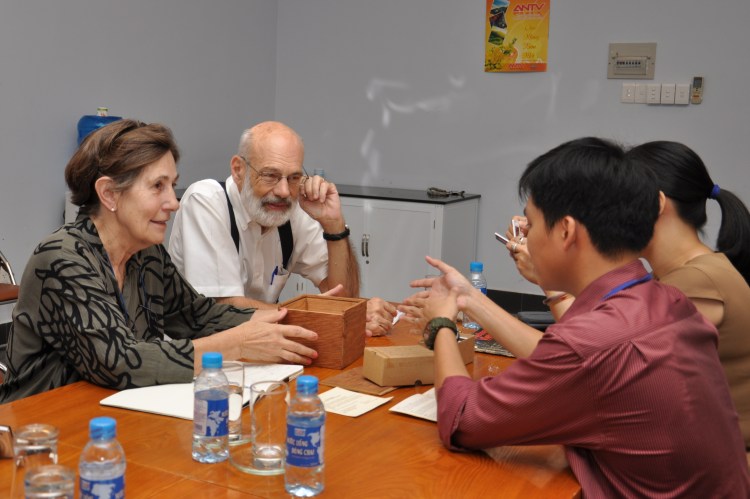
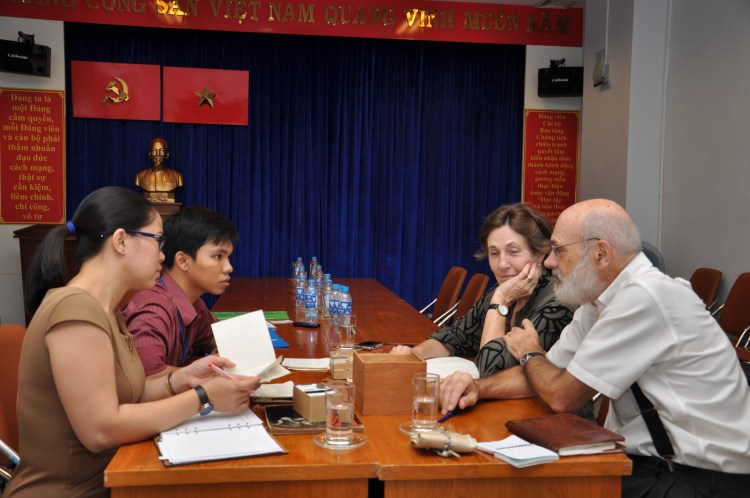
The meeting and conversation went on for a good hour, with signing of donation papers etc. The young man is Tran Huu Duy, Staff Member of the Propaganda and Foreign Relations Division, an interpreter and translator and a graduate of a training program for interpreters. The young woman is Binh Ngoc Hang, Deputy Head of the Research and Collections Department. Her degree is in history.

There is a point at which you don’t want to talk any more about things like this. You take it up to a point and then the two experiences, the US and the Vietnamese, diverge. The donation of an anti-war artifact does not entitle the donor to expand the conversation indefinitely. It’s not the job of the Museum to accept the whole load of the donor’s personal feelings, in addition to the artifact. So don’t go on and on; no speeches. Besides, they’re a different generation. They are the grandchildren of the people Joe would have been told to kill if he hadn’t been declared “pathological passive-aggressive” or whatever by his draft board. The Assistant Director said, “We forgive, but we do not forget.”This is no the first time I’ve heard this. It ends the conversation.

There is a sort of guilt-redemption industry. You can read about it. There was a tour for the children of US soldiers downed in the war and there was an article about it in the NY Times. It’s a good idea and probably helps. But it’s an industry.

Here are some ways my way of being in the world is different from the way the Vietnamese are in the world.  I do not like parades that look like military exercises, even it it’s young people running across the soccer field carrying a huge silk version of the Vietnamese flag. I don’t like displays of military drills with or without guns. They can like it — that’s fine. I am alarmed by nationalism. It’s the difference between being a Vietnamese and coming from a small country that has been invaded over and over again and has to defend itself, versus being American and coming from a big country bursting with weapons that has a history of invading other countries, to say nothing of just bombing them without bothering to invade them. I can sit beside Vinh and watch students performing military drills and feel heartsick, while she feels proud.

WR 5

I also get worried about the way people talk about “ethnic minorities” here.I don’t understand it. Nobody here seems to believe me when I say how many people are in prison in the US, how many Blacks have been killed by police.

And then there’s the TPP labor side agreement. This morning we met with a woman who works facilitating a lot of relationships among NGO’s (non-profits, they call them here) in HCMC, and she said that people she knew were really excited about it. This also worries me. To say nothing of our colleague in the Business Administration Program who said, “If the Americans had won, we would all be rich. South Vietnam would be like South Korea and the North  would be like North Korea.” This guy is an economist teaching from Samuelson and Mankiw, who said that Walmart’s low prices had “saved” Americans billions of dollars.

Although I love Vietnam, including the people, the food, the coastline, everything (except traffic jams), and especially our students, I need to go back to the US and work on the Bernie Sanders campaign.

War Rem outside_1


The Global Financial Crisis and TDTU Classroom Teaching Methods

giving blood

Students line up to give blood at registration: campus life outside the classroom

The TOP 100 aspiration is not just about TDTU.

“In November 2013, the Communist Party issued a Resolution on Fundamental and Comprehensive Education Reform that aims to develop education in Viet Nam to become an advanced education system that meets regional and international standards by 2030 with curriculum renovation for the period after 2015 as one specific objective set out to be achieved for general education.”

http://www.un.org.vn/en/unesco-agencypresscenter1-100/3317-teaching-and-learning-achieving-quality-for-all.html

This Resolution includes higher education.

An “opinionated analysis” in a paper from the Ash Institute (part of Harvard’s Kennedy School, https://www.innovations.harvard.edu/find-innovative-solutions/all-topics/education says, “It is difficult to overstate the seriousness of the challenges confronting Vietnam in higher education. We believe without urgent and fundamental reform to the higher education system,Vietnam will fail to achieve its enormous potential…. It does not bode well for the future that Vietnamese universities lag far behind even their undistinguished Southeast Asian neighbors” (Vallely and Wilkenson 2008). They list number of patents and number of published papers by Vietnamese universities.  Patents for Vietnam: 0, compared with Republic of Korea, 102,633. Papers in peer-reviewed journals: Vietnam, 96; Seoul National University, 5060.

Vallely and Wilkenson view this as a crisis and recommend a “change in governance.” They suggest the establishment of a new university with new forms of governance “in the DNA.” I do not think that change they had in mind is faculty governance, but never mind. In 2015 a new university did appear in HCMC, the Harvard Fulbright University.

This background, provided for me by a member of the XMCA (Mind, Culture and Activity) discussion list, helps me understand what is motivating the changes at TDTU. This is not something taking place here in isolation. It is part of a national effort to upgrade higher education.

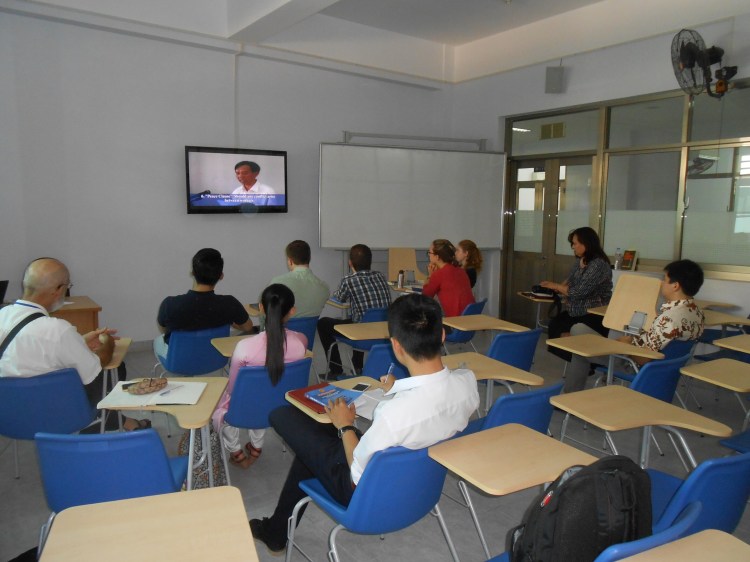
I also note that the paper is from November 2008. That was a big year in both in the US and globally, with the financial crisis (http://www.economist.com/news/schoolsbrief/21584534-effects-financial-crisis-are-still-being-felt-five-years-article). In Vietnam, it was a year that climaxed the rising wave of wildcat strikes following inflation(https://www.wsws.org/en/articles/2008/07/viet-j31.html). One response to the strikes was the attention paid by the ILO to training employers and the union in social dialog; we just showed one of the ILO films this morning, in a class with the Cornell students.
Cornell st and ILO video

Cornell students plus Nghia and Giang watching ILO video

So  a variety of outside observers are looking at Viet Nam, with its booming economy,  7% economic growth rate and frequent wildcat strikes and saying, “This country needs to upgrade and stabilize its institutions, fast.” Higher education and labor relations are just instances of that. I’ll bet that if I looked at the World Bank I’d see some other “systems” that were being targeted for upgrades.

At TDTU, the Labor Relations and Trade Unions faculty was founded around this time in 2009, two years after TDTU became an autonomous public university (a change in governance).  http://english.tdt.edu.vn/?p=2313  The  partnership agreement that links the three labor universities was signed in 2011. So there have been a lot of efforts to smooth out, sew up and stabilize the institutions that are supposed to keep things moving forward together and working smoothly. One effort is TDTU’s plan to emulate a TOP 100 university by 2037 (the date seems to flex a bit) measured by the QS Star system  (http://www.topuniversities.com/qs-stars/qs-stars-methodology)

Which brings me around to the task in front of me and Joe, which was to prepare a paper about teaching methods. Our two short papers on elite education were something I had to get off my chest —  the whole thing about emulating prestigious institutions disappoints me. But then our assignment changed and we’re supposed to talk about what to do in the classroom.

The elephant in the living room is the fact that everything has to be in English, so I put out a question on the Vygotskian discussion list called XMCA (Mind, Culture and Activity) that is based at UC San Diego, California, USA. A lot of people on that list have long experience with teaching in different cultures. I used the numerous responses to shape the article that I will insert below. Apologies for its length, but this is  where the rubber hits the road. I have written enough in previous posts so that you understand the way teaching at TDTU is constrained presently, so I won’t repeat that. Instead, here we go:

What teaching methods could be adopted at TDTU so it would provide an education like the Top 100?

 A few weeks ago, we were asked to produce two short papers on teaching at Top 100 universities based on our experience in the United States. In those papers, we focused on elite institutions, their resources and the market for elite education. We were then asked to focus on good teaching methods, regardless of whether they are found in elite institutions. That request led to this paper.

TDTU is an astonishing young university that has accomplished a lot in a very short time. To walk down the clean, shiny hallways at TDTU, teach in the well-lit classrooms with clean windows and look out at the well-maintained campus is a pleasure. The students love it, too. But like every other university, it struggles with resources. Some of our suggestions – like class size and teacher load, for example – are costly. But we propose them seriously. If TDTU wants to emulate a Top 100 university, the teaching and learning experience is what matters.
TDTU Piano

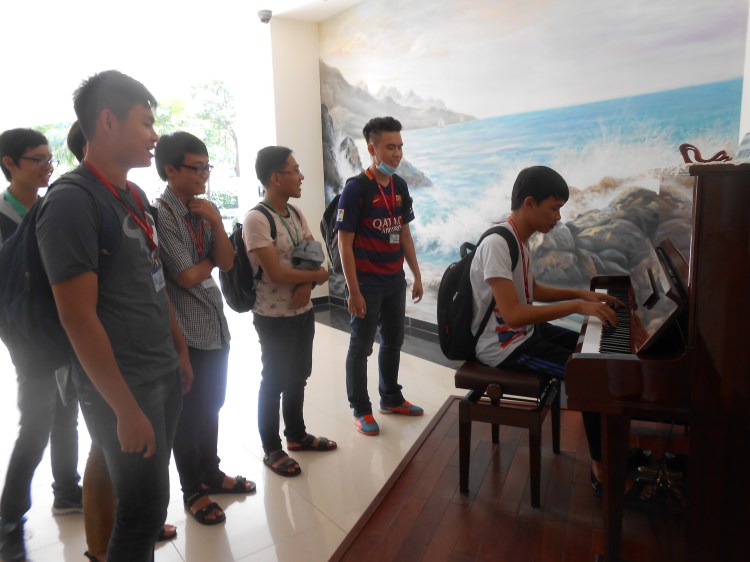
“Open pianos for use” scattered around the campus

Therefore we begin with physical and material support before talking about course content, the role of the teacher, students and research, the use of writing, tests and exams, and finally, the crucial challenge of teaching and learning in English when teachers and students alike have English as a second or perhaps third language.

The most important idea in this paper is that teaching should become student-centered. TDTU is already very student-centered in its campus life outside the classroom, but since we are talking about academic excellence, we have to talk about what students do in the classroom. How can the classroom, and what takes place in it, become more conducive to learning?
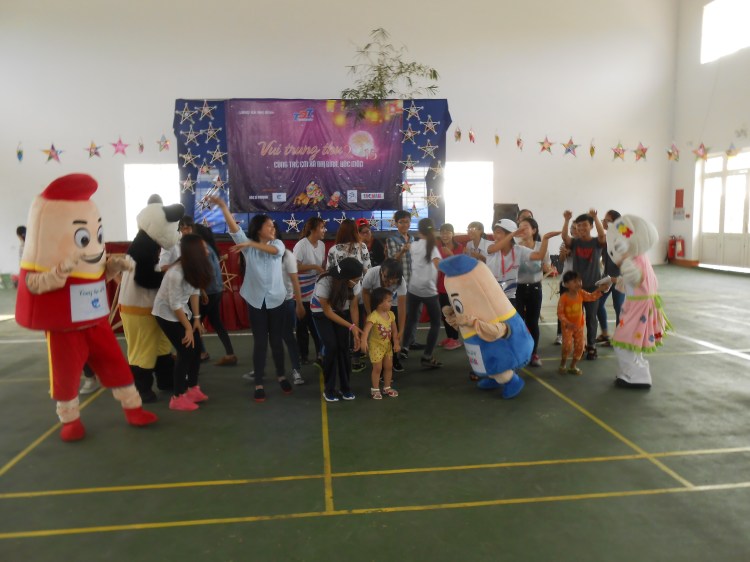
the Autumn Moon festival

TDTU students at the Autumn Moon Festival at Hoc Mon

 Class size, teacher load, other resources

There should be smaller classes: 20-30 students in each class. If a larger class was necessary, there would be teaching assistants or tutors to convene those groups.

Lecturers would teach no more than two-three courses per semester. Students would take no more than five classes per semester.

Teachers should have offices in which they can meet privately with students. There should be easy communication between students and teachers, via phone and email or a well-functioning Learning Management System (LMS). Teachers who are doing research should engage students in that research while it is going on through labs, field work or library work, so that a continuous flow of new knowledge is both produced, learned and taught by the university as a whole.

Books, handouts and other materials should be available at the beginning of the semester. Each student should have books. If physical materials are not available, they can be made available electronically via an LMS.

Course Content

A class does not study just one single book. Three or four would be assigned. Books and articles should represent more than one perspective on the subject in the class. At least one assigned item should contextualize the main subject: what is the history of the main subject in this class? Is this a new or an old discipline? What is its current state? Others should demonstrate the range of the discourse about the subject, including articles that are critical of the way the main reading presents it. The goal is to enable the mature student to enter the discourse and contribute to it.

The teacher encourages an attitude toward assigned readings or other material called critical thinking. The tools of critical thinking are questions. Familiar critical thinking questions are: For whom is this intended? Who produced this? What is its purpose? And: Is it accurate? Is it complete? Is it consistent? Is it good or worthwhile? Students may draw different conclusions from the material and may not agree with what the teacher concludes. Then even the process of critical thinking (on both sides) becomes what is studied critically. Critical thinking is a process of understanding the meaning of something, reflecting on it, analyzing it and drawing conclusions, but never taking it “as scripture,” or unquestioningly.

The outcome of critical thinking is a well-reasoned, complex argument, a theory or a new perspective. Memorization cannot produce this outcome.

 The role of the teacher

The teacher should act more as facilitator rather than an expert. He or she is the person who organizes and structures the learning opportunities for the students. It is the responsibility of the teacher to create that structure. This is not the same as delivering content. Some structures sort students (allow some to succeed and others to fail) and some structures enable the whole class, both weak and strong, to learn together. A structure that only sorts is not a teaching practice, it is really a testing practice. An opportunity structure that really teaches requires a great variety of teaching techniques because students learn in different ways and through different kinds of experiences.

All these learning opportunities involve interaction with students, teachers and course content, and all of these interactions take place using language. The uses of language – reading and writing, listening and speaking – are all actions. When students perform actions, they learn from what they have done. Therefore students have to read, write, listen and speak frequently. The majority of class time is occupied by students using language under the guidance of the teacher.

Examples of things the teacher does to create these learning opportunities:

Get to know the students. Do a questionnaire. Ask them about anything that might affect their performance in school, the background that they might bring to their studies. What languages do their parents speak, what languages do they speak? Do they have a job? Give feedback on what you find. Get on Facebook. Make sure that students meet with the teacher privately in the teacher’s office at least once per semester.

In class, get students to perform by posing problems, comparing efforts to solve problems, developing questions that lead the class discussions, and requiring presentations, reports, or debates. A top student can be put in a “hot seat” to answer the questions of other students.

Get students to interact by pairing them up, forming small groups, organizing group discussions, creating teams, playing games, urging them to meet in study groups outside of class.

Get students to teach each other by pairing up students who have different abilities to read each other’s papers, edit them, ask each other study questions, talk through difficult concepts. Using the concept of “zone of proximal development” (students working closely with a more advanced students), enable students to perform at a level of their potential rather than actual ability.

The teacher conducts the class by setting the pace of the class, guiding the integration of new content into the class, and training the focus of the class on difficult or important issues and concepts. This may be done with short lectures, media presentations, etc. The teacher may model desired student behavior in analyzing course materials. All this activity draws on a foundation of preparation done in advance by students outside of class.

The teacher may assign study questions to be answered in writing about readings or have them write a set of study questions themselves and use them as the basis for discussion in the upcoming class. The purpose of study questions is to push students to think critically about the reading. Students may be asked to write exam questions.

The role of the students

Reading assignments should be completed before class. Students should be expected to be ready to discuss the issues raised by the materials when the class starts. The class does not consist of the teacher repeating what is in a book; the students are already familiar with what is in the books and should have an opinion about what they have read.

Students practice carrying the ideas found in one assignment over to compare or apply them to ideas found in another source. They do the same with material they have learned in other classes, whether general education classes that prepare them for society or major-specific classes that build knowledge toward their specialty. They make analogies across disciplines, perspectives, periods of history, cultures, etc. and test them to see if they have value.

Assuming students have done the assigned reading and preparation, their next job is to question what they are learning. They do not memorize and regurgitate. They test what they are learning by talking about it in the classroom. If they have prepared properly, they are not afraid of making a mistake since the whole class is engaged in a process of building knowledge and mistakes are part of clarification. Students should be able and encouraged to challenge the view of the teacher without repercussions.

Just for fun: A teaching method

Let the teacher pose a really hard question to the class, a question that can be debated and answered multiple ways. The first speaker volunteers to come to the front of the room and responds. Teacher, to the class: “Can anyone add anything?” The next student also comes to the front of the room and adds something, maybe a dissenting view or a problematic implication. Anyone else? A third person steps up. A really good “hard question” will require 10 or 11 people to come and respond before all views on the topic have been contributed. No one can speak twice until everyone who wants to has had the opportunity to speak.

This is a good way to get all the knowledge in the class out into the conversation. When the class cannot bring any more points up, the teacher knows how much the class knows about something. That can be good or bad.

A weakness of this game is that only the high-status students will volunteer and will talk too much. The teacher can avoid this by putting a time limit on each speech (or saying that a speaker can only use one sentence) and by choosing speakers by tossing a soft ball into the class and letting the person who catches it speak.

The role of research

Research is the creation of knowledge and should be a part of every teacher’s practice. When a whole university is engaged in self-transformation, research into that process itself is of great interest to the rest of the world of higher education. Therefore one type of research would be a coordinated self-study by the faculty about how this transformation is taking place. This research would be called “participant action research” and is highly “publishable.” But every other discipline has its own history and its own new horizons. Teachers should have release time to perform research, either individually on topics of their choice, or in groups or teams formed within their faculties. “Visiting experts” should not be doing research in isolation, separate from the university faculties. A good role for visiting experts or highly-rated researchers would be to coach a team of young researchers toward doing cutting-edge work. Students should always be a part of whatever research a faculty is doing.

The use of writing

 In order for a teacher to know if the student understands something, the student has to say what they understand. But in class, only one person can speak at a time (except in a choral response situation, which has its uses). Therefore most of the assessment of student learning takes place through writing.

In the Humanities and Social Sciences, we give short assignments. Students may answer study questions, write a journal that reports the progress of their understanding or produce a portfolio of key subject-matter related documents at the end of the class, among other things.

Again in the Humanities, longer assignments will be papers or the final exam. A 15-week class will have at least 3 short (5-10 page) and 1(over 20-page) papers. These papers will reflect extended reasoning. The kinds of arguments that a student will need to be able to produce in professional life after university are long and draw from multiple sources. Students need to practice writing long form arguments, meaning arguments that gather information from a variety of sources, sort it, critique it, place it in other contexts and draw conclusions. In order to write extended arguments, they need to have practiced reading them and critiquing them.

Science and Technology programs have their own classic forms of writing that differ in length and the use of symbols. The use of writing to make an extended thought process permanent and visible for the purpose of sharing is equally key in those fields. Vocational fields would write about cases and problems.

Of course, many students these days copy written papers from the internet and do not understand how serious plagiarism is. Assigning a question that requires a complex response is one way to prevent this. Also, if a class is small enough so that the teacher understands the mind of each student, a teacher will be able to quickly identify a paper that was written by someone else.

Tests and exams

The overall purpose of a test or exam is to let the teacher find out if the students are learning what she or he thinks they are teaching. The teacher will then adjust their teaching to accomplish the goal better. This means that the teacher must write and grade the exam.

A test that does not also serve a teaching purpose should not be given. A test can be given a teaching purpose by asking questions that make students think about what they have learned in a new and different way. They might apply a core concept in a new context, or put several readings together and compare them, or relate something they have learned in class to their own personal experience.

Exams are often extended essay responses to complex question. in teh Humanities,“extended” may mean 30 double-space typed pages. It also means a complex multi-part rhetorical structure. These would be take-home exams.

A pop quiz that enables the teacher to learn if the class has understood an assignment should not occupy much class time. A pop quiz can be answered with a choral response.

Because speaking and writing are harder than listening and reading, active teaching methods that involve lots of student participation are a challenge for students speaking a foreign language. Active teaching requires students to do what is hardest for them. However, participation – “expressive competence” – is more important than correctness. Students and teachers must adapt to accepting contributions that have meaning, even if they are not expressed correctly.

This leads us to the next topic: teaching in English.

Teaching in English: Some suggestions for transitional practices

Ton Duc Thang is attempting to become a university where the language of instruction is English. Current research in the US about teaching and learning for students whose first language is not English is that they learn best when they learn in both their native language and English at the same time. Not only do people need the subtlety of a native language to grasp complex concepts, but negative emotions created by forbidding speech in a native language may hamper a person’s ability to carry on extended thought processes.

Therefore, here are some possible strategies for designing instruction for non-native English speaking students when they are being taught by non-native English speaking faculty. These could be seen as transitional activities that will “scaffold” the students and faculty as they become more adept at English. These suggestions came from academics around the world who belong to XMCA.

The teachers at TDTU who teach English as their job should be used as a university-wide consulting team to advise on adopting any of these strategies or others.

The “formal” part of teaching such as lectures and textbooks could be presented in English. Since these can be prepared in advance and read, studied and revised, handed out or even presented more than once, there is less risk of losing students or creating misapprehensions because of language problems. Then the “informal” or tutorial part of teaching could be in a combination of English and Vietnamese in order to make sure that students grasp concepts that do not have a one-to-one match or meaning across languages.

A class could be conducted with one teacher speaking English and one speaking Vietnamese. Apparently this has been done at Stanford.

A Shizuoka University in Japan one colleague teaches in English while an advanced upperclassman student participates with her, also in English, in the front of the class. The assistant asks clarifying questions, suggests examples, etc. Students in the class who can keep up will be able to engage and process what is going on directly. Others will use the co-teacher as a mediator. This is also a very good situation for the advanced student to learn from.

One colleague from South Africa suggests that given TDTU’s 20-year goal, the shift to English instruction could be done in 5-year chunks, with a review of progress each five years. This could be part of a university-side research project. Part of the first stage would be making sure that teachers and students had a good grasp of academic Vietnamese. Each faculty could create a dictionary unit that would present the terminology of that discipline (“terms of art”) in Vietnamese and English.

Informally, at the same time, there would be tutorial sessions (small groups with a tutor) that would always start off a topic in Vietnamese and then move to a review of the session in English. At least for the first decade of the transition, students should be free to code-switch.

Universities all over the world are hastening to become part of the English-speaking academic community. This is a necessary survival strategy. Success will bring Vietnamese students and teachers into communication with their colleagues around this world. However, there are examples of failure as well as success, and instances where plans have had to be dropped and expectations changed to fit reality. The surest way to move forward without risking making a mistake is to make sure that teachers have the support and opportunities to do their job right.

Conclusion

The changes suggested in this paper would be costly and difficult and would require a less top-down, more teacher-centered support and governance approach to managing the university. This is indeed a change in governance. In addition, the working conditions that are conducive to good teaching can be negotiated through a collective bargaining agreement which would spread a commitment to the change throughout the teaching faculty. As a union-sponsored university, TDTU could be an exemplar in a negotiating a contract that established good working conditions for teachers.This would also make TDTU as truly student-centered  in the classroom as it is in campus life, and would have the effect of providing a real TOP 100 education for our students.

___________________

THANKS TO XMCA PEOPLE

Andy Blunden, University of Melbourne, AU (retired)

Bella Kotik-Friedbut, Hadassah University, Jerusalem

Hans Lambrecht, Belgian Development Agency, Hanoi

Le Pham Hoai Huong, M.S.

Bosco Li and Anna On Na Shum, The University of Hong Kong

Carol A  Macdonald PhD, Department of Linguistics, Unisa (Pretoria, SA)

Diane Potts, University of Lancaster, UK

Asmalina Saleh, on Hongkong, Thiland, Maylasia and Singapore experience in bilingual education

Elinami Swai, Open University of Tanzania, on the attempt to transition to English from primary to university levels

Valerie A. Wilkinson, Shizuoka University, Japan

REFERENCE

Vallely, T. J. and Wilkinson, B. 2008. Vietnamese Higher Education: Crisis and Response . 79 John F. Kennedy Street, Cambridge, MA 02138: ASH institute

Tiger

Tiger economy

And finally, a snapshot of current plan at TDTU:

In order to become the equal of any of the top 100 universities in the world: identify them based on various ranking  lists, go on line to see what they teach, copy the syllabi as much as possible, and buy one book in English for each class and build sets of power points to “teach the book” through. This is how the new curriculum that will will start in October is being created. It  is intended to draw international students from around Southeast Asia, whose common language is English.

One aspect of this, part of the worldview that includes it, is respect for the authority of the text. Find the text, teach the text.

This respect for the text infuses the culture of exams, too.  We are trying to write the midterm exams right now. We have to write two versions “in case something happens.” This exam is worth 20 percent of the final grade. The rest of the grade comes from a 70 percent final exam (one hour) and a 10 percent exam. We have to write out the answers to each question, because we won’t be grading the exams ourselves. They will be graded anonymously by someone else. Also, all the answers have to be in the handouts (I guess if the students had the book, they could be in the book.) That means that if it isn’t in the handout, it can’t be on the exam. So it’s all regurgitation. No asking students to combine or compare things and do some analysis. No questions that ask, “What do you think about such-and-such?”

The test is supposed to produce grades that form a bell curve a little to the right of the middle. “5” out of “10” is passing.

Doing an exam this way does constitute a sort of quality control measure. There won’t be any cheating, I guess – at least not in the sense of a teacher giving a favorite student (or a paying student) a better grade. So it’s a guard against corruption. That apparently has been a problem, going way back in history to the mandarins in Confucian Viet Nam.

Another thing in its favor is that this exam method completely dis-associates learning from testing. If the tests don’t measure learning, then learning is not what is being tested. Testing measures something else.  I’m not sure what, but it’s not learning. So learning can go on undisturbed by these testing events. Like your annual doctor’s visit that is completely separate from living a healthy life. So it’s really my mistake, to think that the learning of these students is what gets measured by these tests. No wonder I keep getting the feeling that the kids are way ahead of the system – smarter, more conscious.

Actually, what I think the test measures is the teacher’s ability to write a test that will produce the hump in the chart that peaks out at “7.” So it’s the teacher’s ability to guess where the class is.

_____


We actually gave this material as a talk to the lecturers at TDTU. We were supposed to do it in 15 minutes, but I went over. They seemed very interested and the event actually produced some follow-up discussion which was, however, in Vietnamese so I didn’t understand what was being said. But the sight of some real back-and-forth and even joking was an eye-opener, because mostly, discussion does not happen. Here we are posing with many of the lecturers after the talk.
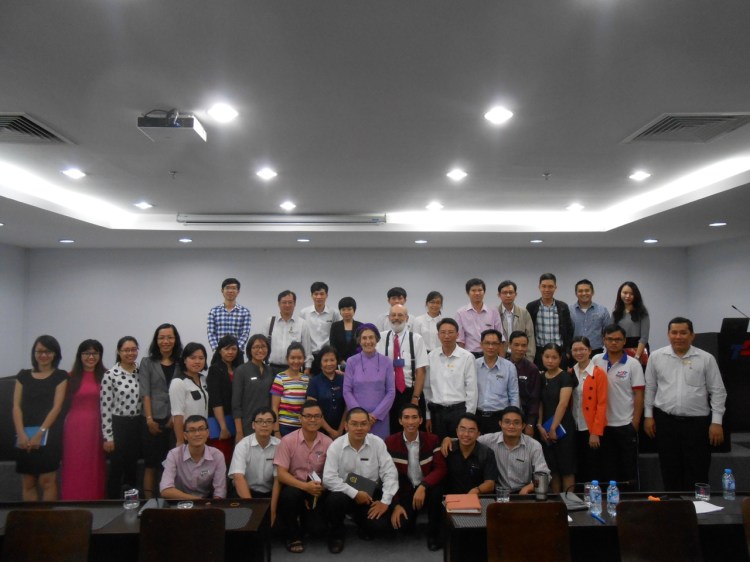
Lecturers at Jn26

Each History is Unique

Border wall crosses_1

The NAFTA border wall between the US and Mexico: Labor walks while capital flies

We are preparing for the meeting on January 14 which will bring together labor people with different perspectives on the Trans Pacific Partnership (TPP). The TPP is the only trade agreement that Vietnam has signed that has a Labor Side Agreement. The TPP Labor Side Agreement requires some major changes in Vietnamese labor that appear to force it to become more like the US system. One of these requirements is to sign on to ILO Declarations permitting the establishment of independent, autonomous unions. This is making some people ask us questions about how things work in the US.

Joe wrote the following piece as a way of thinking through how to respond to their questions.

————–

Now that TPP seems possible, people in Vietnam are wondering what shifting to autonomous, independent unions would be like. They ask questions like:

How do you start a new union? What if there is already a union at a workplace?
How does the AFL CIO control its members? 
Do unions compete?  Are independent autonomous unions strong?  How can someone represent the workers if they are paid by the employer? Who pays union staff? Who pays local union workplace representatives? Can blue collar workers lead unions? Can blue-collar workers lead white-collar workers? Does pluralism in unions lead to pluralism in politics?

Another question that should be asked is, “Will the changes required under TPP contribute to labor peace?” “Labor peace” is a tricky concept. It refers to a situation in which things are stable, not completely up for grabs or, in the case of Vietnam specifically, not punctuated by unpredictable wildcat strikes. But it presumes that we have already considered the over-arching question, “Is TPP going to be good for the Vietnamese and US working class?”

The planners of this discussion of the TPP-US-Vietnam Labor Side Agreement have asked for a brief introduction to certain distinctive aspects of the US labor movement. This is not meant to be a general introduction or a comparison between US and Vietnam labor practices. It is rather meant to respond to specific questions that our Vietnamese colleagues have asked, by highlighting significant aspects of the US labor movement and explaining where they come from.

How History Marks the US Labor Movement

Many aspects of class struggle, the conflict between labor and capital, are universal to all labor movements. However, every labor movement makes its own history. In its structure and functioning today, the US labor movement shows distinctive marks of having emerged during 200 years under capitalism.


  1. The American working class up until the mid 20th century was mostly immigrant or immigrants’ children. This is still true today: compared to the population as a whole, workers are immigrants and immigrants’ children, coming from Asia, Europe, and Latin America and Africa, drawn by the relatively higher wages in the US. This shapes who organizes, how they organize, what they organize, and the divisions they have to overcome in order to organize. The difference now is that native-born people are no longer rising out of the working class in mass numbers, but rather falling into it.


  1. However, much of the central labor in building the US economy, both in the period before the emergence of the labor movement in the early 1800s and after, was performed by enslaved workers, mostly black. The system of black life racial chattel slavery was largely established to divide the popular majority and ensure the failure of any challenge to the minority ruling class since the 1670’s. The racist ideology of white supremacy that justified slavery continues to impact the whole of society, justify discrimination, and divide the working class.
 

  1. At the same time, across US history the resistance to union organization and workers’ struggles by employers, and the government they mostly control, has been more violent and militant than in any other country in the world.


  1. Unlike most other countries, whether colonized or colonizers, the free white male citizen section of the US working class achieved political rights – the right to vote, serve on committees, hold political office – before a major labor movement had consolidated. This may be one of the main reasons why the American labor movement developed largely as a one-handed union movement. It never included a political hand as in a labor, socialist, social democratic, Communist or other revolutionary mass party. This means that the American labor movement has always had to relate to a two-party system in which both are dominated by pro- capitalist business interests.


  1. Perhaps partly because of #4, there has always been debate about what the proper role and scope the labor movement should be. Is the labor movement properly seen as only unions that bargain for members on the job as their main role? Or does it include organizations such as cooperatives, credit unions, working class housing organizations, worker centers, immigrant worker groups, and legal aid centers? Should unions concern themselves only with their own members’ needs on the job or should they speak to all the needs that workers have, individually and as a class?


Although we say “union” in both Vietnam and the US, comparing our histories should warn us that unions in each place will be different in many ways.


Distinctive Features of the US Labor Movement

These historical forces and current pressures have given rise to a US labor movement that has distinctive characteristics, including its shrinkage in recent years. It should not be assumed that the Vietnamese labor movement shares these characteristics; on the contrary, Vietnamese labor, arising from its own history, has its own distinctive characteristics.


  1. The US labor movement is not centrally controlled or centralized, but rather loosely federated. The AFL CIO is a voluntary federation of national unions with no centralized power to give commands. The biggest union in the US is the National Education Association and it is not a member of the AFL-CIO. A group of other unions split off in 2005 but some of them are back, re-affiliated. The AFL-CIO also has state and local bodies that individual local and intermediate unions may or may not voluntarily affiliate with.


  1. Unions are organized on a multiplicity of bases, some on the basis of craft work that people did, others by industry, others have become more general unions linked by a philosophy of unionism or by just whomever they could organize. Many individual unions represent mixed models. When a new group of workers want to organize, several unions may compete for their vote in an election. Today a much great % of public workers are in unions than in private employment, a reversal of history up to the 1970’s.


  1. Most of the activity and resources of organized labor is at the level of national unions, which have local unions and usually intermediate bodies, district or state.

Most organizing of new unions takes place by these national unions, or their local or intermediate bodies. In the private sector organizing is regulated by federal labor law (NLRA) which defines a union as a collective bargaining organization with a defined bargaining unit which it is certified to bargain for with the employer. Once it demonstrates majority support in a bargaining unit through an election or other means, that union is obligated to represent all the workers in that bargaining unit whether they choose to join the union or not and the employer is obligated to bargain with it “in good faith”, but is not required to agree to a CBA. Bargaining units cannot include managers above a certain level. Therefore only one union can represent a particular group of workers in a defined bargaining unit. However the bargaining rights of this union can be challenged by another union, or by a workers’ petition for decertification to “no union”. Both of these do happen, though rarely. Unions and collective bargaining in the public sector are regulated by the various states, which vary greatly.


  1. Unions are funded by membership dues. In the US, it has been illegal since 1935 for the union to receive direct money from the employer. Depending on how much money a union has, it may pay hired staff and elected leaders to do union work and may also bargain for paid time off the job for union work to be done. However, most local activists are not on union payroll but do their waged work for the employer. They are protected in their union work by law and by union solidarity. Most unions bargain that the employer will deduct the dues from workers pay and remit it to the union monthly. Some states allow unions to charge nonmembers a fee for the collective bargaining (negotiating and grievance handling) services they receive. This issue is under great debate in the US today.


  1. Technically, all unions in the US are independent autonomous unions in the sense that they are not centrally controlled, though they must abide by both the constitutions and bylaws of their national affiliates (if they are affiliated locals) and by the regulating labor laws. Some local unions are strong, educate and actively involve their members, bargain good contracts and protect workers. Others may become “company” unions and are essentially extensions of management. Independence or autonomy, either of higher affiliation or of the government or a political party, is clearly not a guarantee of strength or good representation in the US.


  1. Union leaders both at the top and at the workplace level are elected, though by varying processes, some more open and democratic than others. Many important labor leaders came out of the workforce, were elected because they were respected and trusted and then got their training later, as they took more and more important positions. An activist union will invest heavily in education for members. Rich Trumka, president of the AFL CIO, was himself a miner and a member of the UMW, but also got a law degree.


  1. The US labor movement, as mentioned before, does not have a party. There is no single voice and no requirement that political leaders listen to labor leaders. In recent decades, especially since the 1930s, the majority of the labor movement has usually related to the Democratic Party. Many top labor leaders serve on the Democratic National Committee and other bodies. At every election, candidates go to unions and ask for resources including money, endorsements and volunteers to build their campaigns. The effectiveness and value of this practice of donating quite large sums to political campaigns is questioned by many in the labor movement. There have been many efforts to start a mass party of labor, but none have succeeded organizationally in the long run, though some have impacted the political debate substantially.


This overview should provide a historical context and answer some direct questions that our Vietnamese colleagues have asked.


Starting from Zero

Felix Greene 0

Christmas Day we had dinner with Cate Poe and Jeff Phelps who are on an Asia trip.  Jeff was in Vietnam as a soldier at a time when it was clear that the US was getting out. No American wanted to be “the last one to die” in a futile war. LIFE magazine did a photo article about Jeff’s unit. He’s in some of the pictures, but not by name.

https://books.google.com.vn/books?id=clMEAAAAMBAJ&lpg=PP1&pg=PA34#v=onepage&q&f=false

It starts on page 30.

The article is hard to read. While it mentions the lack of support for the war on the part of the US public and the low morale in the army, it is not an anti-war piece. It’s carefully and tightly about how military discipline is softening in a unit where the soldiers do not want to be there. They are not reluctant because they’re against the war, although some have misgivings. They’re reluctant because they don’t want to die. And that’s all. This distinction is a sharp line, carefully drawn.

Evidence of that sharp line is the use of the word “gooks” at least 6 times. North Vietnamese fighters are called “the enemy” twice and once each for the following: contacts, kills, Communists, and NVA. Talking about the failure of a mission to make contact, the commanding officer says, “Professionally, I’m still hungry.”

A Black soldier who observes that Blacks don’t  get many promotions refers to the North Vietnamese fighters as “the little man.” You can see a peace symbol around one soldier’s neck, long hair on others.

The sympathy is for the soldiers who are dragging their feet, refusing to go out on ambushes, doubtful about the war itself, smoking so much pot that the base “smells like a burning haystack.” None of the sympathy leaks across the line to humanize the enemy, not for a moment. That was not the assignment and the writer of the article was very careful.

Jeff was born in 1949. I was born in 1943. Cate was born in 1955. Joe was born in 1948. So we were spread all around that decade. Dates matter: Jeff was drafted 6 months before the lottery went into effect. Joe got summoned to his third physical at a point in 1971 when the army was keeping anti-war activists out, not punishing them by sending them to Vietnam. When Joe told the shrink at the induction center (in Oakland) what he planned to do when he got into the army,  they gave him a 2-Y, which meant “pathological passive aggressive,” a diagnosis created for war resisters, and pulled out a bottle of whiskey.

On Christmas, we sat at the table for a long time, talking. We ate at an Indian restaurant near Cate and Jeff’s hotel, The Majestic. One topic that came up was “What was the moment at which you realized you were down to zero with knowing about something — when you realized that you were either totally ignorant or else totally wrong about something important?”

My own example is when I was 16 or 17 and in Vienna, on one of my month-long jaunts during the vacations from the school in London where I was an exchange student. I was walking around in the center city one day and met a nice-looking middle-aged woman in a wool suit (it was April) who started talking with me in English. This was 1961. We were commenting about the opera and other concerts, which I was attending as much as possible, until she asked me where I was from. I told her and then asked her where she was from: “Russia.”

I heard the word “Russia” and I took to my heels. I am not kidding. I turned and ran, at least a block and around the corner. The word “Russia” struck such fear into me that I did not even take a breath before I ran away.

Afterwards, I walked around for a while in confusion, but I never figured out what had happened or why I behaved as I did.

Looking back on this, I would name this as a point at which I could be said to have zero knowledge about something very important that was going to matter to my life. Zero!  And in 1961, the US was already in Vietnam.

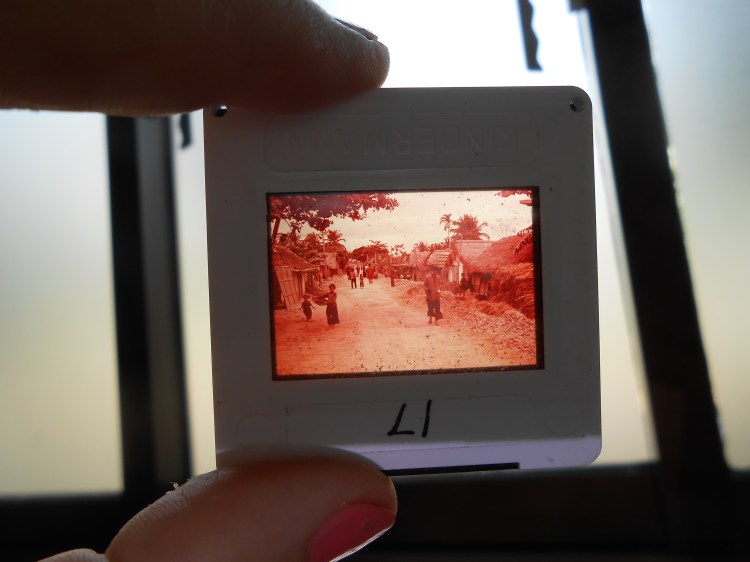
I am surprised by how ignorant I was. Last summer, going through the old wooden file cabinet in the barn attic in Vermont we found a box full of slides showing Felix Greene’s visits to Vietnam in 1965. This was a set intended to be used in presentations in the US to dissuade the US from supporting the French colonial regime in Vietnam. The US moved from supporting the French to replacing the French, which turned into what is known here as the American War. Slide #50 is missing. Dad’s handwriting on the box of slides says, “Felix Greene Slides of North Vietnam (ONI & FBI took #50 showing Greene and Ho Chi Minh together).” I don’t know what ONI refers to; maybe Office of Naval Intelligence. He was in the Pacific in the Navy in WWII and retired as a Lieutenant Commander.

Slide 17

He and Mom were turned in by a neighbor in Lake Dunmore, Vermont, for showing these slides at a meeting. Dad often gave presentations as local history associations; he was a history teacher. It would be perfectly normal for him to do this presentation. So the FBI came to the house and talked with them. I remember Mom saying she fed them cucumber sandwiches.

In addition to the color slides, the box contains newspaper clippings from the Akron Beacon Journal, a 3 3/4 inch audio tape of Felix Greene talking, a written description of each slide for use when a tape recorder is not available, and a paper about 25 pages long, typewritten on small squares that fit in the box, that gives a history of Vietnam and the war.

We have an appointment with someone at the HCMC War Remnants Museum at 9 am on Wednesday, to see if they would like to accept this box as a donation.


Cu Chi Tunnels with Vy and An

An and Vy

In 1975, the Government gave land in the Cu Chi area to people who were living in Ho Chi Minh City who would be willing to move out there. it’s about 70 km. Vy’s grandmother took them up on this. She had eight children, of whom 7 lived. Now she lives with one of her daughters, Vy’s aunt, in what was originally her own house. It’s a big house that stretches out to the rear. In the front is a mini-market shop which was Vy’s grandmother’s business and is now operated by Vy’s aunt and uncle.

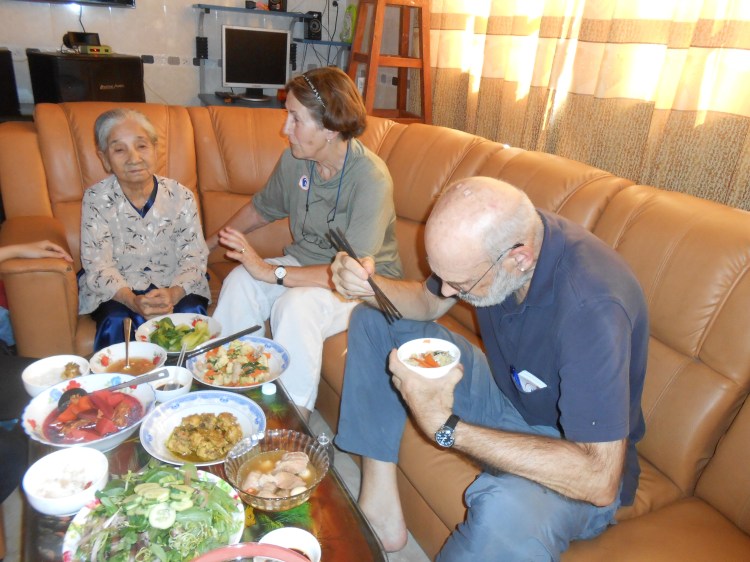
Vy’s aunt and her husband have no children. They have more or less adopted Vy and her sister. Vy’s aunt cooked a really amazing lunch for us. The picture above is An and Vy eating. You can see how hungry they were — we were just as hungry, and ate just as enthusiastically. The green bok choy was especially for us because they know we like vegetables. You can see Vy’s grandmother’s hand on the right; she is now blind and has been for the last year, from glaucoma.

Although I keep saying “This is the best food I’ve ever had,” this lunch was also the best food I’ve ever had.

Grandmothers in Vietnam seem to be especially beautiful. She wore purple satin pyjamas with a brocade over shirt and jade and gold earrings.

Vy's grandmother

That morning, we met An at 6:30 am and got on the first of 3 buses that would get us to Cu Chi about 3 hours later, maybe more, through dense traffic all the way except for the last bus which went through fields along small paved country roads.

bus to Cu Chi

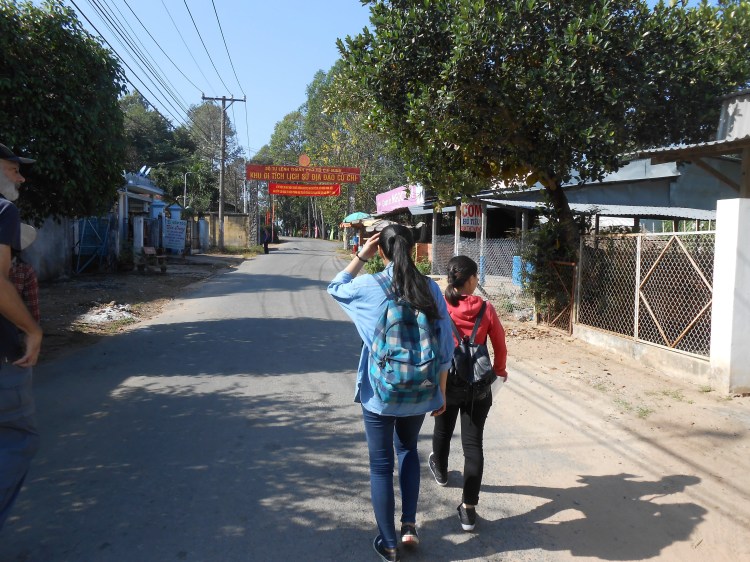
When we got off the last bus, we walked.

Entrance to park

It’s not just tunnels there. It’s a huge park, with a temple to soldiers who were killed in the war with names like on our Vietnam Memorial in DC, a lake, a miniature of the country about a kilometer long and wide, plus recreation and education facilities for kids, swimming pool, paintball area,  and other things. The tunnels are just one section.

A guide took us first through a village — many little thatched houses, maybe 20 or 30, spread around the way they probably really were becuase there really was a village here. The tour took a couple of hours and the guide was great. I will have to write more about this later. The tunnels took 20 years to build, got started under the French, go for 350 kilometers and have 3 levels (clay earth, with little rocks, very good for tunneling) and the bottom level is really bombproof, even when the B-52s started dropping bombs. The tunnels had hospitals, kitchens, dormitories, bathrooms, and above all, meeting rooms. Tables for meetings, big enough to spread out a map.


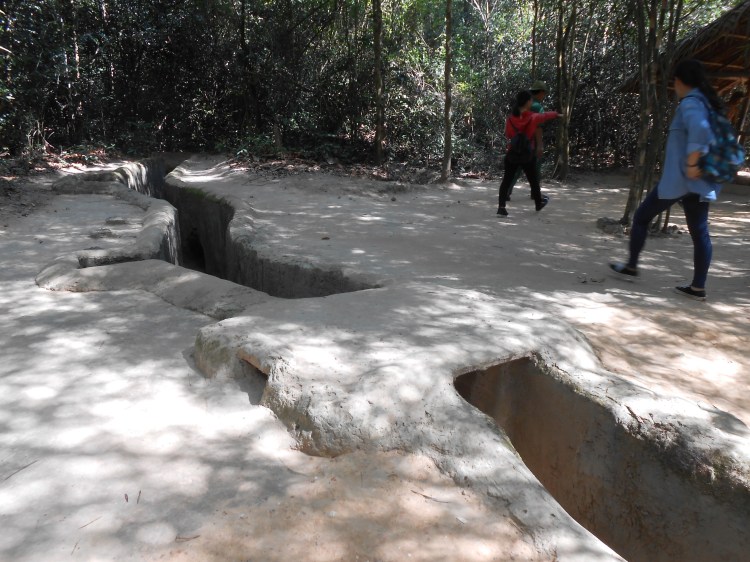
Trenches in the village. Aperture for rife barrel under clay cap.

trenches

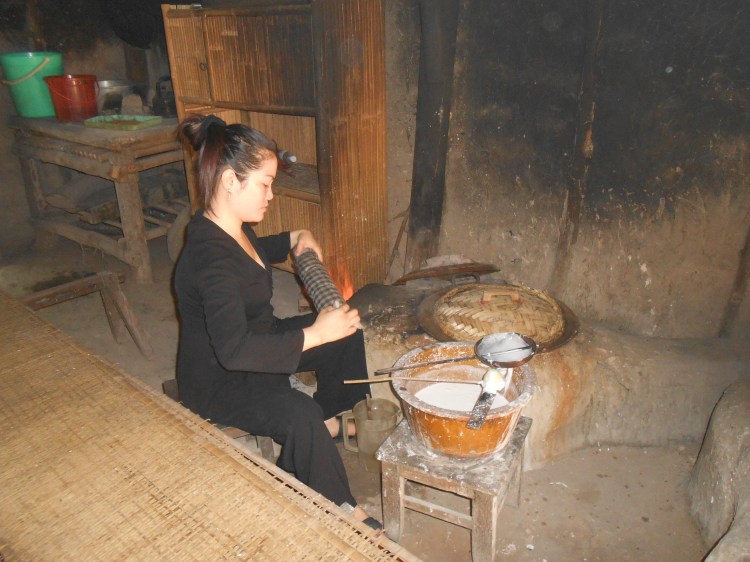
How to make paper out of rice, for rolling spring rolls.

Rice paper

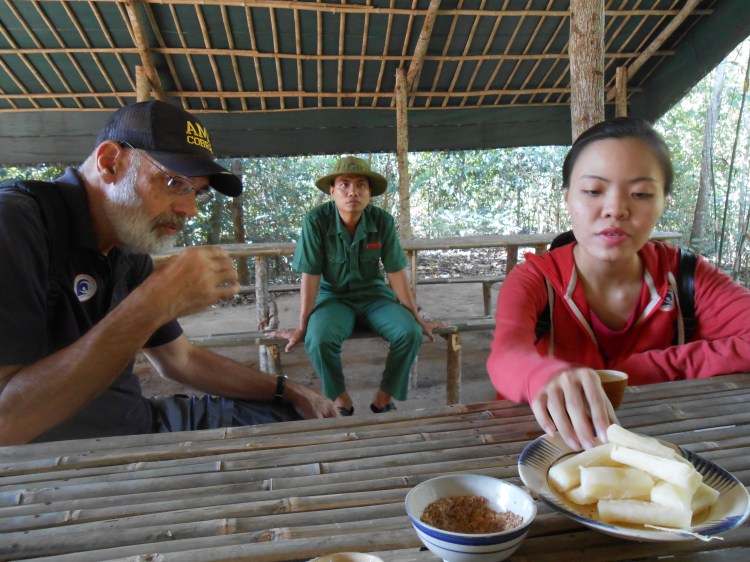
Mid-tour they served tea in tiny cups and “tapioca,” also called cassava, described as “some kind of sweet potato.” It grew wild in the forest so  when they couldn’t cultivate the fields, they could eat this. Our guide in the background; he was a sort of mysterious guy, very good teacher, seemed to be on a mission to be a good guide for us, for this place, and he succeeded.

Tapioca, Cassava

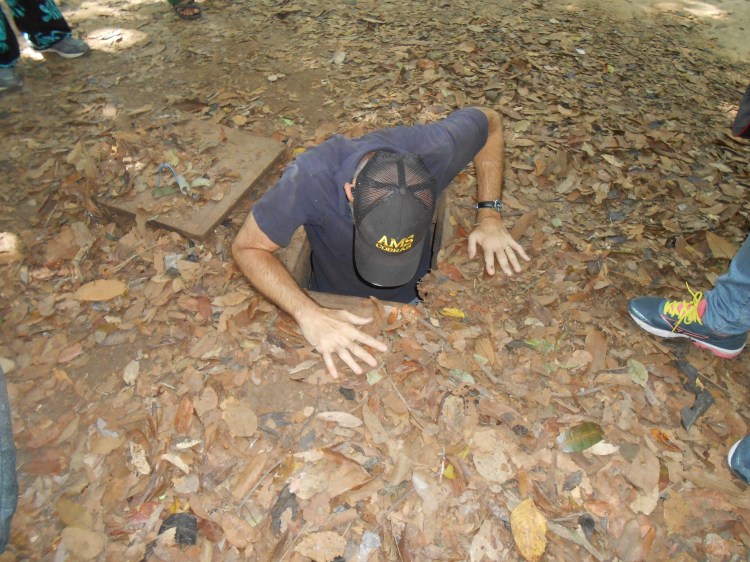
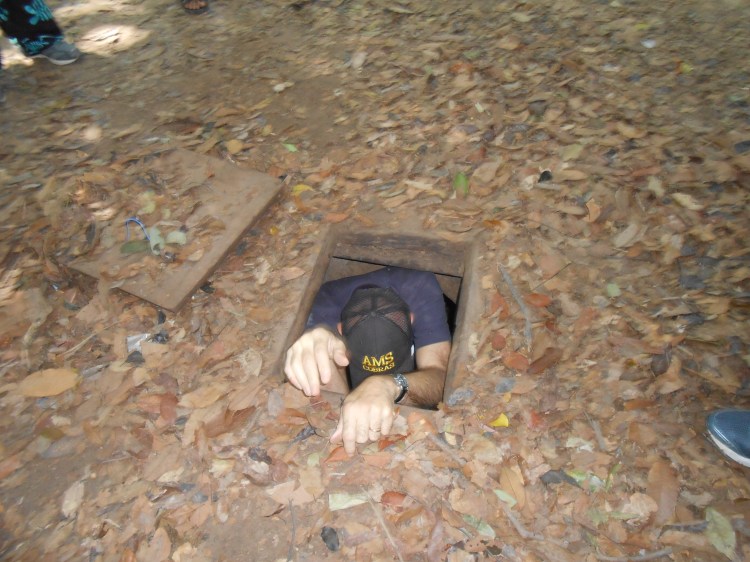
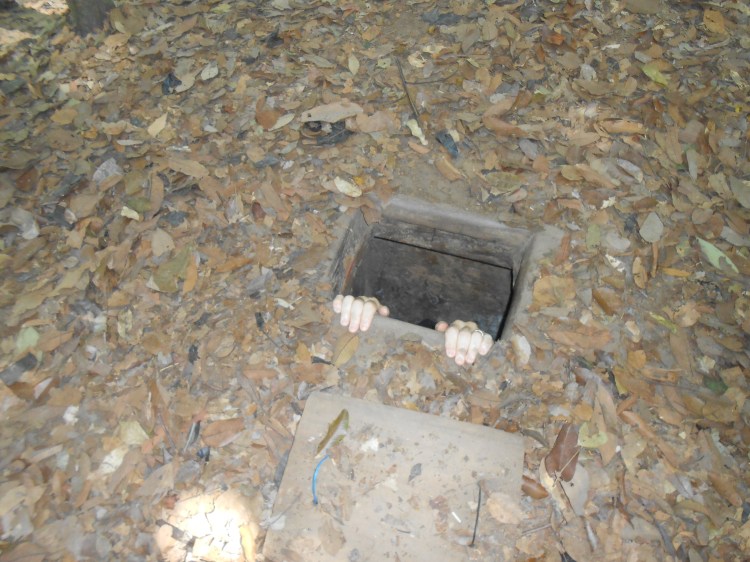
I went into a small, short tunnel. Joe went into a longer one.

Joe 1

Joe 2

Joe 3

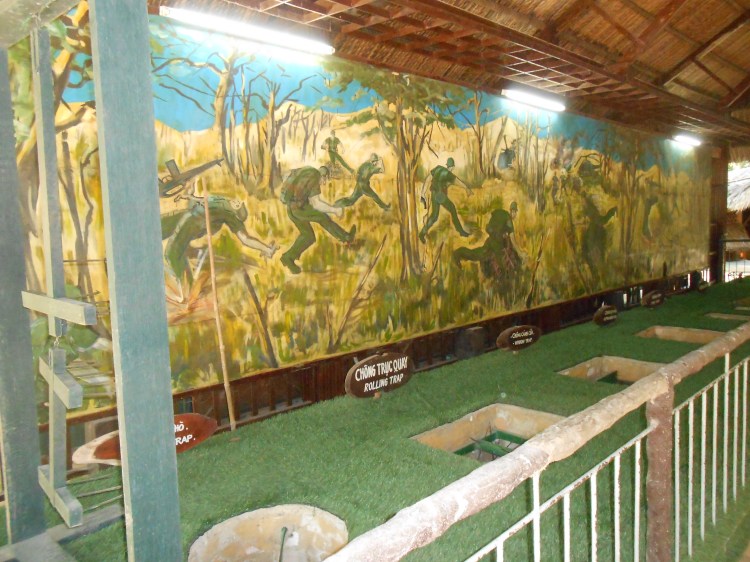
We saw examples of different kinds of traps that they set, traps with swinging lids that you’d step on and then fall into a it with sharpened bamboo sticks that would impale you. (Note my pronouns here, can’t help it.) These were scattered through the village.

But on our way out we passed this display which had a whole bunch of different kinds of traps: pits, rolling things that would catch you in the arm as you walked past, things that would fall on you. Each thing you can see on the bottom is a different style of trap. Think of all the ways vegetation grabs at you in the jungle, and start with that. All of them have bamboo spikes arranged in some way. And in the mural on the wall you see American GIs running and stumbling and falling into these traps. Our guide told us that the goal was to injure, not kill, because an injured GI would radio his unit and they would send in a helicopter with 4 more guys to carry the wounded out.

Notice that the landscape shows defoliated trees. This whole area was doused with Agent Orange. There is a forest here now, our guide told us, but it’s a young forest, only 40 years old. Forty years ago it was dead land, poisoned, no leaves. You can see that in the mural.

Running and falling GIs

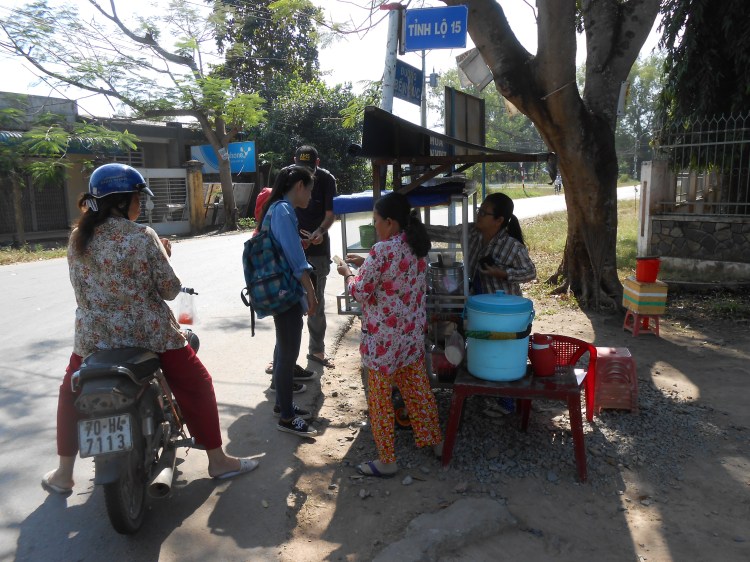
Then we walked out of the park and down the road to the crossroads where we got off the bus earlier. We bought sweet drinks from a roadside stand and then walked down the road in the back, at least a mile (and the sun was hot) until we got to Vy’s grandmothers’ house.

Corner shop

Looking out the front entrance of Vy’s grandmother’s house.

Vy's gm neigborho

When she moved here in 1975 there were not a lot of other houses around; other people came along and moved here, too.


Vy’s aunt gave us rides on his motorbike back to a bus stop (no marker; just a tree that gave shade). We were back in HCMC by 6:30.

There is now so much going on that I can hardly keep up. We have been asked to do new papers on Good Teaching (not “elite” teaching) for the next big teaching workshop. There will be a seminar/workshop or maybe a roundtable or a conference on January 14th about TPP (see posting on blog on that) when Kent’s delegation is here, which is also when the Cornell students are here. We are heavily involved in this because of the TPP thing that we wrote. Also, this afternoon we’ve got students from American University, who are going with Hollis and Leanna to the Agent Orange hospital (“Peace Village”).In addition, a lot of the contacts that Joe has been working on have responded. For example, we’ve got an appointment at the War Remnants Museum next Wednesday to talk about donating a box of slides that came from Felix Green and belonged to my parents, that have images of Vietnam in the 1950’s in them. One slide is missing,the one showing Felix Green with Ho Chi Minh, because the FBI took it as evidence after coming to visit Mom and Dad to see what they were up to.


In addition, the LRTU faculty gave us a lovely party last night at the Lang Am restaurant (where we saw the iguana), really a farewell to Leanna and Hollis, who are leaving on the 3rd. We were late but we met them there. Presents all around. Miss La gave me a beautiful pendant; other presents included books, coffee!  A good party; they ordered vegetables!! We felt very taken care of and in the presence of generous, good people (actually, we feel that most of the time).

There is too much to say about this; I’ll come back to it later.

Feats of Maintenance

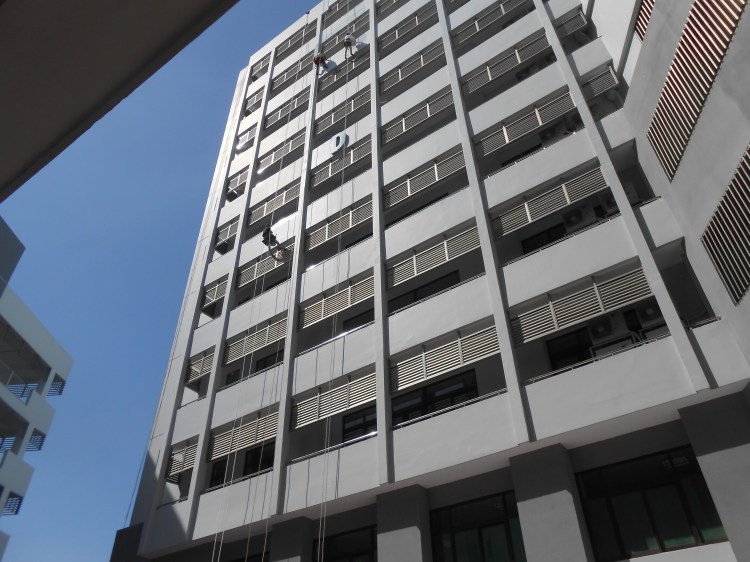
TDTU is kept shiny and new by an army of people who sweep and polish and repaint continuously, including these guys.

Painters from above g

From below, with the sun on their backs:

Painters 1

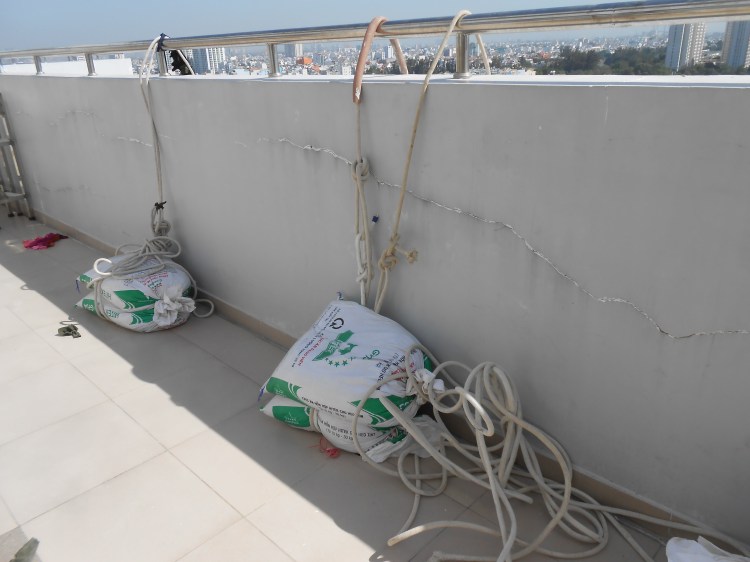
What’s holding them up?

What's holding them up?

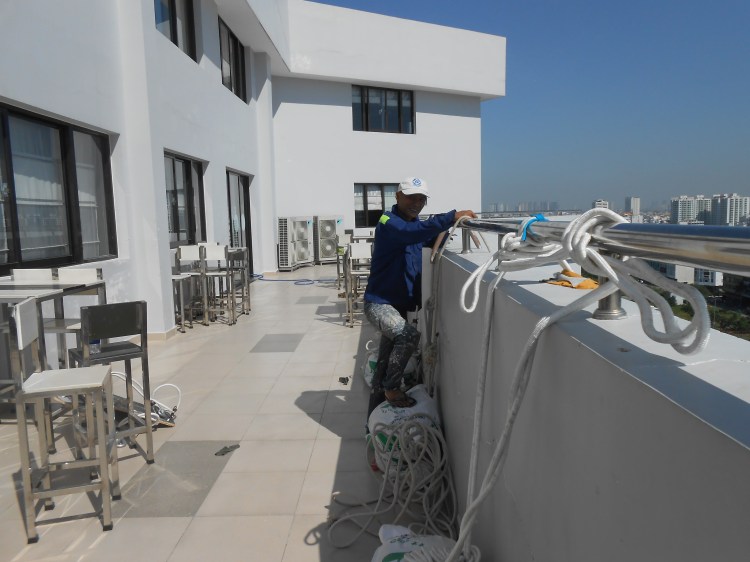
Consider…how is the railing attached; what kinds of knots are those; what if the guy moves his foot?

Foot, knot, railing

Actually, I think that assuming those are really good ropes (and it looks as if they are) the only thing that matters is what’s in the sandbags.

You wouldn’t dream of calling these unskilled or low-skill workers, although they work barefoot.

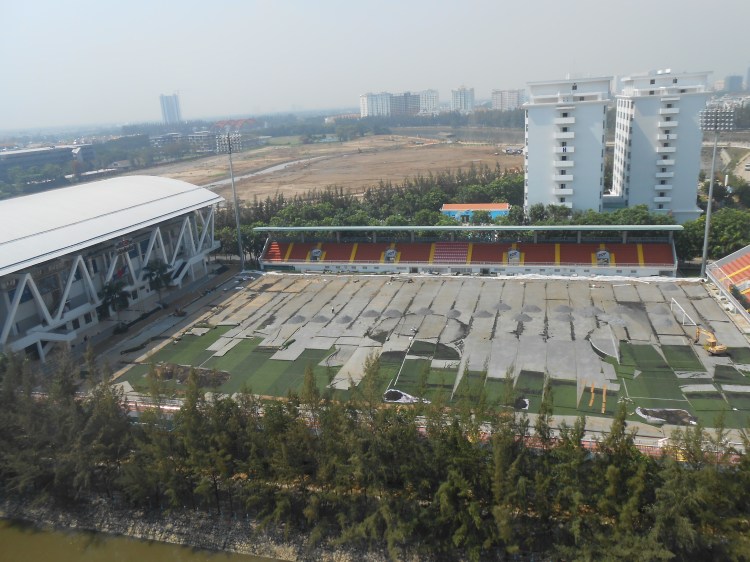
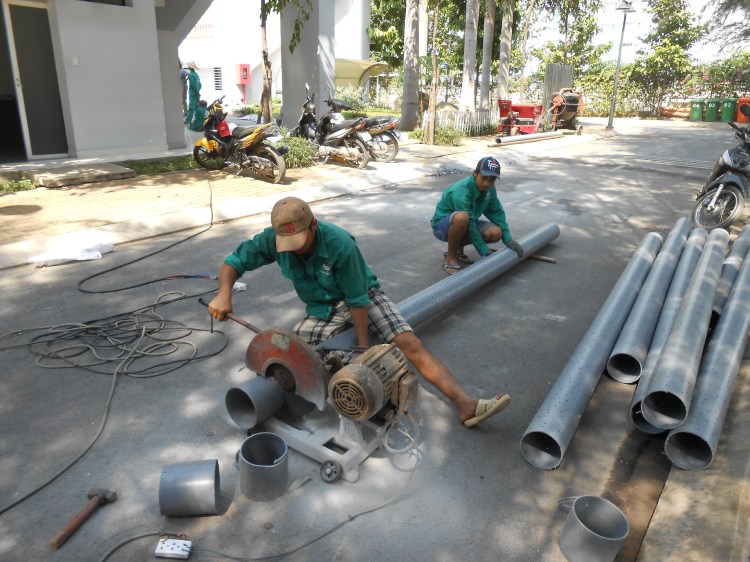
Right behind our faculty housing, they’re completely re-doing the soccer field. This means digging drainage trenches and laying new pipe.

redoing the soccer field

In the rear you can see what appears to be a new river or drainage slough being dug by one guy in an excavator who has been at it for about a month. He’s persistent. Eventually, his river will meet the big river. That will be an interesting moment!

Cutting pipe_1

The pipes for draining the soccer field get delivered to the site, but then they have to be cut to the right length and then the holes get drilled into them, one at a time. One guy holds the drill and the other guy rolls the pipe slowly around.

Apparently an argument against raising the minimum wage is that Vietnamese workers “are not productive.” That is, their productivity rate is low. From this it follows that Vietnamese workers need training to get higher skills to be more productive. Only then can the minimum wage go up. But Joe is working on this big minimum wage project; one of the things he saw early in his lit review was that increases in productivity come fastest from investing in improved technology. So invest in good infrastructure and technology, productivity will go up, minimum wage can go up, right? But what if current wages are so low that even if workers have a low rate of productivity, it’s still cheaper than buying better tools?

So let’s try to figure out what the pipe cutter’s rate of productivity is and see if it is cheaper for him to cut and drill the pipe on the site compared to having the pipe cut and drilled at the factory and delivered ready to install. How cheap does he have to be? Let’s call him Ron, or R, and say that he’s being paid 20,000 D per hour (a little more than most of our students are earning).

R at 20,000 D x 8 hours = 160,000 for one day. Can he cut and drill 20 pipes in one day? That would cost TDTU 8,000 per pipe, or 36 cents per pipe. If the factory charged 40 cents per pipe, custom cut and drilled and delivered, it’s cheaper by 4 cents per pipe to let Ron do it. If the factory could automatically cut and drill custom pipes to pop them out at 10 cents per pipe plus 5 cents for delivery, it becomes more expensive by 21 cents per pipe to let Ron do it. So if the factory invests in new pipe cutting and drilling machines (probably automated), productivity for the factory workers goes up. The factory can pay off the cost of the machines over time.

Now the girl economist gets lost. Some workers at the factory get laid off, of course. Their wage goes to zero.And what happens to Ron now? Does he get absorbed into the soccer field project? Let’s say yes, and he still gets his 20,000 per hour and no longer has to run a circle saw through hard plastic without safety glasses. Does he get trained to have higher skills? I think the skill he is displaying, cutting pipe all day and not getting hit in the eye, is pretty high.

Onward.

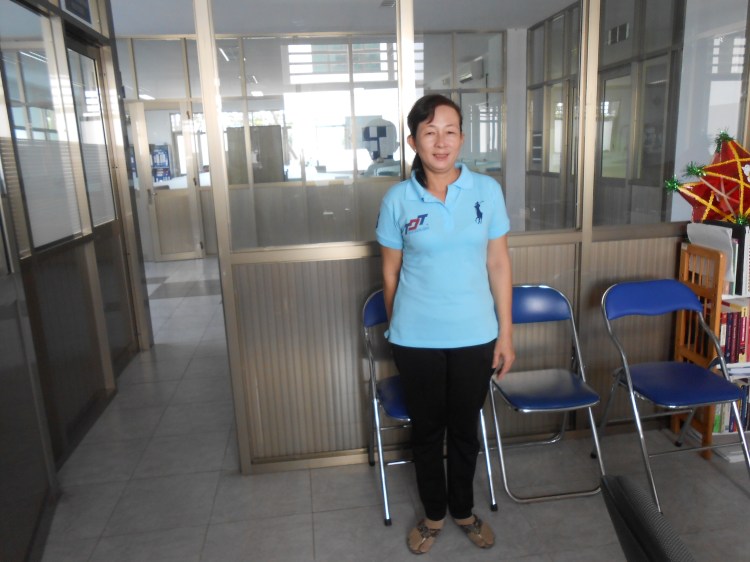
Nguyen Thi Cam Trang

This is Nguyen Thi Cam Trang, who cleans in B Building and cleaned our office today, sweeping, washing and dusting every single surface. She is wearing a TDTU T-shirt because she is one of the Happy Cleaners employees who switched over to TDTU (see our Student Reports for that story) when they found out how much more money the TDTU folks were making for doing the same work. Now that’s a skill, too.

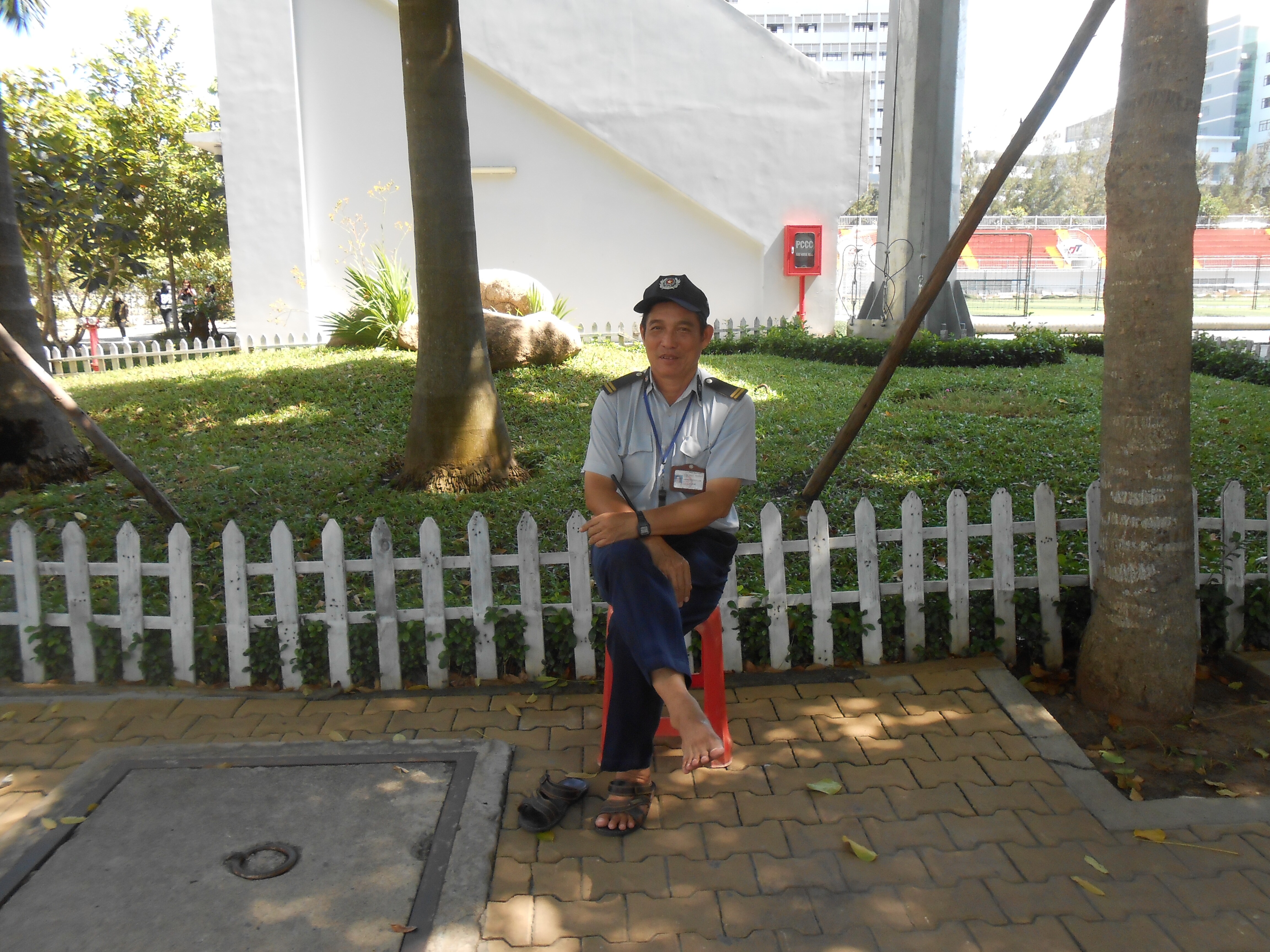
Guard from gate

This is a guard, one of the ones who watch the gate near our room. They work on 24 hour shifts. This guy is very friendly and likes to practice his English. However, they have been told — everyone at TDTU has been told — that they have to speak English. Look at the student reports to see what their working conditions are because they were one of the groups that our students researched.


Bien Hoa Labor Ed

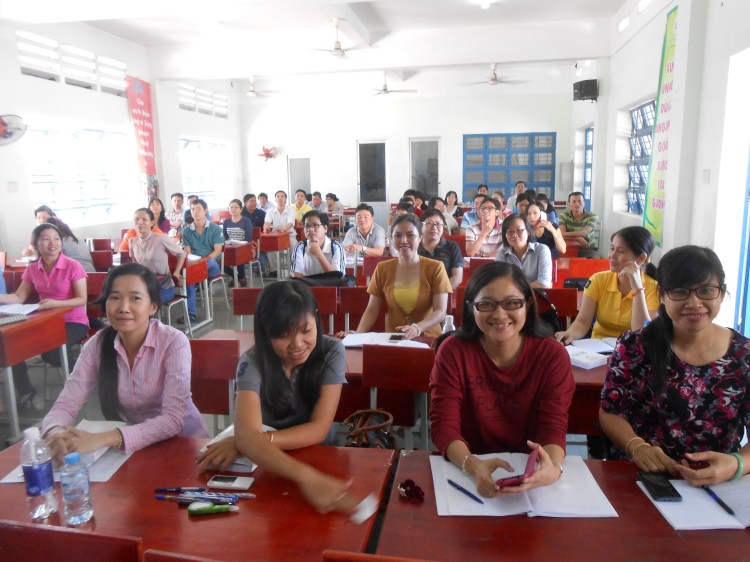
VGCL class faces

The class in Bien Hoa in Dong Nai Province took place today. We were betting 50/50 whether this would ever happen. Our visit had been rescheduled, the amount of time we would have had been changed, all kinds of stuff. It’s a class actually sponsored by the Bien Hoa VGCL for their staff and activists and coordinated by our Faculty, the labor program, at TDTU with a text from TDT.


So a request to let a couple of Americans come and take over their class time could very reasonably have been rejected. “Are you kidding?” they could have said. “Do you know how hard it is for us to get 50 people in a room on Sunday morning when they work 10 hours a day all week long?” Yes, we know, and we appreciated it.


Remember that we haven’t got any OK at all to go to anything put on by the HCMC VGCL. But TDTU and Dean Hoa have a good working relationship with the Dong Nai provincial VGCL. Long story to be told another time.


So at 7:30 am we were at the Faculty office. Pretty soon Vinh showed up in a terrific short green dress and then Dean Hoa showed up and off we went in a TDTU van. Dang, a student with good English who was to help translate, to whom I had sent the materials, was supposed to meet us there. He lives up in Bien Hoa so it was closer for him to come from there.


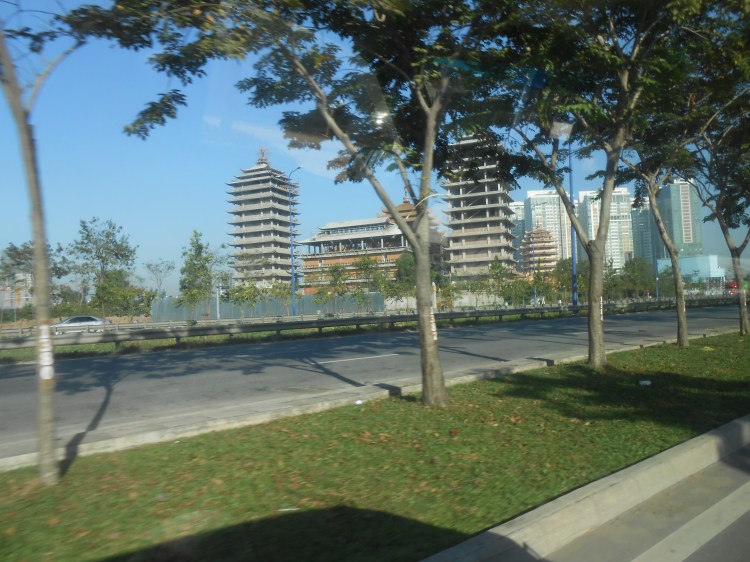
The road to Bien Hoa is a big sometimes 6-lane divided highway that goes northeast from HCMC through miles of industrial zone enterprises. I saw Coca Cola and International Trucks (with acres of them parked in front) but the Business in Asia website http://www.business-in-asia.com/countries/industrial_zone2.html lists 100 different enterprises. Bien Hoa itself was a huge US air base during the American War. It was also a place where they stored Agent Orange (and found traces of it as recently as 2014) and ordered napalm air strikes. There’s also this enormous pagoda that looks as if it could house a thousand monks:

PAgoda city


We couldn’t find the exact address so we were a little late. Dang was already there, waiting outside on his motorbike. All of us had dressed up a bit, it turned out: he was looking very sharp in black.


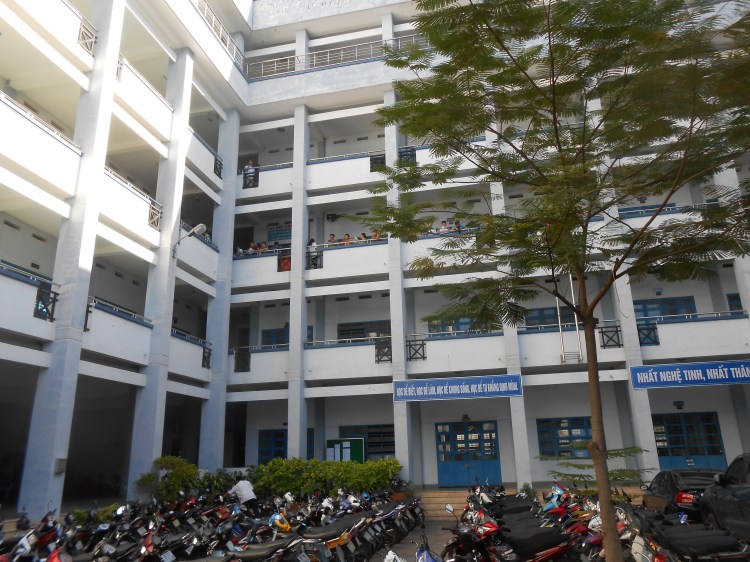
The class was in a vocational school, kind of like a community college although you’re apparently not expected to transfer from a vocational school to university (though we have heard it is possible). A motorcycle driving class was taking place as we walked in. We were late, so our students were hanging over the balconies, waiting for us.

VGCLWe werelate, they waited

After the usual trouble finding the right thumb drive and syncing my computer (with the talking points) and the PPT, we did our show.

I will simply post part of our “show” into this blog, since it wasn’t long. We decided that the thing to do was describe labor education – that is, worker education, not university undergraduate education – in the US and to show it with pictures. I searched my computer for photos of classes. Although the first photos were of classroom situations, I included more about demonstrations, pickets, protests and public advocacy, some very confrontational and visible.  One reason for this emphasis was to show how workers learn in classes and practice in the real world. Another reason was to show what activist unions do in a seriously adversarial environment, such as is now normal in the DFI enterprises and is coming down the pike under TPP.

Some of these photos show “teachers” — like me and other UALE people – in the demonstrations along with students. In action, or practice, the line between teachers and students is not clear. Stuff goes back and forth depending on what is needed. People with experience “know” stuff that people without it do not know. This flexibility finds its way into the classroom, too.  This is a point I will take up with Dean Hoa some time, since we had a discussion in the van going down about whether blue-collar workers had the ability to lead a union or could be taught to lead a union.

We emphasized that these protests, although they were strong, noisy and confrontational, were disciplined and organized in close consultation with the union that represented those workers. They were not wildcat stuff, in others words, which is a big deal in Vietnam. I’ll post some of these photos below. The class was pretty quiet while I was showing these. I could tell that we’d gotten their attention.

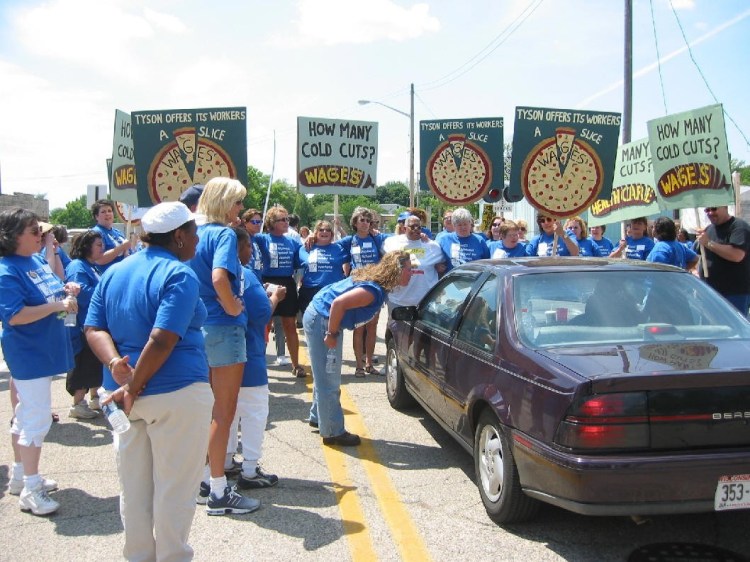
Midwes13 pizza ORIG

This was from the Tyson strike in Jefferson, Wisconsin, the year that Corliss Olsen ran the Midwest School. I explained that we were talking to strikebreakers, that you could talk to them but not threaten them or touch the car. I am standing next to Jean Troutman-Poole, bless her soul, holding a sign, in front of the car.

Indiana cap protest 2.11

This is a protest in Indiana against Right to Work legislation. Ruth Needleman took this photo, I think.

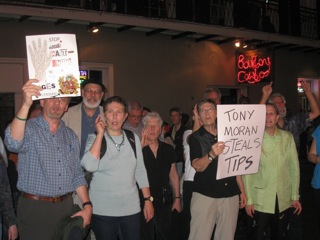
ROC demo NOLA

This is a bunch of labor educators (including me) at a UALE conference protesting with ROC, Restaurant Opportunities Centers.

Southern school

This is a UALE Women’s School. In the last 5 months I could count the number of Black people I’ve see on the fingers of one hand. People here really don’t get (or think about, or can’t believe) the importance of racism in the US. So I was glad to see such a mix of people in my pictures.

Since many of my photos of classes were of women at UALE summer schools or at Polk, I leaned heavily on the importance of women in unions, which also seemed to get through. The class was more than half women, too, as is the employed working class in Viet Nam, and even more in manufacturing in the Industrial Zones. Vinh was translating.

VGCL H listens Vinh tr_1

We managed to get through the PPT and still have 20 minutes for questions. The first question was from someone who was obviously an experienced leader (I got his card later). He said, “Here in Vietnam we have many direct foreign investment enterprises, multinational companies. Some – (and here he listed British, German and US) – are good employers but others are bad, especially in the garment and shoe industry. Asian employers especially are hard. Our workers work many hours and get paid little. How can we help our workers improve their conditions?”
I think I got the essence of the question, although those many not be his exact words. He was speaking English.

Joe responded in terms of workers’ power, international solidarity across countries and the importance of building power from the bottom up. Joe suggested that the two best ways for a union to build this power was to actually organize workers in solidarity at the base and to provide them with labor education so they could make the decisions as to what to do.

Katie at Pod

At that point I remembered that one of our PPT slides was of Katie Jordan, from UNITE, speaking at a big rally at City Hall against letting WalMart into Chicago. I pulled that slide back up. I explained that WalMart pays $9 an hour, just enough for a sandwich, and our students at TDTU who work part-time get 17,000 D per hour (or less) which is just enough for lunch if you eat rice, veggies and a little meat.IN both countries, whether you’re selling clothes at Walmart or sewing clothes for WalMart, for an hour’s work, you can buy a crummy lunch. So it’s the same thing – the same pay, the same work, the same employer.  Heads nodded! And Katie is from the garment workers!

This made real contact. The importance of having photos like this!!!

We had planned for discussion, of course – we wanted people to introduce themselves, tell what kind of work they did, and then discuss whether what we told them about US labor education would be of any use here in Vietnam. A woman in the front row gestured to me to write this on the board and I did so. While I was doing it, the questions started. We really did not have time for our planned discussion, which the workers realized before we did and they just started asking questions, which was exactly right, and a lesson for a couple of old labor educators. It is the workers’ class and you have to let them have it (just like the union). And they will be right more often than they will be wrong.


The second question came from a woman in the rear middle. She asked two things. First, what was the condition of unions in other countries in the world? Second, do unions in the US have paid staff or partly paid staff or workers who are not paid, or what? (Basically, who represents the union on the job?) Both were great questions.


Joe took the first of these, and said that unions were in decline and crisis all over the world as a result of the neoliberal integration of market economic relations for most workers in almost every country now and that these multinational corporations are hostile to unions generally and see them as obstructions to the free market in labor. Unions all over are having to adjunct strategically to this new reality, but there are some bright spots we can learn from, especially in Latin America, some in Europe, and even a few in North America. In many cases we are fighting the same employers all over the world.


I took up the second one. I have heard quite a few Vietnamese ask how anyone can be a workplace representative as long as they get their wages from the employer.  Remember the HR/union president phenomenon. I said that yes, most of the actual work of defending workers is done at the bottom level by stewards who are not usually hired by the union but are paid wages by the employer, just like other employees, but that workers doing union work have certain protections under law just like in Vietnam, although there are enforcement problems in both countries. So how do you find people brave enough to do this work? Courage plus a lot of education, plus the person doing this job never does it alone, always with other people (I didn’t get into concerted activity here), and furthermore, the best workplace representatives are women even though women work three jobs – their work for wages, their union work, and when they home after work.

VGCL class H frm rear

Note that the classroom posters are all about riding motorcycles, including traffic signs (which are never observed in real life). Dang took this.

That was all we had time for. Vinh had to get back to HCMC to go to a wedding, and the actual teacher for the class, who was supposed to teach about social insurance, was waiting to get going. We did pass out pens and pins that national AFT had sent us to take as a solidarity gesture, through the good offices of High Ed Director Alyssa Picard. People were eager and happy to get them, especially the pins, which are really nice. We put the name of American Federation of Teachers on the board, so people would know. You can just barely see it, in red, above my head and to Joe’s left.

VGCL group shot AFTAlso, we passed out our TDTU cards, which have our permanent emails on them and urged people to keep in touch, even though we could only communicate in English. We think some will since two came up to us at the end to ask for materials or ask us to come to their workplace to teach. Not bad for an hour!
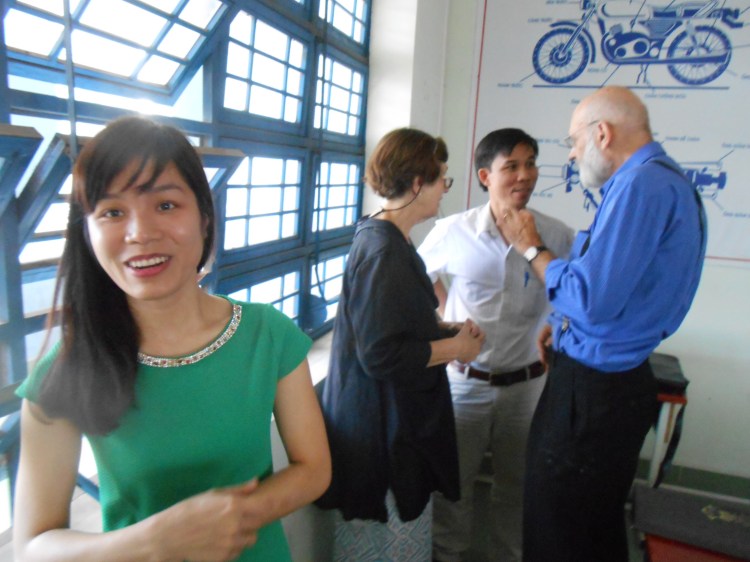
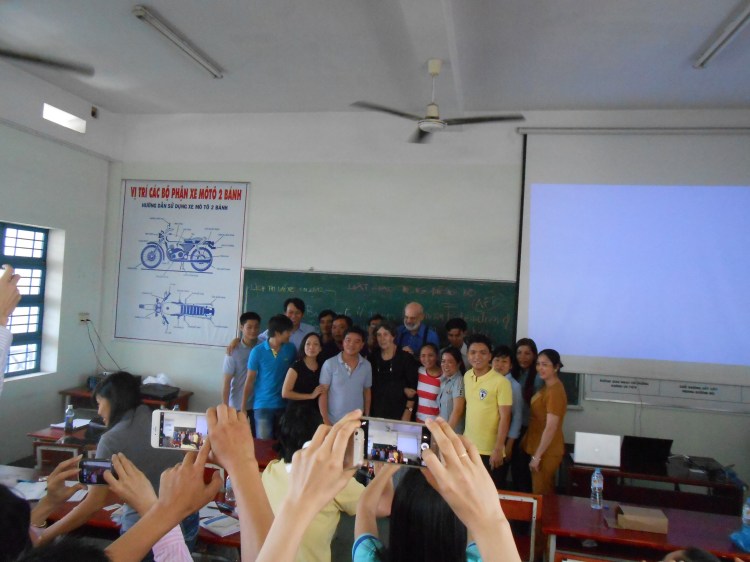
Everyone wants to take a picture.

VGCL guy asks for our materials

Everyone takes a photo. I think they grouped themselves for photos according to what workplace they came from.

VGCL Photo op

The next day one of the participants who asked a question and came and got Joe’s card emailed us and asked for examples of contracts. He had never seen a CBA. Lots of union workplace leaders in Vietnam have never actually seen a CBA. We sent him a copy of the Heartland/AFSCME 3494 contract as well as the link to the UC Berkeley Labor Center collection of contracts. Most of those are public sector AFSCME or teacher (AFT, NEA) contracts, however. We did find a couple of technology/manufacturing contracts, however. What they really need is something from USW. Those are probably on line somewhere but I haven’t had time to look them up.


Top 100, Elite and Good

TDTU has set itself a goal of offering a new curriculum, taught in English and emulating the top one hundred universities in the world. It will be an undergraduate degree. Students will come from all over Southeast Asia. It will use texts assigned in the Top 100 universities. This initiative comes from the President, Dr Le Vinh Danh, who is an economist. The most recent version of the goal that we have heard is to have TDT listed in the top 50 ASEAN universities by 2036. The list they are using for their Top 100 is  the British QS list.

Pres with flowers

President Le Vinh Danh, greeted with flowers at a graduation ceremony

A lot of our work this semester has been related to choosing texts and creating syllabi for this Top 100 curriculum. Dean Hoa looks to see what is being used at in these places. He tries to order those books. When they come, we look at them and discuss them. The academic workshop that Joe and I did for the George Borjas Labor Economics book was an example of such a discussion. The idea is that the English-speaking labor faculty (us)  will prepare power points that follow the book and that will help the Vietnamese speaking faculty actually teach the course next semester. Joe made a list of the universities in the US that are both Top 100 universities and have a labor program. He gave it to Dean Hoa who has used it.

Although we brought about 50 books from the US, many of them like Troublemaker’s Handbook are for union education and don’t show up on the top 100 syllabi. They are sitting in a small bookcase in the office. Hollis and Leanna did use Maurice Better’s Collective Bargaining for a class they wrote up. It gets used at Illinois. I used it.

Getting books is hard for several reasons. First, the order has to be made by the library, which uses a limited list of vendors. The library told Dean Hoa that a book by Harry Katz from Cornell was “off the market.” Then I found it on Amazon and just ordered it. However, that was over a month ago, and it hasn’t shown up. (Correction: It showed up on Dec 25th). Things don’t always make it through the mail. Joe has never received a whole shipment of his books, for example.

Another problem is that labor books are not like engineering or biology books. Microbiology is microbiology, up to a point. With labor books, you can’t tell from the title what the book will be like. Dean Hoa ordered a book called Mediation and it was about neighbor disputes and marriages. Hollis and Leanna wrote a syllabus for a class called Negotiation but they had to use a book that deals with people negotiating to buy a car – all individual, nothing about collective bargaining. This same thing happened with the book Joe had to use in his class that was called Social Persuasion. It was supposed to be about organizing but it is about marketing. In practice, you could ignore the book, but you’re not supposed to. The slides are supposed to “follow the book strictly,” according to Dean Hoa. Joe actually summarized every chapter in Social Persuasion and presented slides on them, which distorted the class and was confusing to students. He then prepared an entire parallel set of lessons that were actually about organizing and Vinh had to translate them. So his classes always had two parts, the real part and the official part.

  With labor books (and of course, every other discipline, but not as clearly) in addition to the confusing titles, there’s perspective. It’s not just the language, it’s the culture and the politics. A book like the Northouse Leadership that I used for my class takes a management perspective. Leaders are employers, but nowhere does it mention that the “followers” of employers are not really followers. They are employees who have to obey their bosses and can get fired.  This has to be countered with explicit re-framing to represent a labor perspective. I prepared the powerpoints for the first chapter of a book called Cross Cultural Management that, not surprisingly, had no mention of labor or unions in the index and was all management lore. This is for a class in the new curriculum that VInh will teach; it’s up to her to flip the perspective for a labor class.

So our introduction to the Top 100 project has been about trying to find English texts used at places like Cornell and then – once the money has been spent and the books show up – trying to figure out how to prepare a course based on them despite degrees of inappropriateness ranging from a little to a lot.

You might say, why worry about a labor perspective in a book? Can’t you just tell students that the book is a management book but this is a labor course, so pay attention and keep your critical thinking running? One reason is that in Vietnam there is already a lot of fuzziness about who is labor and who is management, and whether they overlap or not. This is a culture in which the president of the union can be the HR manager, remember,  conflict is resolved through social dialog and the goal is harmony, not progress through class struggle. So a book that takes a management perspective will not automatically be viewed critically. Another reason is that critical thinking itself is not encouraged. Between Confucius and the Catholic church, this is an educational culture that does a lot of memorizing and regurgitation.

I mention this because, based on what happened yesterday, this may not be true in the new curriculum

The discussions in the office about this and other things related to the Top 100 project have been energetic, mostly focusing on whether a book can be used or not. We have not been talking about the overall purpose of the project. Overall, I have been looking at it skeptically and anxiously. It seems to me to have swept the whole place up into a whirl, overtaking other projects such as, for example, the cooperation agreement among the three labor universities.

I am also always deeply skeptical about these lists like a Top 100 list or a Top 10 or whatever. “Beware of all enterprises that require new clothes,” said Thoreau. This Top 100 project is requiring a lot of new clothes.

The worst case scenario would be that this project is basically a marketing strategy, something dreamed up to fund TDT since it is “autonomous,” meaning that while it has great freedom it also has to raise much of its own funding.


I am actually a Top 100 product

Unfortunately, my CV fits right in with the Top 100 project.

I really did graduate from Harvard, Stanford and Berkeley, and I really did teach at Illinois for 11 years. Joe graduated from Iowa and has a PhD and taught at Illinois, so he looks good too. Speaking as a certified Top 100 example, my opinion is that TDTU would be better off focusing on what was good for Vietnamese students and Vietnam, and stop worrying about what they do at Cornell and Illinois. If trying to emulate a class at Illinois means copying the textbook onto power points and going chapter by chapter in a foreign language (English), then that’s not a good project.

Also, I have been up close in a lot of places that show up on these lists, and a lot of places that will never show up on any list. The top 100 may have a lot of resources (and football teams) but some of the best teaching I have ever seen is in community colleges.

The plot thickens, however.

The presentations on Wednesday Dec 23

Last Saturday just as we were getting on the train in Hanoi to ride down to HCMC when we got an email from Dean Hoa asking us to write two 2-page papers explaining teaching in Top 100 universities. We were supposed to make a list of the Top 100 institutions we had either graduated from or worked at on the first slide. We said OK, we can do this. He needed them by Tuesday. So we got started and by Monday had a draft. Then he said the deadline was 3 pm Tuesday so we wrapped it up and emailed it to him.

Dean Hoa looked at our papers and asked, several times, if we could focus more on teaching techniques – what do you do in the classroom in a Top 100 university? We resisted. Although we did describe many teaching techniques, we focused on the teaching environment – class size, office space, teacher load, and academic freedom, etc. We also wanted to push the presentation toward matching the teaching technique with the purpose of the class: For whom, by whom and for what purpose? Given how much we have seen about how teachers get monitored and –well, the right word is controlled, we did not want to create a checklist that would have been just another way to control young lecturers.

These papers were to be presented at a meeting of all the lecturers on Wednesday morning. The whole Board of Directors was supposed to be present. Our papers would be submitted to the conference organizer and they would decide if we would present. Ultimately, over the course of the next few months, every Faculty would present two papers.

We did a powerpoint and divided up the one 4-page paper into two and went to the meeting on Wednesday morning. It was in the big room in A Building where Philip Hazelton from the ILO spoke back in August. As usual, the foreigners – me and Joe, Leanna and Hollis – were ushered to the front rows. Each of us got an interpreter, me a young woman named Clover who was very good.

Then came four presentations, one after another, each 15 minutes long and fully set out with power points. One from micro economics, one from biology, one from math and one from engineering. All hard sciences (or at least aspirationally hard, if you include economics) using basically one textbook. Sometimes the same book was available in English and Vietnamese.

The presentations all focused on the challenges of teaching in English. I got a different sense of the Top 100 project after hearing these presentations.


Four presentations

The math teacher was from the Faculty of Mathematics and Probability. He had taught in Australia for 4 years, said that English language is the only way a student can get access to talk to the whole world and be part of creating new knowledge and information. When you translate an English academic word into Vietnamese, you can’t get close to the meaning. But students are shocked when they find themselves in an all-English class. It’s hard for a teacher to ask a question and hard for a student to ask one, too. One problem is that it’s hard to form a full sentence in a language that is not your native tongue. It is also hard to write an essay. There is a cultural problem: in Vietnam, students come to class and expect the teacher to talk all the time. When they talk, in order to show the teacher that they know, they will try to re-phrase something in Vietnamese but then they will lose the meaning.

The macroeconomics teacher was from the Business Administration Faculty. His course is required for all TDTU undergrads. He said that in the past, tests were all multiple choice. Now you will have to give homework, give problems that have a connection to reality (like the price of coffee), do sudden quizzes, have students work in groups, and write different kinds of tests. He explained the importance of the class monitor, who will help control the class. He said that it will be important to know the names of all the students, ask students to prepare the material before class, let students have discussions and show their opinions. Students will discuss in groups, choose a leader, the leader will come to the board and present. Do not make students ashamed of a wrong answer, he said. If students fall asleep, make a joke. Encourage self-study. An example of English vocabulary: “Total revenue, total cost.” In the first year of this class, the teacher should use simple words.

A young woman from the Faculty of Applied Sciences, who teaches Technical Biology, a lab course, had an English molecular biology textbook that got translated into Vietnamese, which she has used. She took syllabi from two Australian universities and combined them. She showed a power point with the triangle displaying the % of what people hear is remembered (10%) versus how much of what they do (90%). This was actually theory, and although she didn’t expand on it, it shaped what she does in class. She does a lot of e-learning, gives students work and tests to do at home, and presented the virtual lab that is part of the e-learning.

A man who I am told is the Dean of Civil Engineering Faculty says he will speak generally. He divides things up into challenges, requirements and solutions. The challenges are mostly around English. His solutions are that teachers must be flexible, students must self-study and attend classes. There should be a lot of field trips, to real factories and other places. They should invite more professors from top 100 universities, but the problem is salary.

These four presentations were interspersed with comments from the Assistant to the President, an attractive dynamic woman of a certain age who is also a Vice President. She exhorted the lecturers to upgrade themselves, learn English and get Phds. She warned them that the University was recruiting in Taiwan and that they could be replaced. Vinh translated this for Joe this way and he is convinced this is what he heard.

There were questions. One was, “Should our power points be in English or Vietnamese?” Another was, “How many students will be in a class?” The AP/VP responded that the lowest would be 38, the highest 78. “In other countries,” someone asked, “the class has two parts, the lecture and the tutorial. How about having a tutor if the class is so big? AP: “I will ask the President.” For space to meet, she suggested the lobbies and terraces, which are certainly used for meeting space. Someone else asked about making sure that there is wifi in every room.

There was only time for a few questions but my sense was that there was a real desire to discuss things in the room.

There will be a problem, the AP/VP acknowledged, with students who cannot handle the English and will not be able to graduate. One lecturer said that he speaks in English but writes in Vietnamese, and when he asks if the students understand, a high number say yes.

Joe and I were asked to comment but since we had been expecting to make a 15-minute presentation, I didn’t want to re-structure it to fit into a comment. So I said no. Leanna commented, and gave a very well expressed complimentary statement about her faith that the faculty of TDTU would do a great job, TDTU would become one of the Top 100 and Vietnam had a proud future. This was very appropriate and appreciated, but it’s not the kind of thing that comes naturally to me.

I was thinking that what I had just seen was, on the one hand, a lot like a good professional development day at a community college, of which I have been to many and run some. Serious people trying to do a good job despite hurdles that have been set up outside of their control. People who love teaching, too. It was also nothing like what would happen at a Top 100 university – and this was good. When did you last see tenured professors getting together talking about facing challenges collectively?

But the main thing on my mind was that listening to four presentations boom-boom-boom was like listening to the student presentations in class. A cascade of data. Now what? Time to get out Kolb’s learning cycle and see what categories to drop this data into. How were they different? How were they the same? What was missing? I would have loved to hear the faculty consider these questions. The most urgent question, quite rightly, is how to deal with teaching in English if your own English pronunciation (especially) is not great and your students’ English is even worse? Making a list of ideas that these faculty had just for that would be a good idea.

But what about our presentation?

We had been asked to write about teaching at Top 100 universities, so Joe and I took this literally. Of course, most of the difference is resources, combined with having incredibly well-prepared students. But that aside, what is teaching like at Top 100 universities? I thought about my professors at Harvard ages ago, Wallace Stegner et al at Stanford, the faculty at UCB in the Environmental Design School and in the School of Education only 18 years ago. Joe thought about Grinnell, where there was a top-quality focus on teaching, and Iowa and Illinois. So we have a lot of experience to think about, plus our many years in the real teaching colleges, community colleges, and my dissertation which was actually on teaching in the community colleges and based on that huge NCRVE survey done by Norton Grubb and the rest of us. (I gave my copy of that book to Vinh.)

Here are some short cuts from our paper:

David Larabbee from Michigan State explained in 1997 that there are three ways to define the purpose of an education system in the US. These three approaches compete. First is “democratic equality” which means preparing citizens for active participation in society. Second is “social efficiency” which means training workers and takes the employer’s point of view. Third is “social mobility” which means education for individual social mobility and the maintenance of a ruling class. This creates an education market in which individuals compete to buy and institutions compete to sell education.

Fans of Larabbee will note that I’ve changed his language a bit, but never mind.

In the last 20 years in the US, the third purpose has become dominant. Each purpose has sub-categories: credentialism, where the degree, worthless or respected, is all that matters; membership, belonging to a peer group and the networks of influence that spring from it, and finally, actual learning and knowledge.

We also say:

Teaching techniques that are effective and empowering for teachers and students could be shared and adapted. Others, that reproduce the ideology of US elitism, whether through assigned course content, framing, perspective or actual teaching practices, should be approached critically and contextualized.  

We then go on to talk about academic freedom, general education requirements, critical thinking, and on down into teaching methods and class size. Copies of this are available of course if you want it.

And we talk about the downside of elite education:

  1. The peer group and membership values of elite education can be obtained for the purpose of maintaining class position or upward individual mobility without much actual learning taking place.

2. Since Top 100 education is only accessible to a few students, and they are disproportionally wealthy, this often creates a situation where students (and their parents) can look down on their much less wealthy and powerful teachers.

3. There is a potential for various forms of corruption when the social mobility value of an elite degree becomes very high. This can range from grade inflation, where many students get high grades and no one fails, to actual selling of places.

So it’s probably not entirely surprising that our paper was not “chosen” to be presented. Our paper was directed at this event as we had understood the Top 100 project through our work with choosing textbooks. Once I saw the teachers seriously trying to figure out how to teach in spite of the hurdles they face, I wanted to tone down the criticism in our papers, to at least leave the possibility open that they would find a way to become a world-class university and still do good teaching that is appropriate for Vietnam. However, our descriptions and criticisms of elite education are still true. They just don’t apply to what will probably happen here – unless TDTU really DOES become a Top 100 university! I hope it does not. Instead, I hope it becomes a place where real developments in teaching content across languages are invented.

When we got back to the office Vinh said that she viewed the challenge of the Top 100 project as an opportunity for all the lecturers, herself included, to learn things and “improve ourselves.”  She seemed happy about it. She has an enormous amount of energy. Sometimes these Vietnamese people work so hard it’s scary. That was my first impression, way back when I first met her and Dean Hoa on Skype.  As I mentioned above, I gave her my copy of Norton’s book, Honored but Invisible, about teaching in community colleges, that has two chapters based on my dissertation.

However, my  bet is that  a reason that the presentations were from math, molecular biology, engineering etc was because that opened the fewest doors to political issues. Also, I’ll bet that the other presenters had more than three days’ warning that this event would take place.

Vietnamese roots

This picture is of a bonsai at the Temple of Literature in Hanoi, showing what roots look like if you like roots. The Vietnamese like roots. The Temple of Literature was founded in about 1,000 AD and it was actually a university. The diplomas and key declarations of the scholars who came to join it are all carved in stone placed in rows on the backs of turtles:

turtles R

And here’s what they look like:

Stele text


These people are serious about education. If memorization doesn’t work, they’ll try something else.

And in case you forget, around the corner (in Hanoi) is the Citadel, and here is a small building you might overlook if you didn’t know it was made of bombproof steel plates, had a deep bunker underneath it, and was the military headquarters during the American war.  You can just barely see a meeting room inside with a table. There is a name plate for General Giap and another for Le Duan.

headquarters