Some Key Moments


We’re getting near the end of our semester. We each have one more class. I’m beginning to think in terms of how to best use these last opportunities. It’s time to lay it out there and see if anything hits the fan.


There have been a couple of key moments.


One was in Joe’s class, a few weeks ago, after the students read Tony Dang’s translation of the interviews from Organizing on Separate Shores, in which organizers talk about their work in Vietnam and the US.


At the end of that class, Joe said, “Any questions or comments?” not really expecting any, since free-flowing discussion is not something that happens in these classes no matter how much you wish it would.


But a girl stood up and asked, “How can you tell if someone would become a good organizer?”


Somebody else said, “I think that’s the wrong question. I think the question is, how do we bring up everybody else, not how do you filter people out.”


Another asked, “What do you need to start with?” Joe said, “You need the courage to do something and you need to be clear about what side you’re on. Everything else, you can learn.”


Another asked, “How do you get rid of a bad leader?”


Of course what we heard was through Vinh’s translation, but her translation was probably pretty good. When we heard these questions we gave a big sigh of relief. Someone got the idea! Now we can go home.


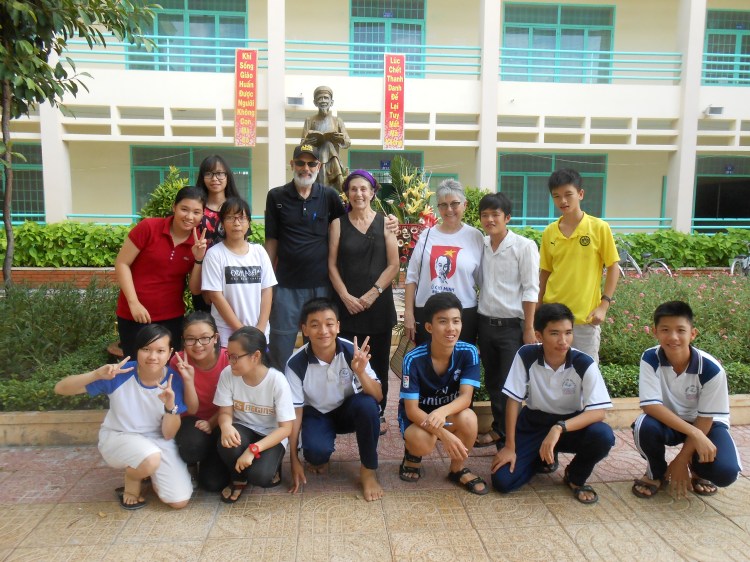
Two other key moments happened in a simulation session. “Simulation” is the word used here, and it means a session in which we demonstrate something as a role-play. It’s probable that they were thinking of collective bargaining simulations, with table skills, etc., and we’ve done two of those. But we have added role-play grievance preparation, meeting with the grievant, meeting the boss with the grievant, plus strategic planning. These sessions are announced on Facebook and students register, somehow, and then show up. We have had attendance ranging from 15 to 3, with 3 in the union grievance (as compared to the individual grievance) session. But those three were hard core.


Key moment #1 happened in the strategic planning simulation last Tuesday where there were 7 students. We used a role play that I found on my computer called “Castaway,” where you put people on a desert island and make them plan how to survive (or escape) and then give them an obstacle like an earthquake or the arrival of a raft full of other castaways to test the quality of their planning.


Joe did a prep for the exercise which was better than the exercise itself, but too long. I was worried that we’d lost them. At last we let them swing into the exercise. They were sitting facing each other on these hard wooden benches. Anh was among them, as was Nghia and Tu. From where we sat, over on the side, it looked like they were whipping through it without a lot of struggle over, for example, any of the typical dead moments during brainstorming, or disagreements on how to word the “mission statement”. We listened as best we could, now and then glancing at Vinh to see if she could tell us where they were in the process. It was all in Vietnamese, of course, and I have to tell you that after four months surrounded by spoken Vietnamese, I cannot recognize a single word except “lao dong” which sometimes means “work” or “union” or things like that. Since I am supposedly good at languages, this is worth mentioning.


Then Anh put the SWOT analysis up on the board and another student, whose name I think is Tong or Hong, stood up and explained how they had assigned the various tasks along with deadlines and reporting duties. Job done.
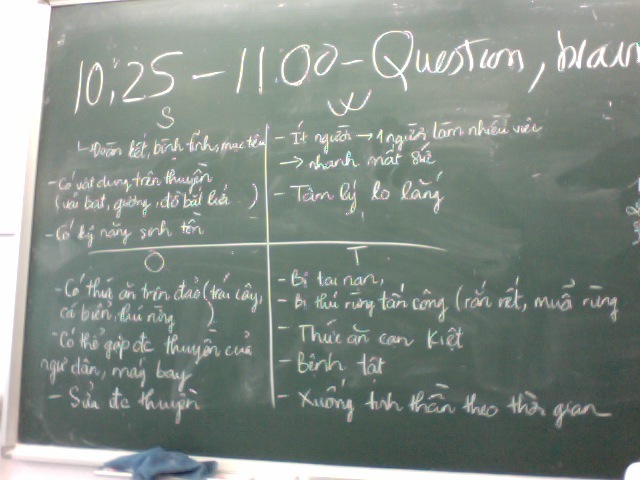
SWOT

After this, we needed to have them slow down a bit and let Vinh translate.


Their mission statement was “Survive and escape.”


We asked them what was the first thing they did when the arrived on the island. They said, “We got together and calmed ourselves down and made sure we had the good spirit together.”


Can you imagine what a difference it would make if a local union, facing a crisis, chose as the first thing they did calming everybody, including themselves, down and making sure they all had good spirits? Who are these kids?


I think back on the various union meetings I have been at where there was a crisis, acute or chronic, and people met for a planning session. I’ve been a participant in strategic planning sessions with the National Writers Union, the California Federation of Teachers, and our labor ed program at the University of Illinois, plus a guide or an observer at multiple other union strategy sessions. Never, never have I seen a group take as its first step calming each other down and making sure they had good spirit.


The rest of their planning was very concrete, very specific, full of clear instructions and good deadlines. I began to think that all this organized activity that they are engaged in, clubs, projects, teamwork, may have made them pretty familiar with planning like this. Readiness training!


Then we had another “simulation”  scheduled for Thursday. This one was going to be focusing on steward preparation, specifically on the idea of a collective or union grievance, as compared to an individual grievance. This was going to be tricky since not only do not all workplaces have unions, not all unions have collective bargaining agreements (CBAs).  It was set to start at 8 am since Anh wanted to come and she had only a small window of time.


Only 3 people showed up. We waited a bit and then, instead of running the simulation, a young man named Hong (I think) asked several questions. They were the kind of questions you do not want to avoid. One: “Why has union membership in the United states gone down?” Another: “How many strikes are there in the US?”


We were sitting on these wooden benches, me and Joe on one side and Hong, Anh and Tu on the other side. Anh has pretty good English. Tu’s English is school English; reading and writing, not much at talking and speaking. It’s hard to tell about Hong. Vinh was sitting at the side facing all of us. I should mention that after reading the story of the four-year struggle of the Heartland AFSCME 3494 workers (Effingham), students have told me that they think  US labor relations are very brutal. They can’t believe the AFSCME 3494 workers held out for four years.


Joe answered Hong’s first question with three reasons. One, that the industries where union density was high, like manufacturing, have mostly gone out of the country, elsewhere, and the remaining work is in the service industries which in the past were not organized. Two, that there has been a relentless attack on the very idea of unions ever since the 1970s. And three, that as far back as the 1940’s (and earlier, actually), because of the competition with the Soviet Union, the Communists – who were the most serious organizers and the most committed to the working class – got purged out of the labor movement.


This was one of those “I wonder if they hear me?” moments.


The number of strikes has also gone down, of course. We did not have time to get into any further points about that, such as the effectiveness of the Chicago Teachers strike in 2012 or the strike threat raised by NUHW against Kaiser just a week or so ago.


The willingness to show interest in the US labor experience convinced me that, since the class coming up was going to be my last one before their presentations on their workplace research, I should say what I really wanted to say, and ask them what I really wanted to find out. So I wrote up the following handout, gave it to Vinh for translation, and had them read it in class on Wednesday.

If you have been reading since last summer, you will recognize my main question.


———————


What Should We Be Teaching?


When we were first thinking of coming to TDTU to teach in the Labor Relations and Trade Union Faculty, we asked, “What do they want us to teach the students?”


The answer to this depends on whether you see Vietnam as being still a socialist economy, moving into a mixed free market economy, or a capitalist economy with some remaining socialist features.
The answer under socialism

One answer was, “Teach them to be more productive, work hard, motivate them to join the union, do sports, study hard and be healthy.”

This answer assumes that Vietnam is still socialist. All these are good things, of course. Being productive, working hard, joining the union, studying hard, staying healthy and doing sports are all good. But they should be the focus of union work only if workers and employers are on the same side. In a capitalist economy, a curriculum designed to teach only these things would leave students vulnerable and ill-equipped to face capitalist employers, either as workers or worker representatives.


The answer under the free market capitalist economy

Another answer was, “They know that capitalism is coming and they want to know how to fight it.”


This answer assumes that Vietnam is moving into capitalism. Now that we have been here five months and are nearly done teaching our classes, I would say that capitalism is not just coming, it is already here. Also, I can tell that you, our students, know this. The list some of you wrote in Joe’s class, of things people want from a good local union, revealed that you know that capitalism is here. One way to see that is that you did not put on your list that it is the union’s job to help the workers be more productive or manage them in any way.


But the second half of that answer was, “They want to know how to fight it.” Do our TDTU students know how to fight capitalism? Specifically, do they know how to defend and improve the jobs of workers who are employed in capitalist companies?


That’s what I’m worried about.


What a good local union also has to do: Fight


The list of things that people need from their local unions that students put on the board in Joe’s class last week was a good description of what a live union does in a capitalist economy. However, one major thing was missing. It’s great to have a union that can resolve labor disputes, ensure fair treatment, safety, good working conditions, good pay and benefits, the right tools and PPE for workers, and stay current with the law and train workers to understand the law – that’s all great. But how? Since not a single one of these things will help the capitalist employer make more profit, the employer will oppose them. Therefore the union must carry out every one of these things in the face of employer opposition. How you carry out these responsibilities in a friendly environment is very different from how you carry them out in a hostile environment. In a hostile environment, the union’s actions often have to be aggressive and direct rather than routine, and they have to be grounded in real power. So the list needs to include “build the union’s power” and “know how to fight.”


The employer will fight with all its power which comes from ownership of the property, equipment and raw materials, and its right to manage what it owns, including locking workers out or demanding obedience from them during the time for which they are being paid.


The union has to fight with all its power,too.The source of this power is the solidarity of the workers. This power starts at the point of production, the point in place and time where the work gets done. Workers can choose to work or choose to stop working, choose to walk out, or choose to sit down. This power extends  out in one direction into the society of which the workers are members and back in the other direction to the negotiation table. If you really wield this power, you don’t have to actually touch the point of production.


This is the situation now. The workplaces you are studying now are operating under these conditions.


So what if the fight gets even more intense?


You have heard of the TPP, the Trans Pacific Trade Partnership. While there are apparently many ways that the TPP will be good for Vietnamese business, the view of it from labor activists in the United States is that its primary beneficiary will be large corporations which will become even more free to move investment money around the globe. This will undoubtedly mean that there will be more competition among manufacturers and more pressure to keep wages low. Vietnamese workers will have to fight back even more effectively to prevent this from happening.


Will the changes required of Vietnamese labor organizations help?


If the TPP is passed, one possibility is that labor relations in Vietnam will become much more like labor relations in the US. I think that many of you view US labor relations as very adversarial, even brutal.


But TPP will also require changes in how Vietnamese unions operate. These changes may or may not make Vietnamese labor bodies more competent to protect workers.


Here is a list some of the changes in Vietnamese unions required by TPP. These are from the side letter on labor that is linked to the TPP.


First, workers will be allowed to form new grassroots autonomous unions. They do not have to be part of the VGCL. These unions can organize, bargain collectively, strike and carry out “labor-related collective activities.” They can elect their own leaders, employ staff and own property. They will still receive that 2% of total payroll costs that is paid by every employer, based on membership, in addition to union dues paid by each worker. All members of these autonomous grassroots union E-Boards must be elected by the membership. An upper-level union may “assist” a grassroots union only if the grassroots union requests it.


Second, there has to be a clear difference in role between people who represent workers and people who represent employers. The agreement says, “Vietnam shall ensure that, for purposes of protecting the interests of the employees, including in collective bargaining, that, in law and practice, it distinguishes between employees and those who have the interests of the employers.” This means that there will not be any HR officers who are also local union presidents.


Third, Vietnam must establish sanctions against anti-union discrimination and failure to bargain in good faith, and ensure that no laws are set up to undermine union activity. This last point is very far-reaching, because that impact can be caused by many different factors.


Finally, a tremendous amount of training is proposed: training inspectors, training criminal system authorities who will inspect sites suspected of employing forced labor and child labor, training for Industrial Relations bodies and “mechanisms”, training personnel in MOLISA and DOLISA and everybody else, including researchers and people who will inspect this whole process. Item D in the side letter says, “Vietnam shall launch an outreach program to inform and educate workers, employers and other stakeholders…” Whether this actually means that there will be more jobs is not clear, but it seems likely.


Discussion questions about the impact of the TPP requirements


Get into your research groups. Have you heard about these changes? Have you heard people discussing them? What might happen at workplaces you have studied in this class? How would you answer the following questions about the impact of these requirements?


What might happen to Vietnamese workers? Will they be better or worse off?


What might happen to local unions?


————————


Here, filtered through translation, are the issues that the students brought up to report after their discussion.


Training. Vietnamese workers are low-skill and will need training to get up to the point where they can compete against workers in other countries.

Labor standards. Signing the ILO standards will be good for women and children.

Equipment. Competition under the TPP will force companies in Vietnam to upgrade their equipment and make a better, safer working environment.

Unions. Workers want grassroots unions and worker representatives. Right now there is the one VGCL. The new unions (under the ILO “freedom of association” standard) will be hard for the government to control.

Education about labor standards and law: a great deal of training will be needed in order to educate workers about their rights under the law. This is true for both Vietnamese workers and foreign workers who come to Vietnam to work.



What stories do we tell?

Laughing 1

The first stories that come up when a bunch of old labor educators are killing a couple of bottles of wine are health and safety stories, like the generator that exploded and the printing press that blew across Michigan Avenue. Then we start remembering stories told us by other people: Emanuel Blackwell, RIch Egeland, Gary Gaines. Pretty soon we’re talking about Charlie Richardson, to whom many owe a great debt.

Da Lat: Garden City

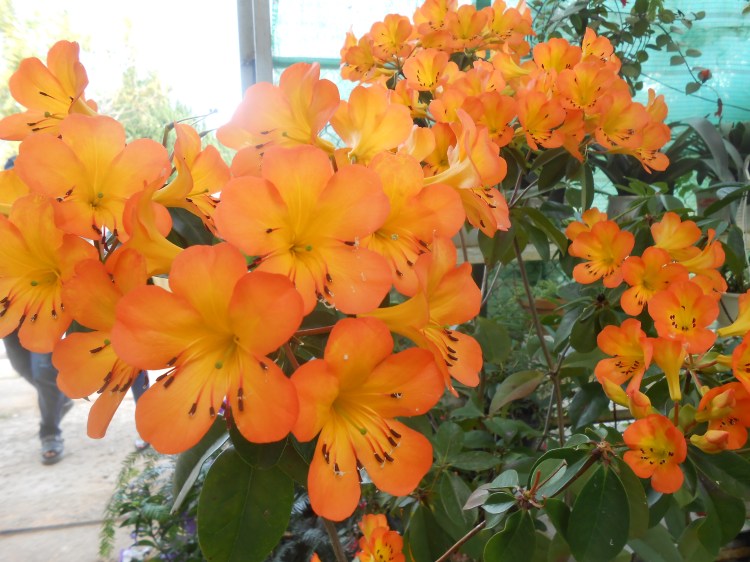
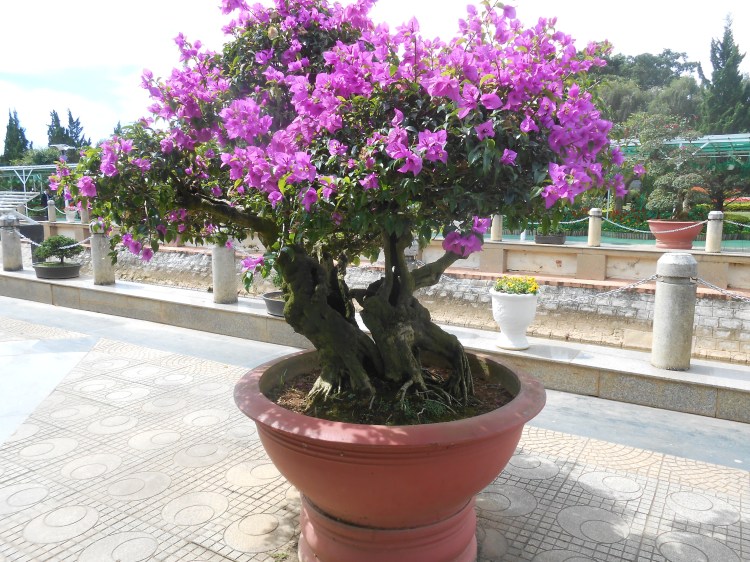
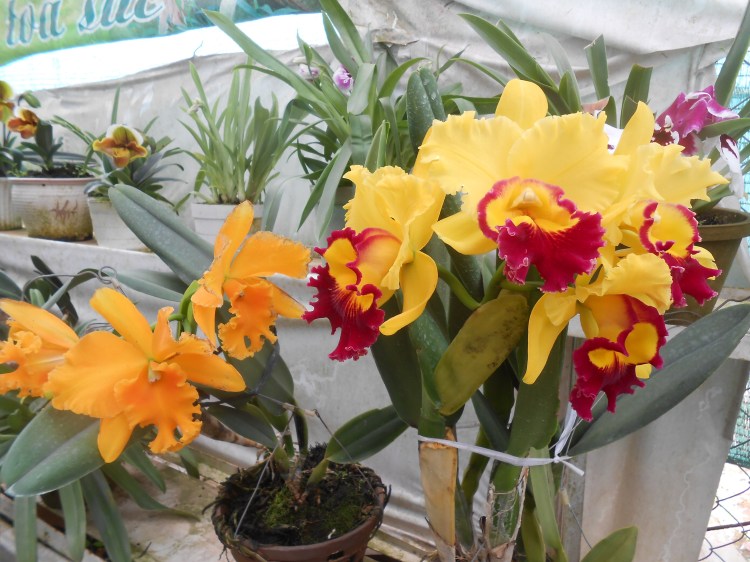
The bus leaves at 9 pm from HCMC and gets into Da Lat about 4 am. It’s one of those Korean sleeper buses; two levels of couches where you lie almost prone. In the dark, the bus climbs. I can feel my ears pop. Da Lat is in the Central Highlands, about 5,700 feet. That means it is cool, like San Francisco. It is known as the City of Flowers.

Yellow orchids_1

Orange flrs

bouga bons

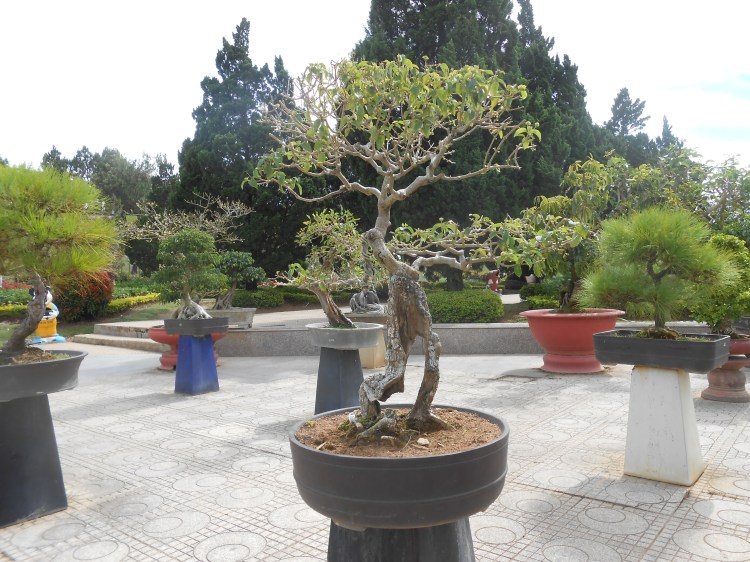
The famous garden center has hundreds of bonsai, some of which have to be over 100 years old. Someone took care of them throughout those 100 years. Where were they kept? This one looks like an ent, walking:

Walking bonsaid b_1

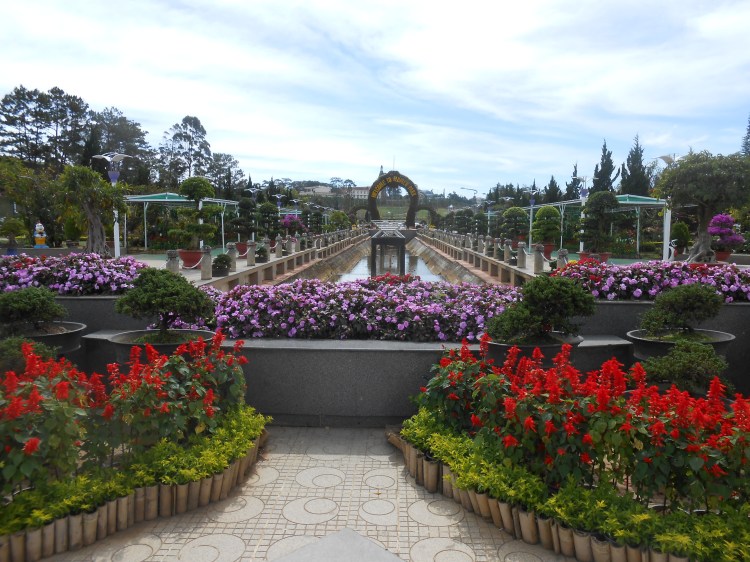
The main entrance to the gardens:

Entrance to grdn

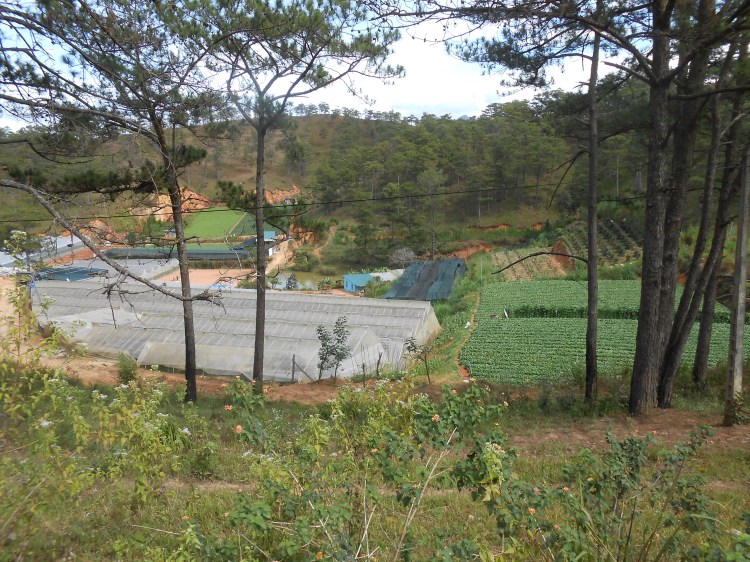
At the center of Da Lat is a large long lake, fed by numerous rivers that come down from the watershed through valleys. Those valleys are filling up with greenhouses and garden beds. This is where strawberries, artichokes, and many other good things come from.

greenhouse valey 2

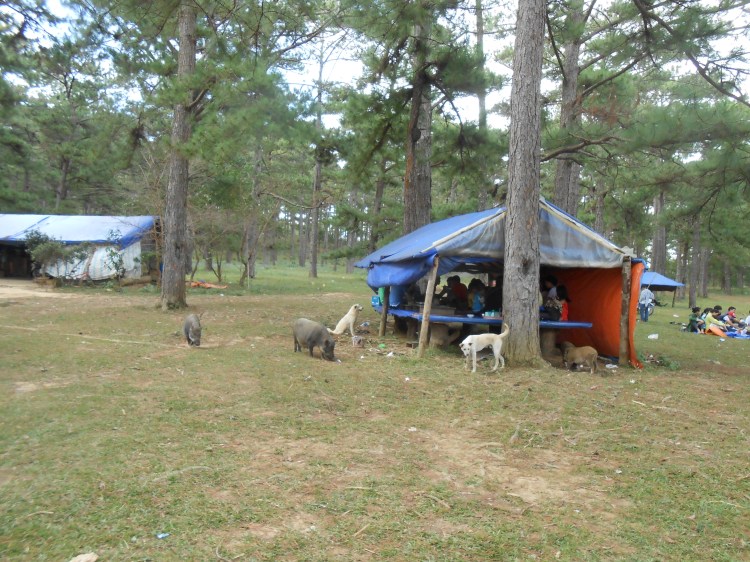
We traveled up into these mountains to visit a performance space where members of what is probably the Co Co ethnic minority (more about that later) offer a show about their life, and then a visit to a valley called Cu Lan, where there is a  village where the Co Co may have lived. On the way, back, we stopped with Vinh’s friend Hien and her boyfriend for a picnic. It’s a full-service picnic area; they will kill a pig or a chicken for you, provide charcoal stoves, and if you want to spend the night, a blanket.

Picnic tent

sow pig

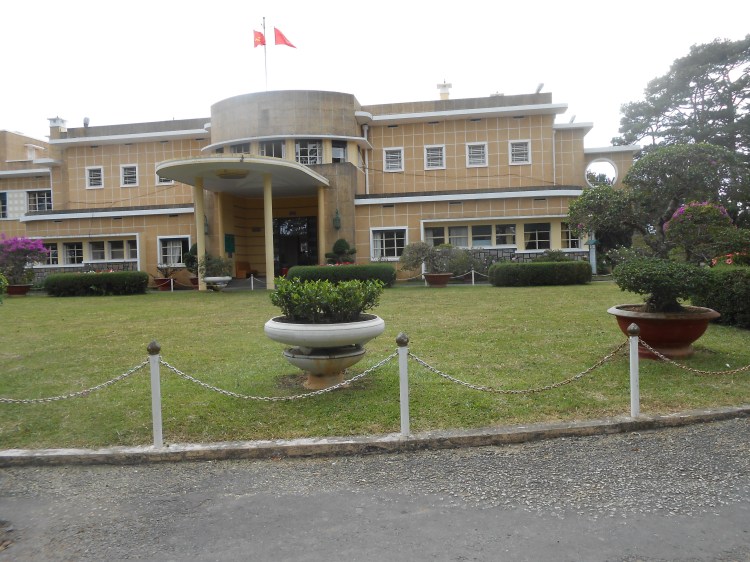
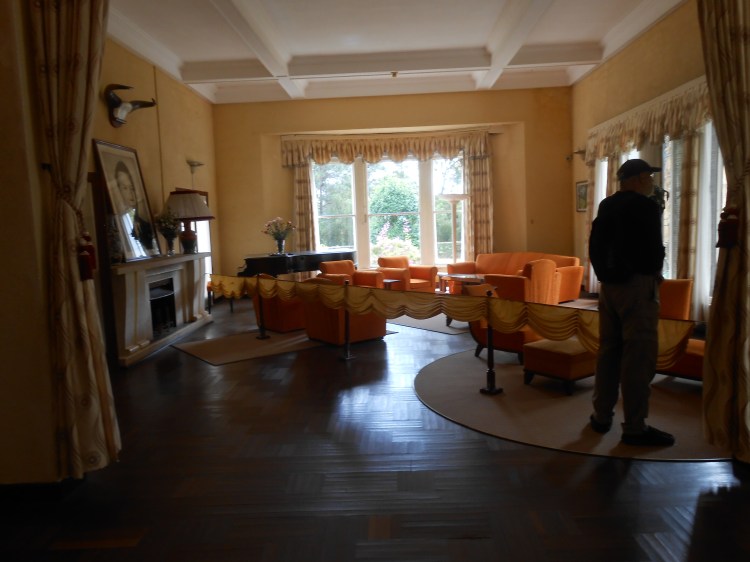
Bao Dai, the last King of Vietnam, had one of his summer palaces up here.  He managed to keep a position after 1945, while the French maintained their occupation, all the way to 1955 when he finally left and went to France. Here’s a paper about the design: http://www.icom-icdad.com/downloads/Shanghai_PlenaryPaper7_Kannes.pdf

Bao Dai paalce 2

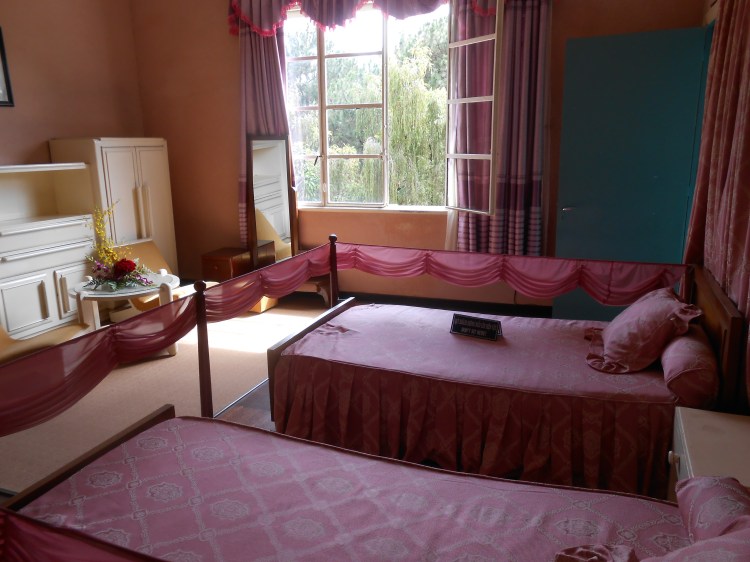
This is the bedroom of two of the princesses.

Princess' bdrm

This is the main parlor. Orange mohair and silk (looks like, at least) upholstery. All original furnishings, somewhat faded. Imagine having to think about what color dress you are going to wear to sit on those chairs.

Living room

Dining Room

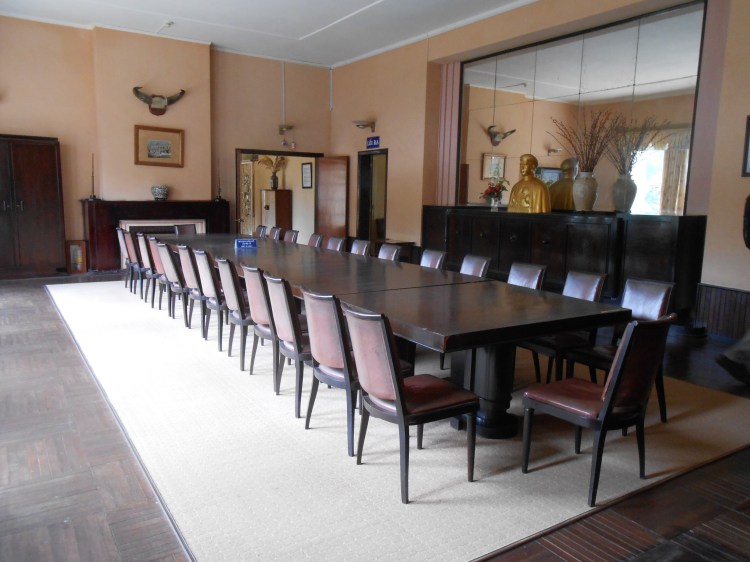
Dining room.

The paper I’ve linked above describes the layout as an arrangement of volumes, not a set of rooms. This sounds right.

There is a “moon-viewing” terrace outside Bao Dai’s bedroom, overlooking one of several formal gardens and a row of trees bordering a steep drop down into a valley. It’s easy to imagine him walking there, smoking, calculating, figuring the best date for getting the hell out of Vietnam. His wife took the kids and went to Paris and died of cancer. Bao Dai stayed on a while with his concubine. His son, the Crown Prince, fought in Algeria and lived into the 2000’s.

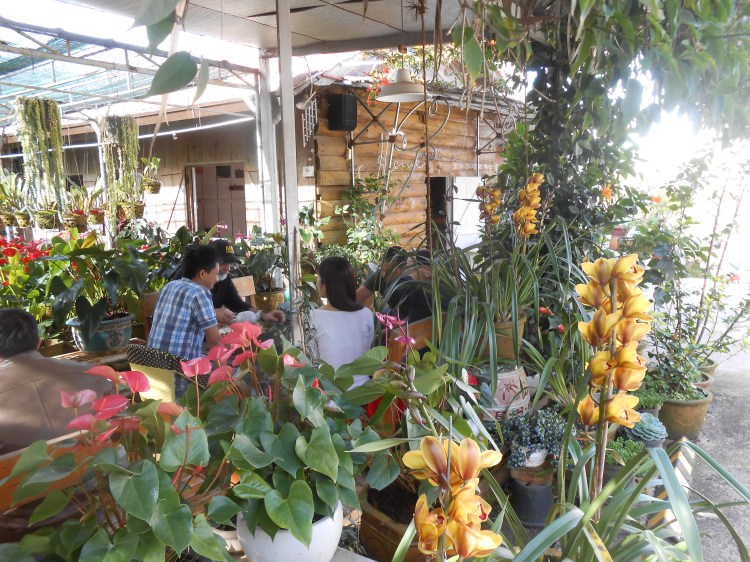
Vinh’s friend Hien lives and works in Da Lat and knew the best place to have breakfast, the Home Cafe, which is somebody’s house and also a greenhouse.

Home cafe bkst

We climbed up through winding roads in the center city and looked down at the the big market, that gray multi-story building in the center, the Cho Da Lat.

Street from above

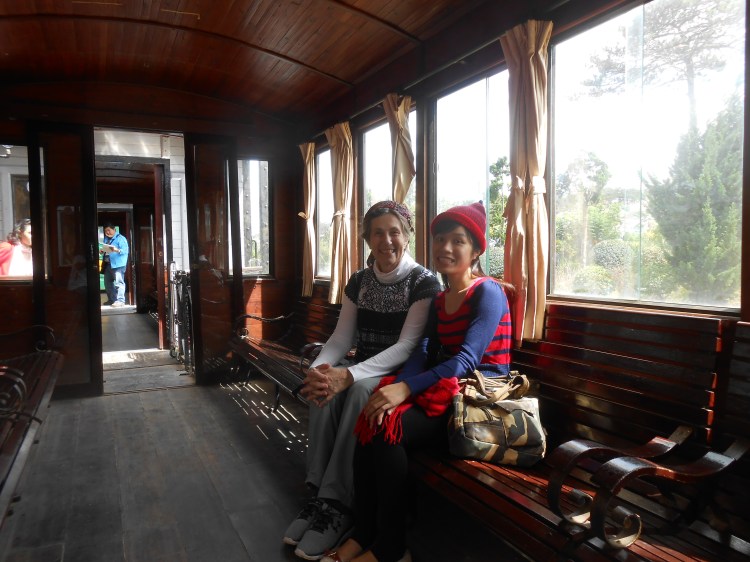
Me and Vinh, on the “tourist train” which still runs to some nearby location; it originally brought the French up from the lowlands to get out of the hot weather. Now the train station is a tourist destination. They’re working on getting the train back running.

Me and Vinh on the train

Thinh at the garden.

T'ung

Six lists about what workers need from their local union

4 and 5

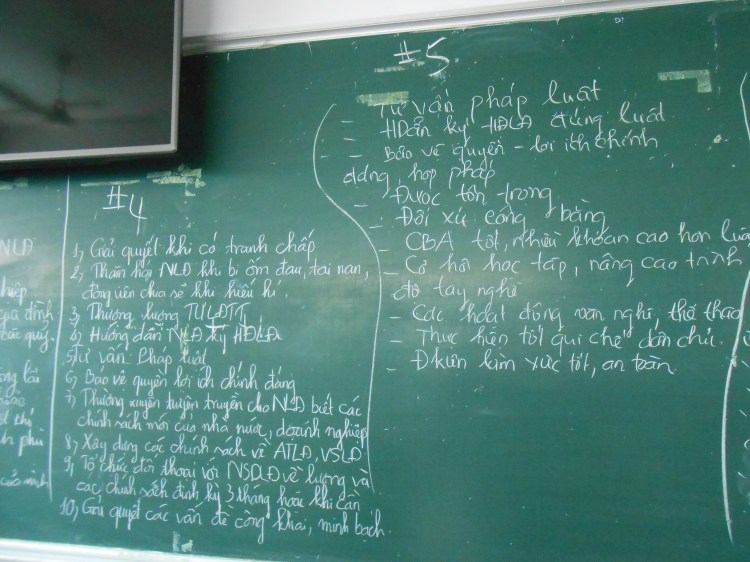
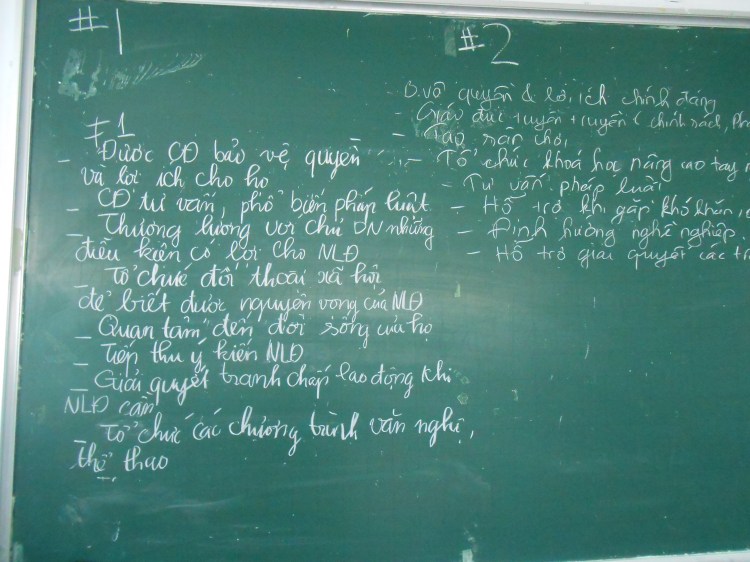
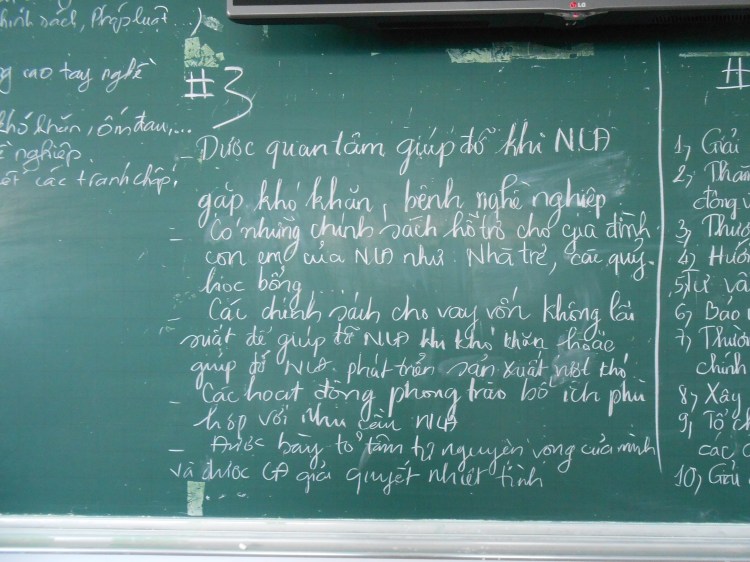
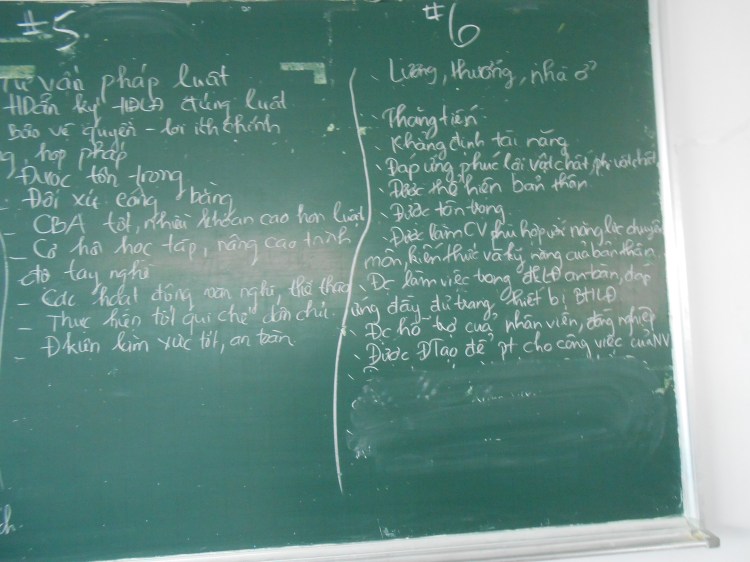
Joe asks his class to discuss in groups, then make a list to answer the question: “What do workers need from a good local grassroots union? What do they need it to do?”


Here are the items from the six lists that the students wrote on the board in Vietnamese, translated by Vinh and typed up as she spoke:

  • To protect the right and benefits for the workers
  • Consult [about] and publicize the law
  • Train and educate the workers about the law
  • Take interest and take care when the workers have difficulties or occupational disease because some kinds of work will cause health problems
  • The union will support some of the good policies to support the families, for example: a kindergarten or other sponsorship, a sponsorship fund
  • Policy to get loan – some are very poor, can’t get a regular loan. This is to help the workers in case they get into difficulty in paying for things
  • Have career orientation, have some of the skill training courses
  • To do social dialogue, collective bargaining and collect the workers’ opinions and solve labor disputes when they arise
  • Visit with workers when they get sick or have accident, and encourage them
  • Sign the CBA
  • Ensure fair treatment between the workers
  • Have some entertainment and sports activities
  • Show respect – be respectful
  • Democracy
  • Ensure good working conditions and safety
  • Have worker pay and bonus policy promotion
  • Good benefits
  • Self-actualization (*highest of Maslow’s hierarchy)
  • Ensure good work in the workplace with enough of the right equipment and tools
  • Well-equipped with labor protections – labor work clothes, gloves, PPE
  • Encourage support from colleagues, co-workers
  • And also to be informed about the new policies of the state or the enterprise
  • Share their opinions with the union
  • Share their opinions with each other

1 nx

Joe noted that this list does not include helping mangers manage the business. Therefore we can say that this list assumes a capitalist and somewhat adversarial relationship between workers and employers. It also does not include motivating workers to be more productive. It does not mention enforcing the contract, which is half of the collective bargaining relationship, the other half being negotiation. Nor does it mention enforcing the laws. What ‘s more, the students did not limit the union to the collective bargaining function. Their list included things that you could not get from a CBA such as education, recreation, or “the policy to get a loan,” which is sort of a union credit union.


I noted that there are some items that are necessary for union democracy, such as showing respect, sharing opinions with the union and with each other, maybe the self-actualization point, and the word “democracy” actually came up. But there are no procedures listed such as voting to ratify a contract or running for office as a union leader.

3 what does a good union do

Joe noted that the six lists overlapped in many ways, but by having six of them, we got a wider range of ideas than we would have if we had just made one list. This is a familiar popular education technique but also good for brainstorming if you are going to do a strategic planning exercise. The point here is that democratic discussion is worth the time; this is a better list than any individual or any one group could have. Although it took more time, it made a better basis for the whole class to move forward.


5 and 6

Some Things Get Straightened Out

drugsMost important, we have an actual date to go and meet with union leaders in Dong Nai. The date is December 21. We will have half a day, to either teach or ask questions, it’s up to us.
 

Dean Hoa told us this at lunch on Tuesday, after we taught in his class on strategic labor relations.


Piecing together information from various people, we have learned something that may help us prepare for this meeting with union leaders. This is about how worker representatives are employed by the VGCL. The jobs are not announced publicly. Instead, you get invited or chosen to come and apply. You may be an activist worker who has become a leader at work, or you may be someone who is well known for other reasons. The body that actually screens you is the provincial government. You take a test. If you pass the screening, the government sends you to the VGCL. In other words, the VGCL does not hire directly.


If this is accurate, the first question we usually ask in a meeting with union leaders — “How did you get involved in your union?” – will generate answers we haven’t heard before.


Dean Hoa’s union contacts are in Dong Nai which is where he has set up our December meeting. He intended to set up a previous meeting in Vung Tau but was unable to arrange the details in time, and we already had a conflict. He told us that those union leaders had wanted to meet us.


Two other things that have been taken care of: Our visas and my medications. It turns out that we got the wrong kind of visa. Our visas are “enterprise” visas, not “tourist” visas. Therefore they were harder, and more expensive, to renew. But Vinh managed to get it done, using a private service, including a young woman who rode out to Ton Duc Thang on a motorbike to deliver them, in the rain. Twice. Now we are legally here through February 15.


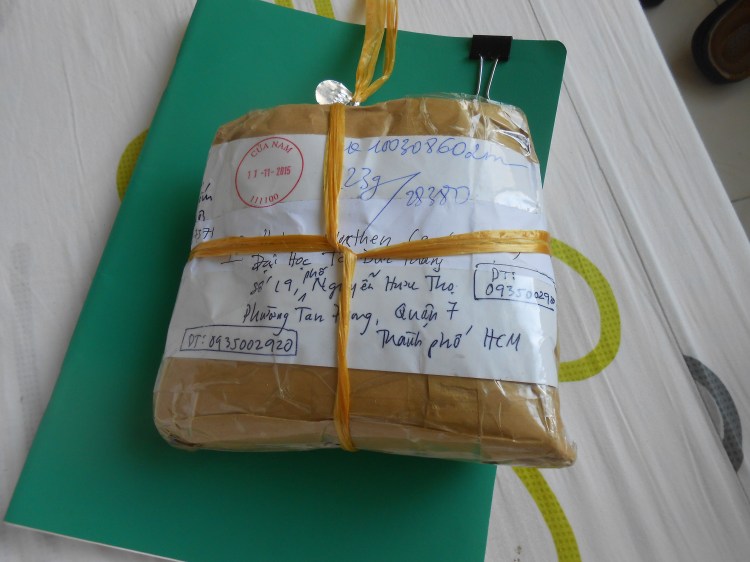
And then, since Kaiser wouldn’t give me six months of meds, I only brought enough for 3 months. I waited until they were re-authorized in October and then re-ordered them. Long story short, after many mix-ups: A friend of Gabi’s named Tenley flew to Hanoi with them in her luggage, mailed them to me at TDTU and luckily kept the tracking slip. Weeks went by.When Tenley checked the tracking slip, there was a name on it of someone who had signed for the package. It turned out that the young woman on whose desk they ended up had gotten married right about then, and simply forgot.


These three things, although not all of the same level of seriousness, created a small storm of tension that has now passed. Included in this storm were the complexities of paying the Berkeley earthquake and homeowners insurance and the property tax, all due this month and next. Now all I have to do is register to pay the Vermont rental taxes, which has been a real fuss; I had to get a business license and now that I’ve got one and am ready to pay online, the Vermont.gov screen keeps freezing on me.


We will have two more full months at TDTU plus two weeks to travel around and then we’ll go home. It’s time to push actively on the contacts that we have made and get the bigger picture we’re in need of. Kent Wong has put in a proposal for a session at UALE in April.


But I am still asking my original question, “What are we suppose to be teaching?” I am not sure that we have contributed anything that is going to stick. We have spoken a lot of English to people who want to learn English, we have taught our classes, we have tried to help with the Top 100 New Curriculum which will be taught in English to Southeast Asians. But what we know about labor-employer interactions in the US may fall on deaf ears. Many of our students simply don’t believe things could get that adversarial. A whole generation of living in a context where the president of the union can be the HR guy has left them unprepared for big fights.


Hollis and Leanna’s first response to my “What are we suppose to be teaching?” question was, “They know that capitalism is coming and they want to know how to fight it.” Well, I think that they don’t really know that capitalism is coming, and they don’t particularly want to know how to fight it.


Here, a big factory here may pay people barely enough to survive on, and cheat on overtime pay and the quality of food. Nevertheless, the social dialog process, if it takes place at all, moves forward rather smoothly with regular meetings. The union may organize a kindergarten or a “travel trip.” In other workplaces, where no one has heard a peep about any union, many people are still “satisfied,” a word we keep hearing students use. They don’t need a second job as a union activist.


When we used the story of the Heartland AFSCME 3494 workers in Effingham to show what a whole campaign looks like, from organizing to contract, the students here couldn’t believe it. How could the workers hold out – for a year on strike followed by a year on lockout? Reportedly, Miss La couldn’t believe it.


In one class I ran down a list of current strikes that were either threatened or in process – a general strike in Quebec, the faculty at AFT 2121, the faculty in the CSU system, NUHW at Kaiser in Oakland, just for starters. Then I told how the UAW workers and the Southwest pilots have voted down their contracts and I realized that to our students, our way of doing things sounds completely brutal and Wild West. “Vietnam is peaceful,” one student told me, in a slightly corrective tone.


Yesterday in Dean Hoa’s class we used the example of the IKEA warehouse workers, 32 workers in the warehouse who work from 2 am to 10 am, who have decided to organize with UFCW. The teaching point was how far back in time the strategic planning had to happen in order to pull off a coordinated action in the present. In this case, it looks like at least 2 years. They have given IKEA 72 hours to recognize the union, and somehow got Bernie Sanders, Martin O’Malley, and the UNI General Workers Union in Switzerland to send out letters of support all at the same time. Seventy-two hours, after which they will probably go to an NLRB election. We got this on Portside and Dang translated it into Vietnamese.


Last on my list of things that have gotten straightened out: Joe and I have decided that at least we can leave them with a small collection of labor ed materials translated into Vietnamese. We’ll pull together all the good stuff we’ve written for our classes and then had translated, and put them into one packet and distribute them. They may never get used… or maybe they will.


Vung Tau with Thi

Thi's little brother

Thi’s little brother

On Saturday morning the four of us plus Thi, who is a first-year TDTU student, took a taxi to the bus station and then a 16-person van (110,000 D each) down to Vung Tau. The highway is good and new and every roadside inch along the way is built up with shops, workshops, hotels, whatever. Only when we started to get close did we see open land, but it was shrimp ponds.

Thi had a tourist agenda planned for us with many activities, and I tried to explain that we are old people and we like to sit around and talk and look at things. She cooperated with this as much as her 19-year old self could manage. She is one of five, all sisters except for the little guy above. Just thinking about their family makes me smile. Her mother is 41, looks great, rides a motorbike and made us amazing seafood lunches. Her father works for the oil company as a machinist (as far as I can tell; he came home in an orange jumpsuit with oil stains on it). There are ships in the harbor that belong to this oil company and a helipad a few blocks away, on top of a big office/headquarters building, where helicopters land ferrying workers out to the ships. Their house is in a neigborhood developed for oil workers. It’s a typical multi-story Vietnamese city house with shiny floors and big carved wooden furniture. Thi and her mother

Thi and her mother when we went out for seafood on Saturday night.

Thi endured and handled well a series of long conversations with four adults, all asking her about what she studied, why Vietnamese students do this or that, how the school system works, what books she read, etc etc. I think that if I had had four adults peppering me with questions for hours on end, in a foreign language, I would have been exhausted. She held up very well.

One of the reasons that students volunteer to be in the group that does things with foreigners is so they can improve their English. Thi certainly got a workout this weekend. One of these conversations took place at their kitchen table after lunch with her mom circulating in the background. If I had been her mom, I would have been proud of her.

After our first lunch (one of two prepared by Thi’s mother, who is a serious cook, expert in the subtleties of very fresh, very local seafood) we took a walk through the neighborhood.

VT house arch des

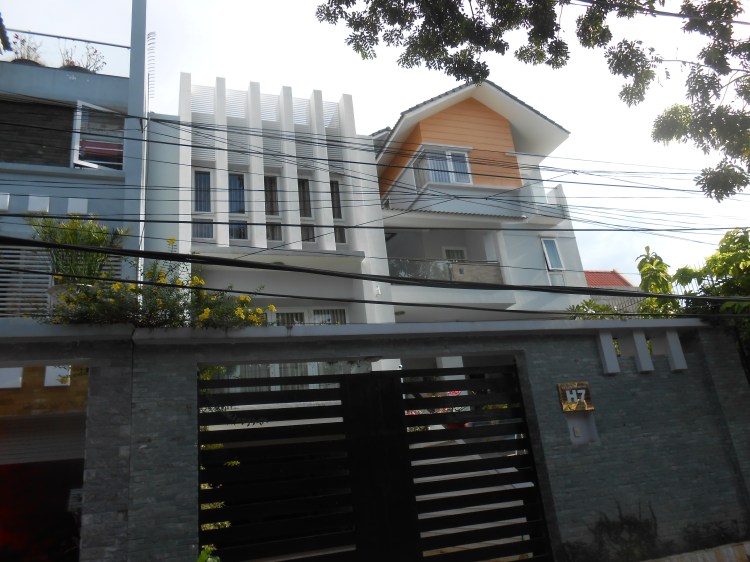
There are three houses in this picture, plus a sliver of a forth on the right. They are tall (at least 3 stories), open to breezes, and have a combination of public and private spaces that is fundamentally different from what I’m used to.

We came to Thi’s high school. She went to a public high school that accepted students who had tested as “gifted.” At age 14, which is the school-leaving age in Vietnam, (ninth grade), she took a test that identifies students as gifted, OK, or failed. If you fail that test, you can either pay a lot of money to go to a “private school,” which is for students who are “lazy,” or else if your family cannot afford to pay, you can go to work, or in some cases get vocational training.

We were not able to find out what percent of students “fail” this test and if the rate of failure varies by neighborhood and if the rate has changed since doi moi. The question is, what is the level of free public education that a working class kid can expect to have, by right? And are there fees in the public education system?

Thi did her best to answer these questions.

At Thi’s school, although it was Saturday, there were two rooms in which students appeared to have gathered. The boys were in one room, being rowdy, and started calling “Hello!” to us. Then the girls, in the next room came out and began a conversation. It turns out they were studying for a big test, in history. History did not used to be one of the subjects that was tested. Now, a history test has been instituted. I would like to know what the story is behind that, and what is on the test. Here are the students:

Thi's school

Thi asked us if we would like to climb a mountain. Since yesterday, on Teacher Day, I did two things that I had not planned to do (run in a footrace and pull in a tug-of-war, not great for knees or back), I didn’t jump at the opportunity, but it turned out to be a wonderful tree-shaded paved winding walk up a small mountain (a little farther than walking from our house up to Tilden) past several temples, many smoothie stands, and some actual monkeys who live in the trees over one temple. This is evidently the aerobic walk of choice for Vung Tau residents on a nice Saturday afternoon.

At the top, Leanna and Thi and I sat at a table and drank papaya and mandarin smoothies while the sun set over the harbor. Joe and Hollis went on up the last stretch, which was rocky, not paved, and came down in the dark.

Sunset from mountain

On Sunday, after I explained to Thi that no, I did  not want to get up at 6 am and go swimming in the sea, the adults all went to the same coffee shop to warm up our brains for the day, reading our books and drinking various Vietnamese coffees. Thi came around at 9 am and we took a taxi to the beach.

Beach in Vung Tau

The water is warm, the waves are great for very gentle bodysurfing, and the fact that the sun is not blazing down is a good thing. A clean water shower costs 10,000 dong.

Bikinis in Vietnam g

These are Vietnamese women’s bathing suits. Although they are modest, they are two-piece, which means that they would not be allowed on swimmers in the pool at TDTU, where girls wear one-piece bathing suits with skirts and usually something that covers their shoulders. It is not unusual to see a girl in a suit that looks like a wetsuit, covering her legs and arms, but with a skirt, plus a bathing cap and goggles. I see this when I go swimming from 6:00 to 6:30 on weekdays and the “swim club,” with students learning to swim, arrives en mass at 6:30. The issue is partly modesty and partly temperature, since to them, the pool water is cold.

Beach Karaoke

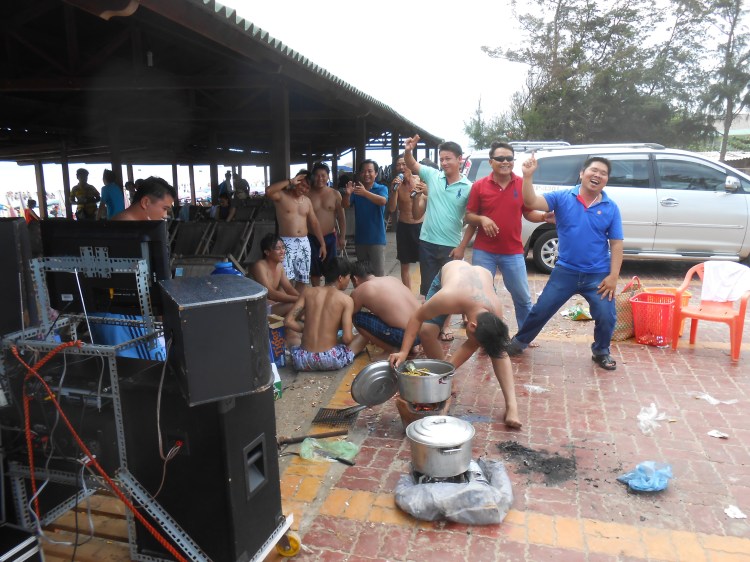
These guys were singing loud Karaoke and dancing around while they made a huge seafood lunch next to the beach parking lot. I asked Thi what the songs were and she said they were Vietnamese military songs from the war. There is a certain character to these songs, which remind me of Russian orchestral music and the Israeli Song of the Partisans. They are in four-four time, of course, but they are in a minor key, and rise to a heart-breaking pause in the middle where you hold a high note  as you stand on the top of a mountain and look back over all the sacrifices that have been made for your country. This is very different from “The Halls of Montezuma,” “Oh, Say Can you See,” or, for that matter, the Marseillaise, which are all in major keys and go whump-bump-bump-bump.

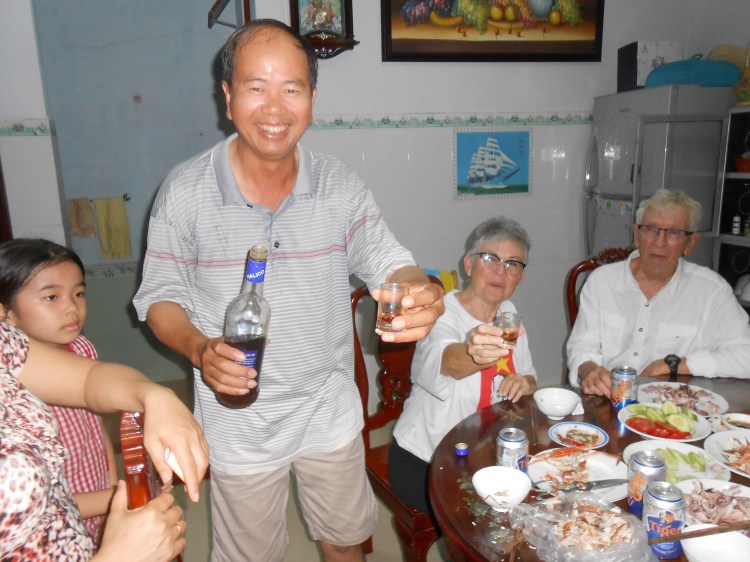
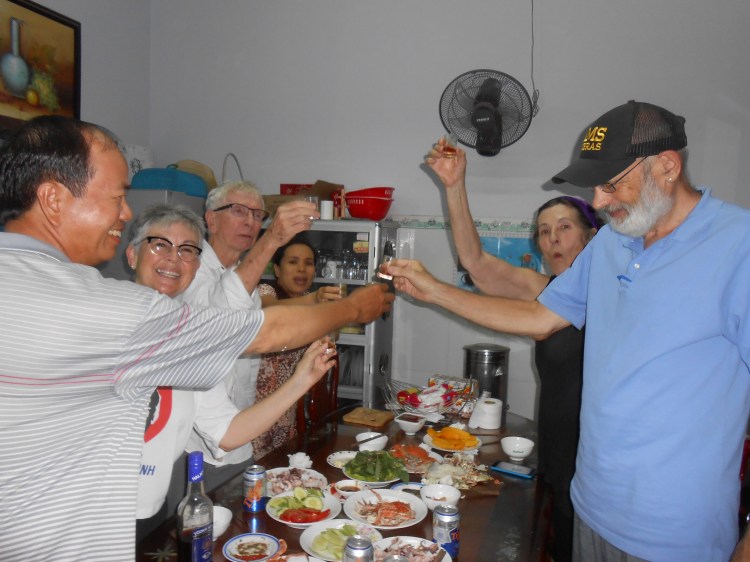
After lunch on Sunday, Thi’s father brought out a bottle of something that tasted like very good whiskey. It is made somewhere in the North.

Thi's father whiskey

Toasting

Van back to Ho Chi Minh City, in the rain. Big motorcycle accident (three bikes lying in an intersection) on the way.

Teacher Day

There is nothing like Teacher Day in the US and I wish there was. There is no place to put, collectively, the strong positive feelings that grow between teachers and students, no place to talk publicly about what that relationships is or how important it is, no place to honor it. Instead we get “Teacher of the Year” awards for single “top teachers” on the one hand, and on the other, a huge contingent workforce that has about as much of a socially legitimate, recognized, stable relationship as a whore and a john. Someone is going to be mad at me for saying that. But if you know “Who is Professor Staff and Why is He Teaching All These Courses?” you’ll know what I mean.I speak from experience. I don’t mean contingents are whores. I  mean the relationship between a whore and a  john doesn’t get any respect. I’m trying to draw a sharp contrast.

Once upon a time I tried writing down all the different students I could remember, giving each one a page, telling their story as I remembered it. Writing teachers hear a lot of stories because people write about themselves. I wrote a pile, a book’s worth of one-pagers, of students who were unforgettable. But there it lay. My memories of those students ended up as a pile of paper. They went their way, I went my way, and that was that.

On teacher’s day in Vietnam students go home to their hometowns and visit their old teachers!  The schools are open and kids bring flowers. Even the bad teachers probably get some visitors, because everyone can reach somebody.

Obviously this day of commemoration awakened some strong feelings in me.

This is an annual holiday, established 33 years ago which means 1982. Madame Binh was Education Minister until she became a member of the Central Committee in 1982 so I don’t know if she had anything to do with establishing Teacher Day in Vietnam. It originated among Communist bloc countries at a meeting in Warsaw in 1957.

The reason why it might have something to do with Mme. Binh is because when she was Minister, teachers were very poor. Of course, most people were poor – starving, in fact. She had a lot to do with raising teachers pay and getting schools built out in the mountains where there was high illiteracy.


Teacher Day at TDTU involved:


Meeting Vinh at the office at 6:50 am, wearing our white TDTU shirts and baseball caps. Going to pray at the gold statue (bust) of Ton Duc Thang at the front of the college, placing incense sticks into the sand-filled vase below it.

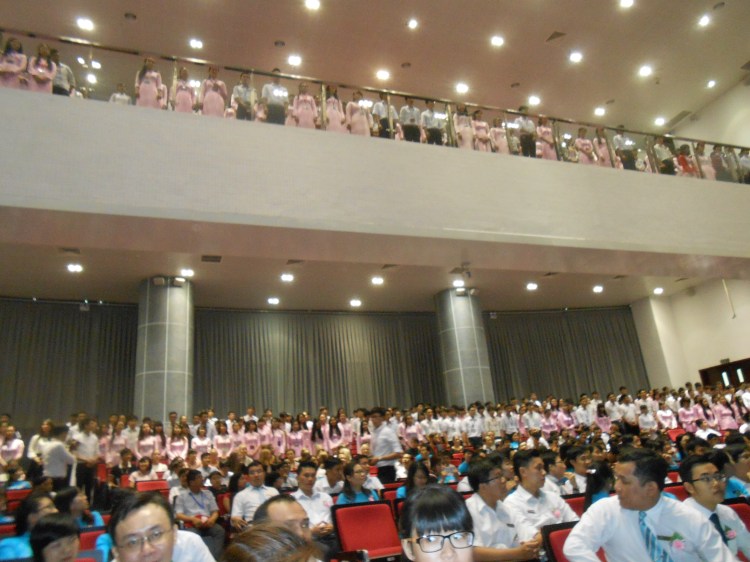
Going up to the giant auditorium called Room A and hearing many speeches, seeing traditional dances on the stage and hearing traditional songs.

Crowd in auditorium

Changing into our sports clothes and going to the gym where all the teachers (the full-timers, called lecturers – adjuncts seem to be missing throughout) lined up by faculty, marched across the gym, were saluted by a traditional teacher’s song, a waltz, in which the gray hair of an old teacher is credited to chalk dust. Then we played games. Each faculty was a team. Bag races were at one end of the gym. Leanna and I were invited to join the International Business Faculty team to play tug of war. We lost, but it was fun. Then came races. Swimming, which I had signed up for, was cancelled for lack of people signing up. Maybe I was the only one. I found myself in the Older Women’s Running, and actually made it around the course running or at least shuffling. Leanna and I finished last. She waited for me.

Then I went quickly to change into my ao dai and go to another ceremony in Room A.

At 11:30 Joe and I accepted the invitation to the Accounting Faculty lunch, where fabulous food, especially a mango/guava/carrot/cabbage salad was spread out in their office. These people in the Accounting Faculty, as I have mentioned before, have really good chemistry with each other. They are almost all very young, too. They keep suggesting things we can do with them, like go on tours. I hope these plans work out. One woman offered to ride us all over HCMC on her motorcycle.

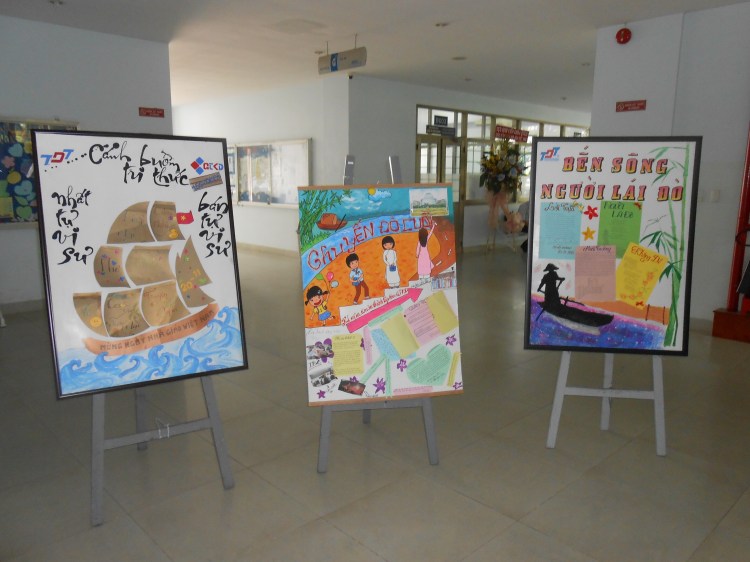
After lunch, still wearing the ao dai, I walked across the terraces, looking at the art. The whole campus was decorated for Teacher Day, with giant posters that the students had been making all week, plus baskets of flowers everywhere. The poster art has many images of children, trees, floating clouds, boats heading out into the ocean. On a nearby terrace is a display of very high-end, techno-sophisticated art produced by the design students, so I have to presume that the teacher day poster art is intentionally naive.

teacher day art

Everyone was saying to me, “Happy Teachers’ Day!” Even the security guards said it.  My “You’ve got to be kidding” function was on high alert. I was having very mixed feelings.

Add in the omnipresence of top-volume music coming over loudspeakers and the fact that our seats in Room A were just 15 or 20 feet away from the speakers.

I have to insert something here. There are two things I do not like, which are inconvenient peeves for someone living in Veitnam:

One, large demonstrations of semi-military or completely military discipline, especially ones that involve people standing in line in the sun for long periods of time. I don’t mind the way a band marches out at half-time at a football game and makes patterns on the field. That doesn’t bother me. That’s partly a joke, anyway. But one step beyond half-time drills and I am on my way gone. Since a lot of celebrations in Vietnam involve precision marching in military formation, there is room for a problem here.

I actually made a silent vow about this years ago when I was teaching in Laney Community College in Oakland. The Gulf War had started. It was 1991. I had been teaching some English 1-A class that allowed me to use WWII materials for essay prompts. In my class were Vietnam vets, Vietnam “boat people”, Oakland high school kids (African American), Africans from the wars in East Africa, poor white kids, battered women, some brainy college dropouts, etc etc etc – the usual wonderful mix. The perfect cast of characters to make someone say, “I will never go to war again.” For some reason, I showed the famous photo of white men with crew cuts sitting in four or five lines of Adirondack chairs. They are wearing what look like hot weather uniforms – khaki shorts, open shirts. If you know this photo, you already remember it. The Adirondack chairs, which are wood and do not belong on a boat, are nonetheless spread out in lines on the deck of some boat. The men are looking off into the distance with serious expressions on their faces. They are looking at an H-bomb test going off. The vow I took was about standing, marching, sitting in line: Lines should be banned. No more lines, ever. Let no one ever stand in line again. This was a personal vow, for me only.

Or course, forswearing military display only earns you points if you are a citizen of a powerful country with a big army. If you are a small country in danger of being invaded by a big country, forswearing military display or military training and preparation is stupid. But I’m talking about myself: a citizen of a big country that invades other countries.

The other thing I don’t like is loud music, especially amplified music coming over loudspeakers. I do not enjoy that at all. Period. Many times sitting in a Vietnamese auditorium where the MC says, “Enjoy the traditional song of Vietnam” and then the music blares up, my deepest wish is to be able to leave. In fact, a couple of weeks ago, we went to a show called “TDTU Has Talent,” and since as foreigners we get ushered to the front row, we were stuck there for the whole thing. I sat with my fingers in my ears.

I have very good hearing. I can hear birds sing. I can hear footsteps. I can tell what’s going on when an orchestra is turning up. I have used my good hearing to enjoy and play music. I love my hearing. I feel like calling the police on someone who turns up the sound so loud that it hurts my ears.

So I spent the whole TDTU has talent evening suffering the pain of loud noise. Leanna and Hollis were next to us. In Room A on Teacher Day we watched videos of previous events, which included many shots of Leanna and Hollis loving every minute of it of the TDTU Has Talent show.  The camera carefully did not catch me with my fingers in my ears.

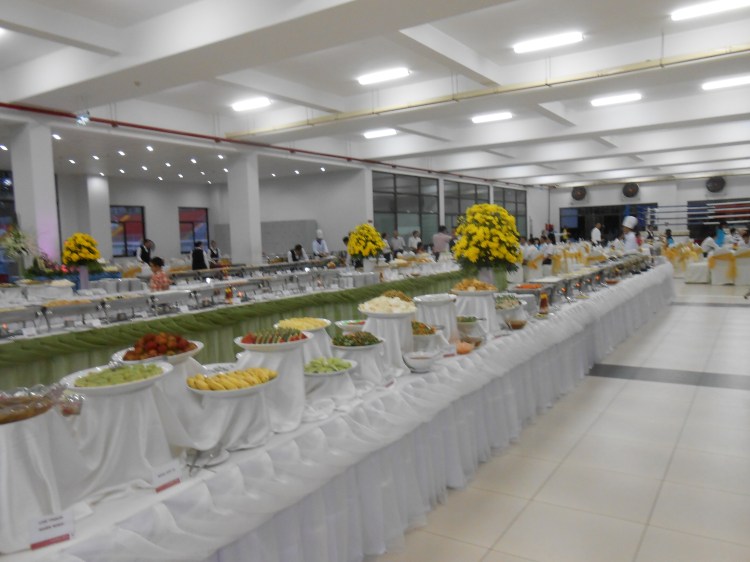
The day finished with a fabulous banquet in the gym, with more food than I have ever seen anywhere. White floors, white walls, white table linens, all the chairs covered with white, with great gold and bronze bows.

Vast buffet

But the high point of the day for me was mid-afternoon, when I was crossing the canal, a boy whom I had never seen before (maybe) started talking with me out of the blue. He was a handsome but very young-looking guy.

He said, “Happy Teachers’ Day!” I smiled back and said, “Thank you! How are you doing?”

He said, “I am so happy! I am going home to my family. I miss my family so much. I have a grandmother and a grandfather who are in their 70s’ and I have two little brothers younger than me, and I miss them so much! I live in a province that is about 100 K from here. I will go home on the bus and come back on Monday. I will see my mother and my father! I haven’t seen my family in five months! I am so happy!”

I was blown away by this warm, happy confession, and especially because he seemed to feel that I wasn’t a stranger at all even though we had never spoken. I was “a teacher” and therefore one of his teachers.

I attribute this moment of openness to Teacher Day.


Employers have too much freedom in the US

Joe, Leanna, Hollis and I went down to Vung Tau, a seacoast city two hours southeast of HCMC. Our guide was Thi, a 19-year old freshman whose family lives there (see next post).


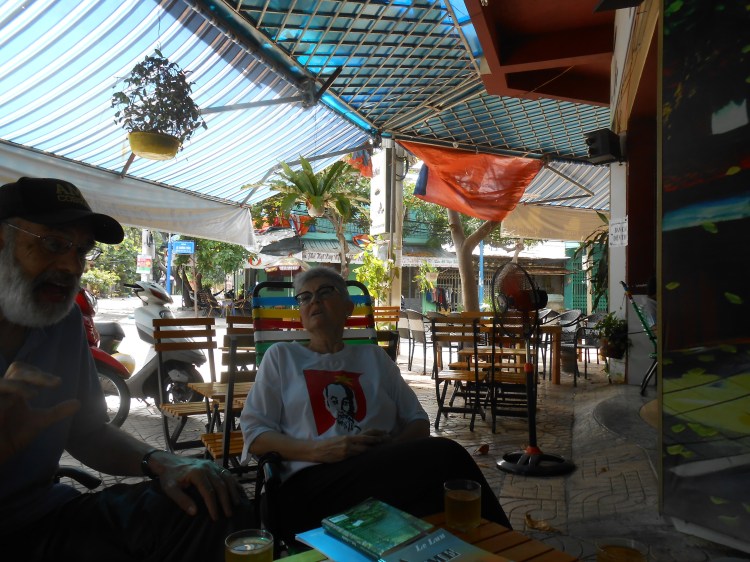
On Sunday morning the four adults left the hotel and went to find a coffee shop on a street at the edge of Thi’s neighborhood. We sat in comfortable chairs under a striped awning and drank various versions of Vietnamese coffee and talked. There was a sea breeze and a blue sky.

Coffee shop

A small, fifty-ish muscular man in an orange T-shirt heard us speaking English and paused on his way over to his own table.  The picture above was taken before this happened, so you can’t see him in the background.

He said, “Aha, Americans, we will see a lot of you now with TPP.” We laughed and he went on towards the other people who were waiting for him.
Later I went over to his table and, apologizing for interrupting, asked if he would mind talking to us a little bit about TPP.


He was happy to do this. Here is basically what he said: “ TPP will be a good thing for us because we will have independent unions. Right now, the union belongs to the government. It does not do anything for workers. Workers don’t see it. It is part of the government.”


We asked, “But will Vietnamese workers really organize their own independent unions?”


“Yes,” he said. “It will happen.”

He himself is an employer. His company, which is based in Vung Tau and makes equipment like cables, hooks, slings, chains and other things that lift stuff up in the air and move it from one place to another, very important in a shipyard, has 30 employees.

“How will employers respond?” we asked.

“They will do it.”

“You are an employer, how will you respond?”
“It is the law,” he said. “They have to allow it.”

We pointed out that in the US it is also the law to allow workers to organize unions, but in practice it is very hard to do because of employer opposition.

“Employers in the US have too much freedom,” he said. “Workers have freedom, employers have freedom. Too much freedom.”

There was that little twinkle that I often see in the eyes of Vietnamese when I make a comparison with the US. It’s as if they are saying, “Oh yeah? You think so?” A great deal of self-confidence is behind that twinkle. “You think we weren’t paying attention?”

He just came back from a conference in Ho Chi Minh City where various government ministers talked about the changes that were coming under the new trade agreements. It sounds as if changes will come sooner rather than later. The TPP will be very good for the Vietnamese garment industry, he said. They heard about the agreements with Chile, Peru, Singapore, Japan and other countries. Vietnam has a whole set of trade agreements, not just the TPP.

You could ask, “Why doesn’t the US government step in and restrain employers who interfere with workers organizing?”  But deep, deep in my view of how things work is the certainty that any law that protects labor by restraining capital will not be enforced. This has been true in my life ever since I was born. In the US, employers certainly do have this freedom.What if this is not true in Vietnam?


Our reading of the TPP Side Agreement is that it is one-sided, favoring the US corporations; that it promises many protections to Vietnamese workers that US workers don’t have or that we had to fight tooth and nail to get; that it may make conditions worse for Vietnamese workers if it weakens the VGCL and divides labor into less powerful, scattered organizations; and that it may allow forces hostile to Vietnam’s socialism to interfere in Vietnam’s internal affairs, violating their sovereignty.

US union people will assume that all those new rights and protections will go unenforced, like in the US. But what if they’re wrong?

Vietnam observers that we have talked to have warned against assuming that Vietnam has entered into the TPP without sufficient preparation. One of them pointed out that for the Paris negotiations, the US rented space for a year; the Vietnamese bought a house.


King Lear in Vietnam

Lear's Kingdom

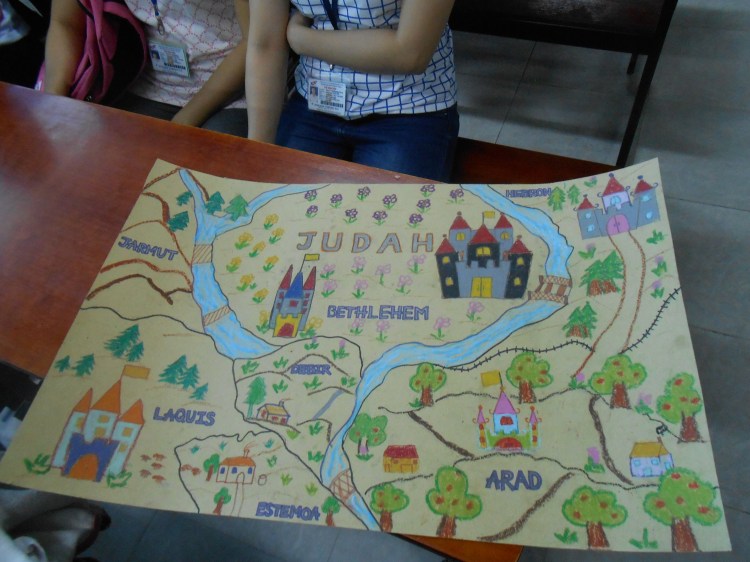
The Map of Lear’s Kingdom

Yesterday (Monday Nov 16) in Joe’s class he used the Xuan-Trang and Binh interviews from Kent Wong and An Le’s book, Organizing on Separate Shores, that Dang (Tony) translated for us, except that at Binh’s request, we cut out the part about his childhood and military experience. The students read these intently. They made a very powerful impact. It seemed as if suddenly organizing became something they could see themselves doing.


They asked questions like: How can you tell if you have the potential to be an organizer? What do you need in order to start? and What do you do if you have a bad leader? This is the connection between Joe’s class and mine right now: bad leaders. King Lear is an example.

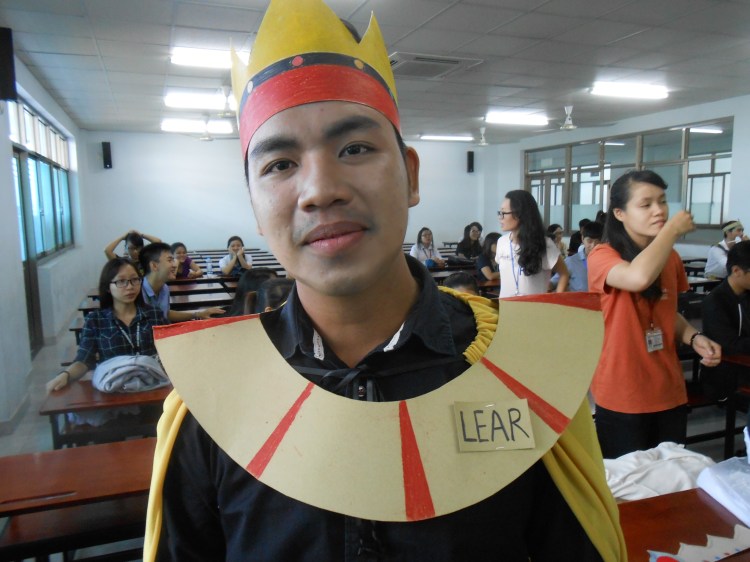
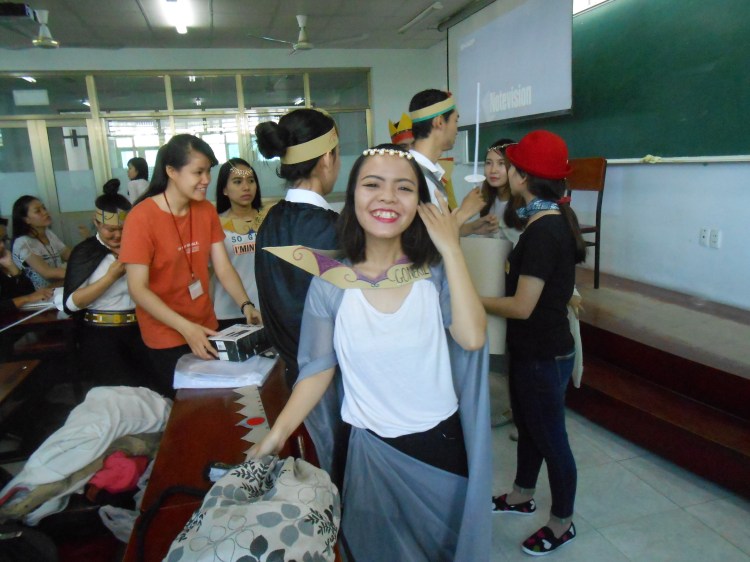
Lear in costume

A good student volunteers to play the role of a bad king.

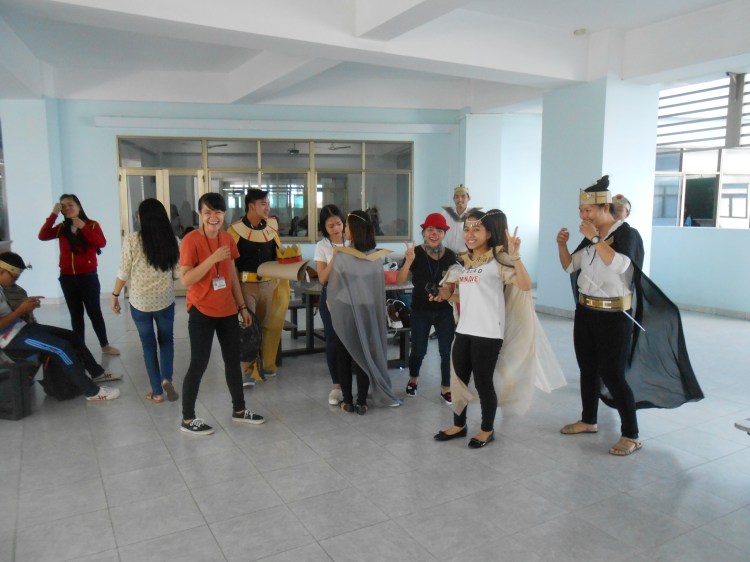
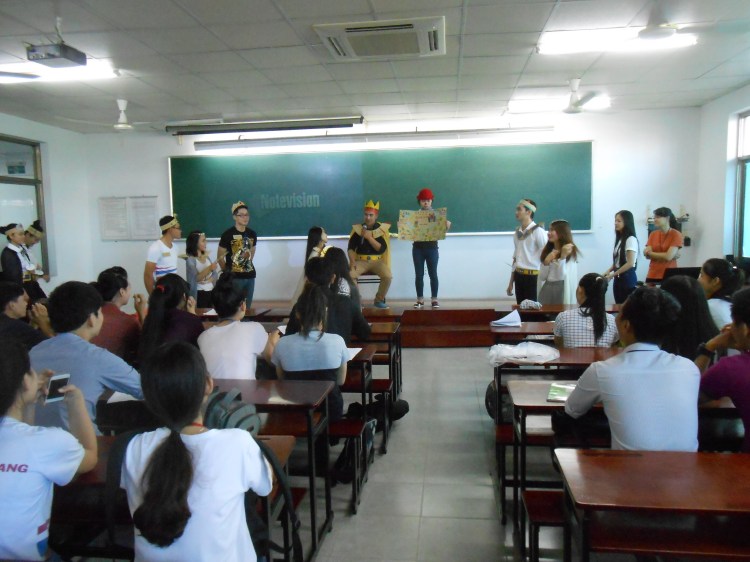
On Wednesday, students in my class performed Shakespeare’s King Lear, starting with Act 1 Scene 2, the scene in which Lear throws everything away. They continued through the end of the play, summarizing but acting it out, all the way through to Lear’s death scene with Cordelia. In Vietnamese, of course.

My reason for asking them to perform King Lear is this. Northouse, the author of our textbook, defines leadership as leaders that he likes. This means that according to his definition, Hitler does not count as a leader. Another problem with this definition is that he avoids having to tell us how he deals with the behavior of a leader who is bad or has gone bad.

Lear rehearsal

Rehearsal on the terrace on a windy day. They only rehearsed once with me and then did the whole rest of it on their own.

So I gave the class one session on Machiavelli, whose book The Prince was advice to leaders about how to keep power, no matter what. I included a particularly bloody story about how Duke Francesco Sforza brought the province of Romagna under control. Machiavellli says:

As he (Sforza) knew that the harshness of the past had engendered some amount of hatred, in order to purge the minds of the people and to win them over completely, he resolved to show that if any cruelty had taken place it was not by his orders, but through the harsh disposition of his minister (de Orco). And having found the opportunity he had him cut in half and placed one morning in the public square at Cesena, with a piece of wood and blood-stained knife by his side. The ferocity of this spectacle caused the people both satisfaction and amazement (p 27).

Two students did a little role-play in which Sforza asks de Orco if he would please go to Romagna and clean it up. Does de Orco feel honored by the assignment, or does he sense that he’s probably being set up for something awful? There was a moment in the role-play when de Orco asks Sforza if he will give him half his land if he does the assignment. Sforza (played by a young woman whose name I think is Trinth) gives him a quick, narrow-eyed glance. You can tell that if Sforza says yes, de Orco will be sure that Sforza will have him killed (because then Sforza won’t have to give him anything.) Sforza then bargained him down, fooling de Orco or at least getting him off the scent.

So then we did King Lear. In one furious scene, this king throws away his crown, his land, his army; in spite of the pleas of Kent, he loses his self-respect and his mind. When he declares he is no longer father to Cordelia, he loses that as well. Positional and personal authority, gone. Regan and Goneril have been watching him for quite a while, it turns out, and may have set the whole thing up as a trap — a trap that both Lear and Cordelia will fall into. This idea comes from Geoff Hoyle’s play, Lear’s Fool, which we saw last spring in San Francisco, but a student in my class also came up with it during the comments section.

Regan speaks

Regan is telling Lear how much she loves him. Cordelia over on the right. The fool is wearing the little red hat and a red knob on her nose; she follows Lear on the heath, bothering him like a puppy dog. Albany and Cornwall are on the left, by the blackboard; France and Burgundy wait over in the far left.

I typed up the script and a team of students volunteered to perform it. They read it out loud to me in English, in our office, and I realized that the Elizabethan vocabulary is no stranger to them than contemporary English – they sailed right through it, oblivious. Once they knew what it said, they turned it into Vietnamese. There were several young people in the group who had pretty good English.

Vy as Goneril

Vy as Goneril.

They did a great job and it was wonderful. They even had sound effects: trumpets to announce the entrance of royalty, thunder to represent the storm, and sad music for when Lear is holding the dying Cordelia in the last scene.

I find that I rely on drama, especially role-plays, in order to find out what the students are thinking, much less learning, since I can’t really find out through translation no matter how well Vinh does it.  I realized this after watching several role-plays having to do with grievance handling.  The students always bring more to the role-plays than I had expected. I can discern things from their body language, tone of voice, etc.

After all, the exams do not capture what they are learning. That may not even be what they are for.  The exams are more like ways to punctuate the semester.

Some kind of special learning is going on with all these team activities. Is this what they need, to take them into the future? Maybe. Maybe they need this more than what US students get. I am not sure I’m going to be able to figure it out, though.

Our Stuff

Soccer stadium

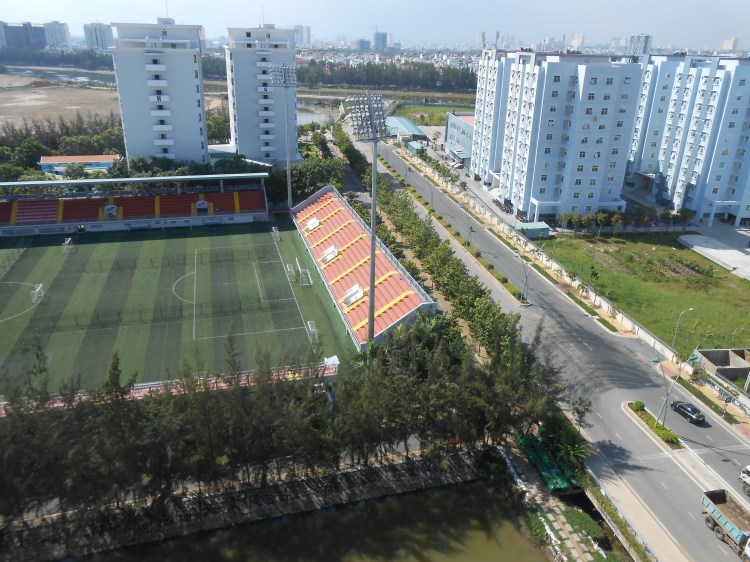
Our room is under the bleachers in the soccer stadium, on the right.

I threw my back out Thursday morning and have spent a lot of time since then lying on my back so tonight (Saturday) I was watching “Orange is the New Black” on Netflix while Joe and Hollis were in HCMC at Vinh’s third wedding. I noticed all the stuff in the apartment Piper and her boyfriend Larry live in. This is before she goes to prison.

Our room

Piper and Larry have a lot of stuff. For example, there is a magnetic board mounted on the kitchen wall with at least a dozen knives on it. There are a lot of other things around on the walls and tables. Some of them look as if they were probably Christmas presents.

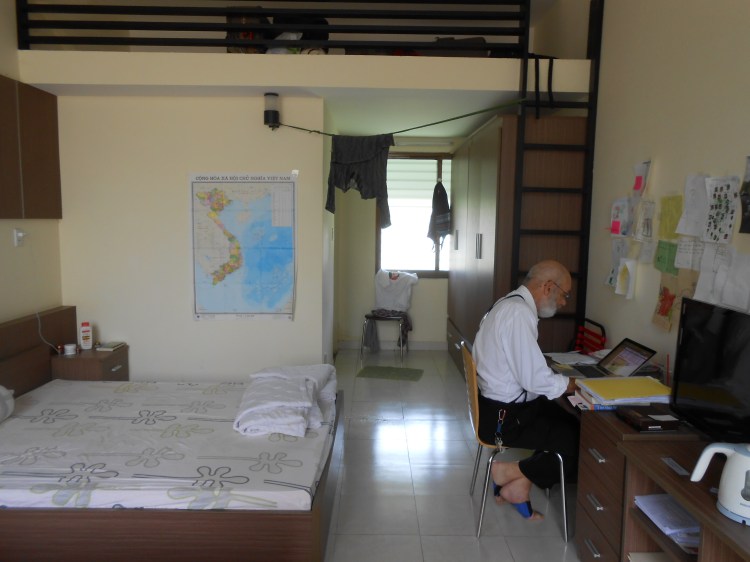
I am going to make a list of our stuff here. This will have the additional value of informing someone else from the US who might come here about our accommodations. I would describe our accommodations as “Spartan.” But at the same time, perfectly comfortable.
We have a flatscreen TV that sometimes gets cable, mostly in Vietnamese. We have pretty good internet with a Cisco Lynksys modem. I have to unplug it and re-start it every now and then. We have air conditioning and a remote to turn it on and off and lower or raise it.

Between us we have three laptop computers which we use pretty much all day long all the time.

For eating we have an electric teapot, two TDTU glasses, two covered TDTU mugs, gifts of the accounting faculty, two other mugs, left by Richard Fincher, the arbitrator who was here last year and is now in Arizona. One good sharp knife that works to cut bread, left by Richard. Two plastic trays, sometimes used for plates. Two Vietnamese drip coffee sets, a white teapot, two small white cups and saucers, espresso size. We have seen these at Lotte Mart. Maybe Richard bought all of these.

There is small square refrigerator. It is not noisy. In the refrigerator we have rolls, cheese (very expensive, 92,000 dong, from Ireland), granola, mangoes, little cucumbers, milk and yogurt in small packs. We shop for this at Lotte Mart. We have three kinds of tea and a couple of kinds of coffee. One kind of coffee that is especially good comes from a restaurant a few streets away and is kept in the refrigerator.

There are two low box double beds with foam mattresses. We use one for sleeping, one for my desk. There is a real desk which Joe uses. It has a set of drawers that lock. There is a bookcase, two bedside tables with drawers, and two chairs. The books we have bought are in the bookcase. All the furniture is made of pressed boards. There is a red plastic folding chair, one of three that Richard bought. Hollis and Leanna have one of the others and the third is in the office.

We taped a big map of Vietnam on one wall and lots of art by Lorenzo and Massimo on the other wall.

We bought two yoga mats. There is not quite enough room on the floor to do side-leg stretches, but otherwise, OK. The floor is white ceramic tile, easy to wash. All our shoes are lined up near the front door.

In the bathroom we have various soaps, dishwashing soap, laundry, shampoo, etc., and a good supply of toilet paper, which we buy at Lotte Mart.

There are two tall armoire-type cabinets near the bathroom. We hang our clothes in there and put folded things on the two shelves. There is a row of drawers at the bottom of the cabinets.

A ladder goes up to a loft where we’ve put our suitcases.

We have a piece of cloth tape strung up for a clothesline. When the air conditioning is on, things dry.

TDTU supplies about 5 towels, two bottom sheets (fitted), two quilted cotton blankets, two big pillows and two pillow roles. I take the laundry to the dorm where it gets washed in a washing machine and then hung up to dry on a balcony on the 11th floor, where the wind dries it. That takes at least 24 hours, more if it rains.

The lighting is fluorescent bars up high. There is one bedside lamp.

And that’s pretty much it. The windows are glazed over so you can’t see in or out, which is OK, because there are people walking past right under one window and soccer players kicking balls around right under the other window. There are heavy gold-colored curtains over the outside windows. The door is also glass, and if you don’t have your clothes on and stand near it, someone on the outside of the room can see a white body through the glass. I’ve noticed this.

The window in the bathroom has a wire screen, no glass, so air comes in and out, so you must shut the door between the bathroom and the main room. Then the air conditioning will work fine in the main room.

There are some insects and some geckos that eat them. I kill the big black insects myself. Joe prefers to ignore them.

My point is that we do not have a lot of stuff here and it’s fine.

I remember reading the Swedish crime novels by Maj Sowall and Per Wahloo, in which the cops go through all the items left in the apartment of the dead person, and they itemize everything: three shirts, two plates, one chair, some books, etc. They can make a list of everything the person owns. From that, you can figure out who they were. You could do that with us here.